
Beijing Road Pedestrian Street
北京路步行街 · Běijīng Lù Bùxíng Jiē
Quick answer
No entry restrictions — Beijing Road is a public pedestrian street open to everyone. The Song-dynasty road excavation museum charges ¥10 (passport scan at the entrance).
Why visit
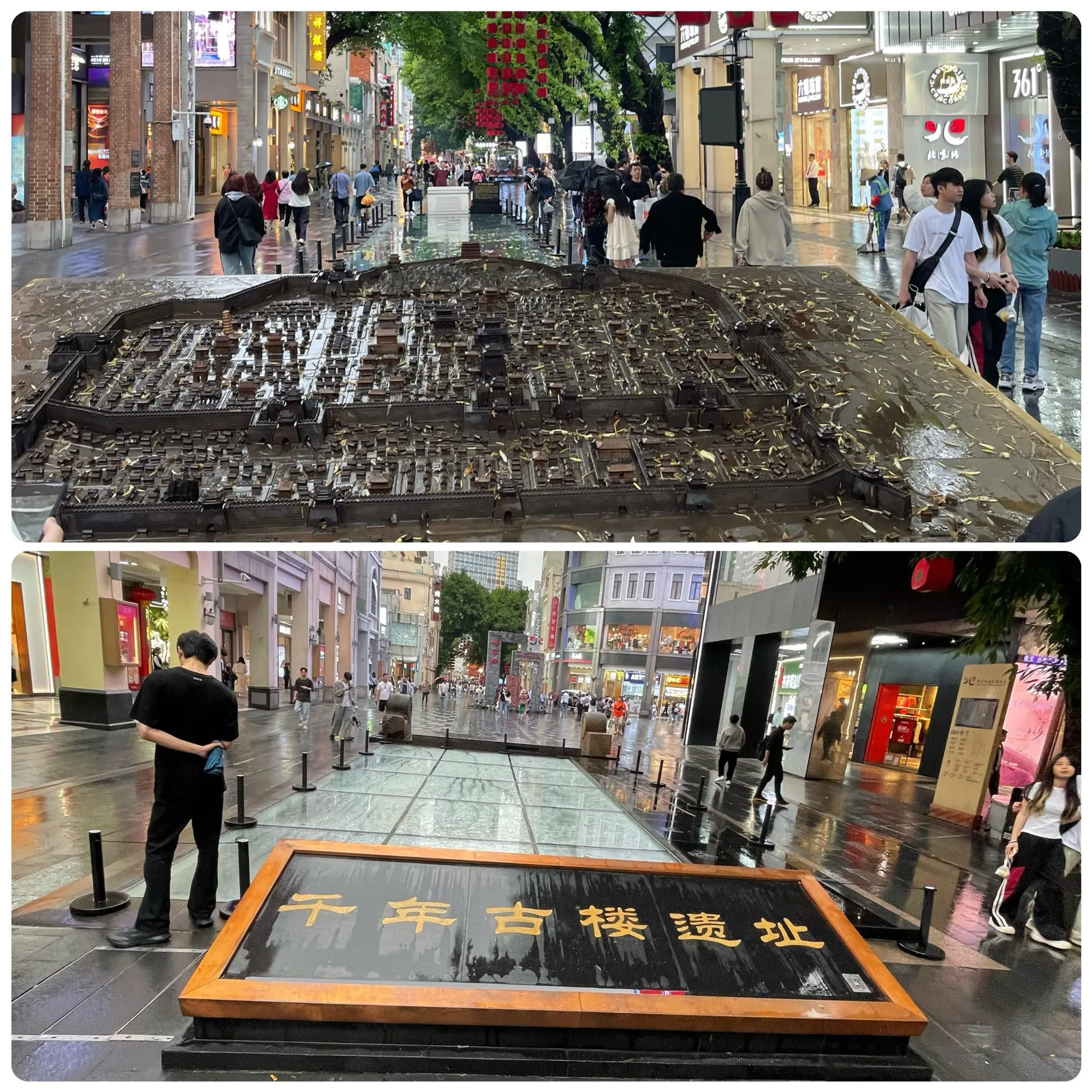
- 1 A 1,500-year-old Song- and Ming-dynasty road excavation visible under glass panels in the middle of the modern pedestrian street — a free open-air museum
- 2 Da Fo Si Buddhist temple (大佛寺) — a 1663 Qing-dynasty temple on the east side of the street, with a peaceful interior courtyard and the night food market behind it
- 3 The 1930s arcade buildings on both sides — preserved Cantonese shopping architecture with second-floor balconies and stone columns
- 4 Cantonese street food scene — 100+ stalls and restaurants along the street and behind Da Fo Si, open until 02:00
- 5 The 24-hour bookstore at the south end — a three-story independent bookshop with English-language China travel books and a rooftop café
Essential tips for foreigners
- Walk the Song-dynasty excavation at street level — the glass panels are in the middle of the pedestrian street, easy to miss if you're looking at the shopfronts. Look down at the four excavation sites (north end, middle, south end, and the small museum in the middle).
- Da Fo Si food street is the real food scene — the restaurants on the main Beijing Road are tourist traps. Go behind Da Fo Si temple (east side) for the local night food market, open until 02:00. ¥10-50/person for a full meal.
- Don't miss the historic side streets — Xihu Road (西湖路) and Dacai Road (大菜路) to the west of Beijing Road have 1920s-1930s arcade buildings, traditional Cantonese tea houses, and antique shops. Quieter, more authentic.
- The bookstore at the south end is a good rest stop — a 24-hour independent bookshop with English-language travel books, a rooftop café, and air conditioning. Free WiFi.
- Combine with the Pearl River night cruise (10 min walk to Tianzi Wharf) — Beijing Road in the late afternoon (15:00-18:00), then walk to the cruise pier for the 19:30 departure.
Suggested route
- 16:00 15 min Arrive at Beijing Road Metro Station, Exit B. Walk 2 min to the north end of the pedestrian street. The Song-dynasty excavation glass panels are immediately visible — start there.
- 16:15 45 min Walk south along the pedestrian street. Stop at the four excavation sites (north, middle, middle-south, south). Each shows a different layer — Tang, Song, Ming, Qing, Republican-era road surfaces.
- 17:00 30 min Step into the Song-dynasty museum in the middle of the street (¥10, 30 min). The museum shows the excavation process and the artifacts found in the road layers.
- 17:30 20 min Walk east to Da Fo Si Buddhist temple (大佛寺). Explore the temple interior (free, 20 min) — the 1663 Qing-dynasty building, peaceful interior courtyard, and the three large Buddha statues.
- 17:50 1 hour Exit the temple on the east side. The night food market is just behind it — 100+ stalls serving cheung fun, wonton noodle soup, beef offal, herbal jelly, snake soup, and roasted chestnuts.
- 18:50 Optional 2 hours Optional: walk 10 min to Tianzi Wharf for the 19:30 Pearl River night cruise. Or stay on Beijing Road for late-night shopping (most shops open until 22:00).
The 1,500-year-old shopping street
Beijing Road (北京路) is a 1,500-year-old shopping street in the Yuexiu district of central Guangzhou. The modern pedestrian street runs 800m north-south, lined with 1930s arcade buildings, modern shops, and the Da Fo Si Buddhist temple. The unique feature is the Song- and Ming-dynasty road excavation — 11 layers of ancient road surfaces visible under glass panels in the middle of the modern street.
For most foreign visitors, Beijing Road is the most-photographed pedestrian street in Guangzhou and the most direct way to see the 1,500-year history of the city. The Song-dynasty excavation is the rare open-air museum that you walk through, not stand outside of.
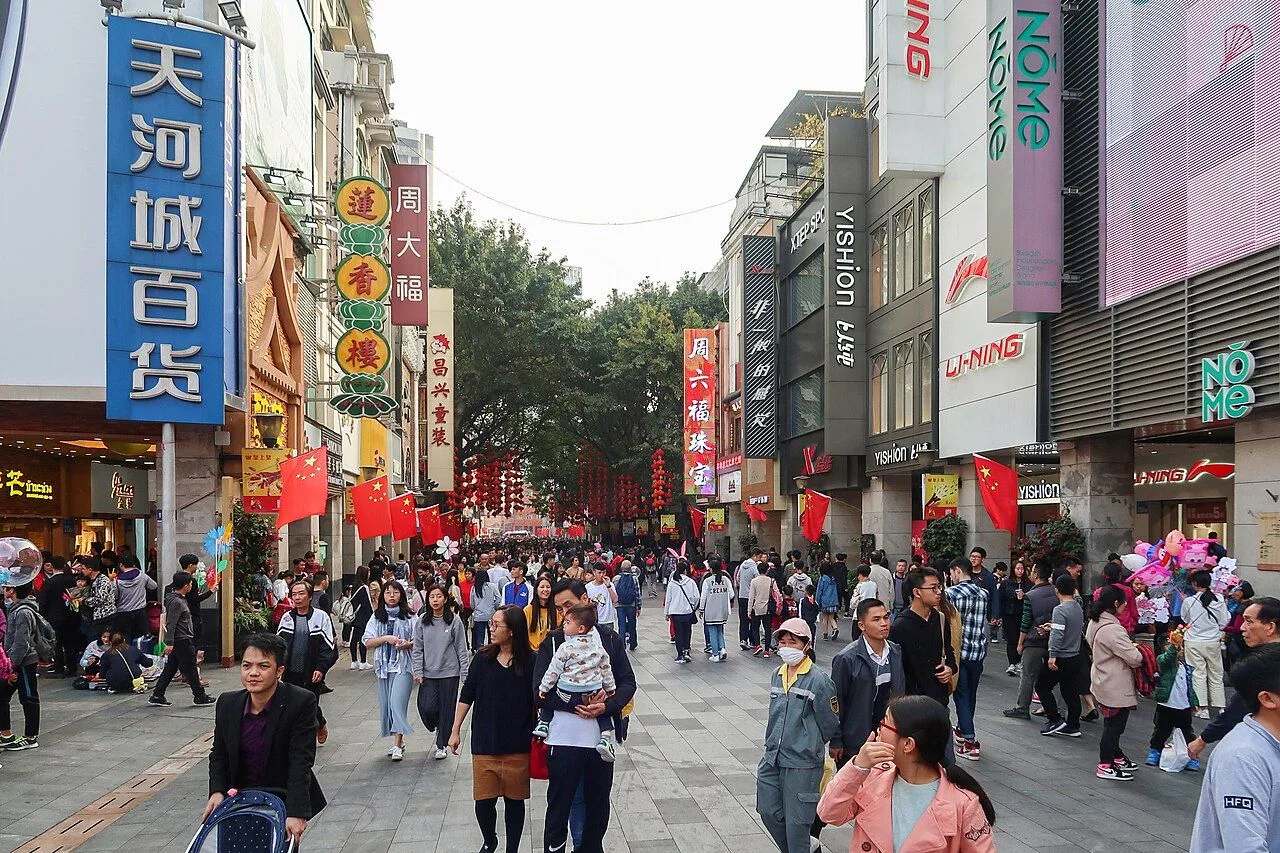
Photo: Wikimedia Commons / CC BY-SA. Source

What to actually see
The Song-dynasty excavation is the highlight. During road construction in 2002, workers uncovered 11 layers of ancient road surfaces — the oldest from the Tang dynasty (1,500 years ago), the most recent from the 1930s. The excavation sites are preserved in glass panels in the middle of the modern pedestrian street, free to view. The small museum in the middle of the street (¥10) has the artifacts found during the excavation — Tang-dynasty coins, Ming-dynasty porcelain, Republican-era bottles.
Da Fo Si Buddhist temple (大佛寺) is a 1663 Qing-dynasty temple on the east side of the street. The main hall has three large Buddha statues, and the interior courtyard is peaceful despite being in the middle of a busy shopping area. Free entry, donations welcome.
The 1930s arcade buildings on both sides of the street are preserved Cantonese shopping architecture. The second-floor balconies and stone columns give the street a distinctive look that you don’t see in other Chinese cities.
The night food market behind Da Fo Si temple is the best late-night Cantonese food scene in central Guangzhou. 100+ stalls serving cheung fun (rice noodle rolls), wonton noodle soup, beef offal, herbal jelly, and roasted chestnuts. Open until 02:00. ¥10-50/person for a full meal.
The 24-hour bookstore at the south end is a three-story independent bookshop with English-language China travel books and a rooftop café. Good rest stop with free WiFi.
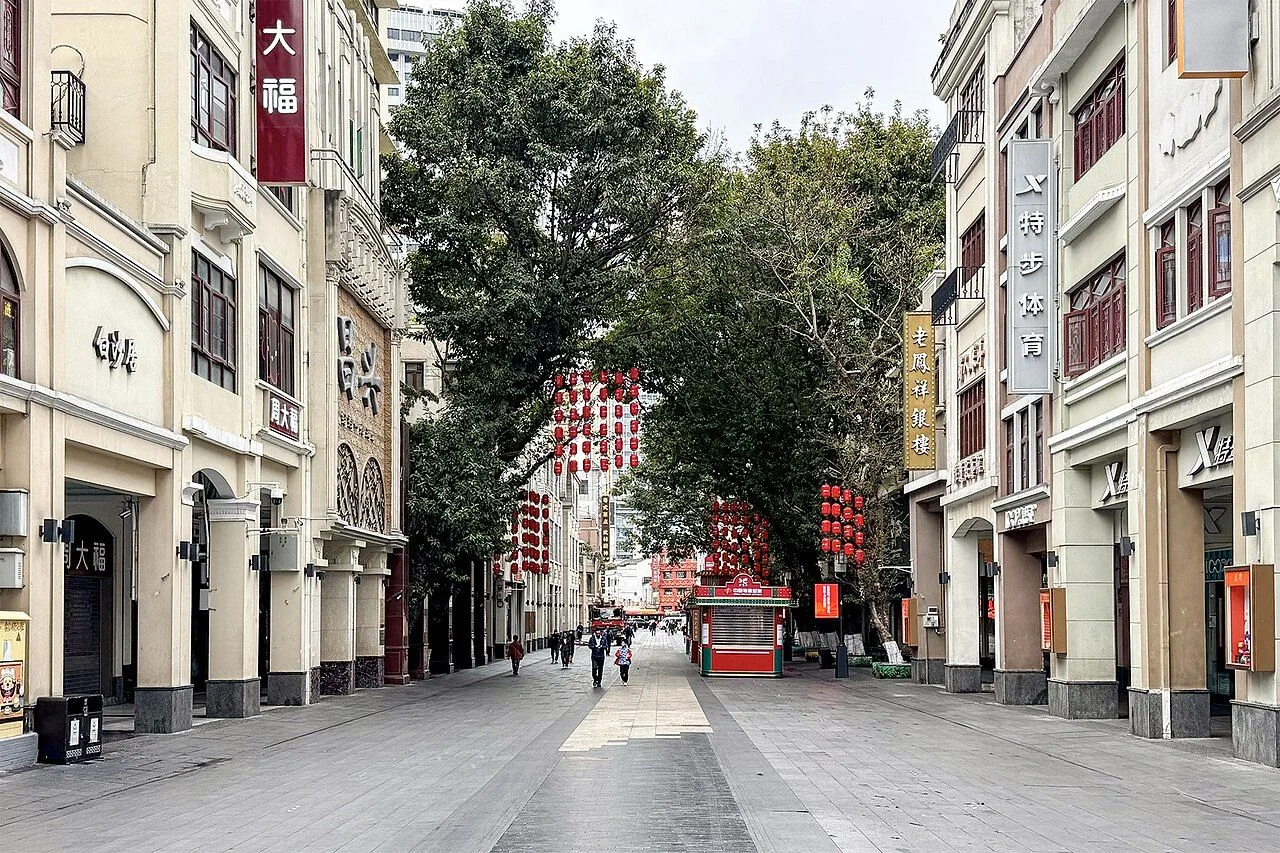
Photo: Wikimedia Commons / CC BY-SA. Source

When to go
Best: October-April. Cool and dry (15-25°C), the night lights and the Song-dynasty excavation (lit by spotlights) are most visible.
Acceptable: May, September. Warm but not yet hot, and the typhoon season is brief.
Avoid: June-August. Brutally hot and humid. The pedestrian street has minimal shade.
Time of day: 16:00-22:00. The lights come on at sunset, the food stalls open at 17:00, and the night market is busiest from 19:00-22:00. Avoid 12:00-15:00 — too hot in summer, too bright for photography.
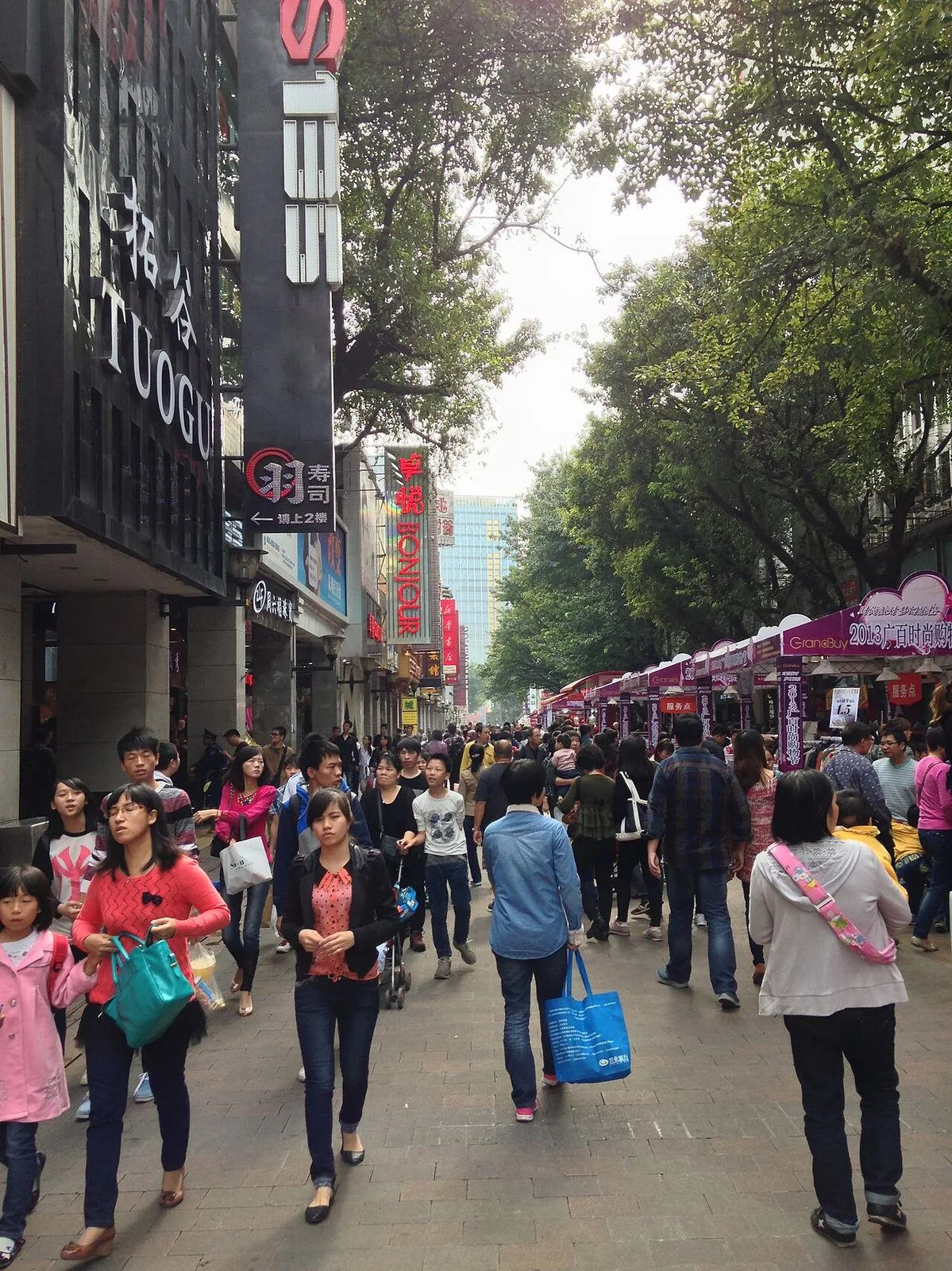
Photo: Wikimedia Commons / CC BY-SA. Source

How to get there
The metro is the easiest. Beijing Road Station on Line 1, Line 2, and Line 6, Exit B. The pedestrian street is 2 minutes walk from the metro.
From Guangzhou South Railway Station (high-speed from Hong Kong), take Line 2 westbound. 15 minutes, ¥4.
From Canton Tower, take Line 3 to Tiyu Xilu, transfer to Line 1, ride 2 stops. 15 minutes, ¥4.
From Shamian Island, take Line 6 eastbound to Beijing Road. 10 minutes, ¥3.
What to pair it with
Beijing Road is in the central Yuexiu district. Pair your visit with:
- Da Fo Si food street (just behind the temple) — the late-night food market
- Pearl River night cruise (10 min walk to Tianzi Wharf) — the 19:30 departure
- Chen Clan Ancestral Hall (15 min by metro) — the Qing-dynasty ancestral hall
- Canton Tower (15 min by metro) — the sunset observation
Best photo spots
-
Song-dynasty excavation glass panels (middle of the pedestrian street) · 16:00-17:00 (afternoon light) or 19:00-21:00 (lit by spotlights)
The 1,500-year-old road layers in glass. Use a wide-angle (16-35mm) at f/8 to capture the full layer sequence. The glass can reflect; a polarizer helps.
-
Da Fo Si temple main hall (大佛寺正殿) · 10:00-11:00 (morning side-light on the golden Buddha statues)
The three large Buddha statues in the main hall. The 1663 Qing-dynasty architecture, the incense smoke, the worshippers. Use a 35mm or 50mm prime at f/2 for the atmosphere.
-
1930s arcade buildings (east side of Beijing Road) · 16:00-17:30 (side-light on the stone columns)
The preserved 1930s arcade buildings with second-floor balconies. Use a 50mm prime at f/4 for the architectural detail. Best in late afternoon when the light is warm.
-
Night food market behind Da Fo Si · 19:00-21:00 (after dark, lit by stall lights)
The food stalls lit by red and yellow lanterns, the steam from the wonton pots, the crowd. Use a 35mm prime at f/2 for the atmosphere. The vendors are friendly and happy to be photographed.
-
24-hour bookstore rooftop café (south end of Beijing Road) · 17:00-18:00 (golden hour from the rooftop)
The rooftop café has views over the southern end of Beijing Road. Use a 24-70mm at f/4 to capture the pedestrian street below. The café has good coffee and air conditioning — a good rest stop.
Where to eat nearby
-
Da Fo Si food street (大佛寺美食街) — behind the temple
Late-night Cantonese street food. Cheung fun (rice noodle rolls, ¥15-25), wonton noodle soup (¥30), beef offal (¥25), herbal jelly (¥5), snake soup (¥35), roasted chestnuts (¥15). Open until 02:00. · ¥30-80/person · Behind Da Fo Si temple, east of Beijing Road
-
Tao Tao Ju (陶陶居) — 10th floor, Beijing Road
1880 heritage dim sum house. Har gow, siu mai, char siu bao, cheung fun. The 10th-floor balcony has views over Beijing Road pedestrian street. · ¥80-150/person · On Beijing Road, central
-
Guangzhou Restaurant (广州酒家) — Beijing Road branch
Classic Cantonese banquet restaurant. Whole roasted pig, abalone, steamed fish. Less touristy than Tao Tao Ju. · ¥150-300/person · On Beijing Road, south end
-
Dai Dai Hotpot (点点心) — Beijing Road branch
Traditional Cantonese dim sum in a 1930s arcade building. Cheaper than Tao Tao Ju, similar quality. Open until 22:00. · ¥60-100/person · On Beijing Road, central
Frequently asked questions
Is Beijing Road worth visiting?
Yes, especially for first-time visitors. The 1,500-year-old Song-dynasty road excavation is a free open-air museum that you don't see in other Chinese cities. The Da Fo Si food market is the best late-night Cantonese food scene. 1.5-2 hours is enough.
How much does it cost to visit Beijing Road?
Free. The pedestrian street is a public open space. The Song-dynasty excavation museum is ¥10. Da Fo Si temple interior is free (donations welcome). Most of the food and shopping is mid-tier (¥30-100/person).
How do I get to Beijing Road from central Guangzhou?
Metro Line 1, Line 2, or Line 6 to Beijing Road Station, Exit B. The pedestrian street is 2 min walk. From Canton Tower is 15 min by metro (Line 3 to Tiyu Xilu, transfer to Line 1, ride 2 stops, ¥4).
What is the best time to visit Beijing Road?
Late afternoon to evening (16:00-22:00). The lights come on, the food stalls open, and the Song-dynasty excavation is lit by spotlights. Avoid 12:00-15:00 — too hot in summer, too bright for photography.
What is the Song-dynasty road excavation?
During road construction in 2002, workers uncovered 11 layers of ancient road surfaces — the oldest from the Tang dynasty (1,500 years ago), the most recent from the 1930s. The excavation sites are preserved in glass panels in the middle of the modern pedestrian street. Free to view, ¥10 for the small museum.
Is Beijing Road stroller-friendly?
Yes. The pedestrian street is flat stone, no vehicles, wide enough for a double stroller. The Da Fo Si temple has one step at the entrance but the interior courtyard is stroller-accessible.
Are the prices on Beijing Road reasonable?
Mid-tier. The main street shops are 20-30% more expensive than local markets. For the best prices, walk one street over to the smaller alleys — Xihu Road, Dacai Road, and the side streets behind Da Fo Si. Food is cheap (¥10-50/person) and good.
What is the difference between Beijing Road and Shangxiajiu Pedestrian Street?
Beijing Road is in central Guangzhou (Yuexiu district), the modern shopping and historic museum area. Shangxiajiu is in the old city (Liwan district), the traditional Cantonese shopping and dim sum area. Both are worth visiting. Beijing Road in the afternoon, Shangxiajiu in the evening.