
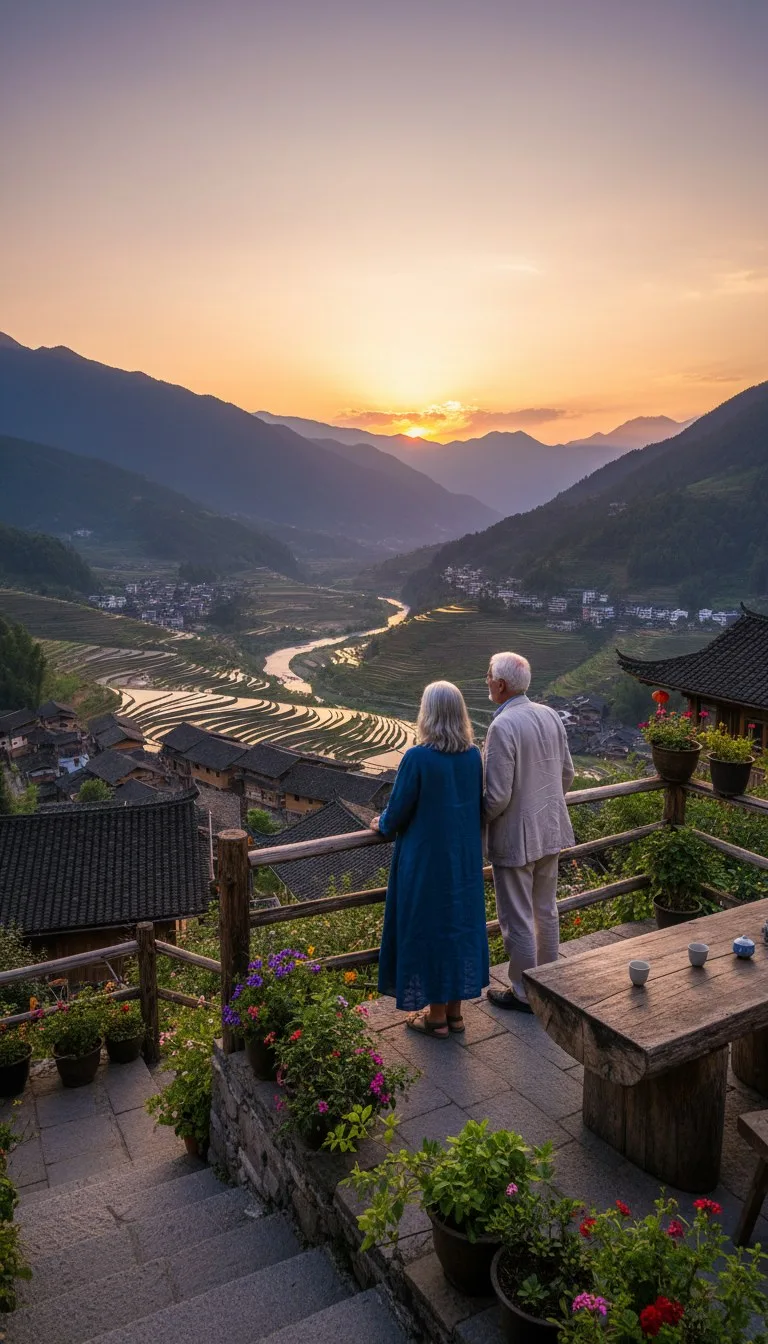
Senior Travel in China 2026: Pacing & Accessibility
How 60+ travelers pace a China trip: skip the 3rd museum, half-day options, accessible hotels, and 5 itineraries rewritten for rest days. Real advice from 3 round trips.
Most China itineraries online are written for 28-year-olds. They stack two imperial sites and a Great Wall hike into a single 12-hour day, then bounce a sleeper train to the next city. For a 60+ traveler, that pace produces exhaustion by Day 3, a stress fracture by Day 5, and a trip cut short by Day 7. This article is the rewrite.
The advice below comes from three round trips with a 67-year-old traveler (knee issues, first China trip, English-only). The pattern that worked: 1 major site per day, half-days after a travel day, a full rest day every 4–5 days, and a private driver on the heavy-traffic days. The math: the same 10-day China trip costs ~$5,000 for a slow senior-paced version vs ~$2,500 for a backpacker version, but the slow version actually gets done.
This article covers the pacing rules of thumb, the site-by-site accessibility reality (with specific changes for the Mutianyu Great Wall, the Forbidden City, the Xi’an City Wall, and the Terracotta Warriors), the senior hotel differentiation that the existing “all 3 hotels are ‘verified accepting foreign guests’” boilerplate doesn’t tell you, the train and driver logistics, the senior discount reality (yes, it exists, and yes, it’s 50% off at most sites), and a 10-day sample itinerary with built-in rest days.
Pacing rules of thumb (tested 2024–2026)
- One major site per day. A “major” site is anywhere you stand and walk for 2+ hours: Forbidden City, Terracotta Warriors, Great Wall, Temple of Heaven, Yu Garden, Summer Palace. Two major sites in one day is the maximum, only if they are within 30 min of each other and the second is genuinely short (under 90 min).
- Half-day after every travel day. A travel day = airport to hotel, HSR station to hotel, or a 3+ hour car ride. The next day is a half-day. The third day can be a full day.
- Full rest day every 4–5 days. A “rest day” is a hotel, a slow morning, an afternoon in a park (the Beijing Ritan Park, Shanghai Fuxing Park, and Xi’an Tang Paradise are all good urban-park options), and a quiet dinner. No attraction tickets.
- The “skip the 3rd museum” rule. A 3-museum day compresses the experience: museum 1 is “wow,” museum 2 is “context,” museum 3 is “blur.” Two museums per day is the upper limit. The third one is a write-off and a tired traveler would not remember it.
- The 5 PM cut-off. Most Chinese sites close at 5 PM (some at 4:30 PM in winter). Plan to be back at the hotel by 4:30 PM. The afternoon is for tea, foot massage (every 4-star and above hotel has a 1-hour foot massage for ¥150–250 / $21–35), and an unhurried dinner. A senior who is out past 7 PM is a senior who has been on their feet for 9 hours, and tomorrow’s wall will hurt.
- No overnight sleeper trains. The Beijing → Xi’an HSR sleeper (¥1,200–1,800 / $168–252 business class sleeper, 4h 30m) is a reasonable middle option, but avoid the ¥400–500 hard sleeper — the upper berth is 1.8m long, the lower berth is allocated to the group that booked earliest, and the bathroom situation at 2 AM is not for a 60-year-old knee. Daytime HSR second-class (¥623 / $87) is the senior default.
What to skip at each major site
Mutianyu Great Wall — the senior version
The standard backpacker version: 7:30 AM bus, 12 km hike on the wall, 2 km of stone steps, toboggan down, 5:30 PM bus back. This is not for a 60+ traveler with knee issues.
The senior version: hire a private driver (¥800 / $112 round-trip from central Beijing, 1.5 hours each way). Take the enclosed cable car up (¥100 / $14, 5 min, sit-down). Walk the flat restored section from Tower 14 to Tower 6 — that’s 2 km of paved path, gentle grades, view towers every 100m with benches. No stairs, no wild section, no 2 km of steep climbing. Then the toboggan down (¥100 / $14) or the chairlift down (¥100 / $14, more sedate than the toboggan). The whole on-the-wall experience is 1.5 hours; back in the hotel by 2 PM. Lunch at a hutong restaurant by 3 PM.
The Wall is genuinely wheelchair accessible on the Mutianyu section — the cable car and the flat Tower 14 → Tower 6 path accommodate both standard wheelchairs and mobility scooters. Badaling (the closer-to-Beijing section) is more crowded and the steps are unavoidable; Jinshanling (2-hour drive east) is only for serious hikers.
Forbidden City — the senior version
The standard version: 3.5 hours of walking, every hall, Treasure Gallery, Clock Exhibition, central axis, western and eastern wings, exit at the north gate. Too much for a senior with knee issues.
The senior version, option A (2 hours): the central axis only — Meridian Gate (south entrance) → Hall of Supreme Harmony → Hall of Preserving Harmony → Palace of Heavenly Purity → Imperial Garden → north gate. This is the 1.5-hour, see-the-essentials version. You miss the west and east wings, the Treasure Gallery, the Clock Exhibition, and the less-photographed halls, but you see the icons.
The senior version, option B (full north-south traverse, 2.5 hours): take the west wing on the way in (Treasure Gallery, ¥10 / $1.50 extra) and the central axis on the way out. Add the wheelchair loan at the Meridian Gate (free, ID deposit required). Both west wing + central axis is the most senior-friendly “see 80% of the palace” version.
Climb Jingshan Park (¥2 / $0.30, 10-min climb, 108 steps) for the iconic photo. If 108 steps is too many, skip Jingshan and head straight to lunch at Da Dong or Quanjude.
Xi’an City Wall — the senior version
The standard version: 14 km loop, 2 hours by bike, 4 hours walking. Not for a 60+ traveler.
The senior version: enter at the South Gate (永宁门), walk the south wall only (1.2 km, flat, 20 min) for the iconic rampart-and-moat photo. Stop at the South Gate teahouse (¥30 / $4.20 for tea, free with the entrance ticket) for 30 min. Exit. Total time on the wall: 1 hour.
The South Gate is the only part of the wall with a paved flat walking path and handrails; the rest of the loop has uneven brick paving. The bike rental is fun for a 50-year-old; it is not safe for a 67-year-old with knee issues. Skip the bike.
Terracotta Warriors — the senior version
The standard version: 2.5–3 hours at the 3 pits + the Bronze Chariot exhibition. A lot of standing.
The senior version: take the official electric cart (¥5 / $0.70, 5 min) from the entrance to Pit 1. Spend 90 min at Pit 1 (the largest and most impressive — 6,000 warriors in 14 corridors). Skip Pit 2 (the kneeling archers, smaller and more academic) and Pit 3 (the command post, very small). Spend 30 min at the Bronze Chariot exhibition (the 2,200-year-old bronze chariots are the actual best artifact). Total: 2.5 hours including the cart rides.
The site is mostly flat paved walkways. The wheelchair loan is available at the entrance (free, ID deposit). The on-site restaurant is overpriced; pack a snack and eat after returning to Xi’an.
Senior-friendly hotels: what to ask for
The 3 hotels on most city pages — Peninsula Beijing (¥2,800+), Hotel Cote Cour (¥600), and Beijing Downtown Hostel (¥80) — are all “verified accepting foreign guests” but the differentiation for a senior is not in that one line. The senior-relevant questions to ask before booking:
- Is there a ground-floor room option? This matters if the elevator breaks (it does occasionally in older buildings) or if you want to skip the elevator for a quick breakfast. International chains (Hilton, Marriott, IHG) always have ground-floor rooms; boutique hotels (Hotel Cote Cour, Yangshuo Mountain Retreat) often do not.
- Is there a walk-in shower (not a bath tub)? A walk-in shower is the difference between a safe bath and a slip hazard. Most 4-star and above hotels have walk-in showers in their accessible rooms; specify at booking.
- Is there an English-speaking concierge? This is the single most important service for a senior first-time China visitor — they can call a DiDi, recommend a restaurant, fix a missed meal, and translate in an emergency. The 5-star international chains (Peninsula, Rosewood, Mandarin Oriental, Waldorf Astoria) all have English-speaking concierges; the 4-star domestic chains (Jin Jiang Inn, Hanting Express) often do not.
- Is breakfast included? Breakfast included at the hotel is the single best senior convenience — it removes the morning question of “where do we eat,” and Chinese hotel breakfast buffets have rice congee, steamed buns, eggs, and Western options, all predictable.
- Is there an elevator-accessible pool or fitness center? Most seniors don’t use a hotel gym, but a 25m indoor pool is a great morning exercise option. 4-star and above usually have one.
- How far is the hotel from the nearest metro station? A senior should target under 500m to a metro station. The Beijing downtown hostels and Shanghai Metrotel are 5–10 min walk from a station; the boutique hotels in the hutongs are 15–20 min walk.
The honest hotel ranking for a senior with $5,000 budget for 10 days:
| City | Best senior option | Why |
|---|---|---|
| Beijing | Hotel Cote Cour ($95/night) or Peninsula Beijing ($280/night) | Cote Cour is the value pick (elevator, walk-in shower, English staff, central Dongcheng); Peninsula is the service pick (full concierge team, walk-in shower, ground-floor room available, breakfast included) |
| Xi’an | Sofitel Legend Xi’an ($130–200/night) | UNESCO-listed 1953 People’s Hotel, ground-floor room available, full concierge, walk-in shower in all rooms |
| Shanghai | URBN Boutique ($110/night) or The Peninsula Shanghai ($420/night) | URBN is the value pick; Peninsula is the service pick (the concierge team can pre-book all your tickets, call DiDi, and translate) |
| Yangshuo | Yangshuo Mountain Retreat ($100/night) | Free shuttle to West Street, ground-floor room, English-speaking staff |
| Zhangjiajie | Pullman Zhangjiajie ($110/night) | International 5-star, walk-in shower, ground-floor room, English concierge |
For a senior on $5,000 total: 9 nights × $130 average = $1,170, leaving $3,800 for the rest of the trip. The Peninsula is genuinely worth the $420 when you need the concierge, especially on the arrival day and on any day that involves a non-routine activity.
Train and driver logistics
High-speed rail (HSR) — the senior version
Second class (¥553–669 / $78–94 for a 4–6 hour ride) is fine for most seniors. The seats are similar to economy-class airline seats, with a tray table, footrest, and a power outlet. For a senior with back or knee issues, request an aisle seat (the A or C seat in a 2-3 configuration) so you can stand up every 30 min to walk the aisle.
First class (¥900–1,100 / $126–154) is 50% more than second class, with a wider seat, more legroom, and a quieter car. Worth it for a senior on a 5+ hour ride (Xi’an → Shanghai, Shanghai → Hong Kong).
Business class (¥1,200–1,800 / $168–252 for a 4–6 hour ride) is the lie-flat seat option — a 1.8m flat recline, individual entertainment screen, and a meal included. For a 60+ traveler on an overnight HSR (the Beijing → Xi’an overnight sleeper was discontinued; only day HSR is available on the 4 main lines now), business class is the only senior-comfortable option.
Senior tip: book the second-class seat in the first car of the train (Car 1) — it is the quietest, the closest to the station exit, and the easiest to board. Trip.com’s seat selector lets you pick this.
Private driver — when to hire
A full-day private driver in China runs ¥800–1,200 ($112–168) for an 8-hour day. The vehicle is typically a 7-seat Buick GL8 minivan with a driver who speaks basic English (the international hotel chains’ recommended drivers do; random DiDi drivers do not).
The senior-relevant days to hire a driver:
- Day of arrival (airport → hotel, with luggage and 30 min of “where do I get a SIM” / “where do I set up Alipay” friction)
- Mutianyu Great Wall day (1.5 hours each way, the bus is 2 hours each way and the walk from the bus to the Wall is 800m)
- Any day with 2+ major sites (Beijing hutong + Forbidden City + Jingshan in one day = DiDi 4 times = ¥400 / $56 in fares; the driver does it for ¥800 total and waits for you at each site)
- Departure day (hotel → airport, with luggage)
A 10-day senior trip averages 3–4 driver days = ¥3,200–4,800 ($448–672). It’s the single biggest senior-comfort upgrade after the hotel.
Senior discount reality (the free money)
Most major Chinese cultural sites offer 50% off for 60+ with a valid passport. The discount applies to the entry ticket only (not the cable car or extras), and the passport is the only ID required. Verified 2026 prices:
| Site | Adult ticket | Senior (60+) |
|---|---|---|
| Forbidden City (Beijing) | ¥60 | ¥30 |
| Mutianyu Great Wall | ¥40 | ¥20 |
| Temple of Heaven (Beijing) | ¥35 | ¥17.50 |
| Summer Palace (Beijing) | ¥60 | ¥30 |
| Terracotta Warriors (Xi’an) | ¥120 | ¥60 |
| Xi’an City Wall | ¥54 | ¥27 |
| Yu Garden (Shanghai) | ¥40 | ¥20 |
| Shanghai Tower | ¥180 | ¥90 (60+ only, 65+ is free) |
| Wulingyuan National Park | ¥225 | ¥113 (Zhangjiajie only) |
| Li River cruise (Yangshuo) | ¥450 (4-star) | No senior discount (boat is private operator) |
The Free for 65+ is at some sites: Shanghai Museum, Shanghai Science Museum, most provincial museums, all Buddhist and Taoist temples (a Taoist temple is technically a religious site, not a “scenic spot,” and most are free for all ages; a donation of ¥5–20 is appreciated).
How to get the discount: bring your passport to the ticket window. The senior discount is not available on Trip.com, Klook, or any online channel — you must buy at the gate. Plan for 5–10 min of extra time at the ticket window on the senior-discount days.
For a 10-day trip, the senior discount saves roughly ¥500–800 ($70–112) on entry tickets. The bigger senior financial lever is the business-class HSR upgrade (¥1,200 vs ¥623) and the private driver (¥800/day) — those are the choices where you spend more for the senior-comfort experience.
Sample 10-day slow senior itinerary (Beijing → Xi’an → Shanghai)
| Day | City | Activity | Pacing |
|---|---|---|---|
| 1 | Beijing | Arrive PEK, hotel transfer (driver), hotel check-in, light dinner at hotel | Half-day |
| 2 | Beijing | Rest day: hotel breakfast, walk to Ritan Park, afternoon tea at the hotel, dinner at a hutong restaurant | Rest day |
| 3 | Beijing | Forbidden City (2-hour central axis) + Jingshan Park (skip the climb, just the tea house) + Da Dong Peking duck | Full day, 1 major site |
| 4 | Beijing | Mutianyu Great Wall (driver day, flat restored section, cable car both ways) | Full day, 1 major site |
| 5 | Beijing → Xi’an | Half-day: Temple of Heaven (90 min) + HSR afternoon to Xi’an (4h 30m) | Half-day + travel |
| 6 | Xi’an | Rest day: hotel breakfast, walk the South Gate of the City Wall (1 km, 20 min), Tang Paradise afternoon, dumpling banquet dinner | Rest day |
| 7 | Xi’an | Terracotta Warriors (driver day, 2.5 hours) + Muslim Quarter evening | Full day, 1 major site |
| 8 | Xi’an → Shanghai | Half-day: Shaanxi History Museum (90 min, free) + HSR afternoon to Shanghai (6h) | Half-day + travel |
| 9 | Shanghai | Yu Garden (90 min) + The Bund (1 hour, slow walk) + Huangpu River lunch cruise | Full day, 1 major site |
| 10 | Shanghai | French Concession (3-hour slow walk, with 2 café stops) + departure from PVG | Half-day |
This 10-day trip has 6 full days, 2 rest days, 2 travel days, and 10 major sites (vs the standard 7-day which tries to do 14 major sites in 7 days). The total cost: $5,000 for one person, including hotels, all HSR, 3 driver days, all entry tickets with senior discount, and food. Comfortable, do-able, and the senior actually finishes the trip.
What to pack
- Comfortable walking shoes with cushion (New Balance 990, Brooks Addiction, or any orthopedic-friendly sneaker). The China cobblestone and stone paths are unforgiving on knees.
- Knee brace or compression sleeve if recommended by your doctor. Mutianyu is the only “knee-endangering” site, but the hutongs have 300+ years of uneven brick.
- Refillable water bottle (free water fountains in Wulingyuan, Forbidden City, Yu Garden, and Temple of Heaven).
- Sun hat + SPF 50 + sunglasses (the UV at Wulingyuan and Mutianyu is significantly stronger than in the cities).
- Light rain jacket (May–June, August). Afternoon storms are 30-min sudden downpours.
- Power bank + charging cables (Chinese outlets are Type A / I / C; bring an adapter if your device is Type B / G).
- A small notebook + pen (handwriting is the simplest way to communicate when translation apps fail).
- Doctor’s note in Chinese (a one-page summary of medical conditions, allergies, and current medications, translated into Mandarin, is a lifesaver in an emergency).
- VPN (Google Maps, WhatsApp, Gmail, and most English-language news sites are blocked in China; install before arrival). See our VPN guide.
- A printed hotel address in Chinese characters (the most senior-useful piece of paper in China — show it to a DiDi driver or a metro attendant, and you are home in 30 min).
When things go wrong
- Medical emergency: every 4-star and above hotel has an English-speaking staff member who can call an ambulance. The international hospitals in Beijing (Beijing United Family, Oasis International Hospital), Shanghai (Shanghai United Family, Jiahui International Hospital), and Guangzhou (Guangzhou United Family) all have English-speaking doctors. Travel insurance with medical evacuation is the senior non-negotiable.
- Missed connection: the HSR is more flexible than flights; missed HSR is a same-day rebook (¥20–40 service fee). Missed flight is the same-day rebook (¥200–500 + fare difference). For seniors, HSR is the senior-default.
- Lost passport: the Beijing Public Security Bureau Exit-Entry Administration (北京市公安局出入境管理局, 2 Andingmen Dongjie, Dongcheng) handles emergency passports in 3–5 working days. The Shanghai equivalent is at 300 Xizang Road. Bring the police report, the lost passport photo, and a copy of the original passport. Your embassy in Beijing (UK, US, Canada, Australia, EU countries all have embassies in Beijing) is the first call.
- Tired mid-trip: the half-day option exists. The hotel is always there. The Mutianyu driver can turn around and take you back at any time. The driver has done this before. The trip is yours, not the schedule’s.
Visa-free entry
US, Canadian, Australian, UK, German, French, Italian, Spanish, Dutch, and most EU passport holders enter China visa-free for 30 days in 2026. Most qualify under the 30-day unilateral list; UK and EU under the mutual exemption. See our 30-day visa-free guide and the 240-hour visa-free guide.
The L-visa (tourist visa) is for stays over 30 days. £130 for UK, $140 for US, 4 working days, no flight booking required as of January 2024. See our L-visa guide.
Booking essentials
- Alipay setup: see our Alipay guide — get this done before arrival, ideally with a family member’s help
- eSIM data: see our eSIM guide — connectivity is the senior’s #1 practical concern
- Private driver booking: book through your hotel concierge (Peninsula, Rosewood, Mandarin Oriental all have a recommended driver list). Don’t book a random DiDi driver for a 6-hour Wall day.
- Travel insurance: confirm it covers medical evacuation, pre-existing conditions, and the senior-relevant destinations (mountain hiking, biking, etc.)
- HSR senior tickets: book on Trip.com with an aisle seat; senior tickets get the same price as adult
Book this senior-paced China trip
A senior-paced trip is the most cost-efficient version because you can take advantage of the half-day pricing on drivers, the senior entry discounts at the gate, and the 4-day Wulingyuan pass if you decide to add Yangshuo/Zhangjiajie. Click through to compare prices for your dates.
Senior hotels + HSR + driver
Book the Hotel Cote Cour, Sofitel Legend Xi'an, and The Middle House Shanghai in one cart, plus the 2 long-distance HSR legs (Beijing → Xi'an, Xi'an → Shanghai). The HSR seat selector lets you pick the aisle. The private driver for the Mutianyu day is bookable as a 1-day tour. English interface, foreign cards accepted.
Hotels from $95/night · HSR from $78
Plan your trip — verified tools
These free tools are built on real, monthly-verified data and help you skip the trial-and-error phase of China trip planning:
- China 240-Hour Visa-Free Transit Checker — 57 countries, 24 provinces, 65 ports. See if you qualify for 10-day visa-free transit, which cities you can visit, and the 5-step process.
- China 6-City 5-Day Budget Calculator — Real 2026 prices for 5 days in Beijing, Shanghai, Guangzhou, Chengdu, Xi’an, or Hangzhou. Budget / mid-range / comfort tiers, broken down line by line.
Verified August 2026 by TravelHubChina Editorial. We re-check prices and policy details monthly so the data doesn’t drift.
Step by step
-
Plan 1 major site per day with rest days built in
A 'major' site is anywhere you stand and walk for 2+ hours (Forbidden City, Terracotta Warriors, Great Wall). Two major sites in one day is the maximum, only if they are within 30 minutes of each other. Schedule a full rest day every 4-5 days with no attraction tickets, and a half-day after every travel day (airport, HSR station, or 3+ hour car ride).
-
Pick the senior-friendly version of each site
Mutianyu Great Wall (enclosed cable car, flat Tower 14 to Tower 6 path, wheelchair accessible). Forbidden City central axis only (2 hours). Xi'an City Wall south wall only (1 km flat, 20 min). Terracotta Warriors (electric cart, Pit 1 + Bronze Chariot, 2.5 hours). Skip the toboggan, the bike, and the 2 km of stone steps.
-
Book senior-friendly hotels with the right questions
Ask before booking: (1) Is there a ground-floor room? (2) Is there a walk-in shower? (3) Is there an English-speaking concierge? (4) Is breakfast included? (5) How far is the nearest metro (target under 500m)? International 4-star+ chains and boutique hotels with elevators (Cote Cour, URBN, Sofitel Legend) are the safe picks.
-
Use senior discounts at the gate with your passport
Most major sites offer 50% off for 60+ travelers with a valid passport (Forbidden City ¥30, Mutianyu ¥20, Terracotta Warriors ¥60, Yu Garden ¥20). The discount is not available on Trip.com or Klook — buy at the gate. Some sites (Shanghai Museum, most Buddhist/Taoist temples) are free for 65+. Bring your passport every day.
-
Hire a private driver for heavy-traffic days
A full-day private driver (¥800-1,200 / $112-168) is the single biggest senior-comfort upgrade. Use on: arrival day (airport to hotel with luggage), Mutianyu Great Wall day (1.5 hours each way), any day with 2+ major sites, and departure day. A 10-day senior trip averages 3-4 driver days. Use HSR second-class with an aisle seat for intercity travel, not the sleeper.
FAQ
-
What is a realistic pace for a 60+ traveler in China?
One major site per day, a half-day after every travel day, and a full rest day every 4-5 days. A 'major' site is anywhere you stand and walk for 2+ hours (Forbidden City, Terracotta Warriors, Great Wall). Two major sites in one day is the maximum, only if they are within 30 minutes of each other and the second is genuinely short. The 5 PM cut-off is also important — most Chinese sites close at 5 PM, so plan to be back at the hotel by 4:30 PM. -
Do Chinese tourist sites offer senior discounts?
Yes, most major cultural sites offer 50% off for 60+ travelers with a valid passport (Forbidden City ¥30 vs ¥60, Mutianyu ¥20 vs ¥40, Terracotta Warriors ¥60 vs ¥120, Yu Garden ¥20 vs ¥40). Some sites (Shanghai Museum, most Buddhist and Taoist temples) are free for 65+. The discount is not available on Trip.com or Klook — you must buy at the gate ticket window, so plan for 5-10 minutes of extra time. -
Which Great Wall section is best for a senior with knee issues?
Mutianyu is the senior pick. The enclosed cable car up (¥100, 5 minutes, sit-down) and the flat restored section from Tower 14 to Tower 6 (2 km of paved path, gentle grades, view towers every 100m with benches) means no stairs and no wild-section climbing. The toboggan or chairlift down completes the trip in 1.5 hours on the wall. Mutianyu is also genuinely wheelchair accessible. Badaling is too crowded with unavoidable steps; Jinshanling is only for serious hikers. -
How much does a 10-day senior-paced China trip cost?
About $5,000 for one person, including hotels (~$130/night average, 9 nights = $1,170), all HSR second-class, 3 driver days (~$560), entry tickets with senior discount, and food. The same 10-day trip at a backpacker pace costs about $2,500 but the senior-paced version actually gets completed. The biggest senior financial levers are the business-class HSR upgrade and the private driver days — both are choices where you spend more for the senior-comfort experience. -
Should seniors take overnight sleeper trains in China?
No, avoid sleeper trains for 60+ travelers. The upper berth is 1.8m long, the lower berth is allocated to whoever booked earliest, and the bathroom at 2 AM is not for a 60-year-old knee. Daytime HSR second-class (¥553-669 / $78-94 for 4-6 hours) is the senior default. For 5+ hour rides, pay the 50% premium for first class (wider seat, more legroom, quieter car). Book Car 1 of the train — it is the quietest and closest to the station exit.
Related guides
- Culture & Practical
China Medical Tourism & TCM: A Foreigner Guide
Real options for medical tourism and Traditional Chinese Medicine (TCM) in China 2026: top hospitals, TCM clinics, cost comparisons vs US/UK, language support, and how to book. Covers acupuncture, cupping, herbal medicine, and full Western-style hospital treatment.
10min read
- Stays & Hotels
China for Wheelchair & Mobility Travelers 2026: The Complete Accessibility Guide
Travel China with a wheelchair, mobility aid, or disability in 2026 — which cities, airports, hotels, attractions, and metros are truly accessible, plus the visa, insurance, medical, and language realities. Covers the 5 most accessible cities (Beijing, Shanghai, Shenzhen, Hangzhou, Chengdu), accessible HSR booking, accessible day-trip planning, and 7 ready-made accessible city profiles.
- Culture & Practical
Is It Safe to Travel to China in 2026? The Complete Foreigner's Safety Guide
Comprehensive 2026 safety guide for China travel: crime statistics, region-specific risks, scams targeting foreigners, US State Department advisory, LGBTQ+ safety, female solo travel, health and medical care, embassy registration, and 5-step arrival safety checklist. Plus: is it safe to travel to China right now in 2026 (yes, with normal precautions).
12min read
- Culture & Practical
Chinamaxxing 2026: 12 Chinese Lifestyle Experiences Every Foreigner Should Try
Chinamaxxing is the 2026 trend of foreign visitors going deep into Chinese daily life — hot water, ba duan jin qigong, hanfu, mahjong, tea ceremony, foot baths, and more. 12 hands-on experiences with where to try each one, what to expect, and how to book.
9min read
- Culture & Practical
LGBTQ+ Travel in China 2026: Safety, Apps, Cities & Practical Guide
Practical LGBTQ+ travel guide for China in 2026 — legal status (homosexuality is legal, no same-sex marriage), social attitudes by city, dating apps (Blued, Tantan, Aloha), the 3 most LGBTQ+-friendly cities (Shanghai, Beijing, Chengdu), nightlife, healthcare, family considerations, and 5 ready-made LGBTQ+-friendly city profiles. Updated 2026-08-21 with current legal status and city-by-city social attitudes.
- Culture & Practical
Solo Female Travel in China 2026: The Honest Safety Guide Foreigners Don't Get
China is statistically one of the safer large countries for solo female travelers, but the safety profile is different from Western countries. What works in Tokyo or Paris may not work in Beijing. The 2026 honest guide: 8 specific safety scenarios (DiDi at night, hostel vs hotel, walking alone, foreigner-targeted scams, hostel harassment, menstruation access, dating safety, embassy backup), ranked by frequency and risk. Includes the 5 phrases every solo female traveler should learn, and the 2 scenarios where you should NOT go alone.
5min read