
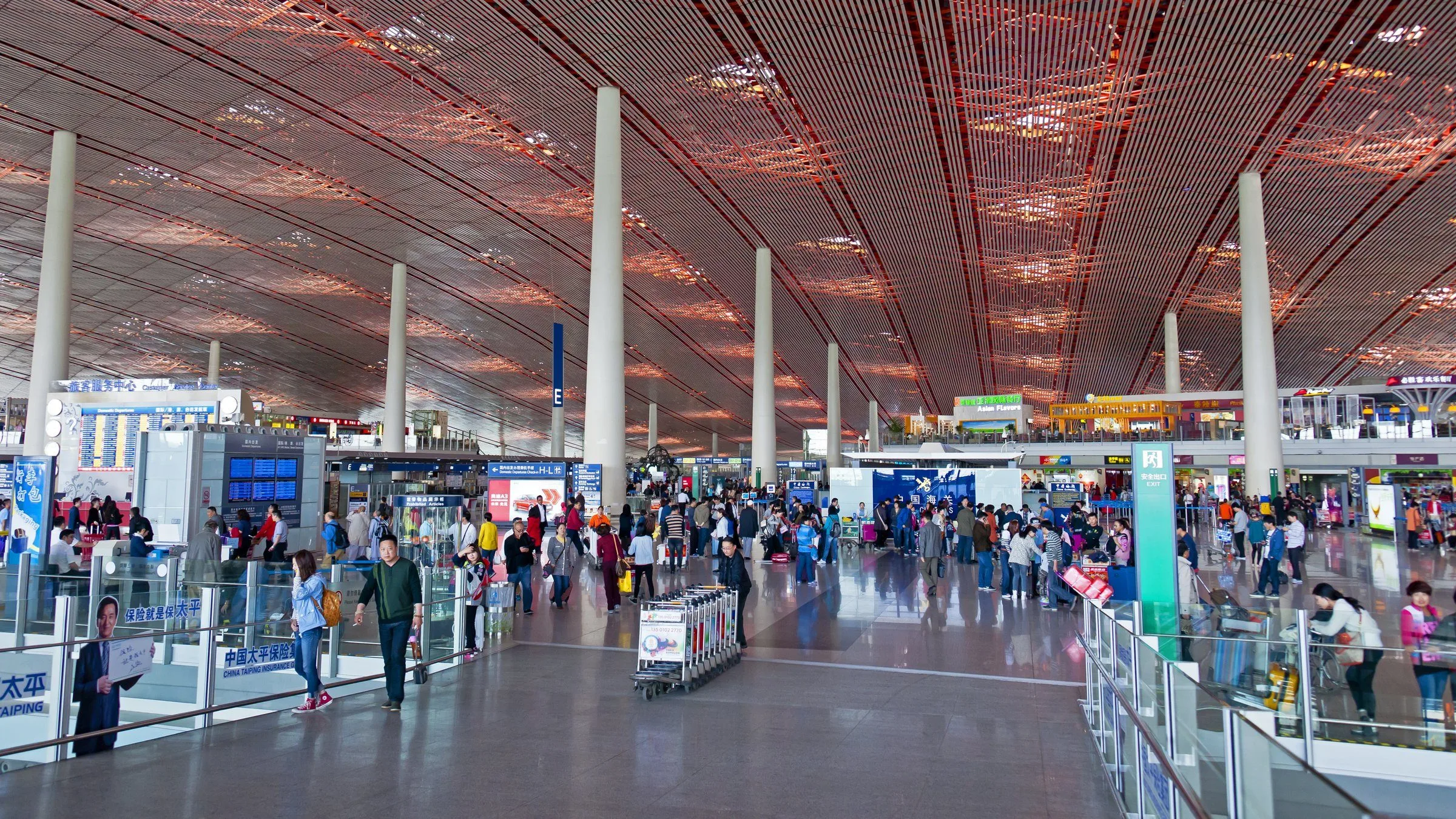
China Airport Transfers 2026: Shanghai, Taxis, Trains & DiDi
Shanghai airport transfers in 2026: from Pudong (PVG), PEK, CAN, CTU and 3 more airports to the city — taxis, DiDi, express trains, Maglev and private cars.
China’s major international airports all have multiple transfer options. The right choice depends on your arrival time, luggage, group size, and budget. This guide covers all 7 main airports, the 4 main transfer modes, and the 3 things to know before you leave the airport.
The 4 transfer options (overview)
1. Airport express train — cheapest, fastest, but limited hours
Best for: budget travelers, daytime arrivals, light luggage, going to a specific station Cost: ¥25-50 (US$3–7) Time: 15-30 min to city center Hours: typically 6:00-22:30 Pros: cheapest, predictable, no traffic Cons: stops at specific stations (not your hotel), hours limited, no luggage storage beyond overhead
2. DiDi (China’s Uber) — best balance
Best for: most travelers, daytime or evening arrivals, 1-3 people with luggage Cost: ¥80-300 (US$11–42) Time: 30-90 min depending on traffic Hours: 24/7 Pros: app shows price upfront, no haggling, no language barrier, safe Cons: DiDi Express pickup zone may be far from arrivals; surge pricing during peak hours
3. Official taxi — most expensive but 24/7
Best for: late-night arrivals, no smartphone, very heavy luggage Cost: ¥200-500 (US$28–69) Time: 45-90 min Hours: 24/7 Pros: no app needed, available any time, driver waits at queue Cons: most expensive, language barrier possible, meter refusal scams
4. Pre-booked private transfer — most convenient, premium
Best for: families, business travelers, late-night, first-timers Cost: ¥200-500 (US$28–69) Time: 30-60 min Hours: 24/7 (pre-arranged) Pros: driver waits with name sign, helps with luggage, fixed price, often English-speaking Cons: 2-3x more expensive than DiDi
The rule: for most arrivals, DiDi Premier is the sweet spot. Save the airport express train for short daytime trips with light luggage. Use official taxi or private transfer only for late-night or when DiDi isn’t working.
Beijing: PEK and PKX
Beijing has two airports. PEK (Capital, older, closer to center) and PKX (Daxing, newer, further south). Most international flights use PEK, but some airlines (especially SkyTeam alliance) use PKX.
Beijing Capital (PEK)
Airport Express train (recommended):
- Route: Terminal 3 (and Terminal 2 via free shuttle) → Sanyuanqiao → Dongzhiman
- Fare: ¥25 (US$3)
- Time: 30 minutes
- Hours: 6:00-22:30 (departures every 10-15 min)
- From Dongzhiman, transfer to Subway Line 2 or 13 to your hotel area
- Best for: budget travelers, going to central Beijing (Wangfujing, Tiananmen, Sanlitun)
DiDi:
- Pickup zone: outside Terminal 2/3 arrivals, follow “DiDi” signs
- Time: 45-90 min to city center
- Cost: ¥100-200 (US$14–28) to central Beijing
- Note: DiDi Premier pickup is closer to arrivals (look for “Premier” sign)
Official taxi:
- Queue is well-organized at both terminals
- Cost: ¥120-250 (US$17–35) to central Beijing
- Time: 45-90 min
- Use the meter (打表 dǎ biǎo)
- Have your hotel address in Chinese (Baidu Maps shows this)
Pre-booked private transfer:
- Book via Trip.com (¥200-400 / US$28–56) or your hotel (often free or ¥100-200 / US$14–28)
- Driver waits at arrivals with name sign
- Recommended for late-night, families, first-timers
Beijing Daxing (PKX)
Daxing Express train:
- Route: Daxing Airport → Caoqiao (transfer to Subway Line 10)
- Fare: ¥35 (US$5)
- Time: 40 minutes
- Hours: 6:00-22:30
- From Caoqiao, continue on Subway Line 10 or transfer to Line 4
DiDi: ¥150-300 (US$21–42) to central Beijing, 60-90 min
Official taxi: ¥200-350 (US$28–49), 60-90 min
Note: PKX is 46 km south of Tiananmen, much further than PEK. Allow 1.5-2x the transfer time.
Shanghai: PVG and SHA
Shanghai has two airports. PVG (Pudong, on the east, all international + some domestic) and SHA (Hongqiao, on the west, mostly domestic + some Asian regional).
Shanghai Pudong (PVG)
Maglev train (the famous one):
- Route: Pudong Airport → Longyang Road (30 km, 431 km/h, 7 min ride)
- Fare: ¥50 (US$7) (regular), ¥40 (US$6) with same-day flight ticket
- Hours: 7:00-21:30 (every 15-20 min)
- From Longyang Road, transfer to Metro Line 2 (to People’s Square, Nanjing Road) or Line 7 (to other areas)
- Total time: 45-60 min airport to central Shanghai
- Best for: tech enthusiasts, time-sensitive travelers, going to Puxi (west bank)
DiDi: ¥200-350 (US$28–49) to central Shanghai, 60-90 min (longer in traffic)
Official taxi: ¥250-400 (US$35–56), 60-90 min
Pre-booked private transfer: ¥300-500 (US$42–69), 50-70 min
Note: PVG is on the east side of Shanghai, while most hotels and attractions (Bund, Nanjing Road) are on the west side. The Maglev + Metro is faster than DiDi during peak hours.
Shanghai Hongqiao (SHA)
Metro:
- Line 2 or Line 10 directly to central Shanghai
- Fare: ¥5-7 (US$0.69–0.97)
- Time: 30-45 min
- Best for: budget travelers going to Puxi
DiDi: ¥80-150 (US$11–21) to central Shanghai, 30-60 min
Official taxi: ¥100-200 (US$14–28), 30-60 min
Note: SHA is much closer to central Shanghai than PVG. If you can choose your flight, SHA is more convenient for downtown hotels.
Guangzhou (CAN)
Metro Line 3:
- Direct to Tiyu Xilu (Canton Tower area) and other central stations
- Fare: ¥8-12 (US$1–2)
- Time: 45-60 min to central Guangzhou
- Hours: 6:00-23:00
DiDi: ¥150-250 (US$21–35) to central Guangzhou, 45-75 min
Official taxi: ¥200-300 (US$28–42), 45-75 min
Note: Guangzhou Baiyun is a major hub for flights to/from Southeast Asia and Australia. The metro is excellent and direct.
Chengdu (CTU)
Metro Line 10:
- Direct to central Chengdu (Chunxi Road, Tianfu Square)
- Fare: ¥5-9 (US$0.69–1)
- Time: 40-50 min
- Hours: 6:00-22:30
DiDi: ¥80-150 (US$11–21) to central Chengdu, 30-60 min
Official taxi: ¥100-200 (US$14–28), 30-60 min
Pre-booked transfer: ¥150-300 (US$21–42), 30-45 min
Note: Chengdu Shuangliu is one of the easier airports. The metro is clean, fast, and well-signed in English. For most travelers, Metro Line 10 is the default.
Xi’an (XIY)
Metro Line 14 (airport express):
- Direct to North Railway Station (where you can transfer to Line 2 or Line 4)
- Fare: ¥16 (US$2)
- Time: 45-60 min to central Xi’an
- Hours: 6:00-23:00
DiDi: ¥100-200 (US$14–28) to central Xi’an, 45-75 min
Official taxi: ¥150-250 (US$21–35), 45-75 min
Note: Xi’an Xianyang is the gateway to the Terracotta Army. If you’re heading straight to the Terracotta Army (40 km east of the city), pre-book a transfer or take a tour bus from the airport.
The 3 scams to avoid
1. Drivers approaching you in arrivals
Anyone who approaches you inside the airport terminal offering rides is unofficial. They’ll quote flat rates 2-3x the meter. Politely refuse, walk to the official taxi queue or use DiDi.
2. “Your hotel is in a bad area, let me take you somewhere else”
A classic scam. The driver tries to convince you that your hotel is in a dangerous or closed area, then offers to take you to a different (often partner) hotel where you get scammed on the room rate. Verify your hotel address on Baidu Maps before leaving.
3. Meter “broken” or “stuck on a high number”
If the taxi meter shows ¥100 (US$14)+ before you’ve even left the airport, the driver is trying to scam you. Get out and find another taxi, or use DiDi.
The 3 things to do before leaving the airport
Getting home is the third job. The departure tax refund has its own deadlines and its own paperwork, and it is not obvious which counters process it: how the China tax refund actually works.
1. Get a local SIM or eSIM activated
If you haven’t already, buy a China eSIM or physical SIM at the airport. Most airports have China Unicom stores in the arrivals hall. Without data, you can’t use DiDi, Baidu Maps, or Alipay. ¥100-200 (US$14–28) for a 2-week SIM with 30GB.
2. Withdraw ¥1,000-2,000 (US$139–278) in cash
While you can use Alipay almost everywhere, having cash for the first 24-48 hours is essential. The airport ATMs (Bank of China, ICBC) accept foreign cards. Avoid the airport currency exchange counters — they have the worst rates.
3. Connect to airport Wi-Fi and set up Alipay
If you haven’t set up Alipay yet, do it now while you have stable Wi-Fi. Open the app, link your foreign Visa/Mastercard, complete the ID verification with your passport, enable QR code payment. This takes 15-20 minutes and is essential for the rest of your trip.
Comparison table
| Airport | Airport Express | DiDi | Taxi | Pre-booked |
|---|---|---|---|---|
| PEK (Beijing Capital) | ¥25 (US$3), 30 min | ¥100-200 (US$14–28), 45-90 min | ¥120-250 (US$17–35), 45-90 min | ¥200-400 (US$28–56) |
| PKX (Beijing Daxing) | ¥35 (US$5), 40 min | ¥150-300 (US$21–42), 60-90 min | ¥200-350 (US$28–49), 60-90 min | ¥300-500 (US$42–69) |
| PVG (Shanghai Pudong) | ¥50 (US$7), 7-60 min total | ¥200-350 (US$28–49), 60-90 min | ¥250-400 (US$35–56), 60-90 min | ¥300-500 (US$42–69) |
| SHA (Shanghai Hongqiao) | ¥5-7 (US$0.69–0.97), 30-45 min | ¥80-150 (US$11–21), 30-60 min | ¥100-200 (US$14–28), 30-60 min | ¥200-300 (US$28–42) |
| CAN (Guangzhou) | ¥8-12 (US$1–2), 45-60 min | ¥150-250 (US$21–35), 45-75 min | ¥200-300 (US$28–42), 45-75 min | ¥250-400 (US$35–56) |
| CTU (Chengdu) | ¥5-9 (US$0.69–1), 40-50 min | ¥80-150 (US$11–21), 30-60 min | ¥100-200 (US$14–28), 30-60 min | ¥150-300 (US$21–42) |
| XIY (Xi’an) | ¥16 (US$2), 45-60 min | ¥100-200 (US$14–28), 45-75 min | ¥150-250 (US$21–35), 45-75 min | ¥200-350 (US$28–49) |
Times are typical, not exact. Traffic, time of day, and weather affect all modes.
China airport codes (IATA) at a glance
The three-letter code is what airlines, hotel bookings, eSIM providers and airport transfer desks all use. Check it before you book a transfer: two airports can serve the same city — Shanghai alone has two on this list — and each one has its own express line and bus route, so the code on your ticket decides which transfer you can actually use.
Every code below was checked against Wikipedia’s list of airports in China (revision 1382280603, checked 2026-10-30). Airports still under construction at the time of checking are left out.
| City | IATA | ICAO | Airport | Service |
|---|---|---|---|---|
| Beijing | PEK | ZBAA | Beijing Capital International Airport | International |
| Beijing | PKX | ZBAD | Beijing Daxing International Airport | International |
| Chengdu | CTU | ZUUU | Chengdu Shuangliu International Airport | International |
| Chengdu | TFU | ZUTF | Chengdu Tianfu International Airport | International |
| Chongqing | CKG | ZUCK | Chongqing Jiangbei International Airport | International |
| Dali | DLU | ZPDL | Dali Fengyi Airport | National |
| Dalian | DLC | ZYTL | Dalian Zhoushuizi International Airport | International |
| Guangzhou | CAN | ZGGG | Guangzhou Baiyun International Airport | International |
| Guilin | KWL | ZGKL | Guilin Liangjiang International Airport | International |
| Hangzhou | HGH | ZSHC | Hangzhou Xiaoshan International Airport | International |
| Harbin | HRB | ZYHB | Harbin Taiping International Airport | International |
| Hong Kong | HKG | VHHH | Hong Kong International Airport | International |
| Huangshan | TXN | ZSTX | Huangshan Tunxi International Airport | International |
| Jiuzhaigou | JZH | ZUJZ | Jiuzhai Huanglong Airport | National |
| Kunming | KMG | ZPPP | Kunming Changshui International Airport | International |
| Lijiang | LJG | ZPLJ | Lijiang Sanyi International Airport | International |
| Luoyang | LYA | ZHLY | Luoyang Beijiao Airport | International |
| Macau | MFM | VMMC | Macau International Airport | International |
| Nanjing | NKG | ZSNJ | Nanjing Lukou International Airport | International |
| Qingdao | TAO | ZSQD | Qingdao Jiaodong International Airport | International |
| Sanya | SYX | ZJSY | Sanya Phoenix International Airport | International |
| Shanghai | PVG | ZSPD | Shanghai Pudong International Airport | International |
| Shanghai | SHA | ZSSS | Shanghai Hongqiao International Airport | International |
| Shenzhen | SZX | ZGSZ | Shenzhen Bao’an International Airport | International |
| Suzhou (Wuxi) | WUX | ZSWX | Wuxi Shuofang Airport | International |
| Wuhan | WUH | ZHHH | Wuhan Tianhe International Airport | International |
| Xi’an | XIY | ZLXY | Xi’an Xianyang International Airport | International |
| Xiamen | XMN | ZSAM | Xiamen Gaoqi International Airport | International |
| Zhangjiajie | DYG | ZGDY | Zhangjiajie Hehua International Airport | International |
Two things worth knowing before you book:
- Beijing, Shanghai and Chengdu each have two airports on this list. They have their own airport express lines and bus routes, so the code on your ticket decides which transfer you can use — “Shanghai” alone is not enough.
- “National” means domestic flights only. Dali (DLU) and Jiuzhaigou (JZH) are national airports, so if you are arriving from outside China you will land at an International airport first.
Pingyao and Yangshuo are not on this list: the source has no IATA-coded airport for either, and we would rather leave them out than give you a code we cannot verify.
What to do if something goes wrong
- Lost luggage: find the airline’s service desk in arrivals (right after customs). Have your baggage claim ticket.
- Missed your flight / connection: go to the airline’s transfer desk. They can rebook on the next available flight, often at no extra charge for delays caused by the airline.
- DiDi not working: airport Wi-Fi may be unstable. Connect to the airport Wi-Fi, or use the airport’s free SIM/eSIM kiosk. As a last resort, use the official taxi queue.
- Can’t find your hotel: have the hotel’s address in Chinese (Baidu Maps or your booking confirmation). Show it to the driver. See our full China hotel booking guide for booking in advance.
- Taxi driver refuses to use meter: get out and find another. Don’t argue.
- Currency emergency: Bank of China and ICBC ATMs in arrivals accept foreign cards. Withdraw ¥1,000-2,000 (US$139–278) to start.
The 3 things to remember
- The airport express train is the cheapest and often the fastest for daytime arrivals with light luggage. It’s ¥25-50 (US$3–7) and runs every 10-30 minutes.
- DiDi is the most reliable for most travelers, especially with luggage. Set up the app before you arrive in China.
- Avoid anyone who approaches you in the terminal — they’re unofficial and will overcharge. Walk to the official taxi queue or DiDi pickup zone.
Plan your trip — verified tools
These free tools are built on real, monthly-verified data and help you skip the trial-and-error phase of China trip planning:
- China 6-City 5-Day Budget Calculator — Real 2026 prices for 5 days in Beijing, Shanghai, Guangzhou, Chengdu, Xi’an, or Hangzhou. Budget / mid-range / comfort tiers, broken down line by line.
- China OTA Comparison 2026 — Trip.com vs Booking.com vs Agoda vs Klook across 5 booking types. Inventory, pricing, foreign card support, English service, per-OTA verdict.
Verified August 2026 by TravelHubChina Editorial. We re-check prices and policy details monthly so the data doesn’t drift.
Sources
- [1] Beijing Capital Airport — Official · Beijing Capital International Airport · Aug 2, 2026
- [2] Shanghai Pudong Airport — Official · Shanghai Hongqiao International Airport · Aug 2, 2026
- [3] Wikipedia — List of airports in China (IATA/ICAO codes; revision 1382280603) · Wikipedia · Oct 30, 2026
- [4] DiDi — Airport Transfers · didiglobal.com · Aug 2, 2026
Step by step
-
Set up Alipay and download DiDi before you land
DiDi is China's Uber and works 24/7 at every major airport. Bind your Visa/Mastercard in Alipay (5 min) so you can pay the driver. Both apps require a foreign phone number or email to register.
-
Identify your airport's metro or express line
Beijing Capital (PEK): Airport Express ¥25 (US$3) to Dongzhimen. Shanghai Pudong (PVG): Maglev ¥50 (US$7) + Metro. Shanghai Hongqiao (SHA): Metro Line 2/10. Guangzhou (CAN): Metro Line 3. Chengdu (CTU): Metro Line 10. Xi'an (XIY): Metro Line 14.
-
Buy a local SIM or activate an eSIM for data
You need data for DiDi, maps, and translation. Airalo eSIM starts at $5 for 5 GB (instant activation). Local China Unicom SIM is $10-20 at airport kiosks if you prefer physical SIM. Skip airport Wi-Fi for payment security.
-
For daytime arrivals: take the airport express train (cheapest)
¥25-50 (US$3–7), 15-30 min to city center, no traffic. Available at PEK, PKX, PVG, SHA, CAN, CTU, XIY. You still need a taxi or metro from the destination station to your hotel — allow 30-45 min total.
-
For late-night or heavy-luggage arrivals: pre-book DiDi Premier or private transfer
After the last train (typically 22:00-22:30), DiDi is the only reliable option. DiDi Premier costs ¥150-300 (US$21–42) but gets a closer pickup and English driver support. Private transfer (Trip.com, hotel): ¥200-500 (US$28–69), driver waits with a name sign. Avoid anyone approaching you in arrivals hall — scam risk.
FAQ
-
What's the cheapest way to get from a Chinese airport to the city?
The airport express train (where available) is cheapest at ¥25-50 (US$3–7) and takes 15-30 minutes. Available at Beijing Capital (PEK, ¥25 / US$3 to Dongzhiman), Shanghai Pudong (PVG, ¥50 / US$7 Maglev to Longyang Road then Metro), Shanghai Hongqiao (SHA, Metro Line 2/10 direct), Guangzhou (CAN, Metro Line 3). For other cities, the airport bus is next cheapest (¥20-50 / US$3–7). DiDi (China's Uber) is more expensive (¥80-300 / US$11–42) but more convenient. Official taxis are the most expensive (¥200-500 / US$28–69) but available 24/7. -
Can I use DiDi at Chinese airports?
Yes. DiDi works at all major Chinese airports. Book from the DiDi app, walk to the designated pickup zone (signposted in the arrivals hall), and the driver will meet you. For foreigners, DiDi accepts foreign credit cards. DiDi Premier (premium) is recommended for airport transfers — better vehicles, English-speaking driver support, fixed pricing. Allow 15-25 minutes for the driver to reach the pickup zone. Note: DiDi Express is cheaper but the pickup zone may be far from arrivals; DiDi Premier has a closer pickup. -
Is the Shanghai Maglev still running in 2026?
Yes. The Shanghai Maglev runs between Pudong Airport (PVG) and Longyang Road station, 7:00-21:30 daily, every 15-20 minutes. One-way fare: ¥50 (US$7) (regular), ¥40 (US$6) with same-day flight ticket. Speed: 431 km/h (267 mph), making it the world's fastest commercial train. Travel time: 7 minutes 20 seconds for the 30 km journey. From Longyang Road, transfer to Metro Line 2, 7, or 16 to reach central Shanghai (additional 30-45 min). Total airport-to-city: 45-60 min via Maglev + Metro, or 60-90 min by DiDi in traffic. -
How do I avoid airport taxi scams?
Three rules: (1) Use only the official taxi queue, never accept rides from people approaching you in arrivals. (2) Make sure the driver uses the meter (打表 dǎ biǎo) — if they refuse, get out. (3) Don't take unmarked 'private cars' that offer to take you to your hotel for a flat rate — they'll quote ¥200-500 (US$28–69) vs ¥80-150 (US$11–21) metered. The most common scam: driver takes a long route, 'the meter is broken, please pay ¥X' for an inflated amount. The fix: open Baidu Maps, watch the route, and ask the driver to follow it. If they refuse, get out. The safest option: DiDi, which shows the route and price upfront. -
What if I arrive very late at night (after midnight)?
After midnight, airport express trains and buses are typically closed. Your only options: (1) official taxi queue, (2) DiDi (works 24/7), (3) pre-booked private transfer. DiDi is the most reliable at 3 AM — drivers are scarce but available. For total peace of mind, pre-book a private transfer through your hotel or a service like Trip.com airport transfer. Costs ¥200-500 (US$28–69) (vs ¥100-200 / US$14–28 normal hours), but worth it for a 3 AM arrival with luggage. Beijing Capital has a 'night bus' (¥16-25 / US$2–3) to central Beijing, but it runs only every 30-60 min and stops at major hotels. -
Should I pre-book a private airport transfer?
Recommended for: first-time visitors, late-night arrivals, families with kids, large luggage, business travelers. Not necessary for: budget travelers, daytime arrivals, solo travelers with light luggage. Private transfer costs ¥200-500 (US$28–69) (more than DiDi ¥80-200 / US$11–28) but the driver waits at arrivals with a name sign, helps with luggage, and takes you directly. Book through your hotel (often free or ¥100-200 / US$14–28), Trip.com airport transfer (¥150-300 / US$21–42), or a private car service. For 1-2 people, DiDi is usually sufficient. For 3+ people or lots of luggage, private transfer is worth the extra cost. -
Is there a metro station at every Chinese airport?
Most major Chinese airports have metro access, but not all. Metro-served: Beijing Capital (PEK, Airport Express ¥25 / US$3), Beijing Daxing (PKX, Daxing Express ¥35 / US$5), Shanghai Pudong (PVG, Maglev + Metro), Shanghai Hongqiao (SHA, Metro Line 2/10), Guangzhou (CAN, Metro Line 3), Chengdu (CTU, Metro Line 10), Xi'an (XIY, Metro Line 14 to North Railway Station), Shenzhen (SZX, Metro Line 11). No metro: smaller airports (Guiyang KWE, Kunming KMG, Hangzhou HGH, etc.) — for these, use DiDi, official taxi, or pre-booked transfer. Operating hours: 6:00-22:30 typically, last train 22:00-23:00. -
How long does immigration take at Chinese airports?
Foreign passport holders: 30-90 minutes typically, longer during peak hours (10:00-14:00, 18:00-22:00). The process: (1) immigration desk (passport + visa or visa-free entry stamp), (2) baggage claim (15-30 min wait), (3) customs check (rarely a long line). Total: 45-120 minutes from landing to leaving the airport. Tips: fill out the arrival card on the plane (saves 10 min), have hotel address and return ticket info accessible, keep the arrival card (needed for hotel check-in). Some airports now use automated e-gates for frequent travelers (faster, but you need to have visited China before).
Related guides
- Transport
Save Money on China Transport 2026: HSR vs Flight
Verified 2026 HSR vs flight cost table for 8 routes, 12306 vs Trip.com trade-off, 4 city-transport modes, and 4 money-saving tricks.
10min read
- Transport
Didi vs Uber in China 2026: How Foreigners Ride-Hail
Uber-DiDi partnership 2026: there is none. Use DiDi’s own app instead — English UI, foreign Visa/Mastercard, airport pickups, and the Hong Kong exception.
9min read
- Transport
China Railway 12306 2026: Book High-Speed Train Tickets
The world's largest HSR network: 50,000+ km and 11,000+ trains a day. The 12306 site now accepts foreign passports and has an English UI.
13min read
- Transport
China High-Speed Rail: How to Book, Board, Survive
Book China high-speed rail tickets in 2026: 12306 vs Trip.com, seat classes, popular routes, station tips and the exact boarding process for foreigners.
12min read
- Itineraries
China Travel Guide 2026: Complete A-Z for Foreign Visitors
China travel guide 2026: 30-day visa-free entry, 240h transit, Alipay and WeChat Pay setup, DiDi, high-speed rail and hotel booking for first-timers.
25min read
- Money & Payment
How to Pay in China 2026: Alipay, WeChat Pay, eSIM
Setup for the 4 apps every foreigner needs in China: Alipay, WeChat Pay, an eSIM for data on landing, and DiDi. Limits and 30-45 minutes.
9min read

