
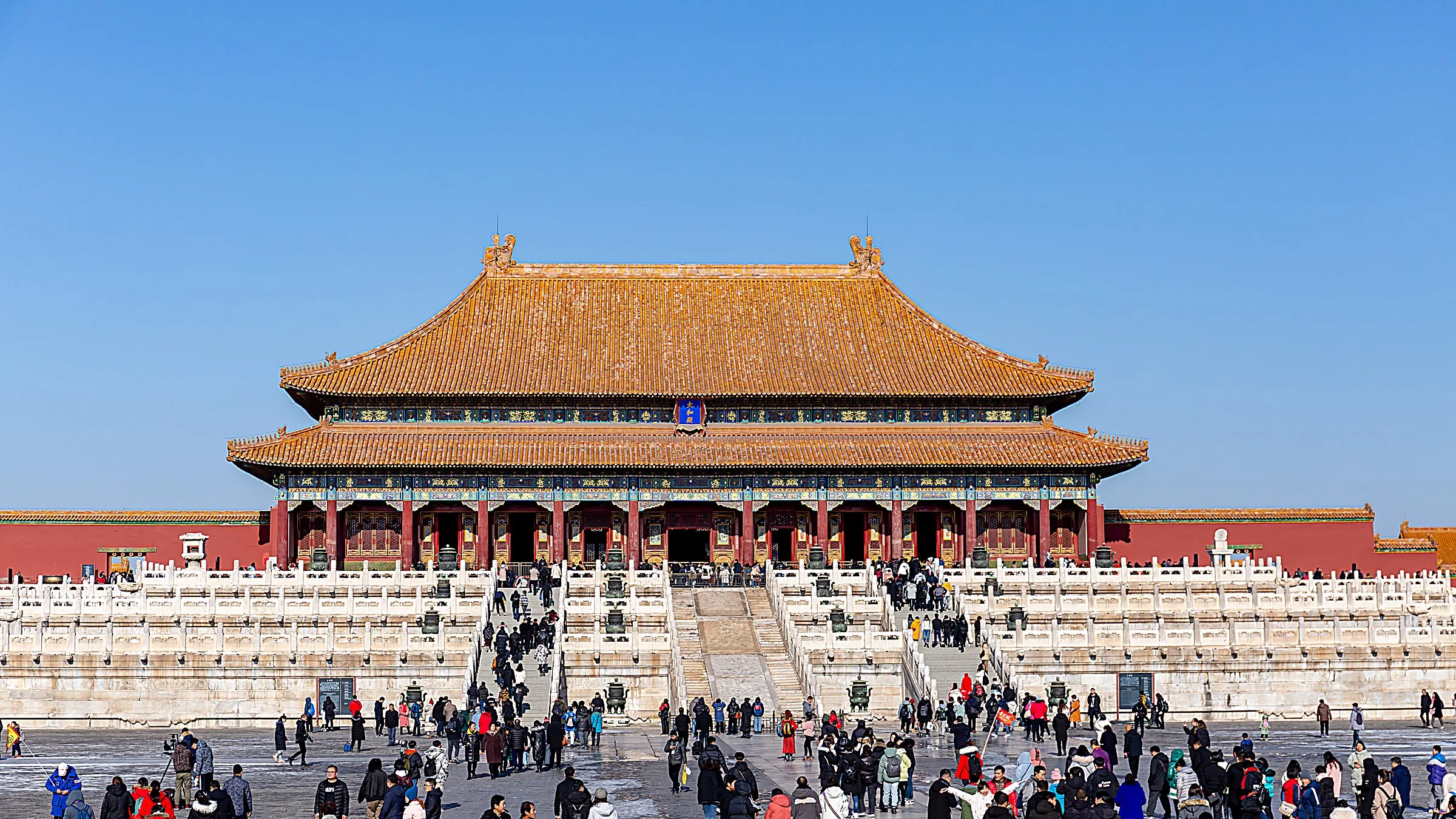
Forbidden City Guide: Beijing Imperial Palace, Tickets & Plan
The Forbidden City in Beijing: 72 hectares, 980 buildings, 1.4 million artifacts, Ming and Qing dynasties, UNESCO since 1987. Tickets (¥60), WeChat booking.
The Forbidden City (故宫, Gùgōng, “Former Palace”) was the imperial palace of the Ming and Qing dynasties from 1420 to 1912. It covers 72 hectares (180 acres) in the center of Beijing and contains 980 surviving buildings - the largest collection of preserved ancient wooden architecture in the world. 24 emperors lived and ruled here. UNESCO listed the complex as a World Heritage Site in 1987.
Today the Forbidden City houses the Palace Museum, with a permanent collection of 1.4 million artifacts (of which about 1% is on display at any time). The site receives 14-18 million visitors per year, making it the most-visited museum in the world. For the broader 3-day Beijing plan that uses the Forbidden City as Day 1 morning anchor, see our 3-day Beijing itinerary; for a compressed 2-day version (layover or short stop), see our 2-day Beijing layover. For the broader 3-day Beijing plan that uses the Forbidden City as Day 1 morning anchor, see our 3-day Beijing itinerary; for a compressed 2-day version (layover or short stop), see our 2-day Beijing layover.
How to plan your visit
3-hour visit (most common)
South gate (Meridian) to north gate (Divine Prowess) along the central axis. This covers the 3 main halls, the Palace of Heavenly Purity, the Palace of Earthly Tranquility, and the Imperial Garden. Miss the side wings and the galleries.
4-5 hour visit (recommended)
Add the Treasure Gallery and the Clock Gallery on the eastern side. Allow 1.5 hours for both. This is the most popular extended route.
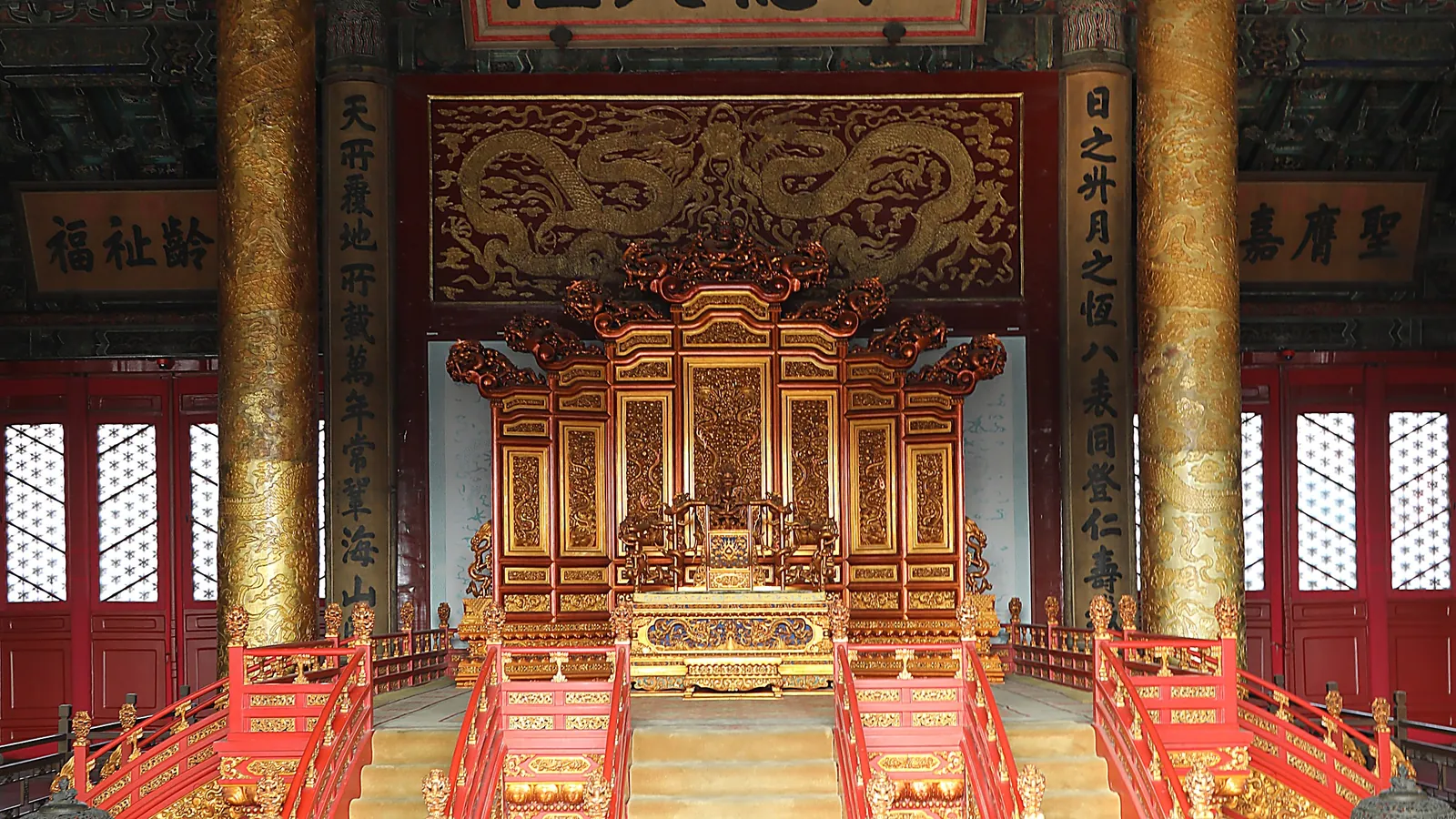
Photo: Wikimedia Commons / CC BY-SA. Source

How the Forbidden City fits into a wider Beijing trip
The Forbidden City pairs naturally with the Great Wall (Mutianyu is the most common 1-day pairing), the Summer Palace (30 min north, half-day add-on), and the surrounding hutong neighborhoods (Nanluoguxiang, Shichahai, the Drum Tower area). For the broader first-timer plan that links all of these — visa-free entry, Alipay, the airport-to-hotel scam list — see our first-time Beijing guide. For a culinary take on the adjacent hutongs, our Beijing hutong food tour walks 8 specific food stops within walking distance of the palace’s north gate.
6-7 hour visit (the full palace)
Add the eastern and western wings (Crown Prince’s Palace, Hall of Literary Glory, Hall of Martial Valor), the Hall of Supreme Harmony’s side halls, and a slower walk through the Imperial Garden. The full palace is enormous; budget 7 hours and bring a packed lunch.
Pairing with nearby sites
How the Forbidden City fits into a wider Beijing trip
The Forbidden City pairs naturally with the Great Wall (Mutianyu is the most common 1-day pairing), the Summer Palace (30 min north, half-day add-on), and the surrounding hutong neighborhoods (Nanluoguxiang, Shichahai, the Drum Tower area). For the broader first-timer plan that links all of these — visa-free entry, Alipay, the airport-to-hotel scam list — see our first-time Beijing guide. For a culinary take on the adjacent hutongs, our Beijing hutong food tour walks 8 specific food stops within walking distance of the palace’s north gate.
Pairing with nearby sites
Most visitors pair the Forbidden City with:
- Jingshan Park (¥2) - 200m from the north gate, 30 min climb to a hilltop for the iconic view over the Forbidden City. Best at sunset.
- Tiananmen Square - the massive public square south of the palace, with the Monument to the People’s Heroes and Mao’s Mausoleum. Free entry, security check required.
- Beihai Park (¥10) - 1 km west of the north gate, a 1,000-year-old imperial park with a large lake. Add 1-2 hours.
- National Museum of China (free, advance booking) - east side of Tiananmen Square, 1.7 million artifacts. Add 2-3 hours.
Tickets, booking, and payment
| Item | Price | Notes |
|---|---|---|
| Forbidden City entry | ¥60 peak / ¥40 off-peak | April-October / November-March |
| Treasure Gallery | +¥10 | Recommended |
| Clock Gallery | +¥10 | Recommended |
| Hall of Supreme Harmony (interior) | Free (combo ticket) | Sometimes closed for restoration |
| Jingshan Park | ¥2 | Outside the palace, north gate |
| Audio guide | ¥20 | Chinese, English, Japanese, Korean, French, German, Spanish |
| Official guide (per group) | ¥300-500 | Up to 8 people, 2 hours |
How to book:
- WeChat mini-program “故宫博物院” - the official booking method, 1-7 days in advance. Foreigners register with passport number. The mini-program shows real-time availability and is the only way to get same-week tickets in peak season.
- Trip.com - English, accepts foreign cards, ¥80-120 per ticket. Slightly more expensive but reliable for foreign visitors without a Chinese phone number.
- At the gate - limited same-day tickets, usually sold out by 10:00 AM in peak season. Same price as advance.
Free entry: Children under 1.2m. Seniors over 65 (with passport). Students with valid Chinese student ID. Foreign student cards are not generally accepted.
Closures: Closed every Monday (except Chinese national holidays). Closed for 2-3 days around Lunar New Year. Individual halls rotate for restoration; check the daily closure list at the entrance.
Visitor cap: The Palace Museum implemented a 30,000 daily cap in 2014. In 2024 the cap was raised to 80,000 during the summer school holidays, but the official target remains 40,000-50,000 for comfort. The cap is rarely hit on weekdays but is often hit on weekends and holidays.
Getting there and around
By subway: The most reliable method. Take Line 1 to Tiananmen East (天安门东) or Tiananmen West (天安门西) station. Exit B or C, 5-10 min walk to the Meridian Gate. Tiananmen Square requires a security check and passport scan; allow 15-20 min total from subway to palace gate.
By taxi or Didi: Drop off at the south side of Tiananmen Square or directly at the Meridian Gate. Traffic in central Beijing is heavy; allow 30-45 min from most central hotels. Didi (China’s Uber) accepts foreign Visa/Mastercard via Alipay.
By bus: Bus 1, 5, 52, 82, 99 to Tiananmen Square. Slow due to traffic and security; not recommended.
By foot from nearby: 10 min walk from Qianmen (前门) area, 20 min from Wangfujing (王府井) shopping district. Both are good areas to stay in for a Beijing visit.
What to bring
- Passport - required for entry, both at the security check and inside.
- Comfortable walking shoes - the palace is 1 km from south to north, plus side wings. Total walking 3-5 km.
- 2L of water - water vendors inside the palace charge ¥10 per bottle. The Forbidden City has very few shaded areas.
- Sun protection - the central courtyards are exposed to direct sun. Hat, sunscreen, polarized sunglasses.
- Power bank - 3-5 hours of photo-taking drains a phone. No outlets available.
- Light jacket - even in summer, the air-conditioned halls are 5-8°C cooler than outside.
- Cash ¥100-200 - most vendors and the audio guide desk accept Alipay, but a small cash reserve helps.
Drone rules (Forbidden City is a Tier-1 no-fly zone)
Drones are banned at the Forbidden City and across the entire central Beijing axis (Tiananmen → Forbidden City → Jingshan → Beihai). The Forbidden City sits inside Beijing’s “净空保护区” (clear-airspace protection zone) for both Capital Airport and the central-government compound, and the Palace Museum itself is classified as a Tier-1 protected cultural site. Penalties are the most severe in China for a heritage site: drone confiscation, ¥10,000–30,000 fine, and for foreign passport holders a Public Security Bureau filing plus possible administrative detention. Tiananmen Square airspace is also covered by the same order — flying anywhere within 5 km of either is treated as a national-security issue, not a tourism violation.
What you can do instead: the Forbidden City is one of the most-photographed places in the world and every iconic shot is from a permitted observation deck. The 5 most-instagramed angles — Meridian Gate from the moat bridge, the Hall of Supreme Harmony through the courtyard line, the Imperial Garden rockery, the corner tower from the outer wall, the Treasure Gallery red-wall corridor — are all ground-level. For an aerial perspective, the Jingshan Park hill (just north of the Palace) gives you a permitted top-down view of the entire Forbidden City roofline for ¥2 entry.
The 5 photo spots that matter
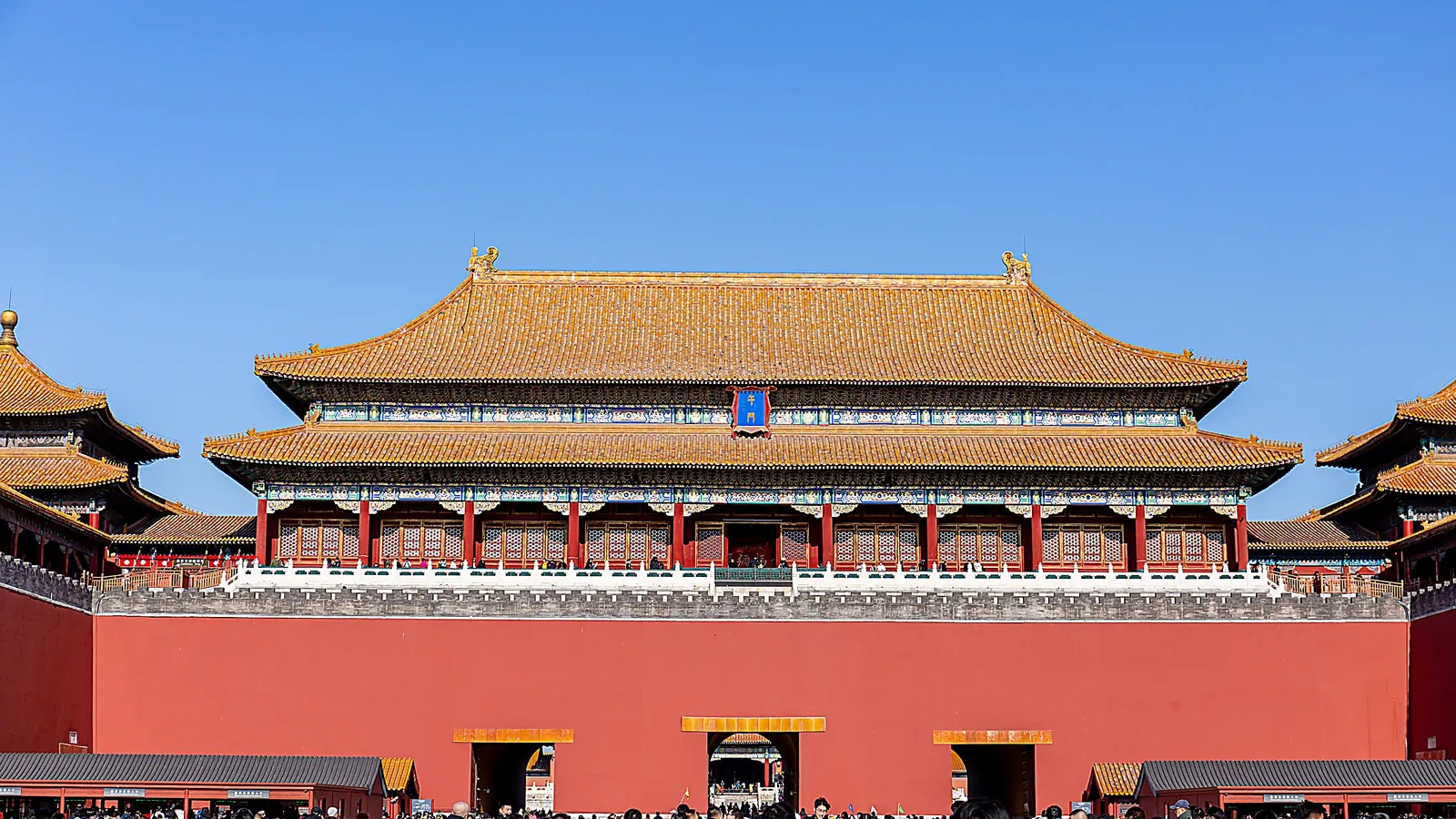
Photo: Wikimedia Commons / CC BY-SA. Source
_West_wing_interior_2015_December.jpg)
- Hall of Supreme Harmony from the courtyard - the iconic view. The triple-eaved golden roof on 3 tiers of white marble, with the sun on the eastern eaves. Best 8:30-10:00 AM.
- Gate of Supreme Harmony from the south - looking up at the gate with the Hall of Supreme Harmony behind it. The ceremonial “approach” to the throne. Best with the morning light from the east.
- Palace of Heavenly Purity interior - the emperor’s residence, restored with the original throne and ceremonial items. Photography allowed (no flash).
- Imperial Garden in autumn - the 1,000+ year-old cypress trees turn gold in late October. The garden is the most-photographed interior space in the palace in autumn.
- Jingshan Park hilltop view - 200m from the north gate, the iconic panorama over the Forbidden City’s yellow roofs. Best at sunset, 30 min before the palace closes.
Common mistakes to avoid
- Showing up without a ticket. Same-day tickets at the gate are usually sold out by 10:00 AM in peak season. Book 1-7 days in advance via the WeChat mini-program or Trip.com.
- Coming on a Monday. The Forbidden City is closed every Monday except Chinese national holidays. Plan for Tuesday-Friday for the smallest crowds.
- Trying to see everything in 2 hours. The palace is enormous; 3 hours is the realistic minimum for the central axis. 4-5 hours for the galleries. 6-7 hours for the full visit.
- Skipping the Treasure Gallery and Clock Gallery. Many visitors skip them because they are off the central axis. Both galleries are excellent and only ¥10 each.
- Wearing heels or open sandals. The palace paths are 1,000+ year-old stone; heels get stuck in the cracks. Closed walking shoes are best.
- Touching the walls or the doorframes. The paint and wood are original. The palace has visible wear from a century of foot traffic. Touching accelerates damage.
- Missing Jingshan Park. 200m from the north gate, ¥2, the iconic view. Most first-time visitors regret skipping it.
Where to stay
- Wangfujing (王府井) area - closest to the Forbidden City, 10 min walk to the Meridian Gate. Most first-time visitors stay here. Budget: Hanting Express, 7 Days Inn (¥200-400). Mid-range: Novotel Beijing Peace, Peninsula Beijing (¥800-1,800). Luxury: Peninsula Beijing (¥1,800-3,500). After a morning in the palace, this is the natural stop for Peking duck.
- Qianmen (前门) area - south of Tiananmen Square, restored hutong district. Walking distance to the palace. Mid-range: Qianmen Jianguo Hotel, Beijing Hotel (¥500-900). Boutique: Cote Cour (¥600-1,000).
- Hutong areas (North Beijing) - 20-30 min by taxi to the palace, quieter and more atmospheric. Mid-range: Orchid Hotel, Red Wall Garden Hotel (¥600-1,200). The hutongs are the best place to see what Beijing looked like before the palace was built.
- Sanlitun (三里屯) area - embassy district, 15-20 min by taxi to the palace. Best for nightlife. Mid-range: Opposite House, China World Hotel (¥1,200-2,500).
Best season and what to expect
April-May (best for spring): Temperatures 15-26°C, light winds. Crowds are moderate (40,000-60,000 per day). The central courtyards have spring flowers (peonies, magnolias). Bring a light jacket for early morning.
June-August (summer): Hot (28-35°C) and humid. Crowds are heavy (60,000-80,000 per day during school holidays). The shaded halls are a relief from the sun. Bring 3L of water, a hat, and sunscreen. Most visitors do the palace in 2-3 hours and escape to air-conditioning.
September-October (best for autumn): Temperatures 12-22°C, clear skies. Crowds are extreme during Chinese National Day (Oct 1-7) - 80,000 per day. The second half of October is the sweet spot: cool weather, autumn foliage in the Imperial Garden, manageable crowds (40,000-50,000 per day).
November-March (winter): Cold (-2 to 8°C), possible snow. Crowds are small (10,000-20,000 per day). The palace in snow is magical but the courtyards are icy. Best for serious visitors who want quiet viewing and great photos.
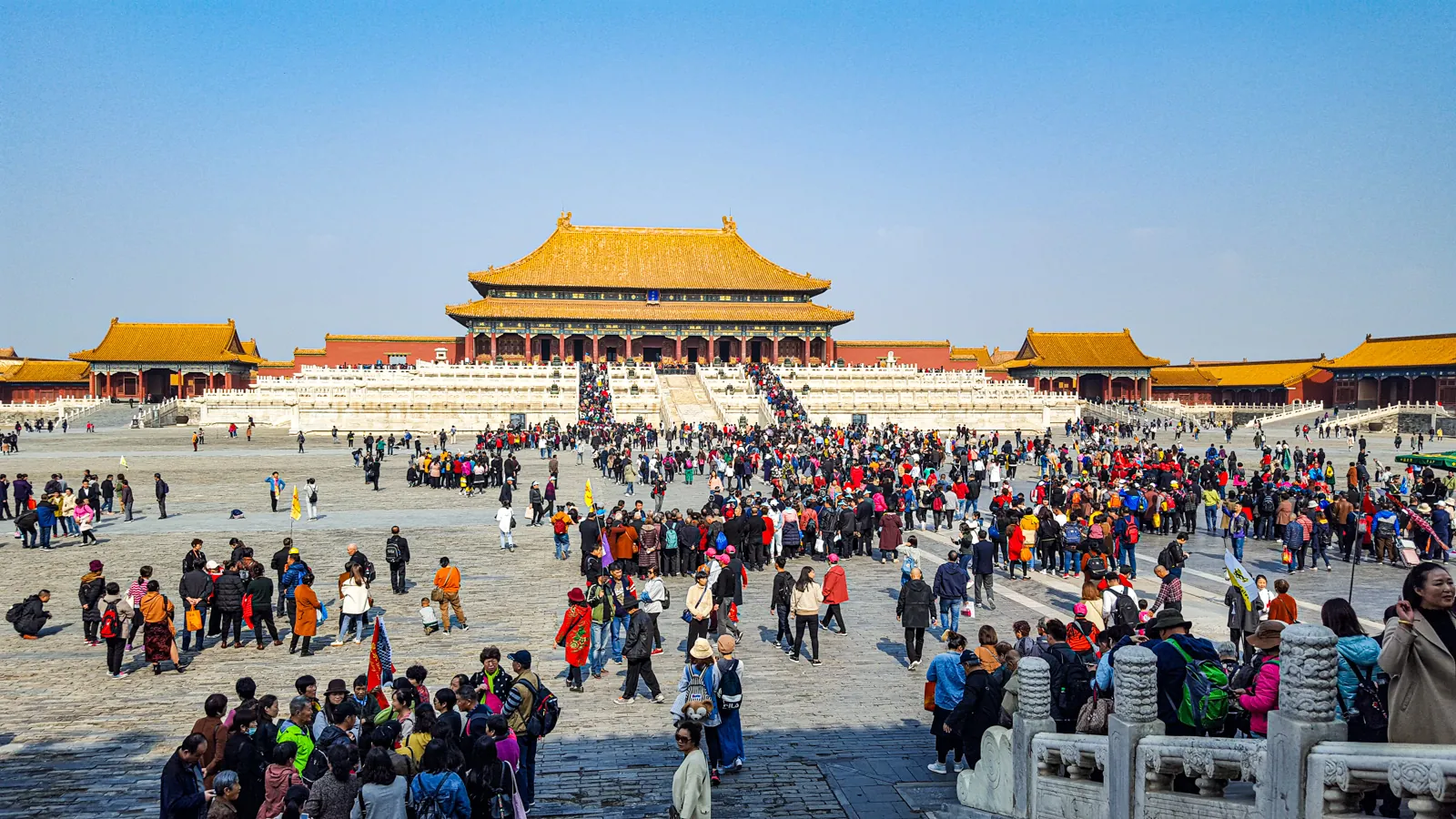
Photo: Wikimedia Commons / CC BY-SA. Source

Plan your trip - verified tools
These free tools are built on real, monthly-verified data and help you skip the trial-and-error phase of China trip planning:
- China 240-Hour Visa-Free Transit Checker - 57 countries, 24 provinces, 65 ports. See if you qualify for 10-day visa-free transit, which cities you can visit, and the 5-step process.
- China 6-City 5-Day Budget Calculator - Real 2026 prices for 5 days in Beijing, Shanghai, Guangzhou, Chengdu, Xi’an, or Hangzhou. Budget / mid-range / comfort tiers, broken down line by line.
Verified August 2026 by TravelHubChina Editorial. We re-check prices and policy details monthly so the data doesn’t drift.
Step by step
-
Book tickets 1-7 days in advance
Book via the WeChat mini-program "故宫博物院" (search for the official account, then the ticket booking section). Foreigners register with passport number. Trip.com is the English alternative - more expensive (¥80-120 per ticket) but accepts foreign Visa/Mastercard. Same-day tickets at the gate are usually sold out; advance booking is essential in peak season (April-May, September-October).
-
Arrive at the Meridian Gate by 8:30 AM
The Meridian Gate (午门) on the south side of the palace is the standard entrance. Subway: take Line 1 to Tiananmen East (天安门东) or Tiananmen West (天安门西) station, 5-10 min walk. Taxi: drop off at the south side of Tiananmen Square. Arrive 15-20 min before opening to clear the security check and be at the gate when the doors open at 8:30 AM.
-
Walk the central axis: Meridian Gate to Gate of Divine Prowess
The standard route is south-to-north along the central axis. The 3 main halls (Supreme Harmony, Central Harmony, Preserving Harmony) are the ceremonial core, built on 3 tiers of white marble. From there continue to the Palace of Heavenly Purity (the emperor's residence), the Palace of Earthly Tranquility (the empress's residence), and exit through the Gate of Divine Prowess (神武门) on the north side.
-
Add the Treasure Gallery and Clock Gallery (¥20 total)
The Treasure Gallery (珍宝馆) and the Clock Gallery (钟表馆) are on the eastern side of the palace. Each costs ¥10 and takes 30-45 min. The Treasure Gallery has gold, jade, and pearl artifacts. The Clock Gallery has 200+ imperial clocks from Europe and China. Allow 1-1.5 hours for both. They are not crowded in the morning.
-
Visit the eastern and western wings
The eastern wing has the Hall of Supreme Harmony's side halls and the Crown Prince's Palace. The western wing has the Hall of Literary Glory (the imperial library) and the Hall of Martial Valor. These wings are quieter and give a more intimate view of court life. Allow 1-1.5 hours for both. Most tour groups skip them.
-
End at the Imperial Garden
The Imperial Garden (御花园) is at the north end of the palace, just before the Gate of Divine Prowess. It is a 12,000 sqm Ming-Qing era garden with 1,000+ year-old cypress trees, rockeries, and pavilions. Allow 30-45 min. The garden is the most-photographed spot in the palace in autumn (cypress turning gold).
-
Exit at the Gate of Divine Prowess and walk to Jingshan Park
Exit the north gate (Gate of Divine Prowess / 神武门) and turn right. Jingshan Park (景山公园) is 200m away, ¥2 entry. Climb the central hill (5 min, paved steps) for the panoramic view over the Forbidden City's yellow roofs - the most-photographed angle in Beijing. Best at sunset. Allow 1 hour for the park.
-
Pair with Tiananmen Square and Jingshan Park
Most visitors start at Tiananmen Square (south of the Forbidden City, 10 min walk), pass through the Meridian Gate, walk the palace, exit the north gate, and end at Jingshan Park. Allow 5-6 hours for the full circuit. Add a 7th hour for lunch inside the palace at the Imperial Cuisine restaurant (¥80-150 per person) or outside at a Beijing roast duck restaurant.
-
Allow 6-7 hours if you want to see everything
First-time visitors typically spend 3-4 hours and see 60% of the palace. A complete visit (central axis + both wings + both galleries + Imperial Garden) takes 6-7 hours. The Palace Museum has 1.4 million artifacts, only 1-2% of which are on display. Most serious visitors come back a second time. Pick your priority: architecture, artifacts, or the imperial living quarters.
FAQ
-
How much is the Forbidden City ticket in 2026?
Entry is ¥60 in peak season (April 1 - October 31) and ¥40 in off-peak (November 1 - March 31). The Treasure Gallery (珍宝馆) is an extra ¥10; the Clock Gallery (钟表馆) is an extra ¥10. Both galleries are worth it. There is no foreigner surcharge - same price as Chinese citizens. Children under 1.2m free; students with valid Chinese student ID get 50% off. -
How do I book Forbidden City tickets as a foreigner?
Book via the official WeChat mini-program "故宫博物院" (Palace Museum), 1-7 days in advance. Foreigners can use a foreign passport number to register. You can also book via Trip.com (English, accepts foreign cards) or at the gate with passport - but same-day tickets are usually sold out in peak season. The mini-program is the most reliable method. Confirmation arrives in 5-15 minutes. -
Is the Forbidden City open on Mondays?
No. The Forbidden City is closed every Monday except for Chinese national holidays (Labor Day, National Day). It is also closed for 2-3 days around Lunar New Year (late January / February) for security sweeps. The standard opening hours are Tuesday-Sunday, 8:30-17:00, with last entry at 15:30 and halls close at 16:30. Plan a Tuesday-Friday visit to avoid the weekend crowds. -
How long should I spend at the Forbidden City?
3 hours is the minimum to see the central axis (the main halls and gates). 4-5 hours lets you add the Treasure Gallery and the Clock Gallery. 6-7 hours covers the eastern and western wings including the Imperial Garden. Most first-time visitors spend 3-4 hours. The Palace Museum is enormous - even after a full day, you will not have seen everything. -
What is the best time to visit the Forbidden City?
April-May and September-October for weather and crowd levels. Arrive at the gate 8:30 AM when it opens - the first hour is the quietest. Avoid Chinese National Day (Oct 1-7), the first week of May, and the summer school holidays (July-August) when daily visitors can hit 80,000. Winter visits (December-February) are quiet (5,000-15,000 per day) but cold. -
Can I go inside the halls at the Forbidden City?
Most main halls (Hall of Supreme Harmony, Hall of Central Harmony, Hall of Preserving Harmony) are viewable from the outside only, with barriers protecting the thrones and interior. The Treasure Gallery and Clock Gallery are interior halls you can enter. The eastern and western wings (Palace of Heavenly Purity, Palace of Earthly Tranquility) have interior displays on rotation. Photography is allowed in the courtyards; flash is forbidden everywhere. -
Should I visit the Forbidden City or the Summer Palace first?
Forbidden City first. It is the more historically important site, has the better-preserved architecture, and most visitors only see it once. The Summer Palace is a 30-min drive or 30-min subway ride from the Forbidden City and pairs well as a half-day afternoon add-on (or Day 2). If you have only 1 day in Beijing, the Forbidden City and the Great Wall (Mutianyu) is the classic combination. -
What is the difference between the Treasure Gallery and the Clock Gallery?
The Treasure Gallery (珍宝馆) in the Ningshou Palace area displays gold, silver, jade, and pearl artifacts from the imperial collection - over 400 items including the famous golden phoenix crowns. The Clock Gallery (钟表馆) in the Fengxian Hall displays 200+ imperial clocks from the 18th and 19th centuries, mostly gifts from Western embassies. Both galleries cost ¥10 each. Allow 30-45 min per gallery. Both are in the eastern side of the palace.
Related guides
- Scenic & Nature
Great Wall of China Guide: Mutianyu, Badaling, Jinshanling Compared
Great Wall of China: 21,196 km. Mutianyu (best first-timers), Badaling (most crowded), Jinshanling (hiking) compared. Tickets, transport, best season.
12min read
- Scenic & Nature
Summer Palace Guide: Beijing's Imperial Garden, Kunming Lake & Longevity Hill
Summer Palace in Beijing: 290 hectares, 3/4 water, UNESCO since 1998. The Long Corridor (728m, 14,000 paintings) is the world's longest covered walkway. ¥30 entry, ¥40 combo, subway access.
- Scenic & Nature
Temple of Heaven Guide: Beijing's Most Photogenic Park
Temple of Heaven in Beijing: 273 hectares, Ming Dynasty (1420), UNESCO since 1998. The Hall of Prayer for Good Harvests is China's most-photographed building. ¥35 entry, free dawn tai chi, subway access.
- Scenic & Nature
Big Wild Goose Pagoda Guide: Xi'an's 1,300-Year Tang Pagoda
Big Wild Goose Pagoda (Dayan Ta) in Xi'an: 64m Tang-dynasty brick pagoda from 652 AD, UNESCO since 2014 as part of the Silk Roads network. Tickets (¥50), climb times, and the free North Square musical fountain (9 PM nightly).
8min read
- Scenic & Nature
China's Top 3 Scenic Wonders Compared: Zhangjiajie vs Huangshan vs Jiuzhaigou (2026)
Zhangjiajie (sandstone pillars), Huangshan (sea of clouds + granite peaks), Jiuzhaigou (turquoise lakes + waterfalls). Decision guide covering which fits your time, budget, fitness level, photography goals, and travel style. Prices, distances from Shanghai/Beijing, best seasons compared.
12min read
- Scenic & Nature
Huangshan (Yellow Mountain) Guide: Sunrise, Sea of Clouds, Trails (2026)
Huangshan (黄山, Yellow Mountain) in Anhui is a UNESCO World Heritage site famous for its sea of clouds, twisted pines, and granite peaks. This guide covers the 2-3 day plan, ticket prices (¥190-310), cable cars, sunrise timing, and Hongcun village.
12min read