Jingshan Park
景山公园 · Jǐngshān Gōngyuán
Quick answer
Passport at the gate: buy at the window or scan in from a 畅游公园 booking, and carry the same passport. Foreign visitors pay the same ¥2. Visitors aged 60 and over enter free on a passport — this is written into the park's own policy and applies to foreign passports, so if you are travelling with parents or grandparents, say so at the window rather than buying tickets for everyone. Signage is Chinese-first with English on the main paths and at the pavilion plaques; the courtyard interpretation inside 寿皇殿 is largely Chinese.
Why visit
- 1 Look straight down on the Forbidden City from Wanchun Pavilion — the entire palace compressed into a grid of yellow roofs and red walls, which is a thing no photograph taken at ground level can prepare you for
- 2 Pay ¥2 for it. Jingshan is the highest point in old Beijing at 45.7m and charges the price of a bottle of water for the best view in the city
- 3 Stand on the geometric centre of the old city — the bronze marker on the summit is the centre point of Beijing's Central Axis, and everything the Ming and Qing built is arranged around where you are standing
- 4 See the four Beijings from one spot: the Forbidden City south, the Drum and Bell Towers north, the White Dagoba west, and the CBD towers east — imperial, republican, religious and hyper-modern in a single turn
- 5 Walk 30 m north of the crowds into 寿皇殿, the Qing ancestral hall, included in the ¥2 ticket and almost always empty
Essential tips for foreigners
- Come for the view, not the hill. The climb is 45.7 m and takes 15-20 minutes at an easy pace. It is stone steps the whole way, some of them worn smooth and slippery after rain. Nobody needs to be fit for this; everybody should wear shoes with grip.
- Go in the morning, or in winter. The view is the product and the air is the variable. Beijing's summer haze flattens the Forbidden City into a yellow smear by mid-afternoon. A clear winter morning gives you individual roof tiles three kilometres out.
- Enter from the South Gate on foot if you are coming from the Forbidden City — it is 150 m from 神武门, the palace's north exit. Do not try to reach Jingshan by metro; there is no station close enough to make it worth it.
- Do not schedule the courtyard halls for a Monday. 寿皇殿, 观德殿 and 关帝庙 close on Mondays except on public holidays. The hill and the pavilions are outdoors and unaffected, so the view is safe — but the ancestral hall is not.
- If you are travelling with anyone aged 60 or over, ask for the free ticket. The park's policy gives free entry at 60 and over, and it explicitly covers foreign passports. Show the passport at the window; do not buy a ¥2 ticket you did not need.
- Stay for the light rather than the sunset. The classic shot is not the sunset itself but the 20 minutes before it, when low sun rakes across the palace roofs from the west. Arrive an hour before sunset in winter if you want the position at the south railing.
Suggested route
- 13:30 10 min Exit the Forbidden City at its north gate (神武门). Cross Jingshan Front Street — the park's South Gate is 150 m directly ahead
- 13:45 20 min Buy the ¥2 ticket (free if anyone in the group is 60+, on a passport) and start up. Take the central stair flight; it is the shortest line and the widest
- 14:05 30 min Wanchun Pavilion. Work the four directions in order: south over the Forbidden City, west to the White Dagoba at Beihai, north to the Drum and Bell Towers, east to the CBD towers. Find the bronze centre-point marker on the summit platform
- 14:35 15 min Walk down the west slope past 辑芳亭 and 富览亭 — the pair of subsidiary pavilions nobody stops at, and the quietest place on the hill
- 14:50 30 min Cross to the north foot for 寿皇殿, the Qianlong-era Qing ancestral hall. Red walls, almost no visitors, included in the ticket. Closed on Mondays
- 15:20 15 min Leave by the West Gate onto 景山西街 and walk north to Beihai's East Gate, or south along 景山前街 for a coffee and the view back up at the hill
Jingshan is a 45.7 m artificial hill directly north of the Forbidden City, and it exists for a bureaucratic reason: when the Ming built the palace in the Yongle period, they dug the moat, and the earth had to go somewhere. It went here. What was a spoil heap became Coal Hill, then 景山 in 1655 — the name taken from a line in the Book of Songs about tall pines on a high mountain.
It is the highest point in what was the walled city, and it sits on the geometric centre of Beijing’s Central Axis. That combination is why ¥2 buys the best view in China’s capital: the entire Forbidden City, 960 m long and 750 m wide, laid out directly below you, roofs and courtyards and all, arranged on the axis that runs through the point where you are standing.
Is Jingshan Park worth visiting?
Worth it — ¥2 and an hour for the best view in Beijing, and it is not a stretch. Jingshan is the highest point in the walled city at 45.7 m, and from Wanchun Pavilion you look straight down the Central Axis onto the entire Forbidden City: 960 m long and 750 m wide, roofs and courtyards all at once, arranged around the point where you are standing. The recommended visit is 60-90 minutes — 20-30 min up, 20-30 min at the top and 20 min down.
What the ¥2 buys beyond the view is the plan of the city, because the four directions resolve in one turn: the Forbidden City south, the Drum and Bell Towers north, the White Dagoba of Beihai west, and the CBD towers east — imperial, republican, religious and hyper-modern from a single platform. The summit also carries the bronze marker that is the geometric centre of the old city, and 30 m north of the crowds at the foot of the hill is 寿皇殿, the Qing ancestral hall, included in the ticket and almost always empty. It is not a destination in its own right — nobody flies to China for Jingshan — but it completes the Forbidden City in a way the Forbidden City cannot do for itself.
Do you need tickets to Jingshan Park?
Yes, but they cost ¥2 for an adult, year-round, which makes it the best-value ticket in Beijing by a wide margin. Students pay ¥1, and the one seasonal increase is the peony festival, roughly 11-30 April, when the gate price becomes ¥10. There are no free days at ¥2, and there is nothing inside the park that costs extra: the ¥2 covers the whole park, including the climb to Wanchun Pavilion and entry to 寿皇殿, with no separate hall ticket and no lift fee.
Several categories enter free, and one of them catches out foreign families. Visitors aged 60 and over are free on production of a passport, and the rule explicitly covers foreign visitors rather than only Chinese ID holders. Children under 1.2m or aged 6 and under are free, as are disabled visitors, active and disabled military personnel, and holders of a 离休证. On an ordinary weekday you buy at the gate window; on public holidays and during the April peony festival, book through 畅游公园 (Changyou Gongyuan), the shared WeChat mini program for Beijing’s municipal parks, a day or two ahead, and carry the passport you booked with.
How long does it take to climb Jingshan Park?
Fifteen to twenty minutes from the South Gate to Wanchun Pavilion at an easy pace, and about ten minutes back down, all on stone steps. The climb is only 45.7 m, but the steps are worn smooth in places and slippery after rain, so the constraint is the surface rather than the height — nobody needs to be fit for it, and everybody should wear shoes with grip.
Budget 60-90 minutes for the park as a whole: 20-30 minutes up, 20-30 minutes at the top if you want to work all four directions, about 20 minutes down, and another 30 if you cross to 寿皇殿 at the north foot on your way out. The top is where the time goes if you are photographing the Forbidden City properly, and you should arrive an hour before sunset in winter if you want the position at the south railing, because it is the most contested spot in the park. Two hours is the right figure if you are waiting for light.
How do I get to Jingshan Park?
On foot, from the Forbidden City’s north gate (神武门) — 150 m, straight ahead, and the way the axis is meant to be walked. If you are arriving independently, buses 101, 103, 109, 124, 58, 专1 and 专2 stop on the same corner, and the West Gate on 景山西街 is the quietest entrance and the easiest taxi drop-off. There is no public car park, and the streets immediately around the park — 景山西街 and 景山前街 — are narrow, one-way in places and often closed to traffic on busy days, so do not drive.
A taxi is the practical answer if you are not on the axis: ¥20-30 and 10-15 minutes from Wangfujing, ¥50-70 and 25-35 minutes from Sanlitun, and you should tell the driver 景山公园西门 or 南门 rather than just 景山公园. Metro is the option to avoid — there is no station within a short walk, and Line 8’s 中国美术馆, the nearest, still leaves a 15-20 minute walk west. One weekend wrinkle: the 景山前街 approach is often closed to vehicles, so the last 300 m may be on foot whatever you arranged.
Can I visit Jingshan, Beihai and the Forbidden City in one day?
Yes — it is the right order, and it is the single best day in Beijing: 12-15 km on foot. The Forbidden City south to north in the morning, because its entry is timed and a missed slot cannot be recovered; out through 神武门 and 150 m into Jingshan for the view; then down the west side and north into Beihai Park for the afternoon. Jingshan is the short leg in the middle at 60-90 minutes, and Beihai is the long one, at 3-4 hours for the full north-gate-to-south-gate circuit or 90 minutes for the lake and the island alone.
The clocks are what make this work, and the one that catches people is the north bank of Beihai. Jingshan’s courtyard halls — 寿皇殿, 观德殿 and 关帝庙 — close at about 17:30 in peak season and 16:30 in winter, and Beihai’s garden-within-garden sights close at roughly the same hours, even though the park itself stays open until 21:00 in peak season and 20:00 in winter. On Mondays both sets of courtyards are shut, though the hill, the pavilions and Round City stay open — so on a Monday this axis gives you the Forbidden City and the view, and little else. Jingshan’s own ticket also rises to ¥10 during the April peony festival.
The ticket, and who gets in free
| Visitor | Price | Notes |
|---|---|---|
| Adult | ¥2 | Year-round, the normal rate |
| Student | ¥1 | With student ID |
| Child under 1.2m or aged 6 and under | Free | — |
| Aged 60 and over | Free | Includes foreign visitors on a passport |
| Disabled, military, 离休证 holders | Free | With documentation |
| Peony festival, approx. 11-30 April | ¥10 | The one seasonal increase |
The 60-plus rule is worth knowing before you reach the window. It is written into the park’s published policy and explicitly extends to 外籍游客 — foreign visitors — producing a passport. Travelling with parents and quietly buying four ¥2 tickets is not a disaster at this price, but the free entry is real.
Hours, and the Monday split
| Park and hill | Courtyard halls (寿皇殿, 观德殿, 关帝庙) | |
|---|---|---|
| Peak, 1 Apr - 31 Oct | 06:00-21:00, last entry 20:30 | approx. 08:00-18:00, last entry 17:30 |
| Off-peak, 1 Nov - 31 Mar | 06:30-20:00, last entry 19:30 | approx. 08:30-17:00, last entry 16:30 |
| Monday | Open | Closed, except statutory public holidays |
The hill is outdoors and answers to nobody’s schedule, so Mondays still work for the view. What you lose on a Monday is 寿皇殿 at the north foot — which is a genuine loss, because it is the emptiest and most atmospheric thing in the park.
The five pavilions, and what each one frames
| Pavilion | Position | What it looks at |
|---|---|---|
| 万春亭 Wanchun | Summit, central | South: the whole Forbidden City. The reason to climb |
| 周赏亭 Zhoushang | East slope, lower | East: the CBD towers, with roof tiles as foreground |
| 观妙亭 Guanmiao | East slope, upper | East-north-east, over the palace’s eastern halls |
| 富览亭 Fulan | West slope, upper | West: the White Dagoba at Beihai, close enough to read |
| 辑芳亭 Jifang | West slope, lower | South-west, the best angle for late-afternoon light |
Nearly everyone walks straight to the summit and straight back down. The four subsidiary pavilions are three minutes off the main stair flights, built in the Qianlong period, and usually empty — which in a park this small is a strange thing to be able to say.
The four directions from the top
The summit platform is the only place in Beijing where the city’s whole historical layering resolves in a single turn. South is the Forbidden City, imperial. North is the Drum and Bell Towers and the hutong grid, the city that kept working after 1911. West is Beihai’s White Dagoba, Buddhist and 700 years older than the palace. East is the CBD — the China Zun and its neighbours, all of it built in the last fifteen years.
The bronze marker set into the summit platform is the centre point of the old city. Everything the Ming and Qing planned is arranged around it, and once you have stood on it the layout of central Beijing stops being an abstraction.
The 1644 story, briefly
On the hill’s east slope, in April 1644, as Li Zicheng’s rebel army entered the city, the last Ming emperor, Chongzhen, hanged himself. The Ming dynasty ended at the foot of a hill 150 m from the palace it had built. The spot is marked as 明思宗殉国处 — the place where Emperor Sizong died for the country — and the tree standing there today is a replanted one; the original did not survive the twentieth century.
It is a strange thing for a city park to contain, and it is treated with a restraint that is easy to walk past. Look for the marker on your way down the east slope.
Getting there, and the right way to sequence it
The correct approach is on foot from the Forbidden City’s north gate, 神武门 — 150 m, straight ahead. That is how the axis is meant to be walked, and it costs you nothing.
There is no metro station close enough to be worth it. Line 8’s 中国美术馆 is the nearest and still leaves a 15-20 minute walk west. Buses 101, 103, 109, 124, 58, 专1 and 专2 stop at 神武门, on the same corner.
The West Gate on 景山西街 is the quiet entrance and the easiest for a taxi. There is no public car park, and the streets immediately around the park are narrow and often closed to traffic on busy days.
The sequence that works: Forbidden City south to north in the morning — timed entry, book ahead — out through 神武门, up Jingshan for the overview, then west and north into Beihai Park for the afternoon. It is 12-15 km on foot and it is the single best day in Beijing. Do not reverse it; the palace slot is timed and a missed slot cannot be recovered.
Our first-time Beijing guide and the 3-day Beijing itinerary both build this axis in as a fixed spine rather than an option.
Also nearby
- The Forbidden City (故宫) — 150 m south. Timed entry; book before you plan anything else.
- Beihai Park (北海公园) — 15 minutes west on foot, and the natural afternoon after this morning.
- Temple of Heaven (天坛) — the other end of the axis, south of the city; a separate half-day.
Best photo spots
-
Wanchun Pavilion, the south railing, looking straight down the Central Axis · One hour before sunset in winter; early morning in summer before the haze builds
The shot of the Forbidden City, taken from above and dead centre. The palace runs 960 m south of you. Use 50-85mm to compress the roofs into a pattern; a wide lens turns them into texture. This railing is the most contested position in the park — arrive early and hold it.
-
Wanchun Pavilion, west side, looking toward Beihai · Golden hour, when the White Dagoba catches the last light
The White Dagoba at Beihai with the city between you and it. A longer lens (100mm+) isolates the dagoba above the treeline and lets you stack it against the hills to the west. This is the frame that shows how close the two parks actually are.
-
Wanchun Pavilion, east side, looking toward the CBD · Clear days only — this direction dies in haze
The contrast shot: Ming-dynasty roof tiles in the foreground, the China Zun and the CBD skyline behind. It only works when visibility is genuinely good, which in Beijing means winter. Check the air before you commit to it.
-
The west slope near 辑芳亭, looking down at the pavilion roofline · Late afternoon, side light
The pavilions as architecture rather than as viewpoints — glazed tile roofs stepping down the hillside with nobody in frame. In late November the ginkgo on these slopes turns and the whole west face goes yellow.
Where to eat nearby
-
Shichahai and Qianhai hutongs
Beijing home cooking, courtyard restaurants, hotpot · ¥60-200 per person · 15-20 min walk north-west from the West Gate
-
Nanluoguxiang
Street food and small restaurants along a hutong that has become a tourist strip · ¥40-150 per person · 20 min walk north-east
-
Wangfujing snack street
Beijing snacks, skewers, and a great deal of sugar · ¥30-120 per person · 20 min walk south-east, or one metro stop
Frequently asked questions
How much is the ticket to Jingshan Park?
¥2 for an adult, year-round. Students ¥1. During the peony festival, usually 11-30 April, the ticket goes up to ¥10. Children under 1.2m or aged 6 and under are free, and so is anyone aged 60 or over — including foreign visitors, on production of a passport. At ¥2 it is the best-value ticket in Beijing by a wide margin.
What are the opening hours of Jingshan Park?
Peak season (1 April to 31 October): 06:00-21:00, last entry 20:30. Winter (1 November to 31 March): 06:30-20:00, last entry 19:30. The courtyard buildings — 寿皇殿, 观德殿 and 关帝庙 — open later and close earlier, roughly 08:00-18:00 in summer and 08:30-17:00 in winter. The hill and the five pavilions are open whenever the park is.
Can you really see the Forbidden City from Jingshan Park?
Yes, and it is the definitive view — Wanchun Pavilion at the summit looks directly south down the Central Axis onto the whole palace complex. The Forbidden City is roughly 960 m long and 750 m wide, and from 45.7 m up you see all of it at once, roofs and courtyards and all. It is around 10 minutes' walk from the palace's north exit.
How long does it take to climb Jingshan?
Fifteen to twenty minutes from the South Gate to Wanchun Pavilion at an easy pace, on stone steps the whole way. Coming down takes about ten. Add 20-30 minutes at the top if you want all four directions, and another 30 if you visit 寿皇殿 at the north foot on the way out. An hour to ninety minutes covers the whole park comfortably.
Is Jingshan Park worth visiting?
For ¥2 and an hour, it is the highest-return stop in Beijing. It is not a destination in its own right — nobody flies to China for Jingshan — but it completes the Forbidden City in a way the Forbidden City cannot do for itself: you see the plan of the whole palace from above, which makes everything you walked through downstairs make sense. Pair it with Beihai next door and it fills an afternoon.
What is the history of Jingshan and the Coal Hill?
The hill is artificial. Earth excavated for the Forbidden City's moat was piled here in the Yongle period, and it was later called Meishan (Coal Hill), from a tradition that coal was stockpiled at its foot for the palace in an emergency. It was renamed 景山 in 1655, taking the name from a line in the Book of Songs. In 1644, as Li Zicheng's forces took the city, the last Ming emperor, Chongzhen, hanged himself on the hill's east slope — the spot is marked, and the tree there today is a replanted one.
What are the five pavilions on Jingshan?
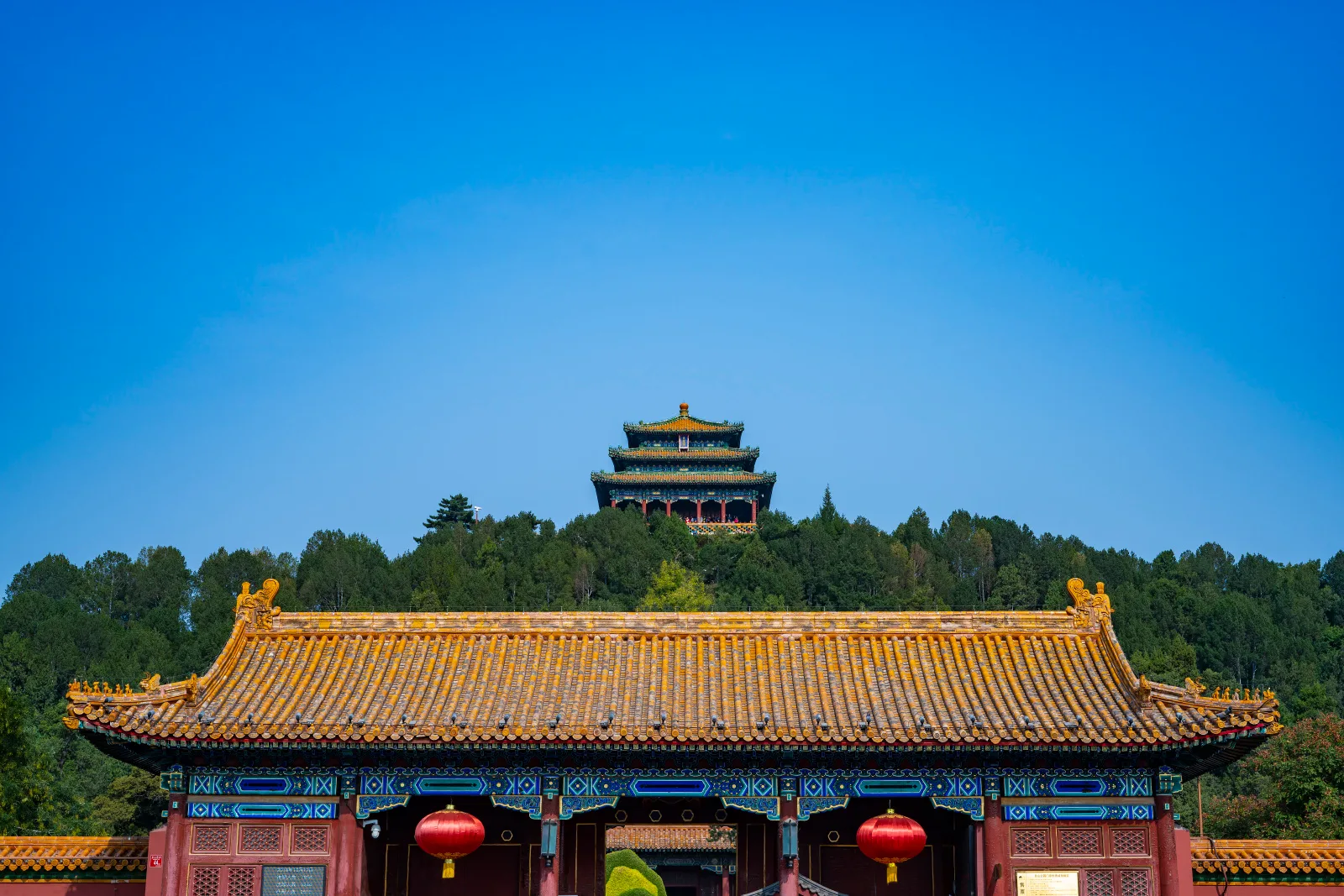
Wanchun Pavilion (万春亭) sits at the summit, square and triple-eaved, and is the viewpoint everyone climbs for. Flanking it down the slopes are four smaller round or octagonal pavilions: 周赏亭 and 观妙亭 on the east side, 富览亭 and 辑芳亭 on the west. They were built in the Qianlong period and each frames a different direction. The four subsidiary pavilions are usually empty — most visitors walk straight past them to the top.
How do I get to Jingshan Park?
On foot from the Forbidden City's north gate (神武门) — 150 m to Jingshan's South Gate, which is how most people arrive and the only way that makes sense. By bus, 101, 103, 109, 124, 58, 专1 or 专2 stop at 神武门. There is no metro station within a short walk; the nearest, Line 8's 中国美术馆, leaves a 15-20 minute walk. The West Gate on 景山西街 is the quietest entrance and the easiest for a taxi drop-off.
Can I visit Jingshan, Beihai and the Forbidden City in one day?
Yes, and it is the right order: Forbidden City south to north in the morning (book the entry slot in advance — it is timed), out through 神武门, 150 m into Jingshan and up for the view, then down the west side and north into Beihai Park for the afternoon. It is 12-15 km on foot across the day. Do not reverse it: the Forbidden City's timed entry means a missed morning slot is a missed visit.