Beihai Park
北海公园 · Běihǎi Gōngyuán
Quick answer
Your passport is your ticket: buy online before you go, or at the gate window, and carry the same passport you booked with. Foreign visitors pay the same ¥10/¥20 as Chinese visitors. English signage covers the gates, the main loop path and the headline sights; the smaller garden courtyards and temple inscriptions are Chinese-only. There is a self-service audio-guide rental point at the gates — ask at the ticket window, and do not assume a specific language is in stock. Wheelchairs can be rented at the gate areas, and there is a baby-care room inside the South Gate.
Why visit
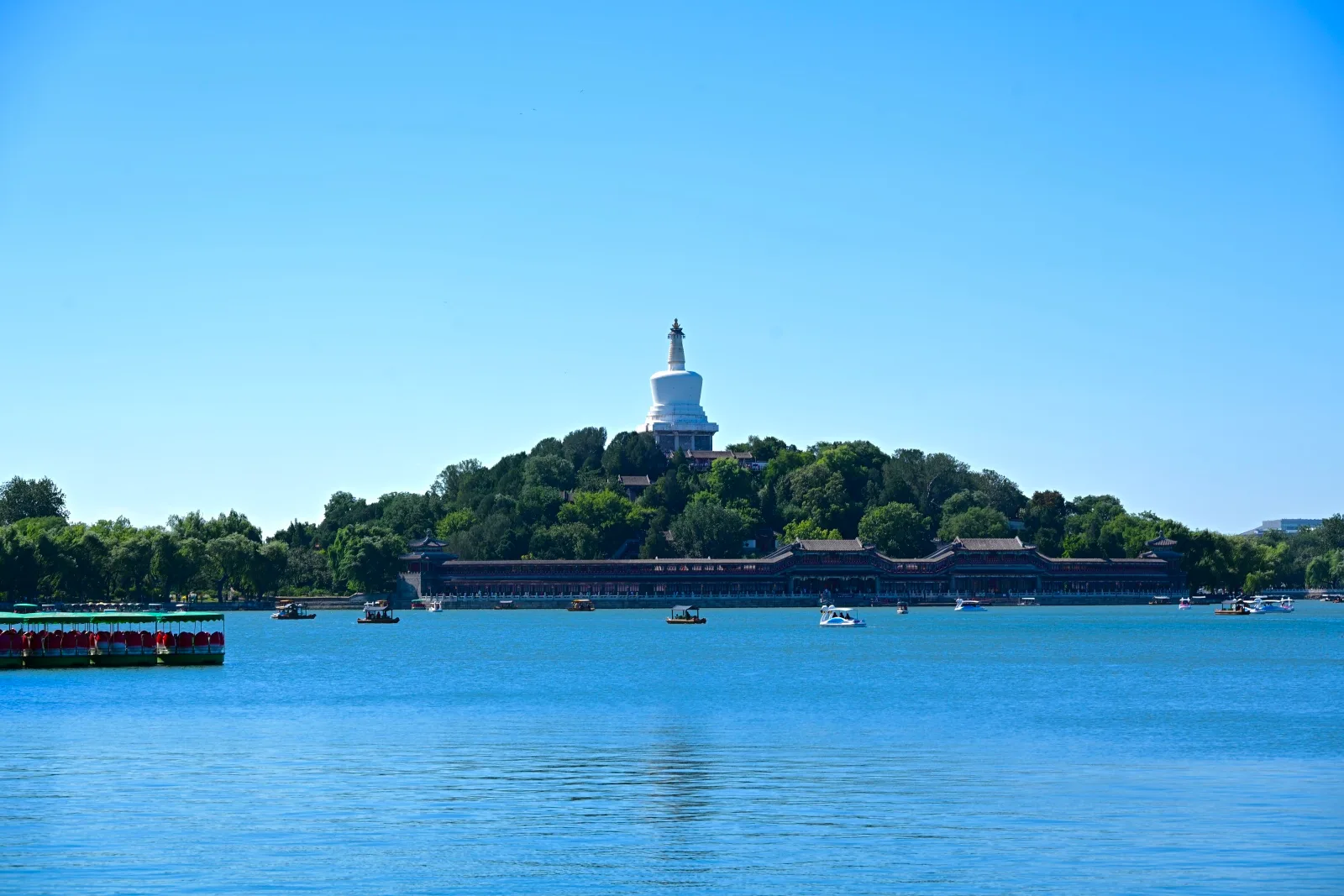
- 1 Climb to the White Dagoba (白塔) on Qionghua Island — the 1651 Tibetan-style stupa that has been the visual signature of this part of Beijing for nearly four centuries, and the one spot where you look down on the lake, the city and, on a clear day, the Forbidden City's roofline at the same time
- 2 Find the Nine-Dragon Screen (九龙壁) on the north bank — the only double-sided one of the three surviving in China, glazed on both faces, so it is worth walking around behind it, which almost nobody does
- 3 Stand on the shore in winter when the lake freezes and the ice rink opens — a Beijing ritual no other capital has an equivalent of, and the reason locals keep coming back in January
- 4 Walk in through the North Gate, not the South — you get the quiet gardens first and the crowds last, and you exit straight into the Jingshan and Forbidden City axis
- 5 Understand the ¥10 versus ¥20 decision before you queue: the cheap ticket does not get you onto the island, and the island is where the dagoba is
Essential tips for foreigners
- Do not come on a Monday expecting the north bank. The garden-within-garden sights — 静心斋, 西天梵境 with the Nine-Dragon Screen, 小西天 and the rest — close every Monday except on statutory holidays. The park itself stays open, so nothing at the gate tells you. Round City is the exception that stays open.
- Buy the ¥20 combo, not the ¥10 gate ticket. The extra ¥10 is what puts you on Qionghua Island with the White Dagoba and inside Round City. With only the gate ticket you can walk the shore and photograph the dagoba from below — which is a fine afternoon, but not the one you planned.
- Arrive at the North Gate on Metro Line 6. Beihai North station, Exit B, 300 m. The South Gate is the one everyone uses because it is next to Jingshan and the Forbidden City, and it is also the one with the longest queue and the worst route through the park.
- The garden-within-garden sights close around 17:30 in summer and 16:30 in winter — hours before the park shuts at 21:00 or 20:00. If you arrive after 15:00, go straight to the north bank first and leave the lake circuit for the evening, or you will spend the golden hour walking past locked gates.
- The White Dagoba climb is steep and has no lift. It is a stone stair flight up a wooded hill, and in summer heat or after rain it is slippery. If anyone in your group cannot manage it, the view from the lake shore and from the Five Dragon Pavilions is a fair substitute and costs nothing extra.
- There is no public car park at the park. This is stated by the park itself. Metro Line 6 or a taxi to the North Gate; if you are driving, you are parking several hundred metres away at Shichahai and paying for it.
Suggested route
- 08:30 20 min Metro Line 6 to Beihai North, Exit B, walk 300 m to the North Gate. Buy the ¥20 combo ticket at the window or scan in from your phone booking
- 09:00 30 min Turn immediately into 静心斋 (Studio of Quiet Heart) — the Qianlong-era Jiangnan-style courtyard that most visitors walk straight past. Small, walled, and quiet at this hour
- 09:30 40 min Continue to 西天梵境 for the Nine-Dragon Screen — walk round the back, because it is glazed on both faces and the reverse side is empty of people. Then the 小西天 hall
- 10:10 25 min Walk west along the north shore to the Five Dragon Pavilions (五龙亭), out over the water on a white marble bridge. This is the best view back at the island and the dagoba from across the lake
- 10:40 50 min Follow the shore south to the Yong'an Bridge and cross onto Qionghua Island. Climb through Yong'an Temple to the White Dagoba. Steep stone steps, no lift; allow time to stop
- 11:30 30 min Come down the island's west side and walk to Round City (团城) at the south end — the circular walled compound with the Yuan-dynasty jade wine vessel, 渎山大玉海, and the old pines
- 12:00 2 hours Exit the South Gate. Jingshan Park is directly across the road — climb Wanchun Pavilion for the view down over the Forbidden City's roofs, or turn west for lunch in the Shichahai hutongs
Beihai Park (北海公园) is the oldest surviving imperial garden in China, and the reason is a quirk of geology rather than politics: the lake at its centre was already a royal water feature under the Liao and Jin dynasties, a thousand years ago, and every dynasty that took Beijing kept building on it rather than starting again. The Kublai Khan made Qionghua Island the centre of his capital. The Ming walled it into the Western Garden. The Qing added most of what you actually walk through today.
What that produces is a park that does not read like a monument. It reads like a park — old men with fishing rods, grandmothers with grandchildren, a lake you can rent a pedal boat on. Then you look up and there is a Tibetan stupa on the hill, built in 1651, and behind it a Nine-Dragon Screen glazed on both faces, and off to one side a walled courtyard the Qianlong Emperor built because he wanted somewhere that felt like Jiangnan.
It is a national 4A scenic area, one of the first batch of Key National Cultural Heritage Protection Units, and it costs ¥10 to walk into. Almost everything foreign visitors get wrong about it is administrative rather than cultural — which ticket, which gate, which day — so that is where this page spends its words.
Do I need a ticket for Beihai Park?
Yes — Beihai charges year-round and there is no free day. Peak season (1 Apr-31 Oct) is ¥10 for the gate ticket and ¥20 for the combo; off-peak (1 Nov-31 Mar) it drops to ¥5 and ¥15, and ¥5 is the cheapest the park ever gets. Children under 1.2m are free, and visitors 65 and over are free on the gate ticket.
You do not need to book ahead on an ordinary day: buy at the gate window, or through 畅游公园 (Changyou Gongyuan), the WeChat mini program and app that Beijing’s municipal parks share. On a public holiday, book two or three days ahead — the queue at the South Gate on a May or October weekend is genuinely long. Your passport is the ticket, so carry the same document you booked with.
The part that trips people up is what a ticket does not include. The combo covers the gate, Qionghua Island with the White Dagoba and Yong’an Temple, and Round City — but not the separate garden-within-garden entries on the north bank, where 静心斋, the Nine-Dragon Screen at 西天梵境 and 小西天 each charge a few yuan at the door of their own courtyard. The boats on the lake and the audio-guide rental are also outside the ticket.
Is Beihai Park worth it?
Worth it — if you have half a day in the middle of Beijing and want the highest concentration of imperial sights per square kilometre anywhere in the city. The ¥20 combo buys three of them: the 1651 White Dagoba on Qionghua Island, the Nine-Dragon Screen at 西天梵境 — the only double-sided one of the three surviving in China, glazed on both faces — and Round City with its Yuan-dynasty jade wine vessel. The full north-gate-to-south-gate circuit is 3-4 hours, or 90 minutes if you only want the lake, the island and the view.
The comparison people actually ask is with the Summer Palace, and the honest answer is that the two answer different questions. Beihai is a working city park at the centre of old Beijing, compact, with the dagoba, the screen and Round City packed into a small area, and it sits on the Forbidden City and Jingshan axis so it costs you almost no travel time. The Summer Palace is four times the scale, further out at Haidian, and needs most of a day. If you have one day for an imperial garden, the Summer Palace; if you have an afternoon and you are already in the centre, Beihai.
One more thing is worth it for a completely different reason: in the depths of winter the lake freezes and an ice rink opens on it, usually from late December into early February, with ice chairs, ice bikes and skates rented on the ice. That is a Beijing ritual rather than a tourist attraction, which is exactly why it is worth doing.
How long does it take to explore Beihai Park?
Three to four hours for the full circuit from the North Gate to the South Gate, and 90 minutes if you only want the lake, the island and the view. Add an hour if you plan to eat inside the park. The individual pieces are worth budgeting, because the park is not uniform and the north bank is where the time goes.
A workable morning runs from 08:30: 静心斋 first, because it is a small walled Qianlong-era courtyard most visitors walk straight past, then 40 minutes for 西天梵境 and the Nine-Dragon Screen — walk round the back, since it is glazed on both faces and the reverse side is empty of people — then 小西天, then 25 minutes out on the white marble bridge at 五龙亭 for the view back at the island. The climb to the White Dagoba through Yong’an Temple is steep stone steps with no lift and takes about 50 minutes; Round City at the south end takes about 30. The shore path itself is roughly an hour at walking pace.
The one thing that turns a 3-hour visit into a 6-hour one is the lake in summer, when pedal boats are on the water and nobody is in a hurry. If the dagoba climb is out of reach for anyone in your group, the view from the lake shore and the Five Dragon Pavilions is a fair substitute and costs nothing extra.
Can I combine Beihai Park with the Forbidden City and Jingshan?
Yes — they sit on one north-south axis, and the combined day is 12-15 km on foot. The order is not negotiable, because the Forbidden City’s entry is timed: walk the palace south to north in the morning, exit at its north gate, cross Jing Shan Front Street into Jingshan Park and climb for the view down over the palace roofs, then continue north into Beihai. A missed morning slot at the palace is a missed slot; the Forbidden City does not take you later.
The hours line up well if you start early. The park itself is open 06:00-21:00 in peak season with last entry at 20:30, and 06:30-20:00 in winter with last entry at 19:30, so the three stops fit comfortably in one day. The constraint is the north bank of Beihai: the garden-within-garden sights close at about 17:30 in summer and 16:30 in winter, hours before the park itself shuts, so on this axis the Beihai courtyards belong early in the afternoon rather than at the end of it.
One date-specific trap worth checking before you build the day: Beihai’s north-bank gardens close every Monday except on statutory public holidays, and Round City is the exception that stays open. On a Monday you can still cross to the White Dagoba and sit by the lake — but the Nine-Dragon Screen and 静心斋 are behind locked doors.
The ¥10 ticket does not get you to the dagoba
This is the first thing to fix, because it is the difference between the visit you planned and an afternoon on a lakeside path.
| Season | Gate ticket | Combo ticket (联票) | What the combo adds |
|---|---|---|---|
| Peak, 1 Apr - 31 Oct | ¥10 | ¥20 | Qionghua Island (White Dagoba + Yong’an Temple) and Round City |
| Off-peak, 1 Nov - 31 Mar | ¥5 | ¥15 | Same |
With the ¥10 gate ticket you can walk the entire shore, sit by the water, photograph the dagoba from below and have a very good two hours. You cannot climb to it. The island is behind a second check, and the combo is the ticket that opens it.
Two things the combo still does not cover: the separate garden-within-garden entries on the north bank, and the boats. Budget a few yuan each for the former — they are charged individually at the door of each courtyard and are worth it.
The Monday rule nobody tells you at the gate
| Park gate | Garden-within-garden sights | Round City | |
|---|---|---|---|
| Monday | Open | Closed (except statutory holidays) | Open |
| Tuesday-Sunday | Open | Open | Open |
The north bank holds the best of Beihai: 静心斋, the Nine-Dragon Screen at 西天梵境, 小西天, 阐福寺. All of them shut on Mondays, all of them except Round City. The park itself stays open, the ticket window sells you a ¥20 combo without a word, and you find out at the first locked door.
If your Beijing days are fixed and one of them is a Monday, this changes the plan rather than ruining it: do the island, the dagoba and the lake circuit on Monday, and put the north bank on a different day. If Monday is your only day, do the island and Round City and accept the rest.
Hours, and the two-hour trap
The park and its interiors close at completely different times, and the gap is what catches people.
| Park | Garden-within-garden sights | |
|---|---|---|
| Peak (1 Apr - 31 Oct) | 06:00-21:00, last entry 20:30 | approx. 08:00-17:30 |
| Off-peak (1 Nov - 31 Mar) | 06:30-20:00, last entry 19:30 | approx. 08:30-16:30 |
Arriving at 16:00 in July feels early and is not: the courtyards you came for have half an hour left. The park’s long evening is real, but it is the lake and the paths that stay open, not the buildings.
The practical sequence if you are arriving in the afternoon is north bank first, island second, shore last — the reverse of the instinct to start at the water.
What to actually see
The park divides into four areas, and they are not equivalent.
Qionghua Island, in the middle, needs the combo ticket and holds the White Dagoba. The climb is a stone stair flight through Yong’an Temple with no lift, steep enough to be a real decision for anyone with knee trouble. At the top the terrace gives you the lake below and, on a clear winter morning, the Forbidden City’s roofline away to the south.
The north bank holds the density: 静心斋, a Qianlong-era courtyard built in deliberate imitation of Jiangnan gardens and small enough to be missed; 西天梵境 with the Nine-Dragon Screen, the only double-sided one of the three surviving in China, glazed on both faces; 五龙亭, five pavilions running out over the water on a marble bridge, which is where you get the photograph of the island.
Round City (团城), by the South Gate, is a circular walled compound on its own account — the Yuan-dynasty jade wine vessel 渎山大玉海 is inside, along with pines old enough to have their own names. It stays open on Mondays, which makes it the Monday substitute.
The lake is not an attraction so much as the organising principle. Pedal boats in summer, an ice rink in the depths of winter, and a shore path that takes about an hour at walking pace.
Getting in from the right side
Metro Line 6, Beihai North station (北海北), Exit B, then 300 m to the North Gate. That is the whole instruction, and it is worth following: entering from the north puts the quiet courtyards first and the crowds last, and drops you out at the South Gate facing Jingshan Park and the Forbidden City axis.
The South Gate is what most visitors use, because it is the one next to Jingshan and everybody arrives from that direction. It also has the longest queue and sets you walking the park backwards.
Buses: 5, 101, 103, 109, 124, 128 and 专1/专2 stop at 北海站 for the South and Southwest Gates; the North Gate is served by 13, 42, 107, 111, 118, 612 and 701.
There is no public car park. The park says so itself, and it is not being modest — the nearest commercial parking is in Shichahai, several hundred metres away. Take the metro.
Winter, which is the version locals prefer
Sometime between late December and early February the lake freezes hard enough to open as a rink, with ice chairs, ice bikes and skates rented on the ice itself. The dates move every year because they depend on the cold, and the park closes the rink when it judges the ice unsafe.
It is not a tourist attraction, which is precisely why it is worth doing: the frame is full of Beijing families, not tour groups, and the dagoba looks different from the middle of a frozen lake.
How to pair it
Beihai sits on Beijing’s north-south axis with the Forbidden City and Jingshan, and the correct order is south to north: Forbidden City, exit at its north gate, cross into Jingshan Park and climb for the view down over the palace roofs, then continue north into Beihai. Do not reverse it — Forbidden City entry is timed and a missed slot is a missed slot.
Our first-time Beijing guide builds that axis into a three-day structure, and the 3-day Beijing itinerary is the version to follow if this is your only stop in the north. If you are doing both imperial gardens, the Summer Palace is the other half of the comparison and needs a separate half-day out at Haidian. For the metro itself, the English metro guide covers the exit-numbering convention, which is the one thing that reliably confuses first-time visitors at Line 6 stations.
Also nearby
- Jingshan Park (景山公园) — directly across the road from the South Gate; the view down over the Forbidden City is the reason to climb it.
- The Forbidden City (故宫) — 20 minutes south along the axis, and timed-entry, so book before you plan the day.
- Summer Palace (颐和园) — the other imperial garden, four times the scale, half a day out at Haidian.
Best photo spots
-
The north shore by the Five Dragon Pavilions, looking south-east across the lake · Early morning before 09:30, when the water is still and the dagoba reflects
The classic Beihai composition: five pavilions running out over the water in the foreground, the island and the white dagoba behind. A 35-70mm lens covers it. Mornings give you still water; afternoons give you the sun on the island's east face.
-
The terrace at the base of the White Dagoba, looking south · Clear winter mornings, when the air is at its sharpest
From here you look down the lake and, on a good day, out across the Forbidden City's yellow roofs to the south. This is the shot that explains Beijing's axis. Bring a longer lens than you think you need — the rooftops are further away than they look.
-
The Nine-Dragon Screen at 西天梵境, north bank · Mid-morning, when low sun rakes across the glazed tiles
Photograph it from both sides — it is the only double-sided screen of the three surviving in China, and the reverse face is genuinely different in colour. Glazed tile blows out easily in direct sun; expose for the tiles, not the sky.
-
The frozen lake in January, looking back at the island from the ice · Mid-afternoon, 14:00-16:00, when the low winter sun comes across the ice at an angle
No other city has this photograph. The ice rink is a working rink with rental chairs and bikes, so the frame is full of local families rather than tourists. Mind the cold: batteries drain fast at -10°C.
Where to eat nearby
-
仿膳饭庄 (Fangshan Restaurant) — inside the park, north shore
Imperial court cuisine, including small banquet-style dishes descended from the Qing palace kitchens · Inside the park, on the north shore near the Five Dragon Pavilions
-
Shichahai / Qianhai hutongs — 10 min walk west of the North Gate
Beijing home cooking, noodles, hotpot, courtyard restaurants · ¥60-200 per person · 10-15 min on foot from the North Gate
-
护国寺小吃 (Huguosi Snacks) — Huguosi Street
Old-Beijing snack shop: douzhi, jianbing, ai wowo, lamb offal soup · ¥20-50 per person · 20 min walk or a short taxi from the North Gate
-
Nanluoguxiang — two streets east of the North Gate
Street food and small restaurants along a hutong that has become a tourist strip · ¥40-150 per person · 15 min walk east
Frequently asked questions
How much does it cost to visit Beihai Park?
In peak season (1 April to 31 October): ¥10 for the gate ticket, ¥20 for the combo ticket. In winter (1 November to 31 March): ¥5 and ¥15. Buy the combo. It adds Qionghua Island — where the White Dagoba and Yong'an Temple are — plus Round City, and without it you cannot climb to the dagoba. The north-bank garden sights such as 静心斋 and 西天梵境 with its Nine-Dragon Screen are ticketed separately and are not included in either ticket.
What are the opening hours of Beihai Park?
Peak season (1 April to 31 October): 06:00-21:00, last entry 20:30. Winter (1 November to 31 March): 06:30-20:00, last entry 19:30. The garden-within-garden sights keep separate, much shorter hours — roughly 08:00-17:30 in peak season and 08:30-16:30 in winter — so a late arrival means walking past the best of the north bank without being able to go in.
Is Beihai Park closed on Mondays?
The park is not, but its best interiors are. The garden-within-garden sights on the north bank — 静心斋, 西天梵境 and the Nine-Dragon Screen, 小西天 — close every Monday except on statutory public holidays. Round City is the exception and stays open. Because the park gates stay open and nothing announces it, Monday visitors routinely pay ¥20 and then find the north bank shut.
How do I get to Beihai Park by metro?
Metro Line 6 to Beihai North station (北海北), Exit B, then about 300 m on foot to the North Gate. That is the entrance to use. The South Gate is closer to Jingshan Park and the Forbidden City and is the one most visitors default to, which is why it has the longer queue and puts you on a backwards route through the park.
What is the White Dagoba and can you go inside it?
The White Dagoba (白塔) is the Tibetan-style stupa on the summit of Qionghua Island, built in 1651 during the reign of the Shunzhi Emperor. You cannot go inside the stupa itself — it is a solid reliquary structure — but the combo ticket gets you up the hill to its base and the terrace around it, which is where the view over the lake and the city is. The climb is a stone stair flight with no lift.
Is Beihai Park worth visiting compared with the Summer Palace?
They answer different questions. Beihai is a working city park at the centre of old Beijing, walkable in half a day, with the dagoba, the Nine-Dragon Screen and Round City packed into a compact area — and it sits on the Forbidden City and Jingshan axis, so it costs you almost no travel time. The Summer Palace is four times the scale, further out, and needs most of a day. If you have one day for an imperial garden, the Summer Palace; if you have an afternoon and are already in the centre, Beihai.
Can you walk on the frozen lake in winter?
Yes — in the depths of winter the lake freezes and an ice rink opens on it, usually from late December into early February depending on the year's cold. Ice chairs, ice bikes and skates are rented on site. It is a Beijing winter ritual rather than a tourist attraction, which is exactly why it is worth doing. The park management closes the ice when it judges the thickness unsafe, so the dates move year to year.
How long does it take to see Beihai Park properly?
Three to four hours for the full circuit from the North Gate to the South Gate, including the north-bank gardens, the island climb and the walk around the lake. Ninety minutes is enough if you only want the lake, the dagoba seen from below and one circuit of the shore. Add an hour if you plan to eat inside the park.
Can I combine Beihai Park with the Forbidden City and Jingshan?
Yes, and it is the natural pairing — they sit on one north-south axis. Walk the Forbidden City south to north, exit at the north gate, cross Jing Shan Front Street into Jingshan Park and climb for the view down over the palace roofs, then continue north into Beihai. That is a full day on foot, roughly 12-15 km, and the sequence matters: do not try it in reverse, because the Forbidden City's entry slots are timed and you will miss yours.