
How to use this guide
Paying for things in China is the single most common point of failure on a first trip, and it is rarely the payment itself that breaks. It is the setup: a foreign card that clears the app but fails at a street stall, a passport verification step that only appears on the first transaction, or a booking page that assumes a Chinese phone number. This hub collects the setup guides, the failure cases, and the fallbacks in the order a traveller actually meets them.
Start with the choice that governs everything else: which wallet you will use, whether your card will bind to it, and what you will do when a merchant cannot accept it. The guides separate the tourist-facing apps from the bank-level rules behind them, because a solution that works in a hotel often does not work at a market stall. Every guide names the error you are likely to see rather than describing an ideal flow.
Once the wallet works, the remaining decisions are about limits and backup. Keep a second card, keep some cash for the cases where a personal QR code cannot accept a foreign card, and read the fee section before a large purchase. The comparison guides below cover Alipay, WeChat Pay, international cards and the eSIM/payment overlap; the troubleshooting guides start from the failure message instead of the marketing page.
Which setup fits your trip?
| If you are… | Start with | Why |
|---|---|---|
| Short stay, one Visa or Mastercard | Bind one wallet first, then add the second | A single verified wallet covers most daily spend; adding both at once doubles the verification surface. |
| Travelling outside tier-1 cities | Carry a cash fallback and a second card | Smaller merchants and personal QR codes are where foreign-card acceptance is least consistent. |
| Booking hotels or rail tickets | Use the booking guides, not the wallet guide | Booking flows have their own passport and confirmation rules, independent of how you pay. |
| A payment is refused at the till | Go to the troubleshooting guide by error text | The same refusal has different causes; matching the message is faster than re-reading setup. |
Start here
Start with the three most recently updated guides in this topic, then use the sections below to go deeper.
- 01 China Currency & Money Guide 2026: CNY, RMB & Yuan Exchange Rates
China money currency explained for 2026: RMB, CNY and yuan are the same money, the yen-sign trap, real exchange rates, and what a trip actually costs.
- 02 UnionPay 中国银联 & 云闪付 2026: Cards for Foreigners
UnionPay (中国银联) is China's own card network. What it is, how 云闪付 works for foreigners, how foreign cards behave, and how to avoid fake official sites.
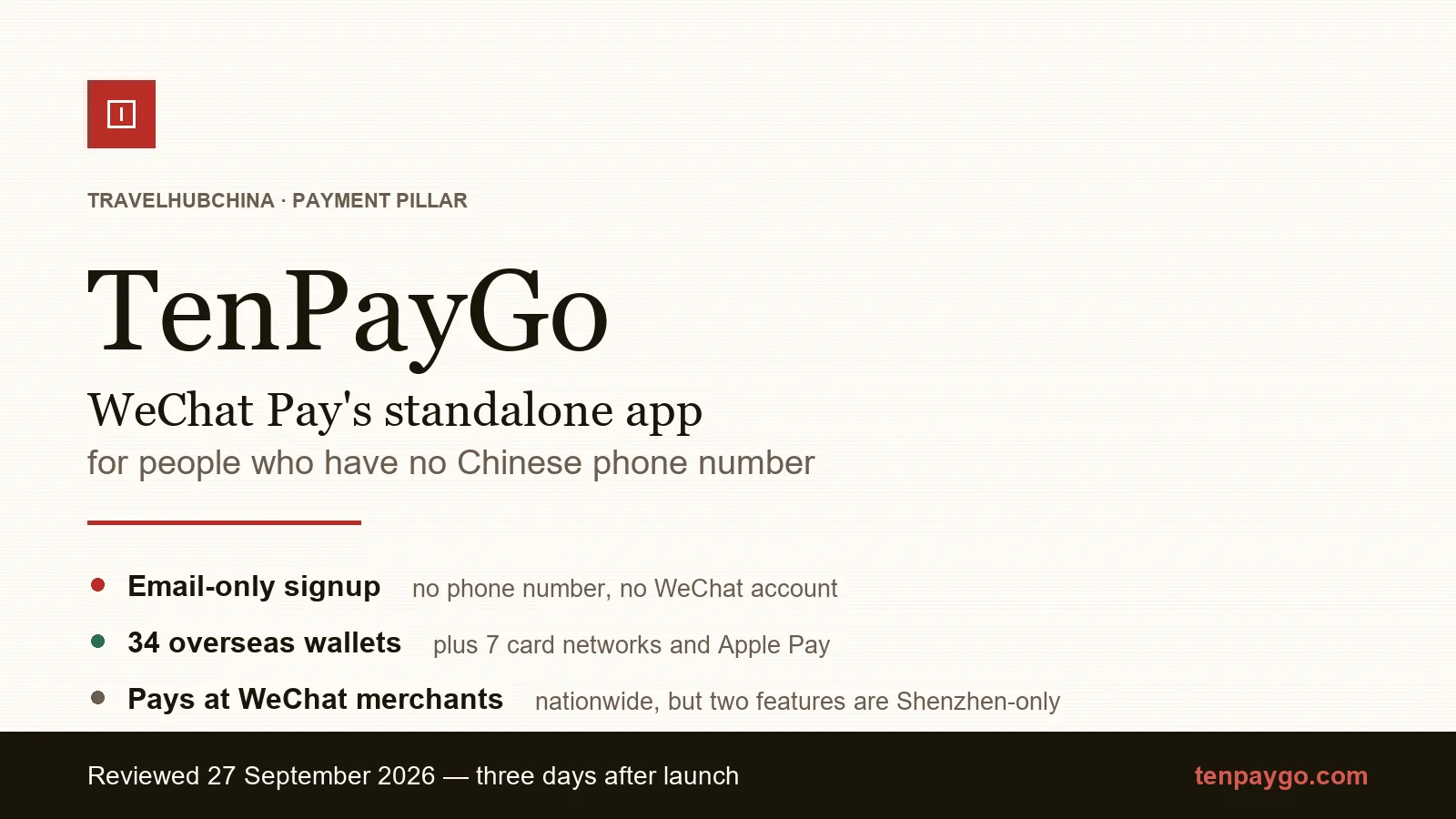
- 03 TenPayGo Review 2026: WeChat Pay Without a Phone Number
TenPayGo is WeChat Pay's standalone app for foreign visitors — email signup, no Chinese number, no WeChat account. Our hands-on review.
Build a custom itinerary for any China city in 30 seconds
Pick your city, days, pace, and must-visit attractions. Get a day-by-day plan with timings, transport, and lunch spots — no signup, no email required.
Alipay

How to Pay in China 2026: Alipay, WeChat Pay, eSIM
Setup for the 4 apps every foreigner needs in China: Alipay, WeChat Pay, an eSIM for data on landing, and DiDi. Limits and 30-45 minutes.
9 min · Aug 2026
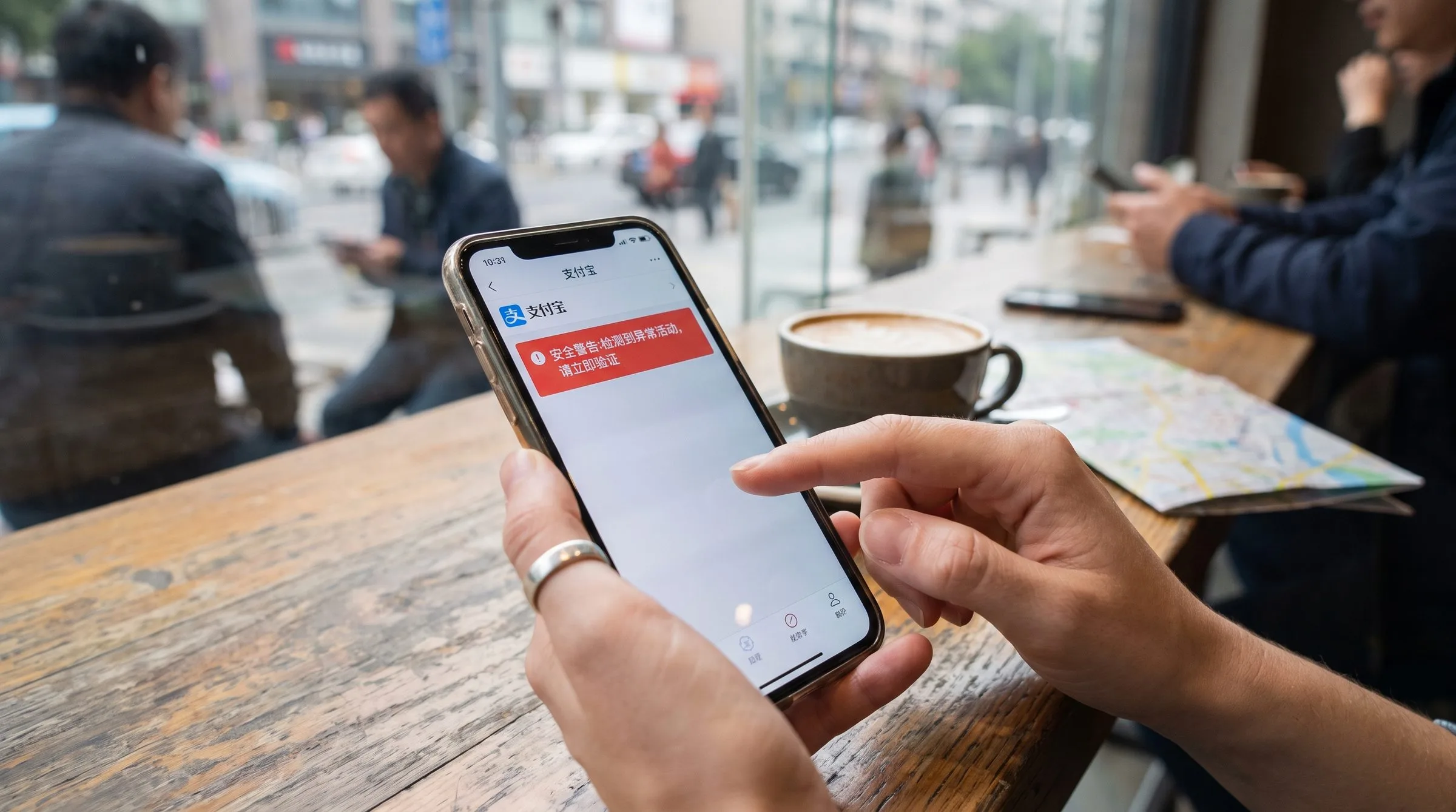
Alipay Account Locked in China 2026: 4-Step Recovery
Your Alipay account is locked or frozen. The 4-step recovery for 2026: find the lock reason, submit the right documents, wait, and appeal.
4 min · Aug 2026
Alipay App for Foreigners 2026: Setup with Visa/Mastercard
Set up the Alipay app with a foreign Visa or Mastercard in 2026: $100 per transaction, up to $1,000 after ID verification, a $3,000 annual limit.
9 min · Aug 2026
Cash

Cash or Card in China 2026: Fees, Limits & Traps
China is hybrid, not cashless: Alipay/WeChat work at 90% of urban merchants, foreign cards at ~60% of mid-range shops plus 2.6-3.2%, ATM fees 6.75-12.75%.
6 min · Aug 2026

How Much Cash to Bring to China (and Where to Exchange)
How much RMB cash to bring to China in 2026, where to exchange (best rates), ATM vs airport counter, and when cash is still the only option.
7 min · Aug 2026
Cny
Credit Cards
Tenpaygo
Unionpay
Wechat Pay
Frequently Asked Questions
-
Can I use Alipay as a foreigner in China?
Yes. Alipay now accepts foreign Visa, Mastercard, and JCB cards via the "Tour Pass" feature, no Chinese bank account required. Link a card in the app, scan merchant QR codes, pay in CNY. See /articles/alipay-for-foreigners-2026/. -
Can I use WeChat Pay without a Chinese bank account?
Yes. WeChat Pay now accepts foreign cards via the "Weixin Pay" international feature. Verify your passport inside the app, link a Visa or Mastercard, and pay at any merchant QR code. See /articles/wechat-pay-for-foreigners/. -
Do I need cash in China in 2026?
Less than before, but yes, carry ¥200-500 in small bills for street markets, rural areas, taxi drivers without QR codes, and backup if apps fail. ATMs at major banks accept foreign cards. See /articles/how-much-cash-to-bring-china/. -
Do credit cards work in China?
Limited. Hotels, large restaurants, and luxury retailers accept Visa/Mastercard, but most daily merchants, transit, and street vendors are QR-only. Use Alipay or WeChat Pay linked to a foreign card as your primary payment. See /articles/using-credit-cards-in-china/. -
Is it safe to use mobile payment in China?
Yes. Alipay and WeChat Pay use tokenized transactions, encrypted card storage, and biometric confirmation. Set a daily payment limit in the app and use face/fingerprint verification for added security. See /articles/alipay-for-foreigners-2026/.