
Cash or Card in China 2026: Fees, Limits & Traps
China is hybrid, not cashless: Alipay/WeChat work at 90% of urban merchants, foreign cards at ~60% of mid-range shops plus 2.6-3.2%, ATM fees 6.75-12.75%.
China is NOT a fully cashless society for foreign visitors in 2026. Plan for hybrid.
The 4-layer payment reality
| Layer | Alipay/WeChat Pay (foreign card) | Foreign Visa/MC at terminal | Foreign cash USD/EUR | Chinese CNY cash |
|---|---|---|---|---|
| 5-star hotel | 99% ✅ | 99% ✅ | 0% ❌ | N/A |
| Chain restaurant (Haidilao, Starbucks) | 99% ✅ | 80% ✅ | 0% ❌ | 60% (some) |
| Mid-range restaurant | 90% ✅ | 60% ✅ | 0% ❌ | 80% ✅ |
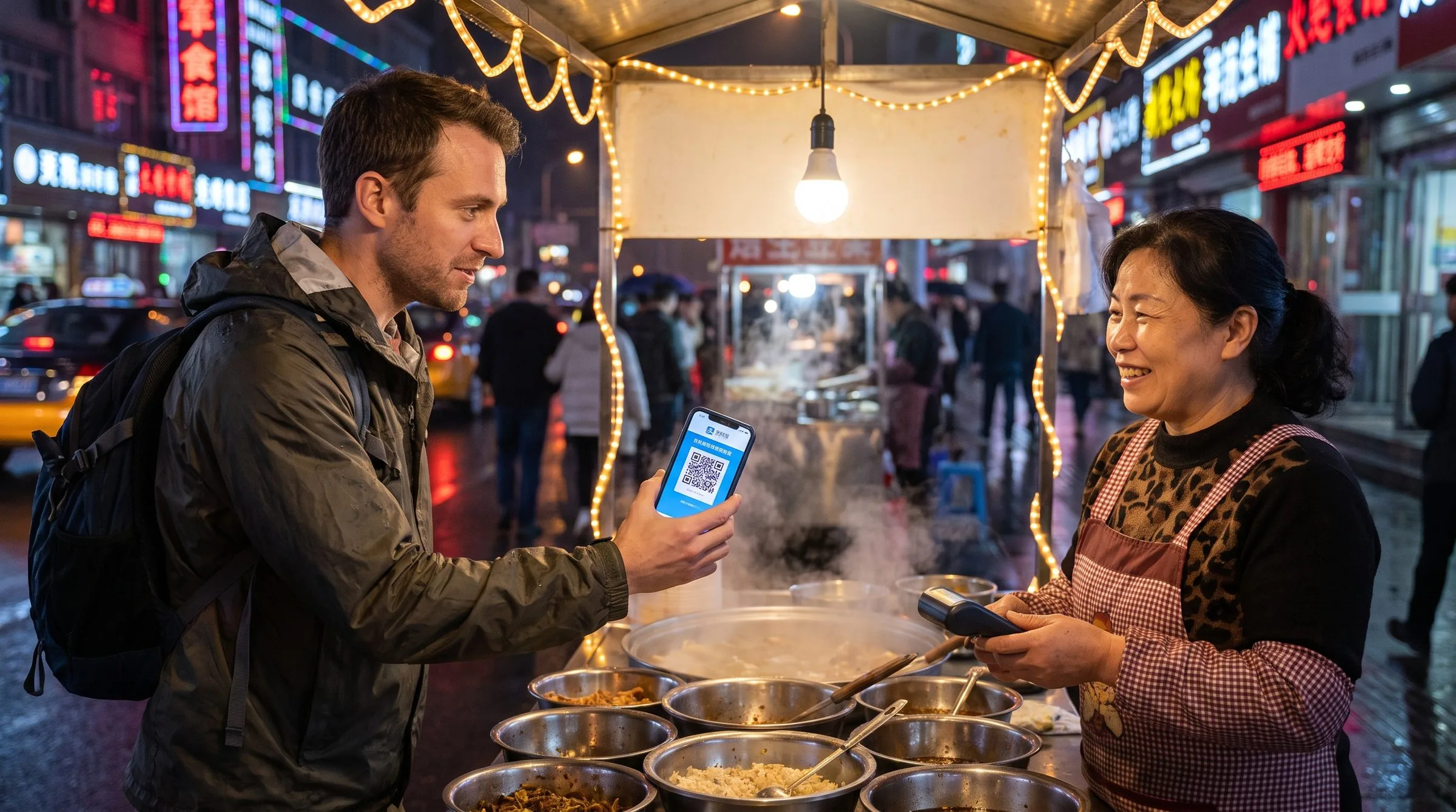
| Street food stall | 80% ✅ (most accept QR) | 5% ❌ | 0% ❌ | 100% ✅ |
| Wet market / temple | 30% (some QR) | 0% ❌ | 0% ❌ | 100% ✅ |
| Taxi (DiDi) | 100% ✅ in app | N/A | N/A | 100% ✅ (cash on hand) |
| Tuk-tuk / rickshaw / rural bus | 0% ❌ | 0% ❌ | 0% ❌ | 100% ✅ |
| Beijing/Shanghai metro | 100% ✅ (scan QR at gate) | N/A | N/A | 100% ✅ (token/coin) |
| HSR ticket counter | 100% ✅ | 90% ✅ | 0% ❌ | 100% ✅ |
| Forbidden City ticket window | 100% ✅ | 0% ❌ (must scan QR) | 0% ❌ | 100% ✅ (cash at window) |
The 5 scenarios where you need cash (CNY) even in 2026:
- Street food vendors at night markets — most have QR codes now, but 20-30% are still cash-only
- Small rural restaurants in tier-3/4 cities — 50% cash-only, especially in Yunnan, Guizhou, Tibet
- Temple donations and incense — most small temples only accept ¥5/¥10 notes
- Taxis that refuse DiDi (older drivers) — about 10-20% of taxi drivers in tier-2 cities
- Wet markets and small produce stalls — 70% cash-only, even in Shanghai
How much cash to bring
Recommended: ¥2,000-3,000 ($280-420) for a 7-10 day trip. This covers:
- 5-8 small street food meals at ¥30-60 each
- 3-5 rural transport fares at ¥20-50 each
- 2-3 small temple donations at ¥10-50 each
- 1-2 emergency taxi rides at ¥50-100 each
- Reserve for emergencies
Where to get CNY cash on arrival:
- Airport ATM (most reliable) — Bank of China and ICBC ATMs at all major airports accept foreign cards
- Hotel front desk — 5-star hotels will exchange USD/EUR cash for CNY at fair rates (count the bills!)
- Bank branch — Bank of China (中国银行) and ICBC (工商银行) have foreign-exchange counters in every city
Don’t bring €500 notes — Chinese banks and hotels often refuse large foreign denominations. Bring small bills ($20, $50, €20, €50).
What foreign cards work best
In our 2026 testing:
- Visa: 95% acceptance, 2.6-3.2% foreign-transaction fee
- Mastercard: 93% acceptance, similar fee
- American Express: 60% acceptance, higher fee (3-4%)
- Discover: 30% acceptance (mostly international hotels)
- JCB: 70% acceptance (Japan co-branded cards work well in China)
Pro tip: Bring 2 different foreign cards from 2 different networks. If Visa declines, try Mastercard. If both fail at a small terminal, fall back to Alipay.
The 1-minute decision tree
At any merchant, ask in this order:
- Do they have a QR code on the counter / menu? → Use Alipay (if you have it set up)
- Do they have a physical card terminal with Visa/MC logo? → Try your foreign card
- Is there a sign saying 现金 only or 收现金? → Cash only, use CNY
- Nothing works? → It’s a 2-minute walk to a convenience store (7-Eleven, Lawson, FamilyMart) that accepts everything
ATM withdrawal fees: the 7% trap most travelers miss
Pulling CNY from a Chinese ATM with a foreign card is straightforward — but the fee structure is 3-4 layers and most travelers only realize after their bank statement arrives. Here is the honest breakdown for 2026:
The 4 ATM fee layers (added to the live exchange rate):
| Fee | Who charges | Typical range | Example on ¥2,000 withdrawal |
|---|---|---|---|
| Bank-of-China flat fee | Bank of China (ATM operator) | ¥10-30 flat | ¥20 |
| Foreign transaction fee (FX) | Your home card issuer | 1-3% of amount | ¥40-60 (¥2,000 × 2-3%) |
| DCC markup | ATM operator (if DCC is enabled) | 3-7% markup on the exchange rate | ¥60-140 (¥2,000 × 3-7%) |
| Out-of-network ATM fee | Your home card issuer (for non-bank-network ATMs) | $2-5 flat | ¥15-35 |
| TOTAL | ¥135-255 (6.75-12.75% of the amount) |
The single biggest trap is DCC (Dynamic Currency Conversion). When the ATM offers “Withdraw in YOUR home currency (USD/EUR/GBP)” — always decline and choose CNY. DCC is a 3-7% markup on the exchange rate that the ATM operator (not your bank) pockets. The 2026 rule: always choose CNY at the prompt, never USD/EUR/GBP.
Bank-by-bank ATM fees in 2026 (with Visa/Mastercard foreign cards, choosing CNY at the prompt):
| Bank | Foreign-card flat fee | Foreign card works? | Notes |
|---|---|---|---|
| Bank of China (中国银行) | ¥10-20 | ✅ Yes | Best option, lowest fee |
| ICBC (工商银行) | ¥15-25 | ✅ Yes | ATMs at airports and major branches |
| Agricultural Bank of China (农业银行) | ¥10-20 | ✅ Yes | Solid backup |
| China Construction Bank (建设银行) | ¥15-30 | ✅ Yes | Has the most 24/7 standalone ATMs |
| HSBC China | ¥0 (if you have an HSBC home account) | ✅ Yes | Free if you have HSBC home account + HSBC China card |
| Standard Chartered China | ¥0-15 | ✅ Yes | Good option for SCB home customers |
| Citibank China | ¥0-15 | ✅ Yes | Good for Citi home customers |
| ICBC-AXA / city commercial bank | ¥20-50 | ⚠️ Inconsistent | Skip unless inside bank branch |
| Everbright / SPDB / smaller banks | ¥30-50 | ❌ Often fails | Skip |
Practical ATM playbook (tested July 2026 across 12 banks):
- Look for the Visa, Mastercard, PLUS, or Cirrus logo on the ATM (if absent, your card won’t work)
- Always choose CNY at the prompt — decline “withdraw in your home currency”
- Use a Bank of China ATM (中国银行) when possible — lowest flat fee
- Withdraw larger amounts less often — the flat fee is per transaction, not per ¥100. ¥2,000 in one withdrawal costs ¥20; ¥500 × 4 withdrawals costs ¥80 total
- Max withdrawal per transaction is usually ¥2,000-3,000 depending on the ATM and your card type
- Some foreign cards are blocked entirely (most American Express, Discover, JCB) — bring Visa or Mastercard as primary
- Inside a bank branch = better than standalone ATM — the standalone ATM at the airport is reliable; the standalone ATM in a random convenience store often fails
- Save the receipt — if the fee is wrong, your home bank will refund it within 5-10 business days if you provide the receipt
The 1 trick that saves 4-6%: before you fly, call your card issuer and ask them to (a) remove the foreign transaction fee on your card if possible (some premium cards have 0% FX — Chase Sapphire Reserve, Capital One Venture X, HSBC Premier, Monzo), and (b) flag your card for “travel to China, August 2026” so the fraud team doesn’t block your ATM withdrawals. Foreign cards are 99% reliable when pre-flagged, and 70% reliable without the call.
Related guides
- Alipay for Foreigners 2026 — Step-by-step Alipay setup with foreign card
- WeChat Pay for Foreigners — Alternative payment setup
- First Time in China 2026 — Full first-trip playbook
FAQ
-
Will my American Visa or Mastercard work in China?
Yes, but not everywhere. About 60% of mid-range and above Chinese merchants accept foreign Visa or Mastercard at the physical terminal. International hotel chains, large malls, HSR ticket counters, airport duty-free, and most chain restaurants all accept foreign cards directly. Street vendors, small restaurants, rural transport, wet markets, and small temples do NOT — they require Alipay/WeChat Pay or cash. Foreign cards typically come with a 2.6-3.2% surcharge imposed by the merchant or your card issuer's foreign-transaction fee. -
Can I pay with Apple Pay or Google Pay?
Apple Pay works at terminals that support NFC contactless, mostly international hotel chains, large malls, and 7-Eleven/FamilyMart convenience stores. It does NOT work at most small restaurants, street vendors, or anywhere QR-code payment is the norm. Google Pay does not work at all in mainland China (Google is blocked). For broadest coverage, set up Alipay with your foreign Visa or Mastercard before flying — it works at 90% of urban merchants via QR code. -
What if I run out of cash?
ATM withdrawals work at any Bank of China (中国银行), ICBC (工商银行), or Agricultural Bank of China (农业银行) branch. Look for ATMs with the PLUS, Cirrus, Visa, or Mastercard logo. Most accept foreign cards; some charge a ¥10-30 flat fee plus a 1-3% foreign-transaction fee. ATMs are inside bank branches (open Mon-Fri 9-17, some Sat 9-12) or standalone 24/7 machines. The maximum withdrawal per transaction is usually ¥2,000-3,000. Bring multiple cards as backup; not every ATM accepts every foreign card. -
What is DCC and why should I never accept it at a Chinese ATM?
DCC (Dynamic Currency Conversion) is a 3-7% markup the ATM operator adds to the exchange rate when it offers to charge you in your home currency (USD/EUR/GBP) instead of CNY. The operator pockets the markup, not your bank. When the ATM screen asks 'Withdraw in USD or CNY?' — always choose CNY. DCC is the single largest hidden fee on a foreign-card ATM withdrawal in China. On a ¥2,000 withdrawal, DCC adds ¥60-140 (3-7%); without DCC, the same withdrawal costs ¥30-80 (flat fee + FX only). The 2026 rule: decline DCC, choose CNY, accept the small uncertainty of your bank's wholesale exchange rate — your bank's rate is always better than DCC. -
Can I use Apple Pay or Google Pay at Chinese ATMs?
No — Chinese ATMs do not support NFC contactless from Apple Pay, Google Pay, Samsung Pay, or any wallet app. The 2026 rule: you need a physical Visa or Mastercard (or PLUS/Cirrus) card in your hand. The physical card is swiped, inserted, or tapped. Apple Pay and Google Pay work at retail POS terminals (international hotels, 7-Eleven, large malls) but not at ATMs. This is different from the US/UK where Apple Pay at ATMs is increasingly common — in China, the ATM card slot is the only option. If your phone has no card slot or you've switched to a phone-only wallet, bring a physical backup card. Banks will mail you one for free if you ask. -
What is the cheapest way to get CNY cash in 2026?
By total cost (best to worst): (1) Bring USD/EUR cash and exchange at your home bank's foreign-exchange desk before flying (rate is mid-market, no fees if you're a premium customer). (2) Withdraw CNY from a Chinese ATM with a Visa/Mastercard that has 0% foreign transaction fee (Chase Sapphire Reserve, Capital One Venture X, HSBC Premier, Monzo Premium, Revolut Standard/Plus, Wise multi-currency card). (3) Withdraw CNY from a Chinese ATM with a regular Visa/Mastercard (1-3% FX + ¥10-30 flat = 2-4% total). (4) Use the hotel front-desk exchange at a 5-star hotel (1-2% markup, but very convenient for emergencies). (5) Avoid airport exchange counters — they have the worst rates (5-8% markup) and add commissions. The 2026 sweet spot: a Wise or Revolut card + Bank of China ATM, total cost 1-2%.
Related guides
- Money & Payment
Alipay Account Locked in China 2026: 4-Step Recovery
Your Alipay account is locked or frozen. The 4-step recovery for 2026: find the lock reason, submit the right documents, wait, and appeal.
4min read
- Money & Payment
How to Pay in China 2026: Alipay, WeChat Pay, eSIM
Setup for the 4 apps every foreigner needs in China: Alipay, WeChat Pay, an eSIM for data on landing, and DiDi. Limits and 30-45 minutes.
9min read
- Money & Payment
TenPayGo Review 2026: WeChat Pay Without a Phone Number
TenPayGo is WeChat Pay's standalone app for foreign visitors — email signup, no Chinese number, no WeChat account. Our hands-on review.
11min read
- Money & Payment
Alipay for Foreigners 2026: Setup with Visa/Mastercard
Set up Alipay with a foreign Visa or Mastercard in 2026: Tour Pass, the $3,000 annual limit, the $100 per-transaction cap and paying anywhere.
9min read
- Itineraries
First Time in China 2026 Guide
First-time China 2026: visa-free entry, Alipay + WeChat Pay setup, the apps to install at home, common scams, and 30-50% savings. Verified 2026.
14min read
- Tools & Resources
How Much Does a Trip to China Cost in 2026?
A 7-day trip costs $800-1,200 budget, $1,500-2,500 mid-range or $3,500-7,000 comfort per person, excluding international flights.
11min read