
Didi vs Uber in China 2026: How Foreigners Ride-Hail (Step-by-Step)
No Uber in China — and no Uber-DiDi partnership to book through (the only link is Uber's 2016 stake in DiDi). DiDi is the app that actually dispatches cars for foreigners: English UI, foreign Visa/Mastercard, airport pickups. 2026 setup, fares, and the Hong Kong exception.
DiDi (滴滴出行) is China’s dominant ride-hailing app — think Uber, but bigger. As of 2026, the international version accepts foreign Visa, Mastercard, and American Express cards, has full English interface, and operates in 400+ Chinese cities including every tourist destination. Average fare from Beijing Capital Airport to the city center: ¥150–200 (~$21–28). The same trip in a metered taxi is ¥120–180 but you need a working Chinese SIM, cash or a working Alipay, and the willingness to deal with a driver who doesn’t speak English.
DiDi is the easiest way to get around China for foreigners. This guide covers the full setup, payment options, and the specific quirks that come up at airports and train stations.
Is there Uber in China? (and the real Uber-DiDi story)
No — Uber does not operate in mainland China, and you cannot book a DiDi car inside the Uber app. Open Uber in Beijing or Shanghai and you get a blank map: no cars, no prices, no way to request a ride.
The confusion comes from a real deal. In August 2016, after a two-year subsidy war, Uber sold its entire China operation to DiDi in exchange for roughly a 17.7% economic stake in the merged company — Uber’s CEO took a DiDi board seat, and DiDi’s founder joined Uber’s board. Uber China’s app was retired and its riders and drivers moved over to DiDi. That equity holding still exists on paper, but it is ownership, not a service partnership: there is no Uber-DiDi arrangement that lets you hail a car through Uber in China. Your Uber account, credits, and payment methods do not transfer to DiDi — they are separate companies with separate apps and separate wallets.
What that means trip by trip:
- Mainland China → DiDi. It is the app that will actually dispatch a car to you.
- Hong Kong → Uber works. Uber has operated in Hong Kong since 2014 and is unaffected by the 2016 mainland deal. (Local ride-hailing licensing tightened across 2025-2026, but Uber keeps running there under the new regime.)
- Macau → taxis and hotel shuttles. App-based ride-hailing coverage is thin; a metered taxi or your hotel’s shuttle is the reliable choice.
If you have read that “Uber is coming back to China through DiDi,” that is not happening. The 2016 share swap is the entire relationship.
Why DiDi beats taxis for foreigners
Four reasons:
- English interface. DiDi’s international version is fully in English, with English driver chat (auto-translate), English map, English fare display.
- No language barrier at the car. The driver sees your destination on their screen, the app handles the navigation. You don’t need to say anything except hi.
- Fare is fixed upfront. Unlike metered taxis, the app shows the price before you book. No “tourist pricing” risk, no meter manipulation, no “I don’t have change” scam.
- Cashless payment. Your linked card is charged automatically. You don’t need to wrestle with mobile payment or cash at the end of the ride.
The downsides: at peak hours (Friday evening, rain, rush hour), surge pricing can 1.5–2.5x the base fare. Airport pickup may have a small surcharge. Some remote areas have few drivers. And the 4-minute wait time can stretch to 10+ during bad weather.
DiDi scam insurance: 5 driver tricks and how to spot them
DiDi is dramatically safer than metered taxis, but a small number of drivers run specific scams that cost foreign travelers ¥10-200 per ride. The 5 most common:
1. The “destination changed” pickup-text scam. The driver texts or calls (in the in-app chat) saying “I can’t find the pickup point” or “the address is wrong, please meet me at [different location].” They want you to walk to a side street, where they take a longer route. The fix: stay at the original pin. The driver can see your GPS location; if they can’t find you, the in-app chat (with auto-translate) will sort it out. If they insist, cancel and request another driver — there’s no penalty for canceling within 3 minutes of booking.
2. The “phone call” scam. The driver calls your phone (in-app voice). They claim the pickup point is wrong, your phone doesn’t work in China, or they have a “special” route. The fix: don’t accept voice calls from drivers you don’t know. Use the in-app text chat (auto-translated). If the driver insists on a phone call, the voice call is through the app and is recorded — DiDi can review it if you dispute the fare.
3. The “drop-off point moved” scam. Near the end of the ride, the driver texts to say “I can’t drop you here, road is closed” and asks you to get out 200m before your destination. The driver then marks the ride as “completed early” and pockets the difference. The fix: only get out at the address DiDi shows in the app. If the driver insists, take a photo of the address, complete the ride through the app, and dispute if necessary.
4. The “extra stop” scam (route padding). The driver takes a longer route to inflate the fare. DiDi tracks GPS and shows the route, but the algorithm is forgiving — drivers can add 1-2 km without triggering a flag. The fix: watch the map during the ride. If the route is visibly longer than what the app showed when you booked (the original ETA was 25 min, the live ETA is now 40 min), tap “report issue” in the app and DiDi will refund the inflated portion. Do this within 24 hours of ride completion.
5. The “cash on delivery” scam. The driver cancels the in-app payment and asks you to pay cash. They pocket the cash and claim DiDi payment failed. The fix: payment is automatic and the receipt is in the app. If a driver asks for cash, refuse and end the ride through the app. If they push back, call the 24/7 DiDi support number (400-000-0999 for China, or the in-app Help button) and DiDi will cancel the cash request and may compensate you for the inconvenience.
The 3 universal rules that defeat every DiDi scam:
- Don’t get out of the car until the in-app “Ride Complete” screen shows — getting out early is what enables 2 of the 5 scams
- Don’t accept phone calls from unknown drivers — use the in-app chat (auto-translated) only
- Dispute within 24 hours — DiDi’s refund window is 24 hours, after which fare disputes are harder to resolve
DiDi customer support is in English (24/7) and refunds genuine scam fares within 3-7 working days. Report via the in-app Help button or call 400-000-0999 (within China) / +86-10-5907-7777 (international).
Setting up DiDi (5 minutes)
Step 1: Download the international version
There are two DiDi apps:
- DiDi (the Chinese version): For Chinese phone numbers. The icon is orange.
- DiDi - Rider, for international travelers: English interface, accepts international cards, foreign phone number. The icon is white with a blue DiDi logo.
Make sure to download the second one. In the App Store or Google Play, search “DiDi” and pick the one labeled “for international” or with the blue logo. The Chinese version won’t let you register with a foreign phone number.
Source: China Guidelines DiDi guide.
Step 2: Register
Open the app, tap Sign Up. You can register with:
- Phone number (foreign numbers work in 200+ countries)
- Google account
- Apple ID
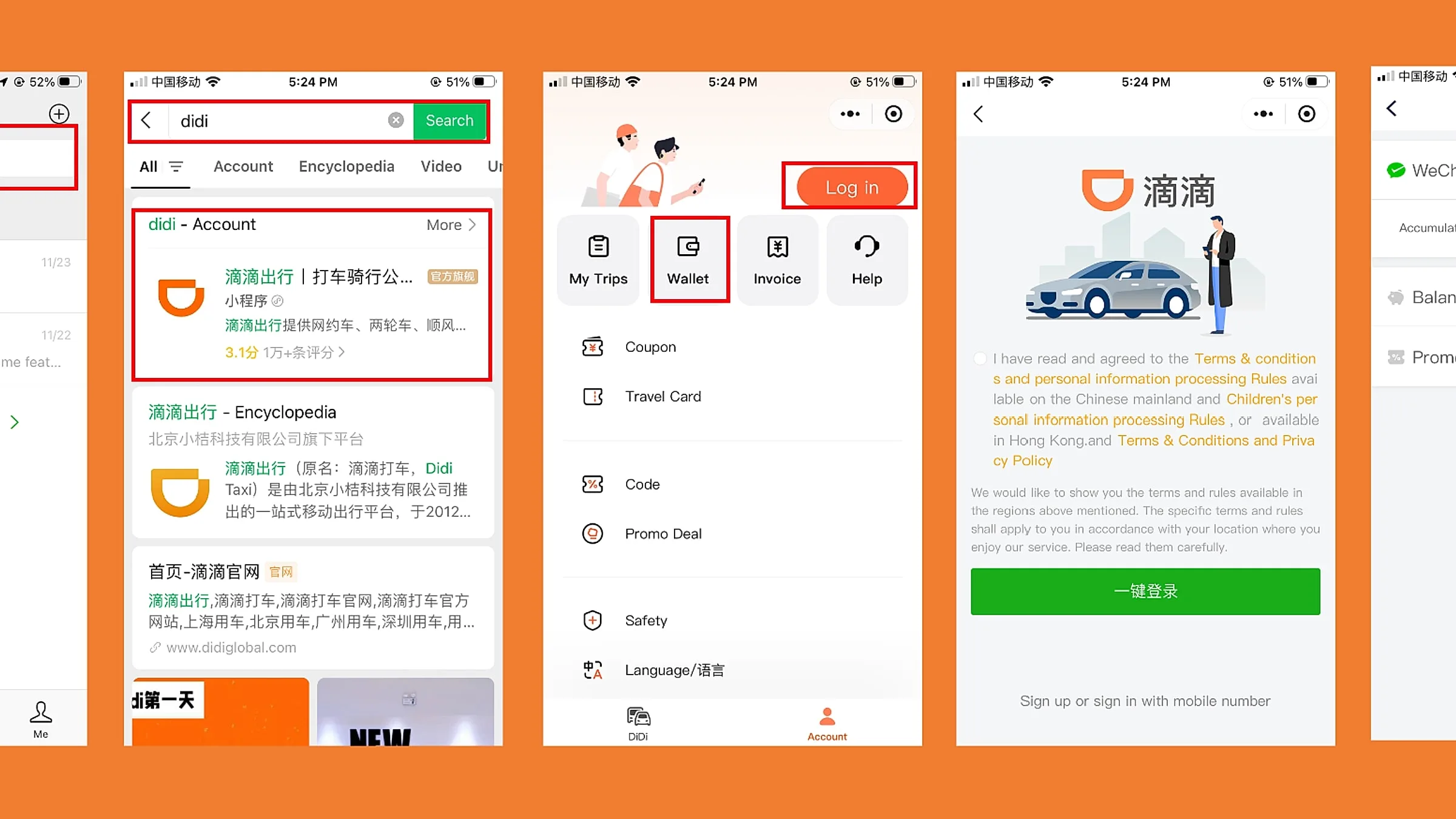
Phone number is the most reliable. The app sends a 6-digit verification code via SMS. Standard SMS rates from your carrier apply; if you have international roaming or an eSIM data plan, this is free.
Step 3: Add a payment method
In Me → Wallet → Payment Methods, you can add:
- Visa / Mastercard / American Express — direct binding via 3-D Secure. The first transaction triggers a one-time password.
- Alipay — if you have Alipay set up, this is the easiest payment (see Alipay for foreigners).
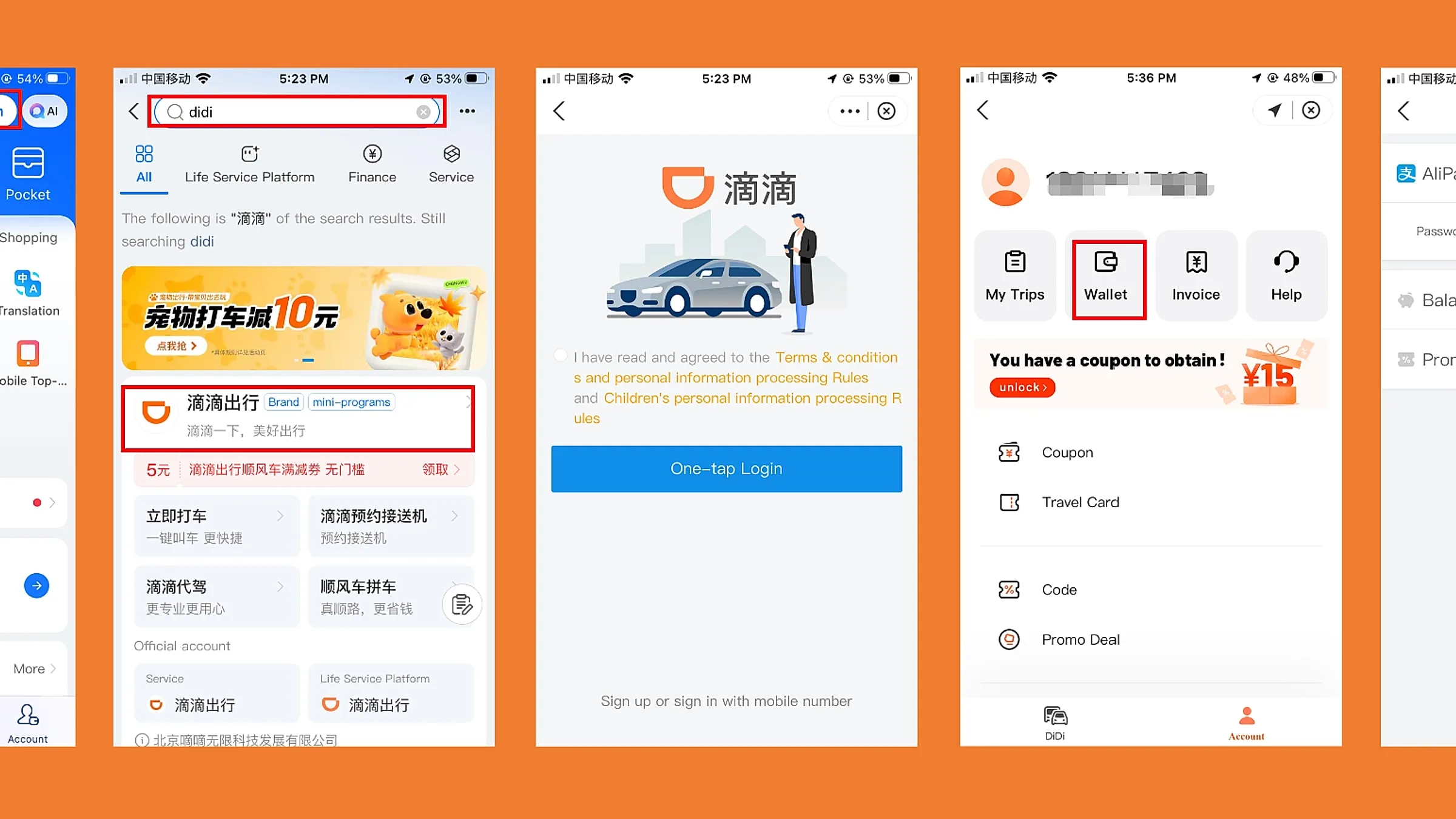
- WeChat Pay — similar to Alipay.
- Apple Pay / Google Pay — works in some markets, less reliable in China.
For most foreign users, add a Visa or Mastercard credit card as primary, and Alipay/WeChat Pay as backup. International credit cards work in 90%+ of rides.
Step 4: Set your language
The app’s default language is whatever your phone’s region is set to. If you downloaded the international version, it should be in English by default. If not: Me → Settings → Language → English.
Step 5: Set your home and work addresses (optional but recommended)
In Me → Settings → Saved Places, add your hotel address in Chinese characters. This saves you from typing it every ride. If you don’t read Chinese, copy-paste from the hotel’s confirmation email — they always include the Chinese name.
Booking a ride
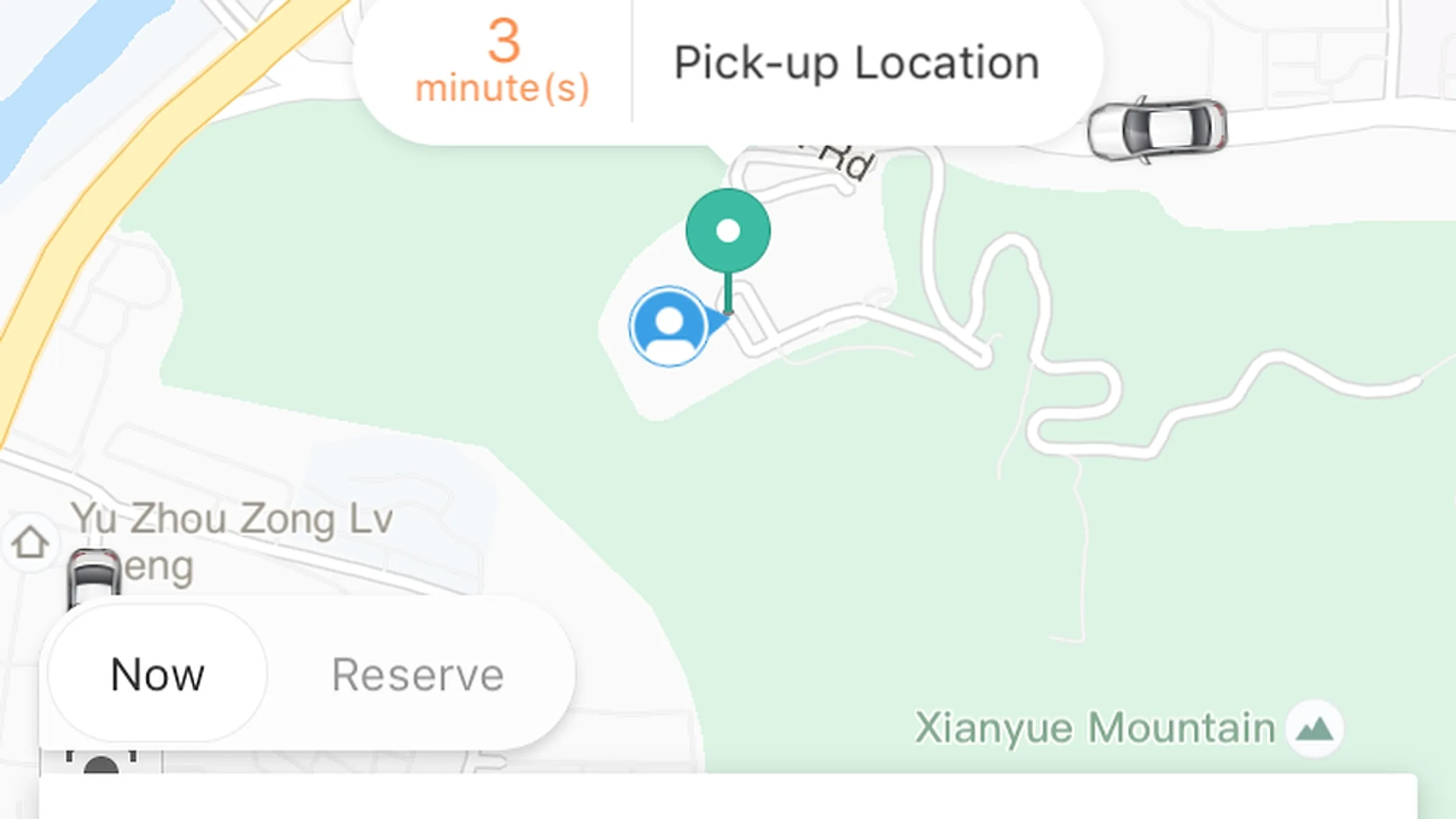
The booking screen has:
To book:
- Tap the Where to? field
- Type your destination in English (“Beijing South Railway Station” or “北京南站” if you have the Chinese) or select from recent destinations
- The app shows service options with estimated prices and arrival times
- Pick the option that matches your priority (cheapest, fastest, largest car)
- Confirm pickup point if needed (defaults to your current GPS)
- Tap Confirm or Book
The driver accepts within 10–30 seconds usually. You see their name, photo, car model, plate number, and rating. The app shows the car moving toward you on the map in real time.
Reading the license plate and car
Chinese license plates are blue (private cars) or green (new energy vehicles) with a Chinese character at the front indicating the province, then a letter for the city, then 5 alphanumeric characters. Example: 京A·12345 means Beijing (京), license type A (private).
When the car arrives, the driver may or may not get out. Look for:
- The plate number shown in the app
- The car model and color shown in the app
- Sometimes the driver’s name on a dashboard card
Verify the plate matches the app before getting in. If it doesn’t match, cancel and rebook (you won’t be charged for cancellation in the first 2 minutes).
During the ride
- Seatbelt: Recommended. Most drivers wear theirs; you should too.
- Phone calls: Don’t take calls in the car. It’s considered rude and the driver may cancel the ride.
- Music/smoking: Most drivers don’t smoke in the car. Some have Bluetooth music on by default. If you want silence, just say “no music” or “qing bu fang yin yue” (请不放音乐) — though they probably won’t understand you. Use the in-app chat (auto-translates).
- Stops mid-ride: Possible but complicated. Use it for one direct trip, not a multi-stop tour.
- Route deviation: DiDi drivers occasionally take a slightly different route than the app suggests, especially in cities with one-way streets. If the deviation is suspicious, you can tap “Share trip” to send your live location to a friend or family member.
Airport pickups: the specific process
Airport pickups are a DiDi specialty because they avoid the chaos of the taxi queue and the risk of unlicensed drivers. Each major Chinese airport has a designated ride-hailing pickup zone, usually on the arrivals level (一层 or 到达层).
Beijing Capital (PEK)
After collecting your bags, follow signs for “Taxi / Ride-hailing” (出租车/网约车). The pickup area is on the first floor of each terminal’s parking garage. Walk outside the arrivals hall, look for the “网约车” (ride-hailing) sign, and tap “I’m at the pickup point” in the app to ensure the driver comes to the right spot.
Beijing Daxing (PKX)
The ride-hailing area is in parking garage P1. Allow 10 minutes to walk from the gate to the pickup point.
Shanghai Pudong (PVG)
Ride-hailing pickup is at the designated zone on the arrivals level. Follow “出租车/网约车” signs.
Shanghai Hongqiao (SHA)
Connected to the metro, long-distance buses, and HSR. The DiDi pickup is on the B1 level of the arrivals hall.
Guangzhou Baiyun (CAN)
Ride-hailing pickup is at the designated parking area on the first floor.
Source: China Guidelines DiDi airport guide.
General airport pickup tips
- DiDi at airports has a small surcharge (¥10–30) for the airport pickup zone fee.
- During peak hours (5–7 PM weekdays), surge pricing is significant. Wait 30 minutes if you can.
- The pickup point is sometimes a 5–10 minute walk from baggage claim. Allow for this.
- Drivers in the airport pickup zone may have a 5–10 minute wait between your booking and arrival because they queue in a holding lot.
Train station pickups
Same idea as airports. Each major HSR station has a designated ride-hailing pickup zone, usually marked “网约车” or “网约车上客区”.
Beijing South Station: Look for the ride-hailing zone on the south side, accessible via exit from the arrivals hall.
Shanghai Hongqiao: Connected directly to the HSR station. The DiDi pickup is on the B1 level.
Guangzhou South: Ride-hailing pickup is at the east square.
For smaller stations, the pickup may just be a small curb with a DiDi sign. Ask any station attendant or the security guard at the exit.
Fares and surge pricing
Average DiDi fares in 2026:
| Trip | Estimated fare (USD) |
|---|---|
| Airport → city center (tier-1) | $20–30 |
| Airport → city center (tier-2) | $10–20 |
| Within city center (5 km) | $3–6 |
| Across city center (15 km) | $8–15 |
| HSR station → hotel | $5–12 |
Surge multipliers: 1.2x to 2.5x during peak. Major surge events: 5–7 PM weekdays, weekend nights, public holidays, heavy rain, snow.
The fare shown in the app is the fare you’ll pay. The meter doesn’t run after pickup.
When DiDi isn’t the best choice
Late night in residential areas
Between midnight and 5 AM, DiDi drivers are scarce. In some cities, you can’t get a DiDi at all between 2–5 AM. Pre-book a regular taxi instead, or stay near a hotel with a 24-hour taxi queue.
During heavy rain
Demand spikes 3–4x. Surge is brutal. Consider waiting 20–30 minutes for prices to drop, or use a metro if your hotel is near a station.
Going to airports
DiDi at airports is great in the morning but expensive in the evening. If your hotel is near a metro line that goes to the airport, the metro is 1/10 the price. For example, Shanghai Hongqiao Railway Station connects directly to both Hongqiao Airport and Shanghai’s metro network.
Going to restricted zones
Some areas of Beijing (near Tiananmen Square, the Forbidden City) and other cities have restrictions on ride-hailing drop-off. The driver will ask you to walk the last 100–200 meters.
Payment troubleshooting
- Card declined: Most common cause is your bank blocking international transactions. Call your bank before you leave. Also check that 3-D Secure (one-time password) is enabled.
- Charged twice: Rare but possible. DiDi’s support team refunds duplicates within 3–5 business days. Contact through the in-app chat.
- Wrong currency: DiDi charges in CNY (¥) and your card converts to your home currency. Some cards offer wholesale rate; others add a 1–3% foreign transaction fee. Use a no-foreign-transaction-fee card for best results.
- Alipay/WeChat Pay preferred: Drivers in some cities (Hangzhou, Shenzhen) prefer mobile payment. They don’t need to do anything — the payment is automatic through the app.
DiDi vs alternatives
| Option | Pros | Cons |
|---|---|---|
| DiDi Express | Cheap, easy, English | Surge pricing, can be hard to find at peak |
| DiDi Premier | Larger cars, English-speaking drivers sometimes | 30–50% more expensive |
| DiDi Taxi | Real metered taxi, no surge | Older cars, less English support, drivers may try cash |
| Metered taxi (street hail) | Available everywhere, no app needed | Cash required, language barrier, no fixed price |
| Metro | ¥3–10 flat fare, no surge | Limited hours, doesn’t reach some hotels |
| Public bus | ¥2 flat | Slow, route knowledge required, no English |
For most situations, DiDi Express is the right choice. The exception is when you need to go somewhere the metro covers more directly, or when surge is over 2x and a taxi would be cheaper.
Amap (高德地图): the 2025 game-changer for navigation
If DiDi is the “Uber of China,” AMap (高德地图, also called Gaode Maps or AutoNavi) is the Google Maps of China — and the most-used map app in the country, with 170 million+ daily active users. Owned by Alibaba and integrated with the Taobao lifestyle ecosystem, AMap has been the dominant map app in China for a decade.
The big news for foreigners: AMap launched its first English-language version in January 2025, called “AMap Global,” with full English UI, English POI names for attractions/hotels/restaurants/gas stations, and lane-level navigation with traffic light countdowns. It is the most accurate map in mainland China — better than Google Maps (which is blocked), Apple Maps (limited China data), or Bing Maps. The app is free on iOS and Android globally.
What AMap Global does well:
- Navigation in English — turn-by-turn driving, walking, cycling, and public transit directions, all in English. Lane-level guidance shows you exactly which lane to be in before complex interchanges, which is genuinely useful in cities like Shanghai and Beijing where interchanges have 4-6 lanes.
- Real-time traffic — color-coded (green = smooth, red = congested) with traffic-light countdowns at major intersections. Saves 15-30% of your travel time vs. Google Maps in tier-1 cities.
- Taxi-hailing (Amap Taxi / 高德打车) — book a car without leaving the map app. Aggregates Didi, CaoCao, T3, and other drivers, often 5-15% cheaper than DiDi because you can see real-time cross-platform pricing.
- POI database — 13M+ Chinese POIs with English names: hotels, restaurants, attractions, subway stations, hospitals, embassies, and convenience stores.
The catch: the taxi-hailing function uses Chinese-language driver chat for some cities, so for pickup coordination stick to DiDi’s auto-translate chat. Most drivers will recognize the AMap pickup pin on their own driver app.
For day-to-day navigation in any tier-1 Chinese city, AMap Global is more useful than Didi, Google Maps, or Apple Maps. Set it as your primary map, with DiDi as the ride-booking backup.
CaoCao Mobility (曹操出行): the executive option
CaoCao is Geely’s premium electric-vehicle ride-hailing service, launched in 2015. All cars are Geely’s own BYD or Geometry electric vehicles, and drivers are full-time employees (not gig workers) with standardized training.
For foreigners: CaoCao has an English-language app version available on iOS and Android. Payment is via Alipay or WeChat Pay (foreign cards work via Alipay, but not directly through CaoCao’s app). The service is concentrated in 30+ tier-1 and tier-2 cities: Beijing, Shanghai, Hangzhou, Shenzhen, Guangzhou, Chengdu, Chongqing, Tianjin, Wuhan, Xi’an, Nanjing, Suzhou, and others.
When to pick CaoCao over DiDi:
- Business travel — newer cars (all electric, under 3 years old), professional drivers, no cigarette smell, no random phone calls. CaoCao is the de facto standard for exec travel in tier-1 cities and is increasingly used for HSR station and airport transfers.
- Inter-city HSR station transfers — CaoCao runs premium fixed-price routes between city centers and HSR stations (e.g., Hangzhou East ↔ West Lake hotels, Shanghai Hongqiao ↔ Pudong hotels) with the fare shown upfront.
- Group or luggage — CaoCao’s fleet skews toward mid-size sedans and SUVs, more space than DiDi Express.
- Late night — CaoCao’s full-time drivers are more available 1-4 AM than gig workers on DiDi.
When DiDi wins:
- 400+ cities (CaoCao is 30+)
- Foreign card direct binding (CaoCao needs Alipay first)
- Cheaper base fare (CaoCao is 20-40% more expensive than DiDi Express)
For most foreign tourists, DiDi remains the right default. CaoCao is a meaningful upgrade if you’re on a business trip, have a tight inter-city transfer, or want the most professional driver experience.
Amap Taxi vs DiDi vs CaoCao: which to use when
| App | Best for | Cities | English | Foreign cards | Avg fare (5 km) |
|---|---|---|---|---|---|
| DiDi Express | Most situations, tourists | 400+ | Full UI | Visa/MC/Amex | ¥18-25 ($2.50-3.50) |
| DiDi Premier | Groups, business, luggage | 400+ | Full UI | Visa/MC/Amex | ¥35-50 ($5-7) |
| Amap Taxi | Day-to-day, frequent short trips | 200+ | Full UI since Jan 2025 | Alipay / WeChat (foreign cards via Alipay) | ¥15-22 ($2-3) |
| CaoCao | Business, late night, HSR transfers | 30+ | English app | Alipay / WeChat | ¥30-45 ($4-6) |
| Metered taxi | No-app backup, short hops | All cities | None | Cash or mobile | ¥20-30 ($3-4) |
Practical recipe:
- Download all three: DiDi, AMap Global, CaoCao.
- Set AMap as your default map for navigation (most accurate in China).
- For rides: open AMap → Taxi → compare prices across providers → pick the cheapest. If the wait is more than 10 minutes, open DiDi as backup.
- For business or HSR transfers: CaoCao.
- Late night (1-4 AM): CaoCao first, then DiDi, then walk to a taxi queue.
Safety
DiDi is generally safe. The app tracks every ride, shares your live location with emergency contacts if you tap the button, and drivers are licensed. Reports of incidents are rare.
For extra safety:
- Share your trip: Tap the share icon, send live location to a friend or family member.
- Verify the driver: Plate number, car model, and driver photo must match the app.
- Sit in the back seat: Standard practice, especially as a foreigner.
- Trust your gut: If something feels off, end the ride at the nearest safe public place and call support through the app.
DiDi’s in-app emergency button connects directly to 110 (Chinese police). For English-speaking emergency support, the China-based 12345 government hotline has English operators in major cities.
For the rest of the transit picture, see high-speed rail booking, China metro, and domestic flights.
Plan your trip — verified tools
These free tools are built on real, monthly-verified data and help you skip the trial-and-error phase of China trip planning:
- China 6-City 5-Day Budget Calculator — Real 2026 prices for 5 days in Beijing, Shanghai, Guangzhou, Chengdu, Xi’an, or Hangzhou. Budget / mid-range / comfort tiers, broken down line by line.
- China OTA Comparison 2026 — Trip.com vs Booking.com vs Agoda vs Klook across 5 booking types. Inventory, pricing, foreign card support, English service, per-OTA verdict.
Verified August 2026 by TravelHubChina Editorial. We re-check prices and policy details monthly so the data doesn’t drift.
Step by step
-
Download the international DiDi app
Search 'DiDi' in the App Store or Google Play. Download the BLUE icon (the international version with English UI), not the Chinese version. The international app is ~100 MB — download over WiFi. As a 2026 backup, also install AMap Global (高德地图) for English navigation + taxi aggregation.
-
Register with your foreign phone number and add a card
Open the app, tap Sign Up, enter your mobile number. The app sends a 6-digit SMS verification code. International SMS rates apply (usually free with international roaming, or use an eSIM like Airalo for $5). Go to Account → Payment → Add Card. DiDi accepts Visa, Mastercard, and American Express.
-
Set pickup and confirm the fare
DiDi auto-detects your GPS location. Confirm the pickup pin is on the correct side of the street (especially at airports — pickup zones are usually on a specific floor or terminal). Type your hotel name or destination. DiDi shows upfront pricing for DiDi Express (cheapest, may stop for other riders) or DiDi Premier (newer car, professional driver).
-
Watch the driver approach and verify the plate
When a driver accepts, the app shows their name, car model, license plate, and ETA. Cross-check the plate against the actual car before getting in. Tap 'Call' in the app if you cannot find the driver — most speak enough English for basic coordination. For airports, follow the 'DiDi' signs to the designated pickup zone.
-
Pay through the app and save the receipt
Payment is automatic through the card on file. Tipping is not expected. Save the e-receipt from the app for expense reports. The whole flow from app open to driver arriving is 5-10 minutes in central Beijing, Shanghai, or Guangzhou. The international app does NOT work in Hong Kong or Macau — use Uber or local taxi there.
FAQ
-
Is there Uber in China in 2026? Is there an Uber-DiDi partnership?
No on both counts. Uber has not operated in mainland China since August 2016, when it sold its China business to DiDi for roughly a 17.7% stake in the merged company — open the Uber app in Beijing or Shanghai today and you get a blank map with no cars or prices. That 2016 share swap is the only Uber-DiDi relationship: it is an equity holding, not a service partnership, and there is no way to book a DiDi car through Uber. Your Uber account, credits, and payment methods do not transfer to DiDi. For rides in mainland China you need DiDi (English UI, accepts foreign Visa/Mastercard/Amex). Hong Kong is the exception — Uber still operates there, unaffected by the 2016 deal. -
Can I use DiDi in China with a foreign credit card?
Yes. The international DiDi app accepts Visa, Mastercard, and American Express. Download "DiDi" (the blue icon, the international version), register with your phone number, add a card under Account → Payment, and you can book rides in 400+ Chinese cities. Fares are the same as the Chinese version. -
Does the DiDi app have an English version?
Yes, the international DiDi app has full English UI. You set the language to English at signup. The interface, driver messages, support chat, and receipt are all in English. The driver’s app remains in Chinese, but the driver sees your name in pinyin and the destination in Chinese characters you do not need to type yourself. -
Is DiDi cheaper than a taxi in China?
Yes, typically 10-30% cheaper. DiDi Express is the cheapest tier (rideshare, may stop to pick up other passengers); DiDi Premier is the most expensive (professional driver, newer car, similar to Uber Black). For solo travelers, DiDi Express is the best value. For groups or luggage, DiDi Premier or a metered taxi is more comfortable. -
How do I get from Beijing Capital Airport to the city with DiDi?
Open DiDi, set pickup to "Beijing Capital International Airport" (the app auto-detects your terminal from GPS), set dropoff to your hotel. The app gives you a fixed-price quote (about ¥150-200 to central Beijing, $21-28) and dispatches a driver. The whole process takes 5-10 minutes; allow 60-90 minutes for the trip during rush hour (7-9 AM, 5-8 PM). -
Didi China: what is it and is it the same as Uber?
DiDi is China's dominant ride-hailing app, often called "the Uber of China." It operates in 400+ Chinese cities and handles over 60% of all ride-hailing trips nationwide. For foreign travelers, DiDi works the same way as Uber: you set a pickup point, set a dropoff, see the upfront fare, watch the driver approach on the map, and pay through the app. The international DiDi app (blue icon, English UI) accepts Visa, Mastercard, and Amex and is the easiest way for a foreign visitor to call a car in China. Unlike Uber, DiDi is not blocked in mainland China, and you do not need a Chinese phone number to register (any foreign mobile number works). -
How to use Didi in China: step-by-step guide for first-time users
Six steps: (1) Download the international DiDi app (blue icon, NOT the orange Chinese-only Didi Chuxing). (2) Register with your foreign mobile number, then set the UI to English at first login. (3) Add a Visa, Mastercard, or Amex under Account → Payment. (4) Set pickup (your GPS or type an address in English) and dropoff. (5) Confirm the fare, watch the driver approach in real time, and meet at the pin on the map. (6) Pay automatically through the card on file; tip is not expected. The whole flow from app open to driver arriving is 5-10 minutes in central Beijing, Shanghai, or Guangzhou. The international app does NOT work in Hong Kong or Macau — use the local Uber or local taxi there. -
What is the best ride-hailing app in China for foreigners in 2026?
Three apps work for foreigners in 2026: DiDi (the international version, 400+ cities, English UI, accepts foreign Visa/Mastercard/Amex — still the safest default), Amap Taxi (高德打车) (the taxi-hailing function inside the AMap Global app, now with full English UI after the January 2025 update, often 5-15% cheaper than DiDi because it aggregates Didi, CaoCao, and T3 drivers in one screen), and CaoCao Mobility (曹操出行) (Geely's premium electric-vehicle fleet, 30+ cities, English app version, business and exec travelers prefer it for newer cars and professional drivers). For most travelers, AMap Global is the best first choice in 2026 because it works in English, shows real-time traffic across multiple ride options, and is the most-used map app in China (170M+ daily active users). Download DiDi as a backup for cities Amap doesn't cover well, and CaoCao for business or late-night trips. -
Does Amap (高德地图) work in English in 2026?
Yes — AMap Global launched its first English-language version in January 2025 and now has full English UI, English POI names for attractions/hotels/restaurants/gas stations, lane-level navigation with traffic light countdowns, and a built-in taxi-hailing function (Amap Taxi / 高德打车) that lets you book a car without switching apps. It is the most accurate map in mainland China — better than Google Maps (which is blocked in China), Apple Maps (limited China data), or Bing Maps — and the app is free on iOS and Android globally under the name 'AMap Global' or '高德地图'. The catch: the taxi-hailing function still uses Chinese-language driver chat for some cities, so for pickup coordination stick to DiDi's auto-translate chat. The POI database covers 13M+ Chinese locations with English names, which makes it the best single map + taxi app for English-speaking visitors. -
Should I use CaoCao (曹操出行) or Didi in China?
For most travelers, DiDi is the right default — it's available in 400+ cities, accepts foreign Visa/Mastercard/Amex directly, and the English UI is mature. Use CaoCao instead if: (1) you're on a business trip and want a newer, electric vehicle with a full-time professional driver (CaoCao is Geely's premium fleet, all BYD/Geometry electric cars, drivers are employees not gig workers); (2) you need an inter-city HSR station transfer (CaoCao runs premium fixed-price routes like Hangzhou East ↔ West Lake hotels, Shanghai Hongqiao ↔ Pudong hotels); (3) it's late night 1-4 AM and gig drivers are scarce (CaoCao's full-time drivers are more available). For tourists in tier-1 cities, DiDi and Amap are the practical choices; CaoCao is a 'nice to have' for exec-class travelers. CaoCao is 20-40% more expensive than DiDi Express, and currently requires Alipay/WeChat Pay rather than a foreign card directly. -
How much does a DiDi ride cost in China compared to a taxi?
DiDi is typically 10-30% cheaper than metered taxis in the same city, and surge pricing caps at 1.5-2x during peak hours versus 3-4x for taxis. A 30-minute ride in central Beijing runs ¥40-60 ($5-8) on DiDi Express versus ¥50-80 on the meter. The savings add up: 5 rides/day saves roughly $15-20. -
Can I use DiDi from Beijing Capital Airport or Shanghai Pudong to the city?
Yes, but you must select the airport pickup zone in the app (not 'current location' which sometimes fails inside the terminal). The international DiDi app accepts foreign cards. Beijing Capital to Sanlitun takes 30-60 min and costs ¥150-200 ($21-28). Shanghai Pudong to the Bund runs ¥200-280 ($28-40) including the ¥50 tunnel fee. -
What happens if my DiDi driver cancels on me?
Drivers can cancel mid-trip, but DiDi refunds the full trip and gives a ¥10-15 voucher if cancellation is the driver's fault. Frequent cancellations signal high demand — wait 2-3 minutes and retry, or switch to 'DiDi Premier' (more reliable but 30% pricier). If you have a flight, book an airport transfer instead of relying on DiDi. -
Is DiDi safe for solo female travelers in China?
Yes — DiDi's 2026 safety features include: real-time trip sharing, one-tap emergency button that dials 110, automatic audio recording on all rides, and a driver rating system. Solo female travelers should verify the driver photo and license plate match the app before getting in, share the trip with a contact, and avoid the cheaper 'Express' option after 11pm.
Related guides
- Transport
China Airport Transfer Guide 2026: PEK, PKX, PVG, SHA, CAN, CTU, XIY
The complete 2026 guide to getting from China's 7 major international airports to city center: official taxis, DiDi, airport express trains, Maglev, shuttle buses, and pre-booked private cars. Includes price ranges, hours of operation, which scams to avoid at the airport, and the 3 must-do things before you board.
12min read
- Transport
Save Money on China Transport 2026: HSR vs Flight
Verified 2026 HSR vs flight cost table for 8 routes, 12306 vs Trip.com trade-off, 4 city-transport modes, and 4 money-saving tricks.
10min read
- Transport
China High-Speed Rail 2026: The Foreigner's Complete Guide to 12306, HSR, and Sleeper Trains
China has the world's largest HSR network (50,000+ km, 11,000+ trains/day). The 12306 official booking site is now foreigner-friendly. This guide covers: how to register on 12306 with a foreign passport, buy tickets, ride 350 km/h HSR, sleeper trains, station navigation, food, and the 2026 mobile app changes. Save 30-50% vs domestic flights on most routes under 1,500 km.
13min read
- Transport
China High-Speed Rail: How to Book, Board, Survive
Book China high-speed rail (HSR) tickets in 2026: 12306 vs Trip.com, seat classes, popular routes, station tips, and the exact boarding process for foreigners.
9min read
- Transport
Domestic Flights in China: When Cheaper Than Train
When to fly vs. take the train in China 2026: route distance, time-vs-price, booking platforms, airport experience, baggage rules, and the cheapest airlines.
7min read
- Tools & Resources
Maps That Work in China 2026: Google, Baidu, Apple
Google Maps is essentially useless in China without VPN. Here are the 4 maps that actually work: Baidu Maps, Amap (Gaode), Tencent Maps, and Apple Maps. With price comparisons and city coverage.
7min read