
Domestic Flights in China: When Cheaper Than Train
When to fly vs. take the train in China 2026: route distance, time-vs-price, booking platforms, airport experience, baggage rules, and the cheapest airlines.
For routes over 1,500 km, flying is faster, sometimes cheaper, and usually easier than the train. Beijing–Shanghai in 4.5 hours by HSR or 2 hours by flight — but the train is often the better door-to-door choice because airports are 25+ km outside city centers. For Beijing–Guangzhou (2,300 km), Shanghai–Chengdu (1,950 km), or any route involving Urumqi, Lhasa, Kunming, or Harbin, the flight is unambiguously better. China has the world’s third-largest aviation market with strong safety standards, multiple budget airlines, and English-friendly booking through Trip.com and the airline apps.
This guide covers when to fly, which airlines to pick, how to book, and the airport experience for foreigners.
When to fly vs. when to take the train
The decision comes down to distance, time, and price.
Fly when the route is over 1,500 km
For these popular routes, flying wins on time:
| Route | Distance | Flight time | HSR time | Best choice |
|---|---|---|---|---|
| Beijing → Shanghai | 1,318 km | 2.0 h | 4.5 h | HSR (city-center to city-center) |
| Beijing → Guangzhou | 2,298 km | 3.0 h | 8 h | Fly |
| Shanghai → Chengdu | 1,950 km | 3.0 h | 12 h | Fly |
| Beijing → Shenzhen | 2,088 km | 3.0 h | 10 h | Fly |
| Shanghai → Urumqi | 3,800 km | 5.5 h | 40+ h | Fly |
| Shanghai → Hong Kong | 1,427 km | 2.5 h | 7 h | Fly (or HSR) |
| Beijing → Kunming | 2,400 km | 3.5 h | 13 h | Fly |
| Chengdu → Lhasa | 1,700 km | 2.5 h | No HSR | Fly |
For routes under 1,000 km (Beijing–Xi’an, Shanghai–Hangzhou, Shanghai–Nanjing), HSR wins on every dimension.
Fly when there’s no direct HSR
Some cities don’t have HSR at all, or the HSR route is circuitous:
- Chengdu → Lhasa — no HSR. Flight is 2.5 hours.
- Shanghai → Urumqi — HSR exists but takes 30+ hours. Flight is 5.5 hours.
- Beijing → Sanya — HSR takes 13 hours. Flight is 4 hours.
- Chengdu → Sanya — no direct HSR. Flight is 3 hours.
Source: Travel China Guide HSR vs flight comparison.
Fly when price is the same or cheaper
For routes over 1,500 km, second-class HSR runs $90–$200. The same flight often runs $80–$150 on budget carriers, sometimes less during promotions. Add HSR’s higher food/drink costs and the price gap closes further.
China’s major airlines
There are about 50 commercial airlines in China. For foreigners, the practical shortlist is:
Big three (full-service)
- Air China (CA): Flag carrier. Hub: Beijing. Most international and tier-1 routes. English website and app.
- China Eastern (MU): Hub: Shanghai. Largest domestic network. English website and app.
- China Southern (CZ): Hub: Guangzhou. Strongest on southern routes. English website and app.
These three are full-service: free checked baggage (20 kg for economy), in-flight meals, more legroom, better on-time statistics. Prices are usually 30–60% higher than budget carriers.
Budget carriers (low-cost)
- Spring Airlines (9C): Hub: Shanghai. The largest LCC in China. Recently added to AirlineRatings’ top 25 safest low-cost airlines list. Most aggressive pricing. Extra fees for baggage, seat selection, meals.
- Lucky Air (8L): Subsidiary of Hainan Airlines. Hubs: Kunming, Shenzhen.
- 9 Air (AQ): Subsidiary of Spring Airlines. Hubs: Guangzhou, Tianjin.
- West Air (PN): Chongqing-based.
- Tianjin Airlines (GS): Tianjin-based, often cheap to/from northern cities.
- Ruili Airlines (DR): Kunming-based, often the cheapest on southern routes.
Budget carriers are 30–50% cheaper than the big three but charge for everything extra: baggage ¥30–50 per kg (~$4–7), seat selection ¥20–50, meals ¥30–50.
Source: New QQ 2026 safest airlines list.
Best for foreigners specifically
- Air China, China Eastern, China Southern for English service, reliable baggage allowance, and better customer support when something goes wrong.
- Hainan Airlines (HU): Hub: Haikou. Often routes Beijing–Seattle, Beijing–Boston, etc. Higher-end service. “Five-star airline” by Skytrax.
- Xiamen Airlines (MF): Hub: Xiamen. Best service in China by some rankings. Strong on southeast Asia routes.
Booking platforms
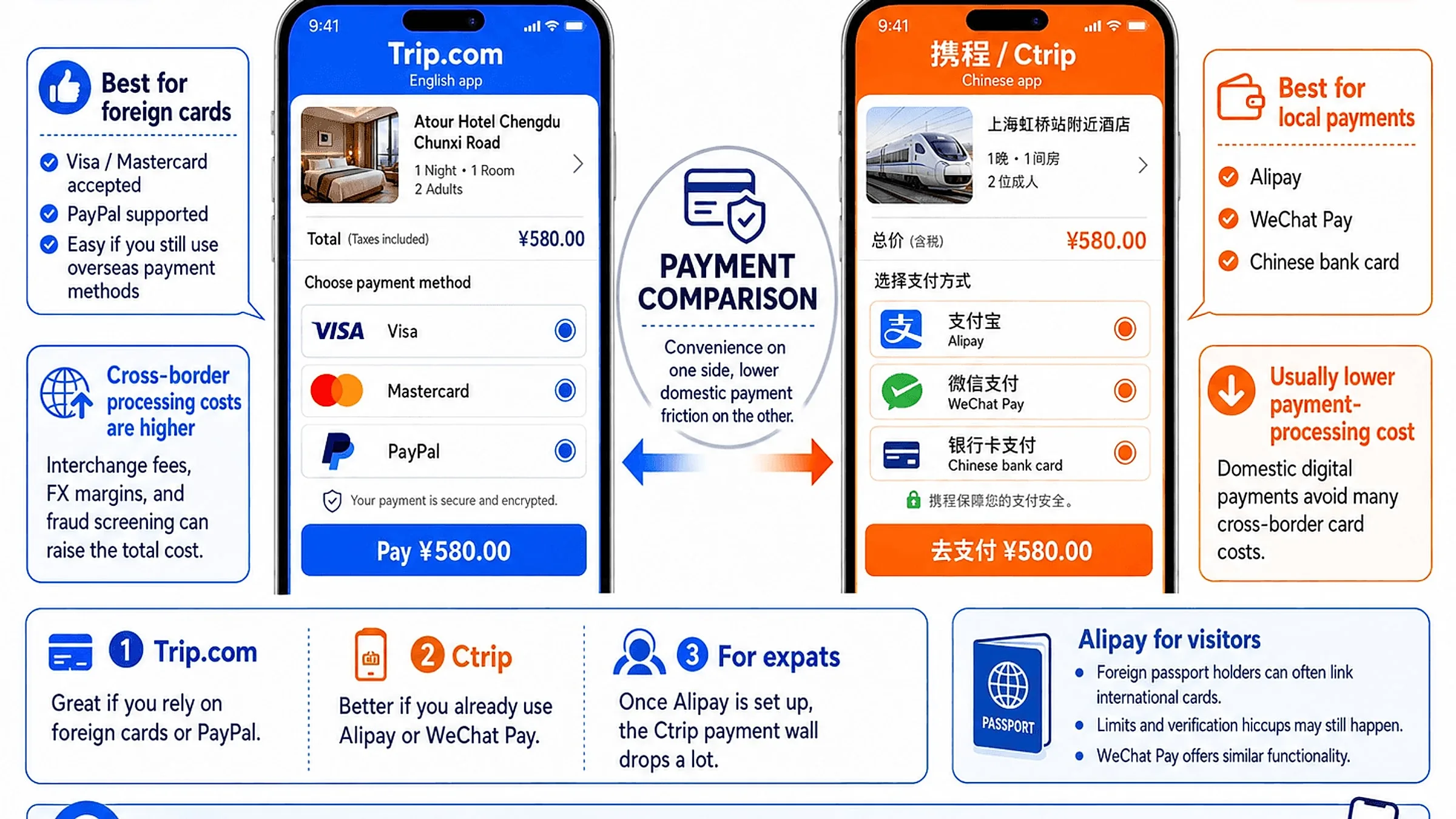
Trip.com (recommended for foreigners)
- Full English interface
- Accepts international Visa/Mastercard/PayPal
- 24/7 English customer support via in-app chat
- Includes all Chinese airlines plus most international
- Often has promo codes (search “Trip.com coupon China”)
- E-ticket integration
- Price: same as airline direct, sometimes slightly higher due to small service fee
Airline direct websites/apps
- Air China (airchina.com.cn): English, international cards accepted
- China Eastern (ce.cn): English, international cards accepted
- China Southern (csair.com): English, international cards accepted
- Spring Airlines (ch.com): English interface exists but limited; international card acceptance is inconsistent
Direct booking is sometimes cheaper (no third-party fee) but customer support is usually Chinese-only.
Other platforms
- Qunar (去哪儿) — owned by Trip.com’s parent company. Chinese interface but with full English. Often has the lowest prices.
- Ctrip (携程) — Trip.com’s Chinese version. Best prices but Chinese interface.
- Skyscanner / Google Flights — international metasearch. Useful for price comparison, then book direct on the airline.
For the easiest experience: Trip.com. For the absolute lowest price: Qunar (English version) or Skyscanner for comparison, then book direct.
Booking step-by-step
- Go to Trip.com (or your chosen platform)
- Click “Flights”
- Enter origin and destination (e.g., “Beijing” and “Chengdu”)
- Select date and number of passengers
- Click “Search”
- Compare results — sort by price, time, or duration
- Filter by airline, departure time, stops if needed
- Select a flight
- Choose fare class:
- Economy Basic: cheapest, no refunds, no changes
- Economy Standard: ¥100–200 more, free changes for a fee
- Economy Flex: ~¥300–500 more, free changes and partial refund
- Add passengers (yourself + any travel companions) with passport details
- Pay with international card
- E-ticket is emailed and saved in the app
- Web check-in opens 24 hours before departure; do this for the best seat selection
Web check-in and boarding
24 hours before: web check-in
Most Chinese airlines open web check-in 24 hours before departure. Do this from your phone:
- Open the airline’s app or Trip.com
- Find your booking
- Tap “Check-in” or “Online Check-in”
- Select your seat (window, aisle, extra legroom if available for fee)
- Add baggage if needed (cheaper online than at the airport counter)
- Download or screenshot the boarding pass
Web check-in is the best way to:
- Get a window or aisle seat (random otherwise)
- Avoid the check-in counter line at the airport
- Add checked baggage at lower pre-departure prices
At the airport: the foreigner’s process
Chinese airports are well-signed in English. The process for foreigners:
- Arrive 90 minutes before domestic flights (2 hours for international)
- Find your airline’s check-in counter (or use the self-service kiosks)
- Show your passport and booking confirmation
- Receive boarding pass (if you didn’t web check-in)
- Drop checked baggage at the counter
- Walk to security (X-ray, metal detector)
- Pass immigration — for domestic flights, no immigration; just scan boarding pass
- Walk to your gate (gate numbers are clearly posted)
- Boarding starts 30–40 minutes before departure and closes 10 minutes before
The whole process takes 30–60 minutes. Add time if you need to exchange currency, charge devices, or buy last-minute items.
Baggage rules
Free checked baggage (full-service carriers)
- Economy: 20 kg (44 lbs), 1 piece
- Premium Economy: 25 kg, 1 piece
- Business: 30 kg, 1 piece
Budget carriers
- No free checked baggage. You pay per kg.
- Prices: ¥30–50 per kg for domestic routes
- A 20 kg suitcase = ¥600–1,000 ($85–140) extra each way
- Add baggage online 24+ hours before for ~30% lower prices
Carry-on baggage
- 5 kg per passenger (most airlines)
- Maximum dimensions 55 × 40 × 20 cm
- One personal item: backpack, handbag, or laptop bag
Onboard experience
Economy class on a G train vs. a budget flight
- HSR economy: 5 seats per row (3+2), 95 cm seat pitch, power outlet, free Wi-Fi
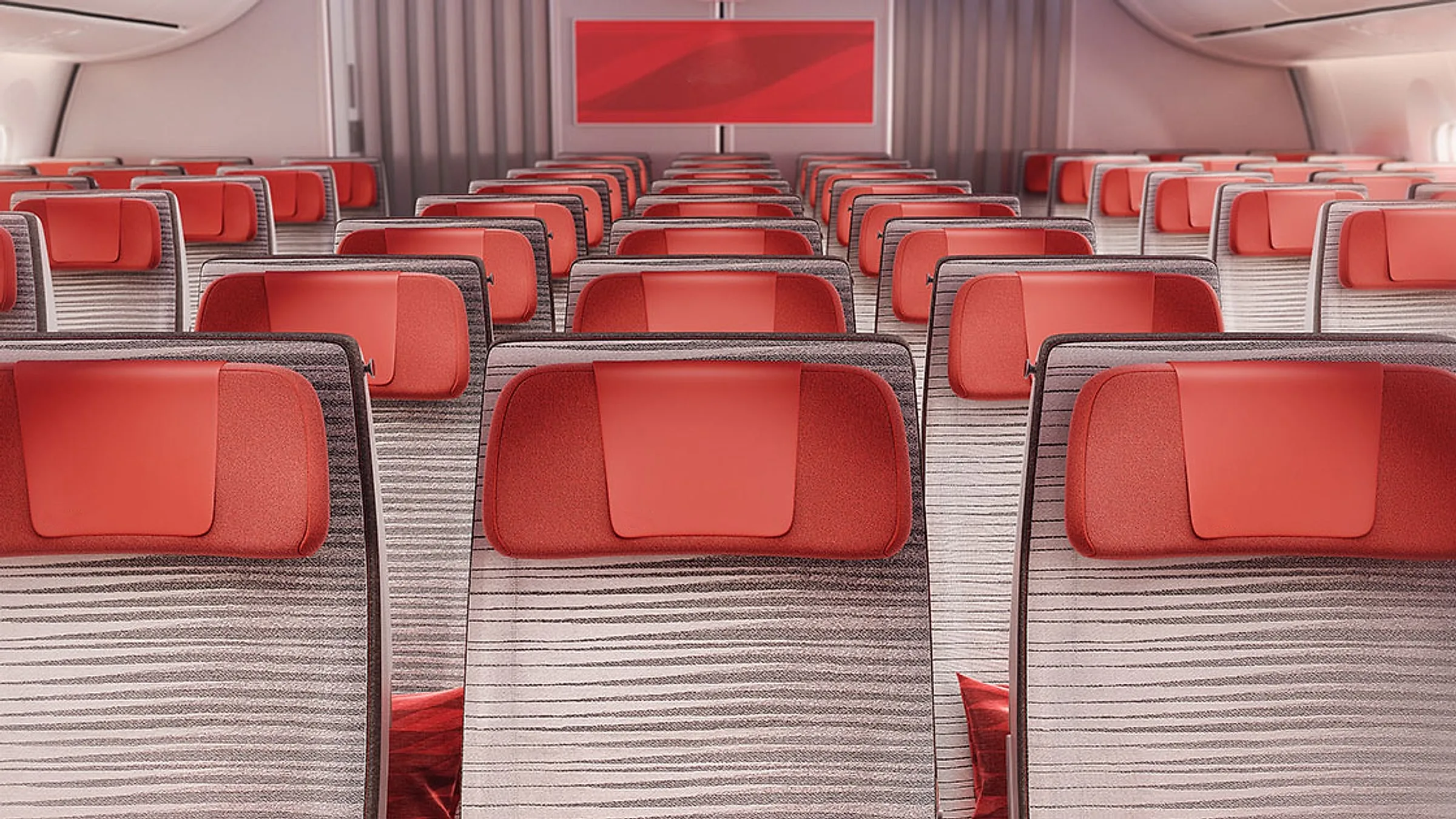
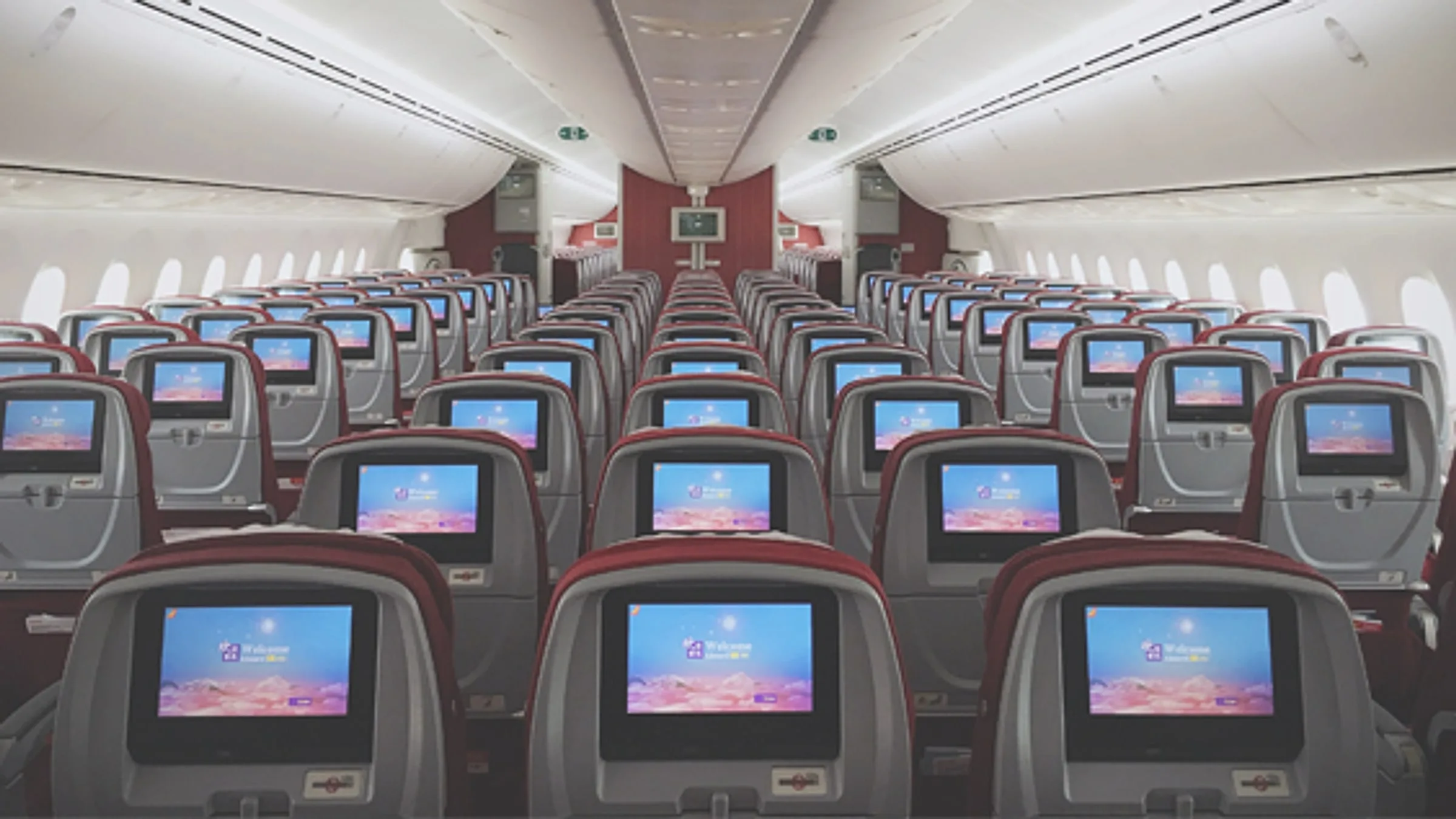
- Budget airline: 6 seats per row (3+3), 71–73 cm seat pitch, no power outlet, no Wi-Fi
Budget flights are noticeably tighter. If you’re tall (over 180 cm) or large, consider paying the extra ¥200–400 for an exit row or premium economy on full-service carriers.
Meals
- Full-service carriers: Free meal and drinks (1 hot meal on flights over 1.5 hours)
- Budget carriers: No free meal. Buy on board (¥30–60) or bring your own.
At the destination: airport transit
China’s major airports have multiple transportation options to city center:
- Metro: Beijing Capital (Line 2 transfer), Shanghai Pudong (Line 2 + Maglev), Guangzhou Baiyun (Line 3). ¥3–9, fastest during rush hour.
- DiDi: ¥80–200 to city center. Most reliable, English interface, fixed price. See DiDi guide.
- Airport Express Train: Beijing Capital–Dongzhimen (¥25, 20 min), Shanghai Hongqiao–Hongqiao Railway Station (¥8, 15 min).
- Airport Bus: ¥20–40, 60–90 min depending on traffic. Less common in tier-1 cities.
- Taxi: ¥120–200, similar to DiDi but no English interface, cash required.
For a detailed airport-specific guide, see DiDi airport pickups.
When to book for best price
Flight prices in China follow predictable patterns:
- Cheapest: 6–8 weeks before departure for domestic
- Most expensive: 1–2 weeks before (especially during holidays)
- Last-minute deals: Sometimes available 1–2 days before if the flight is undersold
- Tuesday, Wednesday, Saturday are typically cheaper than other days
- Early morning and late night flights are cheaper
For Lunar New Year, National Day week, and summer holidays, book 2–3 months ahead.
Refunds and changes
Most Chinese airlines have similar policies to international carriers:
- Economy Basic: No refund, no changes (some airlines allow change for ¥200–500 fee)
- Economy Standard: 50–80% refund if cancelled 7+ days before; change fee ¥300–500
- Economy Flex: 90% refund any time; free change
- Business: 90% refund any time; free change
Budget carriers are stricter: usually no refund, change fee often 50% of ticket price.
Buy trip insurance (¥30–100, $4–14) if you’re worried about last-minute changes. It covers medical, cancellation, and delays.
Common mistakes
- Showing up at the wrong airport. Beijing has 2 (Capital + Daxing), Shanghai has 2 (Pudong + Hongqiao), Chengdu has 2 (Shuangliu + Tianfu). Confirm the airport code (PEK, PKX, PVG, SHA, CTU, TFU).
- Forgetting your passport. Your passport is your ID. Without it, you can’t pass security.
- Not web checking in. If you don’t check in 24 hours ahead, you get a random seat — usually middle seat.
- Ignoring the baggage allowance. Budget carriers charge ¥30–50 per kg. A 25 kg suitcase adds ¥750–1,250 to your “cheap” ticket.
- Underestimating airport commute time. Allow 60 minutes for travel to a tier-1 city airport, plus 90 minutes at the airport.
Quick decision framework
For any China route, ask three questions:
- Is the distance over 1,500 km? Yes → fly. No → consider HSR.
- Is there direct HSR? No → fly. Yes → compare time and price.
- Is the flight under $100 and the HSR over 6 hours? Yes → fly. Otherwise → HSR.
For booking: use Trip.com unless you have a strong reason to book direct.
For more on the alternative to flying, see China high-speed rail guide. For getting to and from the airport, see DiDi for foreigners.
Plan your trip — verified tools
These free tools are built on real, monthly-verified data and help you skip the trial-and-error phase of China trip planning:
- China 6-City 5-Day Budget Calculator — Real 2026 prices for 5 days in Beijing, Shanghai, Guangzhou, Chengdu, Xi’an, or Hangzhou. Budget / mid-range / comfort tiers, broken down line by line.
- China OTA Comparison 2026 — Trip.com vs Booking.com vs Agoda vs Klook across 5 booking types. Inventory, pricing, foreign card support, English service, per-OTA verdict.
Verified August 2026 by TravelHubChina Editorial. We re-check prices and policy details monthly so the data doesn’t drift.
Step by step
-
Decide fly vs train: HSR wins under 1,000 km (Beijing-Xi'an 4.5h CNY 300, Shanghai-Hangzhou 1h CNY 73); fly over 1,500 km (Beijing-Guangzhou 3h, Shanghai-Chengdu 3h, Beijing-Urumqi 5.5h)
Decide fly vs train: HSR wins under 1,000 km (Beijing-Xi'an 4.5h CNY 300, Shanghai-Hangzhou 1h CNY 73); fly over 1,500 km (Beijing-Guangzhou 3h, Shanghai-Chengdu 3h, Beijing-Urumqi 5.5h)
-
Compare prices on Trip.com 2-3 weeks before departure; budget airlines (Spring 9C, 9 Air AQ) are cheaper but charge CNY 100-200 for checked baggage
Compare prices on Trip.com 2-3 weeks before departure; budget airlines (Spring 9C, 9 Air AQ) are cheaper but charge CNY 100-200 for checked baggage
-
Book via Trip.com (Visa/Mastercard accepted, English interface, passport-friendly) — avoid the Ctrip app (requires a Chinese phone number)
Book via Trip.com (Visa/Mastercard accepted, English interface, passport-friendly) — avoid the Ctrip app (requires a Chinese phone number)
-
Arrive at the airport 90 minutes before departure; have your passport ready for check-in and the security ID check (5-15 min)
Arrive at the airport 90 minutes before departure; have your passport ready for check-in and the security ID check (5-15 min)
-
Pick Air China (CA), China Eastern (MU), or China Southern (CZ) for English support; budget carriers have limited English cabin crew and charge for everything
Pick Air China (CA), China Eastern (MU), or China Southern (CZ) for English support; budget carriers have limited English cabin crew and charge for everything
FAQ
-
Are domestic flights in China expensive?
No. Domestic flights in China are very affordable by Western standards — most one-way tickets are ¥300-1,500 ($40-210). Beijing–Shanghai is about ¥700-1,200 ($95-165), Chengdu–Shanghai £800-1,400 ($110-195). Book 2-3 weeks ahead on Trip.com or Ctrip for the best prices. Budget airlines (Spring Airlines, 9 Air) are even cheaper but charge for baggage. -
Can foreigners book domestic China flights with international cards?
Yes. Trip.com and the airline websites (Air China, China Eastern, China Southern) all accept Visa, Mastercard, and Amex. Booking with your passport number is straightforward. Booking on the Chinese Ctrip app requires a Chinese phone number; Trip.com is the foreigner-friendly option. -
How early should I arrive at a Chinese domestic airport?
Plan for 90 minutes. Domestic flights close check-in 45 minutes before departure. Security is fast (5-15 minutes), and walking from check-in to gate is usually 10-15 minutes. For Beijing Capital and Shanghai Pudong, allow 2 hours during peak hours. Have your passport ready at check-in and at the security ID check. -
Which Chinese domestic airline is best for foreigners?
Air China (CA), China Eastern (MU), and China Southern (CZ) are the big three — all have English websites, English cabin crew on most flights, and reliable schedules. Hainan Airlines (HU) and Xiamen Air (MF) are also good. Budget airlines Spring (9C) and 9 Air (AQ) are cheap but charge for baggage and have limited English support.
Related guides
- Transport
China High-Speed Rail: How to Book, Board, Survive
Book China high-speed rail (HSR) tickets in 2026: 12306 vs Trip.com, seat classes, popular routes, station tips, and the exact boarding process for foreigners.
9min read
- Transport
China High-Speed Rail 2026: The Foreigner's Complete Guide to 12306, HSR, and Sleeper Trains
China has the world's largest HSR network (50,000+ km, 11,000+ trains/day). The 12306 official booking site is now foreigner-friendly. This guide covers: how to register on 12306 with a foreign passport, buy tickets, ride 350 km/h HSR, sleeper trains, station navigation, food, and the 2026 mobile app changes. Save 30-50% vs domestic flights on most routes under 1,500 km.
13min read
- Transport
Save Money on China Transport 2026: HSR vs Flight
Verified 2026 HSR vs flight cost table for 8 routes, 12306 vs Trip.com trade-off, 4 city-transport modes, and 4 money-saving tricks.
10min read
- Transport
China Airport Transfer Guide 2026: PEK, PKX, PVG, SHA, CAN, CTU, XIY
The complete 2026 guide to getting from China's 7 major international airports to city center: official taxis, DiDi, airport express trains, Maglev, shuttle buses, and pre-booked private cars. Includes price ranges, hours of operation, which scams to avoid at the airport, and the 3 must-do things before you board.
12min read
- Transport
Didi vs Uber in China 2026: How Foreigners Ride-Hail (Step-by-Step)
No Uber in China — and no Uber-DiDi partnership to book through (the only link is Uber's 2016 stake in DiDi). DiDi is the app that actually dispatches cars for foreigners: English UI, foreign Visa/Mastercard, airport pickups. 2026 setup, fares, and the Hong Kong exception.
9min read
- Tools & Resources
Trip.com for Foreigners: The Complete 2026 Guide
Complete 2026 Trip.com guide for foreign travelers: registration, payment methods, coupons, 6-tier loyalty, refunds, price-match, and 5 places where Trip.com is the wrong choice. Verified 2026-09-06.
9min read