
Temple of Heaven Guide: Beijing's Most Photogenic Park
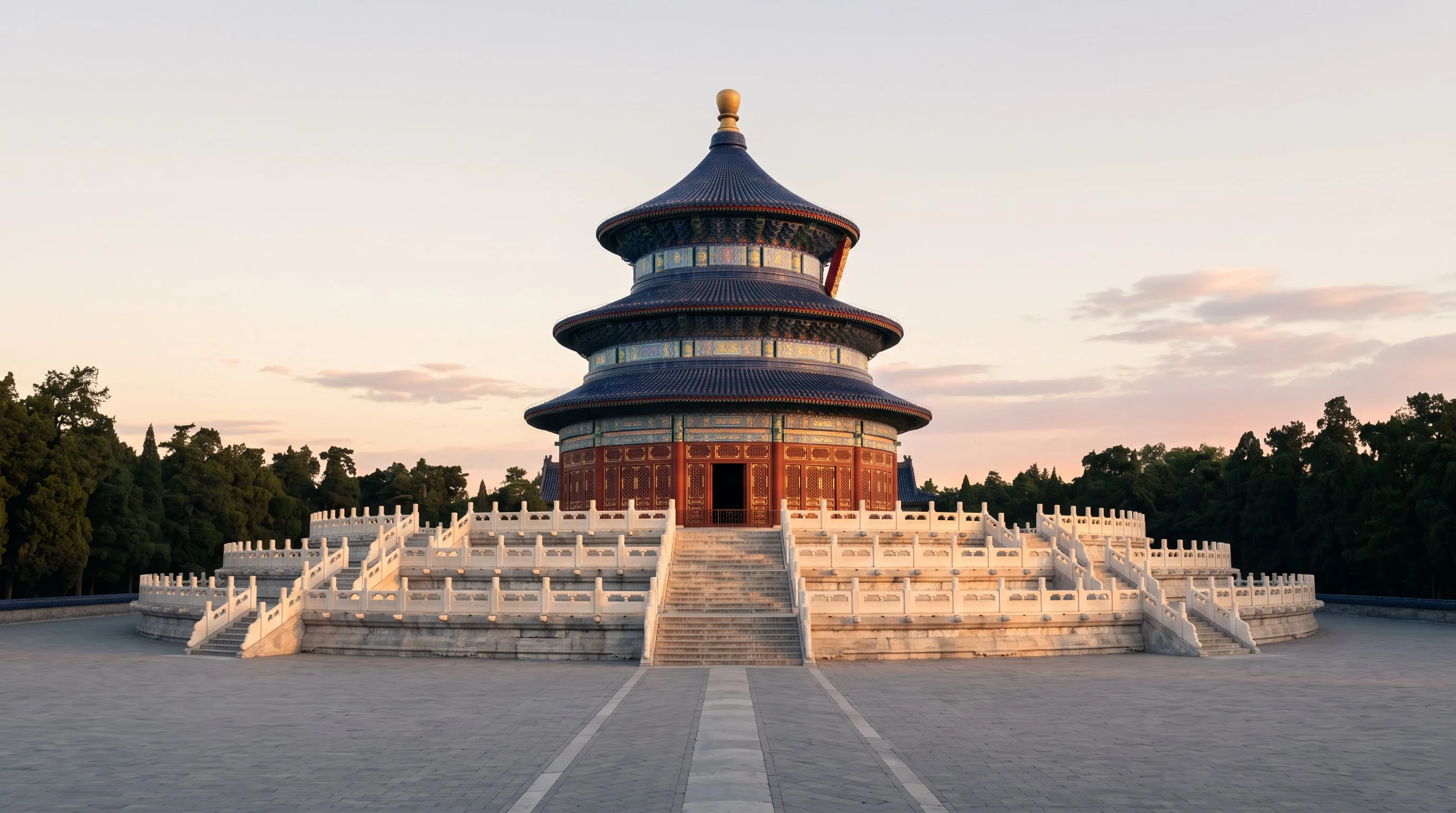
Temple of Heaven in Beijing: 273 hectares, Ming Dynasty (1420), UNESCO since 1998. The Hall of Prayer for Good Harvests is China's most-photographed building. ¥35 entry, free dawn tai chi, subway access.
The Temple of Heaven (天坛, Tiāntán) is the single best half-day in central Beijing. It’s where Ming and Qing emperors came twice a year to pray for good harvests, and the architecture — a perfect circle inside a perfect square, deep blue roof tiles symbolising heaven, vermillion pillars symbolising earth — is the cleanest expression of imperial Chinese cosmology you’ll see anywhere in the country.
The surrounding park (273 hectares, larger than Central Park in New York) is free and open from 6 AM. Locals flood in at dawn for tai chi, fan dance, kite-flying, and ballroom dance. The contrast between the ancient religious complex and the elderly residents gossiping over their morning chess is one of the most Beijing things you’ll ever see.
Plan your visit
- Entry: ¥35 standard (¥15 with foreign passport; bring the actual passport, not a copy). Combo ticket with guided tour available at the gate for ¥50.
- Hours: Park 6:00-22:00. Temple complex 8:00-17:30 (last entry 16:30). Closed Mondays for the temple complex only — park stays open.
- Subway: Tiantan East Gate Station (Line 5) drops you at the east entrance. Tiantan West Gate Station is closer to the north end.
- Best time: Arrive 6:30-7:30 AM for dawn tai chi and empty courtyards. The Hall of Prayer is best photographed in the morning when the front facade catches direct sun.
The 3 main structures
Hall of Prayer for Good Harvests (祈年殿, Qǐniándiàn)
The triple-eaved circular pavilion you see in every Beijing postcard. Built in 1420, rebuilt in 1890 after a fire, 38m tall, sits on a 3-tiered marble terrace. The interior has 28 pillars symbolising the 4 seasons, 12 months, and 12 Chinese hours. The roof is deep blue glazed tile, the columns are vermillion — the classic imperial colour scheme. No photos allowed inside.
Imperial Vault of Heaven (皇穹宇, Huángqióngyǔ)
The circular blue-roofed building that surrounds the Echo Wall. Stand at one end of the wall, whisper, and the person at the other end hears you. The acoustical effect is real but exaggerated in tourist lore — the sound carries, but not for the full 60m wall distance legend claims.
Circular Mound Altar (圜丘坛, Yuánqiūtán)
A 3-tiered circular marble altar where the emperor stood to pray. The number 9 dominates (9 rings of stones, 9 steps, multiples of 9 in the stone counts) because 9 was the imperial number. Stand in the centre stone and speak — your voice carries a faint echo. The whole altar is open to the sky, with no roof.
What to skip
- Long Corridor (366m covered walkway) — photogenic but crowded, and the painted ceiling is more impressive at the Forbidden City.
- Hall of Imperial Heaven (the smaller round hall between the main buildings) — a quick photo stop, not worth 20 minutes.
- Echo Wall “full-distance whisper” — crowded, and the actual effect is a 5m whisper, not the legend’s 60m.
Practical tips for foreign visitors
- Bring your passport — the ¥15 discounted rate requires it. Photocopies won’t work.
- Wear comfortable walking shoes — the park is 2.7 km², you’ll walk 4-6 km in a typical visit.
- Cash + WeChat Pay both work at the gate. Card acceptance is improving but not universal.
- No food vendors inside the temple complex — eat before or after. The east gate area has a good stretch of street food.
- Free dawn access is for the park only — the temple buildings open at 8 AM.
Common questions
Is the Temple of Heaven worth visiting if I only have 2 days in Beijing?
Yes — it’s the best single half-day in central Beijing after the Forbidden City. The Forbidden City is a museum; the Temple of Heaven is an active park with imperial architecture. You see how Beijingers actually use the space, and the Hall of Prayer is the more iconic photo.
Can I see tai chi in the morning?
Yes — the park is full of it from 6:30 AM. The east courtyard and the area north of the Hall of Prayer are the densest. Anyone is welcome to join the group exercise, no Chinese required. Bring water and a light jacket in winter.
Is the Temple of Heaven the same as the Forbidden City?
No. The Forbidden City was the emperor’s palace (where he lived and worked). The Temple of Heaven was his religious space (where he prayed for good harvests twice a year). Different purpose, different architecture, different location — the Forbidden City is north of Tiananmen, the Temple of Heaven is south.
Should I book tickets online?
Optional. Same-day purchase at the gate is normal and rarely sells out (only the ¥50 combo-tour has limited capacity). If you want to skip the ticket line, book via WeChat or Klook in advance.
Temple of Heaven + Beijing essentials
Skip-the-line Temple of Heaven ticket, Forbidden City + Great Wall combo (the classic 2-day Beijing route), airport transfer, and hotel booking in one cart. English interface, foreign cards accepted, e-voucher to phone. The 'Beijing 3-day classic' bundle is the most efficient for first-timers.
Temple ticket from $11 · Hotel from $84/night
Verified August 2026 by TravelHubChina Editorial. We re-check prices and policy details monthly so the data doesn’t drift.
FAQ
-
What is the entry fee for the Temple of Heaven?
¥35 standard admission, or ¥15 with a foreign passport (bring the actual passport, not a copy). The surrounding park (273 hectares) is free and open 6:00-22:00. Combo ticket with a guided tour is available at the gate for ¥50. Tickets can only be purchased at the gate — no online booking. Major credit cards, Alipay, and WeChat Pay are accepted. -
What's the best time of day to visit the Temple of Heaven?
Arrive 6:30-7:30 AM for dawn tai chi with locals and empty courtyards. The Hall of Prayer for Good Harvests is best photographed in the morning (8-10 AM) when the front facade catches direct sun and the deep blue roof tiles glow. Avoid 10 AM-2 PM on weekends and Chinese holidays — peak crowd time. The temple complex is closed Mondays, but the park stays open all week. -
Can I see tai chi at the Temple of Heaven?
Yes — it's the best free experience in Beijing. Every morning from 6:00-8:00 AM, hundreds of local residents gather in the park outside the temple complex to practice tai chi, fan dance, kite-flying, calligraphy-with-water, and ballroom dance. You can join, watch, or just sit and observe. The West Gate area (west of the main complex) is the most popular tai chi gathering spot. No reservation needed, no fee, just show up. -
Is the Temple of Heaven accessible by subway?
Yes. Tiantan East Gate Station (Tiantan Dongmen) on Line 5 is closest to the main east entrance, 2 minutes' walk. Tiantan West Gate Station (Tiantan Ximen, same Line 5) is closer to the north end. The Tiantan South Gate (Tiantan Nanmen) is reachable from Qianmen Station on Line 2. All three Line 5 stations are within 1-2 stops of central Beijing (Qianmen / Tiananmen East). -
What's the difference between the Temple complex and the surrounding park?
The temple complex is the religious/imperial architecture (Hall of Prayer for Good Harvests, Echo Wall, Circular Mound Altar) — fenced and ticketed, 8:00-17:30 daily, closed Mondays. The surrounding park is 273 hectares of public green space with no fee, open 6:00-22:00 daily, used by locals for morning exercise, family walks, and kite-flying. Most first-timers enter via the South Gate, see the temples, then walk back through the park to observe local life. -
What is the Hall of Prayer for Good Harvests?
The Hall of Prayer for Good Harvests (Qiniandian) is the iconic triple-eaved circular wooden pavilion with a deep blue-tiled roof and vermillion pillars. Built in 1420 during the Ming Dynasty, it was where emperors came twice a year to pray to Heaven for good harvests. The design symbolizes Heaven (round, blue) and Earth (square, yellow in the original), the core concept of Chinese imperial cosmology. It is the most-photographed building in China and the visual symbol of Beijing. -
What is the Echo Wall and how does it work?
The Echo Wall (Huiyin Bi) is part of the Circular Mound Altar complex. It's a circular wall (~193m circumference, 6m tall) with smooth, perfectly curved glazed tiles. If two people stand at opposite ends of the wall and one whispers, the other can hear the whisper clearly due to the wall's perfect circular geometry reflecting sound waves. The acoustic effect works because the wall is continuous (no sharp corners) and the glazed tiles are smooth. Try it: whisper toward the wall, walk to the opposite side, listen. It's a popular spot for first-timers and a favorite for the engineering-curious.
Related guides
- Scenic & Nature
Forbidden City Guide: Beijing Imperial Palace, Tickets & Plan
The Forbidden City in Beijing: 72 hectares, 980 buildings, 1.4 million artifacts, Ming and Qing dynasties, UNESCO since 1987. Tickets (¥60), WeChat booking.
12min read
- Scenic & Nature
Great Wall of China Guide: Mutianyu, Badaling, Jinshanling Compared
Great Wall of China: 21,196 km. Mutianyu (best first-timers), Badaling (most crowded), Jinshanling (hiking) compared. Tickets, transport, best season.
12min read
- Scenic & Nature
Yuanyang Rice Terraces Guide: Hani Culture & Water Mirror
Yuanyang Rice Terraces in Yunnan is a UNESCO site (17,000 hectares, 1,300 years old) with Hani culture. Covers tickets, transport, sunrise, 3-day plan.
12min read
- Scenic & Nature
Summer Palace Guide: Beijing's Imperial Garden, Kunming Lake & Longevity Hill
Summer Palace in Beijing: 290 hectares, 3/4 water, UNESCO since 1998. The Long Corridor (728m, 14,000 paintings) is the world's longest covered walkway. ¥30 entry, ¥40 combo, subway access.
- Scenic & Nature
Big Wild Goose Pagoda Guide: Xi'an's 1,300-Year Tang Pagoda
Big Wild Goose Pagoda (Dayan Ta) in Xi'an: 64m Tang-dynasty brick pagoda from 652 AD, UNESCO since 2014 as part of the Silk Roads network. Tickets (¥50), climb times, and the free North Square musical fountain (9 PM nightly).
8min read
- Scenic & Nature
China's Top 3 Scenic Wonders Compared: Zhangjiajie vs Huangshan vs Jiuzhaigou (2026)
Zhangjiajie (sandstone pillars), Huangshan (sea of clouds + granite peaks), Jiuzhaigou (turquoise lakes + waterfalls). Decision guide covering which fits your time, budget, fitness level, photography goals, and travel style. Prices, distances from Shanghai/Beijing, best seasons compared.
12min read