
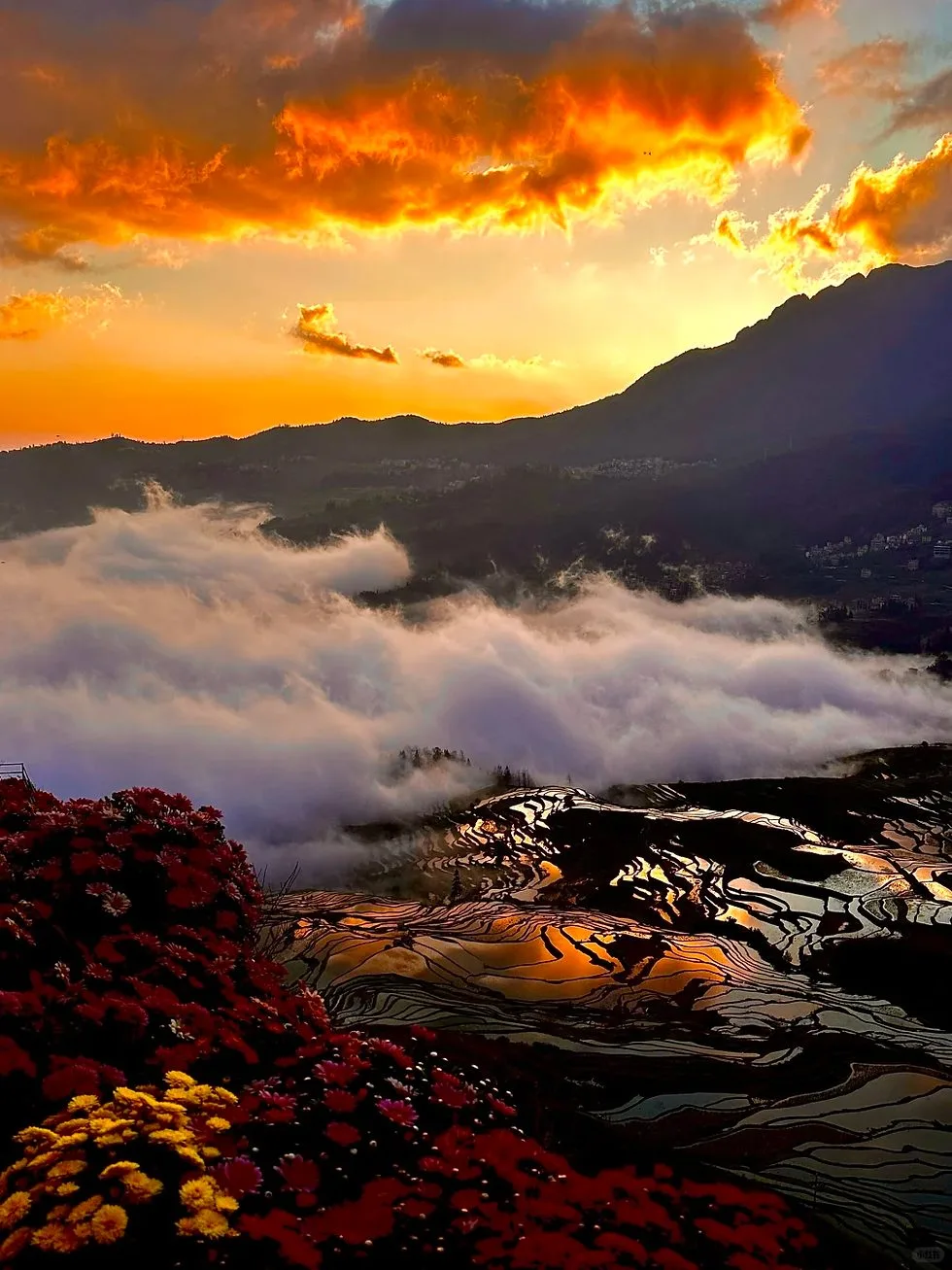
Yuanyang Rice Terraces Guide: Hani Culture & Water Mirror
Yuanyang Rice Terraces in Yunnan is a UNESCO site (17,000 hectares, 1,300 years old) with Hani culture. Covers tickets, transport, sunrise, 3-day plan.
Yuanyang Rice Terraces (元阳梯田, Yuanyang Titian) are a system of rice terraces carved into the Ailao Mountains in southern Yunnan by the Hani people over the past 1,300 years. The cultural landscape covers 17,000 hectares across four counties (Yuanyang, Honghe, Jinping, and Lvchun) and was inscribed as a UNESCO World Heritage Site in 2013. The Hani have maintained a complex water-management system that diverts water from the upper forest, distributes it through the villages, and channels it down to the lowest terraces, creating a continuous flow that has sustained rice farming for centuries. The closest scenic comparison is the Jiuzhaigou Valley 800 km north in Sichuan — lakes and forest rather than rice, but the same scale of UNESCO nature photography.
The most famous viewing area is the Duoyishu-Laohuzui-Bada triangle in Yuanyang County, about 350 km south of Kunming. The terraces are most photogenic from November to early April, when the paddies are filled with water but not yet planted with rice, creating a mirror surface that reflects the sky and the surrounding mountains. The morning cloud sea, when it forms, is one of the most dramatic landscape phenomena in China, with the terraces appearing to float in a sea of white. The Hani villages on the ridges above the terraces have preserved traditional architecture and lifestyle, and homestay programs allow visitors to experience the culture directly. For a broader view of minority villages open to visitors across China — Tibetan, Miao, Dong, and Yi, as well as Hani — see our China minority villages guide.
How to plan your 3-day trip
Day 1 - Arrive and acclimatize
Fly Kunming-Mengzi (45m), then drive 3 hours to Duoyishu village. Or drive Kunming to Yuanyang directly (6 hours). Check into a homestay in Duoyishu. Afternoon: walk to the Duoyishu viewing platform (1 km from the village) for the sunset. Evening: Hani dinner at the homestay (¥80-150 per person).
Day 2 - Sunrise and four terraces
5:30 AM wake-up. Walk to Duoyishu platform for sunrise (6:00-7:30 AM). Return to homestay for breakfast. Visit Aichun blue terraces (10 km east, 30-minute drive) at 10:00 AM when the sun is overhead. Lunch in Bada village (Hani noodle soup, ¥30). Visit Bada terraces and village shrine. Return to Duoyishu. Late afternoon: drive to Laohuzui (Tiger Mouth) for sunset (5:30-6:30 PM). Return to homestay.
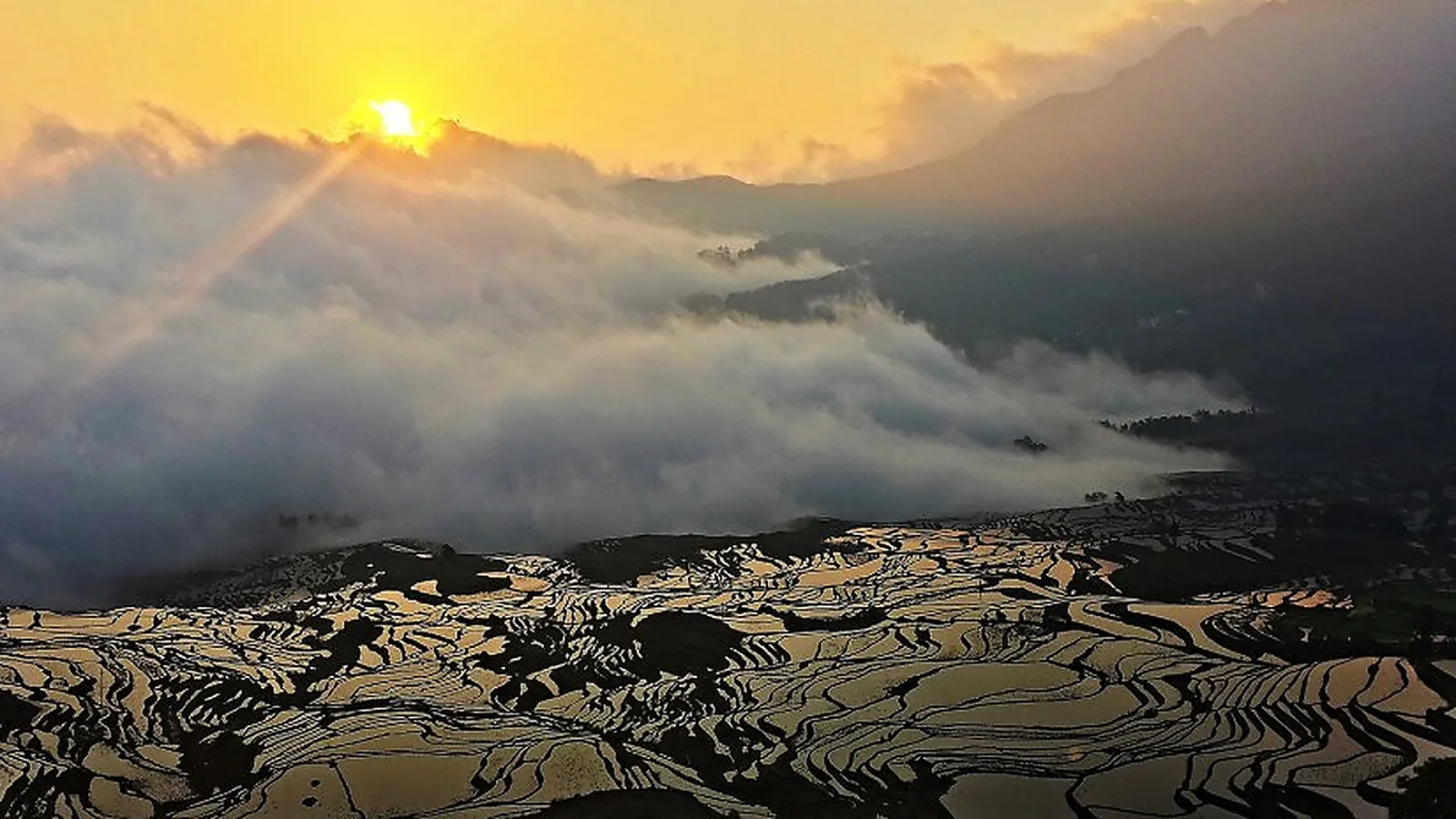
Photo: Wikimedia Commons / CC BY-SA. Source

Day 3 - Buffer day or extra village
If you have a third day, add Azheke village (10 km from Duoyishu) for the traditional mushroom houses. Or visit the Qingkou Hani market on a Saturday morning. Afternoon: drive back to Mengzi (3 hours) and fly to Kunming, or continue to Lijiang (5 hours drive, scenic route).
Tickets, booking, and payment
Major sites and their 2026 entry fees:
- 3-day pass (covers all four main terraces) - ¥180 per person. Buy at any terrace gate.
- Duoyishu shuttle bus - ¥20 one-way from village to platform.
- Laohuzui shuttle bus - ¥20 one-way from main road to viewing platform.
- Aichun entry - included in 3-day pass.
- Bada entry - included in 3-day pass.
- Azheke village entry - ¥30 per person, includes guided village walk.
- Tiger Mouth Lodge guided tour (optional) - ¥400 per group, 3 hours.
How to book:
- At the gate - passport required, cash or Alipay/WeChat. No foreigner surcharge.
- Trip.com - English, accepts Visa/Mastercard, 5% service fee. Most comprehensive booking platform for Kunming-Yuanyang-Lijiang tour packages.
- Via homestay - most homestays in Duoyishu can arrange tickets, transport from Mengzi, and guides. The owner typically takes 5% commission but provides English support and saves you a day of planning.
Free entry: Children under 1.2m, seniors over 65 (with passport). Most sites give 50% student discount with Chinese ID.
What is NOT included:
- Transport from Mengzi or Kunming to Duoyishu (¥300-400 per car, 4 passengers)
- Guide (¥300-500 per day, optional but recommended)
- Hani dinner at the homestay (¥80-150 per person)
- Motorbike rental (¥100-150 per day)
Getting there and around
By air (to Mengzi): Mengzi Airport (MGM). Direct flights from Kunming (45m, 3-4 daily), Beijing (3h 30m, 1-2 daily), Shanghai (3h 30m, 1 daily), Guangzhou (2h, 1 daily). Round trip from Kunming is ¥600-1,200. The airport is 20 km from Mengzi city center; taxi ¥50-80.
By car (from Kunming): The G245 highway from Kunming to Yuanyang is 350 km, 6 hours, all paved. The drive passes through the Ailao Mountains and the Red River valley. The road is mostly two-lane with passing lanes on hills. Self-drive is the most flexible option; rental cars in Kunming are ¥300-500/day for a sedan, ¥600-800/day for a 4WD.
By bus (from Kunming): Direct tourist bus from Kunming South Bus Station, 7 hours, ¥120-150, runs 2-3 times daily. Slower than flying but cheaper.
Inside the terrace region: Most travelers hire a driver for the 3 days. Driver-hire in Duoyishu is ¥400-500 per day including fuel. The driver can take you to all four terraces and the outlying villages. Motorbike rental is ¥100-150 per day for fit travelers; the roads are paved but the climbs are steep.
When to go and what to expect
November to early April (water-filled, cloud sea). Peak season. The terraces are filled with water but not yet planted with rice. The mirror reflections and the cloud sea at sunrise are the most photogenic. Temperatures: 5C to 18C, with cool mornings (5-10C). Book homestays 2-3 weeks ahead. Crowds are highest during Chinese New Year (late January-February). For the country-wide view of when to go, see our best time to visit China guide.
Late April to June (rice planting). Shoulder season. The terraces are being planted with rice seedlings; the water is still there but the color is less pure. Fewer crowds. Temperatures: 12C to 25C. Good for travelers who want the terraces without the peak crowds.
July to October (green rice). Off-peak. The terraces are filled with green rice plants. Less photogenic for the mirror effect but the green-on-green landscape has its own beauty. Most rain falls in July-August. Temperatures: 18C to 28C. Best for budget travelers; homestay rates drop 30-50%.
January-February (Chinese New Year). Highest crowds. Avoid unless you specifically want to see the Hani New Year celebrations. Hotel rates triple in some homestays.
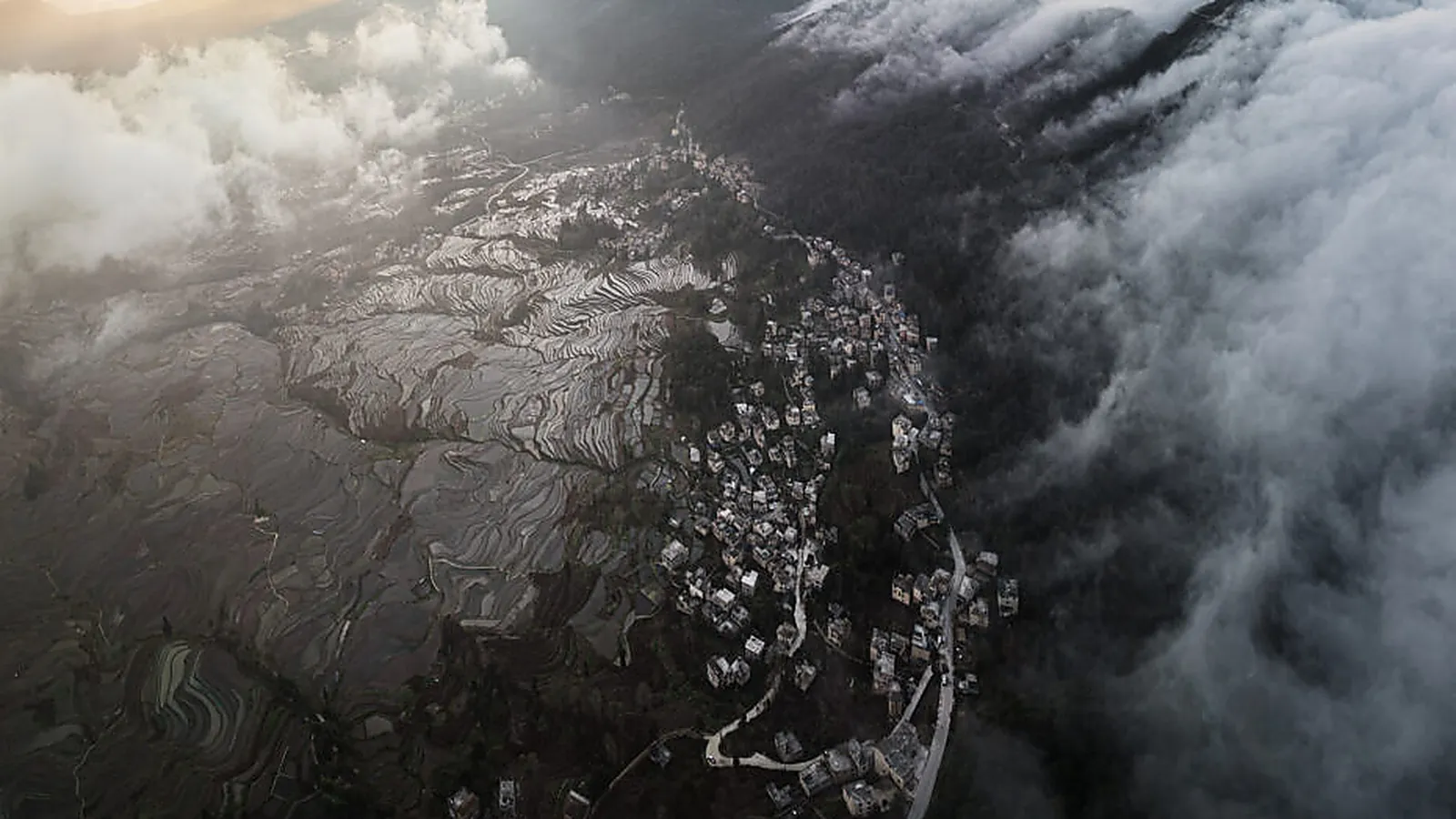
Photo: Wikimedia Commons / CC BY-SA. Source

What to bring
- Tripod - essential for the sunrise mirror reflections and the cloud sea long exposures. Most homestays lend tripods if you ask in advance.
- Wide-angle lens (16-35mm equivalent) - captures the broad terrace views. A polarizing filter enhances the sky and cuts water surface reflections.
- Layered clothing - Mornings are 5-10C in winter, 18C in summer. Afternoons are 18-25C year-round. A fleece and a windbreaker are essential.
- Hiking shoes - The terrace paths are stone steps and dirt; running shoes are not adequate. Bring a pair with ankle support.
- Cash (¥500-800) - Small villages and homestays prefer cash. Mengzi and Kunming accept Alipay. Foreign cards are not accepted in the terrace region.
- Power bank - The viewing platforms have no outlets. A 20,000 mAh pack is enough for 2 phone charges.
- Headlamp - Morning walks to the sunrise platform are in the dark (5:00-6:00 AM in winter). Most homestays lend flashlights but a headlamp is more convenient.
- Offline maps - Amap or Apple Maps. Cell signal is good in Duoyishu, weak in the more remote villages.
- Water bottle and snacks - Few shops on the terrace paths. Stock up in Duoyishu each morning.
Hike difficulty cheat sheet
Yuanyang is rice-terrace walking — short walks between Hani villages and terrace viewpoints, mostly on stone steps and dirt paths through terraced fields. The terrain is “up and down” more than “strenuous.” No technical hiking required.
| Trail | Distance | Time | Elevation | Difficulty |
|---|---|---|---|---|
| Qingkou Hani village → Duoyishu viewpoint (多依树) | 5 km linear | 2 h | +200 m | Easy-Moderate — stone steps, terraced fields, mostly shaded |
| Laohuzui → Bada terraces (老虎嘴→坝达) | 4 km linear | 1.5-2 h | +100 m | Easy — village road, then terrace walk |
| Aichunlan terrace loop (爱春蓝) | 3 km loop | 1.5 h | +150 m | Easy — small blue-water terrace loop, photographers’ favorite |
| Pingzhuang → Mengpin terraces | 6 km linear | 2-3 h | +250 m | Moderate — longer village-to-village walk, fewer tourists |
| Lvshuixiang → Jiayin terraces | 4 km linear | 1.5-2 h | +200 m | Easy-Moderate — quiet alternative to the main viewpoints |
Best for backpackers: do the Qingkou→Duoyishu sunrise walk (2 h, get up at 5 AM) followed by the Laohuzui→Bada sunset walk (2 h, get there by 5 PM) on day 1. Day 2, do the Aichunlan blue-water loop in the morning and the Pingzhuang→Mengpin walk in the afternoon. The terraces are 1,500-2,000m elevation — altitude sickness is rare but the steps can be slippery after rain, so bring proper hiking shoes (not sneakers).
The 5 photo spots that matter
- Duoyishu sunrise platform (多依树). The classic sunrise spot. The terraces are arranged in a horseshoe shape with a small village on the ridge. The cloud sea forms in the valley below. Best 6:00-7:30 AM in winter. Bring a tripod for the long exposures. Arrive by 5:30 AM for the best position.
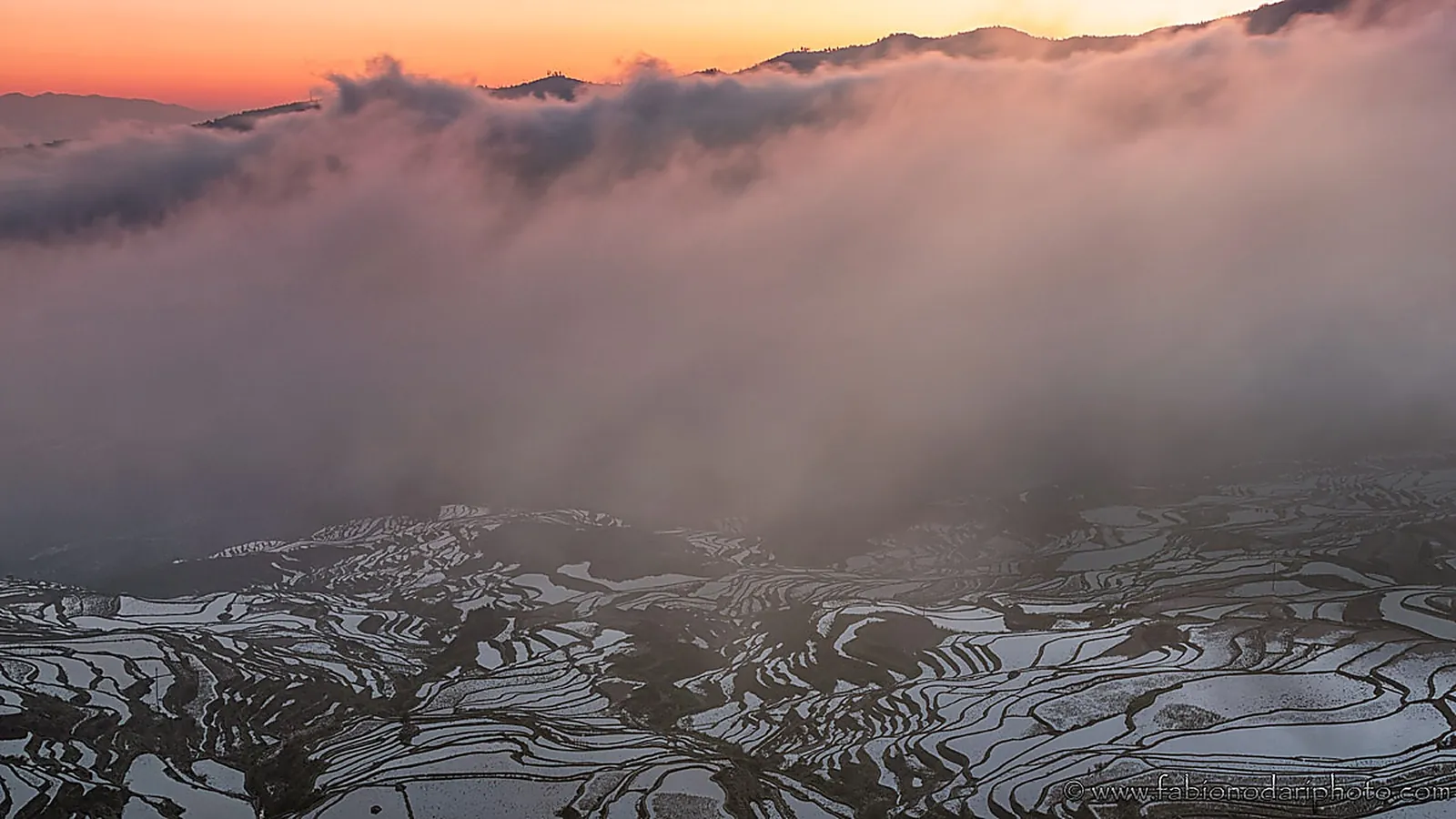
Photo: Wikimedia Commons / CC BY-SA. Source 2. Laohuzui (Tiger Mouth) sunset (老虎嘴). The Y-shaped terraces glow orange and red at sunset. Best 5:30-6:30 PM in winter. The viewpoint is a 10-minute walk from the parking lot; the shuttle bus (¥20) drops you at the trailhead. 3. Aichun blue terraces (爱春). The terraces are filled with water and reflect the blue sky. Best 10:00 AM to noon when the sun is directly overhead. The viewpoint is a 5-minute walk from the road; no shuttle needed. 4. Bada village and terraces (坝达). The most photogenic of the four main terrace areas. The terraces cascade down a long ridge with a Hani village on top. Best 2 hours before sunset. The village has a small shrine worth visiting. 5. Azheke village (阿者科). The UNESCO-supported traditional Hani village with mushroom-shaped thatched houses. Best 7:00-9:00 AM when the morning mist rises from the terraces below. The village is a 30-minute drive from Duoyishu.

Common mistakes to avoid
- Arriving at Duoyishu at 7:00 AM for sunrise. The sun rises at 6:30-7:00 AM in winter; you need to be at the platform by 5:30-6:00 AM to get a good position. Most sunrise platforms are crowded from 6:30 AM onward.
- Skipping Laohuzui at sunset. Duoyishu gets all the attention but Laohuzui is the most photogenic of the four main terraces. The Y-shape is unique to this site.
- Driving yourself without a local driver. The mountain roads are narrow with sharp turns and the Hani villages are not signed in English. A local driver (¥400-500/day) is much safer and more efficient.
- Wearing white shoes. The terrace paths are muddy after rain and dusty in summer. Dark shoes with ankle support are the practical choice.
- Visiting during the May-October rice-growing season for the “iconic” mirror effect. The water is not as pure during rice growing; the most photogenic season is November-April. Plan your trip around the water-filled window.
- Trusting Google Maps. Google services are blocked in China. Use Amap (高德地图) for navigation. Save key Chinese names: 元阳梯田, 多依树, 老虎嘴, 爱春, 坝达, 阿者科.
- Underestimating the Hani dinner experience. The Hani-style dinner at a homestay (yak meat, bamboo shoots, smoked pork, sticky rice, homemade rice wine) is a 2-hour cultural event, not just a meal. Plan for it.
Where to stay
- Duoyishu village (the main base) - homestays with shared or private bathrooms. Budget: Yuanyang Sunshine Inn, Hani Family Homestay (¥150-250/night). Mid-range: Tiger Mouth Lodge, Yuanyang Cloud Sea Hotel (¥400-700/night). Most include Hani dinner (¥80-150) and breakfast.
- Bada village - quieter, smaller selection. Bada Terraces Inn (¥200-300/night). Allows early morning access to the Bada sunrise spot.
- Azheke village - UNESCO-supported homestay program, 4-6 traditional mushroom houses, basic amenities. ¥200-300/night including dinner and breakfast. Limited electricity (no air conditioning).
- Mengzi city - the gateway airport. Not recommended as a base; stay 1 night only if arriving late. Mengzi Hotel, Hanting Express (¥180-300/night).
- Kunming - the international gateway. Use as a 1-night stopover, not a base for the terraces. Hotels from ¥180-800/night.
Local food and Hani culture
Hani cuisine is a Yunnan regional specialty. Must-try dishes:
- Hani-style roasted pork (哈尼烤肉) - marinated in fermented soybean and roasted over a wood fire, ¥60-80 per dish. The Hani signature dish.
- Bamboo shoot soup (竹笋汤) - the fresh bamboo shoots from the Ailao Mountains, ¥30-40 per bowl.
- Sticky rice in bamboo tube (竹筒饭) - rice steamed in a fresh bamboo tube, ¥20-30 per tube. The traditional Hani field meal.
- Hani rice wine (哈尼酒) - fermented from local glutinous rice, served in a shared bowl with long bamboo straws, ¥30-50 per bowl. Mild (3-5% alcohol).
- Hani smoked pork (腊肉) - cured over a pine fire for weeks, served fried or in soup, ¥50-70 per dish.
- Wild mushroom soup (野生菌汤) - in July-August only, made with freshly picked wild mushrooms, ¥60-100 per pot. Some species are mildly toxic; only eat at restaurants that cook them properly.
Hani culture: the mushroom-shaped thatched houses (蘑菇房) are the traditional Hani dwelling, found in Azheke and the older parts of Bada. The Hani have a complex water-management system (分水木刻) where wooden boards with carved notches are used to divide water between villages. The Long Street Banquet (长街宴) is held in some villages during the October Hani New Year; visitors are welcome. The Hani are a matrilineal society in some clans; visitors should be respectful of the village shrine customs. Photography of people is generally accepted with a smile and a gesture, but always ask before photographing the village shrine or the elderly.
Plan your trip - verified tools
These free tools are built on real, monthly-verified data and help you skip the trial-and-error phase of China trip planning:
- China 240-Hour Visa-Free Transit Checker - 57 countries, 24 provinces, 65 ports. See if you qualify for 10-day visa-free transit, which cities you can visit, and the 5-step process.
- China 6-City 5-Day Budget Calculator - Real 2026 prices for 5 days in Beijing, Shanghai, Guangzhou, Chengdu, Xi’an, or Hangzhou. Budget / mid-range / comfort tiers, broken down line by line.
Verified August 2026 by TravelHubChina Editorial. We re-check prices and policy details monthly so the data doesn’t drift.
Step by step
-
Fly to Kunming Changshui International Airport (KMG)
Direct flights from Beijing (3h 15m), Shanghai (3h 30m), Guangzhou (2h 30m), Shenzhen (2h), and 50+ other Chinese cities. Round trip from Beijing is ¥1,800-3,200. Kunming is the gateway to all Yunnan destinations. The airport is 30 km east of downtown; airport bus ¥20, taxi ¥80-100. Spend 1 night in Kunming to acclimatize if coming from low altitude.
-
Connect to Mengzi or drive directly to Yuanyang
Option 1: Fly Kunming-Mengzi (MGM) in 45 minutes on China Eastern or Ruili Airlines, 3-4 daily, ¥300-600 one-way. Drive 3 hours south to Yuanyang from Mengzi. Option 2: Drive Kunming to Yuanyang on the G245 highway, 350 km, 6 hours, all paved. The drive is scenic but long. Option 3: Tourist bus from Kunming South Bus Station, ¥120-150, 7 hours, runs 2-3 times daily.
-
Stay 2-3 nights in Duoyishu village
Duoyishu (多依树) is the most popular village base for terrace viewing. Most homestays and small hotels are within 5-10 minutes walk of the Duoyishu sunrise platform. Budget homestays (¥150-250/night) have shared bathrooms; mid-range (¥250-500/night) have private Western-style toilets and hot water. Book 1-2 weeks ahead in winter peak season. The Tiger Mouth Lodge is the upscale option (¥600-900/night).
-
Buy the 3-day pass (¥180) and visit the four main terraces
The pass covers entry to Duoyishu, Laohuzui (Tiger Mouth), Aichun (Blue Terraces), and Bada (Hani Village). Buy at any terrace gate. Pass valid for 3 calendar days. Some terraces (Duoyishu, Laohuzui) require a separate shuttle bus (¥20) from the village. Each terrace has a wooden boardwalk and viewing platforms. The four terraces are 5-25 km apart, accessible by car or motorbike.
-
Catch sunrise at Duoyishu and sunset at Laohuzui (Tiger Mouth)
The two classic photo spots. Duoyishu sunrise: arrive at the platform by 6:00 AM in winter, 5:30 AM in summer. The terraces fill with water and the sun rises behind the Ailao Mountains, with the cloud sea rolling through the valley. Laohuzui (Tiger Mouth) sunset: arrive 1 hour before sunset, the Y-shaped terraces glow orange and red as the sun sets behind the Wuliang Mountains.
-
Visit Aichun blue terraces and Bada Hani village
Aichun (爱春) is famous for the blue color of its terraces, best 10:00 AM to noon when the sun is overhead. Bada (巴达) is a working Hani village with traditional mushroom-shaped thatched houses. Walk through the village, see the village shrine, and have lunch at a family homestay (¥50-80 per person for Hani dishes). Allow 3 hours for both combined.
-
Add a half day for Azheke village or Qingkou Hani market
If you have a buffer day, visit Azheke (阿者科), a UNESCO-supported traditional Hani village 10 km from Duoyishu. The village has 60 families in traditional thatched mushroom houses, no cars, and a community-run homestay program (¥200-300/night, includes dinner and breakfast). Alternatively, the Qingkou Hani market on Saturday morning is a 2-hour drive south and a working market for the local Hani communities — for the broader set of minority villages open to travelers, see our China minority villages guide.
-
Download offline maps and translation before arrival
Google Maps does not work in China. Use Amap (Gaode) or Apple Maps. Download Pleco dictionary for offline Chinese-English. The terrace region has very limited English; even the homestay owners speak only basic English. Save key Chinese names: 元阳梯田 (Yuanyang Terraces), 多依树 (Duoyishu), 老虎嘴 (Laohuzui Tiger Mouth), 爱春 (Aichun), 坝达 (Bada), 阿者科 (Azheke), 箐口 (Qingkou).
FAQ
-
How many days do you need at Yuanyang Rice Terraces?
3 days is the minimum to see the four main terraces (Duoyishu, Laohuzui, Aichun, Bada) and one Hani village walk. 2 days is doable if you fly in, stay one night in Duoyishu, and catch one sunrise plus one sunset. Less than 2 days is not worth the 6-hour drive from Kunming; consider a guided bus tour from Kunming that includes transport and tickets. -
What is the best time of year to visit Yuanyang?
November to early April for the water-filled terraces and the cloud sea at sunrise. The terraces are filled with water from November to March (after the rice harvest), creating the iconic mirror reflections. May to October is the rice-growing season when the terraces are green and the water is not as photogenic. Sunrise is best 6:30-7:30 AM in winter, 6:00-7:00 AM in summer. Sunset is best 5:30-6:30 PM in winter. -
How do I get to Yuanyang from Kunming?
Option 1: Drive from Kunming on the G245 highway, 350 km, 6 hours, all paved. Option 2: Fly Kunming to Mengzi (MGM) 45 minutes, then drive 3 hours south to Yuanyang. Option 3: Direct tourist bus from Kunming South Bus Station, 7 hours, ¥120-150. Most independent travelers fly to Mengzi and hire a driver from the airport. There is no direct public bus from Mengzi to the Duoyishu terrace area. -
Do I need a guide to visit the Yuanyang terraces?
A guide is not required but strongly recommended. The terrace area covers 17,000 hectares with dozens of viewing platforms, and the Hani villages are not signed in English. A local guide (¥300-500 per day) knows the best sunrise spots, can drive the unpaved mountain roads safely, and can introduce the Hani culture. Most hotels in Duoyishu village arrange guides on request. Independent hiking is possible with a paper map and offline GPS. -
Are the Hani villages authentic or just for tourists?
Most of the villages in the Duoyishu and Bada areas are working Hani villages with 100-500 families. The Hani have lived in this area for 1,300 years and continue to farm the terraces using traditional methods. Tourism has added homestays and small restaurants but the daily life (rice farming, water management, family rituals) is unchanged. The most authentic villages are Bada (巴达) and Azheke (阿者科), which have UNESCO-supported homestay programs that keep tourism revenue in the village. -
How do foreigners buy Yuanyang tickets and tours?
Buy the 3-day pass (¥180) at any of the four main terrace gates in cash or via Trip.com (English, accepts Visa/Mastercard, 5% service fee). No foreigner surcharge. Homestays in Duoyishu can arrange airport pickup from Mengzi (¥300-400 per car, 3 hours), guided tours (¥300-500 per day per guide), and onward transport to Lijiang or Kunming. Most homestay owners speak some English; the more upscale options (like the Tiger Mouth Lodge) have full English support.
Related guides
- Scenic & Nature
Huangshan (Yellow Mountain) Guide: Sunrise, Sea of Clouds, Trails (2026)
Huangshan (黄山, Yellow Mountain) in Anhui is a UNESCO World Heritage site famous for its sea of clouds, twisted pines, and granite peaks. This guide covers the 2-3 day plan, ticket prices (¥190-310), cable cars, sunrise timing, and Hongcun village.
12min read
- Scenic & Nature
Big Wild Goose Pagoda Guide: Xi'an's 1,300-Year Tang Pagoda
Big Wild Goose Pagoda (Dayan Ta) in Xi'an: 64m Tang-dynasty brick pagoda from 652 AD, UNESCO since 2014 as part of the Silk Roads network. Tickets (¥50), climb times, and the free North Square musical fountain (9 PM nightly).
8min read
- Scenic & Nature
China's Top 3 Scenic Wonders Compared: Zhangjiajie vs Huangshan vs Jiuzhaigou (2026)
Zhangjiajie (sandstone pillars), Huangshan (sea of clouds + granite peaks), Jiuzhaigou (turquoise lakes + waterfalls). Decision guide covering which fits your time, budget, fitness level, photography goals, and travel style. Prices, distances from Shanghai/Beijing, best seasons compared.
12min read
- Scenic & Nature
Forbidden City Guide: Beijing Imperial Palace, Tickets & Plan
The Forbidden City in Beijing: 72 hectares, 980 buildings, 1.4 million artifacts, Ming and Qing dynasties, UNESCO since 1987. Tickets (¥60), WeChat booking.
12min read
- Scenic & Nature
Great Wall of China Guide: Mutianyu, Badaling, Jinshanling Compared
Great Wall of China: 21,196 km. Mutianyu (best first-timers), Badaling (most crowded), Jinshanling (hiking) compared. Tickets, transport, best season.
12min read
- Scenic & Nature
Jiuzhaigou Scenic Guide: Five-Color Lakes, Waterfalls, Autumn (2026)
Jiuzhaigou Valley in Sichuan is a UNESCO World Heritage site with turquoise multi-level lakes, 18+ waterfalls, and 220 sq km of forest. This guide covers the Y-shaped valley plan, ticket prices (¥190+¥90 bus), when to go for autumn colors, Huanglong nearby, and altitude tips.
12min read