
China's Minority Villages: Miao, Dong, Hakka, Yi, Tibetan (2026 Off-the-Beaten Guide)
The 2026 off-the-beaten-path guide to China's 5 most photogenic minority cultures: Miao silver + embroidery in Guizhou (Kaili, Xijiang, Langde), Dong drum-tower villages in Guizhou/Hunan (Zhaoxing), Hakka tulou earthen roundhouses in Fujian (Nanjing, Yongding), Yi/Yue festivals in Yunnan (Yuanyang), and Tibetan villages in Sichuan (Danba, Litang). With how to get there, where to stay, what to eat, and the cultural respect notes (don't photograph without asking, dress modestly at village ceremonies).
Most China itineraries hit the same 4-5 cities and the same 3-4 ethnic Han cultural sites. This guide is for travelers who want the real China — the rural, minority-culture, off-the-beaten-path China where 55 officially-recognized ethnic minority groups (the largest being Zhuang, Manchu, Hui, Miao, Uyghur, Yi, Tujia, Tibetan, Mongol, and Dong) preserve distinct languages, festivals, and architectural styles. The 5 cultures below are the most accessible and the most photogenic, and all are reachable by HSR + short bus from a major Chinese city. None of them require a Chinese-speaker guide.
The 5 cultures, in 5 regions
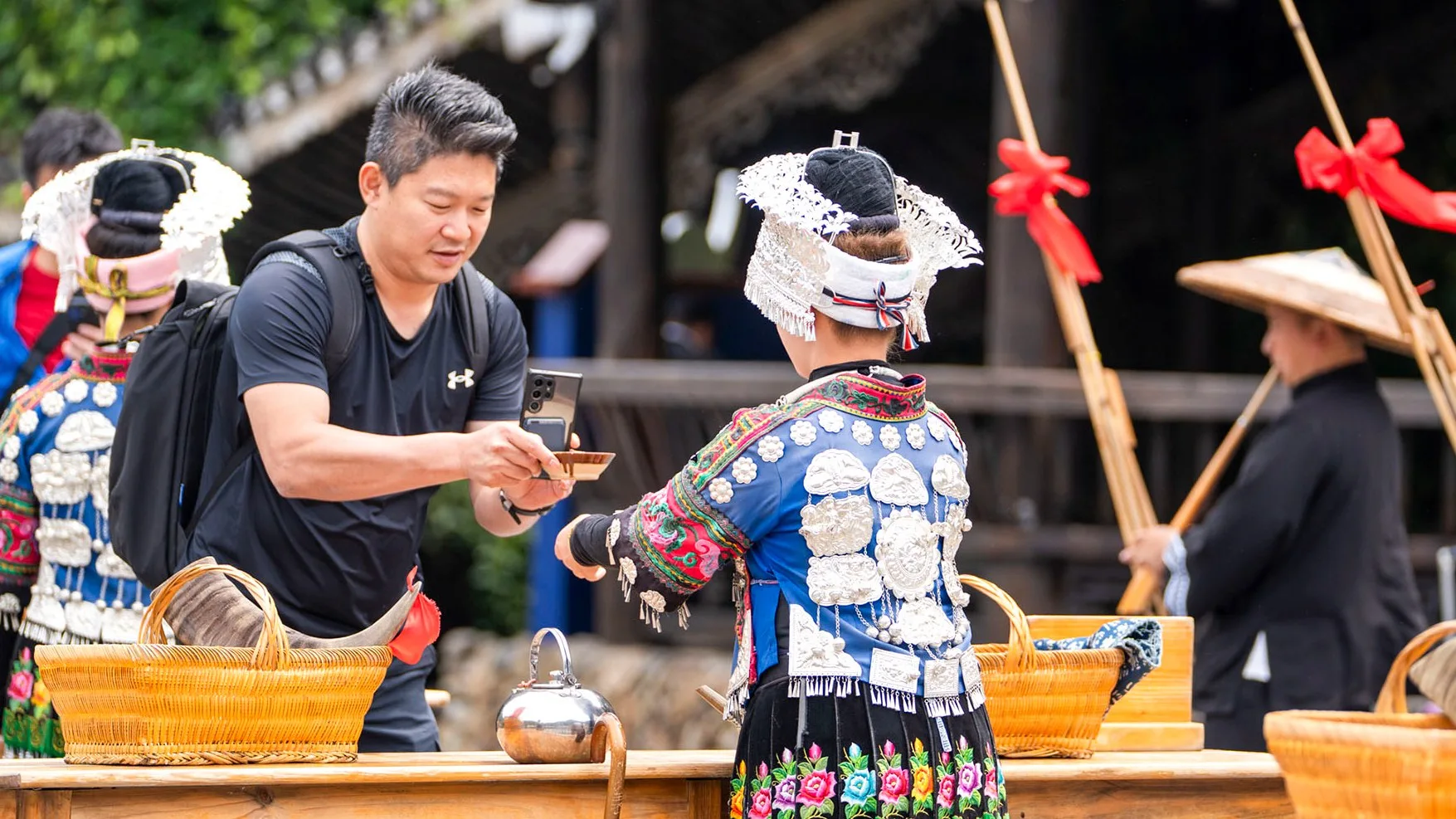
1. Miao (苗族) — Guizhou, around Kaili
Where: Southeast Guizhou province, in the Qiandongnan (黔东南) Miao and Dong Autonomous Prefecture. The cultural capital is Kaili (凯里), a small city 220 km south of Guiyang (the provincial capital, 1 hour by HSR from Guangzhou / 2 hours by HSR from Chongqing). From Kaili, the Miao villages are 30-90 minutes by minibus.
The signature villages:
- Xijiang Qianhu Miao Village (西江千户苗寨) — the largest Miao village in the world, 1,300+ households, 6,000+ Miao residents, all living in traditional wooden stilt houses (吊脚楼 diào jiǎo lóu) on the hillside. The 3-day Miao New Year (苗年 Miáo nián, October/November by the lunar calendar) is the biggest festival; the daily “Miao costume parade” at noon is the most-photographed moment. ¥100 entry, ¥80 sightseeing bus (the village is on a hillside, you need the bus to reach the top). Allow 1 full day. Book a guided day trip from Kaili on Trip.com.&Allianceid=9534379&SID=325958578
- Langde Miao Village (郎德上寨) — smaller, more authentic, less touristy than Xijiang. 100+ wooden stilt houses, an ancient water-powered grain mill, and a 12-drum welcome ceremony for visitors (the 12 drums represent the 12 Miao clans). ¥50 entry. Allow 3-4 hours. Recommended for travelers who want the Miao culture without the Xijiang crowds.
- Zhaoxing Dong Village (肇兴侗寨) — technically a Dong village (see below), but it’s the most-accessible cultural-immersion village in Guizhou, with Miao and Dong cultures blending in the surrounding hills.
Where to stay: Xijiang Miao Cultural Hotel (西江苗文化酒店) inside the village (¥400-600/night, traditional wooden stilt room, Miao embroidery on the walls, mountain view from the balcony) OR a chain hotel in Kaili (¥150-250/night) with day trips to the villages.
What to eat: Sour fish soup (酸汤鱼 suān tāng yú) — the signature Guizhou dish, hot and sour, served in a clay pot. Miao sticky rice (糯米饭 nuò mǐ fàn) colored pink, yellow, and purple with local plant dyes. Rice wine (米酒 mǐ jiǔ) — the village-produced version is 8-12% alcohol and very drinkable.
Cultural respect notes:
- Always ask before photographing a Miao elder or child. A common gesture is to extend your hand with palm down, and the elder will either shake or place their hand on top — both mean “yes, you can photograph.” A refusal is a flat hand waved left-right.
- Do not enter a stilt house without being invited. The ground floor is for livestock, the second floor is the living quarters, and the third floor is for the unmarried youth.
- Don’t touch the Miao silver headdress (银饰 yín shì) on display in the workshops. The headdresses are family heirlooms worth ¥10,000-50,000 and the Miao consider the silver to be alive.
2. Dong (侗族) — Guizhou + Hunan border
Where: South of the Miao region, in the Qiandongnan (黔东南) Dong and Miao Autonomous Prefecture, plus the northern edge of Hunan province. Zhaoxing (肇兴) is the Dong cultural capital.
The signature villages:
- Zhaoxing Dong Village (肇兴侗寨) — the largest Dong village in China, 5 distinct drum-tower clusters (鼓楼 gǔ lóu, the multi-story wooden pagoda-like structures that are the heart of every Dong village), a 1,000-seat covered wind-rain bridge (风雨桥 fēng yǔ qiáo), and a daily 7 PM Dong Grand Song performance (侗族大歌 dòng zú dà gē, the polyphonic choral singing that is UNESCO Intangible Cultural Heritage). ¥80 entry. Allow 1 full day. Book Zhaoxing on Trip.com.&Allianceid=9534379&SID=325958578
- Tang’an Dong Village (堂安侗寨) — 5 km uphill from Zhaoxing, an old Dong village where terraced rice fields have been continuously farmed for 700+ years. The 2-hour hike between Zhaoxing and Tang’an passes through the rice terraces. No entry fee. Allow 4-5 hours round-trip (hike + village visit).
- Basha Miao Village (岜沙苗寨) — in Congjiang county (从江), 80 km south of Zhaoxing. The “last gun-carrying tribe in China” — adult Basha men still carry traditional firearms and wear topknots (the only group in China to maintain the Qing-dynasty hairstyle into the 21st century). Performances of gunpowder shooting are held daily. ¥80 entry. Allow 2-3 hours.
Where to stay: Zhaoxing Dong Village Inn (肇兴侗寨旅馆) — wooden Dong-style stilt houses, ¥200-400/night, breakfast included. Indigo Lodge Zhaoxing (靛蓝客栈) — a boutique Dong-style lodge run by a Hangzhou-born designer, ¥500-800/night.
What to eat: Dong sour soup (侗族酸汤) — a different variant from the Miao version, with more fermented chili. Dong sticky rice (糯米饭) wrapped in bamboo leaves. Glutinous rice wine (糯米酒) in shared wooden bowls (sanitized between visitors).
Cultural respect notes:
- The drum towers (鼓楼) are sacred. Enter barefoot, never touch the central pillar (the soul of the village), and don’t photograph the Dong elders’ Council meeting.
- The Grand Song (大歌) performances are communal, not entertainment. The Dong sing together as a way of communicating with the spirit world. Listen quietly; no flash photography.
- Basha village has strict rules. No touching the men’s hair (their topknot is sacred, cut only at death), no pointing cameras at the gunpowder demonstrations, and no entering the village if you have a recent ancestor who served in the military (Basha consider this bad luck).
3. Hakka (客家) Tulou (土楼) — Fujian, around Nanjing county
Where: Southwest Fujian, in the Longyan (龙岩) and Zhangzhou (漳州) prefectures, about 2-3 hours by HSR + bus from Xiamen. The Hakka are a Han Chinese subgroup who migrated south 1,000+ years ago and built massive earthen roundhouses (土楼 tǔ lóu) to defend against bandits and wild animals. The 46 most-famous tulou clusters are a UNESCO World Heritage Site (2008).
The signature tulou clusters:
- Nanjing Tulou Cluster (南靖土楼) — the most-photographed tulou. Includes Tianluokeng Tulou Cluster (田螺坑土楼群), the “4 dishes + 1 soup” cluster (四菜一汤) where 4 round tulou surround 1 square tulou, viewed from above it looks like a traditional Chinese meal layout. ¥90 entry. Allow 3-4 hours. Book Nanjing Tulou tour on Trip.com.&Allianceid=9534379&SID=325958578
- Yongding Tulou Cluster (永定土楼) — the original “king of tulou.” Hongkeng Tulou (洪坑土楼) has the Zhenchenglou (振成楼), the most ornate tulou, built 1912-1936, with 4 rings of rooms and a central ancestral hall. ¥90 entry. Allow 3-4 hours.
- Taxia Village (塔下村) — a Hakka river-village with 5 tulou along a single stream, the most photogenic cluster for river-reflections shots at dawn. ¥50 entry. Allow 2 hours.
Where to stay: Tulou Prince Hotel (土楼王子酒店) in Nanjing (¥300-500/night, modern hotel with views of Tianluokeng cluster) OR Tulou homestay inside the actual tulou (¥150-300/night, simple but authentic, run by the Hakka families who still live there). Stay overnight in a tulou to experience the communal courtyard at night when the lanterns are lit.
What to eat: Hakka stuffed tofu (酿豆腐 niàng dòu fǔ) — tofu cubes stuffed with minced pork, pan-fried. Hakka salt-baked chicken (盐焗鸡 yán jú jī) — chicken wrapped in salt and baked in a clay pot. Hakka rice noodles (客家米粉) in a clear pork broth. Hakka rice wine (客家娘酒) — sweet, amber-colored, 10-15% alcohol.
Cultural respect notes:
- Tulou are still family homes. Some tulou have 100-200 residents in 3-4 rings of rooms. Don’t enter private rooms; the central ancestral hall is the only public area.
- The central well is shared drinking water. Don’t contaminate it; ask before pouring anything into the well.
- Photographing Hakka elders without permission is a serious insult. A small donation (¥10-20) for the photo is appreciated, and goes to the village elder council.
4. Yi (彝族) — Yunnan, Yuanyang + Lijiang area
Where: Central and northern Yunnan. The Yi are the largest minority in Yunnan, with distinct sub-groups (Nuosu, Lalu, etc.) and the famous Torch Festival (火把节 huǒ bǎ jié) every June 24 by the lunar calendar. The most accessible Yi cultural areas are Yuanyang (元阳, in the Honghe Hani and Yi Autonomous Prefecture) and the Lijiang area (丽江).
The signature experiences:
- Yuanyang Hani Rice Terraces (元阳哈尼梯田) — the most-photographed terrace landscape in the world, UNESCO World Heritage (2013). The terraces are built and farmed by the Hani people (a Yi sub-group). Best for sunrise at Duoyishu (多依树) and sunset at Laohuzui (老虎嘴). Allow 2-3 days for the terrace circuit. See our full Yuanyang guide.
- Lijiang Old Town + Naxi culture — actually Naxi, not Yi, but worth a side trip from Lijiang for the Yi Torch Festival in late June.
- Shaxi Ancient Town (沙溪古镇) — 2 hours north of Dali, a Bai + Yi + Han blend of architecture. The Sideng Square (四方街) and the Xingjiao Temple (兴教寺) are the highlights. ¥30 entry. Allow 1 day.
Where to stay: Yuanyang Cloud Terraces Guesthouse (元阳云梯客栈) inside the Duoyishu scenic area (¥200-300/night, simple but with terrace views). Lijiang Ancient Town boutique courtyard (丽江古城精品客栈) — Bai-style courtyard, ¥400-800/night.
What to eat: Yi-style grilled fish (烤鱼 kǎo yú) — freshwater fish from the terrace irrigation system, marinated in chili and grilled over charcoal. Yi buckwheat cakes (荞麦饼 qiáo mài bǐng) — earthy, nutty, served with honey. Yi fire pot (彝族火塘) — a communal hotpot cooked over an open fire in the center of the house.
Cultural respect notes:
- The Yi ancestor worship is centered on the kitchen fire pit (火塘 huǒ táng). Don’t extinguish or step over the fire; don’t sit on the threshold.
- The Yi lunar calendar is 10 months (not 12), so festival dates shift each year. Confirm the Torch Festival dates in advance.
- The Yi color code: black is sacred (the Yi consider themselves descendants of the black bear), red is celebratory, yellow is for elders. Avoid white in Yi villages (associated with death).
5. Tibetan (藏族) — Sichuan, around Danba + Litang
Where: Western Sichuan, in the Garzê (甘孜) Tibetan Autonomous Prefecture. The Tibetan villages are 4-8 hours by road from Chengdu (the capital of Sichuan). The two most accessible Tibetan cultural areas are Danba (丹巴) and Litang (理塘).
The signature villages:
- Danba (丹巴) — the “Valley of Beauties” (美人谷 měi rén gǔ), home of the Jiarong Tibetans (嘉绒藏族, a distinct Tibetan sub-group with their own language and architecture). The villages of Suopo (梭坡) and Zhonglu (中路) have the most authentic Jiarong stone tower-houses (碉楼 diāo lóu, multi-story defensive stone towers). The Tibetan-style houses are built into the hillside with white walls and flat roofs. ¥30 entry to the village, ¥20 per tower. Allow 2-3 days.
- Litang (理塘) — the highest-elevation county in Sichuan (4,014 m), the “City of Sky” (天空之城 tiān kōng zhī chéng). Home of the 7th Dalai Lama, with a 400-year-old Litang Monastery (理塘寺). The Tibetan nomadic grasslands surrounding Litang are the most pristine in Sichuan. The town’s altitude means acclimatization is critical (don’t arrive from Chengdu in 1 day). Allow 2-3 days.
- Tagong (塔公) — a smaller Tibetan town 1 hour west of Danba, with the Tagong Monastery (塔公寺) and views of Mount Yala (雅拉雪山, 5,884 m). The Tagong grasslands are the most-photographed in western Sichuan. Allow 1 day.
Where to stay: Danba Tibetan Family Inn (丹巴藏家客栈) in Suopo (¥300-500/night, traditional Tibetan house with prayer flags, view of the Jiarong valley). Litang Sky City Hotel (理塘天空之城酒店) in Litang (¥400-600/night, modern Tibetan-style hotel, oxygen-supplied rooms to handle the altitude). Manjuelongfu Tibetan Guesthouse (曼觉隆府藏式客栈) in Tagong (¥200-400/night, simpler but with the best Yala mountain views).
What to eat: Tibetan momos (藏包子 zàng bāo zi) — steamed dumplings stuffed with yak meat and onion. Yak butter tea (酥油茶 sū yóu chá) — salty, oily, an acquired taste, but essential for the altitude. Tsampa (糌粑 zān bā) — roasted barley flour, mixed with butter tea into a dough, the staple food. Yak meat hotpot (牦牛肉火锅) — the most accessible Tibetan food for first-timers.
Cultural respect notes:
- Always walk around the monastery clockwise (顺时针 shùn shí zhēn). The reverse direction is for funerals.
- Don’t touch the prayer flags (经幡 jīng fān) or mani stones (玛尼石). They are sacred.
- No photos inside the monastery main hall. Photography is allowed in the courtyard but not in the Buddha halls.
- Altitude sickness is real. Litang is 4,014 m, Tagong is 3,700 m, Danba is 1,800 m. Spend 1-2 nights in Danba (1,800 m) first to acclimatize before going to Litang.
- Sky burials (天葬 tiān zàng) are practiced in some Tibetan areas; they are private ceremonies, do not attempt to photograph them.
The 7-day route (the off-the-beaten classic)
The optimal 7-day route covering all 5 cultures. Each day is a 2-6 hour transit + 4-6 hours of cultural activities.
Day 1: Guiyang → Kaili (Guizhou). Fly or HSR to Guiyang (1-2 hours from Guangzhou/Chongqing/Chengdu), then HSR 1 hour to Kaili. Check in. Evening at Kaili’s old town for sour fish soup.
Day 2: Kaili → Xijiang → Langde (Miao). Minibus to Xijiang (1 hour), full day in Xijiang + Langde. Overnight in Xijiang Miao Cultural Hotel.
Day 3: Xijiang → Zhaoxing (Dong). Minibus back to Kaili (1 hour), then bus to Zhaoxing (3 hours). Check in. Evening Dong Grand Song performance at 7 PM.
Day 4: Zhaoxing + Tang’an (Dong). Full day in Zhaoxing + the Zhaoxing-to-Tang’an hike (2 hours one way). Overnight in Zhaoxing.
Day 5: Zhaoxing → Congjiang → Basha → Guiyang. Morning bus to Congjiang (1.5 hours), then minibus to Basha (30 min), 2-3 hours in Basha. Afternoon bus back to Guiyang. Overnight in Guiyang (4-star hotel ¥250-400).
Day 6: Guiyang → Xiamen → Nanjing Tulou (Hakka). Fly Guiyang → Xiamen (1.5 hours, ¥500-800), then bus 3 hours to Nanjing Tulou cluster. Check into a tulou homestay. Evening walk through the illuminated Tianluokeng cluster.
Day 7: Nanjing Tulou → Xiamen. Morning at Tianluokeng, then Hongkeng Tulou, then Taxia Village. Afternoon bus back to Xiamen. Departure.
For 5 culture, 14-day route (with Yi + Tibetan): add Days 8-14 for the Yunnan + Sichuan leg.
Days 8-9: Xiamen → Kunming → Yuanyang. Fly Xiamen → Kunming (3 hours), then bus to Yuanyang (6 hours) or fly Kunming → Jianshui (45 min) + bus to Yuanyang (2 hours). 2 days in the terrace circuit.
Days 10-11: Yuanyang → Lijiang → Shangri-La. Bus to Lijiang (8 hours) or fly Yuanyang → Kunming → Lijiang. 1 day in Lijiang Old Town. Day trip to Shaxi or 1 day in Shangri-La (3-hour bus from Lijiang).
Days 12-14: Lijiang → Chengdu → Danba → Litang. Fly Lijiang → Chengdu (1.5 hours), then bus to Danba (6 hours). 1 day in Danba (Suopo + Zhonglu). Day 13: bus to Litang (8 hours), acclimatize (rest day in Litang). Day 14: bus back to Litang, then Litang → Tagong (5 hours), then Tagong → Chengdu (8 hours). Departure.
This 14-day route covers all 5 cultures, the major scenic stops, and uses the standard HSR + minibus transit pattern. It assumes you can do long bus rides (6-8 hours); if not, fly between Yunnan and Sichuan (¥400-600 per flight).
When to go — best months per culture
- Miao + Dong (Guizhou): April-May (rice-planting season, the terraces flood and reflect like mirrors) OR September-October (autumn harvest, the terraces turn gold). Avoid June-August (heavy rain, mud, leeches in the rice paddies). The Miao New Year (苗年) is October-November (lunar calendar, confirm dates).
- Hakka Tulou (Fujian): March-May and October-November (mild weather, comfortable for walking the village clusters). Avoid July-August (40°C+ heat, the stone-and-earth tulou hold heat).
- Yi (Yunnan): December-February (the Hani terraces are flooded, the best mirror-effect season) OR June 24 (Torch Festival, the most important Yi celebration). Avoid July-August (rainy season, leeches).
- Tibetan (Sichuan): April-May and September-October (the grasslands are green, the yaks are at pasture, the wildflowers bloom). Avoid November-March (the high-altitude passes can be closed by snow; the temperatures are brutal at 4,000m+).
What to bring
- Walking shoes with grip (the cobblestone village paths get slippery after rain)
- Rain jacket (Guizhou rains often even in “dry” season; Sichuan and Yunnan afternoon thunderstorms are common)
- Sunscreen + sunglasses + hat (high-altitude UV, especially in Litang and the Yunnan terraces)
- Power adapter (China uses Type A/I plugs, 220V)
- Cash in small bills (¥10/20/50 — the village vendors often don’t have mobile payment set up)
- Chinese SIM card or eSIM (Airalo, see China eSIM guide — most village guesthouses have Wi-Fi but the bus stops don’t)
- Altitude medication (Diamox for Litang; check with your doctor)
China minority village hotels + transit
Single platform for off-the-beaten China: Kaili + Xijiang + Zhaoxing hotels in Guizhou, Nanjing + Yongding tulou in Fujian, Yuanyang + Lijiang in Yunnan, Danba + Litang in Sichuan. Plus the connecting HSR (Guiyang-Xiamen, Lijiang-Chengdu) and domestic flights. English interface, foreign cards accepted.
Village guesthouses from ¥150/night · Tulou homestays from ¥200 · HSR from ¥80
eSIM for off-the-beaten China
Essential for the village buses and remote guesthouses where hotel Wi-Fi is unreliable. Airalo China eSIM works the moment you land, has 4G/5G in all 5 regions (Guizhou, Fujian, Yunnan, Sichuan), and you can top up from your phone. The 5GB/15-day plan is enough for a 2-week trip if you use hotel Wi-Fi for big downloads.
5GB/15 days: USD 8.50
Plan your trip — verified tools
- China 240-hour visa-free checker — confirm your nationality is on the 240h eligible list (most EU/AU/NZ/Canada are)
- China Alipay setup guide — link your foreign credit card to Alipay (village vendors increasingly take only Alipay/WeChat)
- Sick in China: Foreigners’ Hospital Network — international hospitals in Guiyang, Kunming, Chengdu (the gateway cities)
- China HSR route map + class comparison — for the Guiyang → Xiamen and Lijiang → Chengdu segments
China’s 5 minority cultures are the most photogenic and the most authentic “real China” you can experience as a foreign traveler. The infrastructure is there (HSR + minibus + village guesthouses), the costs are low (¥150-500/night for accommodation), and the cultural rewards are unmatched anywhere else in the country. Book the flight to Guiyang or Chengdu, pack sturdy walking shoes, and let the 5 cultures take you back 1,000 years.
Step by step
-
Pick 1-2 of the 5 cultures to focus on (Miao, Dong, Hakka, Yi, Tibetan)
Choose based on your travel region and interests. Miao + Dong pair naturally — both in Guizhou, accessible from Kaili (220 km south of Guiyang, 1 hour by HSR from Guangzhou). Hakka Tulou clusters in Fujian, 2-3 hours by HSR + bus from Xiamen. Yi + Hani Rice Terraces in Yunnan, 6-hour bus from Kunming to Yuanyang. Tibetan villages in western Sichuan, 4-8 hours by road from Chengdu. The 7-day route covers Miao + Dong + Hakka; the 14-day route adds Yi + Tibetan.
-
Pick the right season (April-May or September-October for most cultures)
Best months: Miao + Dong (Guizhou) — April-May (rice-planting, terraces flood like mirrors) or September-October (autumn harvest, gold). Hakka Tulou (Fujian) — March-May or October-November; avoid July-August (40°C+ heat, tulou hold heat). Yi (Yunnan) — December-February (Hani terraces flooded, mirror effect) or June 24 (Torch Festival). Tibetan (Sichuan) — April-May or September-October (grasslands green, wildflowers); avoid November-March (passes closed by snow). Avoid June-August in Guizhou (heavy rain, leeches in rice paddies).
-
Book gateway hotel + HSR to Guiyang / Xiamen / Kunming / Chengdu
Book 4-star gateway hotels in Guiyang (¥250-400/night), Xiamen (¥300-500), Kunming (¥200-350), or Chengdu (¥300-500) via Trip.com. HSR tickets: Guiyang from Guangzhou 1 hour, from Chongqing 2 hours. Xiamen from Hong Kong 4 hours, from Shanghai 5 hours. Kunming from Chengdu: no HSR, fly 2 hours. Lijiang from Chengdu 1.5-hour flight. Reserve via Trip.com 2-3 weeks ahead for peak months.
-
Book village guesthouses + arrange local guide for cultural depth
Village guesthouses (¥150-500/night): Xijiang Miao Cultural Hotel (¥400-600, traditional wooden stilt room, mountain view), Zhaoxing Dong Village Inn (¥200-400), Tulou homestay inside an actual tulou (¥150-300, run by Hakka families), Yuanyang Cloud Terraces Guesthouse (¥200-300), Danba Tibetan Family Inn (¥300-500), Litang Sky City Hotel (¥400-600, oxygen-supplied rooms for altitude). For cultural depth, hire a local guide (¥300-500/day) via your hotel concierge or a Trip.com local-tour listing.
-
Pack appropriate gear + learn the cultural respect notes
Pack: walking shoes with grip (cobblestone + rain = slippery), rain jacket (Guizhou rains even in 'dry' season), sunscreen + sunglasses + hat (high-altitude UV in Litang + Yunnan), Type A/I power adapter (220V), ¥10/20/50 cash in small bills, Chinese eSIM (Airalo 5GB/15-day = $8.50), altitude medication (Diamox for Litang at 4,014m, check with your doctor). Cultural respect: ask before photographing elders, don't enter stilt houses without invitation, don't touch Miao silver headdresses (they are family heirlooms), don't step over the Yi fire pit, walk clockwise around Tibetan monasteries, no photos inside monastery main halls.
FAQ
-
What are the 5 main ethnic minority cultures to visit in China?
The 5 most accessible and photogenic for foreign travelers: (1) Miao (苗族) in Guizhou around Kaili — Xijiang Qianhu Miao Village (1,300+ households, the largest Miao village in the world) and Langde (smaller, more authentic). (2) Dong (侗族) in Guizhou/Hunan — Zhaoxing Dong Village with 5 drum-tower clusters and UNESCO-recognized Grand Song choral singing. (3) Hakka Tulou (客家) in Fujian — Nanjing and Yongding clusters, UNESCO World Heritage 2008, 46 earthen roundhouses. (4) Yi (彝族) in Yunnan — Yuanyang Hani Rice Terraces (UNESCO 2013), June Torch Festival. (5) Tibetan (藏族) in Sichuan — Danba (Jiarong stone towers), Litang (4,014m altitude), Tagong (Yala mountain views). All reachable by HSR + minibus from a major city. -
When is the best time to visit China's minority villages?
Per-culture best months: Miao + Dong (Guizhou) — April-May (rice-planting, terraces flood like mirrors) or September-October (autumn harvest). Hakka Tulou (Fujian) — March-May + October-November (mild weather); avoid July-August (40°C+ heat, the stone-and-earth tulou hold heat). Yi (Yunnan) — December-February (Hani terraces flooded, best mirror effect) or June 24 (Torch Festival). Tibetan (Sichuan) — April-May + September-October (grasslands green, yaks at pasture, wildflowers); avoid November-March (high-altitude passes closed by snow, brutal cold at 4,000m+). Avoid June-August for Guizhou (heavy rain, mud, leeches in rice paddies). -
Do I need a Chinese-speaking guide to visit minority villages?
None of the 5 cultures require a Chinese-speaker guide, but one helps. Self-guided visits are possible: HSR + minibus reach every region, village guesthouses have basic English or translation apps, and the major cultural sites (Xijiang Miao Village, Zhaoxing Dong Village, Nanjing Tulou cluster, Yuanyang terraces, Danba Tibetan villages) have English signage at the entry. For cultural depth — Miao embroidery workshops, Dong Grand Song performances, Hakka tulou homestay families, Yi Torch Festival, Tibetan monastery etiquette — a local guide adds 3-5x the value at ¥300-500/day. The key phrase for any visit: 你好 (nǐ hǎo, hello) + 谢谢 (xiè xie, thank you) + asking permission before photographing.
Related guides
- Culture & Practical
11 Cultural Mistakes Foreigners Make in China (And How to Avoid Them)
The 2026 etiquette guide for foreigners in China: 11 cultural mistakes that cause offense, awkwardness, or worse — and exactly what to do instead. Covers tipping (don't), chopsticks (don't stick them in rice), gift-giving (red envelope etiquette), loud phone calls, queueing, gift color symbolism, and the 茶 ceremony scam. Plus regional and generational differences.
9min read
- Culture & Practical
Is It Safe to Travel to China in 2026? The Complete Foreigner's Safety Guide
Comprehensive 2026 safety guide for China travel: crime statistics, region-specific risks, scams targeting foreigners, US State Department advisory, LGBTQ+ safety, female solo travel, health and medical care, embassy registration, and 5-step arrival safety checklist. Plus: is it safe to travel to China right now in 2026 (yes, with normal precautions).
12min read
- Culture & Practical
Chinamaxxing 2026: 12 Chinese Lifestyle Experiences Every Foreigner Should Try
Chinamaxxing is the 2026 trend of foreign visitors going deep into Chinese daily life — hot water, ba duan jin qigong, hanfu, mahjong, tea ceremony, foot baths, and more. 12 hands-on experiences with where to try each one, what to expect, and how to book.
9min read
- Culture & Practical
LGBTQ+ Travel in China 2026: Safety, Apps, Cities & Practical Guide
Practical LGBTQ+ travel guide for China in 2026 — legal status (homosexuality is legal, no same-sex marriage), social attitudes by city, dating apps (Blued, Tantan, Aloha), the 3 most LGBTQ+-friendly cities (Shanghai, Beijing, Chengdu), nightlife, healthcare, family considerations, and 5 ready-made LGBTQ+-friendly city profiles. Updated 2026-08-21 with current legal status and city-by-city social attitudes.
- Culture & Practical
Solo Female Travel in China 2026: The Honest Safety Guide Foreigners Don't Get
China is statistically one of the safer large countries for solo female travelers, but the safety profile is different from Western countries. What works in Tokyo or Paris may not work in Beijing. The 2026 honest guide: 8 specific safety scenarios (DiDi at night, hostel vs hotel, walking alone, foreigner-targeted scams, hostel harassment, menstruation access, dating safety, embassy backup), ranked by frequency and risk. Includes the 5 phrases every solo female traveler should learn, and the 2 scenarios where you should NOT go alone.
5min read
- Culture & Practical
Beijing Hutongs: A Complete Guide to the City's Ancient Alleyways (History, Map, How to Visit)
Complete guide to Beijing's hutongs: the 700-year history from Yuan dynasty to today, why hutongs are disappearing, the 6 best hutong areas to visit as a foreigner, how to navigate them on foot or by rickshaw, the etiquette rules, and how to experience the real local hutong life (not the tourist-trap version).
8min read