Sick in China 2026: A Foreigner's Complete Medical Guide (Hospitals, Insurance, Pharmacy)
What to do if you get sick in China as a foreigner in 2026: 120 emergency, international hospitals in 4 major cities, travel insurance, OTC pharmacy, and common travel ailments. Verified by TravelHubChina Editorial.
The hardest part of getting sick in China isn’t the illness itself. It’s the 30 minutes after, when you don’t know the emergency number, you don’t have a hospital’s address, and you’re trying to remember if your travel insurance covers this. This guide is what you read before you fly, so when the moment comes you operate from memory, not panic. For the broader non-medical safety picture (scams, pickpockets, what to do if you lose your passport), see our China travel safety guide.
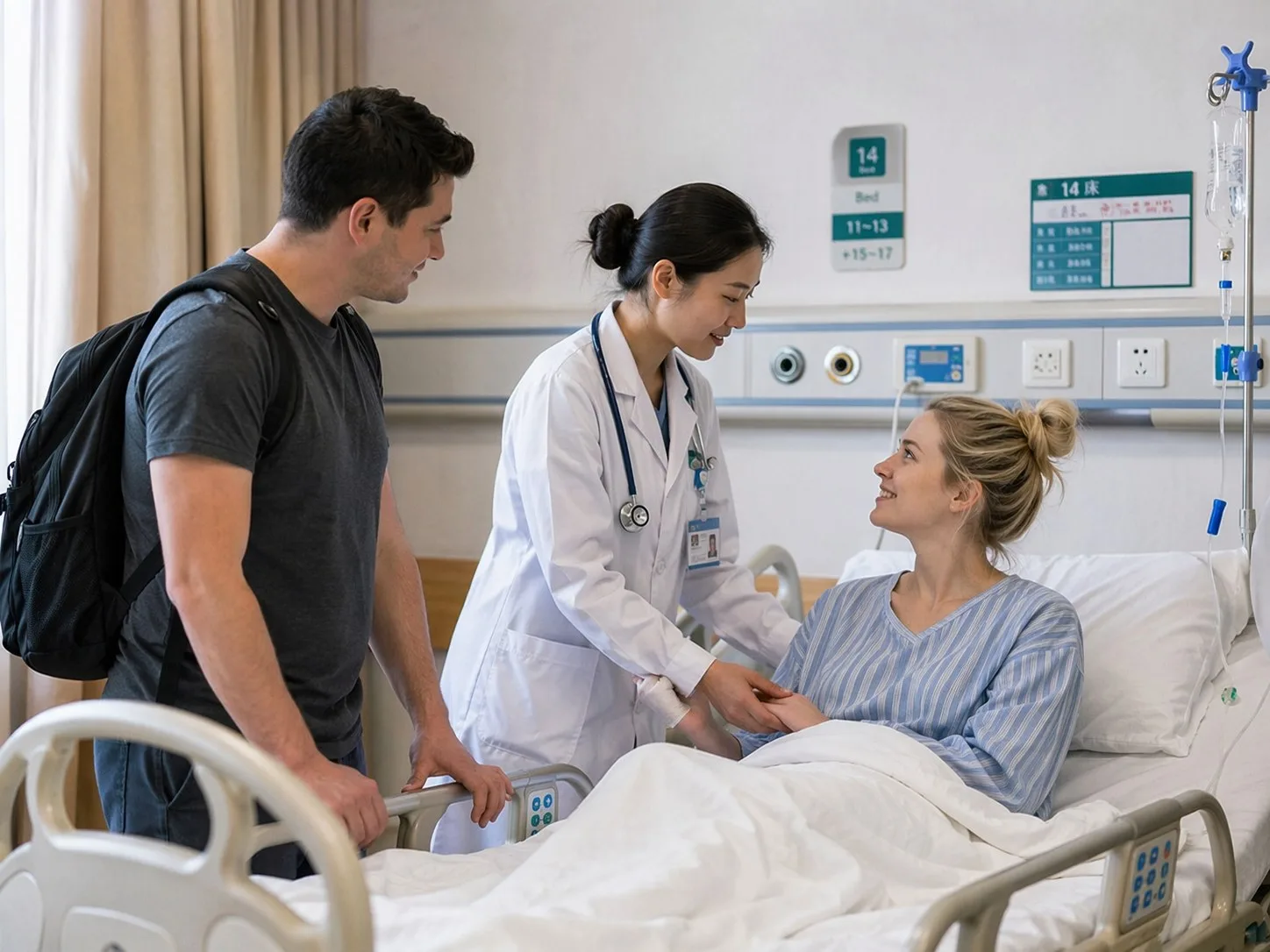
The good news: the four most-visited cities for foreign tourists (Beijing, Shanghai, Guangzhou, Chengdu) all have JCI-accredited international hospitals with English-speaking doctors 24/7. The Chinese public health system is strong, and the recent “China Travel” boom has driven a 73.6% increase in international patient visits at China’s top hospitals between 2022 and 2025. The bad news: the language barrier in emergencies is real (the 110/119/120 hotlines have limited English), and a wrong choice between a public hospital VIP wing and a private international hospital can mean a 5x difference in your out-of-pocket cost.
The 4 numbers every foreigner in China should save
Save these as contacts you can find instantly:
| Service | Number | When to call | English support |
|---|---|---|---|
| Medical emergency / ambulance | 120 | Heart attack, stroke, serious injury, hospital transport | Limited |
| Police | 110 | Crime, theft, assault, lost passport, scams | Limited; ask for the foreign affairs desk |
| Fire | 119 | Fire, gas leak, building evacuation | Limited |
| Multilingual government hotline | 12345 | Non-emergency questions, lost items, language help | Yes — major cities have English operators |
The single most important number for a foreign traveler is your travel insurance 24-hour hotline. Save that, the policy number, and the policyholder name in your phone before you fly. International insurers (World Nomads, SafetyWing, AXA, GeoBlue) all have English-speaking operators who can dispatch help, direct-bill the hospital, and arrange emergency evacuation. They are faster, more reliable, and more useful than 120 for any non-life-threatening emergency.
When to call 120 vs. go to a hospital yourself
Call 120 if: the person is unconscious, has chest pain, can’t breathe, is bleeding heavily, or has had a stroke or serious injury. The ambulance team will stabilize on the way to the nearest appropriate hospital.
Go directly to a hospital if: the situation is urgent but stable — high fever, severe stomach pain, broken bone, deep cut, allergic reaction, severe food poisoning. In tier-1 cities, an Uber or DiDi to an international hospital is often faster than waiting 15-30 minutes for an ambulance that may not speak English.
Go to a clinic (not a hospital) if: mild fever, cough, sore throat, mild stomach upset, mild allergic reaction, small cuts, sprains. Walk-in international clinics (United Family, Jiahui, Parkway) can handle 90% of travel ailments with same-day appointments.
Self-treat at a pharmacy if: diarrhea, common cold, mild allergies, motion sickness, mild altitude sickness, headache, mild sunburn, mosquito bites. See the pharmacy section below.
International hospitals in 4 major cities
Every city has at least 2-3 international hospitals or clinics. All are JCI-accredited (the international standard for hospital quality), accept international health insurance, and have English-speaking doctors on staff.
Beijing
- Beijing United Family Hospital (北京和睦家医院) — Chaoyang District, 2 Jiangtai Road, 24-hour emergency hotline +86 (10) 5927 7120, 24-hour Service Center 4008-919191. The flagship of United Family Healthcare in China, 200+ full-time senior physicians from around the world, JCI accredited, accepts direct billing from World Nomads, AXA, GeoBlue, Cigna, Bupa. Average emergency visit: ¥3,000-8,000 ($420-1,100).
- Peking Union Medical College Hospital (PUMCH, 北京协和医院) — VIP International Wing — Dongcheng District, 9 Dongdan Santiao. Top Chinese hospital overall, the international wing has English-speaking coordinators. By appointment: +86 (10) 6915 5500. Best for complex or specialist cases; cheaper than United Family for the same service level.
- International SOS Beijing — Chaoyang District, Building C, BITIC Jingyi Building, 4 Jiuxianqiao Beilu, +86 (10) 6462 9112. For SOS insurance members and corporate travelers.
Shanghai
- Jiahui International Hospital (上海嘉会国际医院) — Xuhui District, 689 Guiping Road, 24-hour emergency +86 (21) 4008 5000. The newest private international hospital in Shanghai (opened 2018), JCI accredited, 24-hour English emergency, direct billing from major insurers. Average emergency visit: ¥2,500-6,000 ($350-840).
- Parkway Health (百汇医疗) — multiple locations: Shanghai Centre (Jing’an), Jin Mao Tower (Pudong), and others. 6+ clinics across the city, by appointment only, accepts direct billing. Best for non-emergency GP and specialist visits.
- Shanghai United Family Hospital — Pudong District, 1139 Xianxia Road, 24-hour emergency. Sister hospital to Beijing United Family.
Guangzhou
- Guangzhou United Family Hospital — Panyu District, 28 Huakang Road (Clifford Hospital campus), by appointment. International wing of Clifford Hospital.
- Guangdong Provincial People’s Hospital — VIP International Service — Yuexiu District, 106 Zhongshan Er Road. Top public hospital, VIP wing has English coordinators.
- Global Doctor Guangzhou — Tianhe District, by appointment.
Chengdu
- Chengdu Global Doctor (成都环球医生) — Jinjiang District, near Chunxi Road, 24-hour emergency hotline +86 (28) 8528 3638. The main international clinic in Chengdu, by appointment or walk-in for emergencies.
- West China Hospital of Sichuan University — International Service Center — Wuhou District, 37 Guoxue Xiang. Top Chinese hospital, the international center has English coordinators. Best for complex cases; cheaper than private hospitals.
Travel insurance: the thing most travelers forget
If you fly to China without travel insurance that explicitly covers medical evacuation, you are risking a five-figure USD bill if you have a serious accident or illness. A single ICU day at a private international hospital runs ¥15,000-30,000 ($2,100-4,200); a medical evacuation to Hong Kong or Singapore is $50,000-150,000.
The four most-used policies by Western travelers to China:
| Provider | Monthly cost | Emergency medical | Direct billing in China | Best for |
|---|---|---|---|---|
| SafetyWing Nomad Insurance | $40-60 | $250,000 | No (reimbursement only) | Digital nomads, monthly flexibility |
| World Nomads Explorer | $80-150 (per trip) | $100,000 | Yes, at major international hospitals | Tourists, 1-2 week trips |
| AXA Schengen / Asia Assistance | $80-200 | $1-5M | Yes, 24-hour English hotline | Business travelers, longer trips |
| GeoBlue Voyager | $200-500 | $1-5M | Yes, direct billing at United Family and most JCI hospitals | Premium coverage, US citizens |
For a 2-week China trip, AXA Schengen or World Nomads Explorer is the right choice. For 1-12 month stays, SafetyWing (cheap, flexible) or GeoBlue (premium, comprehensive) is better.
The claim process for direct billing: call the 24-hour hotline, give them your policy number, the insurer calls the international hospital to authorize direct billing, you walk in and get treated with no out-of-pocket cost (beyond the policy deductible, usually $100-500).
The claim process for reimbursement (SafetyWing, budget plans): pay the hospital upfront, keep all itemized receipts and the medical report in English, submit the claim via the insurer’s app or website within 30-90 days, expect reimbursement in 2-6 weeks via wire transfer.
Pharmacies and OTC drugs
Chinese pharmacies (药店, yàodiàn) are everywhere — every few blocks in any city, and every hospital has one on the ground floor. Most common travel drugs are sold over the counter without a prescription.
What to ask for, by symptom (Chinese name + pinyin + what it is):
- Diarrhea: 蒙脱石散 (méngtuōshísǎn, montmorillonite) — for acute diarrhea, safe for all ages. Or 思密达 (Sīmìdá, smecta brand).
- Common cold: 999 感冒灵颗粒 (Jiǔjiǔ gǎnmào líng, Sanjiu cold medicine) — most popular OTC in China. Or 板蓝根颗粒 (bǎnlángēn, isatis root, traditional).
- Fever / pain: 布洛芬 (bùluòfēn, ibuprofen) — sold under many brand names. Or 对乙酰氨基酚 (duìyǐxiānānjīfēn, acetaminophen/Tylenol).
- Allergies: 氯雷他定 (lǜléitā dìng, loratadine/Claritin) or 西替利嗪 (xītìqín, cetirizine/Zyrtec).
- Motion sickness: 茶苯海明 (cháběnhǎimíng, dimenhydrinate/Dramamine), sold as 晕海宁.
- Altitude sickness: 高原安 (gāoyuán ān, Rhodiola-based OTC), start 3-5 days before ascending. Serious cases need acetazolamide (Diamox) from your home doctor.
- Cuts / scrapes: 云南白药 (Yúnnán báiyào, Yunnan Baiyao) — traditional hemostatic powder, sold as powder, plasters, sprays. Or 红霉素软膏 (hóngméisù ruǎngāo, erythromycin ointment).
- Indigestion / stomach upset: 健胃消食片 (jiànwèi xiāoshí piàn, digestive aid tablets), or 多潘立酮 (duōpānlìtóng, domperidone/Motilium).
- Mosquito bites: 风油精 (fēngyóujīng, medicated oil), sold as small glass bottles. Or 花露水 (huālùshuǐ, floral water).
Practical tip: download the Pleco app (free Chinese dictionary with offline OCR) before you fly. You can point your phone camera at a Chinese medicine name and get an English translation, or type a symptom and show the Chinese name to the pharmacy staff. For the broader app stack (maps, payments, ride-hailing) see our essential apps for China roundup.
Common travel ailments in China
- Mild stomach upset (1-3 days): water/food adjustment. Drink bottled water, eat cooked food, avoid raw seafood and unpasteurized dairy. Symptoms usually resolve on their own; if not, OTC montmorillonite + oral rehydration salts (口服补液盐). Travelers with food allergies, celiac disease, or who keep kosher or halal should also read our China dietary restrictions guide for what to ask and what to avoid.
- Traveler’s diarrhea (acute): sudden onset, 3+ loose stools in 24 hours. Take loperamide (易蒙停) for symptom relief + montmorillonite. If blood in stool or fever > 38.5°C, see a doctor within 24 hours.
- Common cold / flu: rest, fluids, OTC cold medicine. See a doctor if fever > 39°C or symptoms last > 7 days.
- Altitude sickness (Lhasa, Shangri-La, Daocheng): headache, nausea, fatigue above 3,000m. Start 高原安 3-5 days before, ascend gradually (no more than 600m sleeping altitude per day after 3,000m), drink 3-4L water/day, avoid alcohol. Severe cases (pulmonary or cerebral edema) need immediate descent + hospital.
- Food poisoning: vomiting, diarrhea, cramps. Hydrate, rest, see a doctor if blood in stool or symptoms persist > 24 hours.
- Allergic reaction: antihistamine (loratadine). If throat swelling or difficulty breathing, go to ER immediately.
- Heat stroke (summer in central/southern China): move to shade, cool with water, drink electrolytes. Hospital if confused or unconscious.
- Sunburn (summer, Tibet, Yunnan): aloe vera gel, hydration, SPF 50+ next time.
Embassy contacts and emergency evacuation
Save your country’s embassy or consulate in Beijing and your destination city’s consulate (Shanghai, Guangzhou, Chengdu, Wuhan all have consulates for most major countries). They can help with:
- Lost or stolen passport
- Arrest or detention
- Emergency communication with family
- Connecting you with English-speaking doctors
- Coordinating medical evacuation (with your insurance)
For medical evacuation specifically, your travel insurance 24-hour hotline is the right first call — they have dedicated air ambulance services and can coordinate with your embassy. Hospital registration and deposit are typically paid by Alipay, WeChat Pay, or credit card — see our Alipay for foreigners 2026 guide for how to set up the app so the cashier doesn’t make you the bottleneck.
Verified August 2026 by TravelHubChina Editorial. Hospital contact details and pricing re-checked monthly. Last updated: 2026-08-05.
Step by step
-
Save the 4 emergency numbers + your insurance hotline before flying
Add 120 (medical), 110 (police), 119 (fire), and 12345 (multilingual) to your phone contacts. Most importantly, save your travel insurance 24-hour English hotline (World Nomads, SafetyWing, AXA, GeoBlue) and policy number. The insurance line dispatches English-speaking help and direct-bills the hospital — faster and more reliable than 120 for non-life-threatening emergencies.
-
Buy travel insurance that covers medical evacuation
For a 2-week China trip, AXA or World Nomads Explorer ($80-200/month) covers emergency medical $1-5M and direct billing at international hospitals. For 1-12 month stays, SafetyWing ($40-60/month, reimbursement only) or GeoBlue Voyager ($200-500/month, premium with direct billing). Without insurance, an ICU day at a private international hospital runs ¥15,000-30,000 ($2,100-4,200).
-
Identify the nearest JCI-accredited international hospital
Beijing: Beijing United Family (Chaoyang, 24-hour ER). Shanghai: Jiahui International (Xuhui, 24-hour ER). Guangzhou: Clifford Hospital VIP wing. Chengdu: Global Doctor. All have English-speaking doctors 24/7, JCI accreditation, and direct billing from major insurers. Save the address and number before you need it.
-
Decide: call insurance hotline, call 120, DiDi to hospital, or go to pharmacy
Life-threatening (unconscious, chest pain, can't breathe, heavy bleeding) → call insurance hotline first, then 120. Urgent but stable (high fever, severe pain, broken bone) → DiDi to an international hospital directly. Mild symptoms (cold, mild diarrhea, allergies) → walk to a Chinese pharmacy (药店) for OTC drugs. Most common travel drugs are sold over the counter without a prescription.
-
Pack a small medical kit from home
Bring 1-2 weeks of any prescription medication in original packaging + a copy of the prescription. Add OTC: loperamide (anti-diarrheal), ibuprofen, loratadine (antihistamine), oral rehydration salts, SPF 50+, any asthma inhaler. Download Pleco for offline Chinese translation of pharmacy names and symptoms.
FAQ
-
What is the emergency number in China for medical?
120 is the medical emergency number in China (ambulance). For most foreign travelers, the more reliable path is to call your travel insurance 24-hour hotline first (World Nomads, SafetyWing, AXA, and GeoBlue all have English-speaking operators who dispatch help and direct-bill the hospital). 120 ambulances are reliable in tier-1 cities (Beijing, Shanghai, Guangzhou, Shenzhen, Chengdu) but may take 15-30 minutes; in tier-2 and tier-3 cities the response time can be 30-60+ minutes, and the ambulance may not have English-speaking staff. For non-urgent medical issues, go directly to a JCI-accredited international hospital — United Family, Jiahui, Parkway, or Global Doctor have English-speaking doctors 24/7 in the major cities. -
Is there an English-speaking doctor in Beijing/Shanghai for foreigners?
Yes — every major Chinese city has multiple international hospitals and clinics with English-speaking doctors. Beijing: Beijing United Family Hospital (和睦家, Chaoyang, 24-hour emergency), Peking Union Medical College Hospital VIP international wing (东单, by appointment), and International SOS Beijing. Shanghai: Jiahui International Hospital (嘉会, Xuhui, 24-hour emergency), Parkway Health (百汇, multiple locations), Shanghai United Family (和睦家, Pudong). Guangzhou: Clifford Hospital VIP wing (祈福, Panyu), Guangzhou United Family. Chengdu: Chengdu Global Doctor (环球医生, near Chunxi Road), West China Hospital of Sichuan University international service center. Most major international hospitals are JCI-accredited and accept direct billing from World Nomads, AXA, GeoBlue, and the major international insurers. -
How much does it cost to see a doctor in China as a foreigner?
At a public hospital VIP/international wing, an English-speaking doctor consultation runs ¥500–1,500 ($70–210) for a general practitioner and ¥800–2,500 ($110–350) for a specialist. A full blood panel + chest X-ray + ECG walk-in package is typically ¥1,500–3,000 ($210–420). At a private international hospital (United Family, Jiahui, Parkway), prices are 30-60% higher but the experience is closer to a US clinic: ¥1,200–3,000 ($170–420) for a GP visit, ¥2,000–5,000 ($280–700) for a specialist, and ¥3,000–8,000 ($420–1,100) for a standard emergency room visit before any tests. The same services at a Cleveland Clinic or Mayo Clinic equivalent are typically 3-5x more expensive than China. If you have travel insurance with direct billing, you pay nothing out of pocket at the international hospital — the insurer settles directly. -
What travel insurance covers medical in China?
Three categories of travel insurance cover medical in China, with different price points: (1) Budget ($40-100/month): SafetyWing Nomad Insurance, World Nomads Explorer — covers emergency medical up to $100,000-$250,000, evacuation up to $300,000, but you pay upfront and claim reimbursement (2-6 week wait). (2) Mid-tier ($80-200/month): World Nomads Annual, AXA Schengen-equivalent, IMG PatriotLite — covers emergency medical $1M-$5M, direct billing at international hospitals via 24-hour hotline, evacuation $1M+. (3) Premium ($200-500/month): GeoBlue Voyager, Cigna Global Health, Bupa Global — covers everything mid-tier does plus pre-existing conditions (with waiver), routine care, dental, and direct billing at virtually every international hospital worldwide. For a 2-week China trip, mid-tier AXA or World Nomads Annual is enough; for digital nomads staying 1-12 months, SafetyWing or GeoBlue. -
Can I buy medicine at a Chinese pharmacy without a prescription?
Yes — Chinese pharmacies (药店, yàodiàn) sell most common OTC drugs over the counter without a prescription. For antibiotics and stronger medications you need a prescription from a Chinese doctor, but for typical travel ailments (diarrhea, cold/flu, allergies, mild pain, motion sickness, altitude sickness, mosquito bites) you can walk in, point to what you need (or show the Chinese name on your phone), pay, and leave. Common OTC drugs available: 蒙脱石散 (montmorillonite) for diarrhea, 板蓝根 (banlangen) for colds, 999 感冒灵 (San Jiu cold medicine), 布洛芬 (ibuprofen) under various brands, 氯雷他定 (loratadine) for allergies, 红霉素软膏 (erythromycin ointment) for skin infections, 云南白药 (Yunnan Baiyao) for cuts and bruises, and 高原安 (Gaoyuan An) for altitude sickness. Most pharmacy staff in tourist areas understand 'I have a stomachache' or 'I have a cold' even without English — use the Pleco app or Google Translate to point at the Chinese name. -
Is China safe for foreign tourists medically?
Yes — China is one of the safest major travel destinations medically for foreign tourists in 2026. The country has a strong public health system, the four most-visited cities (Beijing, Shanghai, Guangzhou, Chengdu) all have JCI-accredited international hospitals with English-speaking staff, and the China Travel boom has driven 128 million international patient visits in 2025 across 850+ medical institutions. The main risks to be aware of: (1) language barrier in emergencies — 110/119/120 have limited English support, your insurance 24-hour hotline is more reliable; (2) food/water adjustment for the first 2-3 days — mild stomach upset is common, bring OTC anti-diarrheal from home; (3) altitude sickness if you visit Lhasa, Shangri-La, or Daocheng — ascend gradually, drink water, and ask for 高原安 at any pharmacy; (4) air pollution in winter (Dec-Feb) in northern cities — bring any asthma or respiratory medication; (5) scams at non-international hospitals — stick to JCI-accredited international hospitals or your insurance's network to avoid the rare but real 'overcharging foreigner' risk at public hospital VIP wings.
Related guides
- Stays & Hotels
Medical Tourism to China 2026: The Complete Foreigner's Guide (Cost, Hospitals, Visa, Insurance)
Medical tourism to China in 2026: 1.5M+ foreign patients yearly at 850+ designated medical institutions (+73.6% growth from 2022), 50-70% cheaper than the US on dental, cosmetic, fertility, cancer, and check-ups. Cost comparison tables, 240h/144h/30-day/M-visa pathways, top 5 cities (Beijing, Shanghai, Guangzhou, Chengdu, Boao), 9 most popular treatments, JCI hospital list, international insurance direct billing (GeoBlue, AXA, Cigna, MSH). The most complete EN-language guide for foreign patients considering China.
18min read
- Tools & Resources
Lost Passport in China: 2026 Emergency Guide for Foreigners (What the Embassy Won't Tell You)
Lost your passport in China? Here is the 2026 reality: a police report is required before the embassy will help, the China Foreign Affairs 24/7 English hotline 12308 works for ALL foreigners (not just Chinese citizens), emergency travel documents take 1-3 working days, full passport replacement takes 2-6 weeks, and 4 things most embassies don't tell you upfront (no weekend processing, biometrics required even for ETDs, you may need a new visa to re-enter, hotel registration blocks the police report if your stay record is incomplete). Step-by-step plan: secure your money first, file the police report at a local 派出所, contact your embassy/consulate emergency line, request an emergency travel document (ETD), and 5 prevention steps to take before your next trip.
12min read
- Tools & Resources
Bringing Prescription Medication to China: 2026 Complete Guide for Foreigners (What Pharmacists Don't Tell You About Controlled Substances)
Bringing prescription medication to China in 2026? Here is the reality most travelers learn the hard way: China treats ADHD stimulants (Adderall, Ritalin, Vyvanse, Concerta) as Class I narcotics — any quantity is confiscation + potential detention; pseudoephedrine cold medicines (Sudafed, Claritin-D) are restricted because they can be made into meth; codeine is schedule-controlled even in OTC cough syrup; benzodiazepines (Xanax, Valium) are limited to 7 days; ALL cannabis products including CBD are banned outright; and 4 things your home pharmacist won't tell you (Chinese customs doesn't recognize foreign prescriptions, you must declare controlled drugs in the RED channel not the green one, embassy confirmation is required 4-6 weeks before travel for Class I substances, and a US/EU prescription can lead to criminal prosecution under China's Narcotics Control Law if quantities exceed the limits). The 5-category system that decides your risk + the 5-step pre-flight protocol + the 4 in-China alternatives to bring-in medication.
12min read
- Stays & Hotels
Dental Tourism in China 2026: $550-$1,100 Implants vs $3,000-$6,000 in the US (Complete Foreigner's Guide)
Dental tourism in China in 2026: post-2023 NHSA bulk procurement pricing cut implant costs 55% — a single dental implant averages $550-1,100 in international hospitals ($250-450 in public hospital VIP wings) vs $3,000-6,000 in the US, All-on-4 full arch $5,000-10,000 per arch vs $20,000-35,000 in the US, veneers $400-700 per tooth vs $1,200-2,500, full-mouth restoration from $8,000 vs $40,000-80,000. 6 top dental hospitals for foreigners (Beijing United Family Dental, Jiahui International Dental, Parkway Dental 6+ clinics, Arrail 瑞尔, Modern Dental, Am-Sino 鼎植口腔), all available implant brands (Swiss Straumann, Korean Osstem, Chinese Angelet, German Bego, Nobel Biocare), step-by-step implant process, 240h visa-free and 30-day visa-free coverage, insurance/payment options, sample 5-day Beijing dental itinerary. The most complete EN-language guide for foreign patients considering dental work in China.
14min read
- Food & Dietary
China Food by City: 8 Cities, 24 Iconic Dishes
A guide to Chinese regional food by city — the 8 most foodie-worthy cities for foreign visitors, the 3 iconic dishes in each, and where to find them. Beijing, Shanghai, Chengdu, Guangzhou, Hong Kong, Xi'an, Hangzhou, Chongqing.
14min read
- Stays & Hotels
Trip.com vs Booking.com in China 2026
Side-by-side comparison of Trip.com, Booking.com, Agoda, and Airbnb in China. Pricing, foreign-card support, English interface, real customer support, and which wins in 2026.
9min read