

China Travel Safety: 110/119/120 + Lost Passport
China travel safety 2026: real 110/119/120/122 emergency numbers, 12345 hotline, lost passport playbook, scam patterns, and the apps that protect you.
The hardest part of a China trip going wrong isn’t the moment something goes wrong — it’s the 30 minutes after, when you don’t know the emergency number, you don’t have your embassy contact, and you’re trying to remember if the credit card hotline works internationally. This guide is the one you read before you fly, so when the moment comes you’re operating from memory, not panic.
China is, statistically, one of the safest countries in the world for foreign visitors in 2026. The violent-crime rate is dramatically below the US, UK, and most of Europe. The cities are heavily CCTV-monitored. The transport is clean and reliable. The Chinese concept of “face” means strangers will go out of their way to help you in a crisis. But the country has specific friction points — the language barrier in emergencies, the 110 hotline routing through a Chinese-only call center, the 2024–2026 phone-scam wave targeting foreigners, and the very real “your card gets frozen the moment you do something unusual” risk.
This is the playbook for all of it.
The 4 emergency numbers you need in your phone, in order
Save these as contact names you can find instantly. English-speaking operators are NOT guaranteed on 110/119/120/122. For most emergencies, your best bet is to call your embassy’s after-hours line first, or use the 12345 non-emergency hotline which has English support.
| Service | Number | When to call | English support |
|---|---|---|---|
| Police | 110 | Crime, theft, assault, scams involving financial loss, lost passport report, fraud | Limited; for English, ask for the “foreign affairs” or “110 涉外” desk |
| Fire | 119 | Fire, gas leak, building evacuation | Limited |
| Ambulance / medical emergency | 120 | Medical emergency, hospital transport | Limited |
| Traffic accidents | 122 | Car accidents, hit-and-run | Limited |
| Non-emergency multilingual | 12345 | Lost item, dispute, hotel refused check-in, taxi issue, anything not life-threatening | Yes — full English and Chinese |
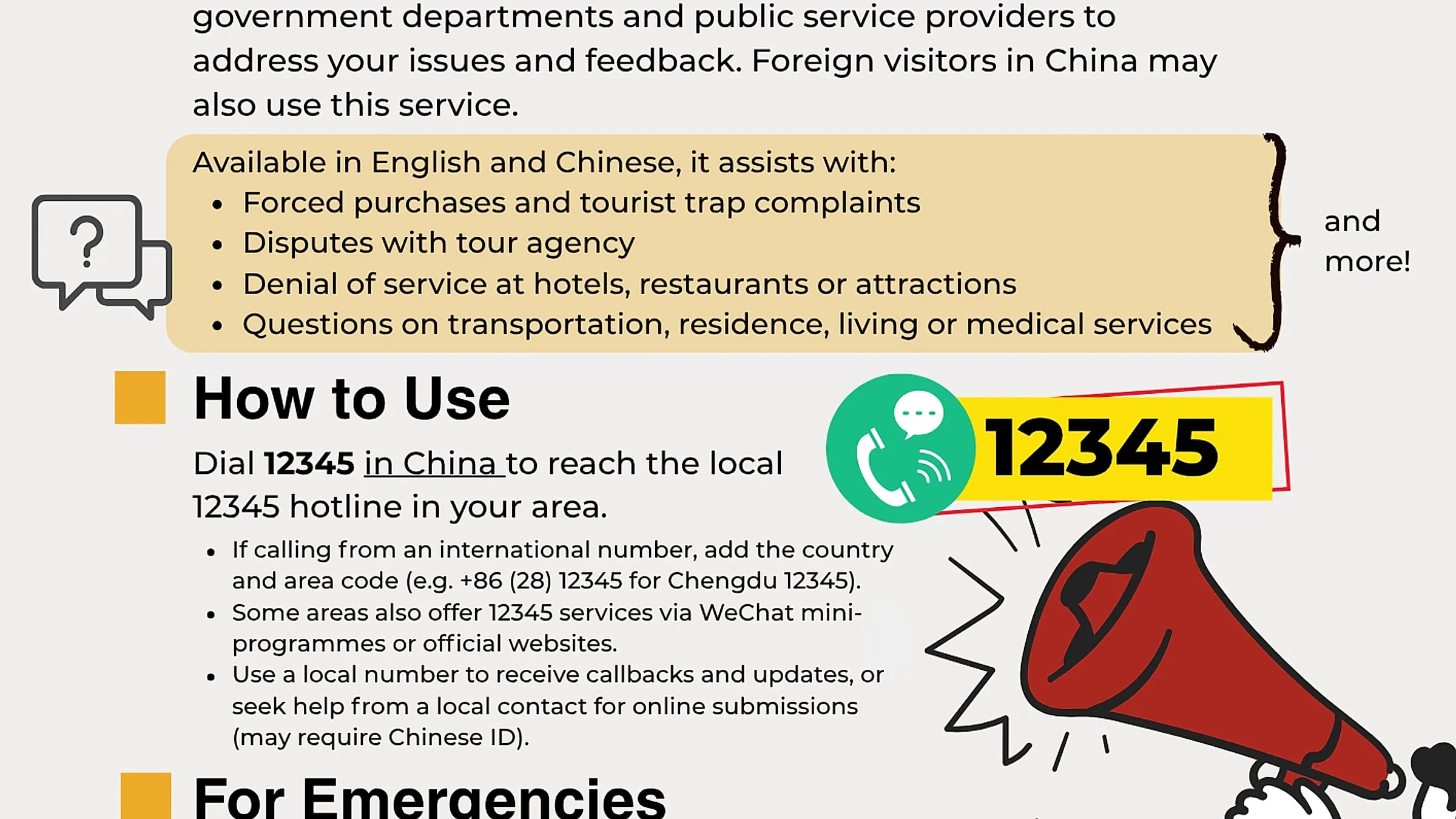
The single most useful number on this list is 12345. It launched nationwide in 2024 as the consolidated citizen-service hotline, with full English support in 30+ major cities. If your card gets stuck in an ATM, your hotel refuses to check you in, a vendor overcharges, or you can’t find a lost item — call 12345, describe the problem in English, and they’ll either resolve it directly or transfer you to the right department. It’s the only “real” English-language emergency-adjacent hotline in mainland China.
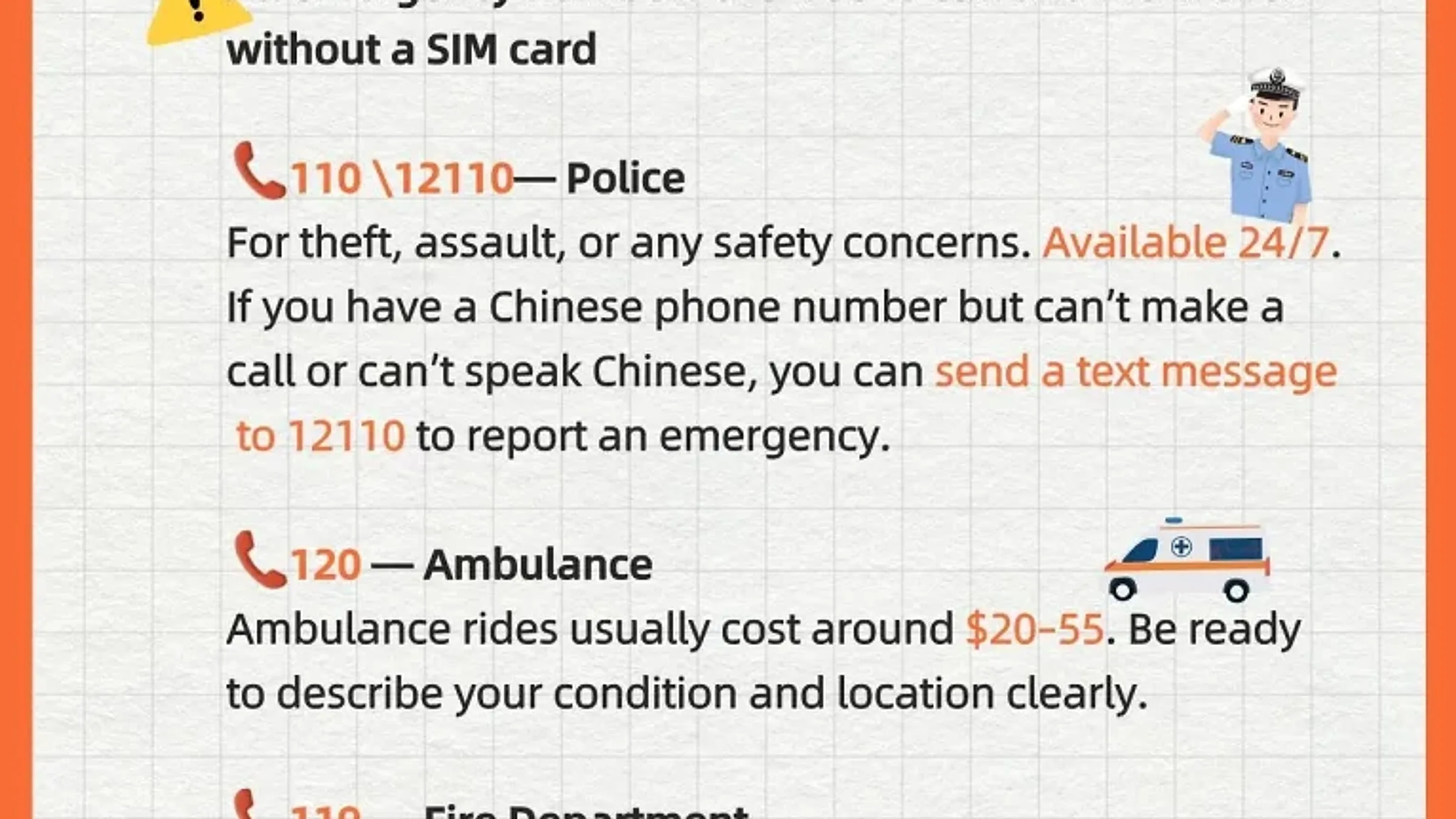
For the actual emergency numbers (110/119/120/122), here is a clean reference infographic:
The lost passport playbook (the 5-step process)
Losing your passport in China is the most common major-issue scenario for foreign visitors. It is annoying but absolutely solvable. The timeline is 2–5 business days for emergency replacement, and the cost is $0–$200 depending on your country.
Step 1: File a police report (110 or 12345)
If your passport was stolen, you must file a police report. The 110 call center can dispatch an officer to your location (English: ask for “涉外警” / “foreign affairs police”) or direct you to the nearest station. You get a “报案证明” (Police Report / Loss Report) with a case number. Keep this — you need it for the embassy, the airline, and any insurance claim.
If your passport was lost (not stolen), you can still file a report, but you can also skip this step and go directly to the embassy. Filing a report takes 1–3 hours at a station.
Step 2: Contact your embassy or consulate
Every major foreign embassy in China has a 24/7 emergency line. Save the number before you fly.
| Country | Embassy in Beijing | 24/7 emergency line |
|---|---|---|
| United States | +86 10 8531 4000 | +86 10 8531 4000 |
| United Kingdom | +86 10 5192 4000 | +86 10 5192 4000 |
| Canada | +86 10 5139 4000 | +86 10 5139 4000 |
| Australia | +86 10 5140 4111 | +86 10 5140 4111 |
| Germany | +86 10 8532 9000 | +86 10 8532 9000 |
| France | +86 10 8532 8080 | +86 10 8532 8080 |
| Japan | +86 10 8531 9800 | +86 10 8531 9800 |
| South Korea | +86 10 8531 8000 | +86 10 8531 8000 |
| Singapore | +86 10 8531 1110 | +86 10 8531 1110 |
| New Zealand | +86 10 8531 7000 | +86 10 8531 7000 |
| India | +86 10 8531 2500 | +86 10 8531 2500 |
Shanghai, Guangzhou, Chengdu, Chongqing, Shenyang, Wuhan, and Hong Kong all have consulates that can issue emergency travel documents. The list above is the Beijing embassy; if you’re in another city, the Beijing number can transfer you.
Step 3: Apply for an emergency travel document (ETD)
Bring to the embassy:
- Police report (if filed)
- 2 passport photos (most embassies can take these on-site for a small fee)
- A copy of your itinerary and proof of onward travel
- A copy of your original passport (photo, ID page) if you have one
- Cash or card for the ETD fee (varies by country, typically $50–$200)
The ETD allows you to exit China and re-enter your home country, but it’s not a full passport replacement. Some countries (US, UK, Canada) issue the ETD same-day; others (Australia, EU) take 2–5 business days.
Step 4: Notify your hotel and airline
Most airlines will let you rebook the flight without a fee if you have a police report. The hotel can extend your stay without re-booking. Do this within 24 hours of the loss.
Step 5: Apply for a replacement passport at home
The ETD is for getting home. Once home, apply for a full replacement passport at your country’s passport office. The Chinese ETD does NOT count as a visa; you’ll need a new visa (if your country requires one for China) for any return trip.
Pro tip: the International SOS membership ($100–$300/year) gives you a single point of contact for embassy coordination, hotel rebooking, and emergency cash — invaluable if you lose your passport in a Tier-2 city.
The lost phone playbook
Losing your phone in China is a much bigger problem than in most countries, because your phone is your wallet, your map, your translation, and your authentication for everything.
Step 1: Use a friend’s phone to log out of critical apps
If you have a friend, partner, or hotel staff with a phone, have them:
- Log out of Alipay (Tour Card) on your lost device
- Log out of WeChat Pay (if you have a Chinese account)
- Log out of DiDi
- Log out of email
If you’re alone, use your hotel’s front-desk computer or a hotel phone.
Step 2: Call your carrier to suspend service
Your home carrier’s international customer service line will suspend your number. The new eSIM activation (from your provider’s app) usually requires a working number — so get a backup physical SIM or eSIM before you fly. Airalo, Holafly, and Nomad all sell eSIMs that work in China.
Step 3: Get a replacement
A new phone in China costs $300–$1,000 depending on the model. The Apple Store, Samsung, and Huawei stores are in every Tier-1 city. If you’re flying home within 24 hours, you can wait.
Step 4: Re-set up Alipay and DiDi
A new device means a new device ID for Alipay. You can call the Alipay international hotline +86 571 2688 8888 to verify your identity and re-bind your card. The process takes 1–3 hours.
The 6 scams targeting foreigners in 2026
These have been documented across Reddit r/China, TripAdvisor, and the China Travel Advisory boards. The 90% rule still holds: if a stranger approaches you with a “free” or “special” offer, walk away.
1. The “tea ceremony” / “art student” scam
Documented in detail in our solo female travel guide. A young Chinese person (often a woman) approaches you near a tourist area, invites you to a tea house / art studio / friend’s shop. The bill is $200–$500. Two large men are at the door. The fix: decline all such invitations.
2. The “I need help” / “lost wallet” scam
A person claims to be a foreign student who has lost their wallet / passport / phone and needs cash urgently to get home. The story is elaborate, the documents (if shown) are fake. The fix: direct them to their embassy, walk away.
3. The “unlicensed taxi” overcharge
A driver (usually at an airport or train station) claims the meter is broken, quotes a flat fare 5–10x the actual rate, and refuses to use the meter. The fix: use DiDi. The price is fixed in the app. The driver cannot renegotiate.
4. The “black market” currency exchange
Someone approaches offering to exchange money at a “better rate” than the bank. The bills are real or partially real, but the count is short, the bills are old foreign currency, or the rate is the same as the official rate after the fake bills. The fix: use your bank’s ATM, use a licensed exchange counter, or use Alipay for payment. Never exchange cash on the street.
5. The “fake” ticket / tour scam
A vendor sells “Great Wall tickets” / “Forbidden City tickets” / “Terracotta Army tickets” at a discount. The tickets are fake or expired. The fix: book all major attractions on the official site, Klook, or Trip.com. Walk-up tickets to most major sites are now online-only.
6. The “massage parlor” bait-and-switch
A “nice” massage parlor offers a special rate, then the bill includes services you didn’t ask for. The fix: book reputable massage parlors (hotel spas, recognized chains) in advance. Don’t go to walk-in parlors in nightlife districts.
The 4 phone-related risks and how to avoid them
- Your card getting frozen — the most common “uh oh” moment. Chinese fraud systems are aggressive; a transaction pattern that’s unusual for your card (large purchase, new city, new merchant type) can trigger a freeze. The fix: call your card’s international customer service line the moment you arrive in China to let them know you’ll be transacting. Save the number before you fly. For Amex, that’s +1-336-393-1111. For Visa, +1-303-967-1098. For Mastercard, +1-636-722-7111.
- Your Alipay Tour Card being flagged — Alipay’s anti-fraud system sometimes blocks first-time foreign users. The fix: complete the full KYC (passport + selfie + card) before you leave home. The Alipay app has a “Tour Card” setup wizard that walks you through it.
- VPN getting throttled or blocked — see our VPN guide for current 2026 recommendations. The short version: Astrill, Mullvad, and LetsVPN are the most reliable. Install before you fly.
- Phone number requirement for some apps — WeChat, Meituan, and Dazhong Dianping require a Chinese phone number for full features. The fix: get a Chinese eSIM or physical SIM at the airport on arrival. China Unicom has the best foreigner-friendly tourist SIMs ($15–$30 for 7–30 days with 3–30 GB data).
Travel insurance: what you actually need in 2026
For a China trip, the must-haves are:
- Medical coverage — minimum $100,000, ideally $250,000. The Chinese hospital system is excellent in Tier-1 cities but expensive without insurance.
- Medical evacuation — minimum $250,000. If you have a serious medical event in a Tier-2 city, you may need air ambulance to Beijing/Shanghai/Hong Kong.
- Trip cancellation — for pre-paid bookings, $5,000 minimum.
- Lost passport / theft coverage — $1,000 minimum, including emergency cash advance.
- Adventure sports coverage — if you’re doing the Great Wall hike, Yangshuo rafting, or any “active” itinerary, confirm your policy includes it. World Nomads and SafetyWing are the two policies that consistently include adventure sports at the base tier.
The 2026 picks:
- SafetyWing Nomad Insurance — $56–$80/month, digital nomad-friendly, includes adventure sports. Good for multi-country Asia trips.
- World Nomads — $100–$200/month depending on age and trip length, comprehensive, well-tested. The standard for most Western travelers.
- Allianz Travel — $80–$200/month, mainstream, easy claim process. Good for first-time insurance buyers.
- AXA China — if you want a policy that specifically understands the Chinese hospital system, AXA is the strongest brand. Slightly higher cost.
The 4-line insurance checklist: before you fly, (1) buy the policy, (2) save the policy number and 24/7 emergency number in your phone, (3) email a copy of the policy to yourself and a family member, (4) bring 2 paper copies.
The 3 things most travelers forget
- Register with your embassy — the STEP program (US), LOCATE (UK), Registration of Canadians Abroad (Canada), and Smartraveller (Australia) all let you register your trip so the embassy knows you’re in the country. If a major incident happens (earthquake, typhoon, political event), they’ll proactively contact you.
- Print backup of every document — passport, visa, insurance, hotel bookings, flight confirmations, embassy contacts, emergency numbers. Keep the prints separate from your phone (a different bag). Chinese immigration at the airport can ask for a printed hotel booking; if your phone dies, you need the print.
- Download a VPN before you fly — Google, Gmail, WhatsApp, Instagram, Facebook, X, Reddit, Wikipedia, and most Western news sites are blocked in mainland China. The VPN sites themselves are blocked, so you cannot download after you arrive. Install 2 VPNs and test them before you leave home.
The 4-line bottom line
- Save these 5 numbers before you fly: 110 (police), 119 (fire), 120 (ambulance), 122 (traffic), 12345 (multilingual non-emergency — the most useful), plus your embassy’s 24/7 line.
- Get comprehensive travel insurance ($100+/month) with medical, evacuation, and lost-document coverage. Save the policy number and emergency hotline.
- Install a VPN before you leave home — Astrill, Mullvad, or LetsVPN. The China VPN sites are blocked; you cannot download after you arrive.
- Print backups of every document and store them in a separate bag. Your phone is your wallet, map, and translation; if it dies or is lost, the print is your fallback.
China in 2026 is genuinely one of the safest countries you can visit. The violent-crime rate is a fraction of Western countries. The cities are well-lit, well-monitored, and the people are curious and helpful. The risks are specific (scams, language barrier in emergencies, the card-freeze issue), and the playbook above handles all of them. Read it once before you fly, save the numbers, and enjoy the trip.
Where to book
The two big-ticket prep items for a safe China trip — internal transport and the base accommodation — book these first:
- Compare hotels in safe, central neighborhoods of Beijing, Shanghai, Chengdu, and Hangzhou (filter by 24h reception and English-speaking staff — the two non-negotiable safety markers)
- Search domestic flights within China (use DiDi from the airport — the fixed app price eliminates the taxi-meter scam and is the safest first-night move)
Affiliate disclosure: Some links above are affiliate links. We may earn a commission at no extra cost to you. See full disclosure .
Plan your trip — verified tools
These free tools are built on real, monthly-verified data and help you skip the trial-and-error phase of China trip planning:
- China 6-City 5-Day Budget Calculator — Real 2026 prices for 5 days in Beijing, Shanghai, Guangzhou, Chengdu, Xi’an, or Hangzhou. Budget / mid-range / comfort tiers, broken down line by line.
- China 240-Hour Visa-Free Transit Checker — 57 countries, 24 provinces, 65 ports. See if you qualify for 10-day visa-free transit, which cities you can visit, and the 5-step process.
- China eSIM Finder 2026 — Pick the right China eSIM in 30 seconds. Airalo vs Holafly vs Nomad with 2026 pricing, coverage by city tier, and a VPN firewall quick-reference.
- China OTA Comparison 2026 — Trip.com vs Booking.com vs Agoda vs Klook across 5 booking types. Inventory, pricing, foreign card support, English service, per-OTA verdict.
Verified August 2026 by TravelHubChina Editorial. We re-check prices and policy details monthly so the data doesn’t drift.
Related: China common scams
Related: China travel etiquette
Related: China sick in foreigners guide
Step by step
-
Save the 5 emergency numbers in your phone before flying
Add 110 (police), 119 (fire), 120 (ambulance), 122 (traffic), and 12345 (English-speaking non-emergency) to your contacts, plus your embassy's 24/7 line. The 12345 hotline is the most useful — it handles lost passports, hotel disputes, and taxi issues with full English support.
-
Set up Alipay and WeChat Pay with a foreign Visa/Mastercard
98% of urban Beijing merchants accept Alipay and ~90% accept WeChat Pay. Download both apps at home, complete real-name verification with your passport, and link a Visa/Mastercard. Bring 2,000-3,000 yuan cash as backup for vendors that don't take QR.
-
Buy comprehensive travel insurance ($100,000+ medical, $250,000+ evacuation)
Recommended: SafetyWing ($56-80/month), World Nomads ($100-200/month), or Allianz ($80-200/month). Confirm adventure-sports coverage if hiking the Great Wall or Yangshuo. Save the policy number and 24/7 emergency hotline in your phone and email a copy to yourself.
-
Install a VPN before you fly and test it on a different WiFi
Google, Gmail, WhatsApp, Instagram, Facebook, X, and YouTube are blocked in mainland China; the VPN download sites themselves are blocked too. Install 2 VPNs (e.g. ExpressVPN + NordVPN) and test them at home. Bring paper backups of every document in case your phone dies or is lost.
-
Print backups and register with your embassy before departure
Print your passport, visa, insurance, hotel bookings, flight confirmations, embassy contacts, and emergency numbers — keep the prints in a separate bag. Enroll in your embassy's traveler program: STEP (US), LOCATE (UK), Registration of Canadians Abroad (Canada), or Smartraveller (Australia).
FAQ
-
Is China safe for tourists in 2026?
Yes. China is consistently ranked among the safest countries in the world for violent crime, with low rates of street theft, assault, and scams. The main safety concerns for tourists are traffic (jaywalking, scooter lanes), tap water (always bottled), and petty scams at tourist sites. Violent crime against foreigners is extremely rare. -
What emergency numbers should I know in China?
The three main numbers: 110 (police), 120 (ambulance), 119 (fire). For tourist-specific help, dial 12301 (national tourism complaint hotline, English support). For English-language police assistance in major cities, contact your embassy or the local Foreign Affairs Office. The 12345 government service hotline handles most non-emergency issues. -
Can I drink tap water in China?
No. Tap water in China is not potable — it is treated but not to drinking standards. Always drink bottled water (ubiquitous, ¥2-3 per 500 ml) or filtered water. Hotel rooms provide a kettle and free bottled water. Avoid ice in drinks at small establishments, and brush your teeth with bottled water if you have a sensitive stomach. -
What should I do if I lose my passport in China?
Go to the local Public Security Bureau (PSB) entry-exit administration office (公安局出入境管理处) to report the loss and get a police report. Then take the report to your embassy or consulate to get an emergency travel document or replacement passport. Most embassies in Beijing, Shanghai, Guangzhou, and Chengdu can issue emergency documents within 1-3 days.
Related guides
- Tools & Resources
China Daily Budget 2026: Beijing, Shanghai + 5 More
Verified 2026 per-person daily budget for 7 China cities in 4 travel styles. Line-item breakdown and 4 city-specific cost traps to avoid.
10min read
- Tools & Resources
Trip.com for Foreigners: The Complete 2026 Guide
Complete 2026 Trip.com guide for foreign travelers: registration, payment methods, coupons, 6-tier loyalty, refunds, price-match, and 5 places where Trip.com is the wrong choice. Verified 2026-09-06.
9min read
- Tools & Resources
Cheapest Flights on Trip.com (2026): Timing + Hacks
Verified 2026 playbook for booking the cheapest flights on Trip.com — booking windows, cheapest days, Air Flexibility, Bundle-and-Save, Price Alerts, and 5 China flight tips. Verified 2026-09-06.
8min read
- Tools & Resources
China Travel Insurance: Complete 2026 Guide (Best Plans, Costs, and What You Actually Need)
Do you need travel insurance for China? Compare the top 5 plans for 2026 (World Nomads, SafetyWing, Allianz, IMG, Seven Corners) by cost, medical coverage, evacuation, adventure activities, and pre-existing conditions. Plus what China-specific risks insurance must cover, how to claim if hospitalized, and the cheapest way to get $100K+ medical coverage.
9min read
- Tools & Resources
How Much Does a Trip to China Cost in 2026? Complete Budget Guide by Travel Style
Real 2026 prices for a trip to China: 3 budget tiers (backpacker $80-150/day, mid-range $200-350, comfort $500+) with line-item breakdown for accommodation, food, transport, attractions, and visas. Plus 5 sample 7-14 day itineraries with total cost, 15 money-saving tips, and the full payment methods guide (Alipay, WeChat Pay, cash, credit card).
11min read
- Tools & Resources
Trip.com vs Booking.com vs Klook for China (2026): Which One, When
Honest 2026 comparison of the 3 booking platforms foreign travelers actually use for China. Real prices, real inventory, real scenarios — not 'Trip.com is cheaper' marketing. Beijing 3-day worked example included.
12min read