
China's Top 3 Scenic Wonders Compared: Zhangjiajie vs Huangshan vs Jiuzhaigou (2026)
Zhangjiajie (sandstone pillars), Huangshan (sea of clouds + granite peaks), Jiuzhaigou (turquoise lakes + waterfalls). Decision guide covering which fits your time, budget, fitness level, photography goals, and travel style. Prices, distances from Shanghai/Beijing, best seasons compared.
The three most-photographed natural landscapes in mainland China are Wulingyuan in Zhangjiajie (Hunan), Mount Huangshan (Anhui), and Jiuzhaigou Valley (Sichuan). All three are UNESCO World Heritage Sites, all three get 10+ million visitors a year, and all three have daily visitor caps to manage crowds. They are very different landscapes, so the right choice depends on what kind of scenery, effort, and trip structure you want.
This article compares them side by side, then gives a decision framework for which to pick, and finally a route to combine all three if you have the time.
At a glance
| Zhangjiajie | Huangshan | Jiuzhaigou | |
|---|---|---|---|
| Province | Hunan | Anhui | Sichuan |
| Landscape type | Sandstone pillars (3,000+) | Granite peaks (77 named) | Karst lakes (118) + waterfalls |
| UNESCO year | 1992 | 1990 | 1992 |
| Daily visitor cap | 30,000+ | 30,000 | 41,000 (peak) / 12,000 (off-peak) |
| Altitude | 500-1,200m | 1,000-1,864m | 2,000-3,100m |
| Best months | Apr-May, Sep-Oct | Apr-May, Sep-Nov | Late Sep-late Oct |
| Days needed | 3-4 | 2-3 | 2-3 |
| Combined ticket | ¥435 (4-day) | ¥190 (peak) / ¥150 (off) | ¥190 + ¥90 bus |
| Cable cars (one-way) | ¥65-90 (4 lines) | ¥80-90 (3 lines) | Included in bus ticket |
| Total trip budget | ¥1,200-2,000 | ¥600-1,200 | ¥1,500-2,500 |
| Closest big city | Changsha (3h HSR) | Hangzhou (2h HSR) | Chengdu (1h 10m flight) |
| Closest international gateway | Shanghai (2h 15m flight) | Shanghai (1h 30m flight) | Chengdu (1h 10m flight) |
| Easiest for seniors | Mid | Demanding | Easiest |
| Most photogenic | Vertical drama | Painterly + sunrise | Color (water + autumn) |
| Most crowded | Oct 1-7, weekends | Oct 1-7, weekends | Oct 1-7, weekends |
The 3 landscapes in detail
Zhangjiajie (Hunan) — sandstone pillars
The Wulingyuan Scenic Area is 264 sq km of quartz-sandstone pillars up to 200m tall, formed by 380 million years of geological uplift and erosion. The vertical landscape inspired James Cameron’s Avatar (2009) and the area has become a magnet for film-style photography. The Tianmen Mountain (different mountain, separate ticket) adds a 1,430m granite peak with a natural arch (Heaven’s Gate) and the world’s longest passenger cable car. The Grand Canyon Glass Bridge (430m long, 260m above the canyon) is the most-photographed single spot in the area. For the practical side (Wulingyuan vs Tianmen Mountain vs Grand Canyon tickets, cable-car routes, and 3-4 day itineraries), see our Zhangjiajie scenic guide.
Best for: Visitors who want dramatic vertical landscapes, the Avatar connection, and the most cable-car-friendly experience. For the full Zhangjiajie plan (Wulingyuan, Tianmen Mountain, Grand Canyon), see our Zhangjiajie scenic guide.
Worst for: Visitors with severe fear of heights (the glass bridge and the Bailong outdoor elevator can be intense), visitors who want a slow contemplative experience (the crowds and the developed infrastructure make it busy).
Huangshan (Anhui) — granite peaks and sea of clouds
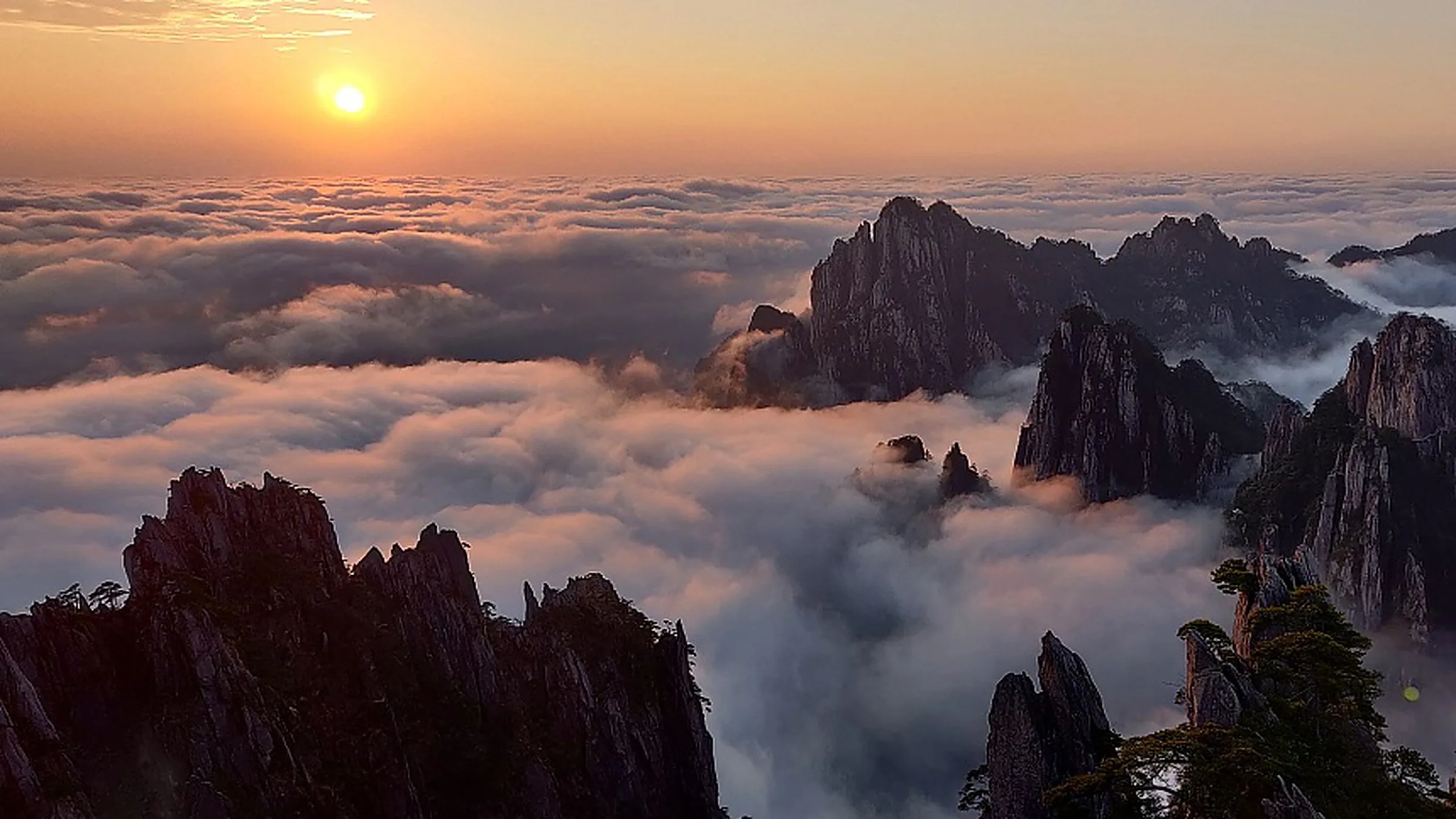
Mount Huangshan (Yellow Mountain) has 77 named granite peaks, the highest at 1,864m (Lotus Peak). The four signature views are: sea of clouds (云海), sunrise (日出), twisted pines (奇松), and hot springs (温泉). The mountain has been a subject of Chinese landscape painting since the Tang dynasty (618-907 CE); nearly every Chinese landscape painting of the last 1,000 years is influenced by it. The summit is reachable by three cable cars; staying overnight on the summit is the only way to see the sunrise. For the full summit sunrise plan, which cable car to take, and Hongcun side trip, see our Huangshan scenic guide.
Best for: Visitors who want the classic Chinese-painting experience, the summit sunrise, and the cultural depth of a UNESCO dual-inscription (natural + cultural). Best in winter for the highest sea-of-clouds probability. For the full Huangshan plan (cable cars, summit hotels, Hongcun village), see our Huangshan scenic guide.
Worst for: Visitors with limited mobility (the stone steps and altitude make it strenuous), visitors in June-August (the rainy season reduces the sea-of-clouds probability to 20-30%), visitors who don’t want to book summit hotels 2-3 months ahead for October.
Jiuzhaigou (Sichuan) — turquoise lakes and waterfalls
Jiuzhaigou Valley is a Y-shaped valley of 118 turquoise lakes, 18+ named waterfalls, and old-growth forest at 2,000-3,100m. The lakes are filled with snowmelt that has passed through travertine (calcium carbonate) deposits; the minerals scatter the sunlight to produce the turquoise and blue colors. The most-photographed spot in China is the Five-Flower Lake (五花海), which is directly accessible from the mandatory sightseeing bus route. The autumn colors (late September to late October) turn the entire valley into a kaleidoscope of red, gold, and orange. For the bus route, the Y-shaped valley, and the Huanglong add-on, see our Jiuzhaigou scenic guide.
Best for: Visitors who want the most-photographed water in China, the easiest park to navigate (mandatory bus, short walks), and the most vivid autumn colors. Best for seniors and families. For the full Jiuzhaigou plan (Y-shaped valley, Five-Flower Lake, Huanglong side trip), see our Jiuzhaigou scenic guide.
Worst for: Visitors with severe altitude sensitivity (the park is at 2,000-3,100m — much higher than the other two), visitors in June-July (flood season makes the water muddy), visitors who don’t want to fly to a remote airport (JZH is 88 km from the park; the HSR option opened only in 2024).
Decision framework — which to pick
Pick Zhangjiajie if:
- You want the most cinematic, dramatic vertical landscape.
- You are comfortable with cable cars, elevators, and glass bridges.
- You have 3-4 days.
- You are coming from Shanghai or southern China.
Pick Huangshan if:
- You want the classic Chinese-painting experience and the cultural depth.
- You want to see a sunrise from a summit.
- You have 2-3 days.
- You are coming from Shanghai or Hangzhou.
- You want the most reliable sea-of-clouds probability (winter).
Pick Jiuzhaigou if:
- You want the most Instagram-friendly color palette.
- You are visiting in October for autumn colors.
- You are a senior or have limited mobility.
- You have 2-3 days.
- You are already visiting Chengdu.
Pairing them — 6 to 12 day routes
6-7 days: Zhangjiajie + Huangshan (Shanghai in / Shanghai out)
- Day 1 — Fly Shanghai to Zhangjiajie (DYG), 2h 15m, ¥400-700. Stay in Wulingyuan.
- Day 2-3 — Wulingyuan (Avatar pillars). 2 days.
- Day 4 — Tianmen Mountain. Afternoon flight to Huangshan (TXN), 1h 30m, ¥300-500. Stay in Tangkou.
- Day 5 — Yungu Cable Car to summit, sunset, summit hotel.
- Day 6 — Sunrise, North Sea loop, descend, Hongcun village.
- Day 7 — Return to Shanghai by HSR (2h 30m, ¥180) or flight.
Budget: ¥3,000-4,500 per person including internal flights and hotels.
8-10 days: All three (Shanghai in / Chengdu out)
- Day 1-4 — Zhangjiajie as above.
- Day 5 — Fly Zhangjiajie to Huangshan, stay in Tangkou.
- Day 6-7 — Huangshan summit.
- Day 8 — Fly Huangshan to Chengdu, ¥600-900, 3 hours.
- Day 9-10 — Jiuzhaigou + Huanglong, fly out from JZH.
Budget: ¥5,500-8,000 per person.
12-14 days: All three + side trips (the slow route)
- Day 1-4 — Zhangjiajie + Tianmen Mountain + Grand Canyon.
- Day 5-6 — Fenghuang Ancient Town (Phoenix, 4 hours by HSR from Zhangjiajie).
- Day 7 — Fly to Huangshan, stay in Tangkou.
- Day 8-9 — Huangshan summit + Hongcun.
- Day 10 — High-speed rail to Shanghai (3 hours), or stay in Hangzhou.
- Day 11 — Fly Shanghai to Chengdu.
- Day 12-13 — Jiuzhaigou + Huanglong.
- Day 14 — Fly out from Chengdu.
Budget: ¥7,000-10,000 per person.
When NOT to go — seasonal pitfalls
(For multigenerational versions of all three parks — pacing, accessibility, and which works for grandparents, parents, and kids in the same group — see our senior travel pacing guide.)
- Chinese National Day (Oct 1-7) — All three parks hit their visitor caps. Daily crowds: Zhangjiajie 80,000+, Huangshan 30,000 (cap), Jiuzhaigou 41,000 (cap). Cable car queues are 90+ min. Avoid.
- Chinese New Year (late Jan / Feb) — All three are open but cold and quiet. Some smaller attractions close.
- May Day Holiday (May 1-3) — All three crowded.
- June-July — Jiuzhaigou is in flood season; the Li River is muddy. Huangshan has the lowest sea-of-clouds probability.
- August — All three hot and humid at lower elevations. Jiuzhaigou altitude makes it cooler.
Money-saving tips
- Buy combined tickets. All three parks offer multi-day combined tickets that include multiple cable cars.
- Use Trip.com with service fee (¥20-50). Avoids the need for a Chinese phone number for Alipay booking. Foreign Visa/Mastercard accepted.
- Stay in chain hotels (Jin Jiang, Hanting, Home Inn). ¥150-300/night for clean, predictable rooms.
- Eat in town, not in the park. Food inside the parks is 2-3x city prices. Eat a big breakfast at the hotel, pack snacks, eat dinner in the nearest town.
- Travel shoulder season. Late April or early November is 30-50% cheaper for flights and hotels than October peak.
- Buy water outside the park. Vendors at the gate sell 2L for ¥10, inside the park the same bottle is ¥15-20.
Booking strategy
| Lead time | What to book |
|---|---|
| 3-4 months ahead | Huangshan summit hotel (October weekends) |
| 2-3 months ahead | Internal flights, especially Chengdu ↔ Jiuzhaigou |
| 1-2 months ahead | Trip.com package deals (sometimes 20% cheaper) |
| 2-3 weeks ahead | Combined tickets via Alipay |
| 1 week ahead | Last-minute hotel deals (less choice but 30% off) |
| 1-2 days ahead | Yangshuo / Guilin tours, bamboo raft tickets |
Final decision — quick answer
If you only have 2-3 days and want one iconic Chinese landscape, the easiest and most photogenic is Jiuzhaigou in October for the autumn colors. The most classic and culturally deep is Huangshan in winter for the sea of clouds. The most dramatic and film-friendly is Zhangjiajie year-round for the Avatar pillars.
If you have 6-7 days, do Zhangjiajie + Huangshan (Shanghai in / Shanghai out is the most efficient routing). If you want to add another UNESCO-grade landscape to the comparison, our Guilin Li River scenic guide covers the karst peaks and bamboo-raft route that pairs naturally with any of the three.
If you have 10-12 days, do all three with Shanghai in / Chengdu out to avoid backtracking.
All three are world-class. None will disappoint. The only wrong answer is to go in the first week of October.
Plan your trip — verified tools
These free tools are built on real, monthly-verified data and help you skip the trial-and-error phase of China trip planning:
- China 240-Hour Visa-Free Transit Checker — 57 countries, 24 provinces, 65 ports. See if you qualify for 10-day visa-free transit, which cities you can visit, and the 5-step process.
- China 6-City 5-Day Budget Calculator — Real 2026 prices for 5 days in Beijing, Shanghai, Guangzhou, Chengdu, Xi’an, or Hangzhou. Budget / mid-range / comfort tiers, broken down line by line.
Verified August 2026 by TravelHubChina Editorial. We re-check prices and policy details monthly so the data doesn’t drift.
Step by step
-
Step 1: Pick your priority landscape
Vertical pillars and dramatic vistas → Zhangjiajie. Sea of clouds, sunrise, and Chinese-painting classic scenery → Huangshan. Turquoise lakes, autumn colors, and the most-photographed water in China → Jiuzhaigou. If you are not sure, this article's comparison tables below will help.
-
Step 2: Check your travel time
Only 3-4 days? Pick one. 6-8 days? Pair Zhangjiajie + Huangshan (Shanghai in / Shanghai out works well). 10-12 days? Do all three (Shanghai in, Chengdu out is the most efficient routing). Less than 3 days anywhere produces a rushed itinerary with one zone missed.
-
Step 3: Check the season
April-May: all three are at their best. June-August: Huangshan is too rainy for sea of clouds; Jiuzhaigou is in flood season. September-November: all three peak, especially Jiuzhaigou's autumn colors. December-February: Huangshan has the most reliable sea-of-clouds; Zhangjiajie can be cold but photogenic; Jiuzhaigou is at its quietest and lakes are still turquoise.
-
Step 4: Check your fitness level
Easiest: Jiuzhaigou (bus + boardwalks). Mid: Zhangjiajie (cable cars + some walking). Most demanding: Huangshan (stone steps + altitude 1,800m). For seniors over 70 or those with joint or heart issues, Jiuzhaigou is the safest choice. For active hikers, Huangshan has the best trails.
-
Step 5: Book flights and tickets 1-3 months ahead
All three have daily visitor caps: Zhangjiajie 30,000+ (no cap), Huangshan 30,000 (cap), Jiuzhaigou 41,000 (cap in peak). Cable car slots sell out in peak season. Summit hotels (Huangshan) book out 2-3 months ahead for October weekends. The combined tickets via Alipay mini-programs work but require Chinese phone number for SMS verification — use Trip.com for English booking.
-
Step 6: Plan the supporting logistics
Zhangjiajie: fly to DYG airport, 35 km from Wulingyuan. Huangshan: fly to TXN airport, 60 km from the south gate. Jiuzhaigou: fly to JZH airport, 88 km from the park (new HSR station since 2024 at Huanglong Jiuzhai). All three require ground transport — bus, taxi, or hotel pickup. Plan 1.5-2 hours buffer between flight arrival and park entry.
-
Step 7: Pack the right gear
All three: sturdy shoes, layers, rain jacket, power bank, sunscreen, 2-3L water refillable. Huangshan adds: headlamp for pre-dawn sunrise, down jacket in winter. Zhangjiajie adds: motion-sickness pills for the 99-bend road. Jiuzhaigou adds: Diamox or similar altitude medication (the park is 2,000-3,100m).
FAQ
-
Which is the most beautiful: Zhangjiajie, Huangshan, or Jiuzhaigou?
It depends on what you mean by beautiful. Zhangjiajie has the most dramatic vertical scenery (the Avatar Hallelujah pillars). Huangshan has the most classical Chinese-painting beauty (sea of clouds, twisted pines, granite peaks). Jiuzhaigou has the most colorful scenery (turquoise lakes, multi-colored autumn leaves, white waterfalls). All three are UNESCO World Heritage sites and would be a top-3 pick in any country. Most visitors who can spare the time do all three. -
Which is the cheapest to visit?
Huangshan is the cheapest per day: ¥600-1,200 for a 2-3 day trip including ticket, cable car, summit hotel, and food. Zhangjiajie is mid-range: ¥435-1,200 for a 3-4 day trip. Jiuzhaigou is the most expensive due to the remote location: ¥800-1,500 for a 2-3 day trip including flights from Chengdu. None of them have foreigner surcharges — same price as Chinese citizens. -
Which is the easiest for seniors or kids?
Jiuzhaigou is the easiest. The mandatory sightseeing bus covers 90% of the park; the lakes are accessible from the bus stops via short boardwalks. Zhangjiajie is mid-easy — the Bailong Elevator and the cable cars eliminate the steepest sections, but Wulingyuan requires 5-10 km of walking. Huangshan is the most demanding — the stone steps and altitude (1,800m) make it strenuous for those with joint or heart issues. -
Which is the best for photography?
All three are world-class. Jiuzhaigou has the most Instagram-friendly color palette (turquoise + autumn red). Zhangjiajie has the most cinematic vertical landscape (the Avatar pillars). Huangshan has the most painterly sunrise/sunset + sea of clouds. The best light varies by month: Jiuzhaigou in October, Zhangjiajie year-round, Huangshan in winter for snow on pines. -
How long do I need for each?
Zhangjiajie: 3-4 days (Wulingyuan + Tianmen Mountain + Grand Canyon). Huangshan: 2-3 days (summit overnight + Hongcun). Jiuzhaigou: 2-3 days (the Y-shaped valley + Huanglong optional). If you only have 4-5 days, pick one. If you have 8-10 days, you can do Zhangjiajie + Huangshan in one loop (Shanghai-Shanghai). Jiuzhaigou requires flying into Chengdu and is harder to combine with the others. -
Which is the best in October (peak autumn)?
All three peak in October, but for different reasons. Jiuzhaigou in October has the most vivid autumn colors — the entire valley turns red, gold, and orange. Huangshan in October has clear skies and the highest sea-of-clouds probability. Zhangjiajie in October has good weather and pleasant temperatures, but the autumn colors are less dramatic than the other two. Avoid the first week of October (Chinese National Day) at all three — the crowds are intense. -
Can I do all three in one trip?
Yes, in 10-12 days. The route is: Zhangjiajie (3-4 days) → fly to Huangshan (1.5 hours, ¥300-500) (2-3 days) → fly Huangshan to Chengdu (3 hours, ¥600-900) → Jiuzhaigou (3 days, including Huanglong). Total budget: ¥4,000-6,000 per person plus internal flights. Most visitors do them in pairs (e.g., Zhangjiajie + Huangshan) or pick one based on season and interest.
Related guides
- Scenic & Nature
Huangshan (Yellow Mountain) Guide: Sunrise, Sea of Clouds, Trails (2026)
Huangshan (黄山, Yellow Mountain) in Anhui is a UNESCO World Heritage site famous for its sea of clouds, twisted pines, and granite peaks. This guide covers the 2-3 day plan, ticket prices (¥190-310), cable cars, sunrise timing, and Hongcun village.
12min read
- Scenic & Nature
Jiuzhaigou Scenic Guide: Five-Color Lakes, Waterfalls, Autumn (2026)
Jiuzhaigou Valley in Sichuan is a UNESCO World Heritage site with turquoise multi-level lakes, 18+ waterfalls, and 220 sq km of forest. This guide covers the Y-shaped valley plan, ticket prices (¥190+¥90 bus), when to go for autumn colors, Huanglong nearby, and altitude tips.
12min read
- Scenic & Nature
Zhangjiajie Scenic Guide: Avatar Mountains, Pillars, and Hikes (2026)
Zhangjiajie National Forest Park in Hunan is a UNESCO site with 3,000+ sandstone pillars, the Avatar Hallelujah Mountains, glass bridges, and Tianmen Mountain's 99-bend road. This guide covers the 4-day plan, ticket prices (¥225-435), foreigner booking via Alipay, cable cars, and photo spots.
12min read
- Scenic & Nature
Big Wild Goose Pagoda Guide: Xi'an's 1,300-Year Tang Pagoda
Big Wild Goose Pagoda (Dayan Ta) in Xi'an: 64m Tang-dynasty brick pagoda from 652 AD, UNESCO since 2014 as part of the Silk Roads network. Tickets (¥50), climb times, and the free North Square musical fountain (9 PM nightly).
8min read
- Scenic & Nature
Forbidden City Guide: Beijing Imperial Palace, Tickets & Plan
The Forbidden City in Beijing: 72 hectares, 980 buildings, 1.4 million artifacts, Ming and Qing dynasties, UNESCO since 1987. Tickets (¥60), WeChat booking.
12min read
- Scenic & Nature
Great Wall of China Guide: Mutianyu, Badaling, Jinshanling Compared
Great Wall of China: 21,196 km. Mutianyu (best first-timers), Badaling (most crowded), Jinshanling (hiking) compared. Tickets, transport, best season.
12min read