
Ejina Populus Forest Guide: 21 Days of Golden China
Ejina Populus Forest in Inner Mongolia has 39,000 hectares of Populus euphratica, gold October 1-21. Covers tickets, transport, Erdaoqiao Bridge, 4-day plan.
The Ejina Populus Forest (额济纳胡杨林) in western Inner Mongolia is the largest remaining population of Populus euphratica in the world, with 39,000 hectares of desert poplar in the Gobi desert basin along the Hei River (黑河, also called Ruo Shui). The Populus euphratica is one of the most ancient tree species on earth, with fossil records dating back 60 million years. Individual trees in the Ejina forest have been dated to 600-1,000+ years old. The species is famous for its ability to survive in extreme desert conditions through a deep taproot that can reach 20+ meters down to groundwater.
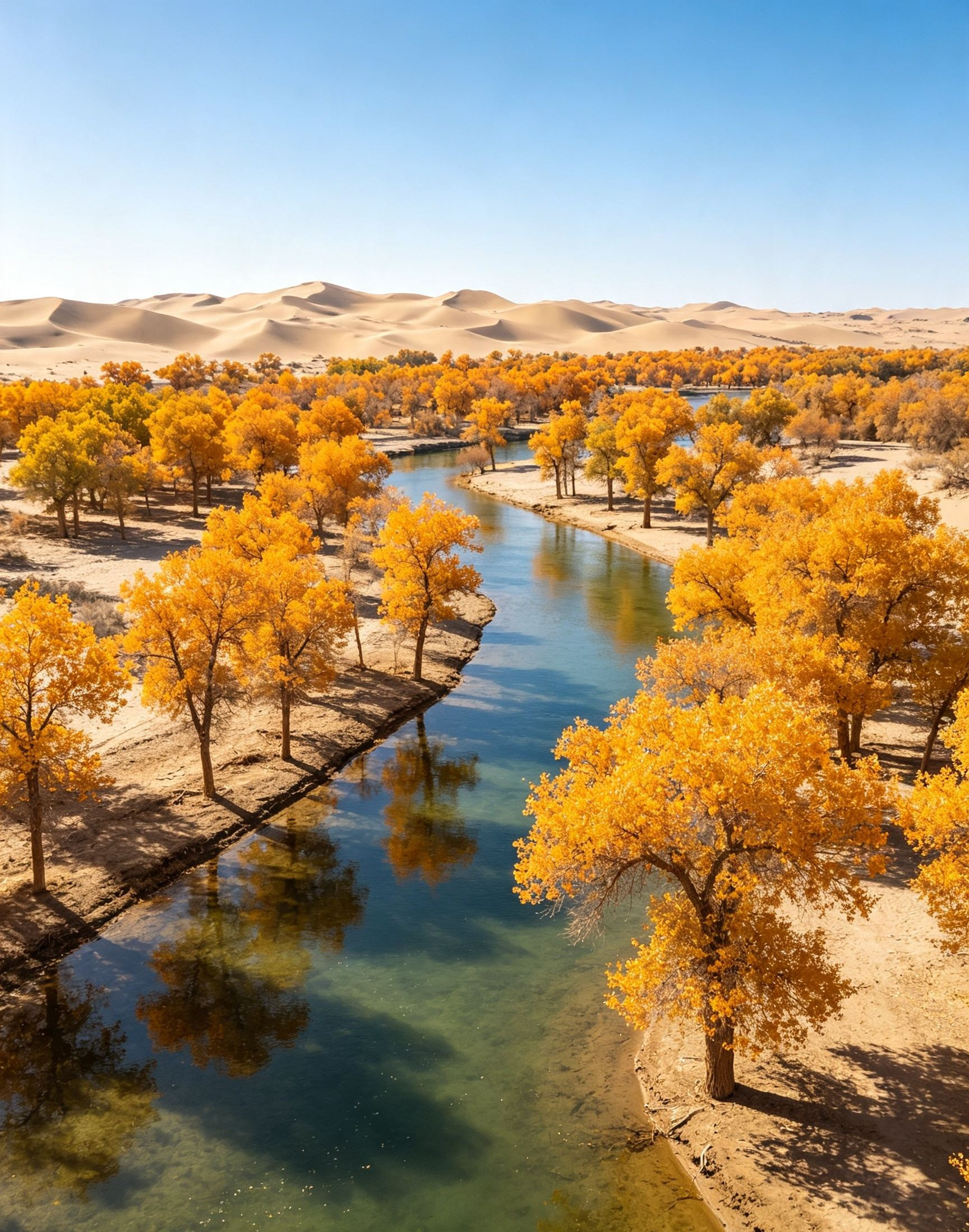
The forest turns gold for a brief 21 days each year, from October 1 to October 21, when the chlorophyll in the leaves breaks down and reveals the underlying yellow pigment. The exact dates shift 3-5 days each year depending on temperature and rainfall. Outside this window, the trees are either green (June-September) or bare (November-April). The combination of golden leaves, deep blue Gobi sky, and the Hei River creates a landscape unlike anywhere else in China. For a different take on China’s autumn colors, our Jiuzhaigou scenic guide covers the most-photographed turquoise-water park in Sichuan (peak gold late September to late October). The most-photographed spot is Erdaoqiao Bridge (二道桥), where the golden trees line the river and a wooden bridge crosses the water, creating a perfect mirror reflection at sunrise.
The forest is in Ejina Banner (额济纳旗), a small administrative unit of Inner Mongolia, on the edge of the Badain Jaran Desert and bordering Gansu province to the south and Mongolia to the north. The Juyan Lake (居延海) section of the populus forest is also home to the ancient Juyan Fort, a Silk Road site inscribed as part of the UNESCO World Heritage Silk Roads designation in 2014 — the same Silk Road corridor that runs past the Mogao Caves in Dunhuang.
How to plan your 4-day trip
Day 1 - Arrive and see Erdaoqiao Bridge sunrise
Drive from Jiayuguan to Ejina (4-5 hours). Check into a hotel. If you arrive by 2:00 PM, drive to Erdaoqiao Bridge for sunset. If you arrive later, rest and prepare for the next day. Dinner at the hotel or a small restaurant in town (no Western food options; the local cuisine is northwestern Chinese and Mongolian).
Day 2 - Sartu Banner Avenue and Badaer Temple
Full day in the populus forest. Start at 8:00 AM with the shuttle to Sartu Banner (萨特塔尔), the 10 km golden populus avenue. Spend 3 hours walking or driving the avenue. Lunch at the small on-site restaurant. Afternoon: shuttle to Badaer Temple (巴丹吉林庙), a small temple in the desert with a few ancient populus trees. Return to Ejina town by 5:00 PM.
Day 3 - Juyan Lake Silk Road fort and desert sunset
Drive 60 km north to Juyan Lake (居延海), entry ¥80. Walk the lake boardwalk (2 km), photograph the migratory birds (geese, cranes). Lunch at the on-site restaurant. Afternoon: drive to the Juyan Fort site, the ancient Silk Road fort. Drive back to Ejina via the desert road for the sunset photo. Return to town by 7:00 PM.
Day 4 - Erdaoqiao Bridge sunrise and return
Early start: 5:30 AM drive to Erdaoqiao Bridge for the 6:30-7:00 AM sunrise. Spend 2 hours. Return to town for breakfast. Pack and drive back to Jiayuguan (4-5 hours) — home of the westernmost Ming Great Wall fort — or to Zhangye (4 hours) or Dunhuang (6 hours, with the Mogao Caves). Fly out from the next airport.
Tickets, booking, and payment
Major sites and their 2026 entry fees:
- Ejina Populus Forest 3-day pass - ¥230 per person (October peak), ¥150 off-peak. Includes Erdaoqiao Bridge, Sartu Banner, Badaer Temple, and the shuttle bus (¥50 separate).
- Shuttle bus - ¥50, mandatory, runs 7:00 AM to 7:00 PM.
- Juyan Lake - ¥80 entry. 7:30 AM to 6:30 PM.
- Jiayuguan Fort (Great Wall) - ¥120 entry. 8:00 AM to 6:00 PM.
- Zhangye Danxia National Geological Park - ¥74 entry, ¥20 shuttle. 6:00 AM to 8:00 PM (sunrise is the main draw).
How to book:
- At the gate - passport required, cash or Alipay/WeChat. No foreigner surcharge.
- Trip.com - English, accepts Visa/Mastercard, 5% service fee. Most comprehensive booking platform for the Jiayuguan-Ejina-Zhangye-Dunhuang loop.
- Via hotel in Ejina - most hotels can arrange tickets, guides, and 4WD rental. The owner typically takes 5-10% commission but provides English support.
Free entry: Children under 1.2m, seniors over 65 (with passport). Most sites give 50% student discount with Chinese ID.
What is NOT included:
- Transport from Jiayuguan or Zhangye to Ejina (¥800-1,000 per day for a driver-guide with 4WD)
- 4WD rental for the Juyan Lake trip (¥500-700 per day)
- Meals (¥50-100 per person per meal at local restaurants)
- Warm clothing rental (most hotels can lend heavy coats for ¥50-100 per day)
Getting there and around
By air: Jiayuguan Airport (JGN) is the closest commercial airport, 400 km (4-5 hours drive) from Ejina town. Direct flights from Beijing (3h, 2-3 daily), Xi’an (2h 30m, 2 daily), Lanzhou (1h 30m, 4 daily), Chengdu (2h 30m, 1 daily). Round trip from Beijing is ¥1,500-2,500. The alternative is Dunhuang Airport (DNH), 6 hours drive, with more international connections.
By car (self-drive): The G312 highway runs west from Jiayuguan, then north on the S312 to Ejina. Total 400 km, 4-5 hours, paved throughout. The last 100 km has no gas stations; fill up at the Jiuquan city stop. A 4WD is recommended for the Juyan Lake and desert sections; a sedan is fine for the main forest roads.
By bus: Direct tourist buses from Jiayuguan to Ejina run during the October 1-21 window, 6 hours, ¥150-200. Limited capacity; book ahead.
Inside the populus region: A 4WD or driver-guide is essential. Most travelers hire a driver-guide in Jiayuguan or Ejina for the full 4 days (¥800-1,000 per day for the car and driver). The main forest has shuttle buses (¥50) but the Juyan Lake and desert sections require private transport.
When to go and what to expect
October 1 to October 21 (golden window). Peak season. The 21-day window is the only time the populus is gold. The leaves turn from green to gold between September 25 and October 1, reach peak gold by October 7, and drop completely by October 21. The exact dates shift 3-5 days each year. Plan for October 5-15 for the highest probability of peak gold. Crowds are highest during the Chinese National Day holiday (October 1-7); visit October 10-18 if possible. For month-by-month timing across China, see our best time to visit calendar.
Late September (turning). Shoulder season. The leaves are just starting to turn; some are still green. Fewer crowds. Best for photographers who want to see the color change. Temperatures: 5C to 20C. Risk: the leaves may not turn fully until after you leave.
Late October to early November (dropping). Off-peak. The leaves are dropping; the forest floor is gold but the trees are partially bare. Temperatures: -5C to 10C. Some hotels close for the season after October 31.
December to March (winter). Cold (-20C nights, -5C days). The bare trees against snow are dramatic but most hotels close. The few that stay open offer winter packages for photographers.
April to June (spring/summer). Off-peak. Green leaves, mild temperatures (10C to 25C), migratory birds at Juyan Lake. Best for travelers who want quiet and birdwatching. Most hotels offer 50% off-peak rates.
What to bring
- Heavy winter coat - October nights are -5C to 5C; afternoons are 10C to 18C. A down jacket or heavy parka is essential. Mornings at sunrise are well below zero.
- Gloves, scarf, hat - the desert wind at sunrise makes the apparent temperature 5-10C colder than the actual temperature.
- Camera with tripod - the Erdaoqiao Bridge sunrise is the single most important shot. A polarizing filter helps with the gold leaves.
- Hiking boots with ankle support - the forest paths are loose sand and gravel. Running shoes are not adequate.
- Cash (¥1,000-1,500) - small restaurants, hotels, and drivers prefer cash. Ejina town accepts Alipay but not foreign cards.
- Power bank - the forest has no outlets. A 20,000 mAh pack is enough for 2 phone charges.
- Sunglasses and sunscreen - the desert sun is intense; the UV reflects off the light-colored desert floor.
- Offline maps - Amap or Apple Maps. Cell signal is good in Ejina town, weak in the forest and at Juyan Lake.
- Headlamp - morning walks in the dark; most hotels lend flashlights but a headlamp is more convenient.
- Water bottle and snacks - the forest has very few shops; stock up in Ejina town each morning.
- Motion sickness pills - the desert roads to Juyan Lake are unpaved and bumpy; 1-2 hours of rough driving.
Hike difficulty cheat sheet
Ejina is desert terrain — flat but sandy, with seasonal river crossings. The “hikes” are really walks into the Populus forest or short dune climbs. Bring sun protection and 3+ L of water per person; shade is non-existent in the desert.
| Trail | Distance | Time | Elevation | Difficulty |
|---|---|---|---|---|
| Erdaoqiao Populus forest (二道桥) | 5 km loop | 2 h | flat | Easy — flat sandy path, golden forest |
| Sandaoqiao (三道桥) | 3 km loop | 1.5 h | flat | Easy — denser forest, fewer tourists |
| Sidaoqiao (四道桥) | 4 km loop | 1.5-2 h | flat | Easy — best hero-tree photography spot |
| Badain Jaran desert entry (巴丹吉林沙漠) | 3 km one-way | 1.5 h | +50 m (dune climb) | Easy-Moderate — sand, soft, calf-strain; bring a local guide |
| Heicheng ruins walk (黑城) | 2 km loop | 1 h | flat | Easy — ancient Western Xia capital ruins, paved path |
Best for backpackers: do the 4-populus-bridge circuit (Erdaoqiao → Sandaoqiao → Sidaoqiao → Heicheng) in one day (12 km total, 5-6 h with photo stops). Best light is sunrise at Sidaoqiao and sunset at Erdaoqiao. The desert entry at Badain Jaran is the highlight for many — book a half-day 4WD tour from Dalaihubu town (¥200-300/person) that includes a short dune walk and camel ride. Do not attempt the dunes in summer (45°C sand, dangerous heat stroke risk) — Ejina is best October 5-25 when the leaves are golden and temperatures are 5-20°C.
The 5 photo spots that matter
- Erdaoqiao Bridge sunrise (二道桥). The classic shot. The golden populus trees line the Hei River and the wooden bridge crosses the water. The mirror reflection at sunrise is the most-photographed scene in the entire populus region. Best 6:30-7:30 AM in October. Arrive 30 minutes early. Bring a tripod.
- Sartu Banner Avenue (萨特塔尔). The 10 km golden populus avenue with the trees forming a tunnel over the road. Best 10:00 AM to noon when the sun is overhead and the gold is most intense. Drive slowly (10-20 km/h) to allow passengers to shoot through the windshield.
- Badaer Temple (巴丹吉林庙). The small temple with a few ancient populus trees. Best 2-3 PM when the sun is on the temple side. The combination of the wooden temple and the golden trees is unique.
- Juyan Lake Silk Road fort (居延海). The ancient Juyan fort site at the edge of the lake. Best 4-5 PM in late afternoon light. The combination of the lake, the desert mountains, and the fort creates a Silk Road atmosphere.
- Desert sunset on the Juyan Lake road. The desert is lit orange and red at sunset. Best 5:30-6:30 PM in October. The road has several safe pull-outs; bring a telephoto for the distant mountain silhouettes.
Common mistakes to avoid
- Arriving on October 1-7 (Chinese National Day). The crowds are extreme; hotel rates triple, shuttle bus queues are 90+ minutes, and the Erdaoqiao Bridge viewpoint is packed. Aim for October 10-18 if possible.
- Driving yourself without a 4WD. The Juyan Lake and desert sections have unpaved roads. A sedan can get stuck in the soft sand. Hire a 4WD or a driver-guide with a 4WD.
- Skipping the warm clothing. The desert temperature swing from morning (-5C) to afternoon (18C) is 23C. A single jacket will not work; you need a layered system including a heavy parka for sunrise.
- Driving from Jiayuguan to Ejina without a full tank. The last 100 km has no gas stations. Fill up at the Jiuquan city stop.
- Arriving at Erdaoqiao Bridge at 7:00 AM. The sunrise is at 6:30-7:00 AM; you need to be at the bridge by 5:30-6:00 AM for the best position and the mirror reflection. The viewpoint fills up by 6:30 AM.
- Trusting Google Maps. Google services are blocked in China. Use Amap (高德地图) for navigation. Save key Chinese names: 额济纳胡杨林, 二道桥, 萨特塔尔, 巴丹吉林庙, 居延海, 嘉峪关, 张掖丹霞.
- Booking only 1 night in Ejina. The 4-day itinerary requires 3 nights in Ejina town. Book 1-2 months ahead for October. The small town fills up fast.
- Forgetting the tripod. The sunrise mirror reflection requires long exposures (1-4 seconds at sunrise). Without a tripod, the shot is impossible.
Where to stay
- Ejina town (the only base) - hotels fill up 1-2 months ahead for October. Budget: Ejina Populus Hotel, Ejina Homeland (¥300-600/night in October). Mid-range: Ejina International Hotel, Populus Forest Lodge (¥600-1,200/night in October). All have Western-style toilets and hot water. Most include a basic Chinese breakfast.
- Jiayuguan city - the airport gateway. Use 1 night before or after Ejina. Hotels: Jiayuguan Hotel, Holiday Inn Express, Hanting (¥200-450/night). Good restaurants and shops.
- Zhangye city - the Danxia gateway. 4 hours drive to Ejina. Hotels: Zhangye Hotel, Zhangye Danxia Hotel (¥200-400/night). The Zhangye Danxia is a 30-minute drive from the city.
- Dunhuang city - the desert and Silk Road gateway. 6 hours drive to Ejina. Hotels: Dunhuang Hotel, Silk Road Hotel (¥200-500/night). Famous for the Mogao Caves and Mingsha Dunes.
Local food and culture
Northwestern Chinese and Mongolian cuisines dominate. For the nearby Silk Road loop’s other half (Jiayuguan Great Wall Fort is the western terminus of the Ming Great Wall, 4 hours from Ejina), our Great Wall scenic guide covers the matching Dunhuang side; the Mogao Caves scenic guide anchors the Buddhist cave art that bookends the route. Must-try dishes:
- Lamb skewers (羊肉串) - the regional staple, ¥5 per skewer. Eat at any evening market in Ejina town.
- Hand-pulled noodles (拉面) - the northwestern Chinese staple, ¥20-30 per bowl. Available in any restaurant.
- Beef noodle soup (牛肉面) - the Lanzhou-style specialty, ¥25-35 per bowl.
- Hui Muslim steamed dumplings (蒸饺) - ¥15-20 per basket of 12.
- Braised lamb with potatoes (大盘鸡) - the Xinjiang-influenced dish, ¥80-120 per dish, enough for 2-3 people.
- Yogurt (酸奶) - the local Mongolian-style yogurt, ¥10-15 per cup. Tart and delicious.
Mongolian culture: Ejina is home to the Torghut Mongolians, a subgroup of the Oirat Mongols. The local language is a dialect of Mongolian. The main cultural event is the Naadam festival in July, with horse racing, wrestling, and archery. For a broader view of which Chinese landscapes are UNESCO-inscribed and how they compare, see our China scenic wonders comparison. The populus forest is sacred in Mongolian culture; the Torghut people have lived in the area for 300 years and consider the ancient trees to be the home of mountain spirits. Visitors should walk lightly in the forest and not damage the trees. The Juyan Lake Silk Road fort is the site of Han Dynasty military outposts (2nd century BCE) and was an important stop on the Silk Road until the 14th century.
Book your Ejina trip
Trip.com
Beijing entry hotel (1 night layover)
Trip.com's Beijing hotel listing for the first-night layover before flying to Jiayuguan (gateway to Ejina). Foreign cards accepted, free cancellation on most rooms.
Hotels from $84/night
Trip.com
Trains to Jiayuguan (HSR + transfer)
Train alternative: Beijing → Lanzhou by HSR (Jiuquan is the next stop, ~8h), then 4-hour pre-arranged driver into Ejina. Trip.com has all China HSR in English with mobile tickets.
HSR Beijing-Lanzhou from $80
Affiliate disclosure: We earn a small commission at no extra cost to you. See full disclosure.
Plan your trip — verified tools
These free tools are built on real, monthly-verified data and help you skip the trial-and-error phase of China trip planning:
- China 240-Hour Visa-Free Transit Checker - 55 countries, 24 provinces, 65 ports. See if you qualify for 10-day visa-free transit, which cities you can visit, and the 5-step process.
- China 6-City 5-Day Budget Calculator - Real 2026 prices for 5 days in Beijing, Shanghai, Guangzhou, Chengdu, Xi’an, or Hangzhou. Budget / mid-range / comfort tiers, broken down line by line.
Verified August 2026 by TravelHubChina Editorial. We re-check prices and policy details monthly so the data doesn’t drift.
Step by step
-
Fly to Jiayuguan Airport (JGN) in Gansu
Direct flights from Beijing (3h, 2-3 daily on Air China and Hainan Airlines), Xi'an (2h 30m, 2 daily on China Eastern), Lanzhou (1h 30m, 4 daily), and Chengdu (2h 30m, 1 daily). Round trip from Beijing is ¥1,500-2,500. Book 2-3 months ahead for October; the airport is small and flights fill up. The airport is 10 km from Jiayuguan city; taxi ¥30-40.
-
Spend 1 night in Jiayuguan city (1,700m)
Jiayuguan is the western terminus of the Ming Great Wall and the gateway to the Silk Road. Use 1 night here to acclimatize to the high-altitude Gobi desert climate and to visit the Jiayuguan Fort (¥120, the westernmost fort of the Ming Great Wall). Hotels: Jiayuguan Hotel, Holiday Inn Express (¥250-450/night). The downtown area has good restaurants for a final hot meal before heading to the desert.
-
Drive Jiayuguan to Ejina town (400 km, 4-5 hours)
The G312 highway runs west from Jiayuguan, then north on the S312 to Ejina. Total 400 km, 4-5 hours. The road is paved throughout but the last 100 km has no gas stations; fill up at the Jiuquan city stop. The drive passes through the Gobi desert with low black gravel hills. Rental car or driver-guide from Jiayuguan. The drive is scenic but the speed limit is 80 km/h on most of the highway.
-
Stay 3 nights in Ejina town (the only base)
Ejina town (额济纳旗) is a small town of 20,000 with limited hotels. During the October 1-21 peak, hotel rates triple and rooms fill up 1-2 months ahead. Budget: Ejina Populus Hotel, Ejina Homeland (¥300-600/night in October). Mid-range: Ejina International Hotel, Populus Forest Lodge (¥600-1,200/night). All have Western-style toilets and hot water. Book early.
-
Day 1: Erdaoqiao Bridge and the Hei River golden trees
Erdaoqiao Bridge (二道桥) is the most photographed spot in the entire populus forest. The golden populus trees line the Hei River (黑河) and the bridge crosses the water, creating a perfect mirror reflection at sunrise. Arrive 30 minutes before sunrise (6:30-7:00 AM in October). Spend 2-3 hours. The ¥230 entry + ¥50 shuttle covers this and other main sites.
-
Day 2: Sartu Banner Avenue and Badaer Temple
Sartu Banner (萨特塔尔) is a 10 km avenue of golden populus on the south edge of the forest, with the trees forming a tunnel over the road. Best in late morning when the sun is overhead. Badaer Temple (巴丹吉林庙) is a small temple in the desert with a few ancient populus trees. Both are included in the entry ticket. Allow 5-6 hours for both.
-
Day 3: Juyan Lake Silk Road fort and desert sunset
Juyan Lake (居延海) is 60 km north of Ejina town, a freshwater lake with an ancient Silk Road fort (the Han Dynasty Juyan fort site, ¥80 entry). The lake is also a migratory bird site (best April-June, but October also has geese and cranes). Drive a 4WD or hire a driver (¥500 for the day). The desert sunset on the way back is one of the most-photographed scenes in Inner Mongolia.
-
Download offline maps and translation before arrival
Google Maps does not work in China. Use Amap (Gaode) or Apple Maps. Download Pleco dictionary for offline Chinese-English. The populus region has very limited English; even the hotel staff speak only basic English. Save key Chinese names: 额济纳胡杨林 (Ejina Populus), 二道桥 (Erdaoqiao Bridge), 萨特塔尔 (Sartu Banner), 巴丹吉林庙 (Badaer Temple), 居延海 (Juyan Lake), 嘉峪关 (Jiayuguan).
FAQ
-
How many days do you need at Ejina Populus Forest?
4 days is the minimum to see the four main areas (Erdaoqiao Bridge, Sartu Banner Avenue, Badaer Temple, Juyan Lake). 3 days means skipping one of the four or rushing the Juyan Lake Silk Road fort. 5 days adds a buffer day for the 21-day golden window's weather variability and a half day for a desert sunset. Less than 3 days, take a guided bus tour from Jiayuguan that includes transport and tickets. -
When is the best time to see the golden populus?
October 1 to October 21 is the only reliable window. The leaves turn from green to gold between September 25 and October 1, reach peak gold by October 7, and drop completely by October 21. The exact dates vary 3-5 days each year depending on temperature and rainfall. Plan for October 5-15 for the highest probability of peak gold. Outside this 3-week window, the trees are either green (June-September) or bare (November-April). -
How do I get to Ejina from Beijing or Xi'an?
Fly to Jiayuguan (JGN) in Gansu province from Beijing (3h, 2-3 daily) or Xi'an (2h 30m, 2 daily). Round trip from Beijing is ¥1,500-2,500. Jiayuguan is the closest commercial airport, 4 hours drive (400 km) to Ejina town. Alternative: drive from Zhangye (4 hours) or Dunhuang (6 hours). There is no rail to Ejina; the Jiayuguan-Ejina highway is fully paved but the last 100 km has no gas stations. -
Do I need a permit or guide to visit Ejina Populus Forest?
No special permit is required for the main forest areas. The entry ticket (¥230) and shuttle bus (¥50) cover Erdaoqiao Bridge, Sartu Banner, and Badaer Temple. A separate ¥80 ticket covers Juyan Lake. A guide is not required but recommended for the 4-day itinerary; the forest is 39,000 hectares with sparse signage in English. Most hotels in Ejina town arrange guides (¥300-400 per day) and 4WD rental for the Juyan Lake and desert sections. -
Are the populus trees really 1,000 years old?
Yes, some of them are. The Populus euphratica (胡杨) is one of the oldest living tree species, with fossils dating back 60 million years. Individual trees in Ejina have been dated to 600-1,000+ years old. The species is famous for the saying 'living 1,000 years, standing 1,000 years after death, and not decaying for 1,000 years after falling' (生而千年不死, 死而千年不倒, 倒而千年不朽). The oldest trees are protected with fences around their trunks. -
What is the difference between Ejina Populus and Zhangye Danxia?
Ejina is golden yellow (autumn populus trees) plus the Gobi desert landscape. Zhangye Danxia is rainbow-colored (red, orange, yellow rock formations) plus the Qilian Mountains. They are 4 hours drive apart and most travelers combine them in a 5-6 day trip: 2 days at Zhangye, 4 days at Ejina. The color contrast is dramatic; together they form the most-photographed 6-day loop in northwest China. -
How do foreigners book Ejina Populus tickets and transport?
Buy the ¥230 entry and ¥50 shuttle at the main gate in cash or via Trip.com (English, accepts Visa/Mastercard, 5% service fee). Book hotels 1-2 months ahead for the October 1-21 window; the small Ejina town fills up. Book flights to Jiayuguan 2-3 months ahead for October. The Jiayuguan-Ejina drive can be done by rental car (4WD strongly recommended, ¥600-900/day in Jiayuguan) or by hiring a driver-guide from Jiayuguan (¥800-1,000 per day for the car and driver).
Related guides
-
China's Top 3 Scenic Wonders Compared: Zhangjiajie vs Huangshan vs Jiuzhaigou (2026)
Zhangjiajie (sandstone pillars), Huangshan (sea of clouds + granite peaks), Jiuzhaigou (turquoise lakes + waterfalls). Decision guide covering which fits your time, budget, fitness level, photography goals, and travel style. Prices, distances from Shanghai/Beijing, best seasons compared.
-
Daocheng Yading Scenic Guide: Three Sacred Mountains & Alpine Lakes
Daocheng Yading in Sichuan is a 4,000-6,032m reserve with three sacred peaks and Milk Lake. Covers ¥146-266 tickets, Chengdu flights, hiking, altitude prep.
-
Forbidden City Guide: Beijing Imperial Palace, Tickets & Plan
The Forbidden City in Beijing: 72 hectares, 980 buildings, 1.4 million artifacts, Ming and Qing dynasties, UNESCO since 1987. Tickets (¥60), WeChat booking.