
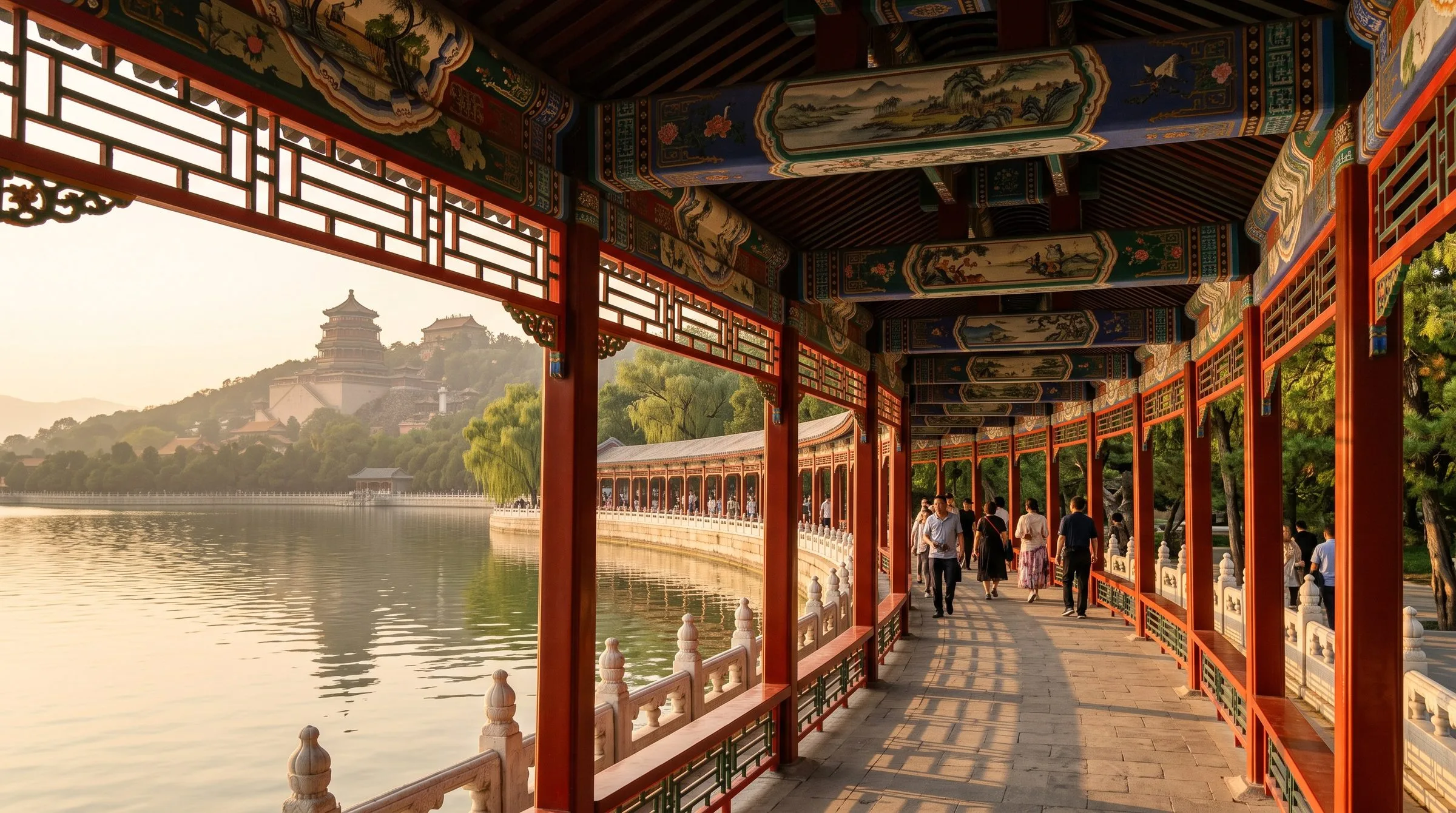
Summer Palace Guide: Beijing's Imperial Garden, Kunming Lake & Longevity Hill
Summer Palace in Beijing: 290 hectares, 3/4 water, UNESCO since 1998. The Long Corridor (728m, 14,000 paintings) is the world's longest covered walkway. ¥30 entry, ¥40 combo, subway access.
The Summer Palace (颐和园, Yíhéyuán) is the single most beautiful day in Beijing. The Qing emperors built it as a retreat from the Forbidden City — a vast imperial garden with 3/4 of the area covered by Kunming Lake, a 728-meter covered corridor (the longest in the world), and Seventeen-Arch Bridge that connects the lake shore to Nanhu Island.
It’s the best place in Beijing to escape crowds: even on peak summer days, you can find quiet sections of the garden, sit on a lakeside rock, and watch the locals fly kites or practice calligraphy with water on the pavement. The Winter Palace is for history; the Summer Palace is for breathing.
Plan your visit
- Entry: ¥30 standard (¥15 with foreign passport). Combo with Suzhou Street (the recreated Qing shopping street inside the park): ¥40.
- Hours: 6:30-18:00 (April-October), 7:00-17:00 (November-March). Last entry 1 hour before close.
- Subway: Beigongmen Station (Line 4) is the north gate, 5 min walk. Xiyuan Station (Line 4) is the east gate. Xinjian Gongmen Station (Line 16) is the west gate.
- Best time: Early morning (7-9 AM) for soft light and few tourists. Late afternoon (4-6 PM in summer) for the sunset over Kunming Lake from the Long Corridor.
- Allow 4-6 hours if walking + boat. Half-day (3 hours) if just hitting the highlights.
The 4 must-see sections
Long Corridor (长廊, Chángláng)
728 meters long, 273 painted sections, ~14,000 individual paintings depicting Chinese history, mythology, and landscapes. Each painting tells a story — the emperor and empress could identify each scene. The corridor connects the Hall of Cloud-Rising (勤政殿) to the Longevity Hill area. Walk the full length at least once; the paintings reward close attention.
Kunming Lake & Seventeen-Arch Bridge (昆明湖, Kūnmínghú)
The lake covers 220 hectares (3/4 of the park). In summer, dragon-boat races and pedal-boat rentals fill the water. The Seventeen-Arch Bridge connects the eastern shore to Nanhu Island — the white marble bridge is the most-photographed single structure in the park. Best photo spot: from the bridge looking back at Longevity Hill with the Tower of Buddhist Incense at the top.
Longevity Hill & Tower of Buddhist Incense (万寿山, Wànshòushān)
The hill rises 108m above the lake. The Tower of Buddhist Incense (佛香阁) is the central building — a 41m wooden pagoda on a 20m stone base, the most imposing structure in the park. Climb the hill for the panoramic view (100+ steps). The Suzhou Street (recreated Qing-era shopping street) is at the back of the hill — small, photogenic, and a quick stop.
Seventeen-Arch Bridge details
The 17 arches symbolise the emperor’s bridge between the mortal world and the afterlife. The lions on the balustrades (544 in total) are each carved in a slightly different pose — legend says no two are identical. Photogenic at any time, but the most beautiful light is mid-afternoon when the sun is behind you and the bridge catches full illumination.
Practical tips for foreign visitors
- Bring your passport — the ¥15 discount requires it. Photocopies won’t work at the gate.
- Comfortable walking shoes are essential. The park is 2.9 km² with significant elevation change (lake to hilltop). Plan 4-6 hours and bring water.
- Boat rentals (pedal boats, dragon boats) are at the East Dock and South Lake Island. ¥40-60/hour, no reservation needed. Closed in winter.
- Restaurants inside the park are overpriced and touristy. Eat before or after.
- Avoid weekends if possible. Weekday mornings are 70% less crowded.
- Combine with the Old Summer Palace (圆明园) if you have a full day — the ruins are 10 minutes away by subway, and the contrast between the rebuilt Summer Palace and the destroyed Old Summer Palace is a powerful history lesson.
Common questions
How is the Summer Palace different from the Forbidden City?
The Forbidden City is the emperor’s working palace (formal, political, walled). The Summer Palace is his retreat (informal, scenic, open). If the Forbidden City is the office, the Summer Palace is the country house. The Summer Palace has more variety: lake, hill, garden, corridor, islands, boat rides, ancient trees. The Forbidden City is buildings only.
Can I see the Long Corridor paintings clearly?
Yes — the corridor is covered and lit naturally through lattice windows. The paintings are ~30cm tall, painted directly on the wood beams. Bring binoculars if you want to read the smaller scenes; otherwise walking slowly and looking up is enough.
Is it worth visiting in winter?
Yes — the lake freezes (no boats), but the Longevity Hill snow scene is the most iconic Beijing winter photo. Crowds are 80% smaller than summer. The corridor paintings are easier to see in winter light.
How do I get from central Beijing (Tiananmen area)?
Subway Line 4 from Xidan or Xuanwumen to Beigongmen, 30-40 min total. Or DiDi for ¥60-80 (40 min in traffic).
Summer Palace + Beijing combo
Skip-the-line Summer Palace ticket, Forbidden City + Great Wall combo (the classic 3-day Beijing route), boat rental on Kunming Lake, airport transfer, and hotel booking in one cart. English interface, foreign cards accepted, e-voucher to phone. The 'Beijing 3-day classic' bundle is the most efficient for first-timers.
Ticket from $11 · Hotel from $84/night
Verified August 2026 by TravelHubChina Editorial. We re-check prices and policy details monthly so the data doesn’t drift.
FAQ
-
What is the entry fee for the Summer Palace?
¥30 standard admission, or ¥15 with a foreign passport (bring the actual passport, not a copy). Combo with Suzhou Street (the recreated Qing shopping street inside the park) costs ¥40 total. The ticket is purchased at the gate; there is no online booking. Major credit cards and Alipay/WeChat Pay are accepted. -
How much time do I need to visit the Summer Palace?
Half a day (3 hours) is enough to see the highlights: the Long Corridor, Seventeen-Arch Bridge, and Hall of Benevolence and Longevity. A full day (4-6 hours) allows for walking + a boat ride on Kunming Lake + a visit to Suzhou Street. Most first-timers spend 4 hours, which is the sweet spot. The park is too large to rush in under 2 hours. -
What's the best time of day to visit the Summer Palace?
Early morning (7-9 AM) gives the softest light and fewest tourists, especially at the Long Corridor. Late afternoon (4-6 PM in summer) is magical for the sunset over Kunming Lake viewed from the western shore. Avoid 10 AM-2 PM on weekends and Chinese holidays — that's peak crowd time. The Hall of Benevolence and Longevity on Longevity Hill is best photographed in mid-morning. -
How do I get to the Summer Palace by subway?
Take Line 4 to Beigongmen Station (Beigongmen) for the north gate — 5 minutes' walk. Line 4 Xiyuan Station reaches the east gate. Line 16 Xinjian Gongmen (Xinjian Gongmen) is closer to the west gate. Allow 45-60 minutes from central Beijing (Tiananmen or Forbidden City) including walking. -
What's the Long Corridor and why is it famous?
The Long Corridor (Changlang) is a 728-meter covered walkway that runs along the northern edge of Kunming Lake, connecting the Hall of Benevolence and Longevity area to the Marble Boat. Built in 1750, it features 14,000 individual painted scenes on its beams and ceilings — historical events, classical literature, landscapes, and folk scenes. It is the world's longest covered walkway and a UNESCO-recognized feature of the Summer Palace. -
Is the Summer Palace free for any visitors?
Children under 1.2m height, seniors over 65 (with ID), and disabled visitors (with disability certificate) enter free. The park area is technically free for early-morning tai chi (locals use it from 6-7 AM before the main complex opens), but to enter the historical buildings, paid admission is required. The free park access is best for jogging and casual walks, not sightseeing. -
Can I take a boat on Kunming Lake?
Yes. Three boat options: (1) Marble Boat ferry (¥5) goes to Nanhu Island via the Seventeen-Arch Bridge. (2) Rowboat rental (¥40-60/hour) at any of 4 docks. (3) The dragon-shaped tour boat (¥10) does a 30-minute loop. Boats operate April-October only. In winter (November-March), the lake may freeze and boats are suspended — check at the gate.
Related guides
- Scenic & Nature
Forbidden City Guide: Beijing Imperial Palace, Tickets & Plan
The Forbidden City in Beijing: 72 hectares, 980 buildings, 1.4 million artifacts, Ming and Qing dynasties, UNESCO since 1987. Tickets (¥60), WeChat booking.
12min read
- Scenic & Nature
Great Wall of China Guide: Mutianyu, Badaling, Jinshanling Compared
Great Wall of China: 21,196 km. Mutianyu (best first-timers), Badaling (most crowded), Jinshanling (hiking) compared. Tickets, transport, best season.
12min read
- Scenic & Nature
Temple of Heaven Guide: Beijing's Most Photogenic Park
Temple of Heaven in Beijing: 273 hectares, Ming Dynasty (1420), UNESCO since 1998. The Hall of Prayer for Good Harvests is China's most-photographed building. ¥35 entry, free dawn tai chi, subway access.
- Scenic & Nature
Big Wild Goose Pagoda Guide: Xi'an's 1,300-Year Tang Pagoda
Big Wild Goose Pagoda (Dayan Ta) in Xi'an: 64m Tang-dynasty brick pagoda from 652 AD, UNESCO since 2014 as part of the Silk Roads network. Tickets (¥50), climb times, and the free North Square musical fountain (9 PM nightly).
8min read
- Scenic & Nature
China's Top 3 Scenic Wonders Compared: Zhangjiajie vs Huangshan vs Jiuzhaigou (2026)
Zhangjiajie (sandstone pillars), Huangshan (sea of clouds + granite peaks), Jiuzhaigou (turquoise lakes + waterfalls). Decision guide covering which fits your time, budget, fitness level, photography goals, and travel style. Prices, distances from Shanghai/Beijing, best seasons compared.
12min read
- Scenic & Nature
Huangshan (Yellow Mountain) Guide: Sunrise, Sea of Clouds, Trails (2026)
Huangshan (黄山, Yellow Mountain) in Anhui is a UNESCO World Heritage site famous for its sea of clouds, twisted pines, and granite peaks. This guide covers the 2-3 day plan, ticket prices (¥190-310), cable cars, sunrise timing, and Hongcun village.
12min read