Fragrant Hills Park (香山公园), Beijing
香山公园 · Xiāngshān Gōngyuán
Quick answer
No passport is checked at the gate. Entry is real-name: the ticket is tied to the ID or passport number used to book it, and the park verifies that ID on the way in. Concession tickets (seniors, students, military) require you to show the qualifying document at the gate, so bring it with you.
Why visit
- 1 188 hectares of wooded imperial garden with 96% forest cover and more than 5,800 ancient trees — a quarter of Beijing's total
- 2 The 1986 'Red Leaves of Fragrant Hills' was named one of the Sixteen Great Sights of New Beijing, and the autumn crowd is the proof
- 3 Entry is genuinely cheap: ¥10 in peak season, ¥5 off-peak, and the gate opens at 06:00
- 4 Five separate heritage sites inside the park — Biyun Temple, Xiangshan Temple, Shuangqing Villa, Jianxin Zhai, Zhiyuan Zhai — plus the revolutionary memorial site
- 5 Biyun Temple and the other sub-sites close on Mondays, so a Monday visit needs a different plan
Essential tips for foreigners
- Go at 06:00, not at 10:00. The gate opens at dawn and the light on the ridge before the crowds is the reason to come early. Between 09:00 and 15:00 on a weekend in the red-leaf season the main paths are shoulder to shoulder.
- Book ahead. Entry is real-name and the park caps numbers when visitor limits are reached. Buy on the WeChat account 「香山公园服务号」 or the 「香山公园」 mini program and go with the ID you booked.
- The cable car is not running. The park published a notice on 2026-10-01 that the Xiangshan cable car is suspended while it is being upgraded, and the official ticket site still listed it as suspended on 2026-10-31. Budget the walk up the hill instead.
- Check the sub-site days. Biyun Temple, Xiangshan Temple, Jianxin Zhai and Zhiyuan Zhai close on Mondays (except statutory holidays and summer). The park itself never closes, so a Monday is fine if you want the red leaves and not the temples.
- Bring the concession document. Students, seniors and military get a half-price ticket but must show the qualifying ID at the gate.
- Wear shoes with grip. The paths are mountain paths with stone steps; after rain they are slippery.
Suggested route
- 06:00 1 hour Enter at the East Gate and walk straight up towards Qinzheng Hall and the main ascent path
- 07:00 1.5 hours Continue up towards Incense Burner Peak while the ridge is still empty and the light is low
- 08:30 1.5 hours Descend to the North Gate side and see Biyun Temple — book it on the same WeChat account, and remember it closes on Mondays
- 10:00 1.5 hours Walk down past Xiangshan Temple and the Shuangqing Villa area, which is free
- 11:30 30 min Leave via the East Gate and eat at Songlin Restaurant by the gate, or head back into central Beijing
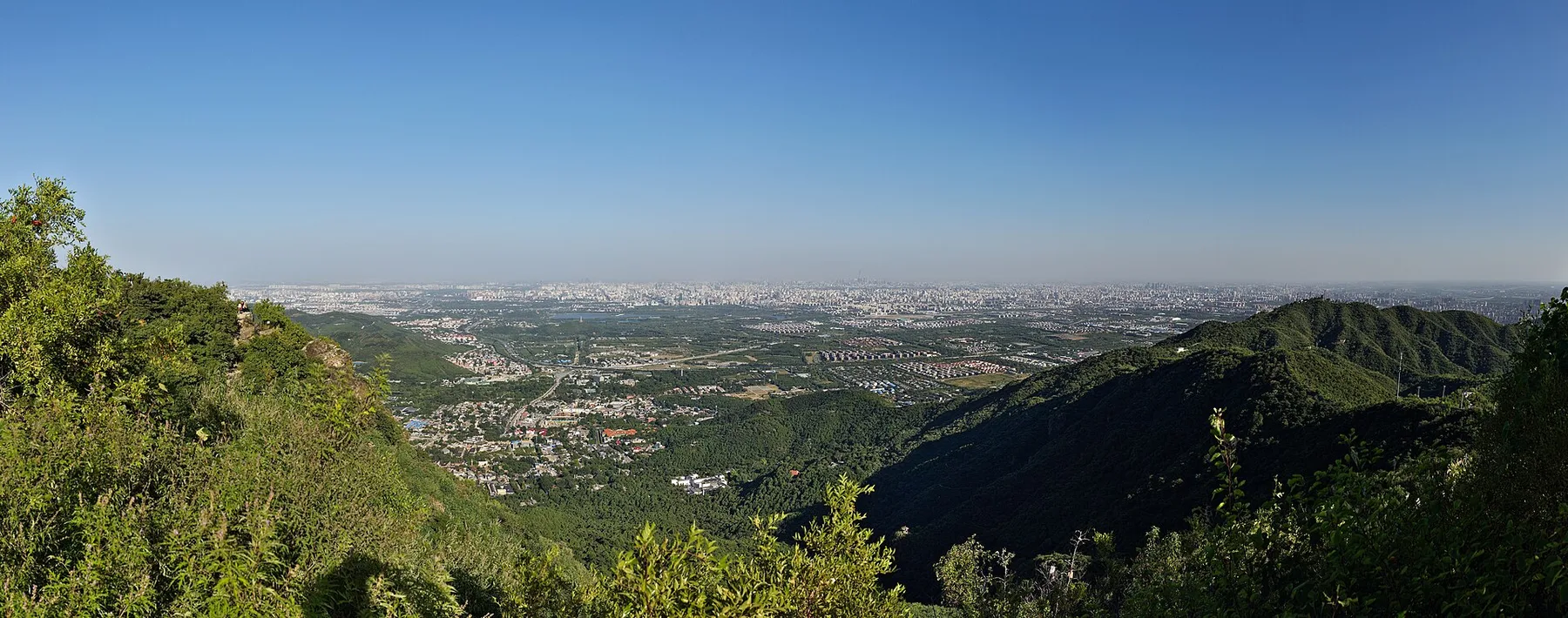
Photo: Ludger Heide / Wikimedia Commons, CC BY-SA 2.0. Source
The mountain that Beijing comes to for eleven days
Fragrant Hills Park (香山公园) sits in Haidian District in Beijing’s western hills, and for most of the year it is a pleasant, inexpensive, wooded park. For about eleven days in late October and early November it is the single most sought-out destination in the city, because the smoke tree and maple leaves over the whole ridge turn red at once. The Chinese name for that spectacle — 香山红叶, “Fragrant Hills red leaves” — was named one of the Sixteen Great Sights of New Beijing in 1986.
What the figures tell you: the park is 188 hectares, its forest cover is 96%, and it holds more than 5,800 ancient and famous trees — roughly a quarter of Beijing’s entire stock of old trees. It was a Qing-dynasty imperial garden (the Fragrant Hills Retreat, 香山静宜园), and the imperial buildings inside it are still there.
The published ticket and hours
These are the park’s own published figures, from its official ticketing site and the Beijing Municipal Parks & Greening Bureau’s park page.
Tickets
- Peak season, 1 April to 15 November: full ticket ¥10, concession ticket ¥5
- Off-peak season, 16 November to 31 March: full ticket ¥5, concession ticket ¥2.5
- Biyun Temple (碧云寺) inside the park: separate ticket, ¥10 full / ¥5 concession
- Shuangqing Villa (双清别墅): free
Opening hours
- Peak season: gate opens 06:00, last entry 18:30, park closes 19:30
- Off-peak season: gate opens 06:00, last entry 18:00, park closes 19:00
The official ticket site states the closing rule plainly: after ticket sales stop, the park stays open for one more hour. That is why you can still walk out of the valley at 19:30 in October.
Entry is real-name. Your ticket is tied to the ID or passport number you booked it with, and that document is checked at the gate. No passport is checked otherwise, but bring the document you booked with — and if you are claiming a student, senior or military concession, bring that document too, because it is verified at the gate.
Booking. The park’s designated platforms are the WeChat official account 「香山公园服务号」 and the 「香山公园」 mini program. Unused tickets can be refunded up to 11:00 on the visit date without a no-show; after 11:00 it counts as one, and anything unused is auto-refunded that night. The park also runs visitor-number caps and will start limiting entry when they are reached.
The cable car is suspended — plan the walk instead
This is the single most important practical fact for a 2026 visit. The park published a notice dated 2026-10-01, 「香山公园关于索道暂停运营的通告」, stating that the Xiangshan cable car is suspended while it is being upgraded, and the official ticket site still showed it as suspended when we checked on 2026-10-31. A third-party guide describes the ride as an open-chairlift trip of about 18 minutes up to the ridge — but it is not running.
That changes the plan: you walk up. The classic ascent from the East Gate past Qinzheng Hall to Incense Burner Peak is a steady climb of a couple of hours, and with the cable car out the early-morning window becomes more valuable, not less.
Mondays: the park is open, half of it is not
The gate never closes. But Biyun Temple, Xiangshan Temple, Jianxin Zhai and Zhiyuan Zhai close on Mondays, except during statutory holidays and in summer, when the park announces separate arrangements. Their hours are also shorter than the park’s own: 08:00-17:00 in peak season and 08:30-16:30 off-peak.
The Fragrant Hills Revolutionary Memorial Site (香山革命纪念地旧址) is the exception — it opens year-round, 09:00 to 16:00, with last entry at 16:00 and closing at 16:30.
So a Monday visit is a good idea for the red leaves and a bad idea for the temples. Check which day you land on before you plan the route.
Getting there
Metro Line 10 to Bagou (巴沟), then the Xijiao / Western Suburban Line (西郊线) to its terminus at Xiangshan (香山) station, then a 5-10 minute walk to the East Gate. Buses also serve Xiangshan and the Xiangshan Park East Gate stop.
Source status, honestly: the park’s official ticket site and the Beijing Municipal Parks & Greening Bureau’s park page do not publish transport instructions, and the park’s own website (www.xiangshanpark.com) did not respond from our build environment on 2026-10-31. The route above therefore comes from a third-party Beijing travel guide — check it against Beijing’s official transit information before you set out.
Driving is not a good idea in the red-leaf season. The roads become extremely congested, the visitor car parks fill early and access is metered; the practical approach is to park at the commercial lots at the foot of the hill and take the park’s shuttle bus.
Where this fits in a Beijing itinerary
Fragrant Hills is in the western hills, which puts it in the same half-day as the Summer Palace — the two are frequently combined on one ticket-and-transport run. If you would rather spend the day in the imperial complex in the centre, the Forbidden City and Temple of Heaven are the other two stops, and the Beijing city page lays out how to sequence them.
Best photo spots
-
Incense Burner Peak (香炉峰) summit · Early morning, 07:00-09:00, before the crowds
The highest point of the park and the classic frame: red leaves filling the valley below and, on a clear day, the Beijing skyline beyond.
-
The red wall of Xiangshan Temple (香山寺) · Mid-morning, when the wall is lit
The temple's red wall with autumn foliage behind it — the most-photographed single composition in the park.
-
Biyun Temple (碧云寺) courtyard · Any time it is open; skip Mondays
A Ming-dynasty monastery with carved stone stelae, quieter than the main hill and worth the separate ticket.
-
Spectacles Lake (眼镜湖) below the North Gate · Late morning
The small lake that fills with reflected foliage, and the usual start of the cable-car queue.
Where to eat nearby
-
Songlin Restaurant (松林餐厅), near the East Gate
Beijing home cooking, including zhajiangmian (noodles with soybean paste) · ¥40-80/person · Inside the park, near the East Gate
-
Restaurants around the Xiangshan Park East Gate stop
Casual Beijing noodles and dumplings · ¥30-60/person · Outside the gate, on the bus interchange
Frequently asked questions
How much is the ticket to Fragrant Hills Park?
Peak season (1 April - 15 November) the full ticket is ¥10 and the concession ticket ¥5. Off-peak (16 November - 31 March) the full ticket is ¥5 and the concession ticket ¥2.5. Biyun Temple is a separate ticket at ¥10 full and ¥5 concession. Shuangqing Villa is free.
What time does Fragrant Hills Park open?
The gate opens at 06:00 in both seasons. Last entry is 18:30 in peak season and 18:00 in off-peak, and the park closes one hour after ticket sales stop — so 19:30 and 19:00 respectively.
Is the cable car at Fragrant Hills open?
Not at the moment. The park published a notice on 2026-10-01 that the Xiangshan cable car is suspended while it undergoes upgrading, and the official ticketing site still showed it as suspended when we checked on 2026-10-31. A third-party guide describes the ride as an open-chairlift trip of about 18 minutes, but it is not operating — plan to walk up the hill.
Do I need a passport to get into Fragrant Hills Park?
No passport is checked at the gate, but entry is real-name: the ticket is tied to the ID or passport number it was booked with, and that document is verified on entry. Bring the same ID you booked with, plus your student or senior document if you are claiming a concession.
How do I get to Fragrant Hills Park from central Beijing?
Metro Line 10 to Bagou (巴沟), then the Xijiao / Western Suburban Line to its terminus Xiangshan (香山) station, and a 5-10 minute walk to the East Gate. Buses also serve Xiangshan and the Xiangshan Park East Gate stop. One caveat: the park's own official pages do not publish transport instructions, so check Beijing's official transit information before you set off.
Can I drive and park at Fragrant Hills Park?
Not reliably. In the red-leaf season the visitor car parks fill early and access is metered, and the roads become extremely congested. The park runs a shuttle bus from the commercial car parks at the foot of the hill, so parking there and taking the shuttle is the practical approach.
Why are some temples closed on Mondays?
Biyun Temple, Xiangshan Temple, Jianxin Zhai and Zhiyuan Zhai close on Mondays, except during statutory holidays and in summer when the park announces separate arrangements. The main park gate stays open every day.
When is the best time to see the red leaves?
Late October to mid-November is the peak, and it is also the busiest. For a quieter visit with colour still on the trees, come in the second half of October or the first days of November, and get to the gate at 06:00.
Is Fragrant Hills Park worth visiting outside autumn?
Yes. It is 188 hectares of woodland with 96% forest cover and more than 5,800 ancient and famous trees, so it works as a cool summer escape from Beijing's heat and as a quiet walk with five heritage sites and a revolutionary memorial site inside.
Sources
- 香山官方售票网站 — Fragrant Hills Park official ticketing site (ticket prices, selling hours, sub-site hours, Monday closures, cable-car suspension notice, visitor rules) · pc.xiangshantickets.com
- 北京市香山公园 — Beijing Municipal Parks & Greening Bureau (首都绿化委员会办公室) official park page (official Chinese name, area, forest cover, opening hours, ticket prices, official website) · Government of the PRC
- OpenStreetMap / Nominatim — park polygon centroid for 香山公园, Haidian District, Beijing · nominatim.openstreetmap.org