
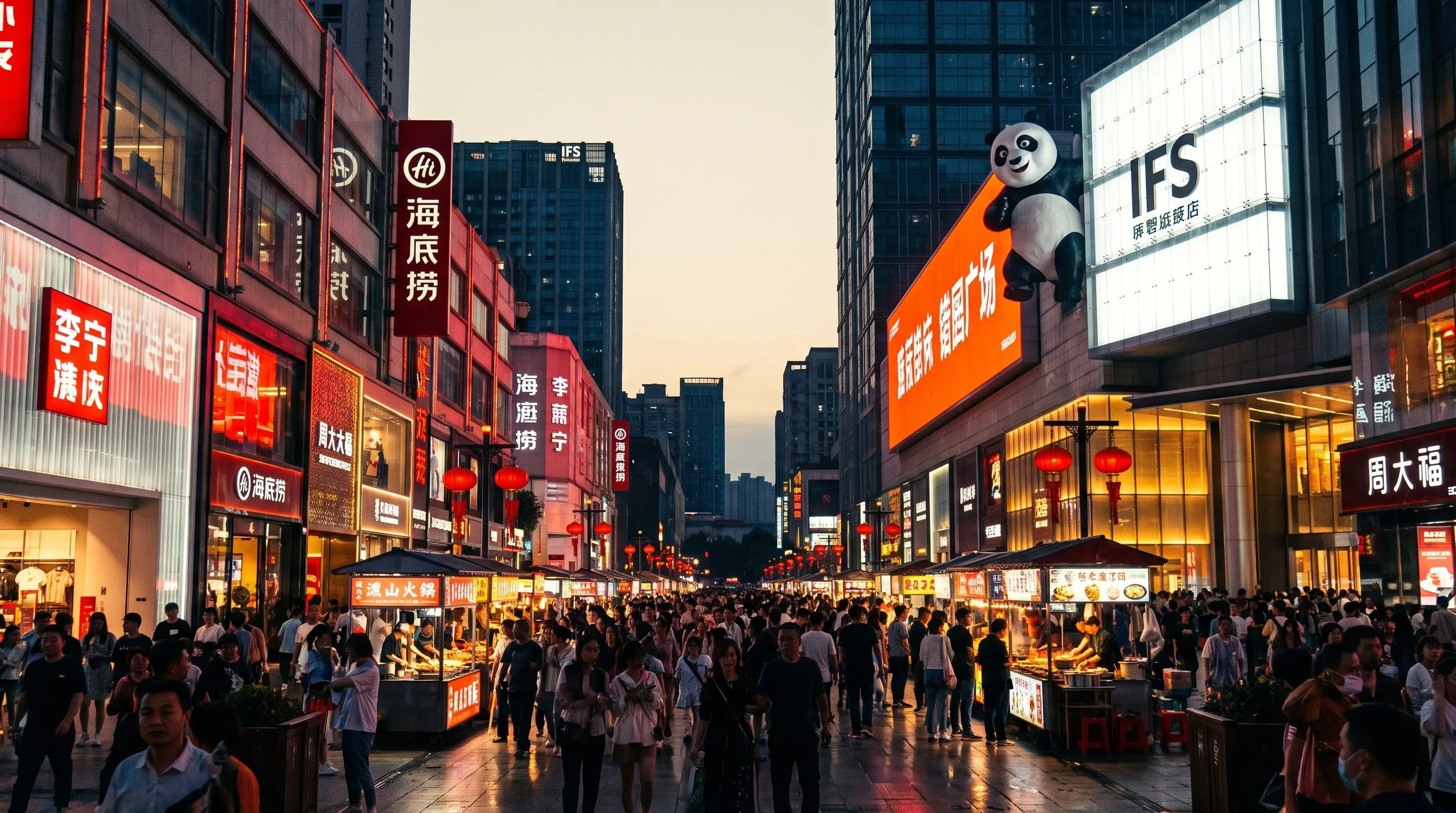
Chunxi Road Shopping Guide: Chengdu's Main Shopping Street
Chunxi Road in central Chengdu: 1.2 km pedestrian shopping street, the city's Times Square. Best for: street food, big-name Chinese brands, night neon, and a few hours of urban wandering. Free to walk, metro access.
Chunxi Road (春熙路, Chūnxī Lù) is central Chengdu’s main shopping street and the closest thing the city has to a Times Square. It’s a 1.2 km pedestrian lane in the heart of the city with 700+ shops, restaurants, and neon-lit facades, plus a few of Chengdu’s most photographed landmarks (the IFS panda sculpture, the giant LED screens).
The street is busy, touristy, and not for everyone. If you hate shopping or crowds, skip it. If you want a glimpse of central Chengdu’s modern urban life, or you’re looking for a place to buy Chinese-brand goods, eat Sichuan street food, or just wander at night under neon, Chunxi Road is a solid 2-3 hours.
Plan your visit
- Entry: Free to walk.
- Hours: Street is open 24/7. Shops typically 10:00-22:00. Restaurants and street food stalls 11:00-23:00.
- Subway: Chunxi Road Station (Line 2/3) is at the north end. Xinnanmen Station (Line 1) is at the south end.
- Best time: Weekday evening 18:00-21:00 for the neon lights without the weekend crowds. Avoid Saturday and Sunday afternoons (peak family shopping hours).
- Allow 2-3 hours for a wander. Longer if you eat a full meal or shop seriously.
The 4 landmarks
IFS Panda Sculpture (熊猫)
A giant 15-meter tall panda sculpture by artist Lawrence Argent, climbing the side of the IFS (International Finance Square) building on the south end of Chunxi Road. The panda’s bottom is visible from street level; the best photo angle is from the building’s roof terrace, where you can see the panda’s face. Free to access the terrace (just take the escalator up to the top floor).
Giant LED screens
Chunxi Road has 2-3 building-mounted LED screens that play Chinese brand ads, music videos, and travel promos 24/7. The most-photographed is the one on the IFS building facing north. Best at dusk or night when the screens are at their brightest.
Wangfujing Department Store (王府井)
The flagship Wangfujing store is on Chunxi Road, a massive 7-floor department store with everything from luxury Chinese goods to snacks. The food court on the top floor is the best place in central Chengdu to try a wide variety of Chinese regional cuisine in one sitting.
Sino-Ocean Taikoo Li (远洋太古里)
A high-end open-air shopping complex adjacent to IFS, mixing modern architecture with restored Qing-era buildings. The most architecturally interesting shopping district in Chengdu. Best for: design-conscious shopping, an afternoon coffee, a more refined dinner. Budget 1-2 hours here.
What to do
Eat Sichuan street food
The street food stalls along Chunxi Road serve the full Sichuan range:
- Three Cannons (三大炮) — ¥10
- Sweet Water Noodles (甜水面) — ¥15
- Lung Ching Chicken (龙抄手) — ¥20
- Mapo Tofu (麻婆豆腐) — ¥30-50
- Hotpot (火锅) — ¥80-150 per person, sit-down restaurants on the side streets
- Bubble tea — ¥15-25, multiple chains
Shop Chinese brands
Chunxi Road is the best place in central Chengdu to buy Chinese-brand goods:
- Sanjing (三精) — Chinese consumer electronics
- Lenovo showrooms — yes, Lenovo is Chinese
- Bosideng (波司登) — Chinese down jackets, the go-to winter brand
- Li-Ning (李宁) — Chinese sportswear (like a more affordable Nike)
- Warby Parker knockoffs — glasses at ¥100-300
- Chinese tea — small specialist shops, the green tea is genuine and well-priced
Take the IFS Panda photo
The IFS panda is the most iconic photo on Chunxi Road. From the street, you see the panda’s bottom. Climb to the top of IFS (take the escalator to the top floor outdoor terrace) for the panda’s face view. Free.
Watch the LED screens at night
The LED screens are at their best 19:00-22:00 when the surrounding neon is also at full brightness. Walk slowly down the street and let the visual noise hit you — it’s the most “modern China” experience in Chengdu.
What to skip
- The “luxury” brands — same as anywhere in China, slightly more expensive than US/Europe, not really a deal. Skip if you don’t actually want Chinese goods.
- The Wangfujing snack section — overpriced tourist snacks. Better street food is on the same street, just walk 50m.
- The crowds on weekend afternoons — if you can, go weekday evening.
Practical tips
- Cash + WeChat Pay + Alipay all work. Foreign cards sometimes work in big stores, never in street stalls.
- Bring an eSIM or Chinese SIM — free wifi is patchy.
- Watch for pickpockets in the densest crowds. Standard urban precautions.
- Photography is welcome. The neon at night is the main attraction; bring a phone with decent low-light capability.
Common questions
Is Chunxi Road worth visiting if I don’t like shopping?
Yes for 1 hour — the IFS panda and the neon at night are worth seeing. No for 3+ hours — that’s the full shopping district experience, which only appeals to shoppers.
Is it similar to Nanjing Road in Shanghai?
Loosely — both are central pedestrian shopping streets. Chunxi Road is more local, less polished, and shorter (1.2 km vs 5.5 km). Nanjing Road has more luxury brands and tourists; Chunxi Road has more local Chinese brands and a younger crowd.
How is it different from Kuanzhai Alley?
Kuanzhai Alley is the upscale boutique experience (¥80 teapots, refined dining). Chunxi Road is the mass-market street experience (¥10 street food, neon, brands). Both are central Chengdu; pick based on your style.
Chunxi Road + Chengdu essentials
Wangfujing Department Store food court credit, Panda Base day tour with English guide, Jinli + Wuhou Shrine combo, and hotel booking in one cart. English interface, foreign cards accepted, e-voucher to phone. The 'Chengdu 3-day classic' bundle is the most efficient for first-timers.
Hotel from $78/night
Verified August 2026 by TravelHubChina Editorial. We re-check prices and policy details monthly so the data doesn’t drift.
FAQ
-
How much does it cost to walk Chunxi Road?
It is free to enter and walk the pedestrian street. Shops, restaurants, and street food are paid individually (most street food ¥10-30, sit-down hotpot ¥80-150 per person). -
What is the best time of day to visit Chunxi Road?
Weekday evening 18:00-21:00 gives you the neon and LED screens at full brightness without the weekend crowds. The article recommends avoiding Saturday and Sunday afternoons, which are peak family shopping hours. -
How do I get to Chunxi Road by metro?
Take Line 2 or Line 3 to Chunxi Road Station at the north end, or Line 1 to Xinnanmen Station at the south end. Both stations are within a short walk of the pedestrian street. -
What is the IFS panda sculpture and how do I photograph it?
The IFS Panda is a 15-meter panda sculpture by artist Lawrence Argent climbing the south end of the IFS building. From street level you only see its bottom; for the face view, take the escalator up to the top floor outdoor terrace of IFS (free). -
Is Chunxi Road worth visiting if I do not like shopping?
Yes for 1 hour to see the IFS panda and the neon-lit facades at night. No for 3+ hours, because the full experience is the shopping district itself, which the article says only appeals to actual shoppers. -
How is Chunxi Road different from Kuanzhai Alley?
Chunxi Road is mass-market street shopping (¥10 street food, neon, Chinese brands), while Kuanzhai Alley is upscale boutique (¥80 teapots, refined dining). Both are in central Chengdu but match very different travel styles. -
Can I pay with a foreign credit card at Chunxi Road?
Foreign cards sometimes work in big stores like Wangfujing, but never in street food stalls. The article recommends carrying cash plus setting up WeChat Pay and Alipay before you go.
Related guides
- Culture & Practical
Hefang Ancient Street + Southern Song Imperial Street: Walking Guide (2026)
Hefang Street (河坊街) and the Southern Song Imperial Street (南宋御街) are restored Qing-era shopping streets in central Hangzhou. Free to walk, packed with tea shops, silk, snacks, and the 1908 Hu Qing Yu Tang pharmacy museum.
6min read
- Culture & Practical
Is It Safe to Travel to China in 2026? The Complete Foreigner's Safety Guide
Comprehensive 2026 safety guide for China travel: crime statistics, region-specific risks, scams targeting foreigners, US State Department advisory, LGBTQ+ safety, female solo travel, health and medical care, embassy registration, and 5-step arrival safety checklist. Plus: is it safe to travel to China right now in 2026 (yes, with normal precautions).
12min read
- Culture & Practical
Chinamaxxing 2026: 12 Chinese Lifestyle Experiences Every Foreigner Should Try
Chinamaxxing is the 2026 trend of foreign visitors going deep into Chinese daily life — hot water, ba duan jin qigong, hanfu, mahjong, tea ceremony, foot baths, and more. 12 hands-on experiences with where to try each one, what to expect, and how to book.
9min read
- Culture & Practical
LGBTQ+ Travel in China 2026: Safety, Apps, Cities & Practical Guide
Practical LGBTQ+ travel guide for China in 2026 — legal status (homosexuality is legal, no same-sex marriage), social attitudes by city, dating apps (Blued, Tantan, Aloha), the 3 most LGBTQ+-friendly cities (Shanghai, Beijing, Chengdu), nightlife, healthcare, family considerations, and 5 ready-made LGBTQ+-friendly city profiles. Updated 2026-08-21 with current legal status and city-by-city social attitudes.
- Culture & Practical
Solo Female Travel in China 2026: The Honest Safety Guide Foreigners Don't Get
China is statistically one of the safer large countries for solo female travelers, but the safety profile is different from Western countries. What works in Tokyo or Paris may not work in Beijing. The 2026 honest guide: 8 specific safety scenarios (DiDi at night, hostel vs hotel, walking alone, foreigner-targeted scams, hostel harassment, menstruation access, dating safety, embassy backup), ranked by frequency and risk. Includes the 5 phrases every solo female traveler should learn, and the 2 scenarios where you should NOT go alone.
5min read
- Culture & Practical
Beijing Hutongs: A Complete Guide to the City's Ancient Alleyways (History, Map, How to Visit)
Complete guide to Beijing's hutongs: the 700-year history from Yuan dynasty to today, why hutongs are disappearing, the 6 best hutong areas to visit as a foreigner, how to navigate them on foot or by rickshaw, the etiquette rules, and how to experience the real local hutong life (not the tourist-trap version).
8min read