
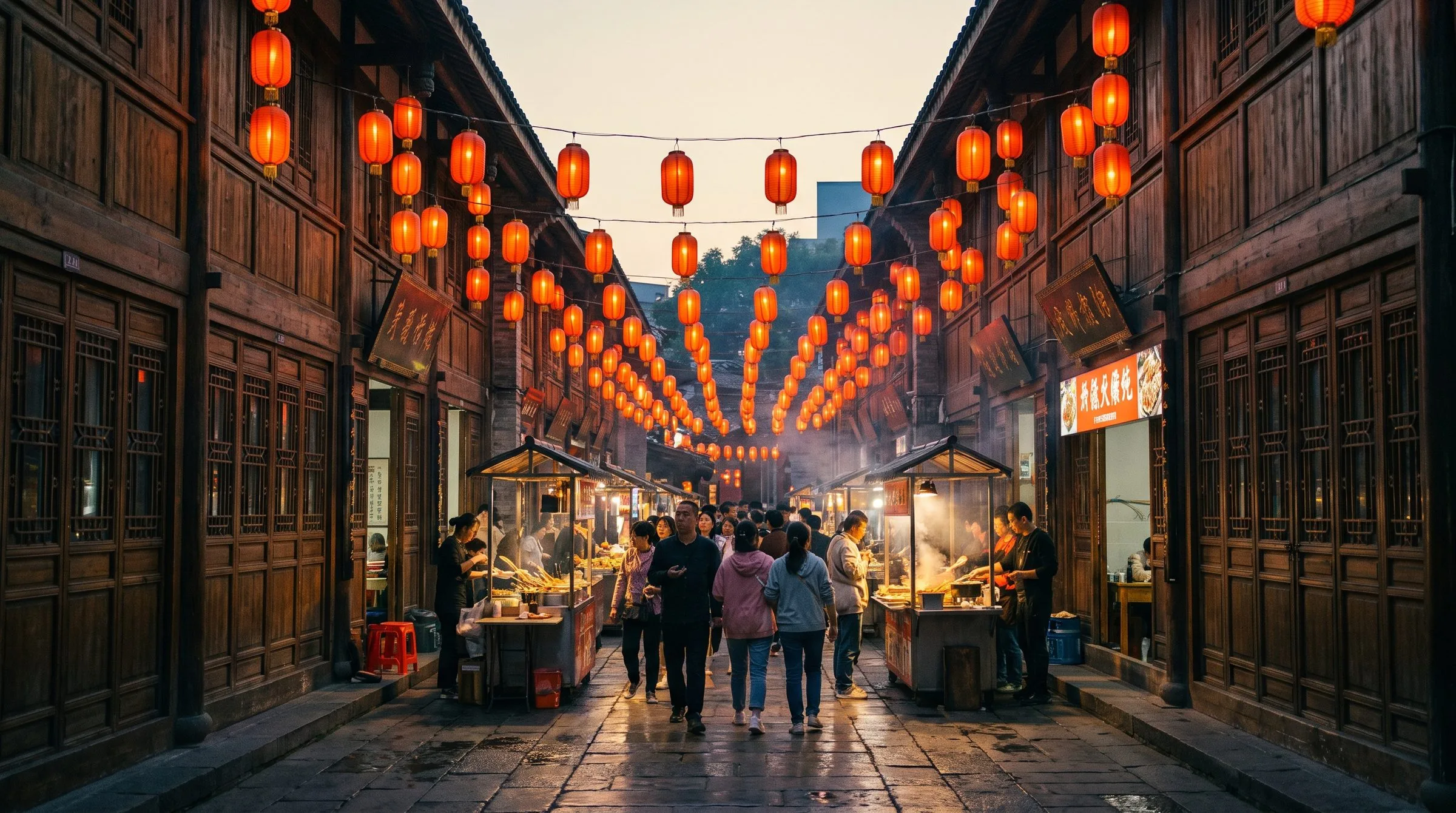
Jinli Ancient Street Guide: Chengdu's Most Photogenic Old Quarter
Jinli Ancient Street in Chengdu: a reconstructed Qing-era street next to Wuhou Shrine, 350m long, free entry. Best at dusk when the red lanterns come on. Combine with Wuhou Shrine and Du Fu Thatched Cottage.
Jinli Ancient Street (锦里, Jǐnlǐ) is the single most photogenic spot in central Chengdu and the best 1-2 hours for first-time visitors who want the “old China” experience without leaving the city center. It’s a 350-meter reconstructed Qing-era pedestrian street, packed with snack stalls, tea houses, and souvenir shops, and located right next to the Wuhou Shrine (the original Three Kingdoms memorial site).
The street is touristy — almost every stall is selling the same Sichuan snacks and the same plastic souvenirs. But it’s the only place in Chengdu where you can walk a fully-restored Qing-era street with red lanterns, wooden facades, and a free Sichuan opera face-changing show every 30 minutes.
Plan your visit
- Entry: Free (the street itself). The neighbouring Wuhou Shrine is ¥50.
- Hours: Street is open 24/7, but stalls operate roughly 9:00-22:00. Best photo light: 17:30-19:00 (dusk, lanterns on).
- Subway: Gaoshengqiao Station (Line 3) or Huaxiba Station (Line 1), 10-15 min walk.
- Allow 1-2 hours. Longer if you eat a full meal.
- Combine with Wuhou Shrine (¥50, 2-3 hours) for a half-day of Three Kingdoms history. Add Du Fu Thatched Cottage (¥50, 2-3 hours) for a full Chengdu history day.
What to do on the street
Eat the 6 must-try snacks
- Three Cannons (三大炮, Sāndàpào) — glutinous rice balls thrown onto a drum, served with brown sugar and soybean powder. Iconic Sichuan street food. ¥10-15.
- San Da Pao (三打炮) — same thing, different vendors. Don’t be confused by the similar name.
- Sweet Water Noodles (甜水面, Tiánshuǐmiàn) — thick wheat noodles in a sweet-spicy sauce with chili oil. Cold, refreshing, a must-try. ¥15.
- Long Chao Shou (龙抄手) — Chengdu’s version of wonton, with thin wrappers in spicy soup. ¥15-20.
- Bang Bang Chicken (棒棒鸡, Bàngbàngjī) — shredded chicken with sesame sauce, cold dish. ¥20-30.
- Dan Dan Noodles (担担面) — the famous Sichuan noodle dish, served in small portions. ¥15.
Watch the free Sichuan opera show
A 20-30 minute free show of Sichuan opera highlights, including the world-famous face-changing (变脸, biànliǎn) act. Shows at fixed times throughout the day (typically 11:00, 14:00, 16:00, 19:00). Tea houses along the street have the schedule posted. Most tea houses have a minimum spend (¥30-50 for tea + snacks).
Buy a souvenir (or just browse)
The souvenir stalls are mostly generic (silk fans, panda plushies, Chengdu fridge magnets). Quality varies; the tea and spice stalls near the back of the street are the best. Don’t expect antique-grade anything — it’s a tourist street, not a flea market.
Visit the small Wuhou Shrine annex
At the back of the street, a small side gate leads into the Wuhou Shrine complex (the main entrance is on the north side of the block). Free access to the annex garden, with bamboo paths and old trees. Quiet escape from the busy main street.
What to skip
- The “ancient” claim — Jinli is a modern reconstruction (built 2004) in the style of a Qing street. Authentic Qing streets exist elsewhere in Sichuan (Huanglongxi, Luodai), but Jinli is a designed experience, not a historical site. Enjoy it as such.
- The “free tea tasting” stands — most are sales pitches that turn into high-pressure sales. Skip unless you actually want to buy.
- Most of the food stalls — the food is touristy and the prices are 2-3x what locals pay. Eat at Jinli for the experience, not the value.
Practical tips
- Bring cash + WeChat Pay. Most stalls accept WeChat Pay and Alipay. Foreign cards are rarely accepted.
- Avoid weekends if possible. The street is impossibly crowded Sat-Sun 14:00-18:00. Weekday evenings are the sweet spot.
- Free wifi is patchy. Bring a Chinese SIM or eSIM.
- Dress for the season. Summer is hot and humid; winter is cold and grey. The lanterns look best in dusk light, any season.
- Photography — best shots are the overhead lantern rows, the wooden facade details, and the tea house courtyards. The street is most photogenic when wet (rain makes the lanterns glow).
Common questions
Is Jinli worth visiting if I only have 2 days in Chengdu?
Yes — it’s the best 1-2 hour stop in central Chengdu. The only real alternative is Kuanzhai Alley (similar but more upscale, less crowded). Pick one; if you have time for both, do Jinli at dusk and Kuanzhai during the day.
What’s the difference between Jinli and Kuanzhai Alley?
Jinli is the touristy, snack-stall, lantern-lit experience. Kuanzhai Alley (Wide and Narrow Alleys) is the upscale teahouse-and-boutique experience, with the same Qing-era courtyard architecture but a calmer, more refined vibe. Locals prefer Kuanzhai; tourists prefer Jinli. Both are worth seeing if you have time.
Is the face-changing show really free?
Yes — the public shows (in the open courtyard, not the paid teahouse rooms) are free. Arrive 10-15 min before showtime to get a seat. The teahouse shows (closer seating, tea + show combo for ¥80-150) are paid but offer a better view and English commentary.
Can I see the lanterns during the day?
Yes, but they look better at dusk. The street is also less crowded at dusk than during peak daytime hours, so the lantern photos are cleaner. Aim for 17:30-19:00 in summer, 16:30-18:00 in winter.
Wuhou Shrine + Jinli combo + Chengdu essentials
Wuhou Shrine skip-the-line ticket, Jinli snack tour, Giant Panda Base day tour (private car, English guide, morning panda viewing), airport transfer, and hotel booking in one cart. English interface, foreign cards accepted, e-voucher to phone. The 'Chengdu 3-day classic' bundle is the most efficient for first-timers.
Shrine ticket from $7 · Hotel from $78/night
Verified August 2026 by TravelHubChina Editorial. We re-check prices and policy details monthly so the data doesn’t drift.
FAQ
-
How much does it cost to enter Jinli Ancient Street?
The street itself is free to enter. The neighboring Wuhou Shrine costs ¥50. Inside Jinli, individual snacks run ¥10-30, and sit-down teahouse Sichuan opera shows are ¥80-150. -
What is the best time of day to visit Jinli for photos?
Aim for 17:30-19:00 in summer (16:30-18:00 in winter) when the red silk lanterns are at full glow and the street is less crowded than peak daytime hours. The article notes the lanterns also photograph especially well in the rain. -
Is the Sichuan opera face-changing show really free?
Yes. Public shows in the open courtyard (typically at 11:00, 14:00, 16:00, and 19:00) are free; arrive 10-15 minutes early for a seat. Paid teahouse shows at ¥80-150 give you closer seating and English commentary. -
How do I get to Jinli by metro?
Take Line 3 to Gaoshengqiao Station or Line 1 to Huaxiba Station. Both are a 10-15 minute walk from the street. -
Is Jinli a real historic street or a modern reconstruction?
Jinli is a modern reconstruction (built 2004) designed in the Qing-era style, not a centuries-old original. Authentic Qing streets exist elsewhere in Sichuan (Huanglongxi, Luodai). Enjoy Jinli as a designed experience, not a historical site. -
What are the must-try snacks on Jinli?
Six signature items: Three Cannons (三大炮, glutinous rice balls, ¥10-15), Sweet Water Noodles (甜水面, ¥15), Long Chao Shou wontons (龙抄手, ¥15-20), Bang Bang Chicken (棒棒鸡, ¥20-30), and Dan Dan Noodles (担担面, ¥15). -
Should I combine Jinli with Wuhou Shrine?
Yes. The two are next to each other and together make a half-day of Three Kingdoms history. Adding Du Fu Thatched Cottage (¥50) turns it into a full Chengdu history day.
Related guides
- Scenic & Nature
Forbidden City Guide: Beijing Imperial Palace, Tickets & Plan
The Forbidden City in Beijing: 72 hectares, 980 buildings, 1.4 million artifacts, Ming and Qing dynasties, UNESCO since 1987. Tickets (¥60), WeChat booking.
12min read
- Scenic & Nature
Kuanzhai Alley Guide: Chengdu's Wide and Narrow Alleys
Kuanzhai Alley (Wide and Narrow Alleys) in Chengdu: 3 parallel Qing-era courtyard streets, free entry, the upscale alternative to Jinli. Best for boutique teahouses, Sichuan opera, and a quieter old-China experience.
- Scenic & Nature
Big Wild Goose Pagoda Guide: Xi'an's 1,300-Year Tang Pagoda
Big Wild Goose Pagoda (Dayan Ta) in Xi'an: 64m Tang-dynasty brick pagoda from 652 AD, UNESCO since 2014 as part of the Silk Roads network. Tickets (¥50), climb times, and the free North Square musical fountain (9 PM nightly).
8min read
- Scenic & Nature
China's Top 3 Scenic Wonders Compared: Zhangjiajie vs Huangshan vs Jiuzhaigou (2026)
Zhangjiajie (sandstone pillars), Huangshan (sea of clouds + granite peaks), Jiuzhaigou (turquoise lakes + waterfalls). Decision guide covering which fits your time, budget, fitness level, photography goals, and travel style. Prices, distances from Shanghai/Beijing, best seasons compared.
12min read
- Scenic & Nature
Daocheng Yading Scenic Guide: Three Sacred Mountains & Alpine Lakes
Daocheng Yading in Sichuan is a 4,000-6,032m reserve with three sacred peaks and Milk Lake. Covers ¥146-266 tickets, Chengdu flights, hiking, altitude prep.
12min read
- Scenic & Nature
Ejina Populus Forest Guide: 21 Days of Golden China
Ejina Populus Forest in Inner Mongolia has 39,000 hectares of Populus euphratica, gold October 1-21. Covers tickets, transport, Erdaoqiao Bridge, 4-day plan.
12min read