
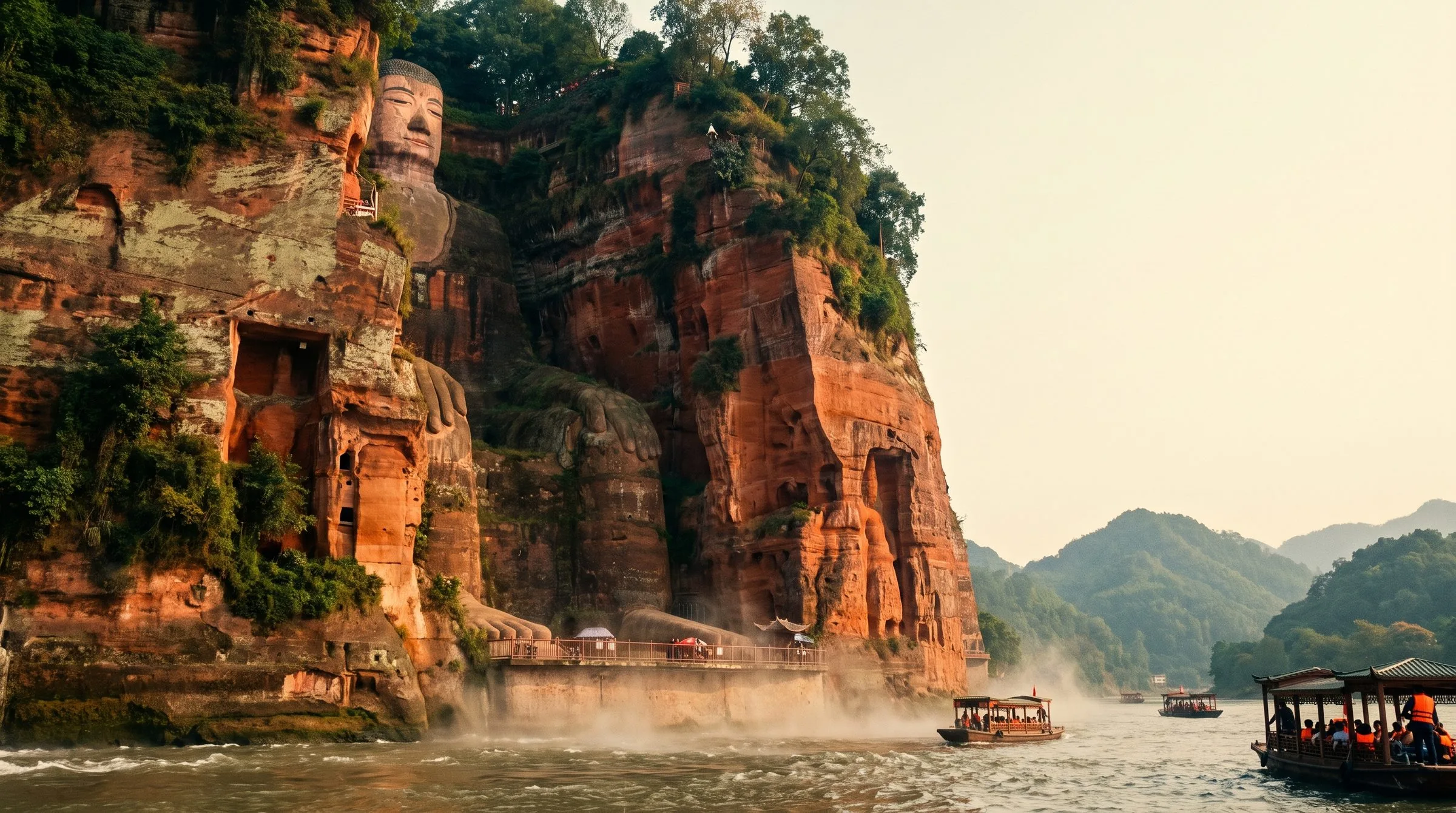
Leshan Giant Buddha Day Trip from Chengdu: 71m, 1,300 Years Old
Leshan Giant Buddha: 71m tall, carved 713-803 AD, UNESCO since 1996. Day trip from Chengdu (1.5 hrs HSR + bus). ¥80 entry. Best for: morning departure, the stair descent to the Buddha's feet, and the river confluence view.
The Leshan Giant Buddha (乐山大佛, Lèshān Dàfó) is the single best day trip from Chengdu and the most awe-inspiring Buddhist site in Sichuan. It’s a 71-meter tall stone Buddha carved into a red sandstone cliff face at the confluence of the Min, Dadu, and Qingyi rivers, started in 713 AD by a Tang Dynasty monk named Haitong and completed 90 years later in 803 AD. The Buddha is so large that each of his toes can seat a person, and the full descent down the carved stairs takes 30 minutes — past the head, shoulders, chest, hands, knees, and feet.
The site has been a UNESCO World Heritage Site since 1996 (jointly with Mount Emei, 40 km away). The day trip from Chengdu is 1.5 hours each way by HSR, plus a 30-minute bus from Leshan Station to the scenic area. Most visitors go as a guided day tour (4-6 hours at the Buddha, including the stairs), or combine it with Mount Emei for a 2-day trip.
Plan your day trip
- Chengdu to Leshan: HSR from Chengdu South Station to Leshan Station, 1-1.5 hours, ¥54-65 second class. Trains run every 20-30 min from 6:00-21:00. Buy tickets via 12306 app (English version exists, buggy but works) or at the station.
- Leshan Station to scenic area: Bus 3 or 13 from the station to the Buddha’s North Gate, ¥2, 30 min. Or DiDi for ¥30-40, 20 min. Some day tours include the transfer.
- Entry: ¥80 (Apr-Oct) or ¥80 (Nov-Mar). Foreign passport discount: not always available, check at the gate.
- Hours: 7:30-18:30 (Apr-Oct), 8:00-17:30 (Nov-Mar). Last entry 1 hour before close.
- Allow 3-4 hours at the site for the full experience (stairs, Lingyun Temple, Wuyou Temple, river confluence view).
- Return: Last HSR back to Chengdu is around 21:30. Easy to make a day trip without overnight.
The stair descent: the highlight
The Buddha is carved into the cliff with a 9-level switchback staircase that goes from the top of his head down to his feet at river level. The descent is the single most memorable physical experience in Sichuan tourism. Expect:
- 9 switchbacks along the carved stairs
- ~30 minutes down, 40-60 minutes up (the climb back is harder)
- Crowds in summer weekends and Golden Week
- No elevators or escalators — pure stairs
- Limited shade — bring a hat and water
The views from each switchback are different and progressively more dramatic. At the bottom (the Buddha’s feet level), you can see the full carved toes and the drainage system hidden in the Buddha’s hair (which has kept the statue from eroding for 1,200 years).
Important: the stairs are sometimes closed for maintenance (typically 2-3 weeks at a time, in low season). Check the official site or ask your hotel before going. If the stairs are closed, you can still see the Buddha from the viewing platforms above and across the river.
What else to see at the site
Lingyun Temple (凌云寺)
The Buddhist temple at the top of the Buddha, built in the 8th century alongside the carving. Small, atmospheric, and free to enter. The temple’s main hall has a small Buddha statue said to be the model for the giant.
Wuyou Temple (乌尤寺)
A separate temple on an island in the Min River, accessible by a short bridge. Quieter than Lingyun, with a 1,000-year-old camphor tree in the courtyard. The walk from the main Buddha area to Wuyou Temple is 20 min and includes river views.
Lingbao Pagoda (灵宝塔)
A 13-story Tang Dynasty pagoda on the hill above the Buddha. Climb to the top for a panoramic view of the river confluence and the full Buddha from above. 15-20 min walk up, 200+ steps.
River confluence view
The Buddha faces the confluence of 3 rivers (Min, Dadu, Qingyi). The view from the river-level viewing platform (bottom of the stairs) shows the full geographic context. On a clear day, you can see Mount Emei in the distance.
Combine with Mount Emei (optional)
Mount Emei (峨眉山, Éméishān) is 40 km from Leshan and the other half of the joint UNESCO site. Mount Emei is one of the Four Sacred Buddhist Mountains of China and the home of the Samantabhadra Bodhisattva. Highlights:
- Golden Summit (金顶) at 3,079m — the highest accessible point, with a golden statue and panoramic views. Cable car to the top, 5 min ride.
- Mountain monkeys — wild macaques that live around the cable car station. Don’t carry visible food.
- Baoguo Temple (报国寺) — the base temple, free entry, 1 hour to walk through.
- Hiking trails — the classic Emei hike is 2-3 days from base to summit. Most visitors do a 1-day Golden Summit trip via cable car.
Most Leshan day tours can be extended to include Mount Emei for an extra ¥150-300. Or do it independently: Leshan → Emei → Chengdu via HSR, all on the same line.
Practical tips
- Wear comfortable walking shoes. The stair descent is 9 switchbacks; the climb back is harder.
- Bring water + a hat. The site has limited shade, especially on the stairs.
- Cash + WeChat Pay for entry. Foreign cards rarely accepted.
- No photos on the stairs — security guards enforce this in busy periods. Photos from the viewing platforms are fine.
- Avoid Golden Week (Oct 1-7) and summer weekends. The stair queue can be 60+ min.
- Lunch on-site or in Leshan city. The site restaurants are overpriced; the town has better options.
Common questions
How long is the HSR from Chengdu?
1-1.5 hours from Chengdu South Station to Leshan Station. Trains every 20-30 min, ¥54-65 second class. Buy via 12306 app or at the station.
Can I see the Buddha without climbing the stairs?
Yes — the viewing platforms above and across the river show the full Buddha. The stair descent is a separate, optional experience. Most visitors do at least the partial descent (1-3 switchbacks) and skip the rest if they can’t do the full climb.
Is Leshan worth a full day?
If you go independently, allow 5-6 hours total (1.5 hr each way HSR + 3-4 hours at the site). A guided day tour is the most efficient. If you also want Mount Emei, allow 2 days.
Should I combine Leshan with Mount Emei?
Yes if you have time — they’re a joint UNESCO site and only 40 km apart. Mount Emei is the Buddhist mountain; Leshan is the carved Buddha. Together they make a 2-day trip that covers the cultural and natural highlights of western Sichuan.
Leshan Buddha + Mount Emei day tour
Round-trip HSR from Chengdu South Station to Leshan, English-speaking local guide at the Buddha site (explains the Tang Dynasty history and the engineering of the carving), Mount Emei Golden Summit cable car, lunch, and return. The most efficient way to see both UNESCO sites in 1 day.
Day tour from $112
Verified August 2026 by TravelHubChina Editorial. We re-check prices and policy details monthly so the data doesn’t drift.
FAQ
-
How long does the high-speed rail from Chengdu to Leshan take?
1-1.5 hours from Chengdu South Station to Leshan Station. Trains run every 20-30 minutes from 6:00-21:00, second class ¥54-65. Buy tickets via the 12306 app (English version exists) or at the station. -
How much does it cost to enter the Leshan Giant Buddha?
Entry is ¥80 in both peak (Apr-Oct) and low (Nov-Mar) seasons. The article notes foreign passport discounts are not always available; check at the gate. -
How hard is the stair descent to the Buddha feet?
The 9-switchback carved staircase takes about 30 minutes down and 40-60 minutes back up. There are no elevators or escalators and limited shade. The article recommends comfortable walking shoes, water, and a hat. -
What is the best time of day to visit the Leshan Buddha?
The site opens 7:30-18:30 in Apr-Oct (8:00-17:30 in Nov-Mar), with last entry 1 hour before close. Avoid Golden Week (Oct 1-7) and summer weekends, when the stair queue can exceed 60 minutes. -
Can I see the Buddha without climbing the stairs?
Yes. Viewing platforms above and across the river show the full 71-meter Buddha. The stair descent is a separate, optional experience; most visitors do at least 1-3 switchbacks and skip the rest if they cannot do the full climb. -
Should I combine Leshan with Mount Emei?
Yes if you have time. They are a joint UNESCO site and only 40 km apart. Mount Emei is one of the Four Sacred Buddhist Mountains of China, with a Golden Summit cable car (5 min ride) and the option to add it for ¥150-300 to most Leshan day tours. -
How do I get from Leshan Station to the Buddha scenic area?
Take Bus 3 or 13 from the station to the North Gate (¥2, 30 min) or a DiDi for ¥30-40 (about 20 min). Some day tours include the transfer. -
Are the stairs to the Buddha sometimes closed?
Yes. The stairs are periodically closed for maintenance, typically 2-3 weeks at a time in low season. Check the official site or ask your hotel before going; if they are closed, the upper and riverside viewing platforms are still open.
Related guides
- Scenic & Nature
Big Wild Goose Pagoda Guide: Xi'an's 1,300-Year Tang Pagoda
Big Wild Goose Pagoda (Dayan Ta) in Xi'an: 64m Tang-dynasty brick pagoda from 652 AD, UNESCO since 2014 as part of the Silk Roads network. Tickets (¥50), climb times, and the free North Square musical fountain (9 PM nightly).
8min read
- Scenic & Nature
Terracotta Army Guide: Xi'an UNESCO Site, Tickets & Plan
Terracotta Army in Xi'an: 8,000+ life-sized warriors from 210 BC, UNESCO since 1987. Tickets (¥120), Bus 306 transport, 3 pits, and how to plan your visit.
12min read
- Scenic & Nature
China's Top 3 Scenic Wonders Compared: Zhangjiajie vs Huangshan vs Jiuzhaigou (2026)
Zhangjiajie (sandstone pillars), Huangshan (sea of clouds + granite peaks), Jiuzhaigou (turquoise lakes + waterfalls). Decision guide covering which fits your time, budget, fitness level, photography goals, and travel style. Prices, distances from Shanghai/Beijing, best seasons compared.
12min read
- Scenic & Nature
Forbidden City Guide: Beijing Imperial Palace, Tickets & Plan
The Forbidden City in Beijing: 72 hectares, 980 buildings, 1.4 million artifacts, Ming and Qing dynasties, UNESCO since 1987. Tickets (¥60), WeChat booking.
12min read
- Scenic & Nature
Great Wall of China Guide: Mutianyu, Badaling, Jinshanling Compared
Great Wall of China: 21,196 km. Mutianyu (best first-timers), Badaling (most crowded), Jinshanling (hiking) compared. Tickets, transport, best season.
12min read
- Scenic & Nature
Huangshan (Yellow Mountain) Guide: Sunrise, Sea of Clouds, Trails (2026)
Huangshan (黄山, Yellow Mountain) in Anhui is a UNESCO World Heritage site famous for its sea of clouds, twisted pines, and granite peaks. This guide covers the 2-3 day plan, ticket prices (¥190-310), cable cars, sunrise timing, and Hongcun village.
12min read