TCM for Foreigners in China 2026: Acupuncture, Pain Management, and Chronic Disease Treatment
Traditional Chinese Medicine (TCM) for foreigners in China 2026: evidence-based uses (chronic pain, post-stroke, chemo nausea, insomnia, women's health, IBS — per Cochrane reviews), the 6 best TCM hospitals for foreigners (Dongzhimen Beijing, Longhua Shanghai, Guangdong Provincial TCM, Chengdu TCM, Yueyang Shanghai, Boao TCM), what a consultation looks like, herb-drug interactions, sample 7/14/30 day plans, and a 14-day Beijing TCM itinerary with USD costs.
If you’re coming to China for medical care — even as a skeptic — Traditional Chinese Medicine (TCM, 中医, zhōngyī) is the one treatment category that simply doesn’t exist anywhere else at the same scale, integration, and price. The same hospital that does your Western-medicine check-up or surgery has a TCM department. The same visit can include an acupuncture prescription, a herbal formula, and a tuina massage — and at a registered TCM hospital, the cost is 60-80% lower than equivalent care in the US, with a 2,500+ year clinical history. The 2026 World Health Organization ICD-11 now includes TCM patterns as a supplementary classification — an institutional endorsement that even the WHO’s biggest skeptics can’t dismiss. And the evidence base is real: the Cochrane Library has 200+ systematic reviews of TCM interventions, with strong support for chronic pain, post-stroke recovery, chemotherapy-induced nausea, insomnia, women’s health, and IBS.
This is the deep-dive TCM guide for foreign patients: what TCM is and isn’t, what the evidence says, the 6 best TCM hospitals in China for foreigners, what a consultation actually looks like, how to combine TCM with Western medicine, sample 7/14/30 day treatment plans, the herb-drug interactions you must know about, and a 14-day Beijing TCM itinerary with realistic USD costs.
For the framework (visa, insurance, general medical tourism), see our China medical tourism guide. For the cultural and lifestyle side of TCM, see the TCM & wellness cultural pillar article. For the dental, cosmetic surgery, fertility, and cancer deep dives. For city-specific TCM, see Chengdu (TCM capital) and Beijing.
What is TCM and why China for TCM
TCM is a 2,500+ year-old clinical medical system with its own diagnostic framework (the pattern diagnosis 辨证, biànzhèng), treatment modalities (acupuncture, herbal medicine, tuina, moxibustion, cupping, qigong), and theoretical foundation (yin/yang 阴阳, five elements 五行, qi 气 through meridians 经络). It is a parallel medical system taught, practiced, and regulated in China for over two millennia, with formal licensure (中医执业医师) since 1999, dedicated 5-year undergraduate and 3-year graduate TCM degrees, and 4,400+ TCM hospitals in mainland China as of 2025 (per the National Administration of Traditional Chinese Medicine 国家中医药管理局 2024 annual report).
What TCM adds to a foreign medical tourism trip that no other country can:
- Integrated into the same hospital as Western medicine. Every Chinese tertiary-A hospital has a TCM department. At PUMCH (协和), Beijing United Family, Huashan, and West China, you can see a Western specialist and a TCM doctor on the same visit, with shared records. This is called 中西医结合 (zhōngxīyī jiéhé, “integrated Chinese and Western medicine”) — a 70-year-old clinical discipline.
- The cost is dramatically lower. A TCM session that costs $150-300 in the US costs $50-150 in China at a registered hospital. A 14-day chronic pain TCM program is $1,500-4,000 in China vs $4,000-10,000 in the US.
- The clinical depth is unmatched. China has 600,000+ licensed TCM physicians (per 2024 NHC data) — more than the rest of the world combined. The top TCM hospitals see 5,000-15,000 patients daily.
- The evidence base is growing. The Cochrane Library indexed 200+ systematic reviews of TCM interventions between 2018 and 2024. The 2026 WHO ICD-11 includes a supplementary chapter on Traditional Medicine Conditions — the first WHO-level recognition of TCM as a clinical system.
- The herbal pharmacy is regulated and standardized. Since the 2020 Pharmacopoeia of the PRC, all dispensed Chinese herbs must pass HPLC fingerprinting, heavy metal testing, and pesticide residue testing at the hospital pharmacy level.
The honest trade-off: TCM is not a substitute for emergency Western care (heart attack, stroke, acute infection, surgery), is not a magic cure for cancer, and outside a registered hospital, quality varies enormously. The rule: always go to a registered hospital TCM department, not an informal clinic.
What TCM actually treats: the Cochrane review verdict
The 2026 Cochrane Library has 200+ systematic reviews of TCM interventions. Honest summary: TCM is evidence-based for a specific list, has mixed evidence for a longer list, and is not evidence-based for the rest.
Strong evidence (Cochrane confirms): chronic low back pain (acupuncture, ACP first-line since 2017/2024); chronic neck pain (Cochrane 2018); knee osteoarthritis (acupuncture + herbal formulas like Du Huo Ji Sheng Tang 独活寄生汤, Cochrane 2018-2022); migraine prevention (Cochrane 2016/2022); chemotherapy-induced nausea (acupressure at P6 内关 + Xiang Sha Liu Jun Zi Tang 香砂六君子汤, Cochrane 2018, ASCO 2023); post-stroke functional recovery (Cochrane 2018); insomnia (acupuncture + Suan Zao Ren Tang 酸枣仁汤 or Tian Wang Bu Xin Dan 天王补心丹); allergic rhinitis (Cochrane 2014/2020); breech presentation (moxibustion at BL67 至阴, Cochrane 2012 — strongest OB evidence of any TCM modality); primary dysmenorrhea (Cochrane 2016); IBS (acupuncture + Tong Xie Yao Fang 痛泻要方, Cochrane 2019); menopausal hot flashes (Cochrane 2018); fertility support adjunct to IVF (Cochrane 2018, modest improvement in live birth rate).
Mixed or limited evidence: chronic fatigue syndrome (Chinese trials positive, Cochrane inconclusive — pattern differentiation matters); asthma; atopic dermatitis (some formulas like Zhen Wu Tang 真武汤 positive, quality variable); Type 2 diabetes (some formulas like Liu Wei Di Huang Wan 六味地黄丸, Jin Qi Huang Tang 金芪黄汤 positive as adjunct, not substitute); hypertension (Tian Ma Gou Teng Yin 天麻钩藤饮 used in Chinese practice); cancer supportive care (NOT cure — TCM for chemo side effects, post-op recovery, immune support has consistent positive data); Bell’s palsy.
Not evidence-based, used in TCM practice anyway: cosmetic TCM; most “detox” protocols; weight loss via TCM; most cancer “cure” claims (dangerous if it delays Western treatment); most chronic disease “miracle cure” claims.
When TCM is NOT a substitute for Western medicine (absolute contraindications): acute myocardial infarction (heart attack — call 120); stroke in the acute phase (first 24-72 hours — go to a Western stroke unit; TCM is for post-stroke recovery, not acute treatment); acute infection with high fever (antibiotics, not TCM); surgical emergencies; trauma/fractures/severe bleeding; cancer in active treatment (Western oncology first; TCM as supportive care, not primary); pregnancy complications (obstetric care, not TCM, except moxibustion for breech with proper supervision).
TCM treatment types: the 6 modalities you’ll encounter
A Chinese TCM hospital typically offers all 6 of the following modalities, often combined in a single treatment program.
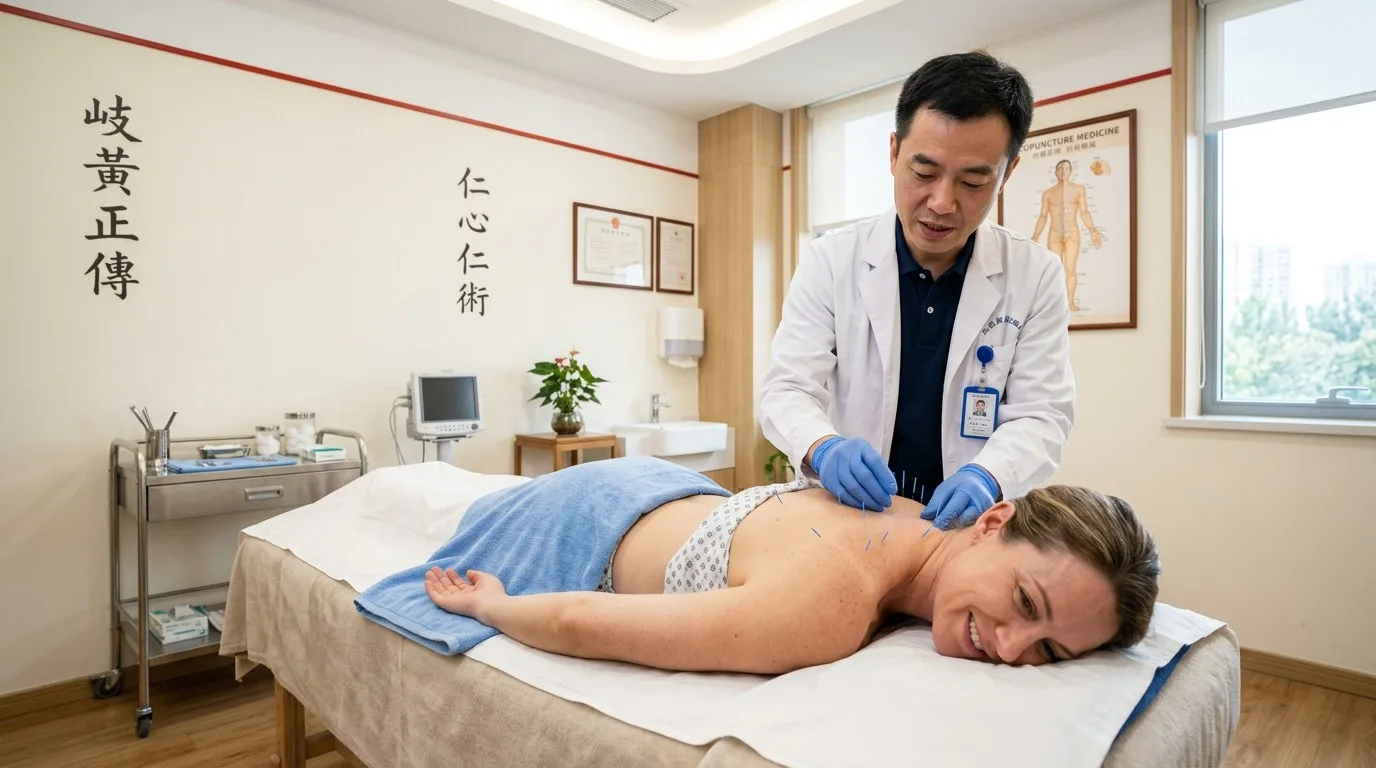
1. Acupuncture (针灸, zhēnjiǔ) — the most evidence-based. Sterile, single-use stainless steel needles (0.18-0.30mm diameter) inserted at specific points along the body’s meridians, left 15-40 minutes, often with manual or electrical stimulation (electroacupuncture 电针, diànzhēn). Best for (per 2026 Cochrane): chronic low back pain, neck pain, knee osteoarthritis, migraine prevention, tension headache, chemotherapy-induced nausea, insomnia, allergic rhinitis, primary dysmenorrhea, fertility support adjunct to IVF. Cost (2026): $50-150 per session in China vs $150-300 in the US; programs at $200-500/week for 5 sessions. Safety: extremely safe in registered hospitals; single-use disposable needles standard since 2010; serious adverse events <0.01%.
*2. Chinese herbal medicine (中药, zhōngyào`) — the most customizable. A personalized formula of 5-20 herbs, prescribed based on your pattern diagnosis (e.g., liver qi stagnation 肝气郁结, spleen yang deficiency 脾阳虚, kidney yin deficiency 肾阴虚). At a registered hospital, the formula is prepared in 3 forms: decoction (汤剂 tāngjì) — raw herbs you boil at home; granules (颗粒剂 kēlìjì) — instant-dissolve powder; patent formula (中成药 zhōngchéngyào) — pre-made pills/capsules. Best for (per 2026 evidence): chemotherapy-induced nausea, IBS, primary dysmenorrhea, insomnia, post-stroke recovery, fertility support, common cold and post-viral fatigue, certain chronic skin conditions. Cost (2026): $50-200 per week in China vs $100-400 in the US. The most important rule: always tell your TCM doctor every Western medication and supplement you take.
3. Cupping (拔罐, báguàn) — the most visible, the most misunderstood. Glass or plastic cups placed on the skin (usually back, shoulders, thighs), with air evacuated to create suction. Cups are left 5-15 minutes, leaving characteristic circular red-purple marks that last 5-10 days. Best for (per evidence): short-term relief of muscle tension and chronic non-specific back pain. Cupping is not a disease cure — it is symptomatic muscle-tension release. The Cochrane review (2012, updated 2018) is inconclusive for anything beyond musculoskeletal tension. Cost (2026): $30-80 in China vs $50-150 in the US.
4. Moxibustion (艾灸, àijiǔ) — heat therapy. Burning of processed mugwort (艾, ài, Artemisia argyi) either on top of the needle (warm needle 温针灸), on a slice of ginger or garlic on the skin (indirect moxibustion 隔姜灸/隔蒜灸), or in a small box held over the skin (moxibustion box 艾灸盒). Best for (per evidence): breech presentation (moxibustion at BL67 至阴 has the strongest OB evidence of any TCM modality — 2012 Cochrane review confirms increased chance of turning from breech to cephalic). Also used for chronic fatigue, menstrual disorders, arthritis pain, post-partum recovery. Cost (2026): $30-70 in China vs $60-150 in the US.
5. Tuina (推拿, tuīná) — TCM manual therapy. TCM therapeutic massage using hand techniques (pressing, rolling, tapping, kneading) along the meridians and acupuncture points. More vigorous and technique-specific than Swedish massage. Includes pediatric tuina (小儿推拿) for children 0-6 years. Best for (per evidence): chronic musculoskeletal pain, post-stroke recovery, infant colic and digestive issues (pediatric tuina), post-partum recovery, certain pediatric respiratory conditions. Cost (2026): $40-100 in China vs $80-200 in the US.
6. Qigong and tai chi (气功 / 太极拳) — movement therapy. Gentle, slow, coordinated movement sequences (tai chi 太极拳 is the most well-known Western form) combined with breath control and meditation. Qigong (气功) is the broader category; tai chi is one specific form with 5 major styles (Chen, Yang, Wu, Sun, Hao). Baduanjin (八段锦, Eight Pieces of Brocade) is a 10-minute qigong form often taught in TCM hospitals. Best for (per evidence): falls prevention in elderly (Cochrane 2017, strong evidence), Parkinson’s disease motor symptoms, chronic pain, post-stroke recovery, anxiety and depression as adjunct, cardiovascular health as adjunct. Cost (2026): usually included in the program cost.
The 6 best TCM hospitals for foreigners
Six hospitals consistently rank at the top for foreign-patient TCM care in 2026. All six have dedicated international departments with English-speaking staff, accept international insurance (MSH International direct-bills at all six; Cigna, Bupa, GeoBlue at some), and provide written English treatment plans.
1. Dongzhimen Hospital (北京中医药大学东直门医院, Běijīng Zhōngyīyào Dàxué Dōngzhímén Yīyuàn) — Beijing (Dongcheng District). Affiliation: Beijing University of Chinese Medicine (北京中医药大学), the top TCM university in northern China. Why #1 for foreigners: dedicated International Medical Center (2018), full English-speaking staff, MSH International direct-billing, all 6 TCM modalities, the most active TCM clinical research program in China (50+ ongoing RCTs in 2026). Specialties: chronic pain (low back, neck, knee osteoarthritis), post-stroke recovery, insomnia, women’s health, fertility support. Cost (2026): initial consultation $80-150, 14-day program $1,500-3,500. Book: international@dzmformc.com (or WeChat “东直门医院国际部”), 2-3 weeks lead time.
2. Longhua Hospital (上海中医药大学附属龙华医院, Shànghǎi Zhōngyīyào Dàxué Fùshǔ Lónghuá Yīyuàn) — Shanghai (Xuhui District). Affiliation: Shanghai University of Traditional Chinese Medicine. Why #2: top TCM hospital for oncology support and kidney disease, strong research program, large international patient base. Specialties: TCM oncology support (chemo side effects, post-op recovery, immune regulation), nephrology (chronic kidney disease TCM protocols), gynecology, geriatric TCM. Cost (2026): initial consultation $80-150, 14-day program $1,800-4,000. Book: longhua-international@longhua.cn.
3. Guangdong Provincial TCM Hospital (广州中医药大学第一附属医院, Guǎngzhōu Zhōngyīyào Dàxué Dì-yī Fùshǔ Yīyuàn) — Guangzhou (Baiyun District). Affiliation: Guangzhou University of Chinese Medicine. Why #3: TCM capital of southern China, the strongest TCM hospital for fertility support, women’s health, and oncology TCM; large Cantonese-speaking international patient base (HK, Macau, SE Asia, US Chinese diaspora). Specialties: fertility support (TCM as IVF adjunct), women’s health (PMS, dysmenorrhea, menopause, recurrent miscarriage), oncology TCM, rheumatology. Cost (2026): initial consultation $70-130, 14-day fertility program $2,000-4,500. Book: gztcm-foreign@gzucm.edu.cn.
4. Hospital of Chengdu University of TCM (成都中医药大学附属医院 / 四川省中医院, Chéngdū Zhōngyīyào Dàxué Fùshǔ Yīyuàn) — Chengdu (Wenjiang District). Affiliation: Chengdu University of Traditional Chinese Medicine. Why #4: the TCM capital of western China, the most immersive TCM environment, the strongest TCM hospital for orthopedic conditions and post-stroke recovery. Specialties: orthopedic TCM (chronic joint pain, post-fracture recovery, post-surgical rehab), post-stroke recovery, chronic pain, geriatric TCM. Cost (2026): initial consultation $60-120, 30-day comprehensive program $3,000-7,000 (Chengdu has the most competitive 30-day pricing). Book: cdutcm-international@163.com.
5. Yueyang Hospital of Integrated TCM and Western Medicine (上海岳阳中西医结合医院, Shànghǎi Yuèyáng Zhōngxīyī Jiéhé Yīyuàn) — Shanghai (Hongkou District). Affiliation: Shanghai University of Traditional Chinese Medicine. Why #5: the best example of true 中西医结合 (integrated Chinese and Western medicine) — a hospital where TCM and Western medicine share the same floor, same records, and same treatment plan. Specialties: chronic disease management (Type 2 diabetes, hypertension, chronic kidney disease, coronary heart disease), acupuncture for paralysis rehabilitation, TCM-Western combination oncology. Cost (2026): initial consultation $80-140, 14-day program $1,500-3,500. Book: yueyang-international@yueyang.com.
6. Boao TCM Center at Hainan Boao Lecheng International Medical Tourism Pilot Zone (海南博鳌乐城国际医疗旅游先行区, Hǎinán Bó’ào Lèchéng Guójì Yīliáo Lǚyóu Xiānxíngqū) — Boao, Hainan (about 1 hour flight from Beijing/Shanghai). Why #6: the only place in mainland China where you can access US FDA-approved acupuncture devices and certain TCM-related pharmaceuticals not yet approved by mainland China’s NMPA. Boao is the Chinese government-designated special zone for cutting-edge medical access. Specialties: cutting-edge TCM-Western combination programs, longevity TCM, post-cancer recovery with imported supplements, integrative oncology. Cost (2026): initial consultation $150-300, 14-day program $3,000-8,000. Book: through any Boao facility, M-visa required.
For chronic pain and post-stroke recovery: start with Dongzhimen or Longhua. For fertility support and women’s health: Guangdong Provincial TCM. For a 30-day comprehensive program: Chengdu (most cost-effective, most immersive). For combined TCM-Western management: Yueyang. For cutting-edge TCM access: Boao. For city context, see Beijing guide and Chengdu guide.
What a TCM consultation actually looks like
For first-timers, a TCM consultation is unlike a Western doctor visit — longer, more conversational, and includes diagnostic techniques that don’t exist in Western medicine.
Before the visit: you check in at the international department reception, show your passport and insurance card, and the coordinator hands you a TCM-specific intake form in English. The form asks for chief complaint plus detailed questions on: sleep (入睡困难 / 易醒 / 多梦 — difficulty falling asleep / waking easily / vivid dreams), digestion (大便 — bowel movements, including frequency, consistency, color), temperature preferences (怕冷 / 怕热 — cold-averse / heat-averse), sweating patterns, energy levels, emotions, menstrual cycle (for women, a 1-page detailed form), and any Western diagnoses and current medications.
The consultation (60-90 minutes): (1) Interview (20-30 min): the TCM doctor reviews your intake and asks follow-up questions about temperature sensitivity, food preferences, emotional patterns, sleep quality, sweat patterns, bowel/urinary habits, (for women) menstrual cycle. (2) Tongue diagnosis 舌诊 (5 min): you stick out your tongue. The doctor looks at color, shape, coating (苔 tāi), moisture, teeth marks. Each appearance maps to a TCM pattern — pale tongue with thick white coating suggests cold-damp 寒湿, red tongue with yellow coating suggests heat 热, tongue with teeth marks suggests spleen qi deficiency 脾气虚. (3) Pulse diagnosis 脉诊 (5-10 min): the doctor feels your pulse at three positions on each wrist (cun 寸, guan 关, chi 尺) at three depths (浮 superficial, 中 middle, 沉 deep), 18 pulse readings total. The pulse reveals the state of each organ system in TCM terms — slippery pulse 滑脉 often indicates dampness or pregnancy, wiry pulse 弦脉 indicates liver qi stagnation, thin pulse 细脉 indicates blood deficiency. (4) Pattern diagnosis 辨证 (5 min): the doctor synthesizes into a TCM pattern (证型 zhèngxíng). Common patterns: liver qi stagnation 肝气郁结, spleen qi deficiency 脾气虚, kidney yin deficiency 肾阴虚, heart blood deficiency 心血虚, damp-heat in the lower burner 下焦湿热, wind-cold exterior 风寒表证, blood stasis 血瘀. (5) Treatment plan (10-15 min): the doctor explains the pattern in plain English, proposes a plan (typically a combination of acupuncture, herbal formula, and one other modality), and gives a written plan with session frequency, expected duration, and cost estimate. (6) First acupuncture session (optional, 30-45 min): if you’re starting acupuncture that day, needles are inserted, you rest 20-30 minutes, then removed. (7) Herbal prescription (if prescribed): you take the prescription to the hospital pharmacy, which prepares the formula. (8) Follow-up: scheduled in 3-7 days to adjust the formula based on your response.
Follow-up visits (30-45 min): shorter. The doctor re-checks tongue and pulse, asks about symptom changes, adjusts the formula and treatment frequency, re-issues the herbal prescription.
Bring to your first TCM consultation: passport; insurance card (if you have one that covers TCM); all current medications (in original packaging, with generic names); list of any TCM herbs you currently take; recent Western medical records (especially for the condition being treated); a 2-week food and symptom diary (optional but helpful for pattern diagnosis).
The whole first-visit process takes 2-3 hours including waiting. Plan accordingly.
TCM and Western medicine integration at Chinese hospitals
The single biggest advantage of getting TCM in China — versus in the West — is integration with Western medicine in the same hospital. The clinical discipline is called 中西医结合 (zhōngxīyī jiéhé), a formal medical discipline in China since the 1950s, with 50+ dedicated integrated medicine hospitals and integrated departments in nearly every tertiary-A hospital.
How integration works in practice: (1) Initial Western workup (1-2 days): blood panel, imaging if relevant, specialist consultation. (2) TCM consultation (1-2 hours): the TCM doctor reviews the Western diagnosis, performs tongue and pulse diagnosis, proposes a TCM pattern and treatment plan that complements (not replaces) the Western care. (3) Combined treatment: the Western specialist continues management (e.g., chemotherapy cycle for cancer, insulin titration for diabetes, IVF cycle for fertility), and the TCM doctor adds acupuncture (typically 3x per week), herbal formula (daily), and possibly tuina or qigong. (4) Coordinated records: in a registered hospital, the Western and TCM doctors share the same electronic medical record, and the hospital clinical pharmacist reviews the herbal formula for herb-drug interactions before dispensing. (5) Combined discharge summary: includes both the Western diagnosis and the TCM pattern, the Western prescription and the TCM herbal formula, and a follow-up plan naming both the Western specialist and the TCM doctor.
Where integration is most evidence-based (2026): post-stroke recovery (most established; Chinese stroke units routinely start TCM acupuncture, tuina, and herbal formulas 7-14 days post-stroke, in coordination with Western rehab medicine; 2018 Cochrane review supports; 2024 Chinese Stroke Society guidelines recommend); cancer supportive care (NOT cure — TCM for chemotherapy-induced nausea, fatigue, post-op recovery, immune support, and quality of life is now standard at all major Chinese oncology centers; 2023 ASCO guidelines include acupuncture for chemo-induced nausea); chronic pain (especially low back and knee — combined Western pain management with acupuncture and herbal formulas, now recommended by the American College of Physicians); fertility support (adjunct to IVF — acupuncture on the day of embryo transfer and a 2-3 month preconception TCM program have 2018 Cochrane review showing modest improvement in IVF success rates); Type 2 diabetes (combined Western diabetes management with TCM herbal formulas like Jin Qi Huang Tang 金芪黄汤 and acupuncture); chronic kidney disease (TCM herbal formulas for renal protection, in coordination with Western nephrology); hypertension (acupuncture as adjunct shows modest BP reduction; herbal formulas like Tian Ma Gou Teng Yin 天麻钩藤饮 used in Chinese practice).
Where integration is contraindicated: TCM should NOT be combined with (or only with explicit Western doctor awareness): anticoagulants (warfarin, heparin, DOACs — herbs with antiplatelet activity like Salvia 丹参, danshen, ginkgo, ginger in high doses, feverfew can potentiate bleeding — must be coordinated); immunosuppressants (post-transplant, autoimmune — some TCM herbs like astragalus 黄芪 are immunostimulatory); chemotherapy drugs (some herbs can affect chemo metabolism — always tell your oncologist); thyroid medications (iodine-rich herbs like kelp 昆布, seaweed can interfere with thyroid replacement); diabetes medications (some herbs have hypoglycemic effects); digoxin and other narrow-therapeutic-index drugs (licorice 甘草 and others can affect levels).
The rule: always tell the TCM doctor every Western drug you take, and always tell your Western doctor every TCM herb you take.
Sample TCM treatment plans (7 / 14 / 30 day)
Realistic 2026 programs at registered TCM hospitals. All prices include consultations, acupuncture, herbal medicine, and one or two other modalities. Excludes accommodation, food, and airfare.
7-day TCM pain program ($500-1,500) — best for chronic low back pain, neck pain, knee osteoarthritis, tension headache, acute musculoskeletal pain. Sample at Dongzhimen Hospital, Beijing: Day 1 arrival, Western workup (X-ray or MRI if needed, $50-200), TCM consultation (60 min, $80-150); Days 2-6 daily acupuncture (45 min, 5 sessions, $50-80 each = $250-400), weekly tuina (60 min, 1-2 sessions, $40-80 each = $40-160), 1 week herbal formula ($50-150); Day 7 follow-up TCM consultation, herbal refill for 2-4 weeks at home, discharge summary. What you get: a TCM pattern diagnosis, a customized herbal formula for home use, a 2-4 week continuation plan, and a substantial pain reduction (most patients report 30-50% pain reduction in the first week for chronic musculoskeletal pain per Chinese clinical data).
14-day chronic disease program ($1,500-4,000) — best for post-stroke recovery, chronic insomnia, IBS, fertility support, women’s health, chronic fatigue. Sample at Longhua Hospital, Shanghai, or Guangdong Provincial TCM, Guangzhou: Days 1-2 arrival, Western workup, comprehensive TCM consultation, pattern diagnosis; Days 3-12 acupuncture 3-4x per week (8-10 sessions, $400-1,200), daily herbal formula (2 weeks, $150-300), tuina or moxibustion 2-3x per week ($80-300), dietary consultation (1-2 sessions, $50-100), qigong or tai chi daily ($0-30/session); Days 13-14 final consultation, English discharge summary, 2-4 week herbal formula to take home, follow-up plan. What you get: a comprehensive TCM pattern diagnosis integrated with your Western diagnosis, a 2-4 week at-home herbal continuation, a dietary plan (食疗 shíliáo, food therapy), a qigong or tai chi routine, and a measurable improvement in chronic disease symptoms.
30-day comprehensive program ($3,000-8,000) — best for post-stroke recovery, complex chronic pain, refractory insomnia, fertility optimization, longevity and prevention, post-cancer recovery. Sample at Chengdu University of TCM Hospital: Days 1-3 arrival, comprehensive Western workup, in-depth TCM consultation, pattern diagnosis, treatment plan; Days 4-27 acupuncture 5x per week (20+ sessions, $1,000-3,000), daily herbal formula adjusted weekly (4 weeks, $400-800), tuina 2-3x per week, moxibustion 1-2x per week, weekly TCM consultation to adjust formula, dietary and qigong program; Days 28-30 final comprehensive consultation, English discharge summary, 1-2 month herbal continuation, follow-up plan. What you get: the most thorough TCM intervention possible, with regular formula adjustment, integration with your Western specialist, lifestyle reprogramming, and a long-term continuation plan. Most published Chinese RCTs of TCM use 4-12 week protocols.
For insurance, see the insurance & payment guide — most international plans do not cover TCM as standard, but MSH International has the most generous TCM coverage of the major insurers.
TCM safety, herb-drug interactions, and when NOT to use TCM
TCM in a registered hospital is generally safe, but it is not risk-free. The 2024 China Food and Drug Administration (NMPA) report on TCM adverse reactions lists the most common risks.
1. Herb-drug interactions (most common safety issue). Some Chinese herbs interact with Western drugs. The clinical pharmacist at a registered hospital reviews for these, but know the most common: ginseng (人参) + warfarin (bleeding risk, moderate); Salvia (丹参) + warfarin/aspirin/clopidogrel (bleeding risk, moderate); licorice (甘草) + diuretics/digoxin/insulin (hypokalemia, can affect digoxin levels, moderate); ginkgo (银杏叶) + warfarin/aspirin (bleeding risk, moderate); astragalus (黄芪) + immunosuppressants like cyclosporine/tacrolimus (may counteract immunosuppression, moderate); Dang Gui (当归) + warfarin (bleeding risk, mild-moderate); Huang Qin (黄芩) + some statins/antibiotics (CYP450 enzyme induction, may affect drug levels, mild); Tripterygium (雷公藤) (hepatotoxic, nephrotoxic, reproductive toxicity, high severity — use with extreme caution); Polygonum (何首乌) (hepatotoxic at high doses, moderate); kelp/seaweed (昆布, 海藻) + thyroid medications/levothyroxine (high iodine content, moderate).
The rule: always tell the TCM doctor every Western drug and supplement you take, in writing. If you start a new Western drug during a TCM program, tell the TCM doctor immediately.
2. Heavy metal and adulterant contamination (rare in registered hospitals, real in informal clinics). Historically, exported TCM products have had issues with heavy metals and adulterants. The 2020 Pharmacopoeia of the PRC sets strict limits, and the 2020-2024 hospital pharmacy reforms require HPLC fingerprinting of all dispensed herbs. In a registered hospital, this is now a non-issue. In an informal clinic, it remains a real risk. The rule: get herbs at the hospital pharmacy, not from a separate supplier.
3. Pregnancy and breastfeeding. Many TCM herbs are contraindicated in pregnancy and breastfeeding. The “blood-activating” (活血化瘀) herbs especially (e.g., Salvia, leech 水蛭, frankincense 乳香, myrrh 没药) can cause miscarriage. The rule: if pregnant or planning pregnancy, tell the TCM doctor at the first visit.
4. Acute conditions — when to skip TCM and call 120. TCM is not appropriate for medical emergencies. If you experience any of the following during a TCM program, go directly to a Western emergency department (or call 120): chest pain, shortness of breath, suspected heart attack; sudden severe headache, weakness on one side, slurred speech, suspected stroke; high fever (>39°C / 102°F) with confusion; severe abdominal pain, vomiting blood, blood in stool; major trauma, fractures, severe bleeding; suicidal thoughts or severe psychiatric symptoms; allergic reaction with throat swelling, difficulty breathing.
5. The “TCM miracle cure” red flag. Walk away from any TCM provider that promises: “cure cancer with TCM”; “cure diabetes with TCM, stop your insulin”; “cure HIV / hepatitis B with TCM”; “detox your body of toxins in 7 days”; “lose 30 pounds in 30 days with TCM”; “TCM can replace your chemotherapy”; “100% effective, no side effects”; “ancient secret formula, only available from us.” These are marketing claims, not medicine. The registered hospital TCM departments never make them.
Plan your TCM trip: 14-day Beijing TCM itinerary
A realistic 14-day mid-tier TCM program in Beijing (Dongzhimen Hospital or another top Beijing TCM hospital), with 1 companion and 3 days of cultural sightseeing. Total: $6,170 for 2 people, 14 days, full TCM program + 3 sightseeing days.
Day-by-day (USD, 2 people):
- Day 1: Fly US/EU → Beijing, airport pickup, hotel near Dongzhimen — $1,200 + $80 + $100 = $1,380
- Day 2: Hospital intake, Western workup, TCM consultation — $100 + $50 + $300 = $450
- Day 3: TCM consultation 2 (pattern refinement), first acupuncture, herbal formula start — $100 + $50 + $80 + $50 = $280
- Day 4-9: Daily acupuncture + tuina + qigong, sightseeing on Days 5 (Forbidden City/Tiananmen) and 7 (Mutianyu Great Wall), Day 10 (Summer Palace + hutong tour) — daily $280-380
- Day 10-12: Continue daily TCM, final TCM consultation Day 12 with English discharge summary and 2-4 week herbal formula to take home
- Day 13: Last acupuncture/tuina/qigong, farewell Peking duck dinner
- Day 14: Fly back home — $80 + $1,200 = $1,280
For 1 person instead of 2, subtract $1,500-2,000 (no companion). For a different city (Shanghai, Guangzhou, Chengdu), adjust hospital and hotel costs. For a longer program (21 or 30 days), add $80-200/day in TCM and hotel costs.
The same 14-day TCM program in the US would be: TCM consultations $2,000; acupuncture (10 sessions) $2,500; herbal medicine (4 weeks) $800; tuina (4 sessions) $600; 14 days of US lodging and food $2,500; Total $8,400 for the program alone, no international flights, no cultural sightseeing. So China adds $1,200-1,500 for round-trip flights but saves $2,200+ on the TCM itself. Net value: substantial.
Adjust the itinerary for your condition: chronic pain (low back, neck, knee): 14-day as above; post-stroke recovery: 30-day (2x TCM costs, expect $8,000-12,000 per person); fertility support: 14-30 day in Guangzhou (Guangdong Provincial TCM); women’s health (PMS, dysmenorrhea, menopause): 14-day in Guangzhou or Shanghai (Yueyang); insomnia: 14-day in Beijing or Shanghai; cancer supportive care: 14-30 day in Shanghai (Longhua) or Beijing; wellness + prevention + longevity: 7-14 day in Chengdu (most immersive).
Book your TCM trip
All of the trip logistics (flights, hotel, airport pickup) can be booked through Trip.com, often 20-30% cheaper than Western OTAs for the same routes. The TCM hospital’s international department helps with the medical-side booking.
China medical tourism flight + hotel package
Round-trip flights to Beijing, Shanghai, Guangzhou, Chengdu, or Boao + 14-day hotel near top TCM hospital (Dongzhimen, Longhua, Guangdong Provincial TCM, Chengdu TCM, Yueyang). Combine for 10-15% discount vs booking separately. Free cancellation on most rooms, English support, 24/7 customer service. Most TCM hospitals offer free airport pickup if you share your flight details 3+ days in advance.
From $1,200 round-trip + $80/night hotel
China TCM wellness retreat + medical package
7-14 day TCM retreat packages at Dongzhimen (Beijing), Longhua (Shanghai), Guangdong Provincial TCM (Guangzhou), or Chengdu TCM. Includes daily acupuncture, herbal medicine, dietary consultation, and 1 companion free at most centers. Combine with sightseeing package (Forbidden City, West Lake, Great Wall, Chengdu panda base) for full cultural immersion.
From $500 per week per person
For the full framework (visa, insurance, hospital selection, red flags), see the China medical tourism guide. For the cultural and lifestyle side of TCM, see the TCM & wellness cultural pillar article. For city-specific TCM, see Chengdu (TCM capital) and Beijing. For the visa, see medical visa guide. For insurance, see insurance & payment guide. For the dental, cosmetic, fertility, and cancer P1 deep dives, see those articles.
FAQ
-
Is TCM evidence-based or pseudoscience?
Some of it is, some of it isn't. The 2026 Cochrane Library has 200+ systematic reviews of TCM interventions with clear evidence for several specific conditions, weak or no evidence for others. Strong evidence: acupuncture for chronic low back pain (American College of Physicians first-line since 2017/2024), neck pain, migraine prevention, knee osteoarthritis, chemotherapy-induced nausea, post-stroke recovery; moxibustion at BL67 for breech presentation (Cochrane 2012); herbal formulas for IBS, insomnia, fertility support. Mixed/weak: most chronic fatigue, most cancer 'cure' claims, cosmetic TCM, weight loss, 'detox' protocols. The 2026 World Health Organization ICD-11 includes TCM patterns (证, zhèng) as a supplementary chapter — institutional endorsement of TCM as a classification system, not a validation of every claim. Practical take: TCM works well for the conditions the Cochrane reviews support, and should be used in registered hospital TCM departments, not informal clinics. -
What conditions does TCM treat best?
Per 2026 Cochrane and Chinese clinical guidelines (中华医学会临床诊疗指南), TCM has the strongest evidence for: (1) Chronic pain — acupuncture is first-line non-pharmacologic treatment for chronic low back pain per ACP 2017/2024; Cochrane confirms neck pain, knee osteoarthritis, chronic headache, migraine prevention. (2) Post-stroke recovery — Chinese stroke units combine Western acute care with acupuncture, herbal medicine, tuina starting 7-14 days post-stroke (Cochrane 2018). (3) Chemotherapy-induced nausea — acupressure at P6 (Neiguan 内关) and herbal formulas (Xiang Sha Liu Jun Zi Tang 香砂六君子汤) have Cochrane-level evidence and 2023 ASCO inclusion. (4) Insomnia — acupuncture plus Suan Zao Ren Tang (酸枣仁汤) or Tian Wang Bu Xin Dan (天王补心丹). (5) Women's health — dysmenorrhea, PMS, menopause, fertility support adjunct to IVF (Cochrane 2018, modest live birth rate improvement). (6) IBS — acupuncture and Tong Xie Yao Fang (痛泻要方) (Cochrane 2019). (7) Allergic rhinitis — acupuncture. (8) Breech presentation — moxibustion at BL67 (至阴), strongest OB evidence of any TCM modality. -
How much does TCM cost in China vs the US?
TCM in China runs 60-80% cheaper than equivalent US care. Per-session 2026 prices for a foreign patient at a registered TCM hospital: acupuncture $50-150 in China vs $150-300 in the US; TCM herbal prescription (1 week) $50-200 vs $100-400; cupping $30-80 vs $50-150; tuina $40-100 vs $80-200; moxibustion $30-70 vs $60-150; full TCM consultation (60-90 min) $80-200 vs $200-500. Package programs: 7-day pain program $500-1,500 in China vs $1,500-4,000 in the US; 14-day chronic disease program $1,500-4,000 vs $4,000-10,000; 30-day comprehensive $3,000-8,000 vs $10,000-25,000. Add round-trip airfare ($600-1,500) and 14 days hotel ($80-150/night), and a 14-day TCM trip is $3,000-7,000 total per person — less than one US chronic pain program alone. Most international health insurance (Cigna, Bupa, GeoBlue) does not cover TCM as standard. See insurance & payment guide. -
Which are the best TCM hospitals in China for foreigners?
Six hospitals consistently rank at the top. (1) Dongzhimen Hospital (北京中医药大学东直门医院) — Beijing, flagship of Beijing University of Chinese Medicine, dedicated International Medical Center, English-speaking TCM doctors, MSH International direct-billing — the most foreigner-friendly TCM hospital in northern China. (2) Longhua Hospital (上海中医药大学附属龙华医院) — Shanghai, top for oncology support and nephrology. (3) Guangdong Provincial TCM Hospital (广州中医药大学第一附属医院) — Guangzhou, strongest for fertility, women's health, oncology TCM. (4) Hospital of Chengdu University of TCM (成都中医药大学附属医院) — Chengdu, strongest for chronic pain, post-stroke, 30-day immersive programs. (5) Yueyang Hospital of Integrated TCM and Western Medicine (上海岳阳中西医结合医院) — Shanghai, the best example of true 中西医结合, strong for chronic disease combined management. (6) Boao TCM Center at Hainan Boao Lecheng International Medical Tourism Pilot Zone (海南博鳌乐城国际医疗旅游先行区) — Hainan, the only place to access US FDA-approved acupuncture devices and TCM-related pharmaceuticals not yet approved in mainland China. For chronic pain, start with Dongzhimen or Longhua. For fertility, Guangdong Provincial TCM. For 30-day comprehensive, Chengdu. -
Is TCM safe? What about drug interactions?
TCM in a registered hospital is generally safe, but not risk-free. The 2024 China NMPA report on adverse TCM reactions lists 4 main risks: (1) Herb-drug interactions — ginseng (人参) potentiates warfarin (bleeding); licorice (甘草) causes hypokalemia and interacts with diuretics and digoxin; Salvia (丹参) potentiates blood thinners; certain herbs are hepatotoxic at high doses (Tripterygium wilfordii 雷公藤, Polygonum multiflorum 何首乌). (2) Misidentification / adulteration — the risk with informal TCM clinics, not registered hospitals. The 2020-2024 hospital pharmacy reforms require HPLC fingerprinting of all herbal prescriptions. (3) Heavy metal contamination — rare in registered hospitals, but documented in informal and exported TCM products. The 2020 Pharmacopoeia of the PRC sets strict limits. (4) Pregnancy risks — many herbs are contraindicated in pregnancy (blood-activating 活血化瘀 herbs especially). The rule for foreigners: get TCM at a registered hospital TCM department, tell your TCM doctor every Western drug and supplement you take (in writing), and ask for a written English translation of the herbal prescription. Most registered hospital TCM departments have a clinical pharmacist who reviews herb-drug interactions before dispensing. -
Can I combine TCM with Western medicine in China?
Yes, and in most chronic disease cases, you should. The single biggest advantage of getting TCM in China — versus in the West — is that the same hospital has both TCM and Western medicine departments, and the doctors actually coordinate. This is called 中西医结合 (zhōngxīyī jiéhé), a formal clinical discipline in China since the 1950s, with dedicated hospitals (Yueyang, Beijing Hospital of Integrated Chinese and Western Medicine 北京中西医结合医院), dedicated research institutes (the China Academy of Chinese Medical Sciences 中国中医科学院), and dedicated clinical guidelines for combining TCM with Western medicine for: post-stroke recovery, cancer, chronic pain, fertility, chronic kidney disease, Type 2 diabetes. The practical pattern: Western and TCM doctors share your file, the TCM doctor prescribes acupuncture + herbal formula aware of your Western drugs (a clinical pharmacist reviews for interactions), and you typically see both during a 7-30 day integrated program. When NOT to combine: TCM should not replace emergency Western care (heart attack, stroke, acute infection, trauma, surgical emergency), should not delay evidence-based cancer treatment, and should not substitute for antibiotics in bacterial infection.
Related guides
- Stays & Hotels
Medical Tourism to China 2026: The Complete Foreigner's Guide (Cost, Hospitals, Visa, Insurance)
Medical tourism to China in 2026: 1.5M+ foreign patients yearly at 850+ designated medical institutions (+73.6% growth from 2022), 50-70% cheaper than the US on dental, cosmetic, fertility, cancer, and check-ups. Cost comparison tables, 240h/144h/30-day/M-visa pathways, top 5 cities (Beijing, Shanghai, Guangzhou, Chengdu, Boao), 9 most popular treatments, JCI hospital list, international insurance direct billing (GeoBlue, AXA, Cigna, MSH). The most complete EN-language guide for foreign patients considering China.
18min read
- Stays & Hotels
Dental Tourism in China 2026: $550-$1,100 Implants vs $3,000-$6,000 in the US (Complete Foreigner's Guide)
Dental tourism in China in 2026: post-2023 NHSA bulk procurement pricing cut implant costs 55% — a single dental implant averages $550-1,100 in international hospitals ($250-450 in public hospital VIP wings) vs $3,000-6,000 in the US, All-on-4 full arch $5,000-10,000 per arch vs $20,000-35,000 in the US, veneers $400-700 per tooth vs $1,200-2,500, full-mouth restoration from $8,000 vs $40,000-80,000. 6 top dental hospitals for foreigners (Beijing United Family Dental, Jiahui International Dental, Parkway Dental 6+ clinics, Arrail 瑞尔, Modern Dental, Am-Sino 鼎植口腔), all available implant brands (Swiss Straumann, Korean Osstem, Chinese Angelet, German Bego, Nobel Biocare), step-by-step implant process, 240h visa-free and 30-day visa-free coverage, insurance/payment options, sample 5-day Beijing dental itinerary. The most complete EN-language guide for foreign patients considering dental work in China.
14min read
- Stays & Hotels
Cosmetic Surgery in China 2026: 50-65% Cheaper than Korea, $3,000-$6,000 Rhinoplasty vs $8,000-$15,000
Cosmetic surgery in China 2026: rhinoplasty $3,000-$6,000 (vs $8,000-$15,000 in Korea/US), breast augmentation $3,500-$7,000, facelift $4,000-$8,000, top hospitals Shanghai 9院 + Beijing 8大处, English-speaking clinics growing. Korea still leads in volume but China is closing the quality gap at half the price. Complete EN guide.
14min read
- Stays & Hotels
Fertility Treatment & IVF in China 2026: $4,000-$8,000/Cycle vs $15,000-$30,000 in the US
Fertility treatment in China 2026: IVF cycle $4,000-8,000 vs $15,000-30,000 in the US, 50-60% success rate for women under 35 (at parity with top US clinics), top clinics 中信湘雅 + 北医三院 + 上海九院, surrogacy banned, egg freezing + PGT/PGD available, LGBTQ+ access varies. Complete EN guide for foreign couples considering China for IVF.
16min read
- Stays & Hotels
Cancer Treatment in China 2026: CAR-T Therapy $50,000-$100,000 vs $300,000-$500,000 in the US
Cancer treatment in China for foreigners in 2026: CAR-T therapy at $50,000-100,000 (1/5 the US price of $300,000-500,000+), world-class oncology centers (Fudan Shanghai Cancer Center, PUMCH Oncology, Beijing Cancer Hospital, West China Hospital, Sun Yat-sen Cancer Center), the world's 2nd largest oncology clinical trial portfolio after the US, integrated Chinese-Western oncology with TCM as supportive care, and Hainan Boao as the only place in mainland China to access US FDA-approved cancer drugs not yet approved by NMPA. Cost comparison tables for CAR-T, immunotherapy, chemotherapy, radiation, surgery, and bone marrow transplant. Sample 30-60 day Beijing + Boao itinerary, second-opinion process, and clinical trial access for foreign patients.
22min read
- Stays & Hotels
Trip.com vs Booking.com in China 2026
Side-by-side comparison of Trip.com, Booking.com, Agoda, and Airbnb in China. Pricing, foreign-card support, English interface, real customer support, and which wins in 2026.
9min read