What to Do in Chongqing: 3-Day Itinerary, Hotpot & Caves
What to do in Chongqing in 3 days: Hongya Cave at sunset, Ciqikou, real hotpot, the Dazu Rock Carvings. Plus how to stretch it to 5 days and the direct trains to Shanghai and Hong Kong.
Chongqing is the vertical city. Skyscrapers stack on hills, monorails thread through apartment buildings, and the Yangtze and Jialing rivers meet in the middle of town. It’s also China’s hotpot capital, the wartime capital during WWII, and the gateway to the Three Gorges. Most travelers come for 2-3 days, focused on Hongya Cave, hotpot, and a side trip to the Dazu Rock Carvings. See things to do in Chongqing on Trip.com
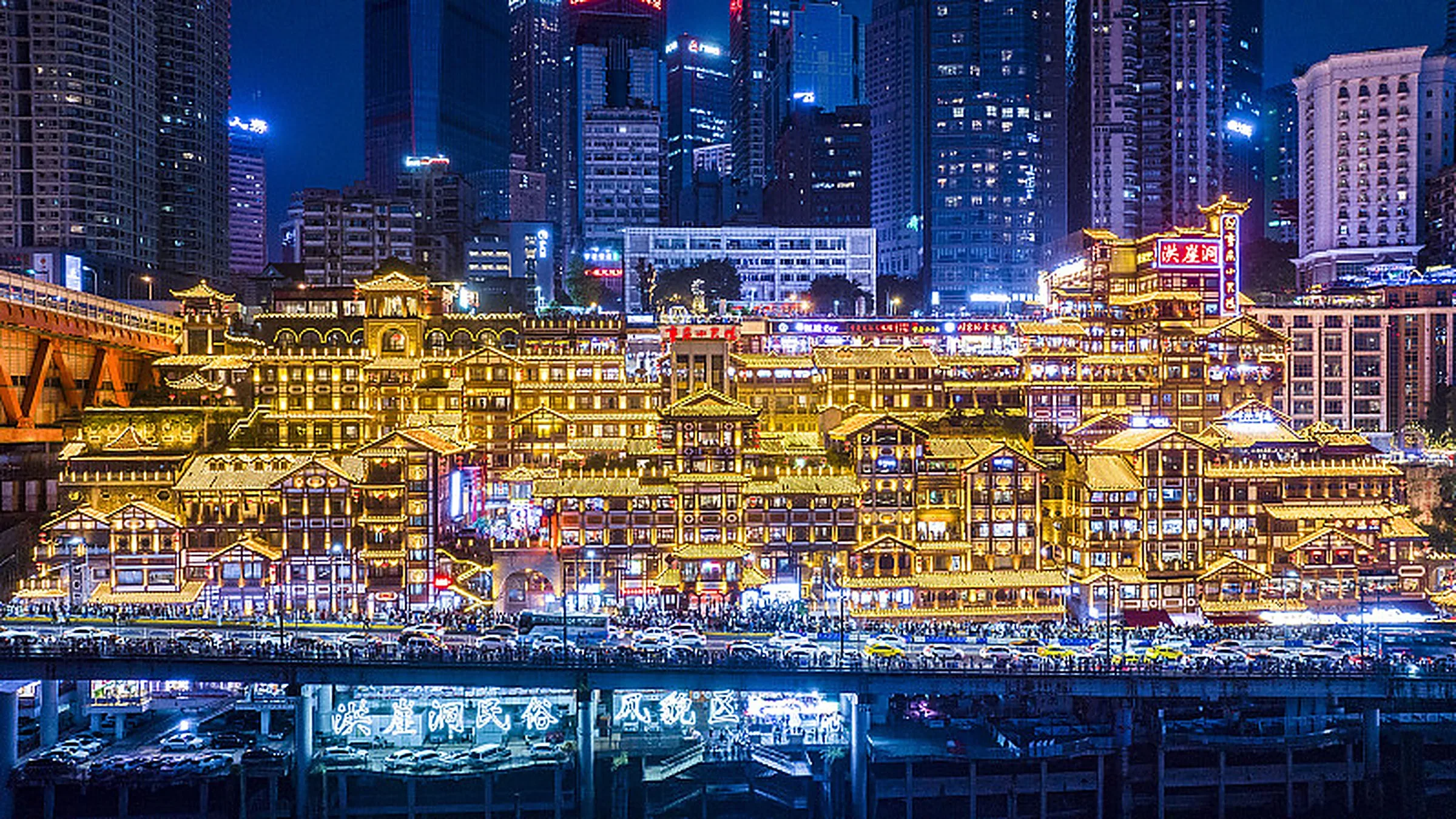
The reason to come is the cityscape. Hongya Cave (洪崖洞) — the 11-story stilted house complex on the Jialing River — is one of China’s most photographed urban scenes, especially at night. The Yangtze River Cable Car (长江索道) crosses between two downtowns over a working river. And the hotpot — 9-grid, mala, Sichuan peppercorn — is the genuine article, not the toned-down tourist version.
Short on days? Chongqing rewards slow travel more than most cities. Wuhan pairs well with it on the same rail corridor, and Guangzhou is the southern counterpart if you are routing through the Pearl River Delta instead.
How many days do you need in Chongqing?
Two days covers the city itself — Hongya Cave, Ciqikou and a real hotpot dinner; three adds the Dazu Rock Carvings. Chongqing is steep, humid and best in the evening, so fewer days with longer evenings work better than the reverse.
| Days | What you get | Verdict |
|---|---|---|
| 2 days | Hongya Cave, the Yangtze cable car, Ciqikou and hotpot | Enough for the highlights |
| 3 days | The above plus the Dazu Rock Carvings day trip | This itinerary — the default |
| 4+ days | Add Chengdu on the high-speed train | The 3-day Chengdu plan pairs with it |
Is 2 days in Chongqing enough? Yes, but skip nothing — the city is at its best between 19:00 and 23:00, so two full evenings are worth more than three rushed ones.
Day 1: Hongya Cave night + Yangtze cable car
The Hongya Cave night view is the money shot. Aim to be at the Jiabin Road viewpoint (the big plaza in front of the Raffles hotel, opposite the stilted houses) by 5:30 PM in winter, 6:30 PM in summer. The lights come on at sunset, but the best photos are 20-30 minutes after full dark. Allow 1.5 hours.
Then walk 10 minutes to the Yangtze River Cable Car (长江索道) at Xinhua Road station. The one-way ride crosses the Yangtze between Yuzhong district and the south bank, with the city skyline dropping away below. It runs ¥30 on current ticket listings (older guides still quote ¥20 — confirm at the box office). The cable car is a tourist attraction, not practical transit, but it is worth the fare just for the view.
End the night at the Jiefangbei Pedestrian Street (解放碑). The 1945 Liberation Monument anchors the downtown, surrounded by a mix of luxury malls and night-market food stalls. Try 酸辣粉 (sour-spicy glass noodles, ¥10) and 烤脑花 (grilled pig brain, ¥25) — the latter is a local delicacy that’s better than it sounds.
Day 2: Ciqikou + real hotpot
Start at Ciqikou (磁器口), the 1,000-year-old porcelain-port town now turned into a tourist maze of Ming- and Qing-dynasty buildings. The 1.5 km main street climbs the hillside, lined with tea houses, snack vendors (the local 陈麻花 twisted doughnut is the must-try), and the 12th-century Baolun Temple. Allow 2-3 hours.
Then the main event: Chongqing hotpot. Recommended chains: 珮姐老火锅 (Peijie Old Hotpot) and 晓宇火锅 (Xiaoyu Hotpot). Order 鸳鸯锅 (yuanyang pot — half spicy, half mild chicken broth), and even with the “mild” side ask for 中辣 (medium) — true 微辣 will seem weak to locals. Order: 毛肚 (tripe, dip 15 sec), 鸭肠 (duck intestine, 10 sec), 老肉片 (old pork slices), 藕片 (lotus root). ¥80-150 per person. The numbing Sichuan peppercorn hits first, the chili burn 30 seconds later. Order a 唯怡豆奶 soy milk and 冰粉 ice jelly to cool down.
In the afternoon, hit the Three Gorges Museum (三峡博物馆, free, English captions) for 1.5-2 hours, then walk across to Eling Park for the hilltop pavilion view of the vertical skyline. End the day at South Mountain (南山一棵树) for the panoramic night view — the city lights up like a circuit board, with the two rivers glowing below.
Day 3: Dazu Rock Carvings day trip
The Dazu Rock Carvings (大足石刻) are the cultural sleeper hit of the region. 10,000+ Buddhist, Confucian, and Taoist figures carved into cliffs over 400 years (9th-13th century), UNESCO World Heritage, and almost entirely empty of foreign tourists. The Thousand-Armed Guanyin and the 31m Reclining Buddha are the highlights.
Take the HSR from Chongqing West Station to Dazu Station (¥50, 1.5 hrs, every 30 min). Bus 205 to Baodingshan (¥5, 30 min). ¥115 entry. Allow 3-4 hours. Return by evening HSR. Alternatively, take a guided tour from Chongqing (¥400-600/person) for a deeper reading of the iconography.
If you prefer natural scenery, swap Dazu for the Wulong Karst (武隆喀斯特, UNESCO) — the Three Natural Bridges from Transformers 4. HSR to Wulong (1.5 hrs), shuttle to the site (¥125 entry), 4-5 hours total.
Five days, and the three ways out
Three days covers the city. Five is where Chongqing stops being a stopover and becomes half a trip: the Wulong Karst on top of Dazu, plus one slow day on the river with nothing booked.
The onward connections matter more than most guides admit, because the usual advice (“take the train to Shanghai”) hides a four-hour spread between the fastest and slowest service on the same route.
| From Chongqing to | Fastest service | Time | Second class | What to know |
|---|---|---|---|---|
| Shanghai Hongqiao | G243 from Chongqing West, 07:53 | 9h01 | from about ¥870 | The G1534 that most timetables list first takes 11h54 and runs via Zhengzhou East. Same route, four hours of your day |
| Hong Kong West Kowloon | G905 from Chongqing West, 08:44 | 7h13 | about ¥790 | Direct. No change at Shenzhen North, despite what most forum threads assume |
| Chengdu East | frequent departures | about 1h30 | — | The default pairing; see the 3-day Chengdu plan |
Prices and timings checked November 2026; verify on 12306 the week you travel.
Two planning notes that change the shape of a 12-day trip:
- Hong Kong is a separate immigration area. A mainland visa or the 240-hour transit waiver does not cover it, and re-entering the mainland counts as a fresh entry. If Hong Kong is your last stop, fly home from there instead of doubling back through Shenzhen.
- The river is a fourth exit. Chongqing is where most Three Gorges sailings begin. A downstream cruise to Yichang takes three to four nights and drops you near Yichang East HSR, which puts you back on the Shanghai line without repeating the nine-hour ride.
A five-day block that works: the three days above, day four on the Wulong Karst, day five at the Three Gorges Museum plus a slow evening on the Jialing. Then take G905 south or G243 east, and the trip has a second half rather than a long ride home.
If you are still deciding how many days the whole trip needs, the itinerary self-check is the faster route than adding cities until the calendar fills.
When should you visit Hongya Cave and Ciqikou to avoid the crowds?
Hongya Cave: after 22:00 or between 14:00 and 17:00. Ciqikou: before 10:00, ideally 08:30–09:30. The two sites fail in opposite ways — Hongya Cave is a 30-second photo ruined by a 40-minute crowd, Ciqikou is a 2 km street that only works when the shops are still opening and the tour buses haven’t landed.
| Place | Hours | Quietest window | Busiest window | What to know |
|---|---|---|---|---|
| Hongya Cave (洪崖洞) | Complex open all day; lights on at dusk, off at 23:00 | 14:00–17:00, or after 22:00 | 19:30–21:30, worst Friday–Saturday | Free. The photograph is taken from the far bank — Qiansimen Bridge or the Jiabin Road plaza — not from inside the complex |
| Ciqikou (磁器口) | Town open all day; shops roughly 09:00–21:00 | 08:30–10:00 | 11:00–16:00, when the day-tour buses arrive | Free entry; a handful of halls inside charge ¥10–20. Metro Line 1, Ciqikou station |
| Yangtze cable car (长江索道) | 07:30–22:00 in peak season, last entry 21:00 | The first hour after opening | 19:00–21:00 | ¥30 one-way on current ticket listings — plenty of guides still quote the old ¥20, so confirm at the box office |
| Nanshan One Tree (南山一棵树) | 09:00–22:30 | Arrive by 19:30 to hold a spot | 20:00–21:30 | ¥30, half price for students. The view is best about 30 minutes after full dark |
| Jiefangbei (解放碑) | Streets open 24 hours; malls 10:00–22:00 | Before 18:00 | 20:00–23:00 | The night-market food stalls peak later than the malls close |
Two timing rules do most of the work:
- Arrive an hour before the light you came for. Hongya Cave’s lights come on at dusk and the crowd builds for the next 45 minutes. Being on the far bank at 19:00 in summer gets you the shot; arriving at 20:00 gets you someone’s shoulder.
- Do not put Ciqikou and Hongya Cave in the same evening. They are 40 minutes apart on Metro Line 1, on opposite sides of the peninsula, and both want the same two hours. Ciqikou in the morning, Hongya Cave at night — that is the whole reason Day 2 of this itinerary runs the way it does.
What to eat (besides hotpot)
- Chongqing small noodles (重庆小面) — the city’s daily breakfast. Spicy, numbing, ¥8-15. Try 聚园 (Juyuan) or any small street stall.
- Sour-spicy glass noodles (酸辣粉) — sweet potato starch noodles in a vinegar-chili broth, ¥10.
- Grilled pig brain (烤脑花) — a local delicacy that’s milder than it sounds, ¥25.
- Jiangtuan (江团) — Yangtze catfish, usually steamed with chili. ¥150-300/kg at riverside restaurants.
- 冰粉 (bing fen) — the must-order dessert: ice jelly with brown sugar, sesame, and peanuts, ¥8.
Practical tips
- Walking is harder than it looks. Chongqing’s 5+ road levels mean a 500m walk on the map can be 30 minutes of stairs. Wear comfortable shoes and budget 30% extra time vs. what Google Maps says.
- Cash for the small stuff. Hotpot and small noodle shops often take WeChat Pay but not foreign cards. Get WeChat Pay set up before you arrive (or use Alipay+). See our China trip budget guide.
- The Yangtze is brown. Don’t expect turquoise river views. The brown Yangtze is part of the visual signature.
- The city gets foggy. Especially October-January. The fog is atmospheric but can hide the views. Plan views for clear mornings.
Sources
- [1] UNESCO — Dazu Rock Carvings · UNESCO World Heritage Centre · Aug 12, 2026
- [2] China Discovery — Chongqing 3-day itinerary · China Discovery · Aug 12, 2026
- [3] Travel China Guide — Chongqing tours and tickets · TravelChinaGuide · Aug 12, 2026
- [4] Trip.com — Chongqing top things to do and tickets · Trip.com · Aug 12, 2026
- [5] Lonely Planet — Chongqing city guide · Lonely Planet · Aug 12, 2026
Step by step
-
Day 1 evening — Hongya Cave night view + Yangtze cable car
Arrive in Chongqing, check in to a hotel in the Jiefangbei area. Around 5 PM, take metro Line 6 to Xiaoshizi Station (小什字站), Exit 9, and walk 10 minutes down to the Jialing River waterfront. The Hongya Cave (洪崖洞) stilted houses are best viewed from across the river — go to the Jiabin Road viewpoint (the big plaza in front of the Raffles hotel) for the classic money shot. Stay until 30 minutes after dark for the full light show. Then walk to the Yangtze River Cable Car (长江索道) at Xinhua Road station (¥30 one way on current listings) and ride across the river for the city skyline view.
-
Day 1 late night — Jiefangbei Pedestrian Street
From the cable car's south exit, walk 15 minutes to the Jiefangbei Pedestrian Street (解放碑). The 27.5m tall People's Liberation Monument is the literal 'monument of liberation' from 1945. The surrounding streets are a mix of luxury malls and street food — try 酸辣粉 (sour-spicy glass noodles) and 烤脑花 (grilled pig brain, a local delicacy) from the night market stalls. Allow 1-2 hours.
-
Day 2 morning — Ciqikou ancient town
Take metro Line 1 to Ciqikou Station (磁器口站), Exit 2. The 1,000-year-old porcelain-port town is now a tourist-oriented but visually striking maze of Ming- and Qing-dynasty buildings on a hillside. Walk the main street, climb to Baolun Temple (宝轮寺) for the view, and try 陈麻花 (Chen twisted doughnuts, the local snack). Allow 2-3 hours. The town is most photogenic in the morning before the day-trip tour buses arrive.
-
Day 2 lunch — Real Chongqing hotpot
After Ciqikou, head back to the city center for the main event. Recommended foreigner-friendly chains: 珮姐老火锅 (Peijie Old Hotpot, multiple branches) and 晓宇火锅 (Xiaoyu Hotpot). Order 鸳鸯锅 (yuanyang, half spicy), and ask for 微辣 (mild) or 鸳鸯 with even the mild side 中辣 (medium) — true mild is unpleasantly mild for Chongqing locals. Order: 毛肚 (tripe, 15 sec dip), 鸭肠 (duck intestine, 10 sec dip), 黄喉 (beef aorta), 老肉片 (old pork slices), 藕片 (lotus root), and 土豆片 (potato slices). ¥80-150 per person. Allow 1.5 hours — hotpot is a slow meal.
-
Day 2 afternoon — Three Gorges Museum + Eling Park
Take metro Line 2 to Zengjiayan Station (曾家岩站). The Three Gorges Museum (三峡博物馆, free, English captions) is the city's main museum — 30,000+ artifacts covering the Yangtze region's history, with an excellent scale model of the Three Gorges Dam. Allow 1.5-2 hours. Across the street, Eling Park (鹅岭公园) has a hilltop pavilion (瞰胜楼) with one of the best 360° views of the city's vertical skyline. Free.
-
Day 2 evening — South Mountain night view (南山一棵树)
Take metro Line 3 to Shangjing Station (上丁站) and transfer to bus 346 to 一棵树观景台 (One Tree Observatory). The ¥30 entry gives you the best panoramic night view of Chongqing — the city lights up like a vertical circuit board, with the Yangtze and Jialing rivers glowing below. Allow 1.5-2 hours. The view is best 30 minutes after full dark.
-
Day 3 — Dazu Rock Carvings day trip
Take the HSR from Chongqing West Station to Dazu Station (¥50, 1.5 hours, every 30 min). From Dazu Station, take bus 205 to Baodingshan (宝顶山, ¥5, 30 min) — the main carving site. The UNESCO World Heritage Dazu Rock Carvings (大足石刻) are 10,000+ Buddhist, Confucian, and Taoist figures carved into cliffs between the 9th and 13th centuries. The Thousand-Armed Guanyin (千手观音) and the Reclining Buddha (释迦涅槃圣迹图) are the highlights. ¥115 entry. Allow 3-4 hours. Return to Chongqing by evening HSR. Alternatively, take a guided tour from Chongqing (¥400-600/person including transport and guide).
-
Day 3 alternative (closer) — Wulong Karst day trip
If you prefer natural scenery, swap Dazu for the Wulong Karst (武隆喀斯特, UNESCO). HSR to Wulong Station (¥75, 1.5 hrs), then shuttle to the Three Natural Bridges (天生三桥, ¥125 entry) — the filming location for Transformers 4. The Tianlong Bridge is 200m high and 400m wide. Allow 4-5 hours total. Return to Chongqing by evening HSR.
FAQ
-
Is 3 days enough for Chongqing?
Yes for the city core (Hongya Cave, Yangtze cable car, Jiefangbei, Ciqikou, one hotpot meal). 2 days is doable if you skip Ciqikou. 4 days lets you add the Wulong Karst day trip (UNESCO, 2.5 hrs each way, the Three Natural Bridges from Transformers 4). Most foreign travelers do Chongqing as a 2-3 day add-on to a Chengdu trip — the HSR between them is 1.5 hours. -
Is Chongqing hotpot really that spicy?
Yes. The standard 九宫格 (9-grid) pot has the center square for the spiciest broth and outer squares for milder. Most foreigners order 鸳鸯锅 (yuanyang pot) — half spicy, half mild chicken broth. Even 微辣 (mild) is genuinely hot for Westerners. The numbing Sichuan peppercorn (花椒) hits first; the chili burn comes 30 seconds later. Order a 唯怡豆奶 (soy milk) and a 冰粉 (ice jelly) to take the edge off. -
How do you pronounce Chongqing?
Chóng-qìng, with a falling-rising tone on the first syllable and a falling tone on the second. The 重庆 characters literally mean 'double celebration.' The old English spelling 'Chungking' appears in older travel writing — modern romanization is Chongqing. -
What time does Hongya Cave light up?
The lights come on at dusk and switch off at 23:00, so the exact time moves with the season - roughly 19:00 in summer and 18:15 in midwinter. The complex itself is free and open all day, but the photograph everyone wants is taken from the far bank: Qiansimen Bridge or the Jiabin Road plaza opposite the stilted houses. Arrive about an hour before you want the shot and stay 30 minutes past full dark, which is when the sky still holds colour behind the gold lights. Friday and Saturday nights between 19:30 and 21:30 are the worst crush of the week. -
Is Ciqikou worth visiting, and how long does it take?
Yes, if you go early. Ciqikou is a 1,000-year-old porcelain port turned tourist street: free to enter, open around the clock, with shops running roughly 09:00-21:00. Allow 2-3 hours to walk the main street, climb to Baolun Temple and eat a bag of Chen twisted doughnuts. Before 10:00 it is still a working neighbourhood with breakfast stalls; from 11:00 the day-tour buses arrive and the main street becomes a single slow-moving queue. A few halls inside charge 10-20 yuan on top of the free entry. -
When is the best time to visit Chongqing?
October through December is best — 12-20°C, low humidity, clear Yangtze views. March to May is pleasant but increasingly humid. June through September is brutally hot (35-40°C) — Chongqing is one of China's 'three furnaces' (alongside Wuhan and Nanjing). Winter (December-February) is cool (5-12°C) and damp, with fog — the city is nicknamed the 'Fog Capital' for a reason. -
How do you get around Chongqing?
Metro is the best option — Lines 1, 2, 3, and 6 cover all the main sights. The Yangtze River Cable Car is a tourist attraction itself, not practical transit. Taxis are cheap (¥10-30 for most cross-city rides) but the city's hilly terrain makes walking routes counter-intuitive — Google Maps works but the city has 5+ levels of roads in some areas, so allow 30% extra time vs. what the app says. -
Is Chongqing worth a stop on a China trip?
Yes, especially as a 2-3 day add-on to a Chengdu trip. The Hongya Cave night view is one of China's most photographed urban scenes. The Yangtze cable car is a unique city experience. The hotpot alone is worth the trip for food-focused travelers. The Dazu Rock Carvings day trip is a UNESCO site most tourists skip — and it's one of the best preserved Buddhist grottoes in the world.
Related guides
- Itineraries
3 Days in Wuhan: Yellow Crane Tower, East Lake (2026)
A foreigner-friendly 3-day Wuhan plan: Yellow Crane Tower at sunset, Hubu Lane food street, East Lake cherry blossoms and the Hubei Museum bronze bells.
9min read
- Itineraries
3 Days in Hangzhou: The Perfect Itinerary (2026)
Hangzhou 3-day itinerary: West Lake on day 1, Lingyin Temple and Longjing tea on day 2, Hefang Street and the Imperial Street on day 3.
9min read
- Itineraries
Beijing Itinerary 2026: 3 Days, Forbidden City to Great Wall
Beijing itinerary for 3 days: Forbidden City, Temple of Heaven, the Summer Palace, a Great Wall section and a hutong food tour. ¥1,500-2,500 (US$208–347) per person.
10min read
- Itineraries
Shanghai Itinerary 2026: 5 Days from the Bund to Zhujiajiao
Shanghai itinerary for 5 days: from the Bund to Zhujiajiao — Yu Garden, the French Concession, a water-town day trip and Shanghai Tower. ¥2,000-3,500 (US$278–486).
11min read
- Itineraries
China Itinerary Self-Check: 10 Tests Before You Book
China itinerary planning: a 7-day route scored against 10 pass/fail tests — backtracking, hotel changes, closed days, last entry, rail legs, pace.
11min read
- Itineraries
2-Week China Itinerary 2026: 4 Cities by Bullet Train
Fourteen-day China itinerary across Beijing, Xi'an, Chengdu and Shanghai — linked by high-speed rail rather than flights.
12min read