

China 240-Hour Visa-Free Transit: Complete 2026 Guide
China's 240-hour (10-day) visa-free transit lets 55 countries travel across 24 provinces without a visa. Updated 2026 rules, eligible ports, and step-by-step entry.
If you’re a citizen of 55 countries and have a confirmed onward ticket to a third country, you can legally enter China and travel across 24 provinces for up to 10 days (240 hours) without applying for a visa. The 240-hour visa-free transit (often shortened to 240h TWOV for “Transit Without Visa”) replaced the older 72-hour and 144-hour rules on December 17, 2024, and is the most generous short-stay visa policy China has ever offered.
This guide covers exactly who qualifies, which entry ports you can use, where you can travel, and the most common mistakes that get travelers turned away at the gate.
What is the 240-hour visa-free transit policy?
The 240-hour visa-free transit is a short-stay entry permit issued on arrival. It allows travelers from 55 eligible countries to pass through China on their way to a third country while stopping to explore up to 10 days. The policy was expanded in 2024 from the previous 72- and 144-hour rules, and the eligible entry port list grew again through 2025 to 65 ports across 24 provinces and regions.
Three conditions must be met:
- Passport from an eligible country (see list below).
- Confirmed onward ticket to a third country or region with a seat assigned, departing within 240 hours.
- Entry through an approved port (most international airports, several cruise ports, the Hong Kong–Zhuhai–Macao Bridge, and the West Kowloon high-speed rail station in Hong Kong count).
The 240-hour clock starts at 00:00 on the day after you arrive, not at your actual arrival time. So if you land at 11 PM on Tuesday, the countdown begins at midnight Wednesday and you have until 23:59 on the 10th day (the following Friday) to depart.
Who is eligible: 55 countries across 4 continents
The 55-country list is broader than most travelers expect. As of 2026, the eligible countries are:
Europe (40 countries): Austria, Belgium, Czech Republic, Denmark, Estonia, Finland, France, Germany, Greece, Hungary, Iceland, Italy, Latvia, Lithuania, Luxembourg, Malta, Netherlands, Norway, Poland, Portugal, Slovakia, Slovenia, Spain, Sweden, Switzerland, Monaco, Russia, United Kingdom, Ireland, Cyprus, Bulgaria, Romania, Ukraine, Serbia, Croatia, Bosnia and Herzegovina, Montenegro, North Macedonia, Albania, Belarus.
Americas (6 countries): United States, Canada, Brazil, Mexico, Argentina, Chile.
Oceania (2 countries): Australia, New Zealand.
Asia (7 countries): South Korea, Japan, Singapore, Brunei, United Arab Emirates, Qatar, Indonesia.
If your country isn’t on this list, you can still use the standard 24-hour transit (any nationality, staying within your arrival city) or apply for a tourist L-visa in advance.
Where you can travel: 24 provinces, but not all of China
The 240-hour policy covers 24 of China’s 31 mainland provinces and regions. You can move freely between them during your stay. The most useful coverage for first-time visitors includes Beijing, Tianjin, Shanghai, Jiangsu, Zhejiang, Guangdong, Sichuan (Chengdu + 10 nearby cities), Yunnan (Kunming + 8 cities including Lijiang and Dali), Shaanxi (Xi’an), Hubei (Wuhan), Fujian (Xiamen), and Hainan (limited).
Seven provinces and regions are excluded from the policy: Tibet, Xinjiang, Inner Mongolia, Jilin, Gansu, Qinghai, and Ningxia. Entering these on a 240-hour permit is treated as overstay and can lead to fines, detention, and future visa denial. A few other areas have partial coverage — for example, in Jiangxi you can only visit Nanchang and Jingdezhen, and in Heilongjiang you’re limited to Harbin. The NIA publishes the full map; we maintain a current version at China transit visa rules.
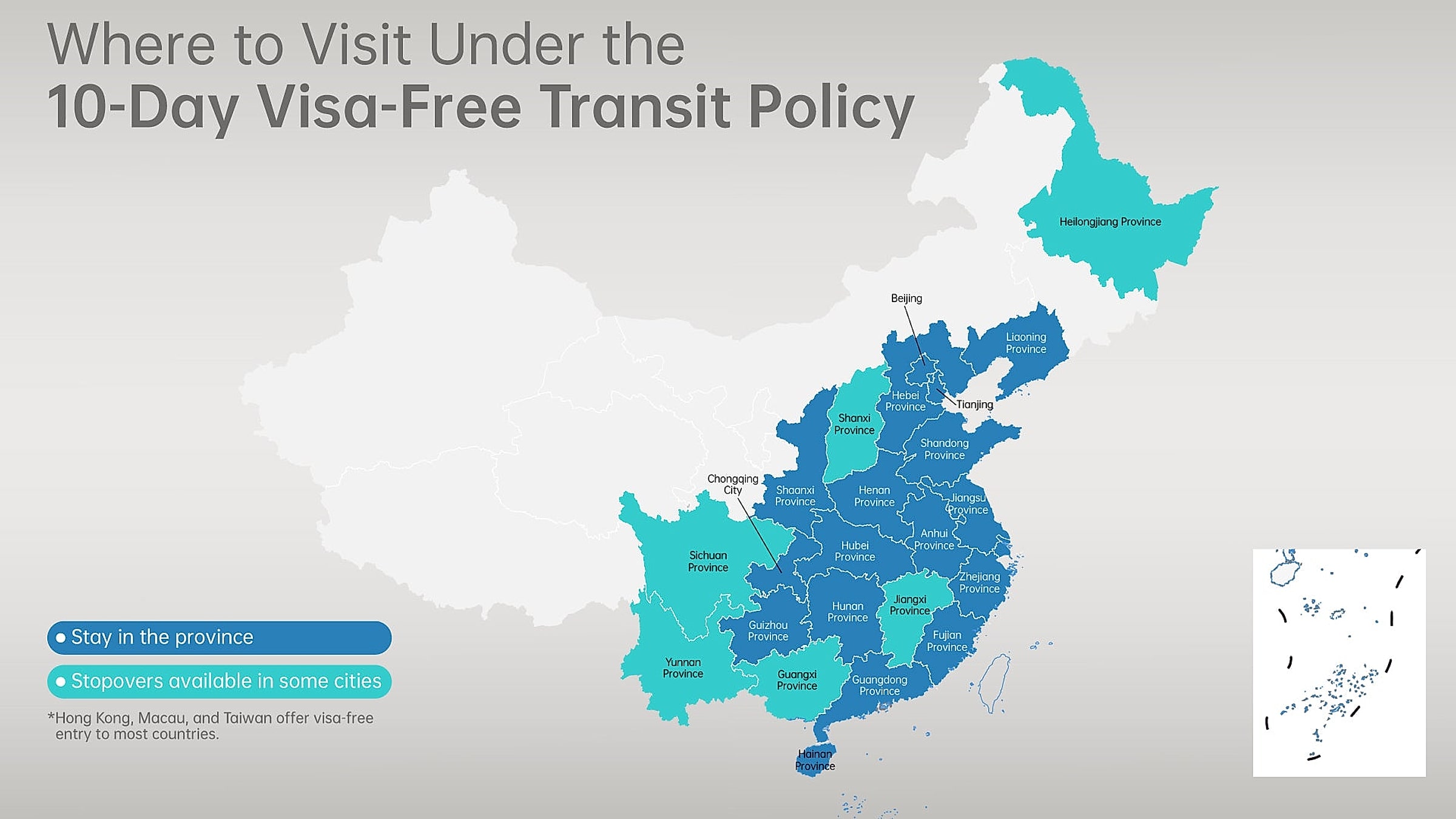
Verified: “Starting from December 17, 2024, citizens from 54 eligible countries with valid international travel documents and connecting tickets with confirmed dates and seats may enter China from any of the 60 open ports in the 24 provinces without a visa when traveling from China to a third country (region), and stay within the allowed areas for no more than 240 hours.” — China Briefing, citing NIA announcement, accessed 2026-07-24
The step-by-step entry process
Before you fly
- Confirm onward ticket to a third country. A round-trip back to your origin country does not qualify unless you have a stop in a third country. For example, USA → Shanghai → Tokyo works; USA → Shanghai → USA does not. Hong Kong, Macau, and Taiwan count as separate “third regions” for this purpose.
- Check your passport validity. It must be valid for at least 3 months beyond your entry date.
- Check your arrival port. Use the NIA’s official 65-port list (or our updated guide at China visa-free countries 2026). Most major international airports qualify; a few smaller ones do not.
- Pre-fill the arrival card. Since late 2025, China has rolled out an online arrival card. You can fill it out at the NIA’s official portal up to 24 hours before landing. Paper forms are still available at ports.
At the airport
- Tell your airline staff you’re using “TWOV” (Transit Without Visa), not “transit visa.” Officially this is not a visa. Saying “transit visa” can confuse check-in agents into looking for a sticker that doesn’t exist and denying boarding. This is the single most common mistake.
- At immigration, present: passport, printed onward ticket (paper or screenshot showing seat and departure time within 240 hours), hotel bookings for at least your first night, and the completed arrival card.
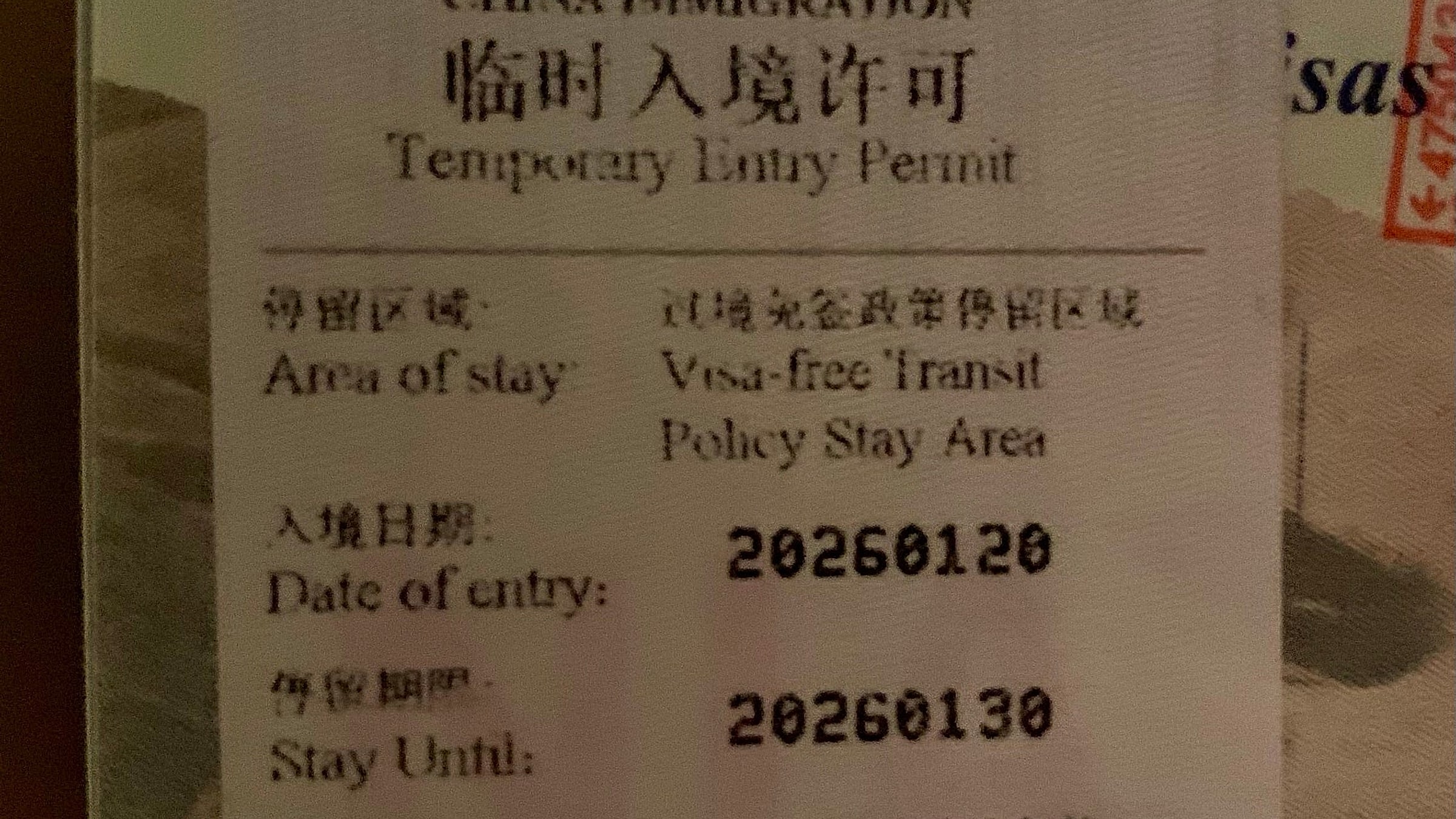
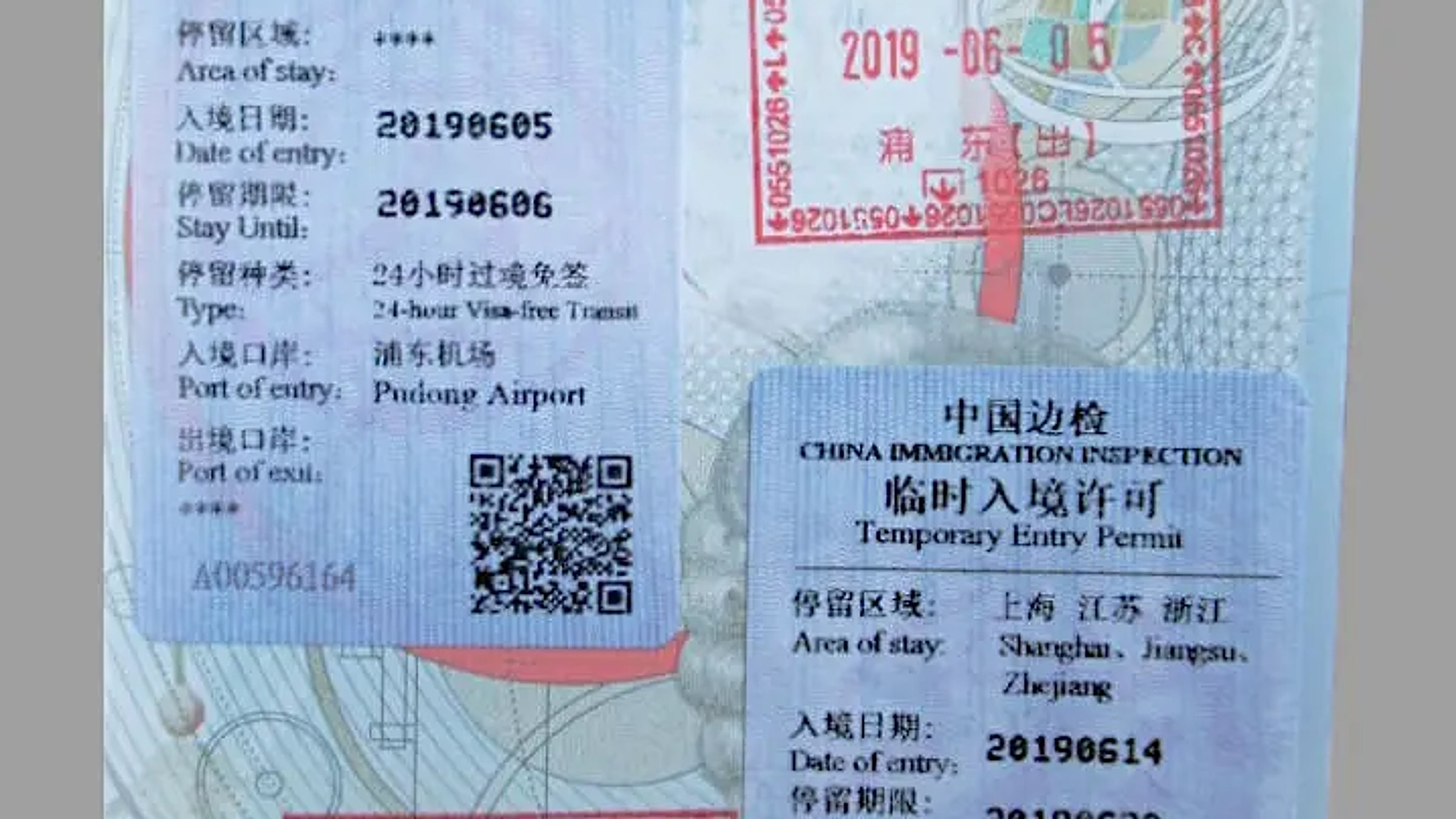
- Receive a temporary entry permit. This is a small slip stapled into your passport showing your permitted stay area and departure deadline. Don’t lose it — you’ll surrender it when you exit.
During your stay
You must register with the local police within 24 hours of arrival. If you stay in a hotel, the hotel handles this for you at check-in by scanning your passport. If you stay in an Airbnb or with friends, you or your host must visit the local police station.
You are not allowed to work, study, or do journalism on a 240-hour permit. Tourism, business meetings, family visits, and short conferences are all fine.
Special notes for Canadian travelers (including Quebec)
Canadian passport holders are on the 240-hour eligible list (since the 2024 expansion), so no visa is required for the same conditions as US/UK travelers. Three notes specific to Canadian travelers, especially those flying from Quebec:
1. Direct flights from Montreal (YUL) to China. Air Canada operates YUL → Beijing (PEK) direct, 4× weekly, 14h, with the same fare class as Toronto (YYZ). No US transit required. Air China operates YUL → Shanghai (PVG) direct, 3× weekly, 14h. Both flights are 240-hour-eligible arrival ports. From Quebec City (YQB) or other regional airports, the most common routing is YQB → YUL → PEK/PVG, with the YUL → China leg qualifying for the 240-hour permit. Do not route via a US airport (JFK, LAX) if you want the 240-hour to count — US pre-clearance voids the transit-without-visa status because the US counts as a “first port of entry” to North America.
2. Chinese consulates serving Quebec residents. For non-240h trips (e.g., 30-day visa-free stays, L-visa applications, or renewals), the Consulate General of the People’s Republic of China in Montreal (consulate address: 2100 Ste-Catherine West, 8th floor, Montreal, H3H 2T3, +1 514-419-6748, http://montreal.china-consulate.gov.cn) is the closest and offers full services in both French and English. The Montreal consulate also accepts visa applications by mail — Quebec residents outside Montreal can mail applications and passports using a prepaid Xpresspost envelope. The Ottawa embassy and Toronto consulate are alternatives, but Montreal is the only French-speaking option. Appointment required (no walk-ins) — book 3-4 weeks ahead during peak summer travel.
3. French-language services at the permit counter. Major Chinese entry ports (PEK, PVG, CAN, HKG) have French-speaking immigration officers, but they are not always on shift. If you speak only French and no English, ask for the “agent francophone” or show them this French card: “Bonjour, je suis un citoyen canadien, j’utilise la transit visa-free de 240 heures. Voici mon passeport, mon billet de continuation, et ma réservation d’hôtel.” Most officers will switch to English if no French speaker is on duty, but the French opening helps. For seniors who prefer to have a French-speaking guide for the immigration process, the Chinese embassy in Ottawa runs a free “Bienvenue en Chine” hotline at +1 613-763-3515 (Mon-Fri 09:00-17:00 ET) for pre-trip questions in French.
Common mistakes that ruin trips
- Returning to the same country. USA → Beijing → USA is not valid. You need a third country. Even a 2-hour stopover in Tokyo before returning home qualifies; it just has to be a different immigration system.
- Trying to enter Tibet or Xinjiang. These regions are explicitly excluded. The checkpoint will turn you back or, worse, flag you for overstay.
- Domestic flight to an excluded province. Even a layover counts as entry. Beijing → Lhasa flight is not allowed; you must apply for a full L-visa first.
- Miscounting the 240 hours. The clock starts at midnight the day after arrival. If you land on October 1 at 9 AM, your deadline is 23:59 on October 11, not 9 AM on October 11.
- Forgetting the hotel registration. Foreign visitors in non-hotel accommodation must register at the local police station within 24 hours. Hotels do this automatically.
- Assuming Hong Kong counts as your final destination. If you enter China on a 240-hour permit and exit to Hong Kong, then return to mainland China, your second entry must be a fresh permit (or you must have a valid visa). Each entry uses one permit.
What if your country isn’t eligible? Three alternatives
- 24-hour direct transit. Every nationality can transit through any Chinese port for up to 24 hours without a visa, as long as you stay within your arrival city and have a confirmed onward ticket to a third country.
- 30-day visa-free entry. If you’re from one of the 50 countries on the unilateral visa-free list (which overlaps with but isn’t identical to the 240-hour list), you can visit China for up to 30 days without any transit requirement. See the full country list.
- Tourist L-visa. Apply at a Chinese consulate or visa center. Standard processing is 4 working days, single-entry fee for US citizens is $140, and as of 2024 you no longer need to submit flight or hotel bookings with your application. Details at our China tourist visa guide.
Sample 7-day itinerary using 240-hour transit
USA → Beijing → Xi’an → Shanghai → Japan (valid route)
- Day 1: Arrive Beijing Capital (PEK) or Daxing (PKX) by 8 PM. Clear immigration. Check into hotel in Dongcheng.
- Day 2: Forbidden City and Tiananmen Square.
- Day 3: Day trip to Mutianyu Great Wall.
- Day 4: Morning high-speed train to Xi’an (4.5 hours). Evening Muslim Quarter street food.
- Day 5: Terracotta Warriors + bike the ancient city wall.
- Day 6: Morning flight to Shanghai (2 hours). Afternoon Bund walk.
- Day 7: Yu Garden, French Concession, Pudong skyline. Late flight to Tokyo.
This works because every leg stays inside the 24 permitted provinces, and the final exit is to Japan (third country).
The 240-hour transit is genuinely the easiest way for citizens of 55 countries to experience China without paperwork. If your passport qualifies and your itinerary has a third country at the end, book the flight — the policy is in active use and immigration officers process it routinely.
For specific 144-hour rules (which still apply in some contexts), see our China 144-hour visa-free guide. For 30-day visa-free options and the full country list, see China visa-free countries 2026.
Where to book
Ready to plan your 240-hour visa-free trip? These booking links help you put the visa to use:
- Book your flight to China — bundle with a hotel for the best rate
- Find Beijing / Shanghai hotels on Trip.com — most visa-free travelers start here
Affiliate disclosure: Some links above are affiliate links. We may earn a commission at no extra cost to you. See our Affiliate Disclosure for details.
Related: China Visa-Free Countries 2026 (47+ List)
Related: China 144-Hour Visa-Free Transit
Related: China Tourist Visa (L-Visa) for Foreigners: Step-by-Step
Plan your trip — verified tools
These free tools are built on real, monthly-verified data and help you skip the trial-and-error phase of China trip planning:
- China 240-Hour Visa-Free Transit Checker — 55 countries, 24 provinces, 65 ports. See if you qualify for 10-day visa-free transit, which cities you can visit, and the 5-step process.
- China 6-City 5-Day Budget Calculator — Real 2026 prices for 5 days in Beijing, Shanghai, Guangzhou, Chengdu, Xi’an, or Hangzhou. Budget / mid-range / comfort tiers, broken down line by line.
Verified August 2026 by TravelHubChina Editorial. We re-check prices and policy details monthly so the data doesn’t drift.
Step by step
-
Verify your country is on the 55-country eligibility list
Includes 40 European countries, US, Canada, Brazil, Mexico, Argentina, Chile, Australia, NZ, Japan, South Korea, Singapore, UAE, Qatar, Indonesia, and others. The list is updated periodically — check the NIA website before booking.
-
Book a confirmed onward ticket to a third country within 240 hours
Must depart China to a country other than your origin. Print the confirmation. A seat assignment is required. The 240-hour clock starts at 00:00 the day after arrival, not at landing time.
-
Book HSR or domestic flights between Chinese cities
Since December 2024, cross-province travel is allowed between 24 permitted provinces. Plan a Beijing → Xi'an → Shanghai HSR loop, or a Shanghai → Hangzhou → Suzhou route, with tickets booked 1-2 weeks ahead for best prices.
-
Reserve hotels in each city on your route
Not strictly required at immigration but strongly recommended. Book refundable options on Trip.com or Booking.com. Print confirmations — some hotels ask for the immigration arrival stamp at check-in.
-
Carry printed confirmations to immigration and at hotel check-in
Passport, onward ticket, hotel booking, and completed Arrival Card. Process: 5-15 min at major airports, longer at peak (10:00-14:00, 18:00-22:00). Keep the arrival card — you surrender it at hotel check-in for police registration.
FAQ
-
Which countries qualify for the 240-hour visa-free transit in China?
About 55 countries are eligible, including most of the EU, UK, Australia, New Zealand, Canada (in some regions), Japan, South Korea, Brazil, Argentina, and Russia. US citizens also qualify as of late 2024. The list is updated periodically; check the National Immigration Administration website before booking. -
Can I enter China multiple times on the 240-hour visa-free transit?
No. The 240-hour transit is single-entry. You get 10 days from your date of entry, and you must be traveling to a third country (not back to your country of origin) when you exit China. If you want to enter and exit China multiple times, you need a regular tourist visa. -
Do I need to book hotels before arriving on a 240-hour visa-free transit?
You need to show proof of an onward ticket to a third country (flight, train, or ferry) departing within 240 hours. Hotel bookings are recommended but not strictly required at immigration. Carry printed confirmations for both — immigration officers may ask. -
Can I travel between cities during the 240-hour visa-free period?
Yes, as of the 2024 expansion you can travel between most approved cities and regions in China, not just the entry port. The list of approved areas covers Beijing, Shanghai, Guangdong, Sichuan, and most major tourist provinces. Cross-province travel by HSR is the most common way to do this. -
What documents do I need at immigration for 240-hour visa-free transit?
You need: (1) a valid passport with at least 6 months’ validity, (2) a confirmed onward ticket to a third country departing within 240 hours, (3) a visa for that third country if required, and (4) a completed Arrival Card. Hotel bookings help but are not mandatory. The whole immigration process takes 5-15 minutes at major airports.
Related guides
-
China 144-Hour Visa-Free Transit 2026: 55 Countries, 24 Provinces
China's 144-hour visa-free transit policy for 2026: 55 eligible countries, 24 provinces, the 65 approved ports, and the 5-step application process. Updated for the 2026 merger with the 240-hour policy.
-
Lost Passport in China 2026: Emergency Guide for Foreigners
What to do step-by-step if you lose your passport in China in 2026: police report (报警) at the nearest Public Security Bureau, embassy emergency travel document, and replacement visa. Includes embassy contact list for 10 major countries and average timeline (2-5 business days).
-
China Tourist Visa (L-Visa) for Foreigners: Step-by-Step
Apply for a China L-visa in 2026: documents, fees, processing time, US/UK/Canada-specific costs, and the new rule that drops flight + hotel bookings.