
Longjing Tea Village: How to Buy Real Dragon Well (2026)
Longjing (龙井, Dragon Well) is China's most famous green tea, grown only in the hills west of West Lake. This guide covers the village, the 10 tea grades, how to spot fake Longjing, and the price you would actually pay at the source.
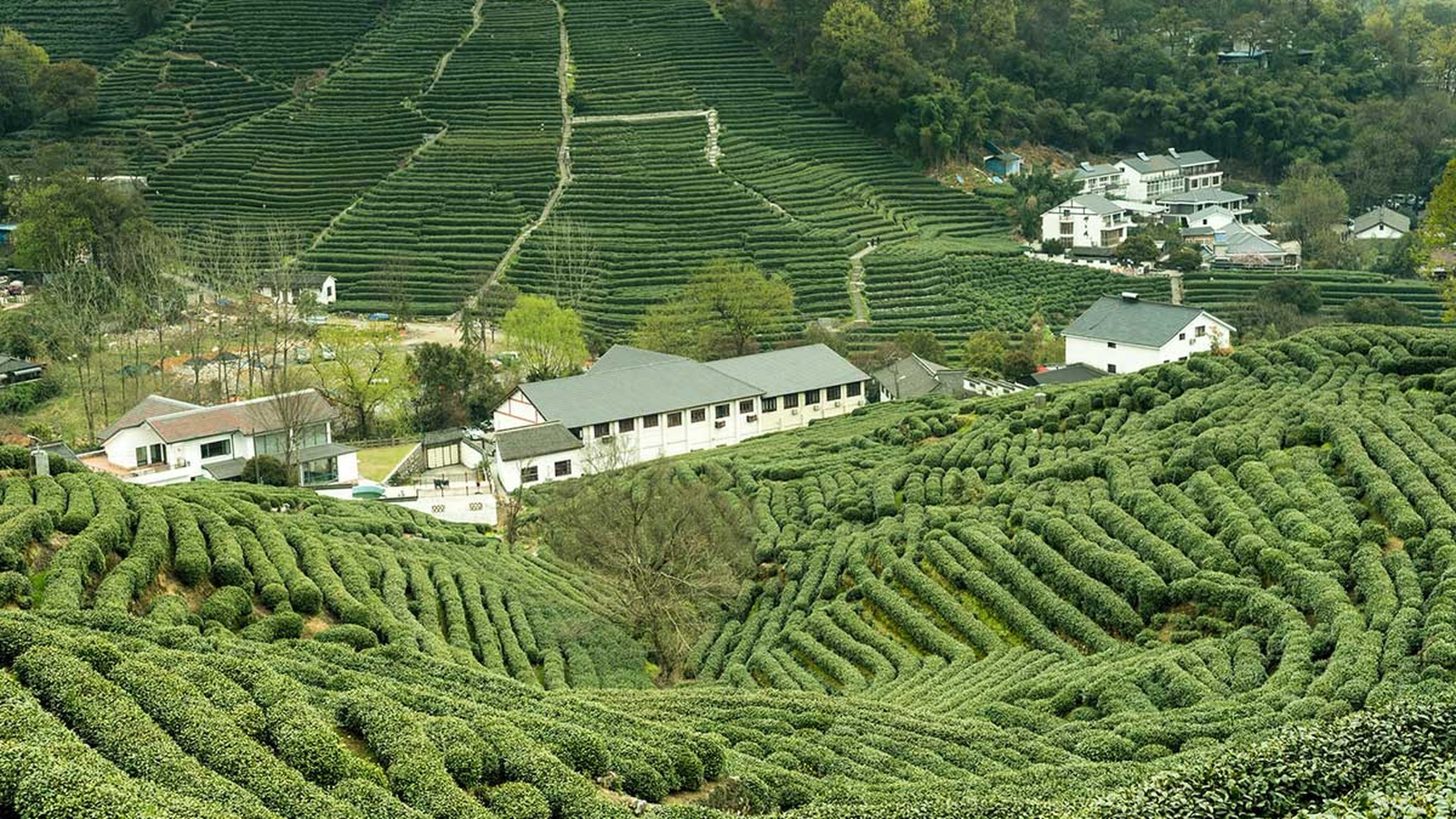
Dragon Well tea (龙井茶, lóngjǐng) is China’s most famous green tea, and the only one with protected geographical origin (国家地理标志产品) in Zhejiang. The 168-sq-km West Lake Longjing protected zone produces about 600 tons a year — a small fraction of what “Longjing” labeled tea is actually sold globally. The rest is either low-grade production from the broader Zhejiang region (legally labeled “Qiantang Longjing” 钱塘龙井 or “Yuezhou Longjing” 越州龙井, often blended), or fake leaves from other provinces dressed up with the name.
The smart move is to visit the village where the tea is grown. The 4 protected villages — Longjing, Shifeng, Hupao, and Yunqi — are all in the hills west of West Lake, 15-20 minutes by taxi from the lake. You can watch the tea being pan-fired, taste 4-5 grades side by side, and buy direct from the farmer at a price 50-80% below what you would pay in an airport shop.
The 4 protected villages
All within 4 km of each other, all open to visitors, all selling authentic West Lake Longjing:
- Longjing Village (龙井村) — the most famous, on the slopes of the Phoenix Hill. 800+ households, most farming tea. Has a tea museum (free), the Imperial Longjing well (the original source of the name), and a cluster of teahouses. The most touristy but also the most developed for visitors — easiest for non-Chinese speakers.
- Shifeng Village (狮峰, Lion Peak) — higher elevation, more prestigious tea. The “Shifeng Longjing” brand is considered the absolute top grade. Smaller, less touristy.
- Hupao Village (虎跑, Tiger Spring) — the village is named for the spring at Hupao Temple, whose water is used to brew Longjing in the local teahouses. Less crowded.
- Yunqi Village (云栖, Cloud Rest) — furthest from West Lake, smallest, most authentic. Best for visitors who want to walk through tea fields without tour-bus crowds.
For first-time visitors, Longjing Village is the most accessible and most likely to have English-speaking farm owners. For repeat visitors, Shifeng or Yunqi are quieter. The half-day here usually pairs with Lingyin Temple next door — see our 3-day Hangzhou itinerary for the full plan.
The 10 grades of Longjing
Longjing is graded by harvest time and leaf quality. From best to lesser:
- Pre-Qing-Ming (明前) — picked before April 5, the first flush of the year. Delicate, sweet, light. The most expensive. Pre-Qing-Ming Longjing from Shifeng can run ¥3,000-5,000/500g wholesale; at the village to consumers, ¥1,500-2,500/500g.
- Pre-Guyu (雨前) — picked before Grain Rain (April 20). Slightly larger leaves, more body. The standard “good Longjing” — ¥600-1,200/500g at the village.
- Post-Guyu (雨后) — late spring, fuller flavor, cheaper. ¥300-600/500g.
- Summer Longjing (夏茶) — June-August, more bitter, more astringent. ¥150-300/500g.
- Autumn Longjing (秋茶) — September-October, lighter body, decent quality. ¥200-500/500g.
- Grade 1-10 (特级 to 十级) — official Chinese national grading system (GB/T 18650). The top 3 grades are most commonly sold; grade 4+ is usually blended or from outside the protected zone.
For most visitors: Pre-Guyu Grade 1 or 2 (雨前一级 / 二级) is the sweet spot — genuine, flavorful, well-priced. ¥400-700/500g at the village.
How to spot fake Longjing
Visual:
- Real: leaves are smooth, flat, pale green-yellow, uniform in size, one bud with 1-2 leaves
- Fake: leaves are dark green, brown, or yellow, uneven sizes, broken or curled
- The “tender shoot” test: real Longjing shoots break cleanly when bent; fakes bend or fold
Aroma (dry leaves):
- Real: a clear orchid or chestnut aroma
- Fake: grassy, musty, or no smell
Brewed:
- Real: pale yellow-green liquor, leaves stand upright then sink, sweet vegetal taste, no bitterness
- Fake: yellow-brown liquor, leaves stay flat or float, bitter or flat taste
Price test:
- West Lake Longjing: ¥600+/500g at minimum
- If a shop is selling “Longjing” for ¥50-200/500g, it is fake or from outside the protected zone
Origin label:
- Real West Lake Longjing has a 国家地理标志保护产品 label with a unique traceability code
- Ask to see the label; if the shop does not have it, leave
The tea farm visit
A typical visit:
- Walk uphill (5-10 min): From the village entrance, follow the paved road uphill past the teahouses. The tea fields are visible on both sides.
- Stop at a farmhouse (free, optional but expected): Look for a farm with a sign in Chinese — “龙井茶 农家” or “品茶” (tasting). Walk in, ask “可以品茶吗?” (may I taste tea?). The owner will pull out a bamboo tray with 4-5 small glass cups, each a different grade.
- The tasting (30-60 min): The owner brews 4-5 grades, from the cheapest summer tea to the pre-Qing-Ming. The differences in color, aroma, and taste are immediately obvious. Take notes or photos (always ask first). Pour the previous cup out before the next brew.
- The sales pitch (5 min): The owner will offer to sell you a tin. Do not feel obligated to buy. Walk to 2-3 other farms, taste their tea, compare prices. Real Longjing at the village is fairly consistent across farms; the differences are in hospitality and freshness of stock.
- Buy (optional): If you like the tea, ask for 50-100g in a sealed tin. Cash or WeChat pay. A 50g tin of pre-Guyu Grade 1 should be ¥60-100. A 100g tin of pre-Qing-Ming Grade 1 should be ¥150-300.
- Pan-firing demo (free, 10 min): Most farms will show you the pan-firing process if asked — a wok heated to 200°C, the farmer hand-firing 200g of leaves for 15 minutes. The skill takes 3-5 years to learn. The aroma is incredible.
Practical info
Hours: 8 AM – 6 PM. Earlier is better — the morning is cooler and the farmhouses are more relaxed.
Getting there:
- By bus: Bus 27, 87 from West Lake to Longjing Village stop. 30 min.
- By taxi: ¥25-30 from West Lake, 15 min. Ask for “龙井村” (Longjing Village).
- By walk: 40-min uphill walk from the western edge of West Lake (Su Causeway western end). Pleasant, allows a Lingyin-Temple + Longjing-Village combination on foot.
Best time to visit: Late March to mid-May for the harvest. Late March for the highest-grade pre-Qing-Ming; late April for pre-Guyu. Outside the harvest, the tea is older but the village is still charming.
What to wear: Casual walking shoes. The tea fields are on slopes and the village paths are cobblestone.
Tipping: Not expected. If you enjoyed the hospitality, buy an extra 50g of tea as thanks.
Combinations
With Lingyin Temple (full day):
- 7:30 AM: Lingyin Temple opening
- 10:30 AM: Exit Lingyin
- 11:00 AM: Walk to Longjing Village (15 min)
- 11:30 AM: Tasting + lunch at a farmhouse
- 1:30 PM: Walk downhill to West Lake or taxi back
With Hupao Spring (half day):
- 9 AM: Hupao Spring (¥15, 1 hour) — see the famous spring, tea ceremony
- 10:30 AM: Walk to Longjing Village (10 min)
- 11:00 AM: Tasting + tea purchase
- 12:30 PM: Lunch in the village
- 2 PM: Taxi back to West Lake
With Nine Creeks hike (full day, spring/autumn only):
- 9 AM: Start at Six Harmonies Pagoda, walk Six Heavens Creek
- 12 PM: Reach Longjing Village from the south
- 12:30 PM: Lunch + tasting
- 2 PM: Walk uphill to the village viewpoint
- 3 PM: Taxi back
What to skip
- The “China Tea Museum” near the village — small, not worth the ¥10 entry
- The “tea ceremony shows” performed for tour groups — performative, not authentic
- The “buy 1 get 1 free” tea deals at the village entrance — always the lowest grade, often fake
FAQ
Can I bring tea back home in my luggage? Yes. The tin is sealed and the tea is dry. No customs issues. Tea in vacuum-sealed bags is also fine for checked luggage.
Is Longjing caffeinated? Yes, like all green tea. A cup has about 30-50 mg of caffeine (vs 80-100 mg in coffee). Three cups a day is fine for most adults.
Does Longjing go bad? Properly stored (cool, dark, sealed), Longjing keeps its flavor for 12-18 months. After 2 years, it is noticeably duller. The recommended storage is a sealed tin in the fridge (not the freezer).
What about pu-erh, oolong, white tea? Hangzhou is green-tea country — those styles are from Yunnan, Fujian, Anhui. If you want to explore, the China National Tea Museum (中国茶叶博物馆) in Longjing Village has exhibits on all major Chinese teas. Free, open 8:30-5.
Plan your trip — verified tools
These free tools are built on real, monthly-verified data and help you skip the trial-and-error phase of China trip planning:
- China 6-City 5-Day Budget Calculator — Real 2026 prices for 5 days in Beijing, Shanghai, Guangzhou, Chengdu, Xi’an, or Hangzhou. Budget / mid-range / comfort tiers, broken down line by line.
- China OTA Comparison 2026 — Trip.com vs Booking.com vs Agoda vs Klook across 5 booking types. Inventory, pricing, foreign card support, English service, per-OTA verdict.
Verified August 2026 by TravelHubChina Editorial. We re-check prices and policy details monthly so the data doesn’t drift.
Step by step
-
Get to Longjing Village
Bus 27 or 87 from West Lake to Longjing Village stop (30 min, ¥2). Taxi from West Lake is 15 minutes and ¥25-30 — say '龙井村' (Longjing Village). The village is also a 40-minute uphill walk from Su Causeway's western end.
-
Walk uphill past the tea fields (5-10 min)
From the village entrance, follow the paved road uphill past the teahouses. The terraced Longjing tea fields are visible on both sides. Stop at any farmhouse with a sign in Chinese (龙井茶 农家 or 品茶) for a free tasting.
-
Taste 4-5 grades side by side (30-60 min)
Walk in, ask '可以品茶吗?' (may I taste tea?). The farmer brews 4-5 grades from summer tea to pre-Qing-Ming Longjing. The differences in color, aroma, and taste are immediately obvious. Pour each cup out before the next.
-
Visit 2-3 farms and compare
Real Longjing at the village is fairly consistent across farms. Walk to a second or third farmhouse, taste their tea, and compare prices. Watch the free pan-firing demo — a wok at 200°C, hand-firing 200 g of leaves for 15 minutes.
-
Buy 50-100 g in a sealed tin
Pre-Guyu Grade 1 is the sweet spot: ¥60-100 for 50 g, ¥150-300 for 100 g. Avoid 'buy 1 get 1 free' deals at the village entrance — usually the lowest grade and often fake. Cash or WeChat pay.
FAQ
-
How much should I pay for real Longjing tea?
At the village, pre-Qing-Ming (明前) first-flush Longjing runs ¥600-2,000 per 500g depending on grade. For a casual visitor buying 50-100g to take home, expect ¥80-300 total. Mid-grade Longjing from the same village is ¥200-500/500g. If a shop anywhere is selling 'Longjing' for less than ¥200/500g, it is almost certainly fake or low-grade blended with leaves from other regions. -
How do I know if Longjing tea is real?
Real Longjing leaves are flat, smooth, pale green-yellow, with one bud and 1-2 leaves. The dry leaves are uniform in size and color. When brewed, the leaves stand upright and sink. Fakes: uneven sizes, brown or dark green color, broken or curled leaves, no aroma when brewed. The 'tender shoot' test: real Longjing shoots break easily when bent, fakes bend. -
Is it rude to visit a tea farm without buying?
Not rude, but expected to taste. Most farm owners invite you in for free tasting, expecting you will buy a small amount (50-100g is enough). Spending 30-60 minutes tasting 4-5 grades is standard. A polite visit = buy a small tin (¥80-150) as thanks for the hospitality. -
Can I visit Longjing village on my own?
Yes — the village is open to visitors, no reservation needed. Walk in, follow the road uphill, and any farmhouse with a tea sign will welcome you. For a more curated experience, book a tea ceremony + tasting through your hotel (¥150-300/person, includes a 1-hour session and 50g of tea to take home).
Related guides
-
Beijing Hutong Food Tour: The 8 Best Stops for a 3-Hour Walk
A curated 3-hour Beijing hutong food walk covering 8 specific stops: from 豆汁儿 (the legendary fermented mung bean drink) to 卤煮 (old Beijing's working-class stew) to 炒肝 (stir-fried liver) to 北京烤鸭 (Peking duck) hutong-style. Includes the exact addresses, what to order at each, how to find the authentic (non-touristy) places, and a printable walking map.
-
Cantonese Dim Sum Guide: 12 Essential Dishes + Tea Etiquette
A practical guide to Cantonese dim sum (点心) for foreign visitors — the 12 essential dishes, how to order from the cart, tea etiquette, where to eat in Guangzhou and Hong Kong, and the famous 饮茶 (yum cha) tradition.
-
Chengdu's Three Famous Snacks: Dan Dan Noodles, Zhong Dumplings, Long Chao Shou (2026)
Complete guide to Chengdu's iconic snack trio: 担担面 (dan dan noodles), 钟水饺 (Zhong dumplings), and 龙抄手 (Long chao shou). Includes each dish's history, where to find the original restaurants, how to order, what they taste like, average prices, and how these local dishes differ from their national imitations.