
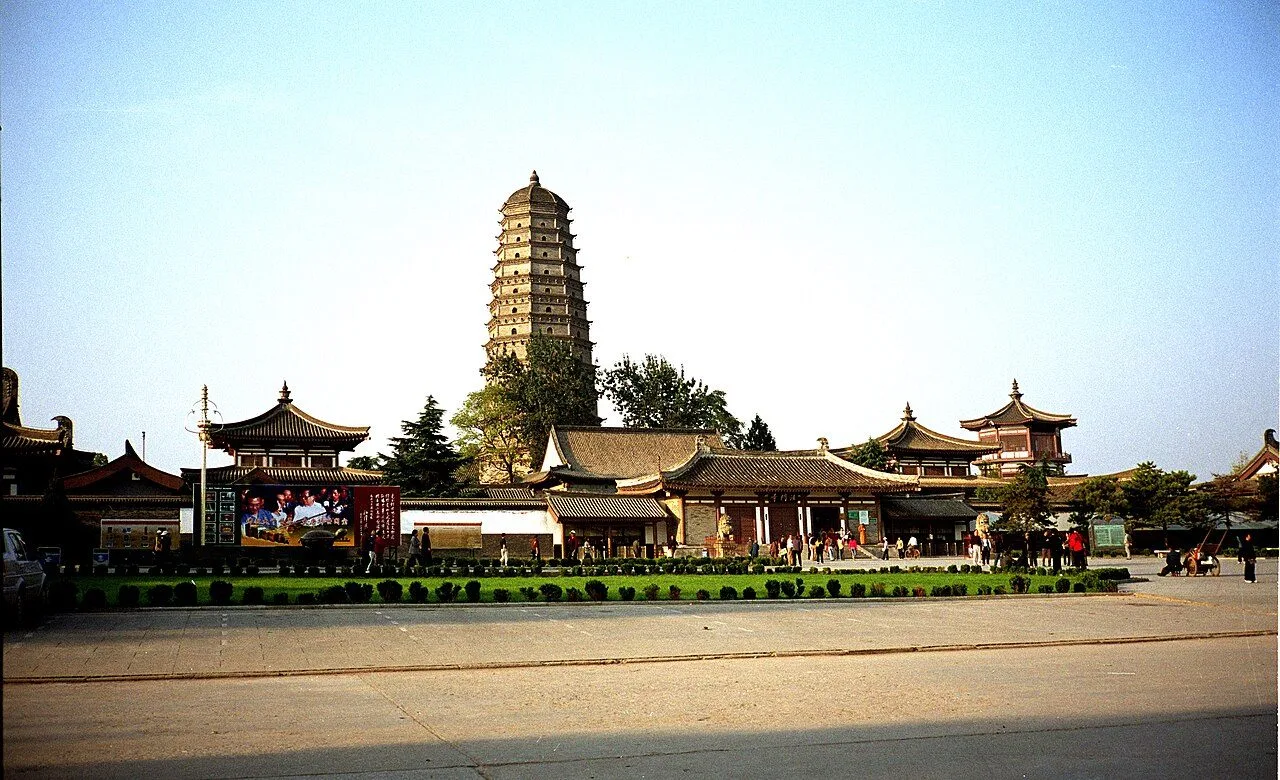
Famen Temple
法门寺 · Fǎmén Sì
Quick answer
Passport required at the ticket office. Foreign visitors can buy same-day tickets at the on-site ticket window or advance tickets via Trip.com. The official WeChat mini-program (法门寺) requires a Chinese phone number; use the on-site window or Trip.com. The audio guide (¥20 deposit) is available in English.
Why visit
- 1 See the Buddha finger-bone relic — sealed in the Tang underground palace in 874 AD, rediscovered 1987
- 2 Walk through the Tang underground palace museum with 2,000+ gold, silver, jade, and porcelain offerings
- 3 Climb the modern 148m hand-shaped relic pagoda — the most striking Buddhist architecture built in China since 2000
- 4 Half-day round-trip from Xi'an by HSR (1 hr each way) — feasible as a Day 4 add-on
Essential tips for foreigners
- Take HSR from Xi'an North Station to Fufeng County Station (1 hr, ¥40-60 one-way, runs every 30-60 min) — the fastest independent way. From Fufeng Station, taxi 30 km / ¥60-80 to the temple.
- Allow a full day: 2 hr each way + 3 hr at the site. The Tang underground palace museum alone is 60-90 min. Trying to fit this into a half-day is too rushed.
- Buy the ¥20 audio guide at the museum entrance — the historical context for the 2,000+ Tang-era offerings is striking and the audio guide is the best way to understand the find.
- Pack water and a hat for the walk between the ancient temple, the museum, and the modern pagoda — the site is large (about 1.5 km end to end) and there is limited shade.
- Pair with the Big Wild Goose Pagoda for a Buddhist Xi'an theme day — but only if you have 3+ days in Xi'an.
Suggested route
- 07:30 1 hour Take the HSR from Xi'an North Station to Fufeng County Station (扶风站). Book a specific seat the day before via Trip.com or the 12306 app. Trains run every 30-60 min
- 08:30 30 min Taxi from Fufeng Station to Famen Temple (30 km, ¥60-80, 30 min). Ask the driver to drop you at the south gate (南门) closest to the museum
- 09:00 1 hour Buy the ¥120 combined ticket at the on-site window with your passport. Optional: ¥20 audio guide. Begin at the ancient temple grounds — walk the Ming-Qing rebuild and the original Tang foundations
- 10:00 1.5 hours Tang underground palace museum — the highlight. 1987 discoveries: gold and silver Tang-era offerings, the Buddha finger-bone relic. Allow 60-90 min
- 11:30 1 hour Lunch at one of the on-site restaurants — vegetarian Buddhist fare is the local specialty (¥40-60/person)
- 12:30 1 hour Climb the modern 148m relic pagoda — elevator to the top, then to the 6th floor to see the Buddha finger-bone relic enshrined
- 13:30 30 min Stroll the temple grounds and gardens, then taxi back to Fufeng Station
- 14:00 1 hour HSR from Fufeng County Station back to Xi'an North Station. Trains run every 30-60 min
- 15:00 Back in central Xi'an — relax or continue sightseeing (City Wall, Big Wild Goose Pagoda, Muslim Quarter)
Famen Temple (法门寺, Fǎmén Sì) is a Buddhist temple 110 km west of Xi’an in Fufeng County, famous for the 1987 discovery of the finger-bone relic of the Buddha in the Tang-dynasty underground palace. The site is one of the most important Buddhist archaeological finds in China, and the temple museum is the highlight of a Xi’an day trip.
For most travelers, the Terracotta Army and Xi’an City Wall are higher priorities than Famen Temple. But if you have 3+ days in Xi’an and an interest in Buddhist history, Tang-dynasty art, or the Silk Road, Famen Temple is worth a full day. The Tang underground palace museum is striking.
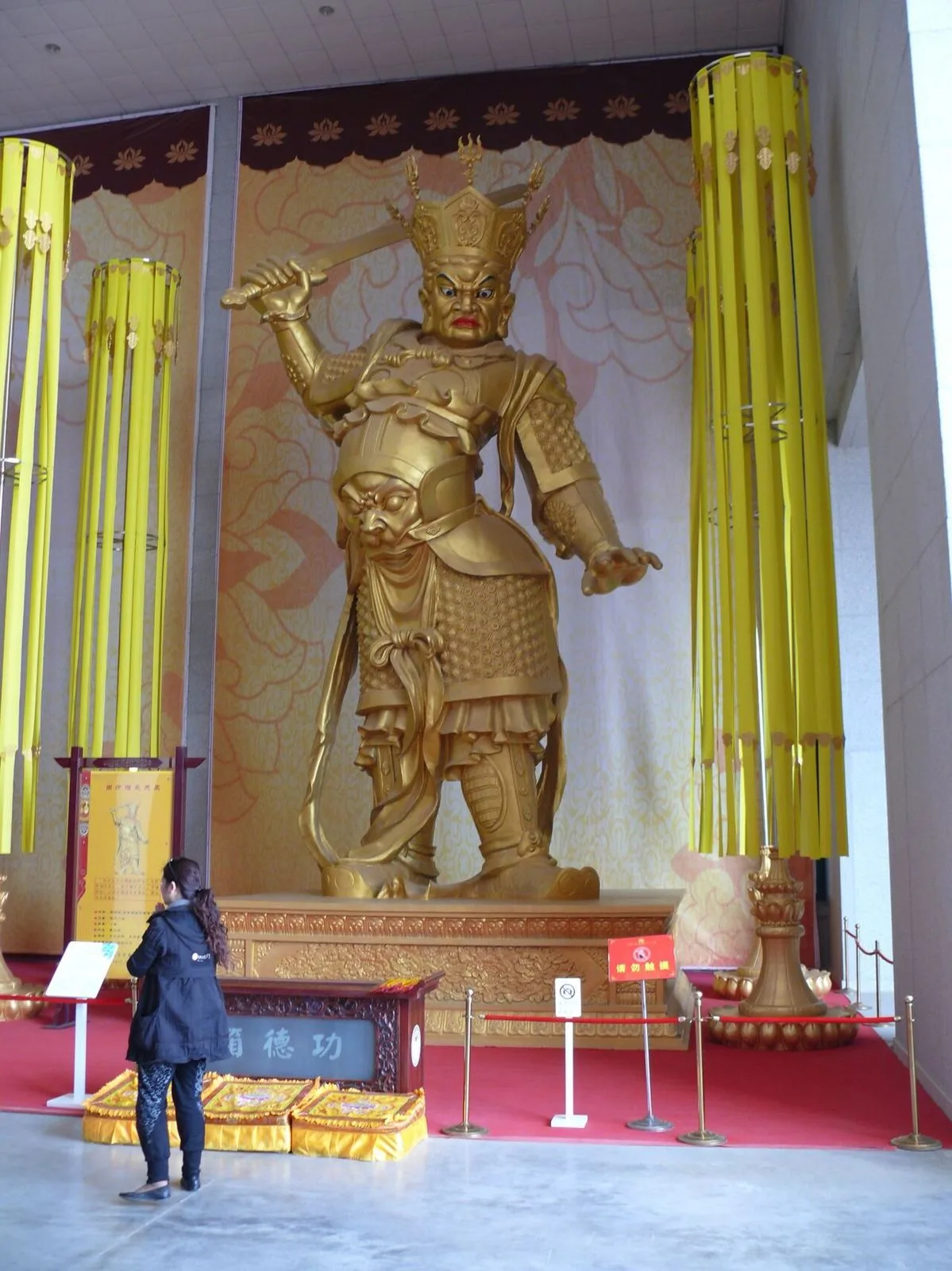
Photo: Wikimedia Commons / CC BY-SA. Source
Is Famen Temple worth the day trip from Xi’an?
Worth it, but only as a full-day commitment with a specific interest behind it — Buddhist history, Tang-dynasty art or the Silk Road — and only if you have 3+ days in Xi’an. The site is 110 km west of Xi’an in Fufeng County, and the day-trip overhead is 4+ hours of travel round trip on top of the hours at the temple, so for a casual visitor the Terracotta Army, the City Wall and the Big Wild Goose Pagoda are better uses of the same days.
What the day buys is the 1987 discovery: over 2,000 gold, silver, jade and porcelain offerings from the Tang underground palace, sealed in 874 AD with the finger-bone relic of the Buddha and reopened for the first time in 1,113 years. That find is why the site made international news, and it is genuinely striking — a 1.96m gold and silver pagoda, a gold Buddhist scepter, Tang-era silk embroidery and a complete set of 13 gold offerings, displayed in a darkened hall with dramatic lighting.
The practical test is the day-trip arithmetic. The museum alone is 60-90 minutes and the whole site wants 3-4 hours; add 2 hours each way from Xi’an and you are looking at a full day for one site. If you have that day and the interest, it is the Xi’an-area stop that shows the Tang dynasty’s Buddhist practice rather than its army or its city wall. If you have 2 days, it is not.
History
Famen Temple was founded in the Eastern Han dynasty (around 68 AD) and grew into one of the most important Buddhist temples in Tang-dynasty China. Empress Wu Zetian donated treasures to the temple in the 7th-8th centuries; Tang emperors contributed Buddhist offerings; the temple housed a finger-bone relic of the Buddha (Sakyamuni) that was venerated by the imperial court.
In 874 AD, the Tang emperor ordered the underground palace sealed with the relic and over 2,000 gold, silver, jade, and porcelain offerings. The temple survived another 1,100 years but the underground palace was forgotten.
In 1987, archaeologists re-opened the underground palace for the first time in 1,113 years. The discovery made international news: a finger-bone relic of the Buddha, a 1.96m gold and silver pagoda, a gold Buddhist scepter, Tang-era silk embroidery, and a complete set of 13 gold offerings. The site museum now displays the discoveries in a darkened hall with dramatic lighting.
Photo: Wikimedia Commons / CC BY-SA. Source
What to see
The Famen Temple complex has three main sections: the ancient temple, the Tang underground palace museum, and the modern relic pagoda.
The ancient temple is a Ming-Qing dynasty rebuild on Tang foundations. The main hall (Mahavira Hall) houses Buddhist statues. It is less impressive than the Big Wild Goose Pagoda but is a pleasant quick walk-through. Allow 30 minutes.
The Tang underground palace museum is the highlight. The 1987 discoveries are displayed in a darkened hall: a 1.96m gold and silver pagoda, a gold Buddhist scepter, Tang-era silk embroidery, gold offering vessels, and silver incense burners. The Buddha finger-bone relic is the centerpiece. Allow 60-90 minutes. The audio guide (¥20) is worth it for the historical context.
The modern relic pagoda is a 148m modern structure built in 2009 to enshrine the Buddha finger-bone relic. The original Tang pagoda (which contained the underground palace) was rebuilt in 1987 and stands next to the modern one. Take the elevator to the top for views of the surrounding countryside. The relic (or its replica, depending on the date) is enshrined on the 6th floor.
Photo: Wikimedia Commons / CC BY-SA. Source
If you have 3+ days in Xi’an, the Big Wild Goose Pagoda is the natural pair — it is in the city rather than 110 km west, and together they make the Buddhist thread of the trip rather than one stop on it.
When to visit
The temple is open 8:30-17:30 daily. The HSR from Xi’an runs every 30-60 minutes, so day trips are flexible.
April-May and September-October have the best weather (15-25°C) and the clearest views from the modern pagoda. The temple grounds are pleasant in the late morning (10 AM) and afternoon (2-3 PM). Avoid Chinese National Day (October 1-7) when the temple is crowded with domestic tourists. Winter (December-February) is quiet but cold; the museum is indoor and warm.
How much does Famen Temple cost for foreigners in 2026?
¥120 for the combined ticket, and foreigners pay the same as Chinese visitors — the passport changes the process, not the price. The ¥120 covers the ancient temple grounds, the Tang underground palace museum and the modern relic pagoda climb, so the museum is not a second purchase. Children 1.2-1.5 m pay ¥60 and are free under 1.2 m, and seniors 65+ pay ¥60.
Two optional extras sit on top. The English audio guide is ¥20 and is worth it, because the historical context for the 2,000+ Tang-era offerings is what makes the museum legible. And Trip.com sells advance tickets at ¥130-150 with free cancellation, which is more than the gate price but removes the queue at the ticket window and the passport check; same-day tickets are sold at the on-site window with your passport and no Chinese phone number needed.
| Item | Detail |
|---|---|
| Combined ticket | ¥120 — ancient temple grounds, Tang underground palace museum and modern relic pagoda climb; foreigners pay the same as Chinese visitors |
| Reduced rates | Children 1.2-1.5 m and seniors 65+ pay ¥60; free under 1.2 m |
| Audio guide | ¥20, in English, recommended for the museum context |
| Opening hours | Temple and museum 8:30-17:30 daily, last entry 16:30; modern relic pagoda 8:30-17:00 |
| Getting there | HSR from Xi’an North Station to Fufeng County Station, 1 hour, ¥40-60 one way, every 30-60 min from 7 AM to 7 PM, then a 30 km taxi at ¥60-80 |
| Time on site | About 3-4 hours; the underground palace museum alone is 60-90 minutes |
One calendar note: the temple is open daily but closed on Lunar New Year’s Eve and Day, so check the official site the week before if your dates fall near it.
How to get there
Three options from Xi’an:
HSR + taxi (recommended for independent travelers): Take the high-speed train from Xi’an North Station to Fufeng County Station, 1 hour, ¥40-60 one-way. Trains run every 30-60 minutes, 7 AM - 7 PM. From Fufeng Station, take a taxi to the temple, 30 km, ¥60-80. Total round-trip: ¥160-280 per person, 6-7 hours including 2-3 hours at the temple.
Tour bus: Tour buses depart from the Xi’an Tourism Distribution Center (Xi’an Lvyou Fafazhan) near the Bell Tower, 2 hours each way, ¥150-200 round-trip including temple entry. Less flexible but no need to negotiate a taxi.
Private car or DiDi: Private car for the day, ¥600-800 round-trip. Useful for groups of 3-4. DiDi (Chinese Uber) works in Fufeng but cars are scarce, so pre-booking a private car is more reliable.
How do I get to Famen Temple from Xi’an by public transport?
The high-speed train is the option that makes the day work for an independent traveler: take the HSR from Xi’an North Station to Fufeng County Station (扶风站), 1 hour, ¥40-60 one way, with trains every 30-60 minutes from 7 AM to 7 PM and no booking needed. From Fufeng Station you still need a taxi for the last 30 km, at ¥60-80, so plan the round trip at ¥160-280 per person and 6-7 hours including 2-3 hours at the temple.
The tour bus is the other public option and the one to pick if you do not want to negotiate a taxi: it departs from the Xi’an Tourism Distribution Center near the Bell Tower, takes 2 hours each way, and costs ¥150-200 round-trip with temple entry included — but it needs 1-day advance booking and it is fixed in both directions. One trip detail worth planning around: the HSR leaves from Xi’an North Station, not from the city centre, so the train and the Bell Tower are different ends of the city. If you take the tour bus you start where most visitors are; if you take the HSR, add the transfer time to Xi’an North on both ends of the day.
A private car at ¥600-800 round-trip is worth it only for groups of 3-4, where the per-person cost falls under the tour bus. In Fufeng itself cars are scarce, so a private car booked in advance is more reliable than trying to arrange one at the station.
Can I visit Famen Temple and Mount Hua in the same day?
Not realistically. Mount Hua is 130 km east of Xi’an while Famen Temple is 110 km west, so the two sites sit on opposite sides of the city, and each one already consumes a full day: Famen Temple is 3-4 hours at the site plus 2 hours each way, and the planning advice on this page is to allow a full day for Mount Hua as well.
With 2 extra days, do them as two separate days — Famen Temple on one for the Buddhist history and the underground palace museum, Mount Hua on the other for the iconic Taoist mountain. For a 2-3 day Xi’an trip, Mount Hua is the more popular add-on, and Famen Temple suits travelers with a deeper interest in Buddhist heritage.
The mistake this question invites is treating the two as complementary because they are both day trips from Xi’an. They are not two halves of one day; they are two days, and each has to be planned around the HSR or the tour bus rather than as a spur from the city.
Is it worth the day?
For most travelers, Famen Temple is the lowest-priority day trip from Xi’an. The Terracotta Army, City Wall, and Big Wild Goose Pagoda are higher priorities. Mount Hua (Huashan) is a more popular add-on day trip for travelers with 2-3 extra days.
The Xi’an City Wall is usually the one that wins that comparison, because unlike this trip it is one of the things you can still do once you are back in the city, alongside the Big Wild Goose Pagoda and the Muslim Quarter.
Famen Temple is worth the day if you have a special interest in Buddhist history, Tang-dynasty art, or the Silk Road. The Tang underground palace museum is genuinely striking — the gold and silver offerings are remarkable. If you have 4+ days in Xi’an, Famen Temple is a good Day 4 add-on after the main 3-day itinerary is done.
If you want the rest of the trip laid out first, our 4-day Xi’an itinerary covers the Terracotta Warriors, the City Wall and the Muslim Quarter, and it lists Famen Temple as the alternative if Mount Hua is more than you want.
If you have less than 3 days in Xi’an, skip Famen Temple. The day-trip overhead is significant (4+ hours round-trip) and the museum alone is not worth the trip for casual visitors.
Best photo spots
-
Modern relic pagoda exterior, north side · Late morning, 11 AM, with the sun behind you
The 148m hand-shaped modern pagoda against a clear blue sky. The most-photographed spot at Famen Temple.
-
Tang underground palace museum, central display · Anytime, indoor
The 1.96m gold and silver pagoda, the gold Buddhist scepter, the Tang-era silk embroidery — the centerpiece of the 1987 discovery. Photography is allowed (no flash).
-
Ancient temple main hall, looking out · Afternoon, 2-3 PM
Looking out from the Mahavira Hall toward the modern pagoda — the juxtaposition of Tang-era and modern Buddhist architecture in one frame.
Where to eat nearby
-
Famen Temple Buddhist vegetarian restaurant (法门寺素斋馆)
Buddhist vegetarian · ¥40-60/person · On-site, 5 min from the museum exit
-
Fufeng County local restaurants
Shaanxi-style noodles, dumplings, lamb · ¥30-50/person · 5-10 min by taxi from the temple
-
Muslim Quarter (back in Xi'an)
Xian street food · ¥20-80/person · Plan to eat back in central Xi'an after the day trip
Frequently asked questions
Is Famen Temple worth the day trip from Xi'an?
Worth it if you have 3+ days in Xi'an and an interest in Buddhist history, Tang-dynasty art, or the Silk Road. The Tang underground palace museum is genuinely striking — the gold and silver Tang-era offerings are remarkable. Skip if you have less than 3 days — the day-trip overhead is significant (4+ hours round-trip) and the museum alone is not worth the trip for casual visitors. The Terracotta Army, City Wall, and Big Wild Goose Pagoda are higher priorities.
How do I get to Famen Temple from Xi'an by public transport?
Three options. HSR + taxi (recommended): Take the high-speed train from Xi'an North Station to Fufeng County Station, 1 hour, ¥40-60 one-way. Trains run every 30-60 min, 7 AM - 7 PM. From Fufeng Station, take a taxi to the temple, 30 km, ¥60-80. Total round-trip: ¥160-280 per person, 6-7 hours including 2-3 hours at the site. Tour bus: Xi'an Tourism Distribution Center (Bell Tower area), ¥150-200 round-trip including temple entry, 2 hours each way. Private car: ¥600-800 round-trip, useful for groups of 3-4.
How much does Famen Temple cost for foreigners in 2026?
¥120 combined ticket (temple grounds + Tang underground palace museum + modern relic pagoda climb). Foreigners pay the same as Chinese visitors. Children 1.2-1.5 m ¥60, free under 1.2 m. Senior 65+ ¥60. The ¥20 audio guide is optional but recommended for the museum context. Same-day tickets sold at the on-site window with your passport — no Chinese phone number needed. Trip.com sells advance tickets for ¥130-150 with free cancellation.
What is the Buddha finger-bone relic at Famen Temple?
A finger-bone relic of the Buddha (Sakyamuni) that was venerated by the Tang-dynasty imperial court. In 874 AD, the Tang emperor ordered the underground palace sealed with the relic and over 2,000 gold, silver, jade, and porcelain offerings. The temple survived another 1,100 years but the underground palace was forgotten. In 1987, archaeologists re-opened the underground palace for the first time in 1,113 years, making international news. The relic is the centerpiece of the Tang underground palace museum and is enshrined on the 6th floor of the modern relic pagoda.
What is the best time of year to visit Famen Temple?
April-May and September-October for clear weather (15-25°C) and the clearest views from the modern pagoda. The temple grounds are pleasant in the late morning (10 AM) and afternoon (2-3 PM). Avoid Chinese National Day (Oct 1-7) when the temple is crowded with domestic tourists. Winter (December-February) is quiet but cold; the museum is indoor and warm. Summer (June-August) is hot (32-38°C) and the open-air walks between sites are tiring.
Is Famen Temple wheelchair accessible?
Yes. The ancient temple grounds, the Tang underground palace museum, and the modern relic pagoda (with elevator) are all wheelchair-accessible. Free wheelchair loans are available at the visitor center — bring your passport. The only non-accessible part is the original Tang pagoda foundation (visible from the walkway, not a major loss). The site is large (about 1.5 km end to end) and mostly flat with paved paths — an electric cart (¥10) is available for visitors who prefer not to walk the full distance.
How long should I spend at Famen Temple?
2-3 hours at the site. There are three main sections: the ancient temple (rebuilt Ming-Qing), the Tang underground palace museum (the highlight), and the modern relic pagoda. Allow 30 min for the ancient temple, 60-90 min for the underground palace museum, 20 min for the relic pagoda, and 30 min for lunch. Add 2 hours each way for transport.
Is the Buddha finger bone relic on display?
Only on specific Buddhist holidays, roughly 4-6 times per year (often the 15th day of the 1st, 2nd and 6th lunar months, plus Buddha's birthday). On other days a replica is on display in the relic pagoda — identical in appearance to the original. The original is preserved in a sealed case inside the pagoda and is not visible outside those rotation dates.
Can I visit Famen Temple and Mount Hua in the same day?
Not realistically — Mount Hua is 130 km east of Xi'an while Famen Temple is 110 km west, on opposite sides of the city. Allow a full day for each. With 2 extra days, do Famen Temple on one (Buddhist history) and Mount Hua on another (the iconic Taoist mountain). For a 2-3 day Xi'an trip Mount Hua is the more popular add-on; Famen Temple suits travelers with deeper interest in Buddhist heritage.




