
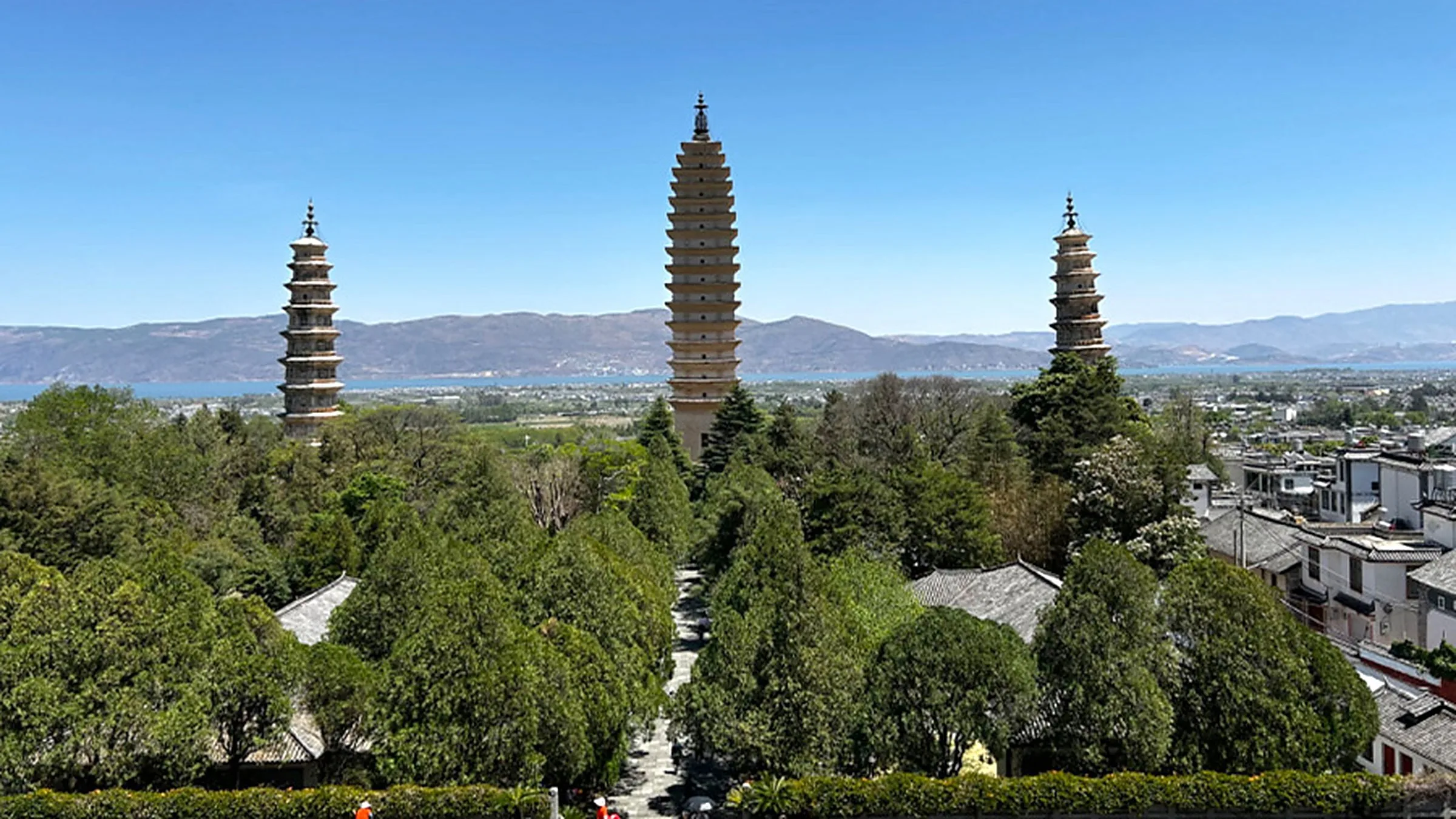
Dali Old Town and Erhai Lake
大理古城和洱海 · Dàlǐ Gǔchéng Hé Ěrhǎi
Quick answer
Foreign passport not required for the Old Town (FREE public space). The Three Pagodas require foreign passport for the ¥121 entry. The official dali.gov.cn has English booking for the Erhai Lake boat cruise.
Why visit
- 1 Dali Old Town — FREE entry to a 600-year-old walled town with cobblestone streets and Bai ethnic architecture
- 2 Three Pagodas of Chongsheng Temple — the 1,000-year-old Buddhist pagoda complex, the most iconic image of Dali
- 3 Erhai Lake — a 250-sq-km alpine lake on the eastern edge of Dali, with electric scooter rental (¥80/day) for the 130-km circuit
- 4 Cangshan Mountain — a 4,000-m mountain range with 19 peaks, hiking trails, and a cable car to the summit
- 5 Xizhou Ancient Town — a Bai ethnic village 30 min north of Dali, with 150+ well-preserved Ming-Qing courtyard houses
- 6 Bai ethnic cuisine — crossing-the-bridge noodles (过桥米线), rushan cheese (乳扇), and Erhai Lake fish
Essential tips for foreigners
- Stay in the Old Town or just outside it — the Old Town has the most authentic experience. Hotels inside the walls are basic; hotels just outside (5-min walk) are more comfortable with similar access.
- Rent an electric scooter for Erhai Lake (¥80/day) — the 130-km circuit is the most iconic Dali experience. Stop at Xizhou village, the lake-shore ancient trees, and the small Bai villages along the way.
- Visit the Three Pagodas at sunset — the reflection in the reflecting pool is the most iconic view in Dali. The light at 5-6 PM is the best.
- Try the crossing-the-bridge noodles (过桥米线) — Dali's signature dish, served with hot broth and a platter of raw ingredients to add. The Xizhou morning market is the best place to try the local Bai version.
- Combine with Lijiang and Shangri-La — Dali is on the classic Yunnan circuit. The HSR connects Dali to Lijiang (2 hours) and Kunming (2 hours).
- Avoid the July-August rainy season — heavy rain obscures the mountains. October-November has the clearest views.
Suggested route
- 08:00 1 hour Hotel breakfast in the Old Town
- 09:00 2 hours Walk the Old Town — South Gate, the main street (Renmin Lu), the Bai craft shops
- 11:00 20 min Walk to the Three Pagodas of Chongsheng Temple (1.5 km north of the Old Town)
- 11:20 2 hours Visit the Three Pagodas complex (¥121) — the iconic pagodas, the reflection pool, the Buddhist halls
- 13:20 1 hour Lunch at a local Bai restaurant in the Old Town — try the crossing-the-bridge noodles
- 14:20 20 min Rent an electric scooter (¥80/day) for the Erhai Lake circuit
- 14:40 5-6 hours Ride the Erhai Lake circuit — counter-clockwise from the Old Town, stopping at Xizhou village, the lake-shore ancient trees, and small Bai villages
- 20:00 1.5 hours Dinner at the Old Town — try the rushan cheese and Erhai Lake fish
- 21:30 1 hour Walk the lit-up Old Town, photos of the South Gate and the wall at night
- Day 2, 08:00 3 hours Take the Cangshan Mountain cable car to the summit (¥282 round-trip)
- 11:00 2-4 hours Hike the Yudai Cloud Road (玉带云游路) — 17 km at 2,500-2,600 m altitude, or partial
- 15:00 1.5 hours Return to the Old Town, visit the local Bai silk workshop or the tie-dye workshop
What is Dali, China famous for?
Three things — a 250-sq-km lake, a 4,000-m mountain range and a 1,000-year-old pagoda complex — and together they are why Dali is one of the most photographed places in China. Erhai Lake (洱海, ‘Ear Sea’) is the alpine lake on the town’s eastern edge, with a 130-km circuit around it. Cangshan Mountain is the range with 19 peaks rising immediately west of the Old Town. The Three Pagodas of Chongsheng Temple are the Buddhist complex whose tallest pagoda is 69 m across 9 stories, and whose reflection in the pool at sunset is the most photographed view in Dali.
Around that core is the Old Town itself: a 600-year-old walled town with cobblestone streets and Bai craft shops, free to enter, best after dark when the red lanterns come on. And around the Old Town is the Bai culture — white-washed walls with painted wall murals, gray tile roofs with upturned eaves, crossing-the-bridge noodles (过桥米线) and rushan cheese (乳扇). Most visitors meet it at Xizhou village, 30 min north of Dali, with 150+ well-preserved Ming-Qing courtyard houses and a morning market that opens 06:00-12:00.
Where is Dali city in China?
In northwestern Yunnan, in southwestern China — 300 km west of Kunming, and about 1,500 km from the major eastern cities. The Old Town sits on the west shore of Erhai Lake, the 250-sq-km alpine lake, with the 4,000-m Cangshan range directly behind it and the Three Pagodas 1.5 km north of the walls.
Arriving is a high-speed rail trip rather than a flight into Dali itself: there is no direct international airport, so you fly to Kunming (KMG) and take the 2-hour HSR (¥145 second class) to Dali. The same line runs 2 hours to Lijiang. Dali sits at 1,900 m altitude, much higher than Kunming, so the first day is worth taking slowly.
Is Dali part of China?
Yes — Dali is in Yunnan Province in southwestern China, and the Old Town is a 600-year-old walled town inside the city rather than a separate destination. It has been a Chinese town for 1,500 years: the Bai people (白族) have lived in the Dali region for over 1,000 years, and their architecture, their cuisine and the town itself are part of that long history.
It is also fully wired into the Chinese transport network. The high-speed rail runs 2 hours to Kunming (¥145 second class) and 2 hours to Lijiang, and the official Dali tourism site has English booking for the Erhai Lake boat cruise, whose sailings run 09:00-17:00. Entry to the Old Town itself is free and open 24/7 — it is the Three Pagodas, not the town, that ask for a foreign passport and ¥121.
Is Dali or Kunming better?
Kunming if you are arriving and want a city day; Dali if you want the sights — and the two are only 300 km apart, covered in 2 hours by high-speed rail for ¥145 second class. Kunming has direct flights from most major Asian cities while Dali has no direct international airport, which is why most itineraries route through Kunming on the way in.
Altitude is the other difference. Dali stands at 1,900 m, much higher than Kunming, and headache and mild dizziness are common there for sensitive visitors, so take the first day easy and avoid alcohol; Kunming, at lower altitude, is the gentler start. What you do with the days is the real split: Dali has the 250-sq-km Erhai Lake and its 130-km circuit, the 4,000-m Cangshan range, and the Three Pagodas at ¥121, while Kunming is the city you pass through on the way in.
If you are routing through Kunming on the way in, Green Lake Park is our page for the city you see first.
How does Dali compare to Lijiang?
Same region, same rail line, different mood — and only 2 hours apart by high-speed rail. Most travelers visit both on a 5-7 day Yunnan circuit: Kunming → Dali → Lijiang → Shangri-La, with the Shangri-La leg a 4-hour drive.
Lijiang is the more touristy and more developed of the two — a UNESCO Old Town that draws bigger crowds — while Dali is quieter, more local, and better placed for the outdoors: the 250-sq-km Erhai Lake and its 130-km scooter circuit, the 4,000-m Cangshan range with the 17-km Yudai Cloud Road (玉带云游路) at 2,500-2,600 m, and Xizhou’s 150+ Ming-Qing courtyard houses 30 min north. If you have 2-3 nights, Dali fills them on its own; if you are running the full circuit, the 2-hour train makes Dali → Lijiang an easy link.
The Bai people’s ancient capital in Yunnan
Dali (大理) is a 1,500-year-old Bai ethnic town in northwestern Yunnan, 300 km west of Kunming and 1,500 km from the major eastern cities. The town sits on the west shore of Erhai Lake (洱海, ‘Ear Sea’) — a 250-sq-km alpine lake — and is backed by the 4,000-m Cangshan Mountain range. The combination of lake, snow-capped mountains, and traditional Bai architecture makes Dali one of the most photographed places in China.
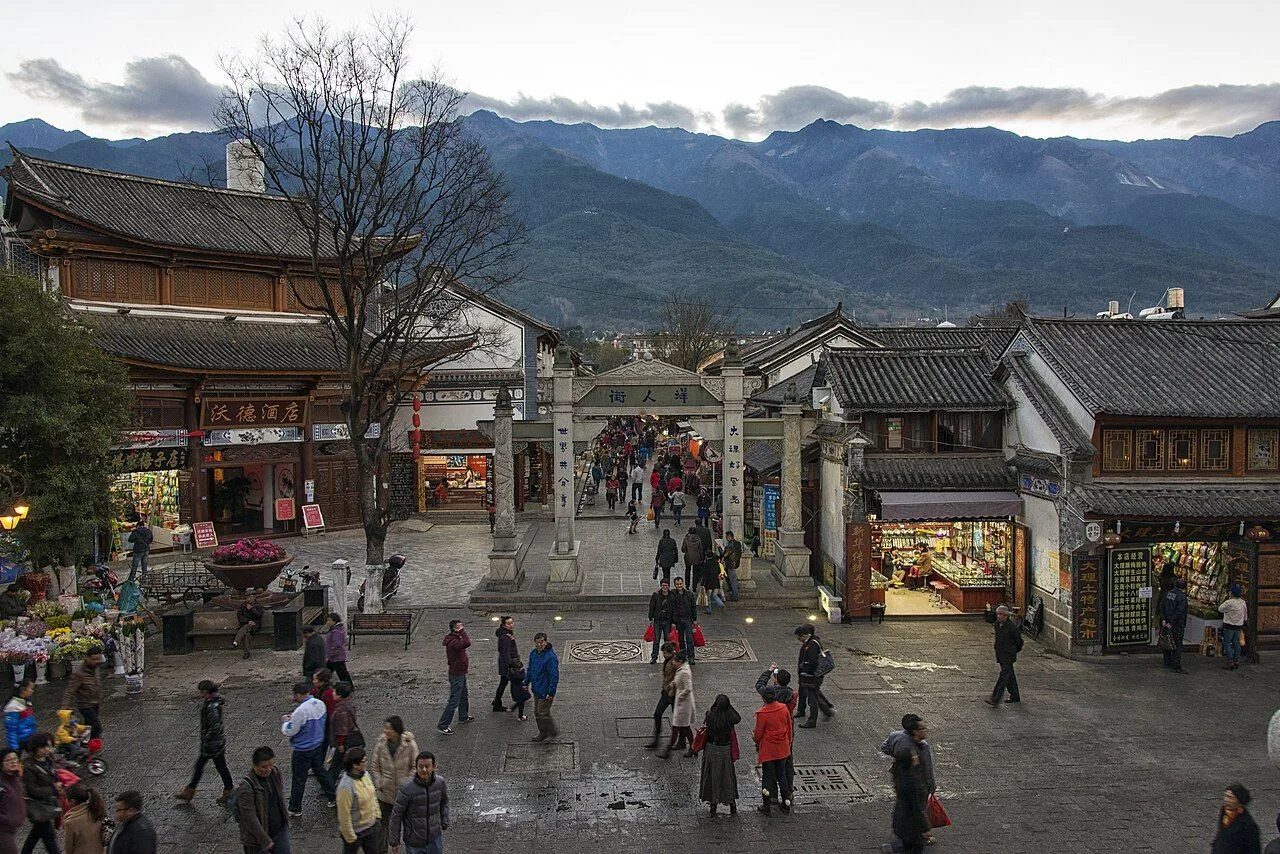
Photo: Wikimedia Commons / CC BY-SA. Source
The Bai people (白族) have lived here for over 1,000 years; their traditional architecture (white-washed walls, gray tile roofs, painted wall murals) and cuisine (crossing-the-bridge noodles, rushan cheese) are a major draw. Dali is also a base for exploring the surrounding area: Xizhou village (a 30-min drive with well-preserved Bai courtyard houses), Shaxi Old Town (2 hours away, a forgotten Silk Road town), and the Cangshan trail system.
The foreigner experience in 2026
Dali is one of the most foreigner-friendly destinations in Yunnan. Entry to the Old Town is FREE, the Three Pagodas have English signage, the Erhai Lake electric scooter rental is straightforward, and the Cangshan cable car has English audio guides. The main challenges: the 1,900-m altitude can be tiring for first-day visitors, the July-August rainy season obscures the mountain views, and the language barrier can be real outside the Old Town.
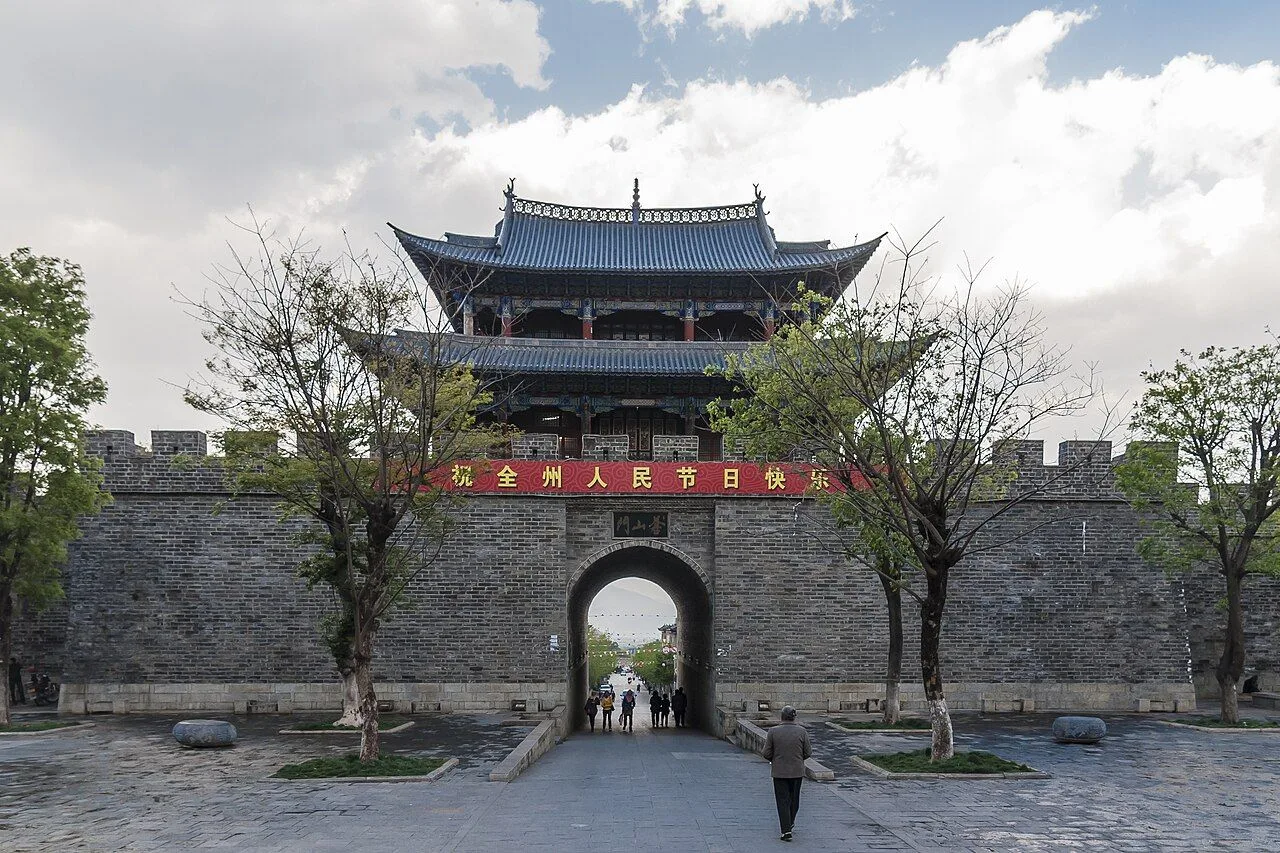
Photo: Wikimedia Commons / CC BY-SA. Source
For first-timers, the recommended approach: 2-3 nights. Day 1: Old Town + Three Pagodas + lunch at the local Bai restaurant. Day 2: Rent an electric scooter for the Erhai Lake circuit (130 km, full day). Day 3: Cangshan Mountain cable car + Xizhou village. Combine with Lijiang (2-hour HSR) and Shangri-La (4-hour drive) for a 7-day Yunnan circuit.
Getting around Erhai, and what each option costs:
| Erhai transport and the bike loop | Cost | Time | Notes |
|---|---|---|---|
| Electric scooter rental | ¥80/day | 5-6 hours for the 130-km circuit | The best way to do the circuit; ride counter-clockwise from the Old Town, where most of it is on quiet lakeside roads |
| Erhai Lake boat cruise | ¥150-300 | Sailings run 09:00-17:00 | Book on-site or via Trip.com — the English interface costs slightly more; the official dali.gov.cn has English booking |
| A full day on the lake | ¥80-280 | 1 day for the full circuit | Most travelers spend a second full day in Dali on Erhai |
| Didi to Xizhou | — | 30 min north of the Old Town | Bai village with 150+ well-preserved Ming-Qing courtyard houses; the morning market opens 06:00-12:00 |
| Didi from Dali railway station to the Old Town | ¥20 | 15 min | Or bus 8, ¥2, 30 min |
What to actually see
Three things stand out. The Three Pagodas of Chongsheng Temple is the most iconic scene — the 1,000-year-old Buddhist pagoda complex, the tallest pagoda at 69 m has 9 stories, and the reflection in the pool at sunset is the most photographed view in Dali. ¥121 entry. The Erhai Lake circuit by electric scooter is the most iconic Dali experience — 130 km around the 250-sq-km lake, with stops at Xizhou village and the lake-shore ancient trees. Dali Old Town is a 600-year-old walled town with cobblestone streets and Bai craft shops — FREE entry, best at night when the red lanterns come on.
The practical numbers for each stop, side by side:
| Stop | Entry | Opening hours | Time to spend |
|---|---|---|---|
| Dali Old Town | Free (¥0) | Open 24/7, never closed | 2 hours for the walled town, best after dark |
| Three Pagodas of Chongsheng Temple | ¥121 (foreign passport, gate purchase) | Daily 07:30-19:00, last entry 18:30 | 2 hours |
| Cangshan Mountain cable car | ¥282 round-trip | 08:30-17:00, last descent 16:30 | 3 hours up and back |
| Erhai Lake | Boat cruise ¥150-300, or ¥80/day for an electric scooter on the 130-km circuit | Cruises run 09:00-17:00 | 1 day for the full circuit |
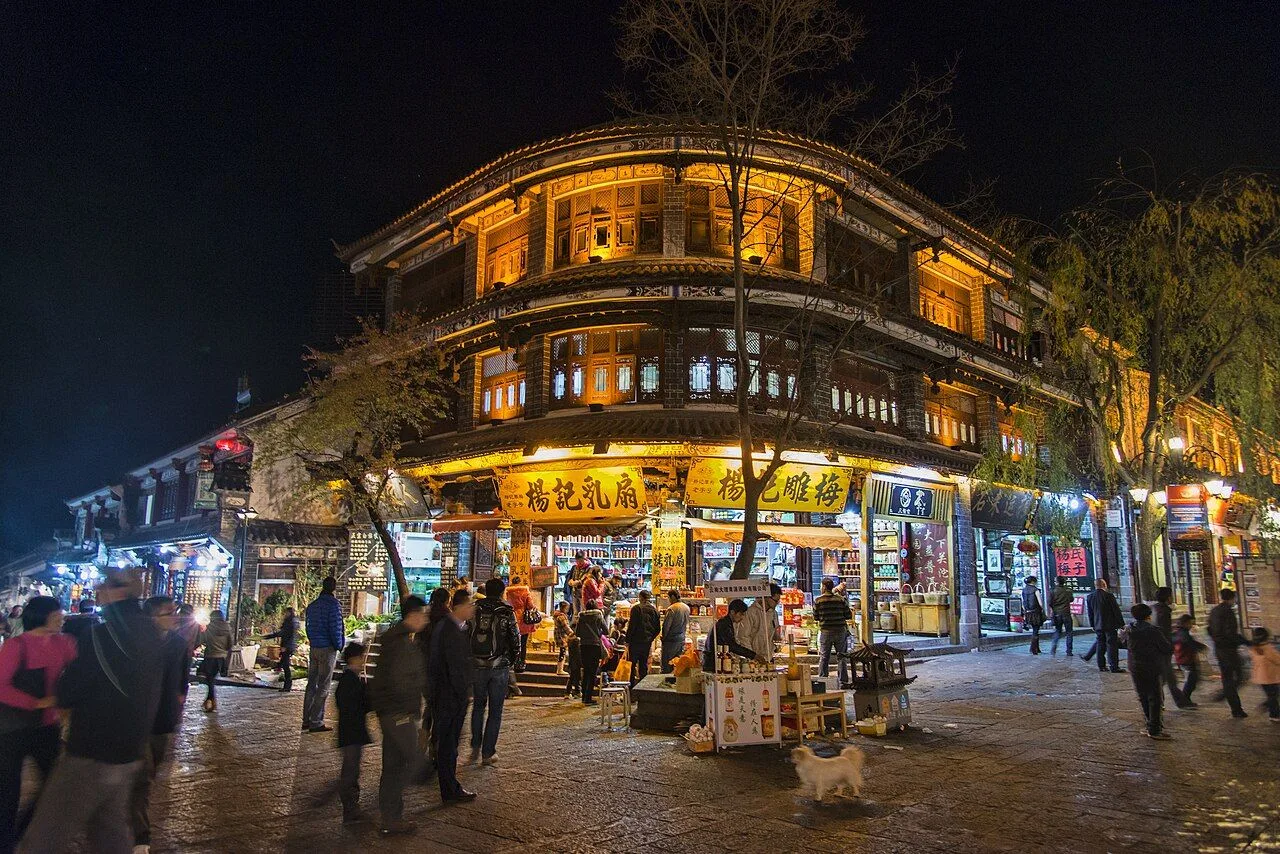
Photo: Wikimedia Commons / CC BY-SA. Source
The Bai people and their culture
The Bai (白族, ‘white people’) have lived in the Dali region for over 1,000 years. Their traditional architecture features white-washed walls with painted wall murals, gray tile roofs with upturned eaves, and central courtyards. The cuisine features crossing-the-bridge noodles (过桥米线, the rice noodles served with hot broth and a platter of raw ingredients to add), rushan cheese (乳扇, a Bai specialty similar to mozzarella but chewier), and Erhai Lake fish. Most visitors encounter the Bai culture through the Xizhou Ancient Town (30 min north of Dali) and the morning market, where Bai women in traditional dress sell breakfast and crafts.
Final tip
The biggest mistake first-timers make: trying to do it as a day trip from Lijiang. The HSR connection is fast (2 hours from Lijiang) but the Old Town + Three Pagodas + Erhai Lake needs at least 2 full days. The second mistake: not renting an electric scooter. The 130-km Erhai Lake circuit is the most iconic Dali experience, and most of it is on quiet lakeside roads perfect for a scooter. The third mistake: visiting in July-August. The rainy season obscures the mountains and makes the lake-shore riding wet and slippery.
For a slower, couple-focused version of the same route, see our honeymoon in Dali guide.
The year at a glance:
| Best month and weather | Weather and temperature | What to plan around |
|---|---|---|
| March-May | Flowers and mild weather | The recommended season, and the most comfortable weather for the Old Town lanes and the pagoda complex |
| October-November | Clear skies and cool temperatures | The clearest views of the mountains |
| December-February | Cool, 5-15°C | Still crisp views of Cangshan |
| July-August | Rainy season — heavy rain obscures the mountains | Wet and slippery on the lake-shore scooter ride |
| Any month | 1,900 m altitude | Headache and mild dizziness are common if you are sensitive — take the first day easy and avoid alcohol |
Also nearby
Best photo spots
-
Three Pagodas reflecting pool at sunset · 17:00-18:00 (sunset)
The single most iconic view in Dali — the three pagodas reflected in the pool with Cangshan Mountain behind. Use a tripod and a wide-angle lens at f/8.
-
Erhai Lake shore at Xizhou · 07:00-09:00 (morning, soft light)
The 250-sq-km lake with the Cangshan Mountain backdrop. Best in the morning when the lake is calm and the mountains are lit by soft light.
-
Dali Old Town South Gate at night · 20:00-21:00 (full darkness)
The 600-year-old South Gate of the Old Town, lit up at night with the city in the background. The most iconic night view in Dali.
-
Cangshan Mountain cable car · 10:00-11:00 (mid-morning)
The 4,000-m Cangshan range viewed from the cable car, with the clouds and Erhai Lake below. Use a wide-angle lens.
Where to eat nearby
-
Xizhou morning market (喜洲早市)
Local Bai breakfast — crossing-the-bridge noodles, rushan cheese, fried dough sticks, fresh fruit · ¥20-50/person · 30-min Didi north of the Old Town, open 06:00-12:00
-
Old Town Bai restaurants (Renmin Lu)
Bai cuisine — crossing-the-bridge noodles, sour fish soup, fried rushan cheese, Erhai Lake fish · ¥40-80/person · Throughout the Old Town
-
Erhai Lake fish restaurants
Fresh Erhai carp and crucian carp — the lake's signature dish · ¥60-120/person · Multiple lakeside restaurants on the eastern side of the Old Town
-
Foreign-friendly cafes and Western restaurants
Western breakfast, coffee, sandwiches, pasta, pizza · ¥50-100/person · Throughout the Old Town, especially on Renmin Lu and Fuxing Lu
Frequently asked questions
Is Dali Old Town free?
Yes — entry to the Old Town is FREE. The Three Pagodas of Chongsheng Temple are ¥121 (foreign passport, gate purchase). The Erhai Lake boat cruise is ¥150-300. The Cangshan cable car is ¥282 round-trip. Most travelers spend 1 day at the Old Town + Three Pagodas (¥121), plus 1 day for Erhai Lake (¥80-280 total).
How do I get to Dali?
Dali has no direct international airport — fly to Kunming (KMG) and take the 2-hour HSR (¥145 second class) to Dali. Kunming has direct flights from most major Asian cities. Dali is at 1,900 m altitude, much higher than Kunming.
How long should I spend in Dali?
2-3 nights covers the main sights. Day 1: Old Town + Three Pagodas. Day 2: Erhai Lake circuit by electric scooter (or boat cruise). Day 3: Cangshan Mountain hike + Xizhou village. Add a 4th day for a side trip to Shaxi Old Town (2-hour drive) or the Jianchuan area (Dali-style wooden architecture).
Is altitude sickness a problem in Dali?
Possibly — Dali is at 1,900 m, lower than Lhasa (3,600 m) or Shangri-La (3,200 m) but higher than most of Yunnan. Most visitors are fine, but if you're sensitive, take it easy the first day. Headache and mild dizziness are common. Drink water, avoid alcohol the first day.
How does Dali compare to Lijiang?
Both are Bai/Naxi ancient towns in Yunnan. Lijiang is more touristy (UNESCO Old Town) and more developed; Dali is quieter, more local, and better positioned for outdoor activities (Erhai Lake, Cangshan hikes). Most travelers visit both on a 5-7 day Yunnan circuit: Kunming → Dali → Lijiang → Shangri-La.