
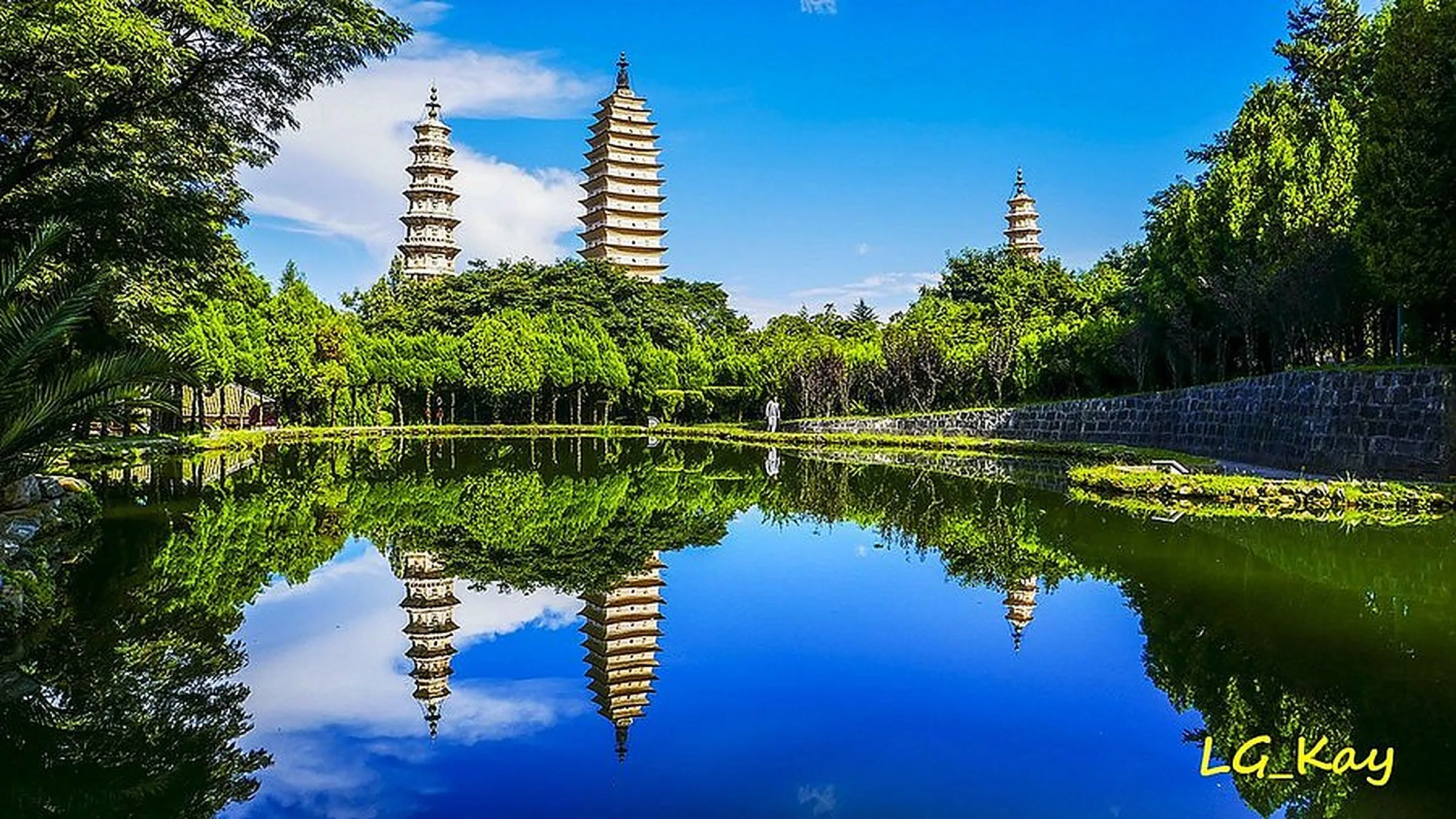
Cangshan Mountain (苍山), Dali
苍山 · Cāngshān
Quick answer
No passport check at the trailheads and no visa needed to walk the lower paths. Your passport is only asked for if you buy a discounted cable-car ticket (students, seniors, military), where the operator accepts the entry permit as a substitute for a Chinese ID. Cash, Alipay and WeChat Pay are accepted at the lower stations.
Why visit
- 1 A 19-peak, 18-stream wall of mountains standing directly above Erhai lake — the reason Dali has the phrase 风花雪月
- 2 Three cable cars reach three different altitudes, so you can pay for height you actually want instead of hiking for it
- 3 The Yudai Cloud Road runs about 18 km along the ridge at roughly 2,000-2,600 m — a flat high-altitude walk above the clouds
- 4 The highest cable car tops out near 4,120 m, which is alpine altitude on a warm day
- 5 Best seen in April-May (rhododendron) and September-October (clear air over the lake)
Essential tips for foreigners
- Go at opening time (08:00). The Gantong and Ximatan lower stations queue hardest between 10:00 and 14:00, and the queues are on the mountain, not at the ticket window.
- Carry cash. The lower stations accept cash, Alipay and WeChat Pay, but if a queue stalls a QR payment, cash still moves.
- Pick your cable car by the altitude you want. Ximatan (洗马潭) is the highest and coldest; Gantong (感通) is the easy one with Qingbi Stream and the Jade Dragon chessboard at the top; Zhonghe (中和) serves the mid-mountain temple and the west end of the Yudai Cloud Road.
- The Yudai Cloud Road is not a casual walk. At roughly 18 km with ups and downs it is a full day even though it is described as flat — take water and do not attempt it in one go if you have not walked 15 km before.
- Treat Ximatan as altitude, not as a viewpoint. Above 4,000 m, headaches and breathlessness are common; go slowly, drink water, and skip it if you have heart or blood-pressure problems.
- Check the operator's WeChat notice the morning you go. Cable cars close for wind, ice and maintenance, and the operator announces it there rather than on a website.
Suggested route
- 08:00 30 min Arrive at the Gantong (感通) cable-car lower station and buy a return ticket before the queue builds
- 08:30 1.5 hours Ride up to Qingbi Stream and the top of the Yudai Cloud Road's southern end; walk the short loop past the Jade Dragon chessboard
- 10:00 3 hours Walk the Yudai Cloud Road north along the ridge, with Erhai on your right the whole way
- 13:00 2 hours Descend to the Zhonghe (中和) upper station and ride down, or continue to Ximatan if you want the high viewpoint
- 15:00 1 hour Back at the lower station in time for the last afternoon cable car; return to Dali Old Town
Photo: TravelHubChina city image library. The 19 peaks and 18 streams of Cangshan are the “snow” (雪) in Dali’s 风花雪月.
The mountain behind the postcard
Dali Old Town faces west across Erhai lake at a wall of mountains that the Chinese have been naming for a thousand years: 苍山, Cangshan — “the blue-green mountain”. It is not one peak but nineteen, strung north to south in a single continuous ridge, separated by eighteen streams that run down to the lake. The highest is Malong Peak at 4,122 m; the lowest point of the range sits a few hundred metres above the rice fields of the Dali basin.
Two facts make it different from the mountains around Erhai. The first is that it stands almost vertically out of the lake, so from the water the ridge fills the entire horizon — you do not see the mountain, you stand under it. The second is that you can be on top of it in about half an hour. Three cable cars run from the lakeside plain up to three different upper stations, and a single high ridge path — the Yudai Cloud Road (玉带云游路) — links them.
For most visitors the practical shape of the day is: pick a cable car, buy a return ticket, walk some of the ridge, ride down.
Which cable car, and why it matters
The three cable cars are not interchangeable; they differ mainly in how high they take you and how much walking they leave you.
Gantong (感通索道) is the easy one. Its upper station sits at 2,523 m beside Qingbi Stream (清碧溪), a ravine of clear green meltwater pools, and at the foot of the southern end of the Yudai Cloud Road. The published operating window is 08:30-16:30 with ticket sales stopping at 16:00. It is also the geopark’s east gate and the closest of the three to the old town.
Ximatan (洗马潭索道) is the high one, climbing to roughly 4,120 m to a blue alpine pool on the snowfield. This is alpine altitude on a warm day. The operator publishes the National Day 2026 ticket window as 08:00-16:00, with cable-car operation continuing until the day’s visitors are finished.
Zhonghe (中和索道) serves the mid-mountain, including Zhonghe Temple, and the western end of the ridge walk.
For the 2026 National Day holiday the operator (大理旅游集团苍山洗马潭索道分公司) published adjusted selling times of 08:00-16:00 for Ximatan and 08:00-16:30 for Gantong, and told visitors that cable-car operation would run until that day’s intake was finished. Holiday adjustments like this are announced on the operator’s official WeChat account — the same channel that carries maintenance closures and weather suspensions.
What the tickets actually cost
We are not going to quote a cable-car fare we could not read. The operator publishes its fares on its official WeChat notices and through the ticket pages it links to; on 2026-10-31, the date we checked, those fares were published as images rather than as text, and we do not publish numbers we cannot read from the source.
What the operator does publish as text is the concession structure, which is the part that actually matters for a foreign visitor planning a budget:
- Free: children 1.2 m and under; ages 70 and over; disabled visitors; active-duty and retired military; holders of a 老干部离休证.
- Half price: children 1.2-1.4 m; ages 6-18; ages 60-69; full-time students.
- Everyone else: the standard fare, quoted by the operator only in its image notices.
Bring cash as well as Alipay or WeChat Pay — all three are accepted at the lower stations, and a stalled QR payment at a busy window is a real risk at 08:00.
For the wider geopark the scenic area’s own published notice lists a parallel structure: entry free for children aged 7 and under or 1.2 m and under; half price for ages 7-18 and for full-time undergraduate students; half price for ages 60-70; free for ages 70+; free for disabled visitors, active military, disabled veterans, military retirees and retired military cadres; and a green channel for holders of a Yunnan provincial high-level talent card. The scenic-area hotline published with that notice is 0872-5365006.
The walk you are actually buying
The Yudai Cloud Road (玉带云游路) is the reason to come on a clear day. It runs along the ridge for roughly 18 km at about 2,000-2,600 m, linking the upper stations of all three cable cars, with the Dali basin and Erhai on one side and the western peaks on the other.
It is described as flat. It is not flat in the sense that matters — 18 km is a long day regardless of gradient, and the surface is mountain path. The practical way to use it is to walk one section, not all of it: ride up at Gantong, walk north for a couple of hours to the next upper station, and ride down. If you want the full length you need a full day, water, and shoes you have already walked in.
The season shape is straightforward. April and May bring rhododendron on the upper slopes and the wettest air. September and October are dry, clear and the best months for looking across Erhai. December to February gives snow and the best ridge views, but the upper cable car closes more often and the path can be genuinely icy.
Getting there, and getting back down
There is no metro in Dali. The railway reaches the city on the Dali-Lijiang line with Dali station a short walk from the old town, and long-distance coaches use the main bus station at the south edge of the old town. From either, the Gantong lower station is a short taxi or local-bus ride; the Ximatan lower station is further up the mountain.
The old town itself is pedestrianised — you cannot drive into it — so park outside the walls and ride or walk the last stretch.
Where this fits in a Dali itinerary
Cangshan is a half-day or a full day, and it pairs naturally with the old town on the same side of the lake. If you want the Bai architecture instead of the mountain, the Bai courtyard houses and the morning market of Xizhou Ancient Town are 30 minutes north on the lakeshore road, and the Dali city page lists the rest of the basin worth pairing with a mountain morning.
For a slower version of the same region, the Dali Old Town page covers the streets, the night market and the practical base for everything above.
Best photo spots
-
Yudai Cloud Road (玉带云游路), southern section near the Gantong upper station · Morning, before cloud builds
The ridge trail itself, with Erhai and the Dali plain laid out below on one side and the western peaks on the other.
-
Qingbi Stream (清碧溪), Gantong upper station · Late morning
Clear green meltwater pools in a shaded ravine, reached a few minutes' walk from the Gantong upper station.
-
Ximatan (洗马潭) summit · Late morning, when the cloud below has lifted
The blue alpine pool at the top of the highest cable car, with snowfields and meadow around it.
-
Erhai lakeshore viewpoint below the ridge · Late afternoon
Looking back down at the lake and the old town, which is where the classic Cangshan-and-Erhai frame is set up.
Where to eat nearby
-
Dali Old Town night market (Renmin Lu)
Bai and Yi street food · ¥20-60/person · About 4 km from the Gantong lower station, by bus or taxi
-
Gantong Temple vegetarian tea house
Bai three-course tea (白族三道茶) and simple vegetarian dishes · ¥30-60/person · Beside the Gantong cable-car lower station
Frequently asked questions
How much does it cost to go up Cangshan Mountain?
The trail network is free — the money is the cable car. The operator publishes its cable-car fares on its official WeChat notices; on 2026-10-31 those fares were published as images rather than text, so we are not quoting a number we could not read. Concessions that the operator does publish as text: 1.2 m and under free, 1.2-1.4 m half, ages 6-18 half, ages 60-69 half, ages 70+ free, full-time students half, and disabled visitors, active-duty and retired military free.
Which cable car should I take?
Gantong (感通) for an easy half-day: it drops you at Qingbi Stream and the top of the Yudai Cloud Road's southern end. Ximatan (洗马潭) for the highest snow views and the alpine altitude — around 4,120 m. Zhonghe (中和) for the mid-mountain temple and the western end of the Yudai Cloud Road. Buy a return ticket unless you are confident you will walk down.
How long does the Yudai Cloud Road take?
It runs about 18 km along the ridge at roughly 2,000-2,600 m. Described as flat, it is still a full day of walking, and it connects the upper stations of all three cable cars, so you can walk one section and ride out from the other end.
Do I need a passport to visit Cangshan Mountain?
No entry document is checked on the trails and no visa is needed to walk the lower paths. A passport is only asked for when you buy a discounted cable-car ticket — students, seniors and military — and the operator accepts an entry permit in place of a Chinese ID.
Can I reach the mountain by public transport?
Yes. Local buses run from Dali Old Town up to the cable-car lower stations, and Dali is on the Dali-Lijiang railway line with Dali station a short walk from the old town. There is no metro in Dali.
Is there a bus inside the scenic area?
No shuttle bus runs along the Yudai Cloud Road — that is why the road is a genuine walk. The cable car is the substitute for internal transport, which is exactly why people buy a return ticket.
Will the cable car be running when I arrive?
It usually will, but not always. The operator closes individual cable cars for scheduled maintenance and for ice or high wind and announces it on its official WeChat account — that notice is the source to check on the morning you plan to go up.
Is Cangshan worth doing in winter?
For snow and the best views over Erhai, yes — that is the most dramatic version of the mountain. The trade-off is that the upper cable car closes more often in bad weather and the trail can be icy.
Sources
- 大理文旅 (Dali Culture and Tourism Bureau official portal) — National Day 2026 cable-car ticket times published by 大理旅游集团苍山洗马潭索道分公司 · daliwenlv.com
- 大理文旅 (Dali Culture and Tourism Bureau official portal) — home · daliwenlv.com
- Cangshan scenic area official notice board (opening hours, concession policy, scenic-area hotline 0872-5365006), transcribed by Qunar's scenic-area record · sight.qunar.com