Xizhou Ancient Town (喜洲古镇), Dali
喜洲古镇 · Xīzhōu Gǔzhèn
Quick answer
No passport, no visa and no ticket to enter the town. Everything in the public street is open to walk. Individual houses and museums inside ask for their own ticket at the door.
Why visit
- 1 The best-preserved Bai vernacular architecture in Yunnan — whitewashed walls, dark tiled roofs and the 三坊一照壁 courtyard plan
- 2 More than 150 well-preserved Ming and Qing courtyard houses in a village of a few thousand people
- 3 A morning market in the village square where the Bai still trade, rather than a market staged for visitors
- 4 Tie-dye (扎染) workshops where the indigo vat is still in the courtyard
- 5 Half an hour from the Dali old town on the lakeshore road, so it is an easy half-day
Essential tips for foreigners
- Go in the morning. The market trades in the square from about 08:00 and it is the reason to be here; by mid-afternoon the square is quiet and the houses are the main draw.
- The town is free and the compound is not. The Yan Family Compound is the museumised Bai courtyard house most visitors pay to enter, and it is the one part of Xizhou that needs a ticket.
- Look up at the eaves. The carved and painted timber brackets and the 'swallowtail' roof ridges on the corner tower are the architectural point of the village, and they are above eye level on every house.
- Do not treat it as a film set. The 2023 drama 《Meet Yourself》 (去有风的地方) was shot here and the streets are used in it, but this is a working village with people living in the houses you photograph.
- Eat the baba (粑粑). Xizhou baba — the Bai flatbread, savoury or sweet — is the local breakfast and the thing to buy at the market.
- Combine it with the mountain or the lake, not with both. Xizhou and Cangshan are on opposite sides of the day: the village in the morning, the mountain in the afternoon.
Suggested route
- 08:00 1 hour Arrive in the village square as the morning market is trading
- 09:00 1 hour Eat a Xizhou baba from a market stall and walk the main street and the corner tower
- 10:00 1.5 hours Enter the Yan Family Compound and walk the Bai courtyard house rooms
- 11:30 1 hour Look for a tie-dye workshop in one of the courtyard houses — the indigo vats are usually in the back yard
- 12:30 1.5 hours Walk out towards the fields between the village and Erhai, then head back to Dali
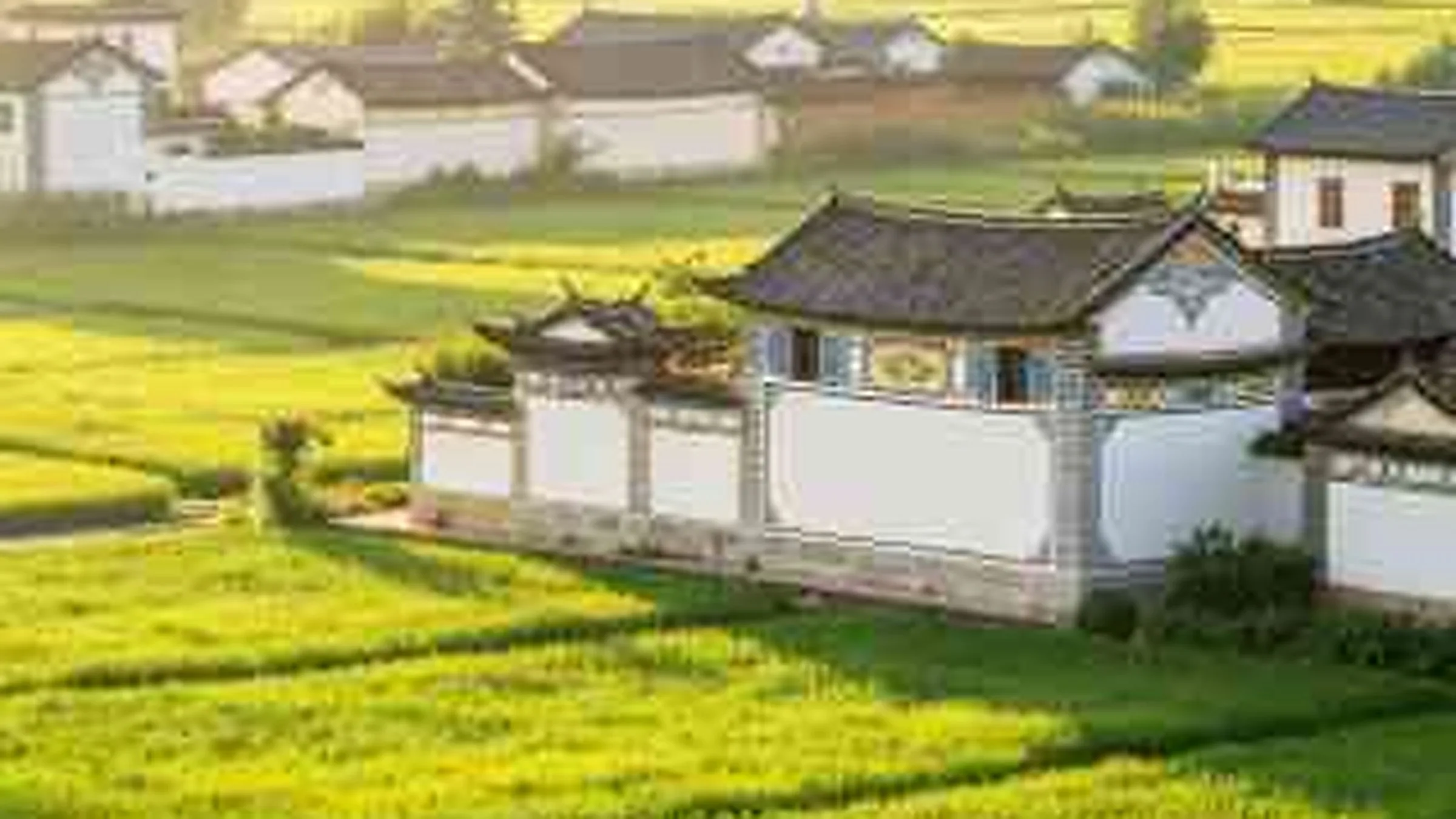
Photo: TravelHubChina city image library. The 三坊一照壁 courtyard plan is visible in the rooflines.
The best Bai architecture in Yunnan, and it is not a museum
Xizhou (喜洲) is a working Bai village on the west shore of Erhai lake, about 30 minutes north of Dali Old Town along the lakeshore road. It holds more than 150 well-preserved Ming and Qing courtyard houses — whitewashed walls, grey tile roofs, carved and painted timber brackets — arranged in the Bai 三坊一照壁 plan: three wings and a screen wall, so that the inner court is hidden from the entrance until you walk around the corner.
Two things make it different from the walled old town 30 minutes south. The first is that the buildings here are Bai, not Han, and the architecture is materially different — the white-and-grey walls, the swallowtail roof ridges, the heavy carved brackets. The second is that it is a village, not a set: people live in these houses, the market trades in the square, and the tie-dye vats are in the back yards.
The village’s own name for the compound that most visitors pay to enter is the Yan Family Compound (严家大院), the best-preserved of the courtyard houses, and the most-photographed building in the village is the corner tower (转角楼) at the junction in the centre.
Xizhou was also a filming location for the 2023 drama 《Meet Yourself》 (去有风的地方), which is one reason it is suddenly on every Dali itinerary — worth knowing before you go, because the streets in the show are the streets you will be walking.
Free to walk — and one ticket inside
The town is free. There is no gate, no entrance ticket and no document check; it is a living village you walk through at any hour. The Yan Family Compound is separately ticketed, and our editorial figure for it is ¥85.
On that compound price, honestly: we could not confirm it, or the compound’s opening hours, from a first-party source on 2026-10-31. The Dali culture and tourism bureau’s official portal (daliwenlv.com) publishes notices for the Cangshan area but has no Xizhou visitor page; the domain xizhou.com returned no readable content from our build environment; and the Dali municipal government portal did not return a Xizhou notice through the searches we ran. The Chinese name, the location and the coordinates below are solid — they come from Wikidata item Q10923614, the same source behind the site’s own generated coordinate for this village. The ticket price and the compound’s hours are our editorial figures and should be re-checked at the door.
What is not in doubt is the shape of the day: the morning market trades in the village square from around 08:00 until early afternoon, and that is the reason to time your visit around Xizhou rather than treating it as an add-on.
Getting there
No metro — Dali has none. From Dali Old Town, 30 minutes north along the Erhai lakeshore road by local bus, Didi or taxi. From Dali station on the Dali-Lijiang railway line, allow a little longer. Car parks are at the edge of the village; the interior streets are pedestrianised.
Because the road is the same road that runs the whole Erhai shoreline, the traffic at peak times is the traffic for the lake route as a whole — leaving early beats leaving on time.
Where it fits in a Dali day
Xizhou and the mountain are opposite halves of a day: the village in the morning for the market, the mountain in the afternoon for the ridge. The Cangshan Mountain page covers the cable cars and the walk; the Dali Old Town page covers the walled town, the night market and where to base yourself. The Dali city page sets out the rest of the basin.
Best photo spots
-
The corner tower (转角楼) at the junction in the village centre · Morning light
The best-known building in Xizhou, with its carved timber brackets and swallowtail roof ridges.
-
The main street and the square · 08:00-10:00, when the market is trading
Market stalls, local produce and people at work — the scene that shows this is a village and not a set.
-
The fields between the village and Erhai · Late afternoon
The relationship between the whitewashed Bai houses, the farmland and the water that makes the layout legible.
-
A courtyard house interior · Midday
The 三坊一照壁 plan seen from the entrance hall, with the screen wall blocking the view of the inner court until you walk round it.
Where to eat nearby
-
Xizhou baba (喜洲粑粑)
Bai flatbread, baked with either a savoury filling or a sweet one · ¥8-15 · Market stalls in the village square
-
Bai tie-dye workshop canteens
Simple Bai home cooking · ¥30-60/person · Inside the courtyard houses
Frequently asked questions
How much does it cost to visit Xizhou Ancient Town?
The town is free — it is a living village with no gate and no entrance ticket. The Yan Family Compound (严家大院) inside it is separately ticketed. Our editorial figure for the compound is ¥85 per person, but we could not confirm that from a first-party source on 2026-10-31, so treat it as a guide rather than a quotation.
What time does Xizhou Ancient Town open?
The village itself has no opening hours — you can walk it at any time of day. The morning market trades from roughly 08:00 into early afternoon, and that is the part worth timing your visit around. The Yan Family Compound keeps its own hours, which we could not verify from a first-party source on 2026-10-31.
Do I need a passport to visit Xizhou?
No. There is no ticket to the town, no document check and no visa requirement. Individual houses and museums inside the village charge at the door and do not check documents.
How do I get to Xizhou from Dali Old Town?
About 30 minutes north along the Erhai lakeshore road, by local bus, Didi or taxi. There is no metro in Dali. The village has car parks at its edge and the interior streets are pedestrianised.
What is Xizhou known for?
Bai architecture. More than 150 well-preserved Ming and Qing courtyard houses in the 三坊一照壁 layout — three wings and a screen wall — with whitewashed walls, carved and painted timber brackets and grey tile roofs. The Yan Family Compound is the best-preserved and the one most visitors pay to enter, and the corner tower is the most photographed.
How long should I spend in Xizhou?
Three to four hours. The market in the morning, the courtyard houses and the compound in the middle of the day, and a walk out along the fields that separate the village from the lake.
Is Xizhou worth going to instead of Dali Old Town?
They are different and both are worth it. Dali Old Town is the Han-style walled town with the night market; Xizhou is the Bai village with the courtyard houses, the morning market and the tie-dye workshops, half an hour away along the lake. Most people can do both in a day.
Sources
- Wikidata item Q10923614 — Xizhou (喜洲), Dali, Yunnan: official Chinese name, administrative location and coordinates (also the source of the site's own dali::xizhou coordinate entry) · Wikidata
- 大理文旅 — Dali Culture and Tourism Bureau official portal (regional official source; no Xizhou-specific visitor notice published as of 2026-10-31) · daliwenlv.com
- OpenStreetMap / Nominatim — 喜洲镇, 大理市, Dali Bai Autonomous Prefecture · nominatim.openstreetmap.org