
Jinsha Site Museum, Chengdu
金沙遗址博物馆 · Jīnshā Yízhǐ Bówùguǎn
Quick answer
The passport question is currently moot, because the museum is closed until 30 April 2027 and nobody is being admitted to prove anything. When it reopens, expect the standard large-Chinese-museum arrangement: your passport is what establishes that you are a foreign visitor, and no separate foreigner ticket tier is published. The genuinely useful thing you can do right now is use the virtual tour — the museum publishes a 360-degree online walkthrough, and with the building shut it is the only way to see the excavated hall before 2027.
Why visit
- 1 THE MUSEUM IS CLOSED FROM 5 DECEMBER 2025 TO 30 APRIL 2027, per its own official site — the most important fact on this page
- 2 The gold Sun Bird, 12.5 cm across and 20 g, found here in 2001 and chosen in August 2005 as the logo representing China's cultural heritage
- 3 A capital, not a village: 50 structures, 300 burials, kilns, ash pits and thousands of objects place it alongside Sanxingdui as a Bronze Age centre on the Chengdu Plain
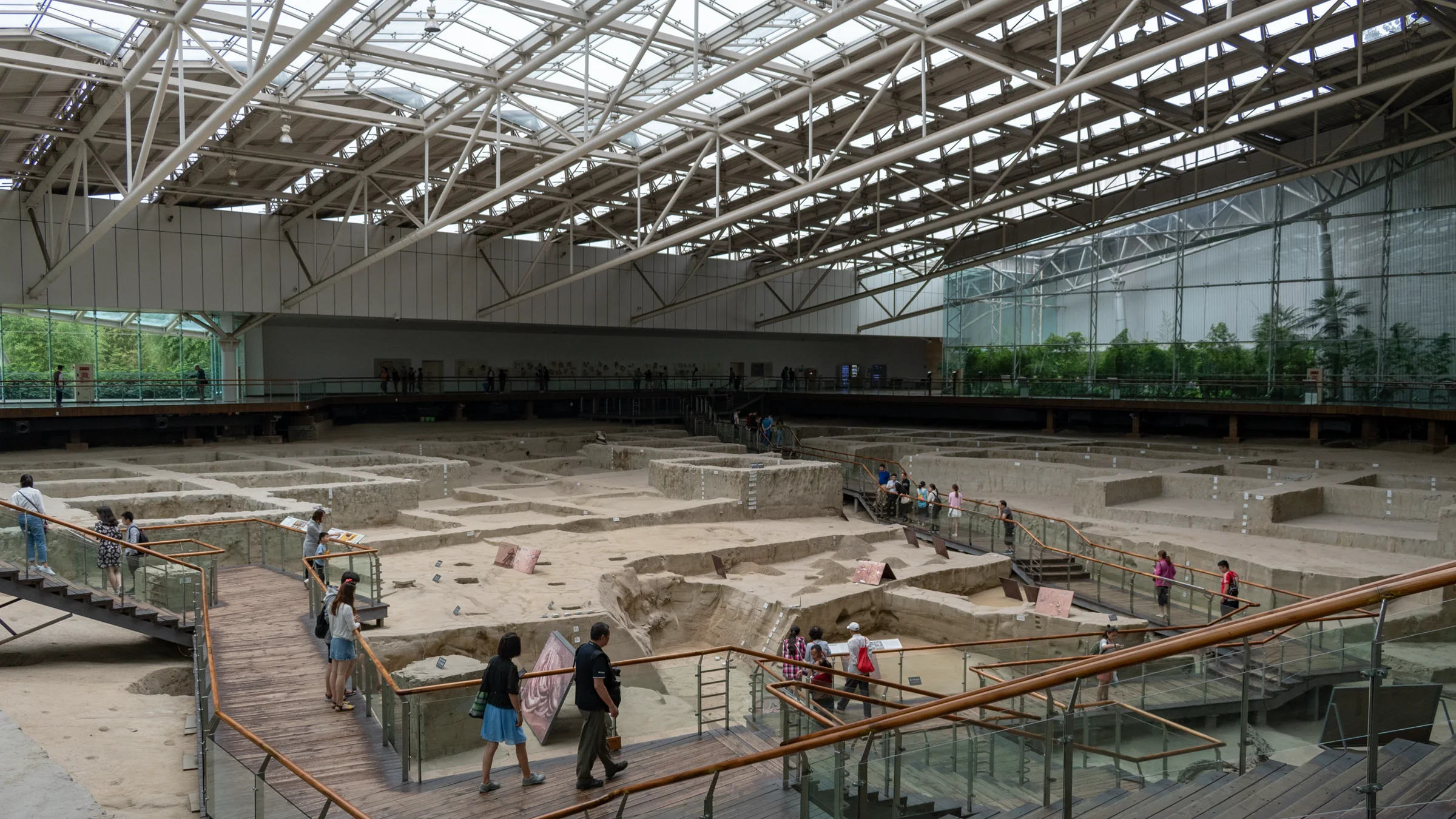
- 4 The excavations are preserved in place under a steel-and-glass hall built in 2007, so you walk over the site rather than looking at cases of what was dug out of it
- 5 The gold leaf is 94.2% gold and was beaten from natural gold dust into a foil 0.02 cm thick — the craftsmanship is the argument, not the metal alone
- 6 Found by accident: a housing estate was being built in 2001 and a drain turned up a cache of bronze, jade, stone and ivory
- 7 On the UNESCO World Cultural Heritage Tentative List, and a Major Site Protected at the National Level
- 8 The settlement simply stops, somewhere between 500 and 200 BCE, and nobody is certain why
Essential tips for foreigners
- Do not plan this visit before May 2027 without telephoning first. The closure runs to 30 April 2027 on the museum's own statement. Anything you read elsewhere, including our own ¥80 figure, predates it.
- Take the ¥80 as historical, not as a quote. We could not verify it, because the museum is not publishing prices while it is shut. Ring 028-87303522 if you need a real number.
- Use the virtual tour instead. The museum publishes a 360-degree walkthrough of the excavated hall. With the building closed until 2027 it is the only way to see the site, and it is free.
- Know what you are looking at when it reopens. Jinsha is routinely compared with Sanxingdui, but they are different places about 60 km apart — Jinsha is the successor centre on the Chengdu Plain, and unlike Sanxingdui it had no city walls or moat.
- The Sun Bird is upstairs. The gold ornament is the museum's own logo and is displayed on the second floor, so it is a floor above where most people stop.
- Two to three hours, almost entirely indoors. That makes it the sensible rainy-day or hot-afternoon choice in Chengdu once it is open again.
Suggested route
- Before visiting 30 min Walk the museum's 360-degree virtual tour of the excavated hall, and note the Sun Bird and mask in the gallery sequence for when the museum reopens
- Reopening, first hour 60 min Start in the protected hall over the excavations themselves, on the boardwalk above the rammed-earth foundations
- Reopening, second hour 45 min Cross to the Mei Yuan locality, where the elephant-tusk pit and the ritual deposits were found
- Reopening, second hour 30 min Go up to the second floor for the Sun and Immortal Birds gold ornament, the museum's own emblem
- Reopening, third hour 45 min The gold collection and the stone figures, including the twelve kneeling human figures from the ritual area
- Reopening, end 30 min Return to the boardwalk for the excavated area in flat light, which is the easiest way to read the plan of the buildings
Read this first: the museum is shut until April 2027
This site is not currently open. The museum’s official English site says so directly: “The museum closed from 5th December 2025 to 30th April 2027.”
That sentence sits exactly where the opening hours would sit, both on the front page and on the page dedicated to opening hours, which is why we treat it as the live position rather than a banner somebody forgot to take down. There is a related detail worth knowing, because it tells you how the museum itself is handling the closure: the text carrying its former normal schedule — daily 09:00-18:00, last entry 17:00, closed Mondays except public holidays and January, February, July and August — is still present in the page source, but it has been commented out. In other words, the schedule was withdrawn rather than replaced. We are recording it here as a description of what the museum used to publish. We are not presenting it as the reopening timetable, and we would not be surprised if the hours differ when it does reopen.
The practical consequence for you is narrow and simple. There is nothing to book, no ticket to buy and no reason to travel to this address before May 2027. If you are in Chengdu now, what you can still do is the 360-degree virtual tour the museum publishes, which walks the excavated hall properly.
What the place is, for when it reopens
Jinsha is an archaeological site rather than a building, and that determines what a visit looks like. The city is preserved in place under a protective hall.
The site covers three square kilometres on the eastern Chengdu Plain, bounded by four roads, with the Modi River dividing it into north and south sections. Excavation identified three main localities with distinct functions: Mei Yuan on the southern bank, where ritual activity and an elephant-tusk pit were found; Lan Yuan, which was residential before it became a burial ground; and Tiyu Gongyuan, the wealthier residential quarter that later took the burials. The museum, built in 2007, covers six hectares directly over the excavated area.
The scale is what distinguishes it. Fifty structures, three hundred burials, kilns, a thousand ash pits and thousands of objects — roughly nine hundred jade pieces and seven hundred bronze — place Jinsha alongside Sanxingdui as a Bronze Age centre of the ancient Shu culture. It is generally read as the successor capital after Sanxingdui declined.
Then, between roughly 500 and 200 BCE, it stopped. Not gradually: the settlement ended abruptly, and the reasons remain genuinely unclear. Earthquake, catastrophic flooding and political upheaval have all been proposed, and the archaeologists writing this up mostly decline to choose. One structural detail worth holding on to is that Jinsha, unlike Sanxingdui, had no city walls and no moat — whatever it was, it was not defended like that.
The Sun Bird, and why it outranks everything else
The gold ornament found in 2001 is the reason most people know the name Jinsha, and it deserves the attention it gets.
The Sun and Immortal Birds ornament is a ring of foil, 12.5 centimetres in diameter with a 5.29 centimetre opening, 0.02 centimetres thick, weighing 20 grams. Four birds fly in the same counterclockwise direction around the perimeter; the centre is a sun with twelve points. The leaf is 94.2% gold and was beaten from natural gold dust. The dating places it in the late Sanxingdui period, around 1200 to 1050 BCE.
Two things follow. The first is technical: getting a 20-gram ring of foil to hold its shape at that thinness, with four recognisable birds and a twelve-rayed centre, is a serious piece of metalworking, and that is the argument the artefact makes beyond its material value. The second is institutional. In August 2005 the State Administration of Cultural Heritage selected the motif as the logo representing Chinese cultural heritage. It is not just the museum’s trademark; it is a national emblem, which is why the artefact is displayed on the second floor and why so many reproductions of it exist.
The motif is usually connected to a passage in the Classic of Mountains and Seas in which four birds pull the sun down at sunset. That reading is traditional rather than proven, and we would rather label it as tradition than present it as the archaeologists’ conclusion.
Two other finds justify the visit on their own. The smiling gold mask is 3.7 by 4.7 centimetres, with crescent eyes and a half-open mouth — a design that has not been found anywhere else in China — and it was bonded onto figures rather than worn, which points to ritual use rather than portraiture. And the twelve kneeling stone figures from Mei Yuan show bound hands, centre-parted braided hair and angular faces with high nose bridges; they are generally interpreted as shamans, ritual performers or sacrificial victims rather than slaves or prisoners.
What we could not verify, and why that matters here
Three things on this page are gaps rather than findings, and on a closed site they are worth more than usual.
The ticket price is the important one. Our own seed data carries ¥80, we have kept that figure, and we could not confirm it — the museum is not selling or publishing a price while it is shut. A number we cannot check is not a quote, so treat ¥80 as a historical planning figure and ring the museum before relying on it.
The reopening date is the museum’s stated 30 April 2027. We have published it because the museum publishes it, not because we have verified it will hold. Reopening dates in China slip.
The metro access is simply something we could not source, so rather than name a station we did not confirm, we have pointed to the Hi Panda scenic shuttle bus, which does list the Jinsha site among the Chengdu attractions it serves, and to a taxi. That shuttle runs from hubs around Kuanzhai Alley and the Wuhou Temple, its WeChat miniapp does not accept foreign phone numbers, and you can usually just pay the driver in cash.
One corroboration worth recording, because it is the kind of check that has caught this repository out before. The two photographs on this page carry GPS coordinates in their Commons metadata — 30.683203 / 104.012727 and 30.684990 / 104.010798. Both fall within a few hundred metres of the coordinate published on this page, and both were taken inside a building with a distinctive form. That is independent confirmation that this is Chengdu’s Jinsha and not some other site sharing the name, which matters more than it might sound: there are enough places in China with common names to have caught a cross-city error before.
Closure and contact details come from the museum’s official English site, read on 16 October 2026; site history and artefact details from English Wikipedia and the Wikipedia article on the Sun and Immortal Birds, read the same day. Reopening dates can move — telephone 028-87303522 before travelling.
Best photo spots
-
The excavated hall under the protective canopy · Flat overcast light, which is most of Chengdu's year
The strongest image available, and the one that cannot be mistaken for anywhere else: low rammed-earth foundations tracing the outlines of ancient rooms, seen from the raised boardwalk with the steel roof structure overhead. The city's famously poor light is an advantage here — hard sun flattens the earthworks, while the diffuse light that Chengdu gets all winter renders the wall lines more clearly than a sunny day would.
-
The Sun and Immortal Birds gold ornament · Whenever the case lighting is on; ask whether flash is permitted
A 12.5 cm ring of gold foil, 0.02 cm thick, with four birds circling a twelve-pointed sun. It is small, so the photography problem is glare rather than distance — photograph it against the dark case backing if the lighting allows, and expect the polished surface to blow out in a straight-on shot.
-
The exterior approach walkway · Late afternoon under broken cloud
The approach across the paved walkway to the earth-toned building, whose curved roof skylight is the strongest architectural gesture of the whole complex. Worth shooting from the walkway itself rather than from the road, with the railings leading the eye to the entrance.
Where to eat nearby
-
Jinsha Shiguang cafe bar (金沙时光餐吧)
Hot meals and tea rather than a restaurant. The museum's own catering page describes it as 简便快捷和经济实惠的简餐和茶水服务 — quick, inexpensive set meals and tea service — with seating for 100. · ⚠ NO PRICE PUBLISHED. The museum describes the food as 经济实惠 (economical) but publishes no figure, and we could not find one from another source. · On-site: on the basement level (负一楼) of the museum's exhibition hall. Service hours published by the museum are 09:00-17:30, telephone 13540455819. ⚠ Note that the museum is closed to the public from 5 December 2025 to 30 April 2027, so none of this is bookable until it reopens.
-
Mao Lu Sichuan and Cantonese private kitchen, Jinsha branch (茅庐·川粤精品私房菜·金沙遗址店)
Sichuan and Cantonese private-kitchen cooking (川粤精品私房菜) — a private-room restaurant rather than a street stall. · ⚠ NOT PUBLISHED. The Ctrip listing for this branch gives a telephone number and an address but no per-person figure, and we could not find one elsewhere. · No. 22 Jinfeng Road (金凤路22号), which the Ctrip listing places west of the Jinsha museum's rear gate (金沙博物馆后门西侧) — a few minutes from the site. Same caveat as above: the museum itself is shut until 30 April 2027.
Frequently asked questions
Is the Jinsha Site Museum open?
No. The museum's official English site states that it closed from 5 December 2025 to 30th April 2027. The notice appears both on the front page and on the page dedicated to opening hours, so it is the current published position. We would still recommend telephoning on 028-87303522 before travelling, since reopening dates for Chinese museums have a habit of moving.
How much is the ticket?
We cannot give you a verified figure. Our own seed data carries ¥80, and we have left that as the planning number, but we could not confirm it from any source we are willing to cite — the museum is not selling or listing a price while it is shut. Ring 028-87303522 for the real figure when it reopens.
What were the opening hours before the closure?
The museum used to publish daily 09:00-18:00 with last entry at 17:00, and closure on Mondays except for public holidays and for January, February, July and August. We are recording that as a description of what it published, not as a live schedule: that text is still in the museum's page source but has been commented out, so it is not being shown to visitors, and we are not presenting it as the reopening timetable.
What is the gold Sun Bird?
The Sun and Immortal Birds gold ornament: a ring of foil 12.5 cm across with a 5.29 cm inner diameter, 0.02 cm thick and weighing 20 g, made from gold leaf at 94.2% gold purity. Four birds fly in the same counterclockwise direction around a twelve-pointed sun. It dates to the late Sanxingdui period, roughly 1200-1050 BCE, was unearthed at Jinsha in 2001, and in August 2005 the State Administration of Cultural Heritage selected the motif as the logo representing Chinese cultural heritage. It is now the museum's own emblem.
How is this different from Sanxingdui?
They are separate sites about 60 km apart, and the comparison is standard in the archaeology because both are Bronze Age centres of the ancient Shu culture and both produced spectacular gold. Jinsha is generally read as the later capital on the Chengdu Plain after Sanxingdui declined, and it differs structurally — unlike Sanxingdui, Jinsha had no city walls and no moat.
Why is there no famous gate or temple here?
Because this is an archaeological site, not a building. Fifty structures were found, all of them facing north-west or south-west, built with wattle and daub — mud inside, timber or bamboo outside. What you walk on today is the footprint of a city, preserved in place under a protective hall built in 2007.
How long would a visit take?
Two to three hours, and almost all of it indoors. The excavated area under the canopy is large and you cross it on boardwalks, and there is a substantial gallery of finds beyond it. Plan on that figure for when the museum reopens — it is arithmetic, not a recommendation you can act on this year.
Can I still see anything?
The buildings are shut, but the museum publishes a 360-degree virtual tour of the site. Given a closure running to April 2027 it is the only way to see the excavated hall, and it costs nothing.
Sources
- Jinsha Site Museum — official English site front page — the closure notice, "The museum closed from 5th December 2025 to 30th April 2027.", shown in the opening-hours position, together with the museum address No. 2 Jinsha Site Road Chengdu, the consulting telephone number 028-87303522, the museum email, and links to the online booking system and the 360-degree virtual tour · jinshasitemuseum.com
- Jinsha Site Museum — official English site, VISIT / Opening Hours page — the same closure statement repeated on the page dedicated to opening hours, which is what establishes it as the current published position rather than a banner that has been left up. The museum's former normal schedule (daily 09:00-18:00, last entry 17:00, closed Mondays except public holidays and January, February, July and August) is present in this page's source but commented out, so it is no longer being published to visitors · jinshasitemuseum.com
- Jinsha — English Wikipedia — the Shang-period site in Qingyang, Chengdu, accidentally discovered on 8 February 2001 when a housing estate was being built 5 km from the city centre and a drain was found containing bronze, jade, stone and ivory artefacts, with excavation beginning on 9 February; the name coined after the discovery, covering 3 square kilometres and spanning investigation projects since 1995; a site of the late Shang and early Western Zhou periods associated with the Shi'erqiao culture, considered the capital of Shu after the decline of Sanxingdui; the Jinsha Museum built in 2007 as a 6-hectare protective shelter; its UNESCO World Heritage Tentative List and Major Site Protected at the National Level status; the Sun and Immortal Birds gold ornament at 12.5 cm across and 20 g, 94.2% gold, dated to the late Sanxingdui period around 1200-1050 BCE and selected on 16 August 2005 as the logo for Chinese cultural heritage; the smiling gold mask at 3.7 by 4.7 cm; the twelve kneeling stone figures; and the site's abrupt end between 500 and 200 BCE · Wikipedia
- Sun and Immortal Birds — English Wikipedia — the gold ornament's construction in detail: a ring of foil, four birds flying in the same counterclockwise direction around a twelve-pointed sun, 12.5 cm in diameter with a 5.29 cm inner diameter, 0.02 cm thick and weighing 20 grams; its late Sanxingdui dating; and its adoption as the motif representing China's cultural heritage · Wikipedia
- Chengdu — English Wikivoyage — the Hi Panda scenic shuttle bus listing the Jinsha archaeological site among the Chengdu attractions it serves, with fares from ¥2 up to ¥68 and the note that its WeChat miniapp does not accept foreign phone numbers while cash can usually be paid to the driver · Wikivoyage
- Q10564008 — Wikidata — the coordinate record behind the published latitude and longitude, matching the value already carried in this repository's own attraction-coords table, where it is recorded as high confidence from Wikidata and OpenStreetMap · Wikidata
- 金沙遗址 Jinsha Site 2018.jpg — Wikimedia Commons (CC BY 2.0, xiquinhosilva, 26 May 2018) — the hero image, opened and visually verified on 2026-10-16, categorised Relics Hall of Jinsha Site and carrying GPS 30.683203 / 104.012727 · Wikimedia Commons
- 金沙遗址博物馆 Jinsha Site Museum 5.jpg — Wikimedia Commons (CC BY 2.0, xiquinhosilva, 26 May 2018) — the exterior gallery image, opened and visually verified on 2026-10-16, carrying GPS 30.684990 / 104.010798 · Wikimedia Commons

