Du Fu Thatched Cottage, Chengdu
杜甫草堂 · Dù Fǔ Cǎotáng
Quick answer
Buy at the window; the official ticket notice does not require advance booking for individual visitors. Carry your passport. Two things are worth knowing before you go. First, the ¥100 annual pass is not available to you. The notice requires the holder to present their original national identity card (身份证) on every entry and to process the pass against that same card, and foreign visitors do not hold one - so it is a trap for a long-stay visitor, not an option. Second, English signage and the languages of the guided commentary are things we could not verify from a citable source. The museum runs a separate English-language website, which tells you the English version exists but says nothing about what is posted on the ground. Take a translation app for the poetry; the halls themselves are legible without it.
Why visit
- 1 A reconstruction of the hut where the Tang poet Du Fu lived for four years from 759, in the period he wrote some 240 poems
- 2 A 24-acre park rather than a single building, laid out in classical Sichuan garden fashion beside the Flower Rinsing Creek
- 3 The original cottage is gone - the buildings you see date from the early 16th century and were extensively rebuilt in 1811, so this is a memorial site, not an original
- 4 Made a National Heritage site in 1961, and the museum carries national first-grade museum status
- 5 Three things are worth your time specifically: the Gongbu Shrine, the reconstructed cottage, and the Hall of Great Poets with its 16 by 4 metre mural of scenes from the poems
- 6 The Gongbu Shrine library holds rare Song-dynasty woodblock editions of Du Fu, and a foreign-language section of translated work
- 7 ¥50 for a full ticket is one of the better-value state museums in Chengdu, and the gardens reward the extra time far more than the halls do
Essential tips for foreigners
- Go at 09:00 or after 15:00. The published window runs to 18:00 but ticket sales stop at 17:00, so arriving late in the day costs you the last hour of the garden for full price.
- Do not buy the annual pass. It is ¥100 and it is tied to your original Chinese national identity card — you must present that card on every entry and you cannot process the pass without one. It is not available to passport holders.
- Budget two hours, not four. The halls are small. Most of the pleasure is the garden, the red-walled flower path and the water, and that scales badly past about two hours.
- Bring a translation app. The poetry is the point and it is untranslated on the ground; the halls are navigable without it, the poems are not.
- Have the address in Chinese ready for the driver. 青华路37号 gets you there far faster than saying 'Du Fu Thatched Cottage' to a taxi driver who does not speak English.
- Ask about the current exhibition hall before you commit the time. The museum rotates displays and garden shows through the year, so what is open on the day varies.
Suggested route
- 09:00 15 min Arrive at opening, through the main gate under the glazed-tile roof
- 09:15 30 min The Gongbu Shrine first, while it is quiet — it holds Du Fu's life and work plus the rare Song woodblock editions
- 09:45 20 min The reconstructed thatched cottage — study, bedroom and kitchen, the object the whole site is named after
- 10:05 30 min The Hall of Great Poets, for the 16 by 4 metre mural of scenes from the poems and the statues of twelve major Chinese poets
- 10:35 40 min Out into the garden proper: the red-walled flower path and the water. This is where the extra hour goes if you have one
- 11:15 15 min Out to 青华路37号 and onward, or combine with Wuhou Shrine and Jinli a short taxi away
The cottage is a reconstruction, and the museum is honest about it
The single most useful thing to know before you arrive is that the building everyone comes to see is not the one Du Fu lived in.
Du Fu moved to Chengdu in 759 and built a thatched hut near the Flower Rinsing Creek, where he lived for four years. That hut is destroyed. What stands on the site today is a reconstruction, and the surrounding buildings — the shrine, the halls, the gate — are largely early 16th-century Ming work that was extensively renovated in 1811. The site was made a National Heritage site in 1961 and the museum holds national first-grade status, but the thing being protected is a memorial, not a relic.
That is not a criticism. It changes what the visit is. You are not walking into a preserved room from 759; you are walking into a garden built by people who thought a particular poet deserved a particular site, and kept rebuilding it for four and a half centuries. The museum’s own material leans into that rather than hiding it, and the four-year period is treated as the creative peak — some 240 poems written from this hut, including the one about the autumn gale tearing the roof off, which is the poem that made the cottage famous.
What the ¥50 actually gets you
One ticket covers the park and the museum buildings. There is no second gate to pay and nothing in the sequence is ticketed separately.
The structure of the visit is three areas, and they are worth roughly half an hour each:
The Gongbu Shrine (工部祠) holds the exhibition on Du Fu’s life and work, and its library carries rare Song-dynasty woodblock editions alongside a section of foreign-language translations of the poems.
The reconstructed cottage is the object the site is named for — partitioned into a study, a bedroom and a kitchen to recreate the working conditions of the poet’s period. It is smaller than people expect, and that is rather the point.
The Hall of Great Poets (大雅堂) carries the large mural, 16 metres long and 4 metres high, depicting scenes from the poems, along with statues of twelve major Chinese poets from Qu Yuan and Tao Qian through to Li Qingzhao and Lu You.
Everything else is garden. On a 24-acre site beside the creek, that is not padding — but it does mean that if you have two hours rather than four, spend them outside rather than inside.
One thing to plan around before you commit
The ¥100 annual pass is not available to a foreign visitor, and it is worth knowing that before you spend time thinking about it.
The museum’s ticket notice states that the annual pass is processed against your original national identity card, that you must present that card on every entry, and that admission is refused without it — one card, one person. A passport is not that document. If you are in Chengdu for a long stay and were tempted by the annual rate, the honest answer is that the day ticket is the only route open to you.
The other thing to plan around is the ticketing cut-off. The published day runs 09:00 to 18:00, but ticket sales stop at 17:00. Arrive at 16:30 and you get an hour of garden for the full ¥50; arrive at 15:00 and the same money buys three hours. The extended-holiday schedule is 08:30 to 18:30 with sales stopping at 17:30.
Getting there, and the thing that will actually slow you down
Taxi or Didi to 青华路37号 is the simple answer. The part worth knowing in advance is that Chengdu taxi drivers overwhelmingly do not speak English, so write the address in Chinese and show it. The Hi Panda scenic shuttle bus also lists the cottage among the Chengdu attractions it serves, running from hubs around Kuanzhai Alley and the Wuhou Temple; its WeChat miniapp does not accept foreign phone numbers, but cash can usually be paid to the driver.
We could not verify a metro station for the front gate from a source we are willing to cite, so we are not naming one. Where the Chinese names genuinely matter — 青华路37号 for the gate — getting them right saves you the entire fare.
Two hours, shaped properly
A workable two hours looks like this. Come in at 09:00 and take the Gongbu Shrine first, because it is the hall that benefits most from quiet. Then the reconstructed cottage, giving it twenty minutes rather than the five most visitors spend on it. Then the Hall of Great Poets and its mural. Then out into the garden, which is the part that justifies having come.
If you only have forty-five minutes, the cottage and the Hall of Great Poets are the core and the garden is what you give up. If you are here in a wet week, lean the other way and give the garden the time — this is one of the better arguments for spending an indoor-heavy trip in Chengdu at this site rather than at a shopping mall or a teahouse.
What we could not verify, stated plainly
Three gaps are worth putting in front of you rather than burying, because each one could cost you something.
The weekly closing day is not published. The museum’s own notice gives opening hours and stops short of naming a day it shuts, so we have left that field explicitly open rather than filling it with a plausible-sounding answer.
English signage and interpretation are unverified. The museum runs a separate English-language website, which tells you an English edition exists; it does not tell you what is on the walls. Bring a translation app.
The rest of the free-entry list was not fully readable to us. We can confirm the rules for minors under 18, and the one-adult-to-three-children accompaniment limit for under-14s, because those are stated plainly. If you are travelling as a senior or with a disability, telephone the ticket line on 028-87345202 before you go rather than assuming a concession you have not confirmed.
That is the honest position, and it is a better one than a page that invents a Monday closure or a fluent English tour and sends you to a counter expecting both.
Prices, hours and access rules on this page come from the museum’s own published visitor notice, read on 16 October 2026. Gate arrangements can change without notice — confirm on the day.
Best photo spots
-
The main gate hall · Mid-morning, about 09:00-10:30
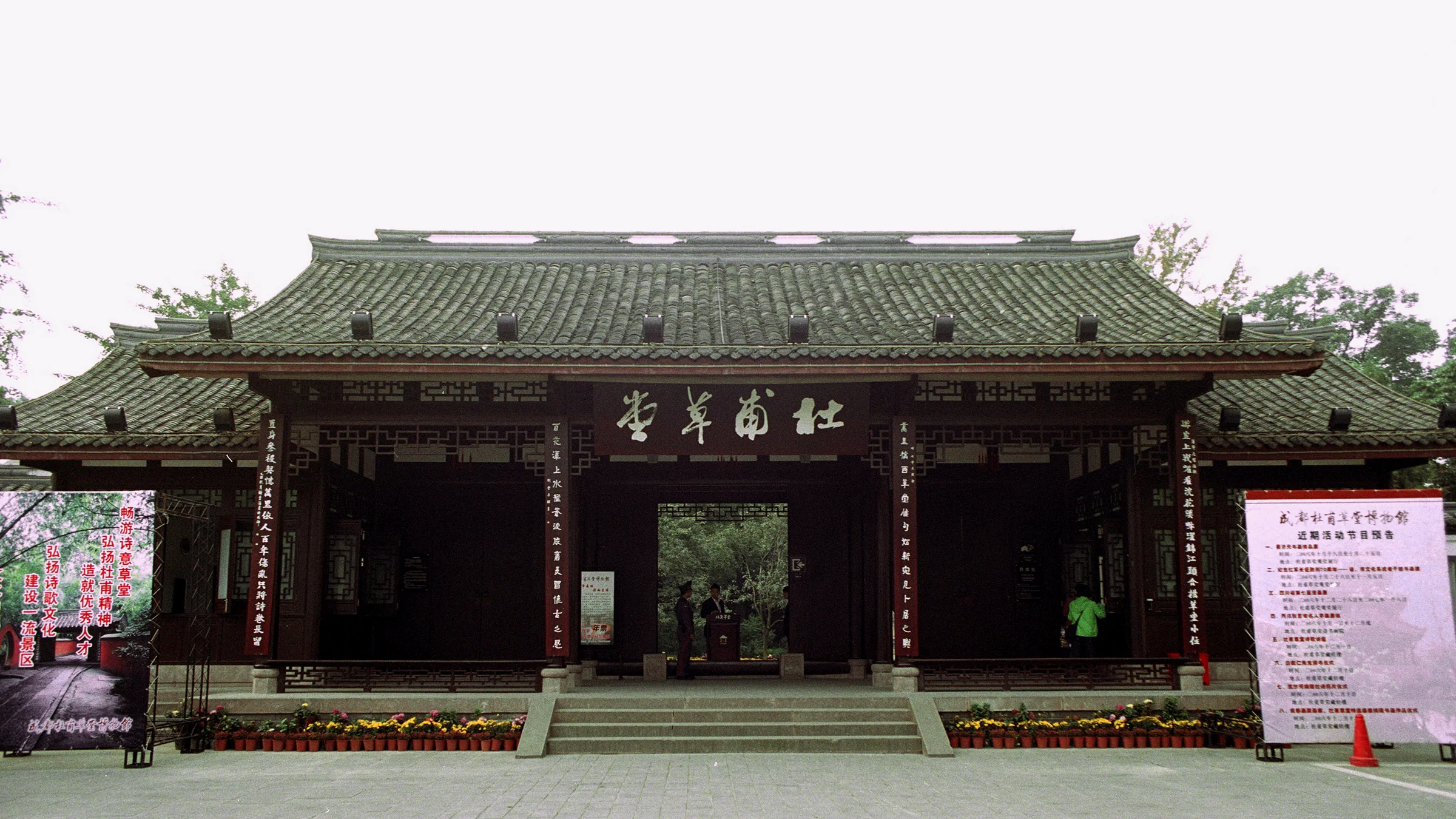
The strongest single image at the site and the one to open a piece with. The four-character plaque above the doorway is the site's own name, so the building identifies itself. Shoot it square-on and early, before the light hardens and the queue forms at the central bay.
-
The red-walled flower path · Late afternoon, or in blossom
A long red wall with seasonal planting against it, the classic composition in this garden tradition and the reason most visitors bring a camera. The wall is best raked by low sun; at midday it flattens into a plain red field.
-
The reconstructed cottage · Whenever it is not crowded
The hut reconstruction itself, a modest thatched structure divided into study, bedroom and kitchen. It is smaller than visitors expect, which is part of the point — photograph it from a low angle to keep the thatch against the sky rather than losing it against the hall behind.
Where to eat nearby
-
Leshan Xianzhiwei Bo Bo Ji, Caotang North Road branch (乐山鲜知味钵钵鸡·草堂北路店) — No. 16 Caotang North Road
Leshan-style bobo chicken (钵钵鸡): cold pieces of skewered chicken and offal in either red chilli oil (红油) or green Sichuan pepper (藤椒). Baidu Baike records the flavours it runs and the sides it serves — boneless chicken feet, chicken soup poured over rice, and iced brown-sugar jelly. · About ¥40/person, REPORTED BUT NOT CONFIRMED. Two 2023 listings (NetEase and Sohu, both reproducing the same roundup) give 人均价格 约¥40. We could not confirm that figure against a source we are willing to cite in full, so treat it as indicative rather than a quote. · No. 16 Caotang North Road (草堂北路16号附17号), Qingyang District, beside Metro Line 4's Caotang North Road station. Trip.com files this branch under 杜甫草堂 / Sichuan Provincial People's Hospital and Dianping files it under 杜甫草堂, so both place it in the cottage's own neighbourhood. We did not obtain a street-level coordinate for it, so we are not quoting a walking time.
-
Jing Ze Ya Chu, Caotang branch (晶泽雅厨·鱼鲜川菜·草堂店)
Modern Sichuan private-kitchen cooking focused on river and freshwater fish (鱼鲜). The listings describe the premise as good ingredients and good flavour, and as new-style Sichuan (新川菜) rather than a reproduction of old recipes. · ⚠ NOT PUBLISHED. Neither listing we retrieved carries a per-person figure, and we could not find one elsewhere. · ⚠ PROXIMITY IS THE SOURCES' OWN WORDING, NOT A MEASUREMENT. Both the NetEase and Sohu roundups describe this restaurant explicitly as near Du Fu Thatched Cottage (杜甫草堂附近), but neither gives a street address and we did not obtain a coordinate, so we are not quoting a distance.
Frequently asked questions
How much does the Du Fu Thatched Cottage cost?
¥50 for a full ticket, which is what our own seed data said and what the museum's published ticket notice confirms. Half price is ¥25 for full-time university undergraduate students and below, with valid ID and student card. There is also a ¥100 annual pass, but see the answer below — it is not for you. All of this comes from the museum's own notice, not a travel site.
What are the opening hours?
09:00 to 18:00, with ticket sales stopping at 17:00. During Spring Festival, Labour Day, the summer period and National Day the museum extends this to 08:30-18:30 with ticket sales stopping at 17:30, and says the exact dates are announced separately. Those are the museum's own published figures.
Is the Du Fu Thatched Cottage closed on any day?
The museum publishes hours but does not state a weekly closing day anywhere we could find, so we are not going to tell you it is open every day as though that were verified. In practice it behaves as a daily site, but if you are building an itinerary that turns on a single day, telephone 028-87345202 and ask.
Can I buy the ¥100 annual pass as a foreigner?
No. The museum's ticket notice says the annual pass is processed against your original national identity card and that you must present that card on every entry, one card per person, with no entry without it. Foreign visitors do not hold a Chinese national identity card, so the pass is not available to you. For a single trip the ¥50 day ticket is the only realistic option.
Is the thatched cottage Du Fu actually lived in?
No, and the museum does not pretend otherwise. Du Fu built a thatched hut here in 759 and lived in it for four years, but that structure is destroyed. What stands is a reconstruction, and the surrounding buildings are largely Ming-period work from the early 16th century, extensively renovated in 1811. It is a memorial site built around an absence, which is a large part of why it moves people.
Is there English signage or an English guide?
We could not verify this from a citable source and are not going to guess. The museum maintains a separate English-language website, which establishes that an English version exists but says nothing about what is posted on the ground. Bring a translation app for the poetry and the inscriptions, and do not rely on the interpretation being available in English.
How do I get there from central Chengdu?
Taxi or Didi to 青华路37号 is the straightforward option — have the address written in Chinese for the driver, as most Chengdu drivers do not speak English. The Hi Panda scenic shuttle bus also lists the cottage among the Chengdu attractions it serves, running from hubs around Kuanzhai Alley and the Wuhou Temple, and you can generally pay the driver in cash. We could not verify a metro station for the front gate from a citable source, so we are not naming one.
How long should I allow?
One to two hours. The park is 24 acres but the museum itself is compact — three areas worth your attention, the Gongbu Shrine, the reconstructed cottage and the Hall of Great Poets. Most visitors give the gardens more time than the halls, and that is the right way round for this place.
Sources
- 成都杜甫草堂博物馆购票须知 (Ticket Purchase Notice), Chengdu Du Fu Thatched Cottage Museum — the museum's own visitor notice, which is the source for every price and hour on this page: opening and closing 9:00-18:00 with ticket sales stopping at 17:00; extended holiday hours 8:30-18:30 with sales stopping 17:30; full ticket ¥50, half ¥25, annual pass ¥100 per person per year under Chengdu DRC price letter 〔2018〕355; student half-price terms; 10% group discount via webpc.cddfct.cn; free entry rules for minors and the one-adult-to-three-children limit; the requirement that the annual pass be held against an original national identity card; and the enquiry telephone numbers · cddfct.com
- 成都杜甫草堂博物馆 official site — the address, No. 37 Qinghua Road, Qingyang District, Chengdu (成都市青羊区青华路37号); the enquiry, ticket and emergency numbers; and the link to the museum's separate English-language site · cddfct.com
- Du Fu Thatched Cottage — English Wikipedia — a 24-acre park and museum in honour of the Tang poet Du Fu on the western outskirts of Chengdu beside the Flower Rinsing Creek; made a National Heritage site in 1961; Du Fu moved to Chengdu in 759 and lived in a thatched hut there for four years, writing 240 poems in that period; the original hut is destroyed, the key buildings date from the early 16th century and were extensively renovated in 1811; and the three constituent areas, being the Gongbu Shrine, the reconstructed cottage and the Hall of Great Poets with its 16 by 4 metre mural · Wikipedia
- Chengdu — English Wikivoyage — the Hi Panda scenic shuttle bus (成都景区直通车) serving Du Fu's Thatched Cottage among the Chengdu attractions on its route, fares from ¥2 up to ¥68, the option of combo bus-plus-entry tickets, and the note that its WeChat miniapp does not accept foreign phone numbers while cash can usually be paid to the driver; also Chengdu taxi flagfall and the standing advice that drivers do not speak English · Wikivoyage
- Du Fu cao tang.jpg — Wikimedia Commons (CC BY-SA 3.0, author 唐戈 / Tang Ge, photographed autumn 2006) — the main gate used as this page's hero image, opened and visually verified on 2026-10-16 · Wikimedia Commons
- Q4390891 — Wikidata — the coordinate record behind the published latitude and longitude for this page, matching the coordinate carried in this repository's own attraction-coords table · Wikidata