
Jiuzhaigou Valley
九寨沟 · Jiǔzhàigōu
Quick answer
Foreign passport required. The official jiuzhai.gov.cn booking system is in Chinese and requires a Chinese ID; foreigners must book via Trip.com, Klook, or the Jiuzhaigou ticket office at the gate. The mandatory sightseeing bus (¥90) is the only way to traverse the park; no private cars.
Why visit
- 1 UNESCO World Heritage since 1992 — the world's most spectacular collection of alpine lakes
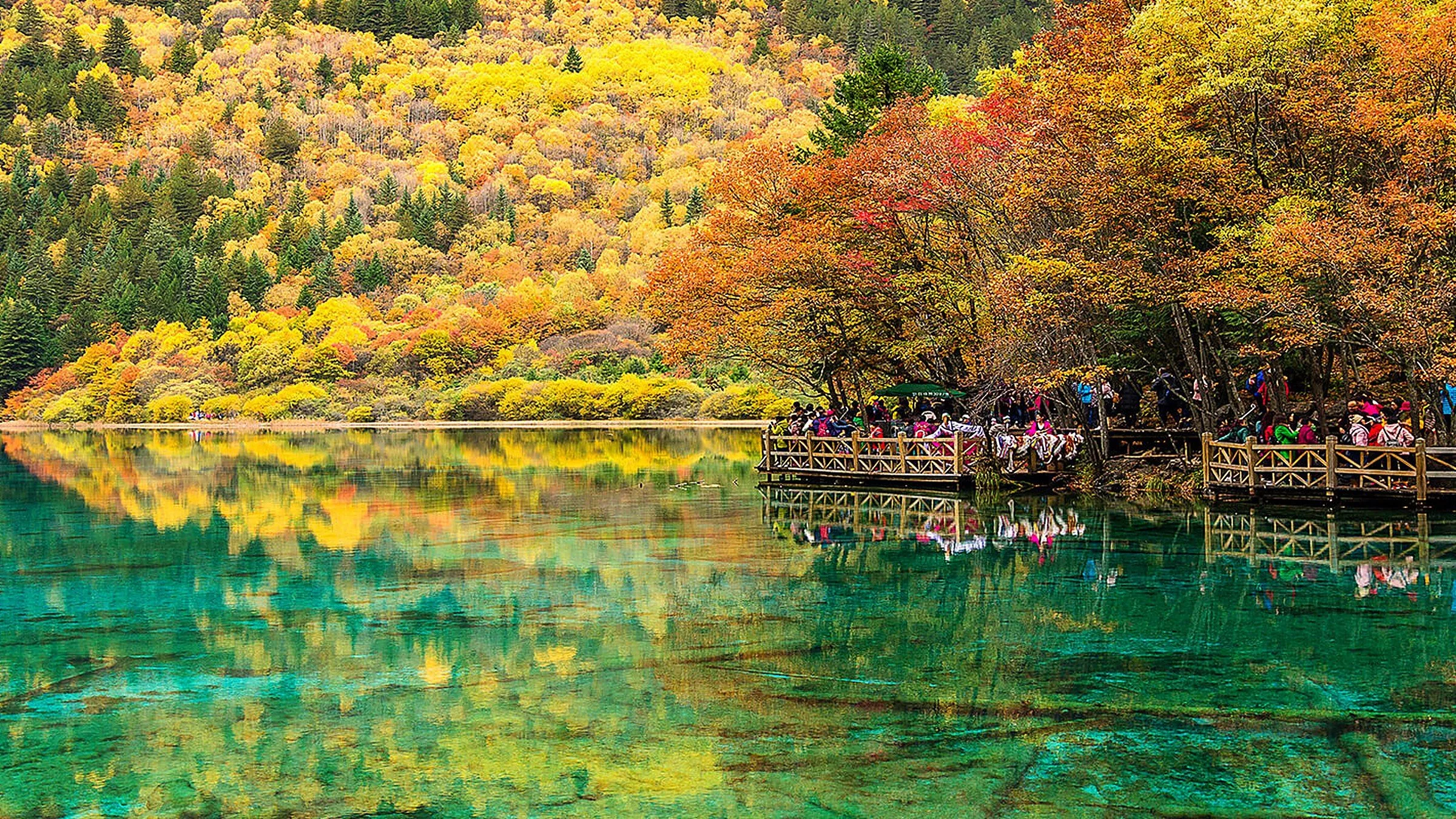
- 2 Five Color Lake (五花海) — turquoise, jade, and gold colors that change throughout the day
- 3 Nuorilang Waterfall (诺日朗瀑布) — 78 m wide, China's widest single-span travertine waterfall
- 4 Long Lake (长海) — 7.5 km long, the highest and largest lake in the park at 3,060 m
- 5 9 Tibetan villages in the Y-shape valley, with traditional Tibetan architecture and culture
- 6 Most dramatic autumn colors in China: golden leaves against turquoise water (Oct 15-Nov 5)
Essential tips for foreigners
- Book 2-3 days ahead via Trip.com for October 15-November 5 (autumn peak). The official jiuzhai.gov.cn is in Chinese and requires a Chinese ID; Trip.com is the foreigner-friendly option.
- Take the mandatory sightseeing bus (¥90) — private cars are not allowed inside the park. The bus stops at all main scenic spots; get off, walk, get back on.
- Wear layers — the park altitude ranges from 2,000-3,100 m. Even in summer, mornings and evenings are cool (10-15°C). Bring a light rain jacket.
- Bring water and snacks — the on-park restaurants are limited and expensive (¥60-100/person). The Tibetan villages near the entrance have small shops.
- Allow 2 full days — the Y-shape valley has 3 branches (Shuzheng, Rize, Zechawa), and each takes 4-6 hours to explore. Trying to do it in one day means missing half the park.
- Watch for altitude sickness — the highest lake (Long Lake) is at 3,060 m. If you're sensitive, take it easy the first day. Drink water, avoid alcohol the first day.
Suggested route
- 07:00 30 min Hotel breakfast, bus to Jiuzhaigou park entrance (from Jiuzhaigou town, 30 min)
- 07:30 30 min Arrive at park, buy ticket (¥220) + sightseeing bus (¥90), board the bus
- 08:00 4 hours Take the bus to the top of Rize Valley, walk down through the lakes (Arrow Bamboo Lake, Five Color Lake, Panda Lake, Pearl Shoal Waterfall)
- 12:00 1 hour Lunch at Nuorilang Waterfall restaurant (basic Chinese, ¥60-100/person)
- 13:00 2.5 hours Take the bus to Zechawa Valley — visit Long Lake and Five Color Pond
- 15:30 3 hours Take the bus back to Nuorilang, then walk down Shuzheng Valley (Shuzheng Lakes, Rhinoceros Lake, Tiger Lake, Sparkling Lake)
- 18:30 1 hour Take the bus back to the park entrance, return to hotel
- Day 2, 07:30 30 min Return to the park, board the bus to Rize Valley (most beautiful in early morning light)
- 08:00 3 hours Re-walk Five Color Lake in early morning light (different from Day 1's view)
- 11:00 1 hour Visit Mirror Lake (best at midday when the sun is overhead)
- 12:00 1 hour Lunch at a Tibetan village restaurant in Shuzheng Valley
- 13:00 2 hours Take the bus to Sparkling Lake, walk the wooden boardwalk loop
- 15:00 — Exit the park, take bus to Huanglong Scenic Area (2 hours, optional half-day)
A fairyland at the edge of the Tibetan plateau
Jiuzhaigou (九寨沟, “Nine Village Valley”) is a 720-sq-km national park in northern Sichuan, on the edge of the Tibetan plateau. The park is a Y-shaped valley of nine Tibetan villages; over 40 million years, mineral-rich water has built up calcium carbonate terraces and travertine dams that turn the lakes into a series of stepped, impossibly blue and turquoise pools. UNESCO World Heritage since 1992.
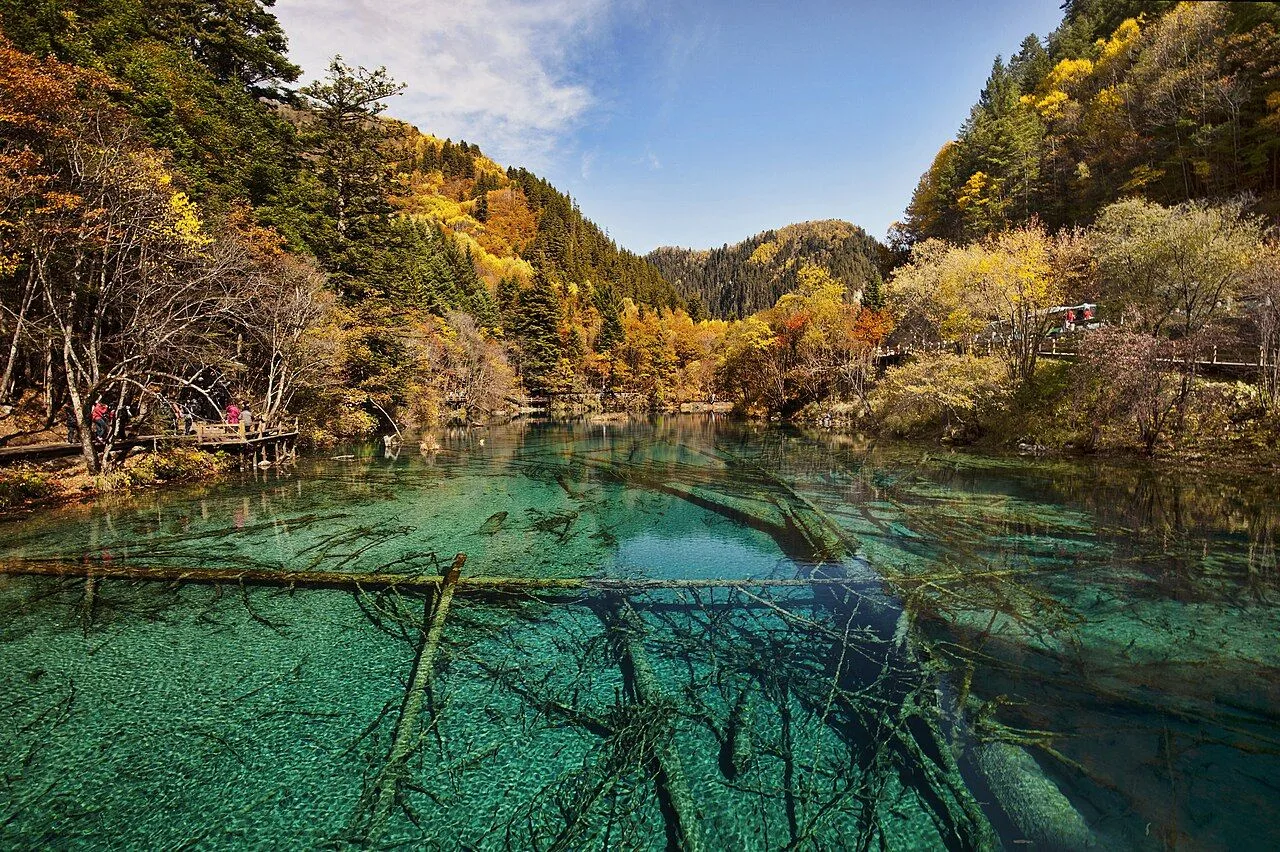
Photo: Wikimedia Commons / CC BY-SA. Source

The park is the world’s most spectacular collection of alpine lakes. The colors — turquoise, jade, gold, deep blue, emerald — come from dissolved minerals (calcium carbonate, travertine) and the depth of the water. The autumn colors (October 15 - November 5) are the most photogenic: golden leaves against turquoise water, in a way that no other place in the world matches.
The foreigner experience in 2026
Jiuzhaigou is set up for foreign visitors, but with one important caveat: the official booking system (jiuzhai.gov.cn) is in Chinese and requires a Chinese ID. Foreigners must book via Trip.com or Klook, or buy tickets at the gate. The mandatory sightseeing bus (¥90) is the only way to traverse the park; private cars are not allowed.
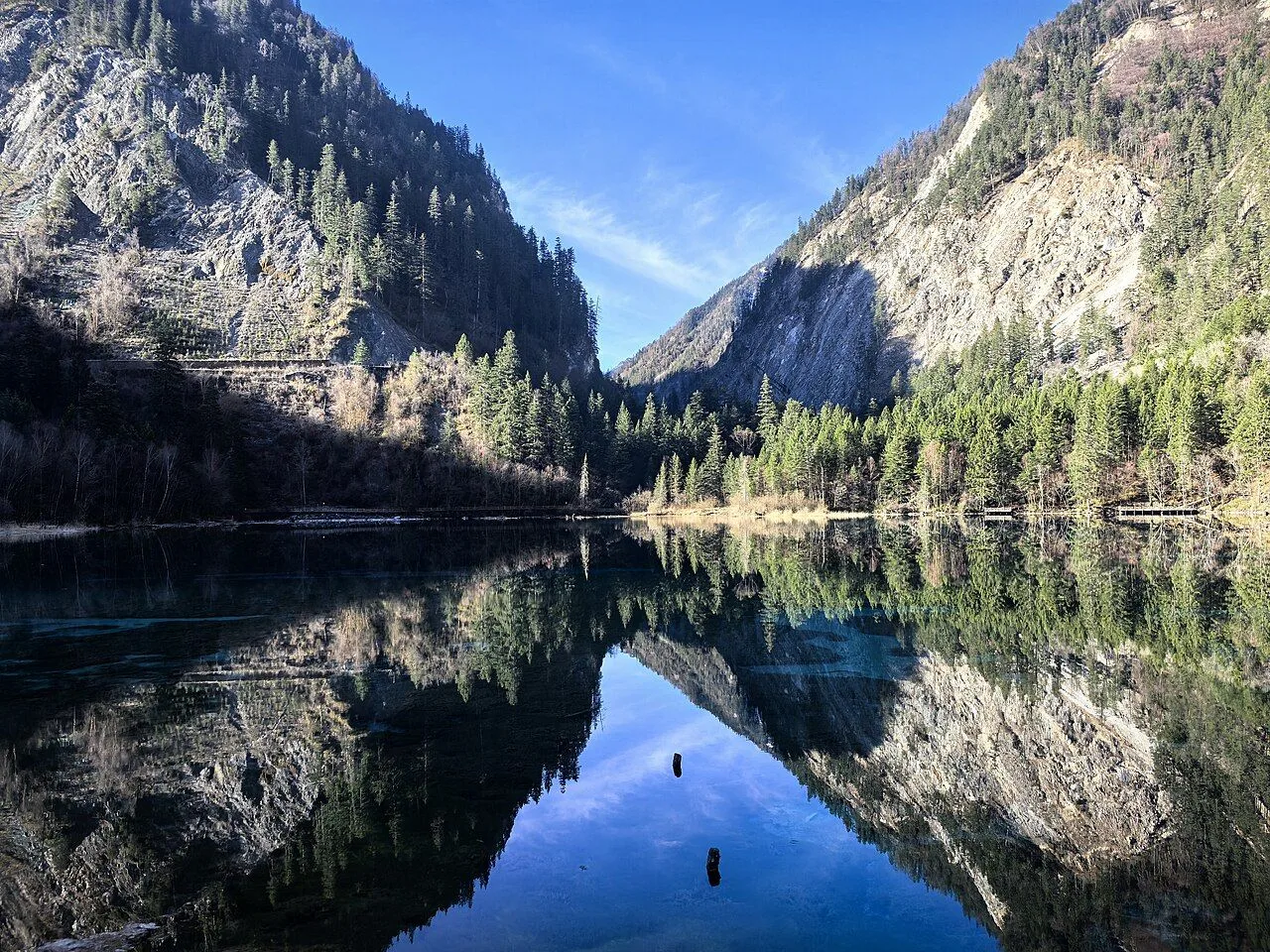
Photo: Wikimedia Commons / CC BY-SA. Source

For first-timers, the recommended approach: 2 full days. Day 1: take the bus to the top of Rize Valley, walk down through the lakes (Five Color Lake, Panda Lake, Pearl Shoal Waterfall), then visit Nuorilang Waterfall and Shuzheng Valley. Day 2: return to Rize Valley in the early morning light (different from Day 1), then visit Mirror Lake, Long Lake in Zechawa Valley, and Sparkling Lake.
What to actually see
Three things stand out. Five Color Lake (五花海) is the most iconic scene — the colors change throughout the day due to the mineral content and light. Best in early morning when the sun lights up the full composition. Nuorilang Waterfall (诺日朗瀑布) is the widest single-span travertine waterfall in China at 78 m wide, with multiple cascades. Long Lake (长海) is the largest and highest lake in the park at 7.5 km long, 3,060 m altitude — a mirror reflecting the surrounding snow-capped mountains.
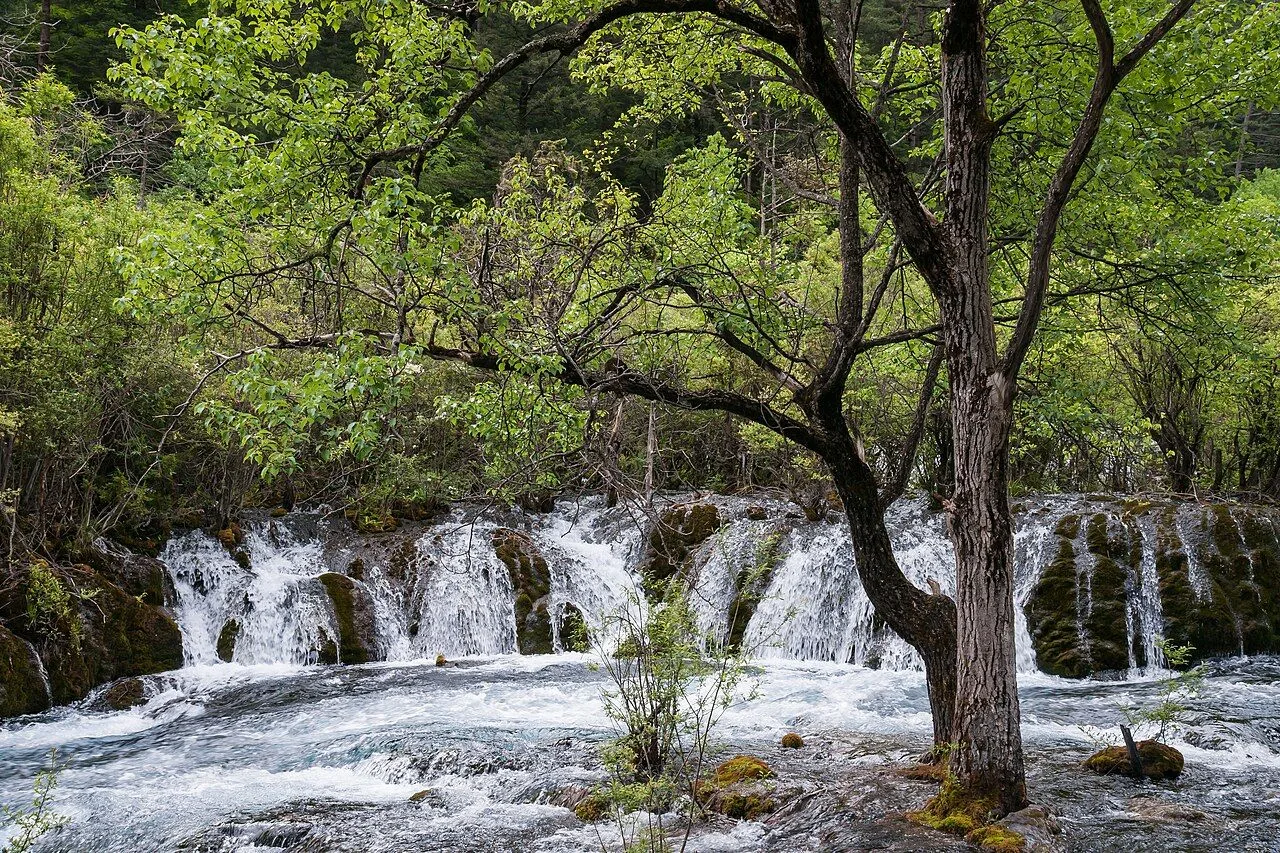
Photo: Wikimedia Commons / CC BY-SA. Source

The four seasons of Jiuzhaigou
The park is beautiful year-round but transforms dramatically. Spring (April-May) — high water flow from snowmelt, lakes at their deepest blue, fresh green leaves. Summer (June-August) — the rainy season, the lakes are at their fullest but cloudy weather is common; afternoon thunderstorms. Autumn (October 15-November 5) — the most photogenic season, with golden leaves against turquoise water; expect crowds and book ahead. Winter (December-February) — cold and snowy (-10°C at the highest lakes); the park is dramatically less crowded (sometimes under 1,000 visitors per day); some lakes freeze over creating a different but beautiful landscape.
Final tip
The biggest mistake first-timers make: trying to do it in one day. The Y-shape valley has 3 branches (Shuzheng, Rize, Zechawa), and trying to cram all 3 in one day means missing half the park. The second mistake: visiting in summer (June-August) thinking it’s the best time. Summer is the rainy season, with cloudy weather and afternoon thunderstorms. The third mistake: not bringing layers. The park altitude ranges from 2,000-3,100 m; even in summer, mornings and evenings are cool (10-15°C). Bring a light rain jacket.
Best photo spots
-
Five Color Lake (五花海) in early morning · 08:00-09:00 (morning, soft light)
The most iconic scene in Jiuzhaigou — turquoise and jade water with golden leaves. Use a wide-angle lens (16-35mm) at f/8 for the full composition.
-
Nuorilang Waterfall · 10:00-11:00 (mid-morning, side-lit)
The 78-m wide travertine waterfall, with multiple cascades. Use a telephoto lens (70-200mm) to compress the multiple cascades.
-
Long Lake (长海) at sunset · 17:00-18:00 (sunset)
The largest and highest lake — a 7.5-km long mirror reflecting the surrounding snow-capped mountains. Best at golden hour.
-
Mirror Lake (镜海) at midday · 11:00-13:00 (midday, no wind)
A perfectly still lake that mirrors the surrounding forest. Best at midday when the sun is directly overhead and there's no wind.
Where to eat nearby
-
Park restaurants (Nuorilang, Five Color Lake area)
Basic Chinese — noodles, rice, simple stir-fry. Prices 2-3x normal · ¥60-100/person · Inside the park at the main scenic spots
-
Tibetan village restaurants in Shuzheng Valley
Tibetan food — yak meat, butter tea, tsampa (roasted barley), momos (dumplings) · ¥50-80/person · Inside the park, walkable from the wooden boardwalks
-
Hotel restaurants (Jiuzhaigou town)
Chinese and Western, including local Tibetan cuisine · ¥80-150/person · 30-min drive from the park
-
Jiuzhaigou town local restaurants
Sichuan cuisine — spicy, heavy on chili and Sichuan peppercorn · ¥40-80/person · 30-min drive from the park
Frequently asked questions
Do I need a visa for Jiuzhaigou?
Jiuzhaigou Huanglong Airport (JZH) has direct flights from Chengdu (1 hour), Beijing, and Shanghai. 57 nationalities can transit visa-free for 240 hours at Chengdu airport; otherwise apply for an L-visa. The park entrance is at 2,000-3,100 m altitude — much higher than Beijing or Shanghai.
How long should I spend in Jiuzhaigou?
2 full days minimum. The park itself needs 2 days (Y-shape = 3 valleys, and walking distance is significant). Add a third day for Huanglong Scenic Area (a separate UNESCO park 2 hours away). Most visitors do Jiuzhaigou as a 3-4 day side trip from Chengdu.
Can I visit in winter?
Yes, but some high-altitude trails close for ice. Temperatures drop to -10°C at the highest lakes. The park is dramatically less crowded in winter — sometimes under 1,000 visitors per day vs. 30,000 in peak autumn. Some of the lakes freeze over, creating a different but beautiful landscape. Allow 3-4 hours for the bus from Jiuzhaigou Airport, which can be delayed by snow.
Do I need a guide?
Not strictly — the park has a mandatory sightseeing bus system (¥90) that stops at all major sights. But the park is huge and many of the most beautiful spots are short walks from the bus stops. A local Tibetan guide (¥300-500/day) explains the geology and the legends and finds the best photo spots.
Is altitude sickness a problem?
Possibly — the park entrance is at 2,000 m, and the highest lake (Long Lake) is at 3,100 m. Most visitors are fine, but if you're sensitive, take it easy the first day. Headache, dizziness, and shortness of breath are common symptoms. Drink water, avoid alcohol the first day, and consider Diamox (acetazolamide) from a pharmacy.