
Lashi Lake
拉市海 · Lāshìhǎi
Quick answer
No passport is needed to look at the wetland from the shore. Bring your passport if you are booking a boat or horse package through an agency, since operators and intermediaries commonly price and check ID on the package, and because it is the document that settles your identity if any part of the booking is ticketed.
Why visit
- 1 A Ramsar site since 12 July 2004 (reference 1437) and a provincial nature reserve, within a larger wetland system that also includes Wenhai lake and the Jizi Reservoir
- 2 More than 100,000 waterbird visits a year, with 76 species of geese and ducks recorded, and habitat for two critically endangered birds — the white-shouldered ibis and Baer's pochard
- 3 The wetland is the drinking-water source for Lijiang city, drained through a tunnel cut from the east shore — the reason the water level is now held artificially high
- 4 A lake of 5,330 ha at 2,437 m, formed as a fault basin and further dissolved by limestone karst, with a catchment of 265.6 km2
- 5 Access is commercially bundled: the small gate fee is sold together with boating and horse riding, and the honest visitor decision is about the package, not the ticket
Essential tips for foreigners
- Price the package, not the gate. The wetland gate fee is small; the boating and horse-ride activities it is bundled with are the real cost and are several times larger. Get the total, the route and the duration agreed in writing before you set off.
- The operators are not the reserve authority. Fishing, poaching and hunting are banned here, but the rides and boat trips are run commercially by local operators. That distinction matters if something goes wrong — know who you booked.
- Come in winter for the birds. Around 20,000–30,000 migratory waterbirds overwinter here and more than 100,000 bird visits are recorded annually. From April to October it is green and pleasant and much emptier of wildlife.
- Go at dawn. It attracts around 5,000 visitors a day, most of them on daytime activity packages. At first light the water is still and the flocks are undisturbed.
- Mean annual temperature is 11.8 °C, and the lake surface is at 2,437 m. Winters are genuinely cold — January averages 3.9 °C — and the wetland is exposed with no shelter. Dress for standing still in wind, not for walking.
- Do not expect mountains in the lake. The water is shallow, reed-fringed and largely open wetland. It is a bird and ecology destination rather than a scenic one, and the shoreline is farmland and Naxi village.
Suggested route
- 06:30 30 min Travel out from Lijiang Old Town — about 20-30 minutes by taxi, earlier if you want the light
- 07:00 1.5 hours Arrive at the park as the operators open; walk the shore before the daytime packages start moving
- 08:30 1 hour Birdwatching along the wetland edge, which is where the wintering flocks concentrate
- 09:30 2 hours If you booked one, meet your operator for the boat trip or the horse ride on the lakeside flats — agree the route before you mount up
- 11:30 1.5 hours Lunch at a lakeside village restaurant, then walk out through the surrounding farmland
- 13:00 45 min Return to Lijiang, or continue on to Shuhe or Baisha which sit on the same road to the north
A wetland that is also a water supply, sold as a horse ride
Lashi Lake is the destination where the commercial arrangement is most visible, and where being straight about it matters most. The honest summary is this: the wetland is a genuine and significant protected site, but almost nobody arrives here purely to look at it, because access is sold bundled with paid boating and horse riding. The gate fee is the smallest line on the bill.
Everything else about the place is real, and in the winter it is remarkable — this is a Ramsar wetland with more than a hundred thousand waterbird visits a year and habitat for two birds on the international critically endangered list.
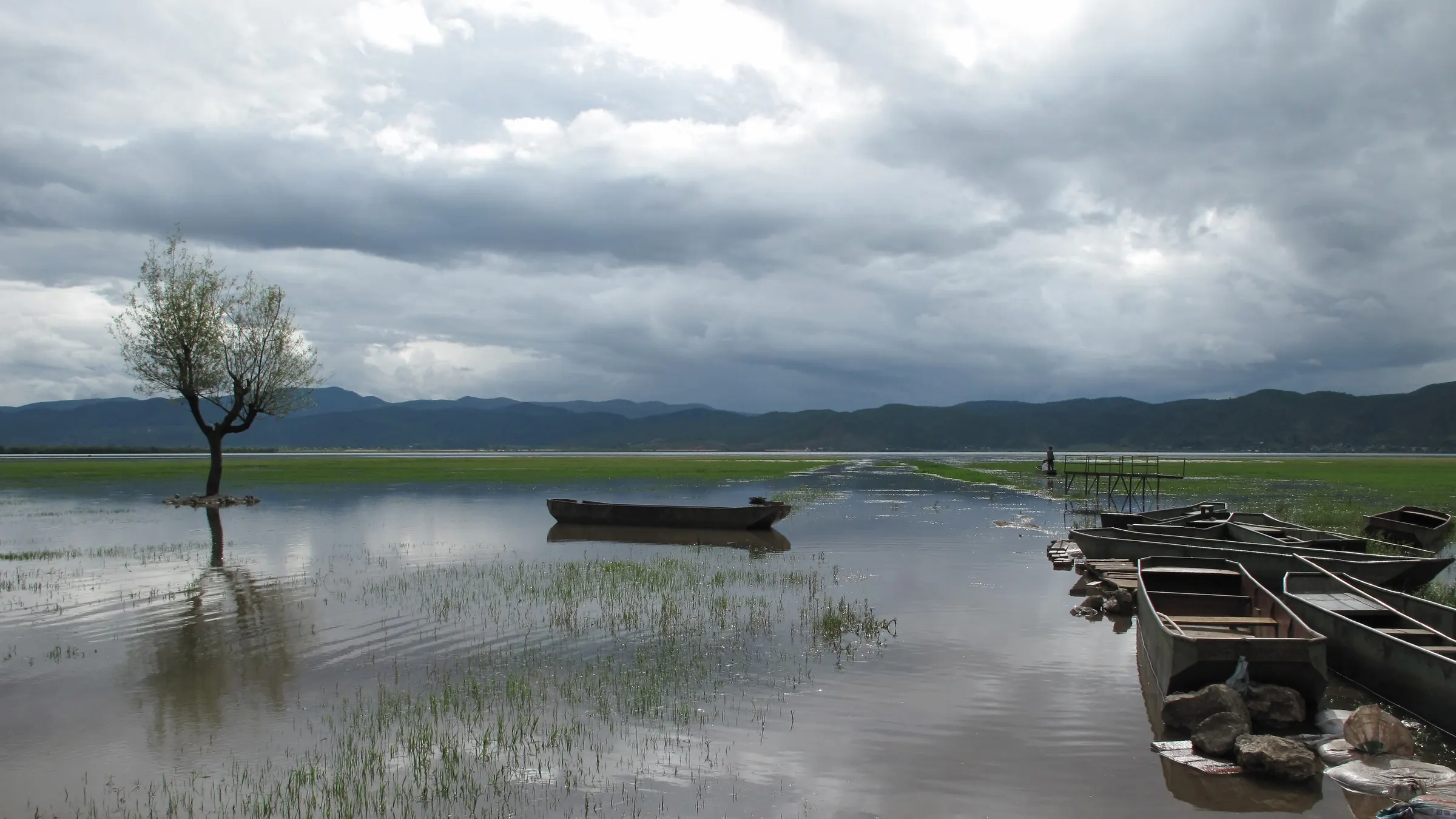
Photo: Wikimedia Commons / CC BY 2.0 (Mónica Xu). Source
Note the boats in that photograph, pulled up along the jetty with the wetland behind them. Those are the same craft the visitor boating trips use. The scene is not a stock image of somewhere else — it is the actual commercial face of this site.
What the ticket situation really is
Our destination seed carries ¥30 for wetland park entry. We were not able to re-confirm that against a live official source when writing this page, and rather than print a confident figure we will flag it as indicative. But the number is the least important thing here.
The gate fee buys entry to the park. It does not buy you a boat, a horse, a guide or a meal. Those are sold separately, by commercial operators rather than by the reserve management authority, and they cost several times more than the admission charge. When someone offers you Lashi Lake, what you are being offered is an activity package with the wetland attached — and the package price, not the gate fee, is what you are choosing between.
This distinction has a practical edge to it. The reserve is a protected site: fishing, poaching and hunting are banned within it. The rides and boat trips are a separate commercial layer running alongside. They are run by local operators, they are usually arranged through your hotel, an agency or a booking desk in town, and they are sold in timed sessions with varying routes and durations. So:
- Agree the total price in writing before you set off.
- Establish the route, the duration and what is included — lunch, tea, a guide, transport back.
- Know who you actually booked, because the operator is not the authority responsible for the wetland.
If you only want to walk the shore and look at birds, you do not need any of that, and the gate fee is genuinely all it costs.
What the reserve actually is
Lashi Lake is the core of the Lijiang Lashi Lake Plateau Wetland Provincial Nature Reserve, approved in June 1998. The reserve covers 6,523 hectares in total, of which the lake itself accounts for 5,330. It sits in the middle of the Lashi Basin, about 8 km west of Lijiang city, on the southeastern slope of Jade Dragon Snow Mountain.
Geologically it is a plateau intermontane lake formed in the Hengduan Mountains. The lake is a fault structure further shaped by limestone dissolution, with a catchment of 265.6 km² fed by the Qingshui River from the south and the Meiquan River from the north. Its surface sits at 2,437 m.
The English-language record describes the wider wetland system as sitting between 2,440 and 3,100 m and as including Wenhai lake to the north and the Jizi Reservoir to the south, draining into the Jinsha River. It is designated as a provincial nature reserve and as a Ramsar site — designated 12 July 2004, reference 1437 — with the protected area covering 35.6 km².
Two facts about it matter more than its scenery.
It is Lijiang’s drinking water. The wetlands supply the city’s water and provide flood control and water storage for the middle and lower Yangtze basin. That is the underlying reason the lake looks the way it does: water has been managed here deliberately, for the city’s benefit, since the 1980s.
It is a serious bird site. More than 100,000 waterbirds visit annually, using it as a stop-over, breeding ground or wintering habitat. Seventy-six species of geese and ducks have been recorded. It is habitat for the critically endangered white-shouldered ibis and for Baer’s pochard. The Chinese reserve inventory records 57 bird species with around 30,000 birds wintering each year, including the bar-headed goose and nationally protected species such as the scaly-sided merganser, the black-necked crane and the black crane. There are also seven fish species and 47 aquatic plant species.
The dam, and why the lake is not what it was
This is the most interesting thing about Lashi Lake and almost never mentioned in visitor material.
Lashi was a seasonal lake. Water drained out through a cave at the outlet, and in the dry season the level dropped sharply or the lake effectively dried. From the 1980s, water conservancy works were carried out: a dam was built ahead of the drainage cave, and water that could no longer leave freely was instead carried through a tunnel bored from Huangshanshao on the eastern shore, delivering it to Lijiang city.
The result is the mirror-like plateau lake that visitors now photograph — a permanent water body holding a stable level, reflecting the ridge opposite. And it is also a source of criticism: Chinese sources record that the construction of the dam, and the way it has been managed since, have been blamed for a degree of environmental problem at the site.
So when you look at the still water that makes the place photogenic, you are looking at an engineered condition that exists because a city needed drinking water. Both things are true.
Life around it
The reserve is inhabited. Eleven ethnic groups live in the area, with the Naxi at 94.8% of the population, at a density of about 54 people per square kilometre. The land around the basin is farmed — maize, wheat, rice, broad beans, potatoes, vegetables and oil crops — with livestock raising the dominant rural activity.
That is worth knowing before you go, because it explains what you will see. The shoreline of Lashi Lake is not a wilderness boundary. It is wetland threaded between working fields and Naxi villages, which is also why the basin has been a productive agricultural area for generations.
When to go, and what to wear
If you want birds, the answer is winter: November to March, when the migratory flocks arrive to overwinter. Through spring and summer it is green and pleasant and there are far fewer birds to see. Late autumn and early spring are a reasonable compromise if you want light without the full flock.
The climate is cool for the latitude, because this is a plateau basin. The reserve sits in a low-latitude highland climate with a mean annual temperature of 11.8 °C. July averages 18 °C; January averages 3.9 °C. Rain falls mainly between June and September, at 800–1,000 mm a year, against roughly 1,200 mm of evaporation — which is part of why the landscape around the lake looks as dry as it does in the dry season.
It is exposed. There is very little shelter on the wetland margin, so dress for standing still in wind for an hour rather than for walking, and bring a windproof layer even in the mild months.
Timing: the site takes around 5,000 visitors a day, mostly on daytime activity packages. At first light the water is flat and the birds are undisturbed, which is why an early start is worth the trip out from town.
Getting there
It is a straightforward 20 to 30 minute drive from Lijiang Old Town for the 8 km, by taxi or Didi. Operators will often collect you from your hotel if you have booked a package. Road access to the park perimeter is easy, though much of the surrounding ground is farmland and village.
The same road continues north to Shuhe and Baisha, so Lashi combines naturally with the smaller heritage settlements on the way rather than competing with them for time.
Final tip
If you are being offered a horse ride here, treat it as a horse ride with a wetland attached — not as a wetland ticket with a ride thrown in. That framing is the difference between choosing between two operators on route and duration, and feeling, afterwards, that you paid a gate fee to be walked past some reeds. Decide which of those two things you actually want before you get in the car.
Best photo spots
-
The lakeside jetty and moored boats · Dawn, or late afternoon when the light comes low across the water
The flat-bottomed wooden boats pulled up along the jetty are the visual signature of the lake, and the reed fringe behind them gives the frame its scale. Early light flattens the water into a mirror.
-
The wetland shallows with emergent aquatic plants · Any time in winter; best under low cloud
The shallow margin with aquatic growth breaking the surface. This is the habitat the whole reserve exists to protect, and it is where the waders feed.
-
The forested ridge on the far shore · Late afternoon
The dark wooded hills beyond the lake give the only real vertical in an otherwise entirely horizontal landscape, and they are what makes the wide shots work.
Frequently asked questions
How much does Lashi Lake cost?
Our destination seed carries ¥30 for wetland park entry, and we were not able to re-confirm it against a live official source, so treat it as indicative. It is also the least informative number on this page. Access to Lashi Lake is sold bundled with activities — chiefly boating on the lake and horse riding on the lakeside flats — and those packages cost considerably more than the gate fee. What you actually pay is the package, and it varies by operator, route and duration. Agree the total in writing before you go.
Is the gate fee enough to visit Lashi Lake?
It buys entry to the wetland park. It does not buy you a boat, a horse, a guide or a meal, and it does not buy the Tea Horse Road experience that most visitors are sold here. If you only want to walk the shore and look at the birds, the gate is enough. If you have been offered a ride or a boat trip, that is a separate purchase and the larger part of the bill.
Is Lashi Lake worth visiting?
For birdwatching and ecology, emphatically — it is a Ramsar site with more than 100,000 waterbird visits a year, 76 recorded species of geese and ducks, and habitat for the critically endangered white-shouldered ibis and Baer's pochard. For scenery, less so. It is a broad, shallow, reed-fringed wetland surrounded by farmland and Naxi village rather than a mountain lake, and if you came to Lijiang for peaks you will be more satisfied with the Old Town and Black Dragon Pool.
Why is the water level so constant? It used to be a seasonal lake.
Because it was dammed. Water used to drain through a cave at the outlet, and in the dry season the lake fell or dried. Since the 1980s a dam was built ahead of that outlet, and water is now carried through a tunnel from Huangshanshao on the east shore to supply Lijiang city. That turned a seasonal lake into a permanently held plateau lake, which is what visitors see today. Chinese sources note that the dam, and the way it has been managed since, have been blamed for a degree of environmental problem at the site.
What can I actually see on a visit?
Shallow water with emergent aquatic plants, reed and marsh fringe, and a shoreline that is largely farmland and village. In winter, large numbers of migratory geese, ducks and cranes. The reserve records 57 bird species with around 30,000 wintering birds, including protected species such as the bar-headed goose, the scaly-sided merganser, the black-necked crane and the black crane. It also has seven fish species and 47 aquatic plant species. Around 5,000 people come here daily, mostly for birdwatching.
How long should I spend at Lashi Lake?
Half a day. The wetland itself is roughly a two-hour walk if you are serious about the birds. What fills the morning is the bundled activity — a boat trip or a horse ride on the lakeside flats — and those are sold in timed sessions. If you only have two hours, come at dawn, walk the shore and skip the package entirely.
Can I get to Lashi Lake with a foreign passport?
Nothing is ID-checked simply to walk into the wetland park. Bring your passport anyway if you are booking a boat or horse package, because operators and the agencies selling them commonly price and check ID on the package, and the passport is the document that settles your identity.
What are the weather conditions like?
Cool for the latitude, because you are on a plateau at altitude. The reserve sits in a low-latitude highland climate with a mean annual temperature of 11.8 °C — July averages 18 °C, January 3.9 °C. Rain falls mainly between June and September, at 800–1,000 mm a year, against roughly 1,200 mm of evaporation. The site is exposed and there is little shelter, so bring a windproof layer.
Sources
- Lashihai Wetland — English Wikipedia (Ramsar site designated 12 July 2004, reference 1437; provincial nature reserve of 35.6 km2; 100,000+ waterbird visits a year; 76 species of geese and ducks; habitat for the critically endangered white-shouldered ibis and Baer's pochard; fishing, poaching and hunting banned; around 5,000 visitors daily, mainly for birdwatching; part of a wetland system including Wenhai lake and Jizi Reservoir draining to the Jinsha River; conservation via a Conservation International China payment-for-ecosystem-services pilot; coordinates 26°53'N 100°08'E) · Wikipedia
- 拉市海 — Chinese Wikipedia (also 拉什海, a Naxi transliteration whose original sense is 'tiger lake'; core of the Lijiang Lashi Lake Plateau Wetland Provincial Nature Reserve approved June 1998 covering 6,523 ha of which the lake is 5,330 ha; lake surface at 2,437 m; fault lake further shaped by limestone dissolution; inflowing Qingshui and Meiquan rivers over a 265.6 km2 catchment; dammed in the 1980s ahead of the 落水洞 outlet and tunnelled from 黄山哨 to supply Lijiang, turning a seasonal lake into a permanent one and attracting later environmental criticism; 57 bird species with around 30,000 wintering birds; mean annual temperature 11.8 °C; 11 ethnic groups with Naxi at 94.8%) · Wikipedia
- Lashi sea — Wikidata Q11076932 (lake in the People's Republic of China; coordinate 26.87917 / 100.13333) · Wikidata