Mu Mansion
木府 · Mùfǔ
Quick answer
Carry your passport. Mu Mansion is inside a ticketed heritage zone within a settlement that levies the Old Town maintenance fee, and ID is what establishes your visitor category for any reduced rate. There is no separate foreigner ticket tier — you buy the same ticket as everyone else.
Why visit
- 1 A full reconstruction of the Naxi rulers' palace, completed on 2 February 1999 after the 1996 Lijiang earthquake, funded with roughly ¥58.6m including a ¥33.6m World Bank loan
- 2 The 1382 founding is the origin of the entire 'Mu' identity of Lijiang — the Ming granted the local ruler the surname Mu and a hereditary prefectship, and the town rebuilt its name around it
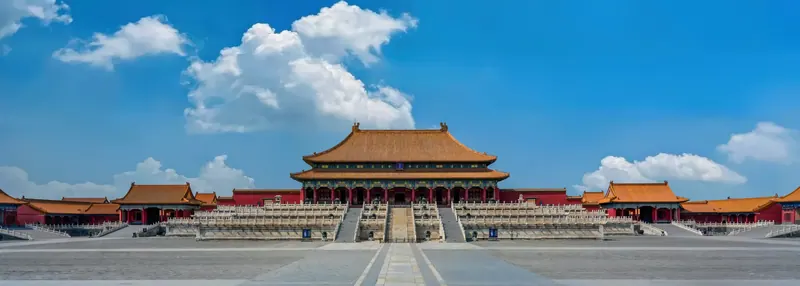
- 3 A 369 m ceremonial central axis of named halls and towers, in a precinct of 46 mu at the foot of Lion Hill inside the Old Town
- 4 Xu Xiake stood here in 1639 and wrote that its palaces were comparable to a king's — the single most cited line in any account of the site
- 5 Burnt in 1860 and damaged again in the Cultural Revolution, so what you see is largely 1990s work standing on a Ming-dynasty plan
Essential tips for foreigners
- Budget for two charges, not one. The mansion ticket is separate from the ¥50 Lijiang Old Town maintenance fee, because the mansion stands inside the area that fee covers. Tour groups usually have the maintenance fee collected for them and folded into the tour price.
- Walk the central axis in order. Screen Wall, Jinshui Bridge, the Zhongyi archway, Ceremonial Gate, the Council Hall, Wanjuan Tower, the Rear Hall, Guangbi Tower, Yuyin Tower and Sanqing Hall. The sequence is the argument the site is making; skipping to the pretty tower at the back loses it.
- The Wanjuan Tower library is the reason to linger — a thousand volumes of Dongba scripture alongside a hundred volumes of the Buddhist canon, which is a rare physical record of a culture that wrote in pictures.
- Do not expect an untouched Ming building. Most of what you are walking through was rebuilt after 1996 under a World Bank-financed programme. Go for the architecture and the story, not for original fabric.
- Combine it with the Old Town rather than dedicating a morning. One to two hours is the honest figure, and it is best spent walking north from the main squares toward Lion Hill.
- Confirm opening hours on the day. We could not verify a current published schedule from an official source, and it is a museum operating inside a larger visitor complex.
Suggested route
- 08:30 45 min Enter the Old Town at the south gate before the coach groups, and walk north through the main lanes toward Lion Hill
- 09:15 20 min Arrive at Mu Mansion and buy the ticket; start at the Screen Wall (照壁), which is where the axis begins
- 09:35 25 min Cross Jinshui Bridge to the Zhongyi stone archway (忠义坊) and through the Ceremonial Gate (仪门) — the ceremonial approach is the point of the site
- 10:00 40 min The Council Hall (议事厅), where the tusi held council, and then Wanjuan Tower (万卷楼), the library holding a thousand volumes of Dongba scripture
- 10:40 30 min The Rear Hall (护法殿), Guangbi Tower (光碧楼) and Yuyin Tower (玉音楼), where imperial edicts were received
- 11:10 20 min Finish at Sanqing Hall (三清殿), the Daoist hall reflecting the Mu family's religious orientation
- 11:30 1 hour Back out into the Old Town for lunch; the mansion precinct has no food of its own
A palace that was destroyed three times and rebuilt in 1999
Mu Mansion is the most misunderstood building in Lijiang. Visitors arrive expecting a Ming-dynasty palace and find a 1990s reconstruction — and then, quite reasonably, feel short-changed. The honest thing to say up front is that this is a twenty-five-year-old building on a four-hundred-year-old plan, and that it is still worth an hour and a half.
It is also the reason the whole town has the name it has. The Mu ruling house took its surname from a single act of Ming imperial policy: in 1382, the head of Tong’an Prefecture submitted to the Ming court and was granted the surname Mu together with a hereditary prefectship over Lijiang. Everything downstream — the palace, the ruling line, and eventually the identity of Lijiang Old Town itself — descends from that one administrative decision.
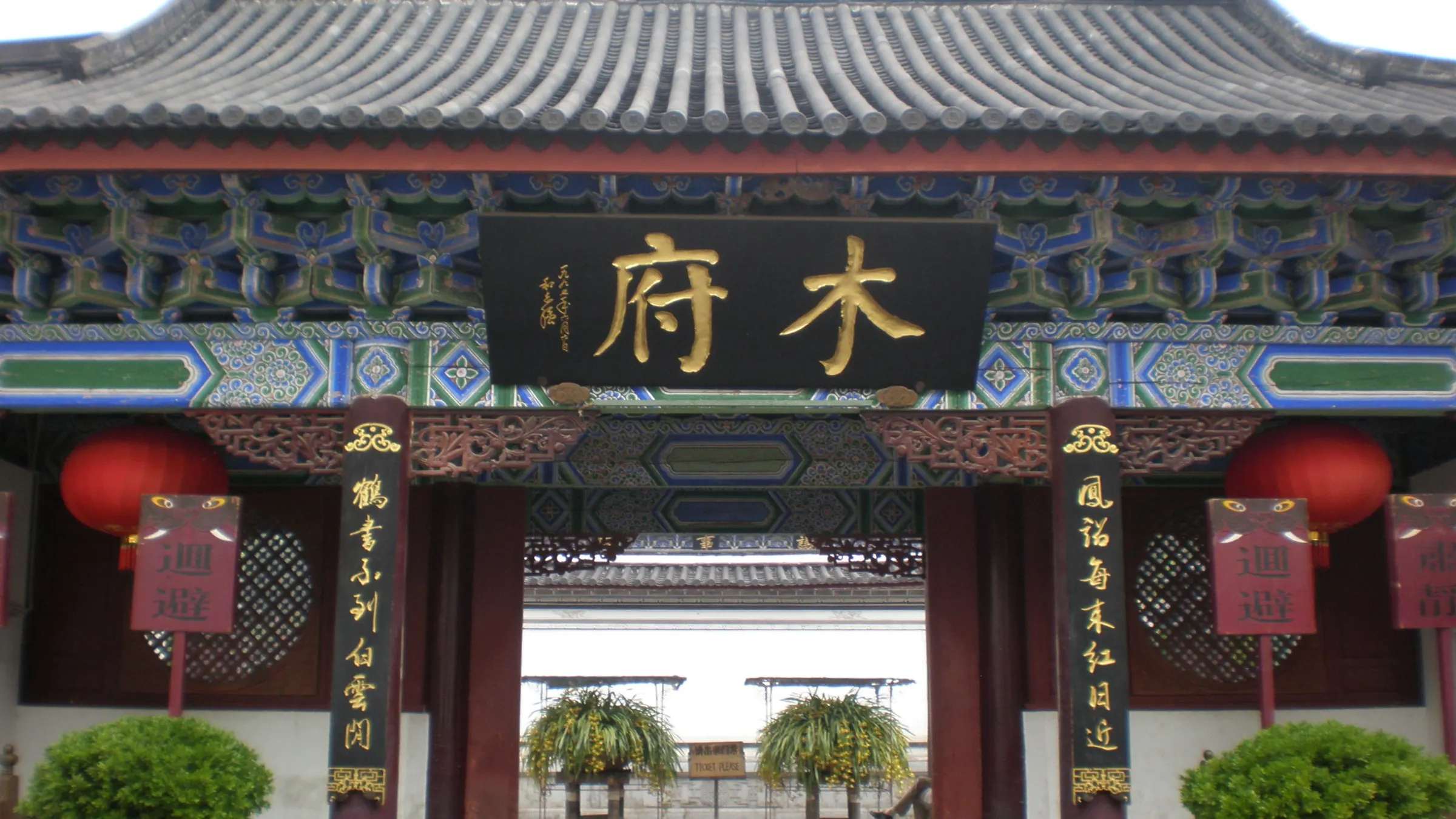
Photo: Wikimedia Commons / CC BY-SA 3.0 (BrokenSphere). Source
Note that sign visible through the gate in that photograph. The mansion sits inside the Old Town, and the Old Town has its own admission charge, so the practical consequence is that you are buying two tickets for one building. More on that below, because it is the thing most likely to surprise you at the till.
Three destructions
The site’s history is a cycle of building and loss, and skipping it makes the reconstruction make no sense.
The palace was first built in 1382, and the Mu rulers added to it through the Wanli reign — the Zhongyi archway, Yuyin Tower and Shouxing Tower date from that period. They built it deliberately in the symmetrical, solemn style of the Han central court. Chinese accounts habitually compare the result to a scaled-down Forbidden City, and while that is flattering, the ambition of it is not.
In 1639 the traveller Xu Xiake reached Lijiang and stood here. His diary records that the palaces of the Mu ruler were comparable to those of a king — 宫室之丽,拟于王者. That line has been quoted about this building ever since, and it is worth remembering as you walk the axis, because the axis was built to produce exactly that impression.
Then the losses came. In 1647 the remnants of Liu Wenxiu’s forces reached Lijiang and carried off the mansion’s valuables and its imperial decrees. In 1860, during the Muslim rebellion in Yunnan, Du Wenxiu took Lijiang and most of the complex burned. The Mu descendants rebuilt part of the residential section in the late Qing, but on a much smaller scale — three courtyards against the original ambition. The Cultural Revolution damaged what survived, including the Zhongyi stone archway.
And then the earthquake. In 1996 a major earthquake struck Lijiang, and the reconstruction that followed was funded with roughly ¥58.6 million, of which ¥33.6 million came as a World Bank loan. The work completed on 2 February 1999, and it included establishing the Lijiang Old Town Museum on the site. In 2012 the complex was designated among the second batch of protected cultural relic sites of Lijiang City. Most recently, on 19 March 2025, Xi Jinping visited.
The central axis
The precinct covers 46 mu and is organised around a 369-metre ceremonial axis. It is worth walking it in order, because the sequence is the argument.
You enter past the Screen Wall (照壁), the traditional buffer that blocks a direct view in, and cross Jinshui Bridge (金水桥). Then comes the Zhongyi archway (忠义坊), the carved stone gateway that marks the shift from public space to official precinct. The Ceremonial Gate (仪门) follows.
The Main Hall, better known as the Council Hall (正殿 / 议事厅), is where the tusi held council — the hall that has been used as a Song imperial palace in Chinese television drama, including a 2008 TVB production.
Beyond it sits Wanjuan Tower (万卷楼), and this is the room to slow down in. It is described as collecting the essence of two thousand years of cultural heritage, and in practice holds a thousand volumes of Dongba scripture, a hundred volumes of the Buddhist canon, the poetry collections of the six tusi, and works by known calligraphers and painters. A thousand volumes of Dongba is significant, because Dongba is a pictographic script — its practitioners, the Dongba, are the Naxi ritual specialists, and this is one of the few places on earth where that written tradition survives in bound form.
Then Rear Hall, also called Hufa Hall (后殿 / 护法殿), where domestic matters were handled; Guangbi Tower (光碧楼), the rear garden gatehouse, historically described as the finest building in western Yunnan; Yuyin Tower (玉音楼), where imperial edicts were received and where music and dance banquets were held; and finally Sanqing Hall (三清殿), the Daoist hall, which reflects the Mu family’s own religious orientation and is the one building here that is not imperial in idiom.
What the ticket does, and what it does not
This is the part worth reading before you go, because it is where visitors go wrong.
Mu Mansion has its own admission charge. Our destination seed carries ¥40 for it. We were not able to re-confirm that figure against a live official source when writing this page, and rather than print a confident number we would rather flag it — check the ticket office on the day, and treat ¥40 as indicative.
More important is what that ticket does not cover. Mu Mansion is inside Lijiang Old Town, and the Old Town levies its own maintenance fee (维护费, universally still called 古维费) on entry. That fee has a history worth knowing precisely, because the figure has changed and most writing online is out of date:
- Levied from 2001.
- Formalised at ¥80 per person by the 2007 Lijiang rules.
- Reduced to ¥50 in 2017.
- Under the Lijiang municipal measures published in July 2025, the fee stays at ¥50, but is explicitly scoped to the core area of the Lijiang Old Town scenic area, its validity is extended to 365 days, and eight categories of visitor are exempt. Travellers on organised tours have it collected by the agency, meaning it is normally already inside the tour price.
So the realistic day cost for an independent visitor who wants both the mansion and the Old Town is ¥40 plus ¥50, or ¥90, before spending anything else. The mansion ticket does not include the maintenance fee, and the maintenance fee does not include the mansion. They are separate charges for overlapping ground.
If you have already been quoted ¥80 as the “Old Town fee” by a hotel, a taxi driver or an older blog, that figure is out of date.
Opening hours, honestly
We could not verify a current published daily opening schedule for Mu Mansion from an official source. It operates as a museum precinct inside a larger visitor complex rather than as a standalone ticketed park, which means it follows the Old Town’s operating day in practice — but that is an inference, not a posted schedule, and we are not going to convert an inference into a printed time.
The same applies to last entry and to any closure calendar. It is a courtyard-and-hall museum inside an open settlement, so it is very unlikely to shut for weather, but confirm on the day rather than planning a tight itinerary around our guess.
Visiting it properly
An hour and a half is the right allocation. Walk the axis in order, give the Council Hall and Wanjuan Tower real time, and finish at Sanqing Hall. Then walk back out into the Old Town, because the mansion precinct has no food, no toilets you would want to linger in, and no reason to keep you once you have seen the axis.
Pair it with Black Dragon Pool early in the morning, and with Lion Hill later — the hill rises directly behind the mansion, and from the top you get the panorama back over the tiled roofs that is the view most people actually come to Lijiang for.
Final tip
Go early, and go in order. The mansion is a sequence rather than a collection, and the mistake almost everyone makes is to arrive at ten, spend forty minutes wandering, and never understand that the axial plan was the entire argument. Arrive at opening, walk the axis once in order without stopping, then go back and look properly.
Best photo spots
-
The Zhongyi Archway (忠义坊) · Mid-morning, when the light rakes across the carved stone
The stone archway on the central axis, between the screen wall and the ceremonial gate. It is the marker that separates the public approach from the official precinct.
-
The central axis from the Screen Wall · Late afternoon for raking side light, or early morning for symmetry
The 369 m axis reads best as a single receding line of roofs and courtyards. Photograph from low down near the screen wall to get the depth of it.
-
Wanjuan Tower (万卷楼) · Indoors, any time it is open
The library holding a thousand volumes of Dongba scripture, a hundred volumes of the Buddhist canon, the poetry collections of the six tusi and a collection of calligraphy and paintings. The most interesting single room in the site.
-
Lion Hill above the precinct · Late afternoon
The hill immediately behind Mu Mansion. Climbing it gives the standard panorama back over the grey-tiled roofs of the whole Old Town, which is the view most visitors to Lijiang actually come for.
Frequently asked questions
How much does Mu Mansion cost, and what does the ticket include?
The ticket covers entry to the mansion precinct and its central axis only. Our destination seed carries ¥40 for it, though we were not able to re-confirm that against a live official source, so treat it as indicative. The important point is what it excludes: the ¥50 Lijiang Old Town maintenance fee is a separate charge, because Mu Mansion stands inside the Old Town area that fee covers. A visitor buying both pays ¥90 without having bought anything beyond admission.
Do I also have to pay the Lijiang Old Town maintenance fee?
Yes, treat them as two charges. The maintenance fee (维护费) is levied on entering the Old Town, and under the Lijiang rules published in July 2025 it applies to the core area of the Old Town scenic area, costs ¥50 per person, is valid for 365 days and waives eight categories of visitor. It has moved before — ¥80 under the 2007 rules, cut to ¥50 in 2017 — so older pages and older blogs quoting ¥80 are out of date. If you arrived on a group tour, the fee was normally collected by the agency and is already in what you paid.
Is Mu Mansion an original Ming building?
No, and this is the single most important thing to know before you visit. The complex was largely destroyed in war in 1860, partly rebuilt on a small scale in the late Qing, damaged again during the Cultural Revolution, and then reconstructed comprehensively after the 1996 Lijiang earthquake, finishing on 2 February 1999. The rebuilding was funded with roughly ¥58.6m, of which ¥33.6m came from a World Bank loan. What you see is a 1990s reconstruction on a Ming-dynasty plan, and it is protected as such — designated in 2012 among the second batch of Lijiang City cultural relic protection sites.
How long should I allow for Mu Mansion?
One to two hours. The central axis alone runs 369 metres and the precinct covers 46 mu, so this is not a quick walk-through. Most visitors take about ninety minutes if they read the interpretation, less if they do not. If you are also doing the wider Old Town and Black Dragon Pool, an hour and a half at the mansion is the right allocation.
Why is it called Mu Mansion, and what does 'Mu' mean?
It is the seat of the tusi, the hereditary local ruler. The surname itself is a Ming invention: in 1382 the head of Tong'an Prefecture submitted to the Ming court, was granted the surname Mu and made a hereditary prefect, and the ruling house and the town took the name from there. It is also why Lijiang Old Town has no city walls — the local story goes that walling in a place ruled by a Mu would have turned the character into 困, meaning trapped, though that explanation is folklore rather than history.
Is there English signage at Mu Mansion?
Yes, and this is one of the better-equipped heritage sites in Lijiang for an English-reading visitor. Interpretation is available across the central axis, and English-speaking guides are readily available in the Old Town. The surrounding Old Town is a different matter, where English signage becomes patchy off the main lanes.
What did Xu Xiake think of it?
He visited in 1639, at the end of the Ming, and his travel diary records that the Mu ruler's palace had palaces comparable to those of a king — 宫室之丽,拟于王者. That single line is the reason the site has the reputation it does, and it is worth knowing as you walk the axis, because the axis was designed to deliver exactly that impression.
Can I get in with a foreign passport?
There is no separate foreigner ticket tier — you buy the same ticket as every other visitor. Carry your passport anyway, because ID is what establishes your visitor category if you are claiming any reduced rate, and because the surrounding Old Town runs its own ID-checked fee.
Sources
- 木府 — Chinese Wikipedia (address at No. 49 Guanyuan Alley inside Lijiang Old Town below Lion Hill; founded 1382 under the Ming, granted the Mu surname and a hereditary prefectship; Xu Xiake's 1639 account; looted 1647 and burned 1860; partial Qing rebuild and Cultural Revolution damage; rebuilt with about ¥58.6m of funding including a ¥33.6m World Bank loan after the 1996 earthquake and completed 2 February 1999; 46 mu with a 369 m central axis; 2012 protected site; the sequence of halls and towers) · Wikipedia
- 丽江古城 — Chinese Wikipedia (maintenance fee 维护费 levied from 2001, ¥80 from 2007, cut to ¥50 in 2017, and the July 2025 Lijiang rules keeping ¥50 while scoping it to the core area of the Old Town scenic area with 365-day validity and eight exempt categories; Dayan named 大研 and the town's origins in the Ming-era awarding of the Mu surname) · Wikipedia
- Old Town of Lijiang — English Wikipedia (Dayan as the historical centre; the Naxi timber and mud-brick building tradition learned from Ming Han traders; the UNESCO inscription of Dayan, Baisha and Shuhe in 1997; the gallery caption identifying the Mu Mansion entrance as a feature of the Old Town) · Wikipedia
- Mu Mansion — Wikidata Q11092976 (coordinate 26.87267 / 100.23293) · Wikidata