
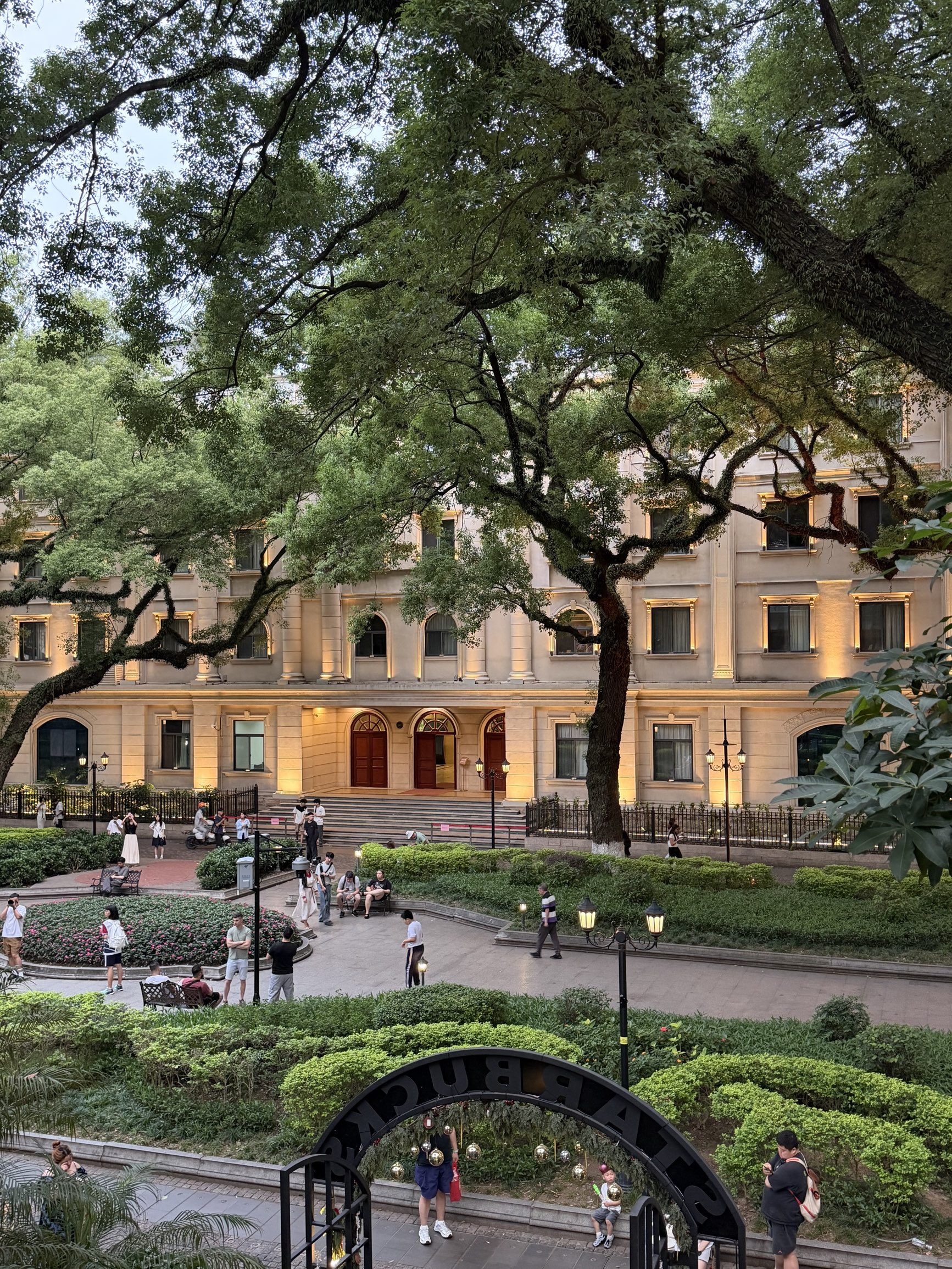
Shamian Island
沙面岛 · Shāmiàn Dǎo
Quick answer
No entry restrictions — Shamian is a public island open to everyone. The historic buildings have free entry to their grounds; interior visits (where allowed) require a passport scan at the building entrance.
Why visit
- 1 A 0.3 sq km island in the Pearl River that served as the British and French concession from 1860 to the 1940s — 150+ colonial-era buildings preserved
- 2 Our Lady of Lourdes Chapel (露德圣母堂) — a 1892 Gothic Revival Catholic church, the only Western-style chapel in Guangzhou with a working interior and Sunday English-language Mass at 10:00 AM
- 3 Lovers' Bridge and Lovers' Lane — the most-photographed corner of the island, especially in spring when the banyan canopy is in full leaf
- 4 The former British and French consulate row — a 500m stretch of white colonnaded buildings on the north bank, the most European-looking 500m in southern China
- 5 The banyan trees — planted in the 1860s, now 30+ m tall with 50m-wide canopies. The most peaceful green space in central Guangzhou.
Essential tips for foreigners
- Go at 09:00-10:00 AM, not at noon — the morning light is best for photography (warm side-light on the white buildings) and the island is nearly empty before the tour groups arrive at 11:00. By 14:00 it's crowded and the light is harsh overhead.
- Walk the perimeter first, then the interior — the 1.5 km riverfront walk gives you the 150-year-old banyan tree views. Then cut into the interior streets (Sha Mian Si Jie, Tai Ping Nan Jie) for the café and gallery scene.
- Don't expect a museum experience — Shamian is a neighborhood, not a museum. The buildings are lived in (some are embassies, consulates, government offices, or private residences). The pleasure is in the walk and the photography, not in checking off specific buildings.
- Bring cash for the small entrance fees — the interior visits of Our Lady of Lourdes Chapel and the former British Consulate accept ¥5-15 in cash. Some smaller buildings also accept WeChat Pay but cash is faster.
- Combine with Shangxiajiu pedestrian street (10 min walk east) — the historic Cantonese shopping street with traditional apothecaries, tea shops, and dim sum houses. A complete half-day in old Guangzhou.
Suggested route
- 09:00 20 min Arrive at Huangsha Metro Station, Exit F. Cross the pedestrian bridge to Shamian Island (5 min). The morning light is just starting — start with the north bank (former British and French Consulate row).
- 09:20 30 min Walk the north riverfront from west to east. The 500m stretch of white colonnaded buildings and 30m banyan trees is the most European 500m in southern China. Allow 30 min for photos.
- 09:50 45 min Cut inland to Our Lady of Lourdes Chapel (露德圣母堂). Free interior visit, ~20 min. Then continue east to Lovers' Bridge (情人桥) and Lovers' Lane (情人路).
- 10:35 45 min Coffee and breakfast at Luqiao Café on the south riverbank — best dim sum view of the island. Try the egg tarts (蛋挞) and a HK-style milk tea (¥40-60/person).
- 11:20 1 hour Walk the interior streets — Tai Ping Nan Jie, Sha Mian Si Jie, Sha Mian Wu Jie. Small galleries, antique shops, and embassies. Optional: visit the former British Consulate (¥10, 30 min).
- 12:20 1.5 hours Optional lunch at Café 32 (former French Consulate building) or a nearby Cantonese restaurant. Most expensive meal of the day (¥80-150/person).
- 14:00 Optional 1-3 hours Walk 10 minutes east to Shangxiajiu Pedestrian Street (上下九步行街) — the historic Cantonese shopping street. Browse traditional apothecaries, tea shops, and snack stalls. Free, can spend 1-3 hours.
The most peaceful walk in Guangzhou
Shamian Island (沙面岛, “Sand Surface Island”) is a 0.3 sq km island in the Pearl River, west of central Guangzhou. From 1859 to 1943, it was the British and French concession — the only place in the city where foreigners were allowed to live, trade, and worship. The 150+ colonial-era buildings from that era were carefully restored in 2000-2010 and the island is now a public open space, free to enter, with no vehicles.
For most foreign visitors, Shamian is the most unexpected part of Guangzhou — a half-European, half-Chinese neighborhood that breaks the stereotype of the megacity. The 150-year-old banyan trees, the white colonnaded buildings, the small chapels, and the riverside cafés are an island of calm in the middle of a 19-million-person city.
What to actually see
The island is a 1.5 km walk around the perimeter, with the interior streets adding another 1 km. There is no museum to enter; the pleasure is the walk itself.
The north bank (former British and French Consulate row) is the highlight. A 500m stretch of white colonnaded buildings from the 1860s-1890s, with 30m banyan trees and the Pearl River in front. This is the most-photographed 500m in Guangzhou.
Our Lady of Lourdes Chapel (露德圣母堂) is the 1892 Gothic Revival Catholic church in the center of the island. The interior is free to visit, the stained-glass is original from the 1890s, and there’s an English-language Mass at 10:00 AM on Sundays. It’s the only Western-style chapel in Guangzhou with a working interior.
Lovers’ Bridge (情人桥) and Lovers’ Lane (情人路) on the south bank are the Instagram corners of the island, especially in spring when the banyan canopy is in full leaf.
The interior streets — Tai Ping Nan Jie (太平南路), Sha Mian Si Jie (沙面四街), Sha Mian Wu Jie (沙面五街) — are quieter, with small galleries, antique shops, and the embassies of various countries that took over the colonial buildings in the 1950s.
When to go
Best: October-December. Cool dry weather (15-25°C), low humidity, the banyan leaves turn slightly yellow. The light is best at 09:00-10:00 (warm side-light on the white buildings).
Acceptable: March-May. Warm (20-28°C), increasingly humid, the banyan trees put on new leaves. Photography is good; the crowds are larger.
Avoid: June-August. Brutally hot (32-38°C) and humid. The stone pavement is hot to walk on in bare feet. The banyan canopy does provide shade, but the light is harsh overhead and the riverside cafés are too hot to enjoy.
Time of day: 09:00-11:00 in the morning, or 16:00-17:30 in the late afternoon. Avoid 12:00-15:00 — the light is harsh and the tour groups arrive.
How to get there
The metro is the easiest. Huangsha Station on Line 1 and Line 6, Exit F. Cross the pedestrian bridge (5 min walk) to the island. The bridge itself is part of the experience — you walk over the Pearl River’s north channel and into the colonial-era enclave.
From Canton Tower, take Line 3 northbound to Tiyu Xilu, transfer to Line 1, ride to Huangsha. Total 25 minutes, ¥5.
From Beijing Road pedestrian street, take Line 6 westbound to Huangsha. 10 minutes, ¥3.
From Guangzhou Baiyun International Airport (CAN), take Line 3 to Tiyu Xilu, transfer to Line 1. 50 minutes, ¥8.
What to pair it with
Shamian is in the old city (Liwan district). Pair your visit with:
- Shangxiajiu Pedestrian Street (10 min walk east) — historic Cantonese shopping street with traditional apothecaries, tea shops, and dim sum houses
- Chen Clan Ancestral Hall (陈家祠, 15 min by metro) — Qing-dynasty ancestral hall with spectacular ceramic and stone roof sculptures, ¥10
- Canton Tower (25 min by metro) — sunset observation, then come back for the 7:30 PM light show
- Pearl River night cruise (¥88-198, 70-90 min) — departs from Tianzi Wharf, 15 min by Didi from Shamian
Best photo spots
-
North riverfront walkway (former British and French Consulate row) · 09:00-10:30 (warm morning side-light)
The classic view. White colonial-era buildings with colonnaded verandas, 30m banyan trees, the Pearl River in the background. Wide enough for a tripod. The 500m stretch is one continuous photo opportunity.
-
Our Lady of Lourdes Chapel (露德圣母堂) exterior · 09:00-10:00 (side-light on the white stone façade)
The 1892 Gothic Revival chapel. White stone, twin spires, beautiful stained-glass window. Best from across the small plaza, looking northwest.
-
Lovers' Bridge (情人桥) · 16:00-17:30 (golden hour on the bridge railings)
The pedestrian bridge connecting the island to the mainland. The most Instagrammed spot on Shamian. The railings are decorated with love locks. Best at golden hour when the light hits the railings.
-
South riverfront under the banyan trees · 10:00-11:00 (dappled light through the canopy)
The most peaceful spot on the island. Sit on a stone bench under a 150-year-old banyan tree and look at the river. The light through the canopy is what makes Shamian different from every other Chinese city.
-
Café 32 terrace (former French Consulate building) · Lunch hour (12:00-14:00)
The terrace of Café 32 has views over the French Consulate gardens. The 1920s building, the manicured hedges, and the arched windows make this a unique lunch photography opportunity.
Where to eat nearby
-
Luqiao Café (鹭桥咖啡) on the south riverbank
Cantonese-Western fusion. Egg tarts (蛋挞, ¥15), HK-style milk tea (¥25), shrimp wonton soup (¥45), sandwiches (¥40-60). The terrace has the best river views on the island. · ¥40-80/person · On Shamian Island, south bank
-
Café 32 in the former French Consulate building
Western-Cantonese fusion. Set lunches (¥88-188), afternoon tea (¥68-128), steak and seafood. The building is a 1920s colonial masterpiece — worth visiting even just for the architecture. · ¥80-200/person · On Shamian Island, central
-
Panxi Restaurant (泮溪酒家) — 10 min walk from Shamian
Michelin-listed Cantonese restaurant in a traditional Lingnan garden setting. Famous for dim sum and roast goose. 1947 heritage house. · ¥150-300/person · 10 min walk east of Shamian, in Liwan district
-
Shangxiajiu Pedestrian Street snack stalls
Traditional Cantonese street food: cheung fun (rice noodle rolls, ¥15-25), ginger milk curd (姜撞奶, ¥10), snake soup (蛇羹, ¥35), herbal jelly (凉粉, ¥5). Open late afternoon to evening. · ¥10-50/person · 10 min walk east of Shamian
Frequently asked questions
Is Shamian Island worth visiting?
Yes, especially if you've never seen colonial China. The 0.3 sq km island has 150+ European-style buildings from the 1860-1940s concession era, surrounded by 30m banyan trees. It's the most peaceful walk in central Guangzhou and free. 1.5 hours is enough.
How much does it cost to visit Shamian Island?
Free. The island itself is a public open space. Individual historic buildings charge ¥5-15 for interior visits. The Our Lady of Lourdes Chapel interior is free; donations welcome. The former British Consulate is ¥10.
How do I get to Shamian Island from central Guangzhou?
Metro Line 1 or Line 6 to Huangsha Station, Exit F. Cross the pedestrian bridge (5 min walk). Didi from Beijing Road is 10 min, ¥20-30. From Canton Tower via metro is 25 min (Line 3 to Line 1, transfer at Tiyu Xilu).
What is the best time to visit Shamian?
Morning, ideally 09:00-11:00. The light is best for photography (warm side-light on the white buildings), the air is cooler, and the tour groups haven't arrived yet. By 14:00 it's busy and the light is harsh. Late afternoon (16:00-17:30) is also good for golden hour.
Can I take photos inside Our Lady of Lourdes Chapel?
Yes, but no flash and no tripod. The chapel is a working Catholic church with Sunday Mass (10:00 AM in English, 11:30 AM in Cantonese). Mass times are posted on the door. The interior is small but beautifully preserved — the stained glass is from the 1890s original.
Is Shamian Island stroller-friendly?
Yes. The island is mostly flat stone pavement, no stairs, all paths are accessible. The riverfront walk is wide enough for a double stroller. Bring a baby carrier for the indoor chapel visits.
Are there restaurants on Shamian Island?
Yes — 8-10 cafés and restaurants, mostly Cantonese with a few Western options. The most popular: **Luqiao Café** (鹭桥咖啡) on the south riverbank (¥40-60/person), **Café 32** in the former French Consulate building (¥60-100/person), and **Lotus Bar** (莲酒吧) in a 1920s colonial building with a beer garden. Dinner reservations recommended on weekends.
What is Shamian Island's history?
From 1859-1943, Shamian was the British and French concession in Guangzhou — the only place in the city where foreigners were allowed to live, trade, and worship. After 1949 and the founding of the PRC, the buildings were taken over by government offices and embassies. In 2000-2010, the island was carefully restored and opened to the public. The banyan trees are original from the 1860s — over 150 years old.