Songcheng (Song Dynasty Town), Hangzhou
杭州宋城 · Hángzhōu Sòng Chéng
Quick answer
The practical entry rule is simpler than at most Chinese attractions, and it is worth stating plainly: **the English-language site exists and the park's own address and telephone number are published on it in English**, but the visitor-facing detail that actually matters is not on it. Opening hours, show sessions and the daily schedule are all presented on the official English Visitor Service page as a WeChat QR code rather than as text, so we could not retrieve them from the operator and are not quoting them. On ticketing, the operator's own English pages route booking through its Fliggy shop (a third-party OTA storefront), alongside a WeChat booking QR code - so there is no official online checkout we could point a foreign cardholder at. Passports: no real-name passport booking requirement is stated anywhere in the published material we retrieved, which is consistent with a walk-up park rather than a Chinese state museum. We found no published statement on English signage, guides or audio interpretation inside the park, so bring a translation app and treat that as unconfirmed rather than absent.
Why visit
- 1 A commercial Song-dynasty theme park, built from March 1995 and opened on 18 May 1996 - not a preserved site, and Hangzhou Bendibao describes it plainly as Hangzhou's first large man-made theme park
- 2 Twenty theatres and performance venues running hundreds of shows, and the operator's own page concedes you cannot see it all in one day, which is the argument for budgeting half a day
- 3 The reason most people come is one show: 《宋城千古情》, roughly an hour, launched in March 1997 and repeated about five times a day from midday into the evening - so the park is deliberately an evening experience
- 4 It is in the hills south-west of the city on Zhijiang Road, not on the West Lake shore and not walkable from it, so it is a half-day commitment plus a real journey each way
- 5 Ticket prices genuinely disagree: a ¥320 floor currently published, a ¥120 sightseeing-only figure, show seats at ¥140 to ¥360, and ¥310 in our own seed data. Nobody should budget this from a single number
- 6 A national AAAAA-rated scenic area since January 2001, which is a rating of the park as an attraction - it is not a statement about the authenticity of what is inside it
Essential tips for foreigners
- Decide whether you want this at all, before you look at the show times. It is a well-run commercial park with a genuinely good live show. It is not Song-dynasty Hangzhou as history, and no amount of Song rooflines changes that.
- Book the show, not just the park. Park entry and show seats are separate products with separate price lists. Booking only entry is the most common way to end up queueing for a show you cannot get into.
- Pin the day to the show schedule, not to the posted hours. The park opens 09:30 (08:30 on public holidays) and closes 30 minutes after the last performance of the day ends, so the show you book is what sets your whole timeline.
- Budget the journey as seriously as the ticket. Zhijiang Road in the hills is not the West Lake shore. The return trip after an evening show is the part people under-plan.
- Expect it to be busy at Chinese public holidays - and note that public holidays are also the days the park opens an hour earlier.
- The English site is not much use for planning, and we are saying so rather than pretending otherwise. Its opening hours, sessions and daily schedule are published only as a WeChat QR code. Use the park's telephone line, 0571-87313101, for the actual schedule.
- Do not buy on an OTA on the strength of a lower headline price without checking what the product includes. We could not establish what the park ticket admits you to, and the online listings do not agree with each other.
Suggested route
- Before you travel 10 min Ring 0571-87313101 and get the day's show times, then book the show and the park entry together - park entry and a show seat are separate products, and the show schedule is what sets your whole day
- 09:30 30 min Arrive for opening, an hour earlier on a Chinese public holiday. The Song-dynasty streets are the reason to come and they are far better empty than they will be after lunch
- 10:00 90 min Work the East, West and North streets and the Market street - the market street is the most convincing of them because the stalls and workshops are doing something rather than being facades
- 11:30 60 min Eat inside the park. Do not plan a restaurant outing in the hills around here; budget the time for a meal and a sit-down rather than a journey
- 13:00 90 min Pick one or two of the smaller venues rather than trying to cover 20. The Forest Theatre and the Cliff Theatre are the ones the operator highlights
- Afternoon 120 min Rest, or ride the Song River. This is the point in the day where most visitors have spent their attention and the show is still ahead
- Evening 75 min Take your seat for 《宋城千古情》, about an hour. Be in your seat before the house lights go down rather than queueing at the theatre door
- After the last show 60 min You have 30 minutes of park time after the final performance ends, and then the journey back to central Hangzhou from the hills - which is the part to have arranged in advance
What this place is, before anything else
Songcheng is a commercial theme park, and that is not a criticism - it is a large, well-run, well-produced one. But it is the first fact you need, because the name and the rooflines invite a different assumption, and because you are being asked to commit half a day and several hundred yuan to it.
The evidence is not ambiguous. Hangzhou Bendibao describes it as 杭州市第一个大型人造主题公园 - Hangzhou’s first large man-made theme park - run on the philosophy 建筑为形,文化为魂, “architecture as the form, culture as the soul”. That is a park’s own operating principle, quoted approvingly. Chinese Wikipedia types it 主题公园 and calls it one of China’s largest Song-culture theme parks, operated commercially by 杭州宋城旅业发展股份有限公司 under the Songcheng Group.
The dates settle it: ground broken March 1995, opening ceremony 18 May 1996, national AAAAA scenic-area rating awarded January 2001.
The Song-dynasty streets - the East, West and North streets, the Market street, Hongqiao Alley, Fenghua Alley - are a constructed set. So are the twenty theatres.
If what you want is Song-dynasty Hangzhou as history, this is the wrong address and no amount of upturned roof eaves will change it. If what you want is a large, genuinely accomplished live show in Song costume, wrapped in a park that is easy to spend an afternoon in, it is the right one.
The show is the reason to go
This is the one thing on this page we would defend without hedging.
《宋城千古情》 - launched March 1997 - is a large-scale three-dimensional panoramic song-and-dance show. Roughly an hour. Staged about five times a day, from midday into the evening, and it moves through Song-court, Yue-family military and folk-story material using stage devices and choreography.
Two consequences follow from “five times a day from midday”.
First, the park is deliberately an evening-weighted experience. This is not a place you do at ten in the morning and leave at one. The shape is: streets in the morning, food, a rest, then the show after dark.
Second, the schedule is the day. The park’s own closing rule is that it shuts 30 minutes after the last performance of the day ends - so the posted 21:00 is a frame, not a clock, and whichever show you book is what sets your entire timeline.
The operator markets the show as standing among the “World’s Three Greatest Shows” alongside the Las Vegas O and the Paris Moulin Rouge. That is the operator’s own claim on its own website, and we are repeating it as a marketing claim rather than endorsing it. The hour of production is real either way.
Four different prices, and we are publishing one of them
This page carries ¥320, because that is the only figure we retrieved that is currently published for this park: Hangzhou Bendibao’s 2026 page says 320元起 - from ¥320, with more ticket types on the booking page.
The other figures, and why they matter:
- ¥120 adult / ¥60 child - Chinese Wikipedia’s sightseeing-only ticket (观光票). This is park entry without the show, and it is roughly a third of the floor price. It is a real published number and it is the one most likely to mislead you if you meet it in an old listing.
- ¥140 / ¥160 / ¥360 - Chinese Wikipedia’s show seat tiers (贵宾席 / 尊宾席 / 豪华席).
- ¥310 - our own seed data in the repository.
The ¥310 and the ¥320 are close enough that one is probably simply out of date. We found no source for the ¥310.
And the gap that actually costs you money: we could not establish what the ¥320 ticket admits you to. Which theatres, whether the signature show is in it, whether food is bundled. Several bundles appear to exist, which is exactly why a single inclusive description would be a guess. The operator’s own English page has a “Tickets” heading with no prices under it, and the published ticket links are a WeChat QR code and a Fliggy storefront.
So: park entry and a show seat are separate products with separate price lists, and booking only entry is the most common way to end up queueing for a show you cannot get into.
The hours, and the source that disagrees
09:30-21:00 on ordinary days. 08:30-21:00 on Chinese statutory public holidays. Closing is 30 minutes after the last 千古情 performance of the day ends.
Chinese Wikipedia gives 09:00-21:00. We publish 09:30 because Bendibao’s 2026 page gives 09:30 across all four of its seasonal bands and singles out public holidays as the case that starts an hour earlier. A source that states one flat 09:00 with no holiday variant is the weaker of the two on this point.
No weekly closing day is published anywhere. The cancellation mechanism is conditional instead: the operator states that attractions and performances are adjusted or cancelled according to weather, site and other actual conditions, and that the park’s own announcement prevails.
It is not West Lake, and pairing them costs you a day
No. 148 Zhijiang Road (之江路148号), Xihu District - in the hills south-west of the city. Not on the lake shore. Not walkable from it.
That is the most useful thing on this page for planning, and it is why this page cross-links to West Lake as a contrast rather than a pairing. West Lake is free, walkable and compressible into a morning. Songcheng is a half-day commitment plus a real journey each way, finishing at an evening show in the hills.
We could not verify a metro instruction for the park from any source we retrieved, so we are not going to invent one. Taxi or Didi to 之江路148号. Plan the return journey after the last show, not the arrival - that is the half people under-plan.
What the park is genuinely good at
Worth saying, because the previous section sounds negative and the place deserves a fair hearing.
Families. The operator’s own strongest claim, and a defensible one: dinosaur and Jurassic experiences for younger children, an Elf Valley and aerial adventures, and rows of traditional workshops that grandparents enjoy - with covered corridors linking the main venues so it works in bad weather.
Scale with a limit. Twenty theatres and performance venues running hundreds of shows. The operator’s page is refreshingly honest that with that many venues you cannot see it all in one day, and that there is always one that suits you. That is also the argument for budgeting half a day rather than skimming it.
Concentration of effort into one thing. Many venues means most are filler; one show means most of the value is in a single hour you sit down for.
Where we have left gaps
This is a paid attraction read by people deciding whether to spend the money, so the gaps are stated rather than smoothed over.
- What the ticket includes is unverified. Not established from any retrieved source.
- No show timetable. The operator’s English Visitor Service page publishes Opening Hours, Sessions and Daily Schedules as a WeChat QR code image, not as text. That is why this page quotes park hours and the closing rule but no performance times. Ring 0571-87313101.
- No discount categories verified. No reduced or free category for children, seniors, students or disabled visitors is published in anything we retrieved, and we have not inferred one from Chinese convention.
- No English interpretation verified. No published statement on signage, guides or audio interpretation inside the park.
- No booking channel a foreign card is directed to. The operator’s own English pages route booking to a WeChat mini-programme and a Fliggy storefront; the group hotline is 400-8888-518.
- Nearby restaurants are not verified - see below.
On eating near here, honestly
We could not verify independent restaurants near this park.
“Nearby” is a genuinely hard constraint at Songcheng: it is in the hills south-west of the city, not on the lake shore, so anything within easy walking distance is inside the park itself. We searched for currently-operating venues with citable details and could not retrieve sources we were willing to publish.
We are not going to pad this with plausible downtown Hangzhou restaurants as though they were around the corner from the park. That would be false, and it would cost a reader a wasted journey into the hills after a dark show.
What is verified: the park’s English site describes traditional workshops and Song-dynasty streets inside the site, and the operator runs the First World Hotel at No. 2555 Fengqing Avenue - the group’s own other property, listed in its visitor-information block, and the nearest dining-adjacent operation we could source. Its address is separate from the park’s.
The practical advice is unglamorous and correct: eat inside the park before the show. The constraint is the journey, not the food.
Ticket floor, opening hours, the closing rule and the address on this page were read from Hangzhou Bendibao’s 2026 Songcheng guide and the operator’s own English site on 17 October 2026. Chinese Wikipedia’s differing figures for entry, show seats and opening time are recorded above rather than reconciled silently. Performances are subject to weather cancellation and fares change - call the park before you travel.
Best photo spots
-
The Song-dynasty streets, early morning · At opening, before the coach groups arrive - and it is worth being deliberate about the frame, because this is a built set and the photograph shows it if you let it
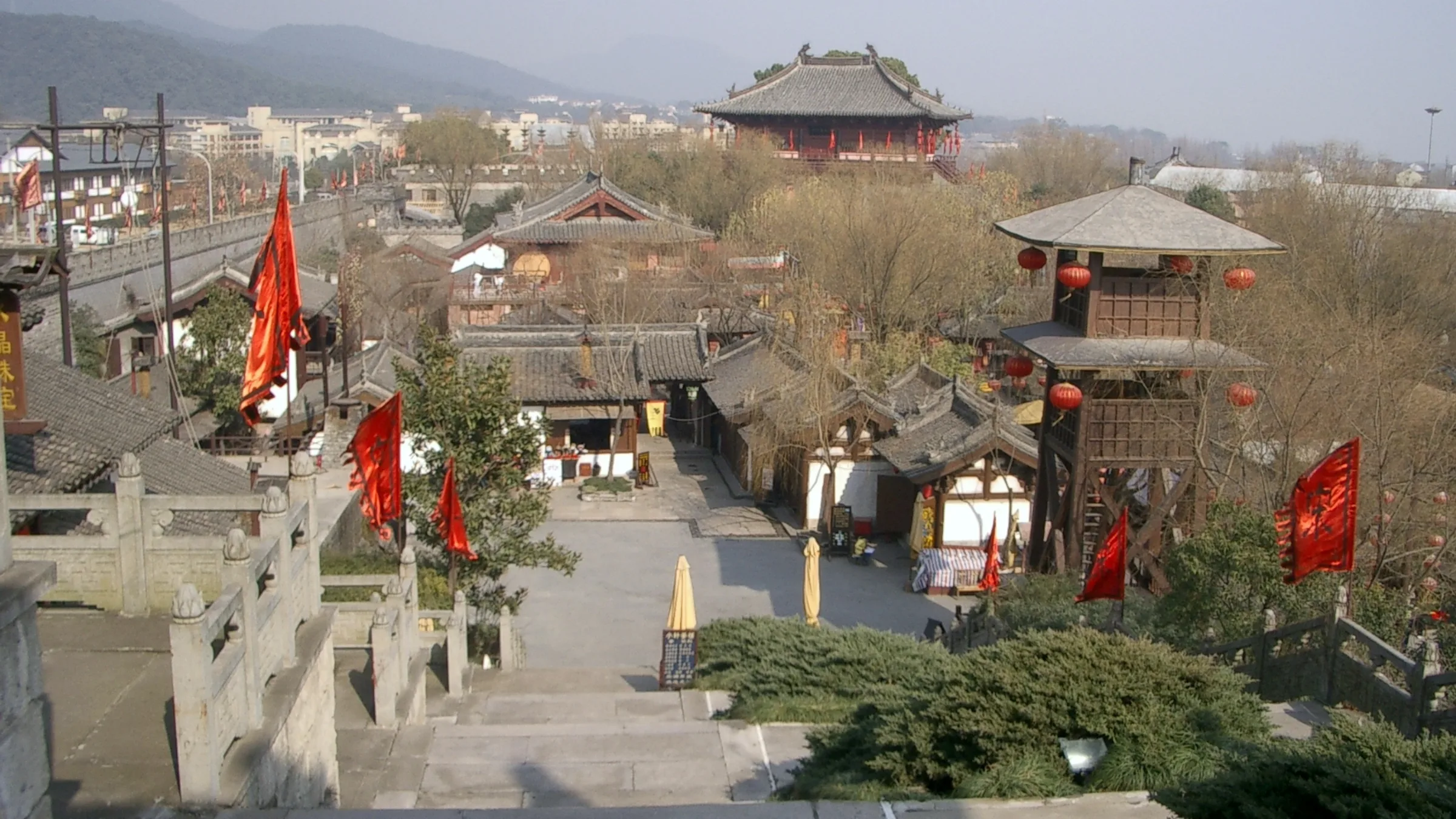
The streets are competent and atmospheric: white plastered walls under grey tiled roofs with upturned eaves, red banners, lanterns, timber-framed upper storeys over shopfronts. Photographed as pure period style the illusion holds. Photographed with any part of the modern park visible above the rooflines - which at this site is genuinely hard, because there are modern apartment blocks close behind - it stops holding, and that tension is the more interesting picture. Both are honest; only one is a marketing image.
-
The show theatre, from the house · The performance itself, which is the reason to be here
A large-scale three-dimensional panoramic production, about an hour, with stage devices, projection, live ensemble and choreography moving through Song-court, Yue-family and folk-story material. The photographic problem here is the obvious one: a fast, dark, heavily effected stage show is close to the hardest thing to photograph in China. Expect to shoot motion and atmosphere rather than a clean still, and consider whether a seat near the middle of the stalls gives you a better frame than the best-sounding seat in the house.
-
The stalls and workshop rows · Late morning, when the craftsmen are working and the crowd has thinned
The rows of traditional craft workshops are the part of the park with the most genuine activity in them - hands doing something, rather than facades doing nothing, which is the general failure mode of this kind of site. These are also where the park's family and older-visitor programming sits, so the light is often better here than on the main streets, and there are fewer people competing for the frame.
-
The hill above the park · Late afternoon, before you go in for the evening show
The park sits in hills south-west of the city, and the one genuinely scenic thing on this site is the view back over Hangzhou from above it rather than anything inside the walls. It is also the shot that makes the site's nature legible: you can see it is a modern commercial park in a modern city, and seeing that clearly is worth more than another period street.
Where to eat nearby
-
The First World Hotel (第一世界大酒店), No. 2555 Fengqing Avenue (风情大道2555号)
Not established, and we are not going to describe it. This is the hotel the Songcheng Group operates alongside the park - its English visitor service page lists it in the same visitor-information block as the park itself - so it is the nearest dining-adjacent operation we can actually source. We did not retrieve any description of its restaurants, its cuisine or its prices, and inventing one is the failure this section exists to prevent. · Not verified. No tariff, no restaurant listing and no opening hours were published on the operator's English site that we could retrieve. · No. 2555 Fengqing Avenue, Hangzhou - the address the operator publishes for this hotel on its own English Visitor Service page. It is a separate address from the park at No. 148 Zhijiang Road, so treat it as the group's other property rather than as on-site, and confirm the actual distance and the return journey for an evening show before relying on it.
-
Honest note on the rest
We could not verify independent restaurants near this park, and 'nearby' here is a genuinely difficult constraint: Songcheng is in the hills south-west of the city on Zhijiang Road, not on the West Lake shore, so anywhere within easy walking distance is inside the park itself rather than in a neighbouring restaurant street. · We searched for currently-operating restaurants near the park with citable details and could not retrieve sources we were willing to put our name to. Rather than publish a list of plausible-looking downtown Hangzhou restaurants as though they were around the corner from the park - which would be false, and would cost a reader a wasted journey into the hills after an evening show - we are leaving this short and saying why. · What is verified and useful: the park's English site describes traditional workshops and Song-dynasty streets inside the site, and the operator runs the First World Hotel listed above. The practical advice is to eat inside the park before the show rather than to plan a restaurant trip in the hills - the park's hours run to an evening finish and the journey back into the city is the constraint, not the food.
Frequently asked questions
Is Songcheng a real historic site or a theme park?
A theme park, unambiguously. Hangzhou Bendibao describes it as 杭州市第一个大型人造主题公园 - Hangzhou's first large man-made theme park - operating on the philosophy 建筑为形,文化为魂, 'architecture as the form, culture as the soul'. Chinese Wikipedia types it 主题公园 and calls it one of China's largest Song-culture theme parks, run commercially by 杭州宋城旅业发展股份有限公司. The ground was broken in March 1995 and the opening ceremony was 18 May 1996. The Song-dynasty streets are a constructed set. If you want Song-dynasty Hangzhou as history this is the wrong address; if you want a large, well-produced evening show in Song costume, it is the right one.
How much does Songcheng cost?
The figure we can currently source is a floor of ¥320 - Hangzhou Bendibao's 2026 page says 320元起, from ¥320, with more ticket types on the booking page. That is not the only number in circulation and you should know why. Chinese Wikipedia gives a different breakdown: park sightseeing entry on its own at ¥120 adult and ¥60 child, and the signature show priced separately by seat tier at ¥140, ¥160 and ¥360. Our own seed data carries ¥310. We could not find a source for the ¥310 and we could not establish what the ¥320 ticket actually includes - which theatres, whether the show is in it, whether food is bundled. Confirm what you are buying at the point of sale.
What time does Songcheng open, and how long should I allow?
09:30-21:00 on ordinary days and 08:30-21:00 on Chinese statutory public holidays, published by Hangzhou Bendibao's 2026 page. The closing time is the interesting part: the park stays open until 30 minutes after the last 《宋城千古情》 performance of the day ends, so the posted 21:00 is a frame rather than a clock. Allow half a day. The operator's own page, which is refreshingly honest, says that with 20 theatres and hundreds of shows you cannot see it all in one day.
Is the show worth it, and how long is it?
The show is the reason to go, and it is the one thing on this page we would defend without hedging. 《宋城千古情》 is a large-scale three-dimensional panoramic song-and-dance show, about an hour, launched in March 1997 and staged roughly five times a day from midday into the evening. It runs through Song-court, Yue-family military and Liang Zhuai and White Snake material using stage devices and choreography. The operator markets it as standing among the 'World's Three Greatest Shows' alongside the Las Vegas O and the Paris Moulin Rouge - that comparison is the operator's own marketing claim on its own website and we are repeating it as such, not endorsing it.
How do I get there, and can I combine it with West Lake?
We could not verify a metro instruction for this park from any source we retrieved, so we are not going to invent one. Take a taxi or Didi to No.148 Zhijiang Road, Xihu District - show the driver 之江路148号. Combine it with West Lake only if you are deliberately spending a whole day on it: the park is in the hills south-west of the city, it is not on the lake shore, and its hours run to an evening finish. That is why it cross-links to West Lake as a contrast rather than as a pairing - West Lake is free and walkable and can be done in a morning, and this one cannot be squeezed into the afternoon.
Is it good for families with children?
Yes, and this is the park's strongest suit. The operator describes it as an ideal family destination: dinosaur and Jurassic experiences for the younger children, an Elf Valley and aerial adventures, and rows of traditional workshops that grandparents enjoy, with covered corridors linking the main venues so it works in poor weather. The practical caveat is the same as for everyone else - with 20 venues you are choosing, and the park is at its most enjoyable when you accept that and plan around one show plus a few streets rather than trying to tick the whole site.
Can I eat there, and where?
Honestly: we could not verify this properly and we are not going to pad it with places we did not check. The park's own English material describes its Song-dynasty streets and traditional workshops but does not itemise restaurants, and when we went looking for independently verified restaurants near the park - which is genuinely in the hills, so 'nearby' does not mean anywhere near the lake - we could not retrieve a source we were willing to cite for a specific venue, its hours and its prices. What we can tell you is that the operator runs the First World Hotel in the same group at No.2555 Fengqing Avenue, and that the practical answer for most visitors is to eat inside the park before the show rather than to plan a restaurant journey in the hills.
How reliable is the operator's own English information?
Mixed, and worth knowing before you rely on it. The park's English page is clear about the site itself - the streets, the theatres, the address, the phone number, and a candid warning that performances are subject to weather and that two of them are first-come first-served. But the Visitor Service page presents Opening Hours, Sessions and Daily Schedules as a WeChat QR code image rather than as text, and the Tickets heading on the park page has no prices under it. Booking is routed to a WeChat mini-programme and to the operator's Fliggy storefront. So the English site is good for orientation and poor for the two things you actually need: the day's schedule and what your ticket buys.
Sources
- Hangzhou Songcheng Show Park, official English page (Songcheng Group, songcn.com - the park's own description: 20 theatres and performance venues hosting hundreds of shows and that you cannot see it all in one day, the Song-dynasty East / West / North / Market streets with Hongqiao Alley and Fenghua Alley, the Song River, the Forest and Cliff Theatres, the family attractions, and the Important Note that attractions and performances are adjusted or cancelled for weather or site conditions and that 'The Earthquake' and 'WA! Dinosaur' are first-come first-served and not guaranteed. It also confirms the address as No.148 Zhijiang Road, Xihu District and the direct line as 0571-87313101) · songcn.com
- Songcheng Group Visitor Service page, official English site (the group's customer service hotline 400-8888-518, the Hangzhou park's address and telephone repeated in English, and - cited here for the gap rather than for a fact - the fact that Opening Hours, Sessions and Daily Schedules are all presented as a WeChat QR code image rather than as retrievable text, which is why this page does not quote a show timetable) · songcn.com
- 宋城 - Chinese Wikipedia (the Hangzhou park specifically: a 主题公园 at 西湖区之江路148号 and one of China's largest Song-culture theme parks, run commercially by 杭州宋城旅业发展股份有限公司 under the Songcheng Group; groundbreaking March 1995, opening ceremony 18 May 1996, national AAAAA scenic-area rating awarded January 2001; the East / West / North / Market streets with Hongqiao and Fenghua alleys and 20 theatres and performance venues; 《宋城千古情》 launched March 1997 as a large-scale three-dimensional panoramic song-and-dance show running about an hour and staged five times a day from midday into the evening; the sightseeing-only ticket at ¥120 adult and ¥60 child; show seats at ¥140, ¥160 and ¥360; and its own opening time of 09:00-21:00) · Wikipedia
- Hangzhou Bendibao, Songcheng attraction page, 2026 guide (the current published opening hours 09:30-21:00 across all four seasonal bands and 08:30-21:00 on Chinese statutory holidays, the closing rule of 30 minutes after the last 千古情 performance ends, the ticket floor of 320元起, the address 西湖区之江路148号 and the official line 0571-87313101 - and the visitor summary describing the park as 杭州市第一个大型人造主题公园, Hangzhou's first large man-made theme park, built in imitation of Song style on the philosophy 建筑为形,文化为魂) · hz.bendibao.com
- 杭州宋城 (Q11102470) - Wikidata, checked as a possible disambiguation-page trap and confirmed NOT to be one (labelled Hangzhou Songcheng, described as a performance-based theme park in China, carrying the official website, the Chinese alias 宋城千古情, its own coordinate statement of 30.172135286964625 / 120.09444982878135, and an address statement of No.148 Zhijiang Road, Xihu District whose cited reference is the operator's own English park page) · Wikidata
- Song Dynasty City (2970193581).jpg, Wikimedia Commons (CC BY 2.0, kanegen, own work, 9 January 2006, Commons description 宋城, categorised under Hangzhou Songcheng - the source of the image used on this page) · Wikimedia Commons