
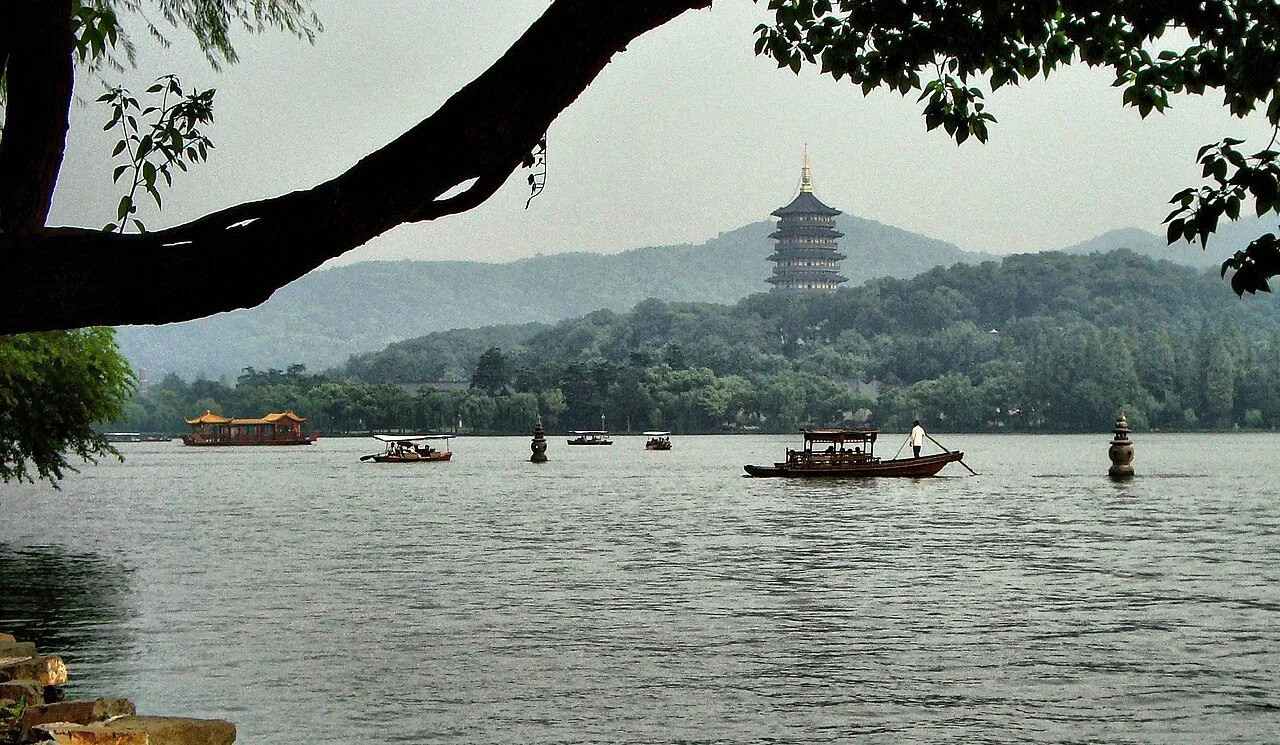
West Lake
杭州西湖 · Xī Hú
Quick answer
Foreign passport required for ID check at the major paid attractions (Leifeng Pagoda, Lingyin Temple). The lake area itself is free and open to all without ID. The metro Line 1 makes the lake area easily accessible.
Why visit
- 1 The Leifeng Pagoda (雷峰塔) — the iconic 5-story pagoda on the southern shore, rebuilt in 2002, best at sunset
- 2 The Su Causeway (苏堤) — 2.8 km of stone causeway built by Song dynasty poet Su Shi, lined with willows and peach trees
- 3 The Three Pools Mirroring the Moon (三潭印月) — three small stone pagodas in the lake, depicted on the back of the ¥1 RMB note
- 4 The Lingyin Temple (灵隐寺) — the largest Buddhist temple in southern China, founded in 326 AD, in the hills west of the lake
- 5 Longjing (Dragon Well) tea plantations in the hills above the lake — visit a tea house for the famous green tea
- 6 A boat ride on the lake — rowing boats (¥150/hour) for up to 4 people, or the painted tourist boat to Three Pools (¥60/person)
Essential tips for foreigners
- The lake area is FREE — only individual attractions (Leifeng Pagoda, Lingyin Temple) charge ¥30-45
- Enter via Line 1 to Longxiangqiao (龙翔桥) station Exit A — 2 min walk to the lake
- Rent a bicycle (¥20-30/hour) to circle the 15 km lake in 2-3 hours. Multiple rental stations around the lake
- The best season is March-May or September-November — the Ten Scenes of West Lake are best in different seasons
- Visit at sunrise for the famous 'Leifeng Pagoda in the morning mist' photo, or sunset for the iconic pagoda silhouette
- Wear comfortable shoes — the lake shore is 15 km and you'll walk or bike at least 8-12 km in a full visit
- Bring your passport for ID check at the paid attractions. Credit cards and Alipay accepted at major sites
- Avoid Chinese national holidays (May 1-3, October 1-7) — the lake area becomes impassable with crowds
Suggested route
- 07:00 30 min Arrive at Longxiangqiao station at 7 AM. Walk to the Broken Bridge (断桥) for the iconic West Lake sunrise photo spot
- 07:30 1.5 hours Walk the Bai Causeway (白堤) east to the Solitary Hill (孤山) and the Zhejiang Provincial Museum (free). Visit the Xiling Seal Society if open
- 09:00 2 hours Take the boat from the Solitary Hill pier to the Three Pools Mirroring the Moon island (¥60/person). Walk the island, return boat
- 11:00 1.5 hours Lunch at Louwailou Restaurant (楼外楼) on the island — try West Lake Vinegar Fish and Dongpo Pork
- 12:30 1.5 hours Walk to the Leifeng Pagoda (雷峰塔, ¥40). Climb to the top for the panoramic view over the lake
- 14:00 2.5 hours Rent a bicycle near the Leifeng Pagoda (¥20-30/hour). Cycle the southern and western shore of the lake. Pass the Su Causeway and the fish-viewing at Flower Harbor (花港观鱼)
- 16:30 1.5 hours Cycle to the Longjing tea plantations in the western hills. Visit a tea house for the famous green tea (¥50-100/person for a tasting)
- 18:00 1.5 hours Cycle back to the Broken Bridge. Watch the sunset over the Leifeng Pagoda — the famous 'Leifeng Pagoda in Evening Glow' scene
The lake that Marco Polo called “the finest and most splendid city in the world”
West Lake (西湖, Xī Hú) is a 6.4 km² freshwater lake in the heart of Hangzhou, surrounded by temples, pagodas, gardens, and tea plantations. It has been a cultural and political center of southern China since the Tang dynasty, and was the favorite retreat of the Southern Song emperors (1127-1279). The lake and its surrounding cultural landscape have been a UNESCO World Heritage Site since 2011.
For most foreign visitors, West Lake is the most rewarding natural and cultural experience in eastern China outside the Great Wall and the Forbidden City. The lake area is free to enter, the metro is direct, and the combination of nature, history, and food makes it the ideal 2-3 day getaway from Shanghai.
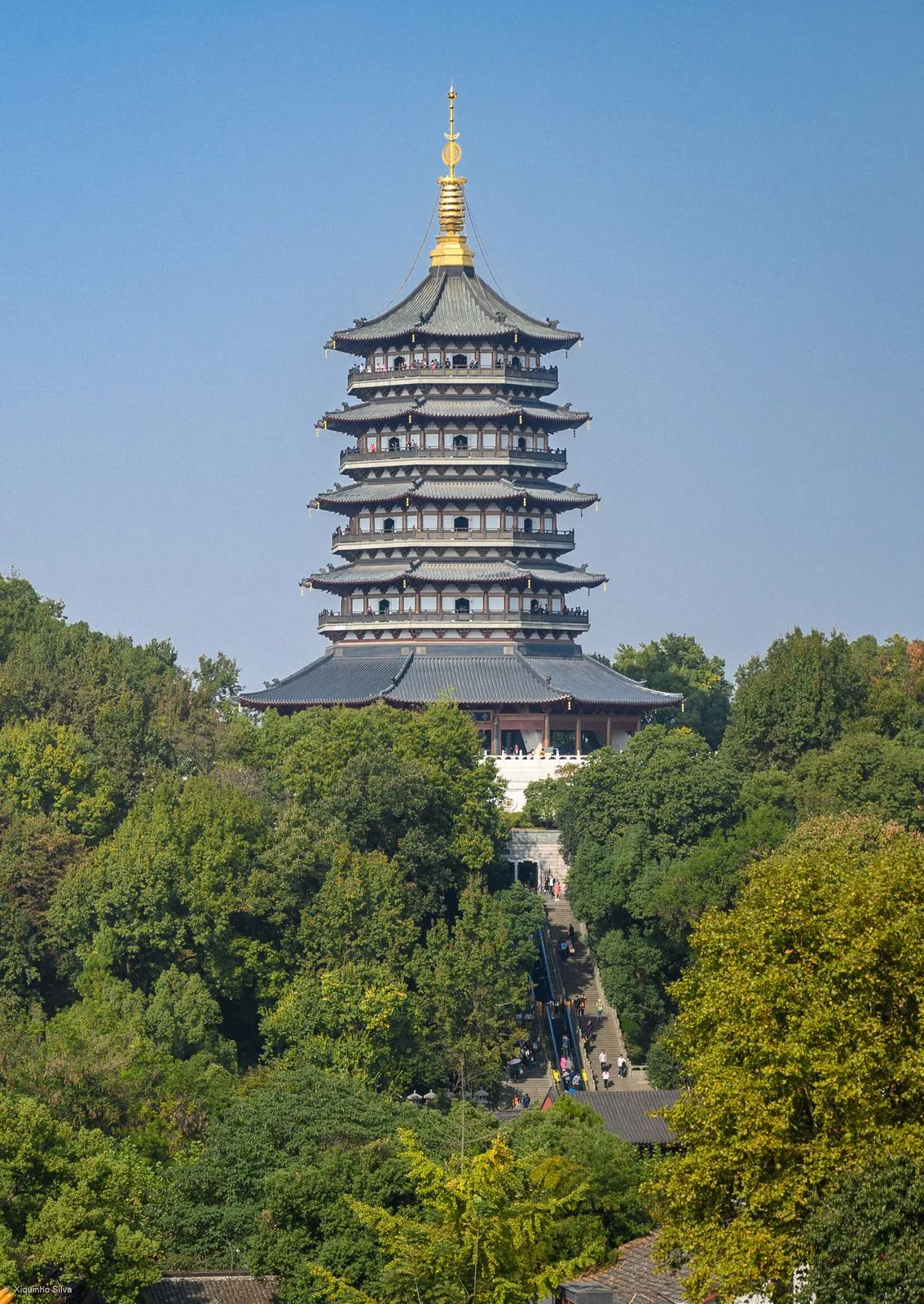
Photo: Wikimedia Commons / CC BY-SA. Source

What the foreigner experience looks like in 2026
West Lake is one of the most foreigner-friendly scenic areas in China. The lake area is free to enter, no advance booking is required, and the metro Line 1 takes you directly to the eastern shore. The English signage is comprehensive, and the area is well-organized for both individual visits and group tours. The main challenge is the scale — 15 km of lake shore, dozens of major attractions, and enough detail to fill a full week.
The main change in recent years: the addition of bicycle rental stations around the lake, the renovation of the Su Causeway and Bai Causeway, and the new Leifeng Pagoda (rebuilt 2002). The lake area has been substantially upgraded in the last decade and is now a model of accessible public space.
Three signature experiences not to miss
First, the Leifeng Pagoda (雷峰塔) at sunset — the 5-story pagoda on the southern shore, originally built in 975 AD, destroyed in 1924, and rebuilt in 2002. The view from the western shore at sunset, with the pagoda silhouetted against the orange sky, is one of the famous “Ten Scenes of West Lake” (雷峰夕照 Leifeng Pagoda in Evening Glow).
Second, the Three Pools Mirroring the Moon (三潭印月) — three small stone pagodas standing in the lake, depicted on the back of the ¥1 RMB note. The image is best at night during the Mid-Autumn Festival (full moon in September/October), when candles inside the pagodas reflect in the water to create 33 “moons” (3 pagodas × 5 holes × 2 reflections + 1 actual moon).
Third, the Lingyin Temple (灵隐寺) — the largest and wealthiest Buddhist temple in southern China, founded in 326 AD, in the hills west of the lake. The temple complex has 7 main halls, a 24-meter tall camphor-wood Buddha, and the Feilai Feng (Flying Peak) grottoes with over 300 Song dynasty Buddhist carvings. The temple is a working religious site — arrive early to see the morning chanting.
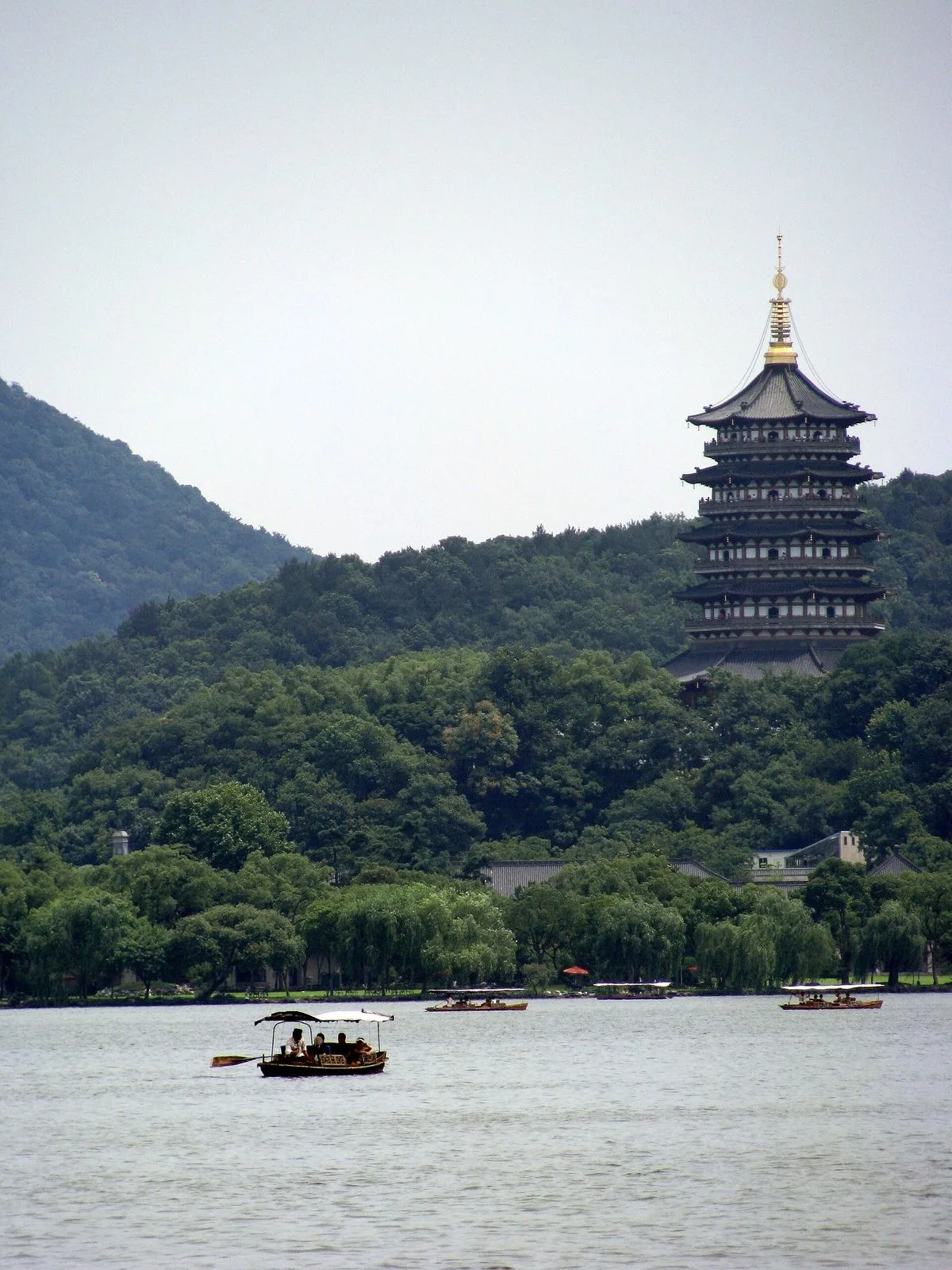
Photo: Wikimedia Commons / CC BY-SA. Source
,_Hangzhou_-279.webp)
Cultural context and the Song dynasty capital
Hangzhou was the capital of the Southern Song dynasty from 1127 to 1279, and the emperors built extensively around the lake. The Su Causeway (苏堤) was built by the poet Su Shi in 1089 during his tenure as governor of Hangzhou — he used the mud dredged from the lake to create a 2.8 km causeway with willows on both sides. The Bai Causeway (白堤) is named after the Tang dynasty poet Bai Juyi, although the current causeway was actually rebuilt in the Song dynasty.
The lake has inspired Chinese poetry and painting for over 1000 years. The famous “Ten Scenes of West Lake” (西湖十景) were codified in the Southern Song dynasty: Leifeng Pagoda in Evening Glow, Su Causeway in Spring Dawn, Broken Bridge in Snow, Three Pools Mirroring the Moon, Lotus in the Breeze at Winding Courtyard, Orioles Singing in the Willows, Leifeng Pagoda, Fish Leaping at Flower Harbor, Twin Peaks Piercing the Clouds, and Evening Bell at Nanping Hill. Each is best in a different season.
The lake is also the home of the Longjing (Dragon Well) green tea, one of China’s most famous teas. The tea is grown in the hills west of the lake and is characterized by its flat, smooth leaves and floral aroma. A visit to a tea house in the Longjing village is a classic Hangzhou experience.
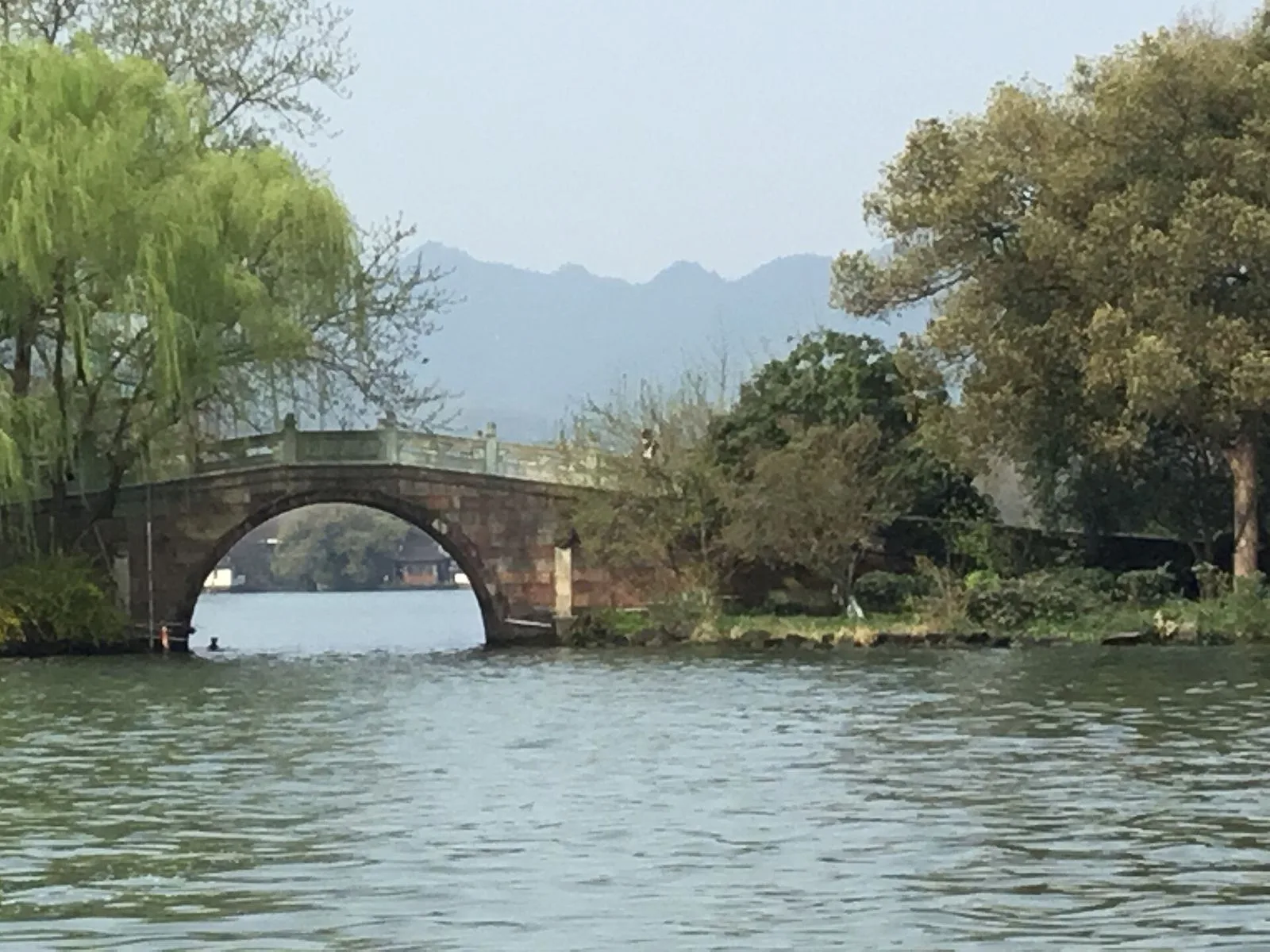
Photo: Wikimedia Commons / CC BY-SA. Source

How to spend your time — three visit lengths
3-4 hours (express): Take the painted boat to Three Pools Mirroring the Moon (¥60, includes the boat). Visit Leifeng Pagoda (¥40). Walk the Bai Causeway to the Broken Bridge. The two essential experiences are the boat ride and the Leifeng Pagoda.
Full day (recommended): Add the Lingyin Temple in the western hills (¥45 + ¥30 for the Feilai Feng grottoes), the Longjing tea plantations, and a bicycle circuit of the lake (¥20-30/hour). Lunch at Louwailou Restaurant on the island.
2 days (comprehensive): Add a half-day in the Longjing tea village (visit a tea plantation, attend a tea ceremony, hike the tea-terrace path), a half-day on the eastern shore of the lake (Zhejiang Provincial Museum, the Xiling Seal Society), and dinner at Green Tea Restaurant or Zhi Wei Guan.
Practical guidance for first-timers
The eastern shore is the most accessible — Line 1 metro to Longxiangqiao (龙翔桥) station Exit A, 2 min walk to the lake. The southern shore (Leifeng Pagoda) is reachable by Line 1 to Jiangling Road (江陵路) station and a short bus ride. The western shore (Lingyin Temple, Longjing tea) is reachable by Line 3 to Huanglong (黄龙) station and a bus to the temple.
Rent a bicycle (¥20-30/hour) at one of the many rental stations around the lake. The full circuit is 15 km and takes 2-3 hours. The Su Causeway and Bai Causeway are the most scenic sections.
Bring water and snacks, although the lake area has plenty of food options. The walking distance in a full visit is substantial (8-12 km) so comfortable shoes are essential. The lake is mostly outdoors, so check the weather and bring sun protection in summer, a warm coat in winter.
When to come
The best months are March-May (spring blossoms, mild weather) and September-November (autumn foliage, Mid-Autumn Festival). The famous “Ten Scenes of West Lake” are best in different seasons — for example, “Leifeng Pagoda in Evening Glow” is best at sunset, “Three Pools Mirroring the Moon” is best at night during Mid-Autumn Festival, “Su Causeway in Spring Dawn” is best in March-April. Avoid Chinese national holidays (May 1-3, October 1-7) when the lake area becomes impassable with crowds.
Final tip
West Lake rewards both a quick visit and a slow exploration. A 3-4 hour visit can see the lake highlights (boat ride + Leifeng Pagoda + Broken Bridge). A full day allows a bicycle circuit, the Lingyin Temple, and the Longjing tea. Two days lets you experience the lake the way it was meant to be experienced — slowly, in different seasons, with the famous “Ten Scenes” revealing themselves over time. Marco Polo was right: this is one of the world’s truly splendid places.
Best photo spots
-
Broken Bridge (断桥) at sunrise · Sunrise, 6-7 AM
The most iconic West Lake view — the ancient stone bridge with the Leifeng Pagoda in the distance. Best at sunrise when mist rises from the lake. The bridge is famous from the Legend of the White Snake.
-
Leifeng Pagoda (雷峰塔) at sunset · Sunset, 5-6 PM
The 5-story pagoda on the southern shore, rebuilt in 2002. The sunset view from the lake's western shore captures the pagoda silhouette against the orange sky — one of the 'Ten Scenes of West Lake' (雷峰夕照).
-
Su Causeway (苏堤) in spring · March-April, 7-8 AM
The 2.8 km stone causeway lined with willows and peach trees. In spring, the peach blossoms are in full bloom and the early morning light is magical. Best photographed from a low angle with the lake as background.
-
Three Pools Mirroring the Moon (三潭印月) at full moon · Mid-Autumn Festival (mid-September to early October) at night
Three small stone pagodas in the lake. At full moon during Mid-Autumn Festival, candles inside the pagodas reflect in the water to create 33 'moons'. The image is depicted on the back of the ¥1 RMB note.
-
Longjing tea plantations · Mid-morning, 9-10 AM
The terraced tea fields in the hills west of the lake. The morning light illuminates the green tea plants and the mist rising from the fields. Best from a viewpoint at the top of the tea village path.
Where to eat nearby
-
Louwailou Restaurant (楼外楼)
Hangzhou cuisine (West Lake Vinegar Fish, Dongpo Pork, Longjing Shrimp) — founded 1848 · ¥200-400/person · On the island in the lake, accessible by boat or the causeway
-
Green Tea Restaurant (绿茶餐厅)
Modern Hangzhou cuisine at affordable prices (popular chain) · ¥80-150/person · Multiple branches near the lake, 10 min walk from Longxiangqiao
-
Zhi Wei Guan (知味观)
Hangzhou dim sum and noodle specialties — founded 1913 · ¥50-100/person · 10 min walk from the Broken Bridge, near the Hubin Yintai shopping area
-
Longjing tea house in the western hills
Tea tasting and Hangzhou snacks · ¥50-150/person · In the Longjing village, 20 min by bicycle from the lake's western shore
Frequently asked questions
Is West Lake free to visit?
Yes — the lake area is completely free. The 15 km lake shore, the Su Causeway, the Bai Causeway, the lotus ponds, and the public gardens are all open without a ticket. Only individual attractions (Leifeng Pagoda ¥40, Lingyin Temple ¥45, China National Tea Museum free) charge admission.
How long does it take to visit West Lake?
3-4 hours for the lake highlights (Broken Bridge, Su Causeway, Leifeng Pagoda, boat ride). 6-8 hours for a full circuit of the lake by bicycle, plus a visit to Lingyin Temple. Full day if you add the Longjing tea plantations in the western hills.
How do I get to West Lake from central Hangzhou?
Line 1 metro to Longxiangqiao (龙翔桥) station Exit A — 2 min walk to the lake. Line 1 also has Fengqi Road (凤起路) station near the northern shore. Multiple bus lines circle the lake. Didi or taxi to any specific attraction (20-40 min from central Hangzhou).
What is the best time of year to visit West Lake?
March-May for spring blossoms and mild weather. September-November for autumn foliage. The famous 'Ten Scenes of West Lake' are best in different seasons — for example, 'Leifeng Pagoda in Evening Glow' is best at sunset, 'Three Pools Mirroring the Moon' is best at night during Mid-Autumn Festival (full moon in September/October). Avoid Chinese national holidays (May 1-3, October 1-7) when the lake area becomes impassable.
Can I take a boat on West Lake?
Yes. There are two main options: rowing boats (¥150/hour, up to 4 people) which you can take anywhere on the lake, and the painted tourist boat to Three Pools Mirroring the Moon (¥60/person round-trip). The Three Pools boat is the most popular and is included in most guided tours. Boats are available 7:00-17:00 in winter and 7:00-18:00 in summer.
Is West Lake wheelchair accessible?
Yes, mostly. The Su Causeway and Bai Causeway have paved paths and are wheelchair accessible. The lake shore path is mostly flat. Some paid attractions (Leifeng Pagoda) have wheelchair access via elevators. The Lingyin Temple in the hills has some steps but wheelchair access is available.
What is the Three Pools Mirroring the Moon?
The Three Pools Mirroring the Moon (三潭印月) is the iconic West Lake image — three small stone pagodas standing in the lake, depicted on the back of the ¥1 RMB note. The pagodas were originally built in the Song dynasty as lanterns for boat navigation. The image is best at night during the Mid-Autumn Festival (full moon in September/October), when candles inside the pagodas reflect in the water to create 33 'moons' (3 pagodas × 5 holes × 2 reflections + 1 actual moon).
Should I visit Lingyin Temple?
Yes, if you have 3+ hours for the West Lake area. The Lingyin Temple (灵隐寺) is the largest and wealthiest Buddhist temple in southern China, founded in 326 AD, in the hills west of the lake. The temple complex has 7 main halls, a 24-meter tall camphor-wood Buddha, and the Feilai Feng (Flying Peak) grottoes with over 300 Song dynasty Buddhist carvings. The temple ticket is ¥45 (¥30 for the Feilai Feng grottoes).
What food should I try near West Lake?
Hangzhou cuisine (浙菜 Zhècài) is one of China's eight great culinary traditions. Must-try dishes near the lake: West Lake Vinegar Fish (西湖醋鱼), Dongpo Pork (东坡肉, named after the Song dynasty poet Su Dongpo), Longjing Shrimp (龙井虾仁, with Longjing tea leaves), Beggar's Chicken (叫花鸡), and Dingsheng Cake (定胜糕). Try them at the Louwailou Restaurant (楼外楼) on the island in the lake, founded in 1848.
Is there a dress code for West Lake?
No formal dress code. The lake area is mostly outdoors. Bring sun protection in summer (temperatures reach 38°C in July-August) and a warm coat in winter (temperatures can drop to 0°C in January). The Lingyin Temple is a working Buddhist temple, so dress modestly (covered shoulders and knees) if you plan to visit.