Hefang Street (河坊街), Hangzhou
河坊街 · Héfāng Jiē
Quick answer
Nothing whatsoever is required. There is no ticket, no gate, no ID check, no registration and no queue - it is a public street in Hangzhou's old town, and passport-carrying visitors are an ordinary part of the crowd. Carry your passport only if you plan to enter a ticketed heritage site standing beside the street, since Chinese heritage museums price their discounted and child categories off identity documents; we did not verify what ID the nearby ones ask for, so we are not going to tell you they all do. On interpretation we are similarly cautious: much of this street is a restoration, and we found no authoritative statement about what signage is physically in place, so bring a translation app rather than assuming bilingual panels.
Why visit
- 1 This is one street, not a district: roughly 1,800 m of main pedestrian frontage inside Qinghefang, so budget one to two hours and not the two to three the surrounding quarter needs
- 2 Free, with no gate, so there is no closing time either - it is lit and busy long after the shops and sites beside it have shut
- 3 It runs east-west from Jiangcheng Road to Nanshan Road and the willows of Orioles Singing in the Willows, at the foot of Wu Shan hill, crossing the Southern Song Imperial Street at the Four Corners
- 4 From the Song dynasty to the early Republic this was the most important commercial street in Hangzhou, which is the reason it was rebuilt rather than left alone
- 5 About a hundred shops and time-honoured brands, including Zhang Xiaoquan scissors, Wanlong ham and Fang Huichun Tang, alongside the tea and silk shops
- 6 Hu Qing Yu Tang, founded in 1874 and a National Key Cultural Relic Protection Unit since 1988, stands on one side of the street - and its great Republican-era painted advertisement is still on the street wall
- 7 Tai Chi Tea Dao Yuan at No. 184 is a long-established tea house on the street itself, serving gongfu tea with freshly made tea snacks - the one place to actually sit down and drink on this walk
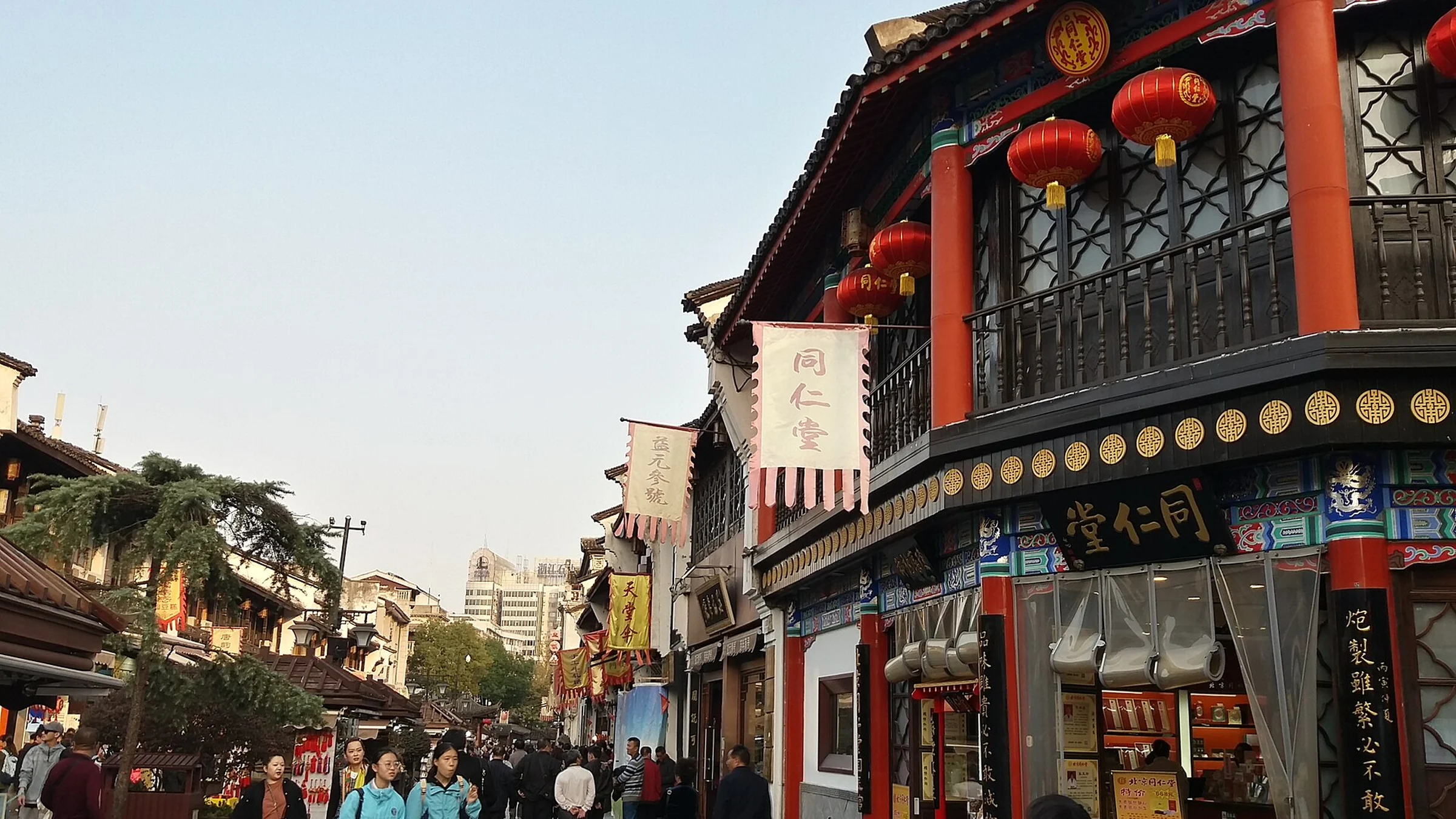
- 8 A plain modern office block is visible at the far end of the street above the roofline, which is a useful corrective: this is a working retail street in a live city, not a preserved film set
Essential tips for foreigners
- This page and the Qinghefang page are two halves of one place. Hefang Street is the main street of the Qinghefang district, and the coordinates this site publishes for the two are about 265 m apart. This page covers the street spine - the shops, the tea house, the lantern walk. The Qinghefang page covers the lanes behind it, Hu Xueyan's former residence and the side-lane architecture. If you have two hours, read this one. If you have four, do both, and know that you will walk the spine twice.
- Arrive at the quiet end and walk into the crowd. Metro Line 7 drops you at Wushan Square at the WEST end, while most of the shopping frontage runs east from there, so you start at the calm end and build up. Going the other way is how you meet the street at its busiest.
- Come back after the lanterns. They go on at around 19:00 in summer and 18:00 in winter and off around 22:30, with 18:30-20:30 the best window. In daylight this is a shopping street; after dark it is the reason people photograph it.
- Skip the by-weight stalls. Travellers repeatedly report stalls where a few yuan of fruit weighs out to ¥30-40 and a few slices of pork jerky to over ¥100, and roadside 'free Longjing tea tasting' or face-changing shows that are hooks to seat you and upsell. The queue is not a quality signal.
- Eat one street away, not on it. Gao Yin Street is a short walk off the frontage and clusters proper sit-down Hangzhou-cuisine restaurants, at roughly ¥60-80 a head for three or four classic dishes, where the main strip is for wandering.
- Carry a translation app and do not date the buildings by their weathering. Much of this street is a restoration, so a weathered carved sign is not evidence of age.
Suggested route
- 18:00 10 min Come out of Wushan Square station on Metro Line 7 and enter the street at its quiet western end. Note that the district's Four Corners junction with the Southern Song Imperial Street is about 320 m along
- 18:10 35 min Walk east along the frontage at browsing pace rather than hurrying. The time-honoured brands are on this stretch, and the old shopfronts are worth reading as you go
- 18:45 40 min Stop at the tea house on Hefang Street itself for gongfu tea and something freshly made to eat. This is the one place on the walk where you sit down properly
- 19:25 30 min Continue east to the Drum Tower end. Shooting upward from beneath the arch, with the lanterns layered against the old eaves, is the shot this street is known for
- 19:55 60 min Have dinner one street away on Gao Yin Street rather than on the frontage - that is where the sit-down Hangzhou-cuisine restaurants are, and where the prices are honest
- 20:55 25 min Drift back west along the lit street. It is still open after the shops have shut, because there is no gate to shut
One street, not a district
This is the single most important thing to read before you plan the evening: Hefang Street is the main street of the Qinghefang district. It is not a separate attraction competing with it.
Chinese Wikipedia draws the distinction itself, and unusually explicitly. The article on this street opens with an About note that separates 整條河坊街, the whole of Hefang Street, from 清河坊, the historic district that the street passes through. The district’s own article then illustrates the point with a photograph whose caption is, in effect, Hefang Street running through the Qinghefang district.
At the coordinates this site publishes, the two places are about 265 metres apart — five minutes’ walk. So the honest question is not “which should I see” but “which am I seeing”. This page covers the street: the axis, the shops, the tea house, the lantern walk, one to two hours. The lanes behind the frontage, the grey-stone upper floors, the water channels and Hu Xueyan’s former residence are on the Qinghefang page, and they need two to three hours. Do both in one trip and you will walk this spine twice — which is a perfectly good evening, as long as you know you are paying for it.
The street itself
Hefang Street runs east from Jiangcheng Road to Nanshan Road and Orioles Singing in the Willows, at the foot of Wu Shan hill. The stretch with the distinctive character is the section between Zhonghe Middle Road and Yan’an South Road. It crosses Zhongshan Middle Road — the Southern Song Imperial Street — and the two together are what Hangzhou calls the Four Corners.
The street is about 1,800 m of main frontage inside the district, and Chinese Wikipedia counts roughly a hundred shops and time-honoured brands on it, alongside the snack stalls, antiques, calligraphy and paintings that fill it. Its earlier names were Xuxuan Street (旬宣街) and Zhuzhai Street (竹斋街), and local sources describe it in the Southern Song as running alongside the travelling palace of Emperor Gaozong and the Lin’an prefectural office. It was repaired in 1999 alongside the building of Wushan Square station, which is the reason the metro reaches it.
What matters is the span this street covers: from the Song dynasty to the early Republic of China it was the most important commercial street in Hangzhou. That is not a tourism slogan. It is why the street was rebuilt rather than left alone, and why the buildings on it are restored Qing-style shopfronts rather than Song fabric. Read the architecture as a twentieth-century reconstruction of a much older trading street, and it makes sense.
The shops, and the one that matters most
The time-honoured brands Chinese Wikipedia names are Zhang Xiaoquan scissors (张小泉剪刀), Wanlong ham (万隆火腿) and Fang Huichun Tang (方回春堂), alongside the tea and silk shops. Those are the names worth looking for as you walk.
But the anchor is Hu Qing Yu Tang (胡庆余堂), founded by the late-Qing merchant Hu Xueyan in 1874 and called the King of Jiangnan Medicine, ranked with Beijing’s Tongrentang. It is a National Key Cultural Relic Protection Unit, designated in 1988, and a national intangible cultural heritage item since 2006. Its house motto is worth knowing because it is carved in the building: 采办务真,修制务精 — procure genuinely, make refined — and 是乃仁术,真不二价 — this is the art of benevolence, one true price, no bargaining.
Two details make it more than a name. First, the pharmacy’s house rules and products are still live: it runs a Chinese-medicine clinic and a museum, and its best-known preparations are Qingyu Jiuxin pills and Biwen Dan. Second — and this is the one to go and see — the large Republican-era painted advertisements for Hu Qing Yu Tang still survive on the walls of Hefang Street and of Nanshan Road. They are among the few genuinely old things on this street.
A caution on prices: a local consumer comparison puts the better-value Hangzhou cooking one street away on Gao Yin Street rather than on the frontage, and rates a sit-down meal there at roughly ¥60-80 a head for three or four classic dishes including Dongpo pork, West Lake vinegar fish and Longjing prawns. It also clusters traditional Hangzhou-cuisine restaurants — Huang Fan’er, Xiao Shaoxin and Zhang Hu Li — against Hefang Street’s own mix of snack stalls and drink stalls.
The tea stop, which is the one to actually use
Hangzhou is a tea city and this is a tea street, so the honest question is whether there is anywhere to drink rather than just buy.
There is, and it is on the street. Tai Chi Tea Dao Yuan (太极茶道苑) at No. 184 Hefang Street, beside the Four Corners, is described as a long-established traditional tea house with a classical interior — long-spouted copper pots, blue-and-white teacups, wooden stools and tables — serving traditional gongfu tea with tea snacks made on the spot.
Two honest caveats. It does not publish a tariff; Hangzhou tea houses commonly charge by the pot and by the seat rather than by the cup, so confirm before ordering rather than after. And if what you actually want is tea at source, a tea house on a shopping street is a stop, not the destination — the China National Tea Museum and the Longjing villages above West Lake are separate trips, and the museum has its own page on this site.
When to go, and the traps
The lanterns are the reason to come. Traveller reports put them lit at around 19:00 in summer, from mid-April to end-September, and around 18:00 in winter from October to April, going off at about 22:30 either way, with 18:30-20:30 the sweet spot: the most atmosphere, fewer crowds than mid-afternoon. Those are reported timings rather than an operator’s published schedule, so treat them as approximate.
The traps on this street are well documented by people who have walked them:
- By-weight stalls. Fruit cups, pork jerky and similar are sold off scales rather than menus, and travellers report a few yuan of fruit weighing out to ¥30-40 and a few slices of jerky to over ¥100. Walk past.
- “Free” tasting and street performances. Roadside free-Longjing-tasting offers and face-changing shows are described as hooks to seat you and upsell. Smile and keep walking.
- Souvenir pricing. A local comparison advises buying at a proper old-brand shop rather than paying main-strip prices for the same thing.
One correction worth making to yourself
Look at the far end of the street while you are there. Above the traditional rooflines you can see a plain modern white office block, and the street frames it directly.
That is not a flaw in the view. This is a working retail street in a live, congested old town, with real traffic on real roads a few metres away — not a closed set. Knowing that changes what you are looking at.
Best photo spots
-
The lantern-hung eave of the two-storey shophouse on the main frontage · 18:30-20:30, in the blue hour after the lanterns come on
Vermilion columns and beams, a deep projecting tiled eave, a continuous run of dark wooden balustrade upstairs and a row of large red lanterns hung underneath. Shooting along the eave rather than straight at it gives the repetition and the depth. This is the image the street is known for.
-
Beneath the Drum Tower at the eastern end · After dark, while the lanterns are still lit
Shooting upward from under the arch stacks lanterns against the old eaves and gives real depth. The tower itself is the top of the lane. Note that the Drum Tower and Wushan Square are opposite ends roughly 700 m apart - two separate stops on this walk, not one place.
-
The Republican-era painted advertisement on the street wall · Flat daylight, when the painted characters read cleanly
The large surviving painted characters for Hu Qing Yu Tang on the Hefang Street wall date from the Republican period and are one of the few pieces of the street that are genuinely old rather than reconstructed. Finding it is the reward for walking the less interesting stretches.
-
Down the street toward the modern skyline · Late afternoon
At the far end the street frames plain modern white office blocks above the traditional rooflines. Photographing the street toward them is a useful corrective to the usual framing, because it shows the thing is a working retail street in a live city rather than a preserved set.
Where to eat nearby
-
太极茶道苑(河坊街店)— Tai Chi Tea Dao Yuan, Hefang Street branch
Tea house: traditional gongfu tea service (功夫茶) with freshly made tea snacks (现制茶点) · Not published — Hangzhou tea houses commonly charge by the pot and by the seat, and this one publishes no tariff, so expect to pay per pot rather than per cup and confirm before ordering · On Hefang Street itself at No. 184, beside the Four Corners junction — steps from the street walk, and the closest genuine tea stop to the published coordinate
-
乾堂里杭州菜(河坊街店)— Qian Tang Li Hangzhou cuisine, Hefang Street branch
Hangzhou cuisine (杭帮菜), sit-down · Around ¥60-80 per head for three or four classic dishes is the going rate on the food lane beside this street, per a local comparison; this branch does not publish a menu price · At No. 149 Gaoyin Street in Shangcheng District — a short walk off the frontage, with the 清河坊, 吴山广场东 and 吴山广场紫薇园 bus stops close by; telephone 18258461681
Frequently asked questions
Is Hefang Street the same place as Qinghefang?
Hefang Street is the main street of the Qinghefang district - they are the street and its container, not two competing destinations. Chinese Wikipedia makes the distinction explicitly: the article on the street opens by separating 整條河坊街, the whole street, from 清河坊, the historic district it passes through, and the district's own article captions its photograph as Hefang Street running through the Qinghefang district. At the points this site publishes, the two are about 265 m apart, so you can walk between them in five minutes. That closeness is exactly why it matters to pick the one you want: this page is the retail spine, the Qinghefang page is the lanes and the merchant houses behind it.
How much does Hefang Street cost, and do I need a ticket?
Nothing. There is no ticket, no gate and no barrier of any kind - it is a public street, closed to through traffic and open to people. That is also why there is no closing time. You pay only for what you choose: food from the stalls, tea and souvenirs from the shops, or a ticket to one of the heritage sites standing beside the street.
How long should I spend on Hefang Street?
One to two hours. The main frontage inside the district runs to over 1,800 m, and walking it at browsing speed fills most of that. Under-allocating is the common mistake: people budget twenty minutes, find themselves still shopping at the far end, and rush the part they came for. If what you actually want is the district rather than the street, allow two to three hours instead and use the Qinghefang page.
What time should I go, and when are the lanterns lit?
After the lanterns, and specifically between about 18:30 and 20:30. Traveller reports put the lighting on at around 19:00 in summer, running mid-April to end-September, and around 18:00 in winter from October to April, going off at about 22:30 either way. That window is when the old shopfronts have the most atmosphere and the crowds are lighter than mid-afternoon. Those are reported timings rather than an operator's published schedule, so treat them as approximate.
Which shops are actually worth stopping at?
The time-honoured brands, which Chinese Wikipedia names as Zhang Xiaoquan scissors, Wanlong ham, Fang Huichun Tang and Hu Qing Yu Tang - the last being a pharmacy founded in 1874, a National Key Cultural Relic Protection Unit since 1988, which also runs a Chinese-medicine museum. The street also carries the tea and silk shops. The large painted advertisement for Hu Qing Yu Tang from the Republican period survives on the street wall, which is worth finding. What is not worth stopping at is the souvenir retail on the main frontage, where a local comparison puts the better value on the side streets.
Is there a tea place on the street, or should I go to Hangzhou's tea villages?
Both, and they are different. On the street itself, Tai Chi Tea Dao Yuan at No. 184 is a long-established traditional tea house in a classical style, with long-spouted copper pots, blue-and-white cups and wooden stools, serving gongfu tea with freshly made tea snacks - that is the place to sit down and actually drink. For tea at source, the China National Tea Museum and the Longjing villages above West Lake are separate trips with their own reasons, and the museum has its own page here.
How do I get there, and is it walkable from West Lake?
Very. Metro Line 7 to Wushan Square is closest, with the street running east from the exit about a six-minute walk, and Line 1 to Ding'an Road is about a thirteen-minute walk. From West Lake's southern shore it is a short walk or taxi east, so it pairs naturally with a lake day. Note that the street is about 700 m end to end, so Wushan Square and the Drum Tower are separate stops at opposite ends rather than one place.
Sources
- 河坊街 — Chinese Wikipedia (the street itself: in Hangzhou's Shangcheng District, running east from Jiangcheng Road to Nanshan Road and Orioles Singing in the Willows, its distinctive-character section being Zhonghe Middle Road to Yan'an South Road; at the foot of Wu Shan hill and, together with Zhongshan Middle Road the Southern Song Imperial Street, known as the Four Corners; Hangzhou's most important commercial district from the Song dynasty to the early Republic of China; that the historic district it passes through is now a National AAAA scenic area; that snacks, antiques, calligraphy and paintings and a hundred-odd shops and time-honoured brands crowd it; and that Hu Qing Yu Tang, founded by the late-Qing merchant Hu Xueyan and now also a Chinese-medicine museum, stands on one side of it) · Wikipedia
- 清河坊 — Chinese Wikipedia (the street/district relationship from the other side: its district photograph is captioned as Hefang Street running through the Qinghefang district) · Wikipedia
- 胡慶餘堂 — Chinese Wikipedia (the old-brand shop that anchors one side of the street: at No. 95 Dajing Alley in Shangcheng District, founded by Hu Xueyan in 1874, called the King of Jiangnan Medicine and ranked with Beijing's Tongrentang, carrying the house motto 采办务真,修制务精 and 是乃仁术,真不二价, known for Qingyu Jiuxin pills and Biwen Dan, a Jiangnan courtyard-style front-shop-back-workshop building of over 3,000 square metres, now running a Chinese-medicine clinic and museum, merged into the Qingchunbao Group in 1996, a National Key Cultural Relic Protection Unit since 1988 and a national intangible cultural heritage item since 2006 - and the large Republican-era painted advertisements for it that still survive on the walls of Hefang Street and Nanshan Road) · Wikipedia
- 杭州清河坊街游玩攻略 — Hangzhou Bendibao (the street's length inside the district: the core framework formed where Hefang Street crosses Zhongshan Middle Road, with a main street over 1,800 m long, the district covering about 220,000 square metres) · hz.bendibao.com
- 【杭州清河坊】攻略2026_清河坊门票_地址 — Hangzhou Bendibao (the surrounding scenic area listed as free, all-day opening, at No. 180 Hefang Street in Shangcheng District) · hz.bendibao.com
- 河坊街街(杭州市境内公路、步行街)— Baidu Baike, as surfaced in search results (the street's earlier names, 旬宣街 and 竹斋街; that its middle section forms part of the Qinghefang historic district and that the whole main road lies within the West Lake Scenic Area; that in the Southern Song it ran alongside the travelling palace of Emperor Gaozong and the Lin'an prefectural office; and that it was repaired in 1999 alongside the building of Wushan Square station) · baike.baidu.com
- 太极茶道苑(河坊街店)— Baidu Baike (the tea house standing on this street: at No. 184 Hefang Street in Shangcheng District, adjacent to Wushan Square, described as a long-established traditional tea house in a classical style furnished with long-spouted copper pots, blue-and-white teacups and wooden stools and tables, serving traditional gongfu tea with freshly made tea snacks) · baike.baidu.com
- 乾堂里杭州菜 (河坊街店) — Hangzhou city8 directory listing (the sit-down Hangzhou-cuisine restaurant carrying this street's name in its branch designation: at No. 149 Gaoyin Street in Shangcheng District, telephone 18258461681, with the 清河坊, 吴山广场东 and 吴山广场紫薇园 bus stops nearby on routes including 40, 84, 524 and WE1314) · hz.city8.com
- 杭州河坊街 vs 高银街 — a local Hangzhou consumer comparison (that Gao Yin Street beside Hefang Street clusters sit-down Hangzhou-cuisine restaurants rather than snack retail, with a per-head figure of roughly ¥60-80 for three or four classic dishes including Dongpo pork, West Lake vinegar fish and Longjing prawns) · post.smzdm.com
- Qinghefang & Hefang Street Hangzhou 2026 Guide — China for Travelers (used for practicalities only: Line 7 to Wushan Square about a six-minute walk and Line 1 to Ding'an Road about thirteen; the lanterns lit at around 19:00 in summer and 18:00 in winter and off around 22:30, with 18:30-20:30 the sweet spot; the street described as the pedestrian spine with narrower lanes branching off it; the by-weight snack-stall and 'free tasting' upsell warnings; locals eating off the main strip on Gaoyin Street and Shiwukui Alley; and the Drum Tower and Wushan Square described as opposite ends roughly 700 m apart) · chinafortravelers.com
- 河坊街 (Q11141961) — Wikidata, cited because src/lib/attraction-coords.ts records this QID against the street; it is the real street item typed as a street in Hangzhou and carries no coordinate statement at all, which is why the published value is OSM-only at medium confidence · Wikidata
- 四拐角 (Four Corners), OpenStreetMap node 29559134, tagged name=四拐角 tourism=attraction at 30.2426088 / 120.1662607 — the junction where this street crosses the Southern Song Imperial Street, about 320 m west of this page's published coordinate · openstreetmap.org