
Qinghefang Historic District (清河坊), Hangzhou
清河坊 · Qīnghéfāng
Quick answer
Nothing is required to walk this district. There is no ticket, no gate, no ID check, no registration and no queue - it is ordinary public street in Hangzhou's old town, and passport-carrying visitors are unremarkable there. Bring your passport anyway only if you intend to go inside one of the ticketed heritage sites in the quarter, because Chinese heritage museums and preserved residences price their discounted and child categories off identity documents; we did not verify which of the sites inside this district ask for an ID, so we are not going to tell you they all do. On interpretation, be similarly sceptical: the district is restored, so some plaques are modern, and we found no authoritative statement about what signage is physically in place. Carry a translation app rather than assuming bilingual panels.
Why visit
- 1 This is a district of about 220,000 square metres, not a street - which is why it takes two to three hours rather than one, and why it gets its own page separately from the street inside it
- 2 Named after Zhang Jun, the Southern Song grand preceptor who beat the Jin army at Mingzhou in 1129 and was later made Prince of Qinghe; his Qinghe Prince's mansion stood on today's Taiping Lane, and the district took its name from him rather than from any river
- 3 It sits on the core site of Lin'an, the Southern Song capital, and is described by local sources as the origin of China's open street-and-lane urban pattern
- 4 Chinese Wikipedia calls it the only substantially intact old quarter left in Hangzhou, which is a much stronger claim than 'old street' and explains why it was rebuilt as a district rather than left as one
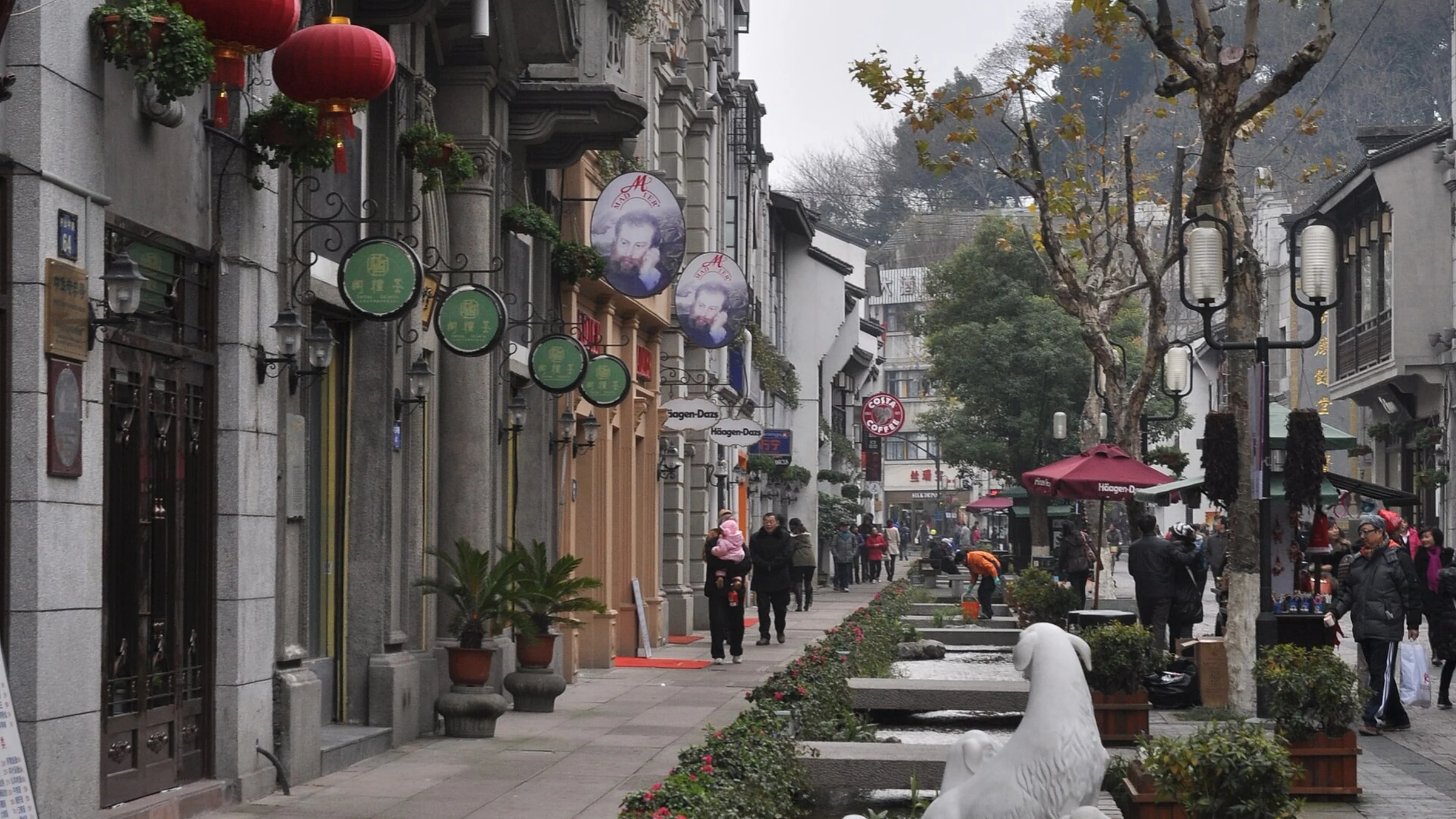
- 5 The upper-floor facades are the point: narrow two-storey shophouses with carved stone lintels and wrought-iron balcony rails, a style you will not find on the main retail frontage
- 6 Hu Xueyan's former residence, a National Key Cultural Relic Protection Unit, stands about 370 m south of this page's pin on Yuanbao Street - and is the single best reason to treat the district as more than a shopping walk
- 7 Free, with no gate, and open at all hours every day, so nothing here can be closed on you
- 8 Chinese Wikipedia's own caption for its district photograph is 'Hefang Street running through the Qinghefang district' - the clearest single statement of how these two places relate
Essential tips for foreigners
- This page and the Hefang Street page are not two different walks. Hefang Street is the main street inside this district, and the two published coordinates are about 265 m apart. Read this page if you want the lanes, the merchant houses and the sites off the retail frontage; read the Hefang Street page if you want the street itself, its shops and its evening lanterns. Doing both in one trip means walking the same spine twice - which is fine, but know that you are paying for it.
- Go after the lanterns, not before them. The lights come on around 19:00 in summer and 18:00 in winter and go off around 22:30, and the window between is when the lanes are worth walking. The same source notes the quarter is a loop rather than a line, which is the thing to know before you plan an evening here.
- Walk past the by-weight snack stalls. Travellers repeatedly flag stalls where a few yuan of fruit weighs out to ¥30-40 and a few slices of pork jerky to over ¥100, and 'free Longjing tea tasting' or 'street face-changing' performances that are hooks to seat you and upsell. The queue length is not a quality signal here.
- Eat in the side lanes, not on the frontage. Gao Yin Street sits about 160 m inside this district and is where locals go for proper Hangzhou cuisine; the main strip is for wandering and photographs.
- Bring your passport only if you are going into a ticketed site. The lanes themselves need nothing at all. If you visit Hu Xueyan's former residence, expect a separate ticket from the free walk around it.
- Do not assume the plaques are original. Much of this quarter is a restoration, so a carved sign may be modern. Take the buildings' age from a source, not from how weathered the stone looks.
Suggested route
- 18:00 15 min Arrive at Wushan Square on Metro Line 7 and walk east into the quarter as the lanterns come on - this is the western end and the busiest street-life of the district
- 18:15 45 min Turn off the retail frontage into the side lanes. This is the whole point of the district: the narrow grey-stone shophouse facades with their carved lintels and iron balcony rails, which are nothing like the main street
- 19:00 60 min Eat on Gao Yin Street, about 160 m inside the quarter, rather than on the main strip. This is the locals' lane for proper Hangzhou cuisine
- 20:00 50 min Walk south to Yuanbao Street for Hu Xueyan's former residence. It is a separate ticket from the free walk around it, and it is the single best interior site in the district
- 20:50 30 min Drift back up through the lanes toward Wushan Square under Wu Shan, or, if the lanterns are still on at 22:30, stay for them - the quarter does not close when the sites inside it do
What this is, and what it is not
The single most useful thing to get straight before you set out is that Qinghefang is a district and Hefang Street is a street inside it. They are not two places to choose between, and they are not two separate outings.
Chinese Wikipedia draws the line itself. The article on the street opens by telling you that 河坊街 is the whole street, and that if you want the historic district it passes through, that is 清河坊. The district’s own article illustrates it with a photograph captioned, in effect, Hefang Street running through the Qinghefang district. That is not a pedantic distinction; it is the difference between a shopping frontage and the old town that contains it.
Physically the gap is small. The coordinates this site publishes for the two sit about 265 metres apart, both on the same east-west axis. So you can walk from one to the other in five minutes. Which is exactly why it matters to read the page for the one you actually want: the street page covers the shops, the lanterns and the evening walk along the spine; this page covers the lanes behind it, the merchant houses and the sites inside the quarter.
The name, which is the best story here
Qinghefang is not named after a river, a gate or a market. It is named after a person.
The account Chinese Wikipedia gives is that in the third year of the Jianyan era, 1129, the Southern Song grand preceptor Zhang Jun defeated the Jin army at Mingzhou — modern Ningbo — in what is recorded as the Battle of Gaoqiao. He was rewarded for it, ennobled late in life as Prince of Qinghe, and built the Qinghe Prince’s mansion on what is now Taiping Lane on Hefang Street. The surrounding area took his title, and the district carries it.
It is worth sitting with that for a minute, because it reframes the quarter. This is not a mercantile space that happens to have acquired a commercial name. It is a district named after a twelfth-century court figure, which then spent eight hundred years becoming the place where Hangzhou traded.
Why the district is the thing worth visiting
Chinese Wikipedia describes Qinghefang as the most famous district in Hangzhou’s history and the only substantially intact old quarter the city still has. That is a much stronger claim than “old street”, and it is the reason the area was rebuilt as a district rather than left as a single thoroughfare. A local encyclopaedia entry goes further, describing it as the origin of China’s open street-and-lane urban pattern and placing it in the core of the Southern Song capital’s site, Lin’an.
The practical consequences are visible once you turn off the main road. The upper floors are the part that gets you: narrow two-storey shophouses faced in grey stone, with carved lintels over the doors, recessed window bays and wrought-iron balcony rails. Some lanes have a narrow cut-stone water channel running along them, edged with planters. On the photo used on this page, the wooded slope of Wu Shan rises directly behind the rooftops in mist, which is what gives the whole quarter its enclosed, valley-like feel.
None of that is on the retail frontage. If you only walk Hefang Street you are looking at a very good shopping street, and you will have missed the district.
What is inside the district
Hu Xueyan’s former residence (胡雪岩故居), about 370 m south of this page’s pin on Yuanbao Street, is the single best interior site. Hu Xueyan was the late-Qing “red-topped merchant”, and the house is a National Key Cultural Relic Protection Unit, designated in 2006 and folded into the same batch as his pharmacy. It stands on a 10.8-mu site, and its afterlife is as interesting as its owner: after his bankruptcy it passed to Wen Yu and then to the family of Jiang Yizhi, founder of Zhejiang Industrial Bank; after 1949 it housed a finance school, then a middle school, then an art college and a succession of performance troupes; in the late Cultural Revolution it was handed to a blade factory and used as both workshop and dormitory. It was restored from 2000 under Hangzhou Museum and finished the following year.
Hu Qing Yu Tang (胡庆余堂) stands on Dajing Alley (大井巷) inside the district. Chinese Wikipedia notes the large Republican-era painted advertisements for the pharmacy survive on the walls of Hefang Street and Nanshan Road — which is one of the reasons the street and the district are hard to separate visually even when they are easy to separate conceptually.
The caveat we owe you: we could not verify current ticket prices or opening hours for the ticketed sites inside this district. Hu Xueyan’s residence in particular is widely reported to charge, and one English source quotes ¥10 for the Hu Qing Yu Tang museum, but we could not confirm either figure against an official source this session. The free walk around them is genuinely free. Treat any interior ticket as something to confirm on the day.
Where it is, and how long it takes
The district covers roughly 220,000 square metres, with about 180,000 square metres of commercial floor area and a main street over 1,800 m long. Its bounds are given consistently: north to Xihu Avenue, south to the Drum Tower, west to Wushan Square, east to Zhonghe Middle Road. That is a real district, and it is why we budget two to three hours rather than one.
It sits at the northern foot of Wu Shan hill, immediately south-east of the southern end of West Lake. That position is the whole practical argument for visiting: it is not a trip you make, it is an evening you attach to a lake day. Metro Line 7 to Wushan Square is closest, with Hefang Street running east from the exit about a six-minute walk away.
The honest warnings
This is a popular quarter and the traps are well documented by people who have walked them.
- By-weight stalls. Fruit cups, pork jerky and similar are sold by weight from scales rather than menus, and travellers report a few yuan of fruit weighing out to ¥30-40 and a few slices of jerky to over ¥100. Walk past.
- “Free” tea tasting and street performances. The roadside free-Longjing-tasting offers and the face-changing shows are described by travellers as hooks to seat you and upsell.
- Restoration. Much of this quarter is rebuilt. A weathered carved plaque is not evidence of age. Where this page gives a date, it is sourced; where it cannot, it says so.
One thing to be clear about
The quarter never closes. Because there is no gate, there is also no last entry, and a lane that is lit and busy at 22:30 tells you nothing about whether the site you came for is still open. Plan the ticketed interiors for daylight and let the streets be whatever time you like.
Best photo spots
-
The side lanes behind the main retail street · Late afternoon into the hour after the lanterns come on
The upper floors are the subject: carved stone lintels, recessed window bays and wrought-iron balcony rails on two-storey shophouses, with red lanterns over the walkway and the wooded slope of Wu Shan behind the roofline. This is the material that distinguishes the district from the street.
-
The water channel running along the lanes · Whenever the paving is dry; the reflections are the point
A narrow cut stone channel lined with planters, with carved stone animal sculpture set beside it. It reads as a streetscape detail from the Ming and Qing period rather than as modern landscaping.
-
The junction of Hefang Street and the Southern Song Imperial Street · Blue hour, when the shop lights and the lanterns are both on
The Four Corners, where the district's two axes cross. This is the point this page is pinned at, and it is the place to stand to understand that the quarter is a crossroads rather than a corridor.
-
The wooded slope of Wu Shan above the quarter · Late afternoon, when the light drops and the hill goes misty
The district sits at the hill's foot, so the slope is present in almost every upward-looking frame and is what gives the lanes their enclosed, valley-like feel. On humid days the ridge disappears into cloud.
Where to eat nearby
-
Gaoyin Street (高银街) — the food lane
Hangzhou cuisine (杭帮菜), sit-down restaurants · Around ¥60-80 per head for three or four classic dishes, per a local comparison; cheaper street snacks a few lanes away run to a few yuan each · About 160 m west of this page's published coordinate, inside the district — geocoded by OpenStreetMap into the Qinghefang community of Shangcheng District
-
小饮与食·中华料理 (Xiaoyin Yushi, Gaoyin Street branch)
Chinese home-style cooking (中华料理) · Not published — treat as mid-range and check the posted menu · At No. 8 Liucuijing Lane (柳翠井巷8号), on the Gao Yin Street food lane inside the district
-
太极茶道苑 (河坊街店) — Tai Chi Tea Dao Yuan, Hefang Street branch
Tea house: traditional gongfu tea service with freshly made tea snacks (现制茶点) · Not published — tea houses in Hangzhou charge by the pot and by the seat, and this one does not publish a tariff · On Hefang Street itself at No. 184, beside the Four Corners junction, a few dozen metres from the district's crossroads
Frequently asked questions
What is Qinghefang, and how is it different from Hefang Street?
Qinghefang is the historic district; Hefang Street is the main street that runs through it. Chinese Wikipedia makes the distinction itself: the article on the street opens by telling you that if you want the whole street that is 河坊街, and if you want the historic district it passes through, that is 清河坊 - and its photograph on the district page is captioned 'Hefang Street running through the Qinghefang district'. In physical terms the two are about 265 m apart at the points this site publishes. So the street is the retail frontage inside the district, and the district is the whole grid of lanes around and behind it. They are worth separating because they are genuinely different experiences, not because they are different places.
Is Qinghefang free, and is there a ticket?
Free, and there is no ticket. It is public street with no gate, which is why it also has no closing time - Hangzhou's local listings give the scenic area as free with all-day access. You pay only for things you choose to buy or enter: the ticketed heritage sites standing inside the quarter, the shops, and the food. One English guide quotes ¥10 for the Hu Qing Yu Tang Chinese-medicine museum while saying the working pharmacy hall beside it is free to walk into, but we could not verify that figure against the museum or the district operator, so treat it as a planning number.
How long should I spend at Qinghefang?
Two to three hours for the district. It is roughly 220,000 square metres with a main street over 1,800 m long, and the layout is a loose grid rather than a single route, so the shopfront stretch, the restored facades and the interior sites are separate walks that add up. One hour is enough for a fast lap of the retail frontage and will leave you having seen the least interesting version of it.
Why is it called Qinghefang?
Not after a river. The name is traced to Zhang Jun, the Southern Song grand preceptor, who in 1129 defeated the Jin army at Mingzhou - present-day Ningbo - in the Battle of Gaoqiao, and was later ennobled Prince of Qinghe. He built the Qinghe Prince's mansion on what is now Taiping Lane on Hefang Street, and the surrounding area took the name from him. That is the origin Chinese Wikipedia gives, and it is a useful reminder that this quarter is named for a twelve-century court figure rather than for its trade.
What is actually worth seeing, beyond the shopping?
The upper-floor architecture on the side lanes - narrow two-storey shophouses in grey stone with carved lintels and wrought-iron balcony rails - and Hu Xueyan's former residence, a National Key Cultural Relic Protection Unit about 370 m south of this page's pin on Yuanbao Street. Hu Xueyan was the late-Qing 'red-topped merchant' whose pharmacy, Hu Qing Yu Tang, stands in the district too and whose residence passed through a school, an art college, several performance troupes and a blade factory before being restored from 2000. If you only have time for one interior site, that is the one. The tea angle is a separate trip altogether and has its own page on the China National Tea Museum.
Is Qinghefang worth visiting, or is it just a tourist street?
It is genuinely worth it, and the reason is that it is a district rather than a set piece. Chinese Wikipedia describes it as the only substantially intact old quarter left in Hangzhou, which is a much stronger claim than 'old street', and local sources describe it as the origin of China's open street-and-lane urban pattern. It is busy and commercial in the middle of the day and considerably better after dark, when the lanterns come on.
How do I get there, and can I visit on a Monday?
Metro Line 7 to Wushan Square (吴山广场) is closest, with Hefang Street running east from the exit about a six-minute walk away; Line 1 to Ding'an Road works too but is about a thirteen-minute walk. On days, there is no restriction at all: because there is no gate, the district is open every day including Mondays and Chinese public holidays. Only the ticketed sites inside it keep their own schedules.
Can I combine Qinghefang with West Lake?
Yes, and it is the natural way to do it. The district sits at the northern foot of Wu Shan hill immediately south-east of West Lake's southern end, so the sensible shape of an evening is a lake walk and then the quarter once the lanterns come on. It is a short taxi or a comfortable walk from the lake's south shore, which is what makes it an add-on rather than a journey.
Sources
- 清河坊 — Chinese Wikipedia (the district specifically: the most famous district in Hangzhou's history and the city's only substantially intact old quarter; its naming traced to the Southern Song Grand Preceptor Zhang Jun, who in 1129 defeated Jin troops at Mingzhou and was later ennobled Prince of Qinghe, and whose Qinghe Prince's mansion stood on today's Taiping Lane of Hefang Street; a Commons image captioned as Hefang Street running through the Qinghefang district; and Dajing Alley shown inside the district) · Wikipedia
- 河坊街 — Chinese Wikipedia (the Hefang Street / Qinghefang relationship in the clearest available form: its own About template distinguishes 整條河坊街, the whole street, from 清河坊, the historic district the street passes through; the street runs east from Jiangcheng Road to Nanshan Road and Orioles Singing in the Willows, its character section being Zhonghe Middle Road to Yan'an South Road; it stands at the foot of Wu Shan and is paired with Zhongshan Middle Road, the Southern Song Imperial Street, as the Four Corners; it was Hangzhou's most important commercial district from the Song to the early Republic; and Hu Qing Yu Tang stands on one side of it) · Wikipedia
- 上城区清河坊历史文化街区 — Baidu Baike (the district as a named heritage unit: at the northern foot of Wu Shan in Shangcheng District, inside the core of the Southern Song capital Lin'an site, described as the origin of China's open street-and-lane pattern, structured on Hefang Street and the Southern Song Imperial Street, covering about 220,000 square metres, and holding century-old brands including Hu Qing Yu Tang and Fang Huichun Tang) · baike.baidu.com
- 杭州清河坊街游玩攻略 — Hangzhou Bendibao, the city's local-government-affiliated information service (the district's bounds and size: core framework formed where Hefang Street crosses Zhongshan Middle Road, north to Xihu Avenue, south to the Drum Tower, west to Wushan Square, east to Zhonghe Middle Road, about 220,000 square metres with roughly 180,000 square metres of commercial floor area and a main street over 1,800 m long; and the scenic area's own listing as free with all-day opening at No. 180 Hefang Street) · hz.bendibao.com
- 【杭州清河坊】攻略2026_清河坊门票_地址 — Hangzhou Bendibao (the district attraction listing: address No. 180 Hefang Street, Shangcheng District, opening hours all day, admission free) · hz.bendibao.com
- 胡雪岩故居 — Chinese Wikipedia (Hu Xueyan's former residence, the district's principal interior site: at No. 18 Yuanbao Street in Shangcheng District, on a 10.8-mu site bounded by Niuyangsi Lane, Yuanbao Street, Yuanjing Lane and Wangjiang Road; residence of the late-Qing 'red-topped merchant' Hu Xueyan; Hangzhou municipal protection 1992, Zhejiang provincial 2005, National Key Cultural Relic Protection Unit 2006; after his bankruptcy it passed to Wen Yu and then to the family of Jiang Yizhi, founder of Zhejiang Industrial Bank; after 1949 it housed a finance school, a middle school, an art college and several performance troupes, then a blade factory; restored from 2000 by Hangzhou Museum, completed the following year; and a coordinate of 30.239722 / 120.168056) · Wikipedia
- 清河坊 (Q15503750) — Wikidata, cited because src/lib/attraction-coords.ts records this QID against the district; it is the real district item, typed as a historic district, and it carries no coordinate statement at all, which is why the published value is OSM-only at medium confidence · Wikidata
- 河坊街 (Q11141961) — Wikidata, cited for the same reason and as the district's main street item; also carries no coordinate statement · Wikidata
- 四拐角 (Four Corners), OpenStreetMap node 29593134 / 29559134, tagged name=四拐角 tourism=attraction at 30.2426088 / 120.1662607 — corroborating that the published district coordinate falls on the historic crossroads of Hefang Street and the Southern Song Imperial Street · openstreetmap.org
- Hangzhou — Wikivoyage (independent coordinates for three sites inside or beside the district, all consistent with the published pin: Huqingyutang Traditional Chinese Medicine Museum at 120.16426 / 30.24218, Former Residence of Hu Xueyan at 120.168056 / 30.239722, and Wushan Square at 120.16022 / 30.24102) · Wikivoyage
- Qinghefang & Hefang Street Hangzhou 2026 Guide — China for Travelers (an English-language editorial source, used for practicalities only: Line 7 to Wushan Square about a six-minute walk and Line 1 to Ding'an Road about thirteen; the lanterns lit at around 19:00 in summer and 18:00 in winter and off around 22:30, with 18:30-20:30 the best window; the quarter described as a loop rather than a line with Dajing Alley off the spine; the ¥10 Hu Qing Yu Tang museum figure; the by-weight snack-stall and 'free tasting' upsell warnings; and the advice that locals eat off the main strip on Gaoyin Street, Shiwukui Alley and Chengtou Alley) · chinafortravelers.com
- 高银街 (Gaoyin Street), OpenStreetMap via Nominatim — geocoded into 清河坊社区, 清波街道, 上城区, with the central segment at 30.2429788 / 120.1649555, about 160 m west of this page's published coordinate; corroborating that the locals' food lane named in the English guide really does sit inside the district · nominatim.openstreetmap.org

