Lingyin Temple (灵隐寺), Hangzhou
灵隐寺 · Língyǐn Sì
Quick answer
A passport is explicitly accepted, and this is spelled out rather than left to inference. The reservation notice says that mainland Chinese visitors may only book using their 身份证, while non-mainland visitors - which includes a foreign passport - book using one of the permitted travel documents: the Mainland Travel Permit for Hong Kong and Macau Residents, the Mainland Travel Permit for Taiwan Residents, the Residence Permit for Hong Kong, Macau and Taiwan Residents, the Foreign Permanent Resident ID Card, or a passport. You enter by presenting the ORIGINAL physical document for an identity-to-face comparison, so a photograph of the passport on your phone will not do it. Two practical consequences. First, book in advance: reservations open at 08:00 each day for the following seven days, there are no same-day bookings, and your booking is valid only for the date and slot you selected. Second, the system penalises no-shows hard - fail to check in by 17:00 on your booked day and you are recorded as a no-show, after which that document cannot book for 30 days, and repeat no-shows extend the block to 60 and then 90 days. On interpretation we are deliberately silent: we could not verify from any published source what signage, printed guides, audio interpretation or volunteer guiding is physically available at the site, so treat that as unconfirmed and bring a translation app.
Why visit
- 1 Admission has been free since 1 December 2025, when the Hangzhou West Lake Scenic Area Administrative Committee abolished the charge for the whole Lingyin-Feilai Feng area including this temple, Yongfu Temple and Taoguang Temple
- 2 Free is not the same as easy: a real-name timed reservation is mandatory, opens at 08:00 for the following seven days, is not available on the day, and is capped at 35,000 a weekday, 50,000 a weekend and 65,000 on a public holiday
- 3 A passport is an explicitly permitted booking and entry document, alongside the Hong Kong, Macau and Taiwan permits and the Foreign Permanent Resident ID - and you present the original for a face comparison at the gate
- 4 The Shakyamuni in the Mahavira Hall stands 24.6 m including its throne and is described as the largest wooden Buddhist statue in China, carved from camphor in 1956 and coated with 60 taels of gold
- 5 The Hall of Five Hundred Arhats has a bronze canopy 12.62 m high and 7.77 m wide that is described as the tallest solid bronze structure in the world, above 500 arhats each around a tonne on a swastika-shaped floor plan
- 6 The neighbouring Feilai Feng grottos, inside the same reservation, hold 153 shrines and more than 470 carvings in an area only 600 m by 200 m, 222 of them from the Northern Song
- 7 Two sutra pillars flank the entrance approach - the eastern one 7.17 m and the western one 11 m - both built in 969 under the Wuyue kingdom and moved to their present position in 1053
- 8 The temple survived the Cultural Revolution because local people and Zhejiang University students stopped its demolition in 1966, after which it was protected on the direct instruction of Premier Zhou Enlai
Essential tips for foreigners
- Book the reservation or you do not get in. It is free, but entry is by timed slot only: mini-programme 杭州灵隐飞来峰 on WeChat or Alipay, up to seven days ahead, quota opening at 08:00, no same-day bookings, and arrival outside your slot is refused at the gate.
- Carry the physical passport. It is a permitted booking document for non-mainland visitors and the original is required for the identity-to-face comparison at entry. A photo of it on your phone will not be accepted.
- A no-show costs you 30 days. Fail to check in by 17:00 on your booked day and that document cannot book again for 30 days; repeat offences extend it to 60 and then 90. Cancel properly if your plans change.
- Every older price you have read is wrong. The ¥75 that most guides quote - about ¥45 for Feilai Feng plus about ¥30 for the temple incense ticket - was abolished on 1 December 2025. If a booking screen offers you a paid ticket, you are on an out-of-date channel.
- Arrive before 17:00, not before 17:30. The published closing time is 17:30 but entry stops at 17:00, and verification stops half an hour before close. The slot rules bite too: the morning slot has a latest entry of 13:00 and the afternoon slot an earliest entry of 11:00.
- We could not confirm the temple vegetarian canteen, so do not build a day around it. Sources conflict on whether the public temple canteen is currently serving. Confirm before you travel, and see the section below for what we did and did not find.
- Budget two to three hours for the halls, more if you walk Feilai Feng. The axis runs uphill and each hall is quick; the time goes on the stairs and courtyards, and the grotto field is a separate 600 m stretch of its own.
Suggested route
- 07:30 15 min Arrive inside your booked slot. Pass the screen wall inscribed 咫尺西天 at the entrance; note Elder Li's Pagoda (理公塔) just inside, which holds the ashes of Huili
- 07:45 60 min Walk the Feilai Feng grottos on your left and Lingyin Hill on your right. Do the grotto field now, while it is quiet, rather than after the halls
- 08:45 30 min Climb to the Hall of the Four Heavenly Kings, the formal entrance: look for the 雲林禪寺 plaque written by the Kangxi Emperor, the Laughing Buddha, and the 800-year-old Weituo at the back
- 09:15 45 min Cross the courtyard to the Mahavira Hall. It is 33.6 m tall with a triple-eaved roof; inside, take in the 24.6 m Shakyamuni and then the Avatamsaka Sutra panorama on the rear wall
- 10:00 30 min Detour left into the Hall of Five Hundred Arhats for the 12.62 m bronze canopy at the centre of the swastika plan
- 10:30 30 min Carry on uphill to the Dhyani Hall of the Medicine Buddha (藥師殿), and the Hall of Ji Gong to its east with the 2.3 m, 2.5-tonne bronze monk
- 11:00 30 min Finish the axis at the Sutra Library and the Huayan Hall, both built 2000-2002 to recreate the five-hall layout that the original temple no longer had intact
- 11:30 45 min Descend and eat, or head back out towards the lake. If you have booked the afternoon slot rather than the morning one, you will have been admitted from 11:00 instead
What this place actually is
Two things share one name and one ticket here, and conflating them is the most common mistake people make.
The temple is Lingyin (灵隐寺), a Chan Buddhist monastery founded in the Eastern Jin and set in wooded hills west of West Lake. It is one of the largest and wealthiest monasteries in China, and for most of the last century it has been as much a working religious institution as a monument.
The scenic area around it, marketed since 1999 as the Lingyin-Feilai Feng Scenic Area (灵隐飞来峰景区), is bigger than the temple and includes the Feilai Feng limestone grotoes in front of the temple proper, plus Yongfu Temple and Taoguang Temple on the slope. From 1 December 2025 all of it is covered by a single free admission and a single timed reservation. You are not buying a temple ticket and a grotto ticket. You are booking a slot.
It is free now, and that is the single most useful fact on this page
From 1 December 2025, the Hangzhou West Lake Scenic Area Administrative Committee abolished the admission charge for the entire Lingyin-Feilai Feng area. The notice is explicit about scope: the scenic area including Lingyin Temple, Yongfu Temple and Taoguang Temple is now 免票 — free of charge — under a real-name, timed-entry reservation system.
The reservation rules were then reissued as version 2.0, updated January 2026 and in force from 1 February 2026.
If you are budgeting from an older figure, check it. The ¥75 that appears on most guides and on this site’s own seed data was the pre-December-2025 combined charge: roughly ¥45 for the Feilai Feng scenic area plus roughly ¥30 for the temple’s 香花券, or incense-and-flower ticket. That is no longer what a visitor pays. The ¥30 incense-ticket instruction still appears on an older announcement page on the temple’s own website, which is why you will still find it if you search — it is superseded, not current.
What free does not mean:
- It does not mean you can walk in. Booking is mandatory.
- There is no separate paid tier to upgrade to, and no paid add-on we could verify.
- Incense, lamps and offerings inside the halls are donations at the altar, not admission. We could not verify whether any specific hall or ritual, such as the 法喜讲堂, carries its own separate charge — ask at the gate rather than assume it is included.
The booking is the actual hard part
Everything about this visit now turns on the reservation, so it is worth reading the mechanics rather than skimming.
Where. One mini-programme, named 杭州灵隐飞来峰, searched on WeChat or Alipay. Not a website, not a third-party app.
When. Up to seven days ahead. The quota for the next seven days opens at 08:00 each day and is allocated until it runs out. Same-day bookings are not accepted. A successful booking is valid only for the date and slot you selected.
How much there is. 35,000 a day on weekdays, 50,000 at weekends, 65,000 on public holidays, tour groups included. Those numbers are why the site is described as free and yet is hard to get into on a holiday — and why the current reservation policy says to book when the quota opens rather than when it suits you.
Which slot. Two: morning 07:30–12:00, afternoon 12:00–17:00. Then two extra constraints that catch people — the morning slot’s latest entry is 13:00, and the afternoon slot’s earliest entry is 11:00. You cannot arrive at 12:30 with a morning booking and stroll in without a question.
Who. Real name, and a document number that will be checked. Mainland visitors may use only a national ID card. Non-mainland visitors may use the Mainland Travel Permit for Hong Kong or Macau Residents, the Mainland Travel Permit for Taiwan Residents, the Residence Permit for Hong Kong, Macau and Taiwan Residents, the Foreign Permanent Resident ID Card, or a passport. Up to 5 visitors per account, each needing their own name and document number; one document books once per day. Minors under 14 must be booked by an adult, and each adult may bring up to 3.
At the gate. Present the original physical document for an identity-to-face comparison. Verification stops half an hour before closing. One document may enter and leave only once.
If the quota is full. The system opens a waitlist automatically. Register by 20:00 the day before your intended visit; allocation runs automatically from 17:00 until 22:00 and the result arrives as a WeChat or Alipay service message. Waitlisted parties pass face verification.
If you do not turn up. This is the harshest rule on the page. Fail to check in by 17:00 on your booked day without cancelling by 17:00 the day before, and it is recorded as a no-show. That document then cannot book or join the waitlist for 30 days. Two no-shows extends it to 60 days, three to 90, and it escalates from there. If your plans change, cancel.
A 24-hour consultation and rescue line is published on 0571-87969691.
What you walk through, in order
The main axis is a five-hall Chan arrangement climbing Lingyin Hill, and the shape matters because it means you are walking uphill all morning.
At the front is the Hall of the Four Heavenly Kings (天王殿), a double-eaved building whose plaque reads 雲林禪寺 and was written by the Kangxi Emperor. Inside, the Laughing Buddha sits at the front and, at the back facing up the hill, is the dharmapala Weituo — a Southern Song statue, roughly 800 years old, described as the oldest and most important statue in the temple. The four heavenly kings flank it.
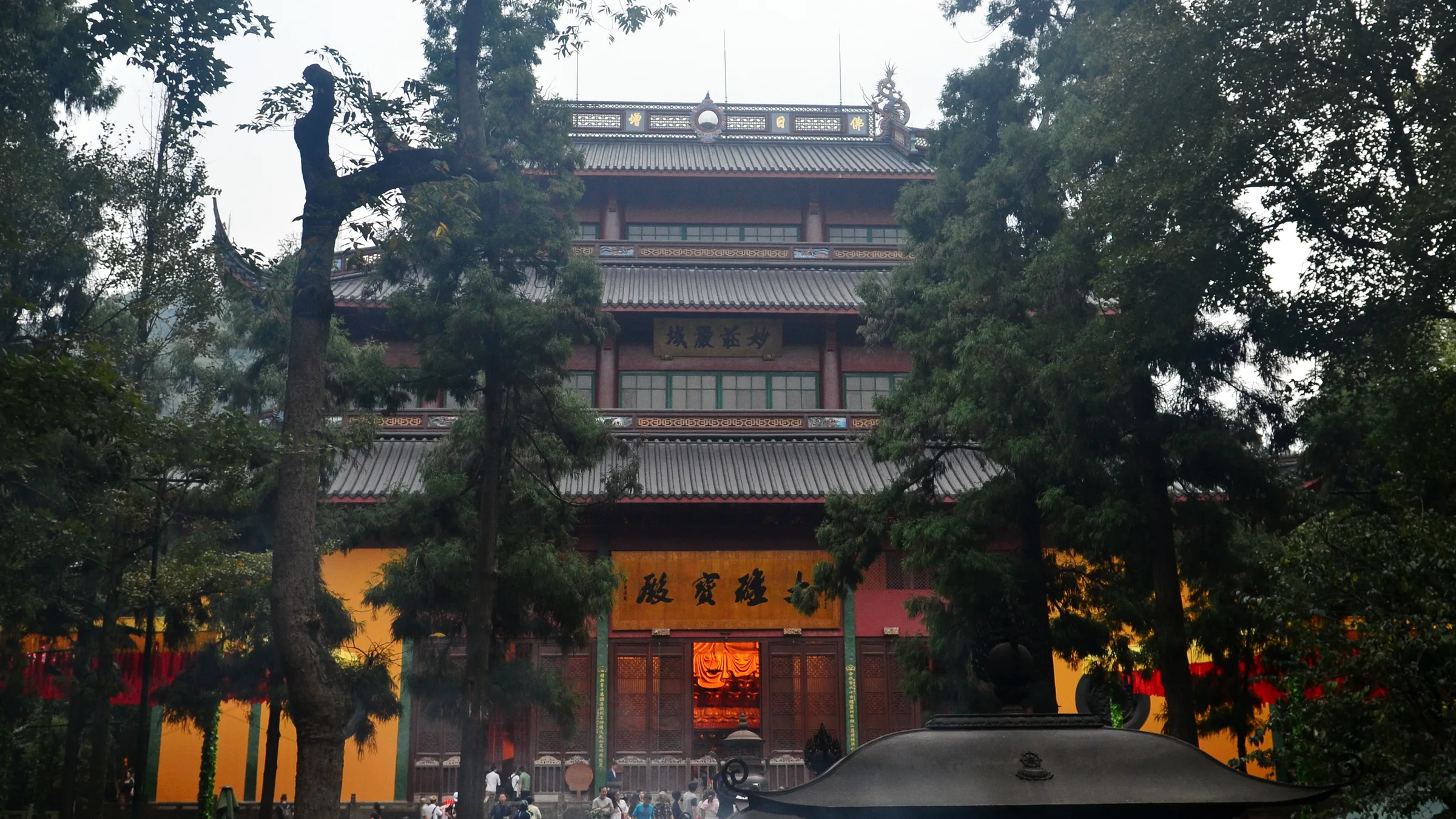
Then the Mahavira Hall (大雄宝殿), the principal hall: 33.6 m tall with a triple-eaved roof, interior height about 30 m, with a gilded ceiling of bas-relief Buddhist symbols. Inside is a Shakyamuni figure 24.6 m high including its throne, carved from camphor wood in 1956 in Tang style and coated with 60 taels of gold — described as the largest wooden Buddhist statue in China. Along each side stand the Twenty-Four Protective Deities, with the Eighteen Arhats and bodhisattvas including Zhunti along the walls. Behind the main figure is a panorama of the penultimate chapter of the Avatamsaka Sutra, centred on the bodhisattva Guanyin, built from more than 150 clay sculptures of Sudhana’s pilgrimage and containing figures including Ji Gong.
To the left of that courtyard is the Hall of Five Hundred Arhats (五百罗汉堂), a modern addition with a floor plan in the shape of a Buddhist swastika, 500 bronze arhats each about 1.7 m high and roughly a tonne, and at the junction a solid bronze canopy 12.62 m high and 7.77 m wide holding the four principal bodhisattvas — described as the tallest solid bronze structure in the world.
Above the Mahavira Hall comes the Dhyani Hall of the Medicine Buddha (藥師殿) and, to its east, the Hall of Ji Gong, whose bronze Ji Gong is 2.3 m tall and 2.5 tonnes, flanked by eighteen murals of his life each 3 m by 3 m running 50 m in total. Then the Dharma Hall, whose present building was put up in 1446 by a monk named Xuanli, with the temple’s cultural relics exhibition in its basement — 638 square metres and over 40 showcases. The Sutra Library and Huayan Hall at the top were built between 2000 and 2002.
That last point is worth internalising before you go: the five-hall axis is largely a modern recreation. Only the front three halls are original Qing work. The upper two were built twenty-odd years ago to restore a layout the temple had lost. You are looking at a rebuilt top, not an ancient one.
Before the hall, in the approach, stand the two sutra pillars. The eastern is 7.17 m, the western 11 m. Both were built in 969 under the Wuyue kingdom, both are carved with the Uṣṇīṣa Vijaya Dhāraṇī Sūtra and reliefs, and both were moved to their present position in 1053.
Feilai Feng is the older thing, and it is the better half
The grotoes in front of the temple are not a later Buddhist addition — they are the older, more interesting half of the site, and they are inside the same reservation.
The name means the Peak That Flew Hither. The story says the limestone came from India overnight to demonstrate the power of Buddhist law. The statues inside do not, which is part of why the field matters: it is where the Indian Buddhist sculptural tradition, the Chinese imperial style, and Tibetan and Mongolian Buddhist art sit against each other in one hillside.
The numbers are startling for the size. The field measures 600 m by 200 m and contains 153 shrines and more than 470 carvings, of which 338 are relatively well preserved. Around 96 are Yuan dynasty, 222 are Northern Song, and about 11 date from the late Tang and Five Dynasties period — those last are recognisable because they depict the Three Saints of the West, the Pure Land triad of Amituofo with Guanyin and Mahasthamaprapta. Yuan work carries visible Tibetan and Mongolian influence alongside Tang and Song styles. The named caves are the Qinglin Grotto, the Yuru Grotto and the Longhong Grotto. In the main cave dedicated to Guanyin there is a crack in the ceiling that admits a sliver of daylight to anyone standing in the right spot, known as the one thread of heaven (一线天).
The single largest shrine is to Budai as Maitreya with the Eighteen Arhats, 3.6 m high and 9.9 m long.
A founding date we cannot settle
The temple is universally dated to the fourth century, Eastern Jin, founded by an Indian monk named Huili — whose literal name in Chinese means “the soul’s retreat,” which is where the common English rendering Temple of the Soul’s Retreat comes from.
But the sources do not agree on the year. English Wikipedia, and most travel writing, give 328 AD. The temple’s own website says the temple was founded in the first year of the Xianhe era, which it renders as 326 AD.
We are not going to adjudicate a two-year discrepancy in the fourth century on the temple’s own doorstep. Both figures are in wide circulation. If you need one for a citation, the temple’s official statement is 326 AD.
What the temple became
Under the Wuyue kingdom (907–978) Lingyin was at its height, with 18 pavilions, 72 halls, more than 1,300 dormitory rooms and over 3,000 monks. Many of the rich carvings at Feilai Feng and the surrounding hills date from that period. Under the Southern Song it was counted among the ten most important Chan monasteries in the Jiangnan region.
It has been rebuilt no less than sixteen times since then, and much of what stands is late Qing restoration rather than medieval fabric.
The twentieth century nearly ended it. During the Cultural Revolution the temple was damaged by the Red Guards, and the planned demolition in 1966 was stopped by local people and students from Zhejiang University, who had been galvanised by the Guards’ ransacking of the nearby tomb of the patriotic general Yue Fei. The temple was subsequently given protection by direct instruction from Premier Zhou Enlai. It is now regularly described as one of the wealthiest monasteries in China.
The vegetarian canteen: contested, and we will not pretend otherwise
This gets written about as a fixed feature of a visit, and we are deliberately not repeating that.
What we found, in summary:
- One source states that the temple’s outward-facing canteen service is currently suspended, gives no reason, and does so without a date — while in the same passage saying that in-temple vegetarian service such as Shifangyuan (十方苑) vegetarian noodles remains available to visitors.
- Another source describes Shifangyuan as the temple’s only official vegetarian canteen, serving from opening time until 14:00, with no reservations taken.
- The temple’s own website runs a 云林素食 section, but that publishes recipes, not a service schedule or opening hours.
Every one of those is a secondary source. None is dated. None is the temple’s own notice. Two of them contradict each other on the central question of whether the public canteen is running.
So: we have not listed a temple canteen in the recommendations below, because we cannot honestly tell you it is open. Before you build a day around it, call the reception on 0571-87968665. What we can point you to instead is the vegetarian restaurant listed below, which is inside the complex but is a hotel restaurant rather than the temple’s canteen.
Getting there
We are not going to invent a metro instruction. We could not verify a published metro route for this site from an official source, so we leave it out rather than publish something plausible and wrong.
What we can verify is that bus 7 runs toward the temple from central Hangzhou — the temple’s own site describes a family pilgrimage day taking bus 7 along Xixi Road, through the Lingxi tunnel, to the temple. A taxi or Didi to 灵隐路法云弄1号 is the easy fallback; show the driver 灵隐寺 and they will know the gate.
The thing to understand about location is that the temple is west of West Lake, backed by Beigao Peak and facing Feilai Feng, in wooded hills. It is not on the lake shore and not in the old city. Allow more time from central Hangzhou than the crow-flies distance suggests, and remember that your arrival window is fixed by a booking slot whether or not you get there quickly.
We also could not verify published parking capacity, tariff or hours for this site, and have left them out. Driving does not help you get in: the site is capped by a daily quota and entered by a timed slot.
Eating near the temple
The recommendations are below, and all three are within walking distance. Two honest warnings.
First, we could not verify published price ranges for any of them, so treat the ranges as rough categories rather than figures.
Second, and this is worth knowing before you sit down: Zhejiang provincial news outlet 潮新闻 reported specifically that some small shops near Lingyin have altered their cooking substantially to suit tourists, losing the authentic Hangzhou flavour, and recommends choosing an older, wok-fired local kitchen over a spot known for “internet-famous modernised dishes” if you want to eat what a local eats. That is a better guide than any list of ours.
One caution about the image on this page
The hero photograph shows the Mahavira Hall, identified by the 大雄寶殿 plaque and the three-eaved roof, and corroborated by the Commons description of the source file as 灵隐寺大雄宝殿. It is a different photograph from this site’s pre-existing Lingyin image, which shows the Medicine Buddha Hall; the two were compared after downscaling to confirm they are not the same shot, and both appear in the gallery above.
That check was worth doing. This repository has been burned before by files named after one place showing something else entirely, and one Commons file categorised as Leifeng Pagoda — inspected while building the companion page — turned out to be a photograph of a bronze incense burner.
Best photo spots
-
The Mahavira Hall from below, through the trees · Late afternoon, when the low sun rakes across the three eaves and the hall's yellow walls separate from the foliage behind
The angle in this page's hero image is the one worth copying: stand below and to the side of the hall on the approach, and frame it through the tree trunks rather than straight on. The 大雄寶殿 plaque reads right to left.
-
The two sutra pillars in front of the Hall of the Four Heavenly Kings · Morning, when the light is still low and the carved reliefs on the pillars catch it side-on
The eastern pillar is 7.17 m and the western 11 m, both carved in 969 under the Wuyue kingdom and moved here in 1053. The height difference between them is the reason to include both in one frame.
-
The Feilai Feng grotto field, especially the Qinglin Grotto · Early morning or late afternoon; midday light flattens the reliefs on the limestone
The carvings sit in shaded clefts in the rock, so they photograph best when the sun is raking in from the side. The Budai-as-Maitreya shrine with the Eighteen Arhats is the largest at 3.6 m by 9.9 m and the obvious target.
-
The entrance screen wall with the 咫尺西天 inscription · Any time; the characters are shaded and legible rather than sunlit
The inscription reads roughly 'Western Heaven is within reach', a phrase with a long history on Chinese Buddhist approaches. It is the first thing you pass and the natural place to shoot your arriving companions.
Where to eat nearby
-
Yunlin Vegetarian Restaurant (云林斋菜), inside the Aman Fayun hotel in the Lingyin complex
Vegetarian, served as a set menu rather than a la carte · High-end; we could not verify a published price range, so treat this as a special occasion rather than a lunch stop · Inside the temple complex at Fayun Lane, effectively on your way in and out
-
Tianzhu Renjia, Hangzhou home cooking (天竺人家·杭州土菜)
Hangzhou local home cooking (杭帮土菜), stir-fried to order · Moderate; we could not verify a published range, so budget as a mid-priced local restaurant · Roughly 1 km from the temple, on foot
-
Zhiwei Xiaoguan, Bailleqiao branch (知味小馆·白乐桥店)
Hangzhou-style small dishes · Moderate; we could not verify a published range · About a 10 to 15 minute walk from the temple, on the Bailleqiao side
Frequently asked questions
How much does Lingyin Temple cost?
Free. From 1 December 2025 the Hangzhou West Lake Scenic Area Administrative Committee abolished the admission charge for the whole Lingyin-Feilai Feng scenic area, which explicitly includes Lingyin Temple, Yongfu Temple and Taoguang Temple. The figure most guides still quote is ¥75, made up of roughly ¥45 for the Feilai Feng scenic area and roughly ¥30 for the temple incense ticket. That is the pre-December-2025 price and it no longer applies. What free does not mean is turn-up-and-walk-in: a real-name timed reservation is now mandatory.
Do I need to book Lingyin Temple in advance, and how far ahead?
Yes, and up to seven days ahead. Book through the mini-programme named Hangzhou Lingyin Feilai Feng (杭州灵隐飞来峰) on WeChat or Alipay. The daily quota opens at 08:00 for the following seven days and is allocated until it runs out. Same-day reservations are not accepted, and a booking is valid only for the date and time slot you selected. If the quota is full you can join the waitlist, registering by 20:00 the day before.
Can a foreigner book and enter with a passport?
Yes, and the notice names it. Mainland visitors may only book with a national ID card; non-mainland visitors may use the Mainland Travel Permit for Hong Kong or Macau Residents, the Mainland Travel Permit for Taiwan Residents, the Residence Permit for Hong Kong, Macau and Taiwan Residents, the Foreign Permanent Resident ID Card, or a passport. At the gate you present the original physical document for an identity-to-face comparison. Up to 5 visitors can be booked per account, each with a name and document number.
What time does Lingyin Temple open, and can I get in late?
07:30 to 17:30, with entry stopping at 17:00. The reservation is split into a morning slot of 07:30-12:00, whose latest entry is 13:00, and an afternoon slot of 12:00-17:00, whose earliest entry is 11:00. Verification stops half an hour before closing, and one document may enter and leave only once per day. There are no published closure days.
Is Lingyin Temple suitable for children, and are there discounts?
Since admission is free there is no price to discount, but there are booking rules that matter for families. Minors under 14 must be booked by an adult and each adult may bring up to 3. Every visitor, adult or child, needs their own name and document number against the reservation, and each document may book once per day. If you are booking from abroad, that means a passport or other permitted travel document for each child, not just the adults.
What is actually at Lingyin Temple worth seeing?
The Mahavira Hall first: 33.6 m tall with a triple-eaved roof, and inside it a 24.6 m Shakyamuni carved from camphor in 1956 that is described as the largest wooden Buddhist statue in China, with a rear-wall panorama of the Avatamsaka Sutra built from more than 150 clay figures. Then the Hall of Five Hundred Arhats with its 12.62 m bronze canopy, and the Medicine Buddha Hall above them. In the entrance approach, stop at the two sutra pillars - 969 AD, moved in 1053 - and at Elder Li's Pagoda near the gate, which holds the ashes of Huili, the Indian monk who founded the temple.
Is the vegetarian temple lunch still served?
We could not confirm it, and we are not going to tell you it is running when our sources disagree. One source states that the temple's outward-facing canteen service is currently suspended with no reason given, while still saying that vegetarian noodle service such as that at Shifangyuan inside the temple remains available to visitors; another describes Shifangyuan as the temple's only official vegetarian canteen serving from opening until 14:00. Both are secondary sources rather than the temple's own notice, and neither is dated. Confirm directly with the temple on 0571-87968665 before you build a day around it.
What is the relationship between Lingyin Temple and the Feilai Feng grottoes?
One reservation covers both, which is the change that catches people who read the old ¥45 plus ¥30 pricing. Feilai Feng - the Peak That Flew Hither - lies in front of the temple proper, and the whole area is now marketed and ticketed as a single Lingyin-Feilai Feng scenic area under one free admission and one timed booking. The grotoes themselves are the older thing: 153 shrines and more than 470 carvings in an area 600 m by 200 m, with 222 from the Northern Song and the largest being a 3.6 m by 9.9 m shrine to Budai as Maitreya with the Eighteen Arhats.
How long should I allow, and can I combine it with West Lake?
Two to three hours for the halls alone and three to four with Feilai Feng and the hill, because the main axis climbs and each hall is a short stop. Combining with West Lake is easy in principle - the temple sits at the western end of the lake area - but the reservation fixes your arrival window, so book a specific slot and plan the lake either before it or after it rather than trying to float in. The 17:00 entry cut-off is the constraint that decides the shape of the day.
Sources
- Hangzhou West Lake Scenic Area Administrative Committee, 杭州灵隐飞来峰景区预约游览须知 2.0 (official notice, published 29 January 2026, in force from 1 February 2026 — the source of the free admission from 1 December 2025 under the 免票 notice, the 07:30-17:30 hours with 17:00 last entry, the morning and afternoon slots and their entry limits, the seven-day advance booking window opening at 08:00 with no same-day booking, the daily caps of 35,000/50,000/65,000, the five-visitors-per-account and three-minors-per-adult limits, the passport as a permitted booking and entry document for non-mainland visitors, the face-comparison entry rule, the categories exempt from booking, the no-show penalty schedule, the waitlist, and the 24-hour line 0571-87969691) · Government of the PRC
- Lingyin Temple official website, announcement page (the temple's own publication of the same free-admission and reservation regime, confirming independently of the government site that the scenic area including Lingyin Temple is now 免票 under real-name timed-entry booking, with the 07:30-17:30 hours and 17:00 last entry) · Lingyin Temple (Hangzhou)
- Lingyin Temple official website, front page (the temple's own published address 浙江省杭州市灵隐路法云弄1号 310013, reception 0571-87968665, fax 0571-87960292, the official site URLs lingyinsi.org and lingyinsi.com, and the founding statement 始建于东晋咸和元年 公元326年 — which is the source of the 326 AD founding date noted as disagreeing with the 328 AD date elsewhere on this page) · Lingyin Temple (Hangzhou)
- Lingyin Temple, Hangzhou — English Wikipedia (founded 328 AD in the Eastern Jin by the Indian monk Huili; the common literal translation Temple of the Soul's Retreat; Chan Buddhism in the Wulin Mountains; the Wuyue-era peak of 18 pavilions, 72 halls, over 1,300 dormitory rooms and more than 3,000 monks; rebuilt no less than sixteen times since the Southern Song; the Cultural Revolution damage, the 1966 destruction halted by local people and Zhejiang University students and the resulting Zhou Enlai protection; the architecture of every hall from the Hall of the Four Heavenly Kings with its Kangxi plaque and 800-year-old Weituo, through the 33.6 m triple-eaved Mahavira Hall with its 24.6 m 1956 camphwood Shakyamuni, the Medicine Buddha Hall, the Ji Gong bronze, the 1446 Dharma Hall and its 638 sqm reliquary, the 2000-2002 Sutra Library and Huayan Hall, and the Hall of Five Hundred Arhats with its 12.62 m bronze canopy; the two sutra pillars built in 969 and moved in 1053; and the Feilai Feng grotto statistics) · Wikipedia
- 灵隐寺 (Q1070228) — Wikidata (checked specifically because this repository has previously held coordinates taken from Wikimedia disambiguation pages: this item is NOT one. English description 'temple in Hangzhou, Zhejiang, China', P31 Buddhist temple, P131 Hangzhou, Commons category Category:Lingyin Temple, official site lingyinsi.org, and its own coordinate statement of 30.24277778 / 120.09666667) · Wikidata
- Hangzhou Lingyin-Temple 20161003.jpg, Wikimedia Commons (CC BY-SA 4.0, Tyg728, own work, 3 October 2016 — the source of the hero image used on this page, described on Commons as 灵隐寺大雄宝殿, the Lingyin Temple Mahavira Hall) · Wikimedia Commons
- Leifeng Pagoda, Hangzhou — English Wikipedia (cited for the pre-2025 structure of this visit: the entrance screen wall inscribed 咫尺西天, Elder Li's Pagoda (理公塔) near the entrance holding Huili's ashes, Feilai Feng lying in front of the temple proper, and the Feilai Feng grotto field measuring 600 m by 200 m with 153 shrines and more than 470 carvings of which 338 are well preserved, 96 from the Yuan dynasty, about 11 from the late Tang and Five Dynasties period, 222 from the Northern Song, and the largest shrine at 3.6 m by 9.9 m being Budai as Maitreya with the Eighteen Arhats, plus the Qinglin, Yuru and Longhong grottoes and the 'one thread of heaven' crack in the Guanyin cave) · Wikipedia
- 杭州灵隐飞来峰景区预约游览须知 — Hangzhou Bendibao local information service (corroborating the same mini-programme booking route and the seven-day advance, no-same-day rule, independently of the two official notices above) · hz.bendibao.com
- 云林斋菜 restaurant listing, 城市惠 (the source for the Yunlin vegetarian restaurant being located inside the Aman Fayun hotel within the Lingyin complex and being run as a set-menu vegetarian restaurant, cited here as the basis for a food recommendation rather than as a claim about the temple's own canteen) · cityhui.com
- 2026 灵隐寺附近美食推荐, 潮新闻 tidenews.com.cn (Zhejiang provincial news outlet — the source for Tianzhu Renjia Hangzhou home cooking being a local-cuisine restaurant within roughly 1 km of the temple, and for its report that some shops near the temple cater to tourists at the expense of Hangzhou authenticity) · tidenews.com.cn