
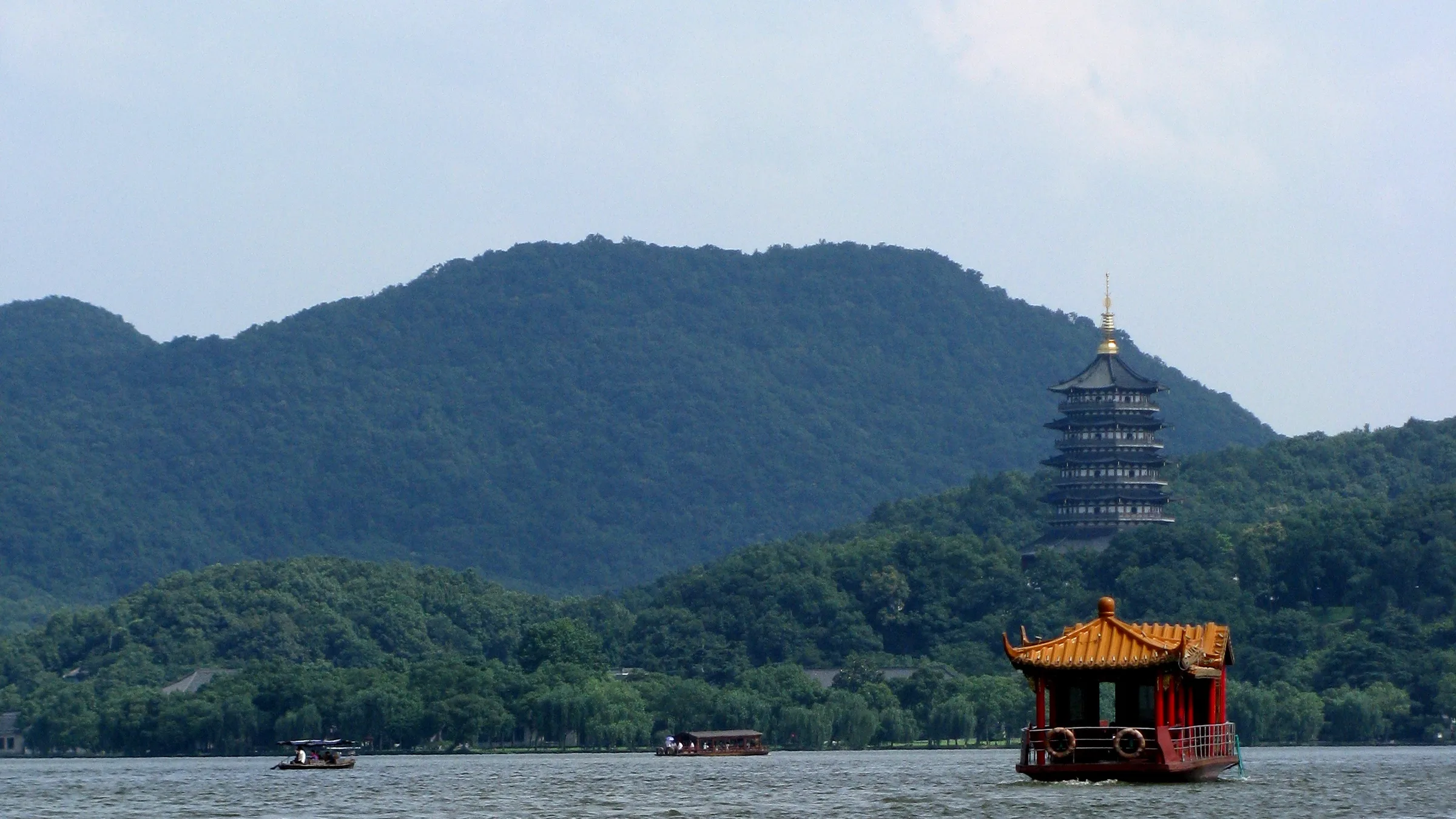
West Lake Boating (西湖游船), Hangzhou
西湖游船 · Xī Hú Yóu Chuán
Quick answer
Nothing published for this service requires a passport. That is the honest and genuinely useful finding: the regular routes are bought at the pier booth for a cash or mobile fare, with no real-name booking, no advance reservation and no identity document named in any of the published route, fare or pier instructions we retrieved. Carry your passport anyway for the rest of the Hangzhou trip, because the temples and pagodas on the shore do ask for it and you will be walking off the boat and into them. On interpretation we are deliberately silent: we could not verify from any published source what signage, commentary or audio interpretation is available on board or on the island, so bring a translation app and do not assume either way. The practical foreign-visitor risk here is not identity, it is the queue and the weather.
Why visit
- 1 There are two fares for one journey, not one fare: ¥55 on the standard leisure boat and ¥70 on the deluxe leisure, painted-boat and new-energy hulls, both landing you on the same islet and bringing you back
- 2 The ¥70 fare includes the ¥20 island admission; time on Lesser Yingzhou Islet is unlimited and the return leg is part of the ticket, so the boat is not what sets your schedule
- 3 The hop-on hop-off circuit is a different product entirely: ten named stops around the rim, 40-seat leisure boats, ¥6 or ¥8 a segment and ¥70 for the whole loop, and it never touches the island
- 4 Nine piers serve the island route, including Two Park and Five Park on Hubin Road, a short walk from Line 1 - but the deluxe Song-style circuit boards from Five Park only
- 5 The standard leisure boat was the bargain here: 40-seat hulls, ¥30 an hour for a five-seat self-rowed boat at Six Park, and a six-seat hand-rowed boat with a boatman at ¥150 an hour
- 6 No passport, no booking, no advance channel. You buy at a pier booth, and every booth has its own published telephone number for asking whether sailing is actually on
Essential tips for foreigners
- Decide between ¥55 and ¥70 before you queue, not at the window. Both reach the same islet. The ¥70 buys you a deluxe hull, not a better island.
- The island admission is bundled, so do not pay for it twice. On the ¥70 fare the ¥20 island entry is included. There is no separate island gate to pay at on the way out.
- Read the four seasonal windows, because they differ by nine hours a day. The booth is open until 17:00 only between April and August; from mid-November to mid-February it shuts at 16:00. Arrive at 16:30 in winter and the booth has closed.
- There is no published departure time. The windows above are ticket-sales hours, and the last boat leaves before the window ends. Board early rather than treating the closing time as a sailing.
- In bad weather the boats stop and the notice comes from the Water Area Administration, not the booth. If your morning is not on the water, ring the pier nearest your hotel first.
- Do not plan dinner on the islet. It has the pagodas and the moonlight scene and effectively nothing to eat. Eat in the Hubin Road or Gushan Road restaurant strip at the pier you land at.
- If you want the covered hand-rowed boat with a boatman, that is ¥150 an hour for the whole six-seat hull - the per-hour figure buys the boat, not a seat. Shared between four is around ¥38 a head.
Suggested route
- Day before 5 min Ring the pier nearest your hotel. Every booth has a published number and the one question that matters is whether sailing is actually running in the weather you are going to get
- 08:00-09:00 20 min Be at One Park or Five Park when the booth opens rather than at midday, which is the difference between a short queue and a long one on the same lake
- Boarding 15 min Buy at the booth: ¥55 on the standard leisure hull or ¥70 on the deluxe, painted-boat or new-energy hull. Both land on the same islet, so choose on the boat you want to sit in
- Outbound leg 20 min Short crossing to Lesser Yingzhou Islet. Sit outside if the weather is clear - this is the stretch where the shoreline pagodas and the wooded ridges read as a sequence
- On the islet 45-90 min Walk to the three stone pagodas, which is the scene the island is named for, then take as long as you like - the ticket sets no limit and the return boat is included, so it is your call when to go back
- Return leg and landing 20 min Back to the same or a different pier. Note that the island route boards from nine piers, so in principle you can land away from where you left; we could not verify from any published source that a one-way island ticket is actually sold, so assume you return to a boat you can find
- Afterwards 60-90 min Eat on the shore. Lou Wai Lou at 30 Gushan Road is across the road from the Zhongshan Park pier; Zhi Wei Guan at 83 Renhe Road is near the Two Park and Five Park piers
This page is about the boat. The lake has its own page.
West Lake is free, needs no ticket, and is walked. Causeways, ten named scenes, temples in the hills, a UNESCO cultural landscape. That is west-lake-hangzhou, and none of it is repeated here.
What is here is the part of the lake you can only learn by getting onto the water: which hull you are buying, which route reaches what, whether the island stop is worth the queue in front of you, and how the whole thing behaves when the weather turns.
The distinction matters more than it sounds. Boating is a paid service with its own operators, its own price list and its own authority - the Hangzhou West Lake Water Area Administration - and the harbour authority that runs it is not the scenic-area authority that manages the shore. You can spend three days on this lake and never touch any of it.
Two fares for one journey
This is the first thing to get right, and almost nobody does, because the two prices sit next to each other in the same sentence at the pier.
The island-landing route - 上岛游 - takes you out to Lesser Yingzhou Islet, 小瀛洲, which is the islet of Three Pools Mirroring the Moon, and brings you back. On the standard leisure boat (普通休闲船) it is ¥55 a head. On the deluxe leisure boat, the painted-boat hulls (画舫船) and the new-energy boats (新能源船) it is ¥70.
Same crossing. Same island. Same return. What the extra ¥15 buys is the boat you sit in, and the hull is a real difference - several of the named boats were built as replicas of vessels in Song and Yuan dynasty paintings. But it is not a better island, and it is not the only way to get there.
The ¥70 fare is stated to include the ¥20 island admission. The published instruction does not break that ¥20 out for the ¥55 boat, so do not assume the cheaper fare is a cheaper island, and do not look for a separate island gate to pay at on the way out.
Children under 1.2 m travel free with an adult; 1.2 m to 1.5 m pay half, on every route.
And two products that are not this at all
The hop-on hop-off circuit (西湖环湖游览线) is the one worth comparing against, because it costs the same ¥70 for the full loop as the deluxe island boat. Forty-seat leisure boats, ten named stops around the rim - Pavilion Bay Riding (一公园), Lakeshore Fair and Rain (五公园), Broken Bridge in Remnant Snow (少年宫), Calm Lake and Autumn Moon (中山公园), Flowers Fair and Moon Round (岳庙), Quyuan Breeze and Lotus (郭庄), Thatched Village Water (都锦生), Flower Harbour, Eighteen Partings (长桥), Qian Shrine (钱王祠). It never lands anywhere. If you do not want the island, this is better value at the same money, and it lets you get off at ten places instead of one.
Priced at ¥6 or ¥8 a segment, ¥70 for the whole loop.
The deluxe Song-style circuit (饮湖上·宋风特色游) is ¥90 including a souvenir, boards from Five Park only, and does a single loop in a large painted hull before returning you to the same pier.
Then there are the small boats, which are a different transaction entirely: five-seat self-rowed boats at ¥30 an hour from the Six Park office, four- and six-seat self-drive boats at ¥30 per half hour from the Broken Bridge office, and six-seat hand-rowed boats with a boatman at ¥150 an hour. That last one is worth doing the arithmetic on: it is the price of the hull, not the seat, so four people sharing is about ¥38 a head.
The island is optional, and that is the good news
Three Pools Mirroring the Moon is the scene on the back of the ¥1 banknote, and everyone who takes this boat has it on their list. Worth knowing before you queue: time on the islet is unlimited, and the return crossing is part of the ticket.
That changes the shape of the decision. The common failure is not missing the island - it is over-running it and assuming a boat is waiting. Nothing on the ticket commits a departure time back. Go, see the three stone pagodas, and go back early if the pagodas were the point, because they genuinely are most of the point and they are three small towers in the water. If you want the scene it is actually named for, that is the mid-autumn night lighting, which the park trades in rather than gives away by day.
There is also no food on the islet worth planning around. Eat before you board or after you land.
Thirteen piers, and picking one is the real decision
The island route boards at nine piers. The densest cluster is on the north-east shore, on Metro Line 1: Two Park at 15 Hubin Road and Five Park at 41 Hubin Road, both within a few hundred metres of the Line 1 stations. One Park is at 197 Nanshan Road. Then Zhongshan Park at 26 Gushan Road, Yue Temple at 78 Beishan Street, Yue Lake at 82 Beishan Street, Youth Palace, Flower Harbour View at the first bridge over the Su Causeway, and Qianwang Shrine.
Nine ways to do the same journey, and the choice changes what you see on the way out and where you end up.
Which is also the practical point: every pier booth has its own published telephone number, listed in the practical notes above. In peak season the number worth spending is not for a ticket - it is for asking whether sailing is running at all in the weather you are going to get.
The hours are ticket-window hours, and they move four times a year
No published source we found gives a sailing timetable. What is published is when the booths are open:
| Season | Ticket window |
|---|---|
| 16 Feb - 31 Mar | 08:00-16:30 |
| 1 Apr - 31 Aug | 08:00-17:00 |
| 1 Sep - 15 Nov | 08:00-16:30 |
| 16 Nov - 15 Feb | 08:00-16:00 |
That is a nine-hour spread across the year. Arrive at 16:30 in February and the booth closed an hour and a half ago.
Because these are sales hours and not departures, treat the end of the window as your real deadline. No last-boat time is published anywhere we could find.
The night sailings on the deluxe circuit are the most awkward thing on this page to plan. They do not run on a daily clock at all - they open on dates the Hangzhou West Lake Water Area Administration (杭州市西湖水域管理处) sets centrally, and run from the end of that day’s daytime sailing until 21:00. If a night sailing is running it is a different experience rather than a version of the daytime one, and if it is not, nothing happens.
What happens when the weather turns
The governing body here is not the scenic-area authority. Boating on this lake is run under the Hangzhou West Lake Water Area Administration, and every route carries the same instruction: in special weather, the actual operating directive issued by that administration takes precedence.
Practically, sailing stops. The hop-on hop-off circuit publishes that it suspends on severe weather and other force-majeure conditions.
So the queue is not the variable in peak season - the weather is. We are not going to invent a waiting time, because no source we retrieved publishes one. What can be said from the structure is enough: nine piers rather than one, 40-seat boats that turn round, and an eight or nine hour window. The queue is a function of how many people are on the same shore at once, not of a capacity that runs out.
One call to the nearest pier’s number in the morning settles both questions at once.
What we could not verify
Being explicit, because this is a paid service read by people deciding whether to spend the money:
- No departure timetable. Only ticket-window hours are published.
- No queue times, anywhere. Nothing to cite.
- No sailing duration for the individual legs. The one-to-two-hour figure is the whole round trip with the island stop, not a crossing.
- No on-board or on-island interpretation. Whether there is English signage, commentary or an audio guide is unknown to us. Bring a translation app.
- Whether you can land at a different pier from the one you left. Nine piers serve the route, which makes it look possible. No published source confirms a one-way island ticket is sold. Assume you return to a boat you can find.
- There is no Chinese Wikipedia article for 西湖游船 at all - the page does not exist. Nothing here is sourced from one.
And a name warning worth carrying: 西湖游船 means “West Lake cruise” in Wuxi, Huizhou and other cities with lakes of the same name, all with their own boat services. Every route, pier, price and hull name on this page is for Hangzhou’s lake, and the piers are named individually so you can check your map says what we say it says.
Fares, seasonal windows, boat names and pier details on this page were read from the Hangzhou Bendibao operating guides on 17 October 2026, in both their 2026 and 2025 revisions, which agree figure for figure. Boat services are suspended by weather order and fares change - ring the pier before you travel.
Best photo spots
-
The boat itself, from the deck · Any light that is not flat, and best of all an hour either side of sunset if you are on the water
The hulls are the subject here, not the scenery. Several of the named boats were built deliberately as replicas of vessels in Song and Yuan dynasty paintings - the dragon boat Quanrao was designed in 2004 from the Yuan painter Wang Zhenpeng's rendering of a Southern Song imperial pleasure boat - so the painted roofline, the upturned eaves and the dragon columns are a deliberate historical reference rather than decoration. A wide lens held low from the bow or the stern rail is what makes the hull read.
-
The shore from the water · Late afternoon, when the ridges behind the south shore go warm and the pagodas separate from the trees
The whole point of taking the water rather than the road is that the shoreline is a sequence instead of a wall, and the causeway crossings break the view into frames that never appear on foot. This is a moving subject: work the near shore rather than trying to hold a wide vista, because the composition changes every few seconds and a tight frame catches more of it than a broad one.
-
The three stone pagodas on Lesser Yingzhou Islet · After dark on a mid-autumn night, which is when they are lit and when the scene they belong to actually happens; by day they are simply three small towers in the water
The three stone pagodas are what give the scene its name and they are on the reverse of the ¥1 banknote, which is why they are photographed more than they are visited. By day they are a quick stop. If you have come at night, this is the shot the whole scene is named for. Note that the third islet on this lake, the Ruan Gong Islet, is not open to visitors at all - it is kept as a nature reserve.
-
The night sailings on the deluxe circuit · Night, on a date the Water Area Administration has actually scheduled
The night sailings are the one genuinely different lighting condition this service offers, running from the end of the day's daytime sailing until 21:00. They are not on a fixed daily schedule, which makes them hard to plan and easy to miss. If a night sailing is running, it is a different experience from the daytime circuit rather than a version of it.
Where to eat nearby
-
Lou Wai Lou (楼外楼), 30 Gushan Road (孤山路30号)
Hangzhou and Zhejiang cooking, one of the city's classical restaurants. Founded 1848 in the Daoguang reign and rated a Chinese time-honoured brand, and a large room rather than a small dining room - the published figure is more than 1,000 covers, so it is built to absorb a post-boat crowd rather than to be intimate. · Not published in the source we cite, so we are not going to put a figure on it. It is a full-service traditional restaurant rather than a snack stop, so treat it as a set lunch or dinner and check the current tariff before you commit. · Effectively on top of a pier. The Zhongshan Park pier is at 26 Gushan Road and the restaurant is at 30 Gushan Road - opposite ends of the same frontage, a level crossing rather than a walk. Zhongshan Park is one of the nine piers serving the island route, so this is a landing-then-eat rather than a eat-then-board.
-
Zhi Wei Guan (知味观), main store 83 Renhe Road (仁和路83号)
Hangzhou snacks and pastries rather than a banquet - catheadar cakes, lotus-root starch, sweet pastries, dumplings. Founded 1913 by Sun Yizhong, with the shop motto 'know the taste and stop the cart, smell the fragrance and dismount', and one of Hangzhou's best-known catering names. · Not published in the source we cite. It operates as a snack and takeaway business at the scale of a patisserie chain rather than a restaurant - the main store is over 7,000 sq m with more than 2,000 seats and there are over 80 branches - so it suits the walk-off-the-boat stop rather than a sit-down meal. · On Renhe Road, a few minutes on foot from the Two Park pier at 15 Hubin Road and the Five Park pier at 41 Hubin Road. Both are island-route piers on Metro Line 1, so this works as the thing you do before boarding rather than after landing.
-
Honest note on the rest
We are not going to pad this list with restaurants we could not check. · Every other dining option in walking distance of a West Lake pier is a street-front operation whose opening hours and prices change faster than we can verify them, and inventing a plausible-looking entry for a page that paying travellers read is exactly the failure this section exists to prevent. · What we can tell you is the shape of it: the Hubin Road and Nanshan Road shore is dense with restaurants and tea houses between One Park and Five Park, which is the stretch with the highest concentration of island-route piers, and the Gushan Road frontage around Zhongshan Park is the other cluster. Eat at the end of the pier you landed at rather than crossing the lake for it.
Frequently asked questions
How much does a West Lake boat ride cost?
Two published fares for the island round trip: ¥55 a head on the standard leisure boat (普通休闲船), and ¥70 on the deluxe leisure boat, the painted-boat hulls (画舫船) and the new-energy boats (新能源船). The ¥70 fare includes the ¥20 admission to Lesser Yingzhou Islet. Separately, the deluxe Song-style circuit is ¥90 including a souvenir, and the hop-on hop-off circuit is ¥6 or ¥8 per segment or ¥70 for the whole loop. Children under 1.2 m go free with an adult; 1.2 m to 1.5 m pay half.
Which boat should I book, and can I get to Three Pools Mirroring the Moon?
Yes, and the island is where the ¥55 and ¥70 boats go. The island-landing route runs out to Lesser Yingzhou Islet, which is the islet of the Three Pools Mirroring the Moon, from any of nine piers. If you do not want the island, the hop-on hop-off circuit circles the rim with ten stops and does not land anywhere - for the same ¥70 as the deluxe island boat, which is the best-value comparison on this page. If you want to row it yourself, there are five-seat self-rowed boats at ¥30 an hour and six-seat hand-rowed boats with a boatman at ¥150 an hour.
Is the island of Three Pools Mirroring the Moon worth the stop?
It is a real stop rather than a photo call, and the generous part is that the ticket sets no limit on your time there and the return boat is part of the fare - so the common failure is not missing it but over-running it and missing the return you assumed was waiting. What you are going to is a small constructed islet best known for the three stone pagodas rising out of the water that give the scene its name and appear on the back of the ¥1 banknote. Whether that is worth your afternoon is a fair question, and because time on the islet is unlimited you can make the call yourself: see the pagodas and leave, or walk the islet and take a later boat back.
How long does a crossing take, and how long should I allow?
Allow one to two hours for the island round trip, and understand what fills it: the boat legs are short and the time is spent on the islet, which the ticket leaves unlimited. The hop-on hop-off circuit is a different shape - ten stops around the whole rim, so it is a half-day if you get off and look at things, and the deluxe Song-style circuit is one loop returning to the same pier. The self-rowed and hand-rowed boats are sold by the hour, so there the sailing length is whatever you buy.
What time can I buy a ticket, and is there a last boat?
The ticket window changes four times a year: 08:00-16:30 from 16 February to 31 March, 08:00-17:00 from 1 April to 31 August, 08:00-16:30 from 1 September to 15 November, and 08:00-16:00 from 16 November to 15 February. Those are booth hours, not departures - no source we found publishes a sailing timetable or a last-boat time, so treat the end of the window as your real deadline. Night sailings on the deluxe circuit are not on a daily clock at all: they run on dates the Hangzhou West Lake Water Area Administration sets, from the end of that day's daytime sailing until 21:00.
Do I need a passport or a booking to take a boat?
No passport and no booking. The standard routes are bought at the pier booth, and none of the published route, fare or pier instructions name an identity document or require real-name purchase. That is genuinely unusual for a Chinese attraction and it is why this page lists it as walk-in. Carry your passport anyway for the rest of Hangzhou. If you want a themed or private charter, that reverses: the themed lines are sold to organised groups of 20 or more and private charter starts at one hour, both by arrangement.
Is there a queue in peak season?
We are not going to invent a number, because no source we retrieved publishes queue times. What can be said from the structure of the service is enough to plan with: the island route is sold at nine separate piers rather than one, the boats are 40-seat hulls that turn round, and the ticket window is open for eight or nine hours a day, so the queue is a function of how many people are on the same shore at once rather than of a capacity that runs out. The thing that actually costs you time in peak season is the weather, not the queue: sailing stops when the Water Area Administration says it stops. Each pier's published telephone number is in the practical notes above - one call in the morning answers both questions.
Can I get food on the island or on the boat?
Plan on not being able to. No meal is included in any fare, and we could not verify any restaurant of consequence on Lesser Yingzhou Islet. The practical pattern is to eat before you board at the Hubin Road or Nanshan Road shore, or after you land. If you want a sit-down meal right by a pier, two are worth knowing: Lou Wai Lou, founded 1848, is at 30 Gushan Road, directly opposite the Zhongshan Park pier at 26 Gushan Road, and Zhi Wei Guan, founded 1913, has its main store at 83 Renhe Road, minutes from the Two Park and Five Park piers on Hubin Road.
Is this the same thing as the West Lake page?
No, and it is worth being clear which is which. The lake itself is free, needs no ticket, and is a walking site - causeways, ten scenes, temples, a UNESCO-listed cultural landscape. The boats are a separate paid service on the same water, with its own operators, hulls, routes, piers and fare structure. You can do the lake in a day without ever boarding anything, and you can do the boat without walking a single one of the ten scenes. Most people who take the island boat still walk part of the shore, because you land on a small islet and the causeways are what is around it.
Sources
- 2026 Hangzhou Mid-Autumn and National Day West Lake boating guide, Hangzhou Bendibao (the 2026 revision, dated 17 August 2026 - the complete operating tariff: the two island-landing fares with the ¥20 island admission and the 1.2-1.5 m half-fare rule, the four seasonal ticket-sales windows, the hop-on hop-off circuit's ten stops and ¥6/¥8 per-segment and ¥70 full-loop pricing, the deluxe Song-style circuit at ¥90 from Five Park only and its centrally-scheduled night sailings to 21:00, the named charter and themed lines, every named boat, and the thirteen pier addresses and telephone numbers) · hz.bendibao.com
- 2025 Hangzhou West Lake boating guide, Hangzhou Bendibao (the earlier revision, dated 26 March 2025 - read alongside the 2026 one specifically to test whether the tariff had moved. Every fare, seasonal window, boat name and pier number is identical between the two, which is why the 2026 figures are published as current rather than as a single unrepeated claim) · hz.bendibao.com
- Hangzhou Bendibao West Lake cruise ticket page (independent second read of the adult fare, and of the flat online listings: 豪华船 plus island landing at ¥35 for a child 1.2-1.5 m and ¥60 for a student and for a 60-69 year old, plus separate ¥50 adult 西湖外事游船 tickets from the Flower Harbour View and Two Park piers. These are booking-desk prices and they do not match the posted walk-up tariff above, which is one of the reasons this page quotes the posted fare and tells you to buy at the booth) · hz.bendibao.com
- West Lake - English Wikipedia (the lake itself: 6.39 sq km, four causeways and three artificial islets plus Gushan as the only natural island, Lesser Yingzhou Islet being the islet of Three Pools Mirroring the Moon, the Ruan Gong Islet closed to visitors as a nature reserve, the scenic area free of admission charges since 2002 and first major Chinese tourist destination to drop them, and more than 30 million visitors a year) · Wikipedia
- 西湖游船 - Chinese Wikipedia (RETRIEVED AND FOUND NOT TO EXIST, cited for that reason rather than for any fact: the page returns 'no article of this title'. There is therefore no Chinese Wikipedia article about Hangzhou's West Lake cruise service, and nothing on this page is sourced from one) · Wikipedia
- 楼外楼 - Chinese Wikipedia (Lou Wai Lou, 30 Gushan Road: founded 1848 in the Daoguang reign, one of Hangzhou's traditional restaurants, adjacent to West Lake and next to Zhongshan Park and Xiling Seal Art Society, administered by the Hangzhou West Lake Scenic Area Management Committee, able to seat more than 1,000 at once, rated a Chinese time-honoured brand) · Wikipedia
- 知味观 - Chinese Wikipedia (Zhi Wei Guan, main store 83 Renhe Road: founded 1913 by Sun Yizhong, its motto 'know the taste and stop the cart, smell the fragrance and dismount', one of Hangzhou's best-known catering businesses, main store over 7,000 sq m and more than 2,000 seats, 80-plus branches in Hangzhou, Shanghai and the surrounding region including 42 in Hangzhou proper) · Wikipedia
- Tour boat on West Lake (Xi Hu), Hangzhou (2790855789).jpg, Wikimedia Commons (CC BY 2.0, Peter Dowley, own work, 20 June 2008, categorised under Watercraft on West Lake - the source of the image used on this page) · Wikimedia Commons

