Leifeng Pagoda (雷峰塔), Hangzhou
雷峰塔 · Léifēng Tǎ
Quick answer
This is the single most useful thing to know before you arrive, and it is the one piece of the ticketing that does not go your way. The operator states plainly that an online ticket purchase requires the valid Chinese ID number of the purchaser. Taken at face value that rules out booking online as a passport holder, and it is consistent with the Hangzhou local-information service's statement that foreign visitors and others without a second-generation resident ID must transact at the on-site box office. We could not verify from the operator's own site exactly what a foreign visitor presents at that window, so treat the process as: go to the box office, bring your passport, and expect to transact there rather than online. One more operator statement worth knowing, because it is unusually blunt for a Chinese tourist site: the Leifeng Pagoda Scenic Area states that it has not authorised any third-party institution or individual to act as its ticket agent. The operator's own channels are the safe route; a cheaper marketplace listing is not a saving, it is a ticket the operator has said it will not stand behind. We could not verify what signage or interpretation is available inside, so bring a translation app.
Why visit
- 1 The pagoda you see opened on 25 October 2002 and stands on the foundation of a tower begun in 975 that stood for 949 years before collapsing on 25 September 1924
- 2 It was built by Qian Chu of the Wuyue kingdom for his favourite concubine Consort Huang, which is why it was called the Huangfei Pagoda before Leifeng
- 3 The 2000-2001 excavation beneath it found the octagonal foundation 17 m to a side and 41 m on the diagonal, 51 groups of artefacts from the underground palace, and 3,428 coins spanning 175 BC to 960 AD
- 4 ¥40 entry, and a three-band seasonal schedule - 17:30 in winter, 19:00 in spring, 20:00 in summer - so the evening sunset view is only available between May and October
- 5 Online purchase requires a valid Chinese ID number of the purchaser, so a passport holder should expect to transact at the on-site box office
- 6 The operator states that it has never authorised any third party to sell its tickets
- 7 The pagoda is 71.679 m: a 9.7 m protective cover, a five-storey body of about 45 m and a 16.1 m spire, built on a 1,400-tonne steel frame with 200 tonnes of copper parts
- 8 The White Snake story and the archaeology are two different things, and the reconstruction tells the story openly on its hidden floor while the foundation sits under a glass panel on the ground floor
Essential tips for foreigners
- Check which seasonal band you are visiting before you plan an evening. The tower closes at 17:30 between 1 November and 15 March, and you cannot see Leifeng Sunset Glow in the afternoon. The 1 May to 31 October band is the one you want, running to 20:00 with last entry 19:30.
- Budget at the box office, not online. The operator requires a valid Chinese ID number to buy online. If you are on a passport, go to the window with the original and transact there.
- Don't buy through a marketplace. The operator states that it has never authorised any third-party institution or individual as its ticket agent.
- Ride up, then walk down. Four sightseeing elevators serve the tower and two escalators take you to the pagoda's base. The vertical layout is why the visit is an hour rather than a walk.
- Do not skip the ground floor. The glass panel over the original foundation and the excavated relics are inside the same ¥40 ticket, and they are the reason this site is more than a view.
- Do not park and climb up an hour early. The pagoda's identity is the sunset; arriving at the foot of the hill at 17:00 in July means standing around for two hours.
Suggested route
- 17:30 (summer band) 20 min Arrive at No. 15 Nanshan Road and walk up to the pagoda. If you are in the winter band this slot does not exist - the tower shuts at 17:30
- 17:50 20 min Go in and ride the escalator to the base, then start on the ground floor at the glass panel over the original foundation and the excavated relics before the queue for the elevators builds
- 18:10 15 min Ride up and stop on the hidden floor for the Dongyang woodcarvings of the White Snake story, which the reconstruction presents openly as legend
- 18:25 20 min Work through the second, third and fourth floors: the Wuyue pagoda paintings, the twelve inscribed poems about Leifeng and its sunset, and the sculpted map of the Ten Scenes
- 18:45 15 min Top floor: the gilded dome, the lotus at its centre, and the 2,002 miniature golden pagodas set into the wall niches
- 19:00 30 min Out on the balcony for the sunset - the reason the pagoda is one of the Ten Scenes of West Lake and the reason Kangxi renamed it
- 19:30 5 min Last admission in the summer band. If you are late, this is the hard stop, not 20:00
What you are actually looking at
The most useful thing to know before you arrive is that the pagoda you can walk into is twenty-odd years old, and that what makes it worth the ¥40 is not the tower above you but the thousand-year-old structure underneath it.
The present Leifeng Pagoda opened on 25 October 2002. It stands on the site of a pagoda begun in 975 AD which stood for 949 years and collapsed on 25 September 1924. So the steel frame, the copper tiles and the gilded spire above the ground floor are contemporary; the octagonal foundation beneath the glass panel, and everything recovered from the underground palace, are a millennium old.
The name will not tell you the origin. Qian Chu, ruler of the Wuyue kingdom, built it for his favourite concubine, Consort Huang — which is why it was first called the Huangfei Pagoda (皇妃塔), corrupted over the centuries into 黄妃塔 and 黄皮塔. The pagoda’s own inscription, written by Qian Chu, records that he intended thirteen storeys to a thousand-foot standard, fell back to seven because the resources were not there, and was later reduced to five. It took the name Leifeng from the hill.
The legend, kept strictly separate from the archaeology
These are two different subjects and this page keeps them apart on purpose, because they are routinely told as one.
The legend. Local gazetteers recorded a belief that a white snake and a green fish dwelt in West Lake and that the pagoda was raised to suppress them; one Song-period source describes a master keeping a white snake in a bowl beneath Leifeng Pagoda. The familiar narrative runs: the monk Fahai deceives Xu Xian away to Jinshan Temple, Bai Suzhen follows to rescue him, and she is pinned beneath the pagoda. There is a later, very Hangzhou variant in which the lake dries up in a great drought, smoke rises from the pagoda’s summit, and the residents conclude the White Snake has escaped.
The archaeology. An excavation, and a considerable one.
We are explicit that the reconstruction tells the story openly. Its hidden floor is lined with Dongyang woodcarvings of Bai Suzhen and Xu Xian, cut in five different techniques — round, semi-round, high relief, deep relief and shallow relief — combined as what the operator calls overlay carving. That is a deliberate exhibit about a story, and it is honest about being one. Meanwhile the thing under your feet on the ground floor is a dig.
What the excavation found
The Zhejiang Provincial Institute of Cultural Relics and Archaeology cleared and excavated the site in 2000 and 2001, reaching the underground chamber on 11 March 2001. The identified remains were the tower foundation, the underground palace, the surviving tower body, and peripheral buildings including monk rooms and roads.
The foundation is an equilateral octagon, 17 m to a side and 41 m on the diagonal, standing 1.2 to 2.5 m above ground — a natural hill platform flattened and faced. It carries a stone Sumeru pedestal, double-layered on the eastern side because the ground falls that way and single-layered on the west. Carved on the eastern pedestal are the Sumeru Mountain and sea waves standing for the Buddhist “Nine Mountains and Eight Seas”; the western has an overturned lotus. Twenty-four excavated limestone column tops let the original platform be reconstructed as four columns and three bays on each face, roughly 5 m wide and 5.8 m deep.
The surviving tower body is only its lowest level, averaging 3 to 5 m high, built in a sleeve-corridor arrangement of outer sleeve, corridor, inner sleeve and core chamber — the same family of plan as Suzhou’s Tiger Hill Pagoda and Hangzhou’s Liuhe Pagoda, and typical of the late Wuyue period. The outer sleeve is 10 m long and 25 m in diameter, the largest surviving tower of the Five Dynasties period. The bricks are 37 by 18 by 6 cm, joined with yellow mud, and some are scripture bricks with a 2.5 cm hole bored 10 cm deep to hold a scroll.
The underground palace held 51 groups of artefacts and 3,428 coins spanning an enormous range — from 175 BC, in the fifth year of Emperor Wen of the Western Han, to 960 AD. That is more than a millennium of continuous deposition in one hole in the ground. Among the objects: a gilt silver Ashoka stupa, a gilt silver box, five gilt bronze Buddha statues, a jade standing figure of a boy, a jade Guanyin, silver armlets and a hairpin, a bronze mirror, a glass vase, and three mutilated sutra scrolls. In the earthly chamber was a gold vessel wrapped in thin gold sheet in the shape of a coffin; in the heavenly chamber a gourd-shaped gold vase. Neither was opened.
Elsewhere on the site, 1,104 stone carvings were recovered, nearly all fragments, about a thousand of them fragments of the Avatamsaka Sutra and about a hundred of the Diamond Sutra, which had lined the outer wall of the outer sleeve. Two fragmentary stelae recording the repair of the Qingyuan era are among the most valuable finds for the tower’s own history.
Most of this material is now in the Zhejiang Provincial Museum at its Gushan site, where eight national first-grade relics are on permanent display — so if you want the artefacts rather than the view, that is a separate trip and it is worth knowing before you budget your afternoon.
The collapse, and why it happened
This is the part of the story that is genuinely a lesson, because the tower did not fall in a war. It fell through neglect and superstition.
The Ming episode: during the Jiajing period, Japanese pirates — the wokou — attacked Hangzhou, and suspecting weapons were stored inside, they burned the wooden eaves. What remained was the brick core standing bare. Qing sources record the odd result: people came to like the bare brick stump.
The Qing episode: Kangxi, on his southern tour, gave the scene the name 雷峰西照 when he formalised the Ten Scenes of West Lake, and the brick tower photographed at that period is reddish-brown. By the late Qing it was in disrepair with age, and a superstition that bricks from the tower could repel illness or prevent miscarriage sent people to steal them and grind them into powder. The bricks were systematically dismantled.
Then, on the afternoon of 25 September 1924, it came down. The Chinese Wikipedia account adds nearby construction work causing vibrations at the site.
The collapse landed in the middle of the New Culture movement, and everyone used it. Lu Xun wrote two essays on it, treating the pagoda as a symbol of pedantic traditional thought collapsing and expressing hope for a new social order. Xu Zhimo and Yu Pingbo wrote poems and essays from the opposite direction, mourning the loss. Eileen Chang used it for a 1963 autobiographical novel.
The rebuild, and the part that is old inside it
The decision to rebuild took the better part of a decade and went through the highest levels of Chinese planning:
- 1935 — the architect Liang Sicheng proposed rebuilding, and proposed restoring it to its original state.
- May 1983 — China’s State Council approved the reconstruction in the Hangzhou City Master Plan.
- October 1999 — Zhejiang provincial and Hangzhou municipal governments decided to rebuild on the ruins of the old one.
- 16 December 2000 — the reconstruction project formally opened; excavation began.
- 25 October 2002 — completed and opened to the public.
The new pagoda was designed by Guo Daiheng and Lv Zhou of the School of Architecture at Tsinghua University, in Southern Song style and scale, keeping the five-storey octagonal form. Structurally it is a 1,400-tonne steel frame with 200 tonnes of copper parts; the pillars, brackets and tiles are copper.
The dimensions are worth knowing because the protective structure is the part visitors usually notice. The total height is 71.679 m, made up of a 9.7 m protective cover — two layers of inclined steel pillars and beams forming a column-free span of 48 m over the original site — a five-storey body of about 45 m containing two hydraulic elevators and a steel stair, and a 16.1 m spire. It has four sightseeing elevators, and two escalators that carry visitors from the entrance up to the base.
Floor by floor, if you want the orientation before you go:
- First floor — a gold plaque inscribed by the calligrapher Qigong, and a glass floor over the protective layer that covers the foundation. You are standing on the dig.
- Hidden floor — the White Snake woodcarvings.
- Second floor — Wuyue-period tower paintings.
- Third floor — twelve selected poems about Leifeng and its sunset, with illustrations.
- Fourth floor — Oushe sculptures mapping the Ten Scenes of West Lake.
- Fifth floor — a gilded dome with a lotus at its centre and a secret chamber holding a replica Heavenly Palace, and wall niches containing 2,002 miniature golden Leifeng pagodas, one for each year of the Western calendar since the rebuild.
The hours that decide your trip
This is the single most practical thing on the page, and it is the part most likely to be quoted wrong somewhere else.
The operator publishes three separate seasonal schedules, not one:
| Dates | Hours | Last admission |
|---|---|---|
| 1 November - 15 March | 08:00-17:30 | 17:00 |
| 16 March - 30 April | 08:00-19:00 | 18:30 |
| 1 May - 31 October | 08:00-20:00 | 19:30 |
The operator adds that any temporary adjustment follows the announcement at the scenic area.
We looked at this against several third-party listings while writing this page, and the disagreements all dissolve once you have the seasonal schedule: a flat 17:30 is the winter band, a flat 20:00 is the summer band, and a 20:30 with a mid-March start is a garbled version of the seasonal pattern. None of them is a separate policy.
The consequence is real. Leifeng Sunset Glow — 雷峰夕照 — is one of the Ten Scenes of West Lake, and Kangxi renamed it Leifeng Evening Glow when he listed the ten. The pagoda exists, historically and commercially, so that you can watch the sun go down past it. In the winter band the tower shuts at 17:30, hours before the light goes. If you are here between November and March, you are visiting a tower, not a sunset, and you should know that before you buy the ticket.
Tickets, and the part that does not go your way
¥40 per person is the adult admission, published by the operator.
Free: children aged 6 and under with effective ID, and visitors with a disability ID card. The operator’s English page also prints a child height threshold, but on that page the figure renders as unreadable garbled text, so we are not reproducing a number we cannot read.
Half price at ¥20: students aged 7 to 18, undergraduate students — the operator explicitly excludes adult, continuing-education and graduate students — with a student ID, and visitors aged 70 and over.
The catch. The operator states that an online ticket purchase requires the valid Chinese ID number of the purchaser. Read plainly, that excludes booking online as a passport holder. It is consistent with a Hangzhou local-information service stating that foreign visitors and others without a second-generation resident ID, and anyone claiming a half-price concession, must transact at the on-site box office. We could not verify that box-office rule on the operator’s own site, so we are calling it strongly indicated rather than confirmed — but the direction is clear enough to plan around: go to the window with your original passport.
And one more, which is unusually blunt to find on a Chinese tourist site: the Leifeng Pagoda Scenic Area states that it has not authorised any third-party institution or individual to act as its ticket agent. The operator’s own channels are the route; a cheaper listing on a marketplace is not a saving.
Getting there
The pagoda is on No. 15 Nanshan Road, on the south shore of West Lake, which means it is on the walk rather than across town — you can approach along the lakeside path or from Su Causeway.
The published metro instruction is Line 7 to Wushan Square Station (吴山广场站) and then on foot; we have not independently confirmed the walking time from that station to the gate, so allow generously. Buses 4 and 31 also serve Nanshan Road.
Since last admission can be 19:30 in the summer band, check the metro’s last train for the evening rather than assuming you can get back easily. A taxi or Didi to 南山路15号 is the simple fallback.
Eating here
Two recommendations are below, both within easy walking distance on Nanshan Road. We could not verify published price ranges for either, so the ranges given are rough categories rather than figures.
The first is on site, which is the practical point: after a late summer-evening visit there is somewhere within the gate rather than a walk back down the hill in the dark.
A note on the photograph, and a Commons trap
The hero image was chosen by downloading candidates and opening them, not by reading filenames — and that was not paranoia. Two files filed under Commons’ own Category:Leifeng Pagoda were checked while building this page:
One of them, File:20090524 Hangzhou Leifeng 7485.jpg, is a photograph of an ornate bronze incense burner with a small tiled canopy in a paved park plaza. It is not a pagoda at all.
The other, File:2014.11.21.103724 Leifeng Pagoda Xihu Hangzhou.jpg, is genuine but so misty and distant that the tower could not be identified from the picture alone, so it was not used either.
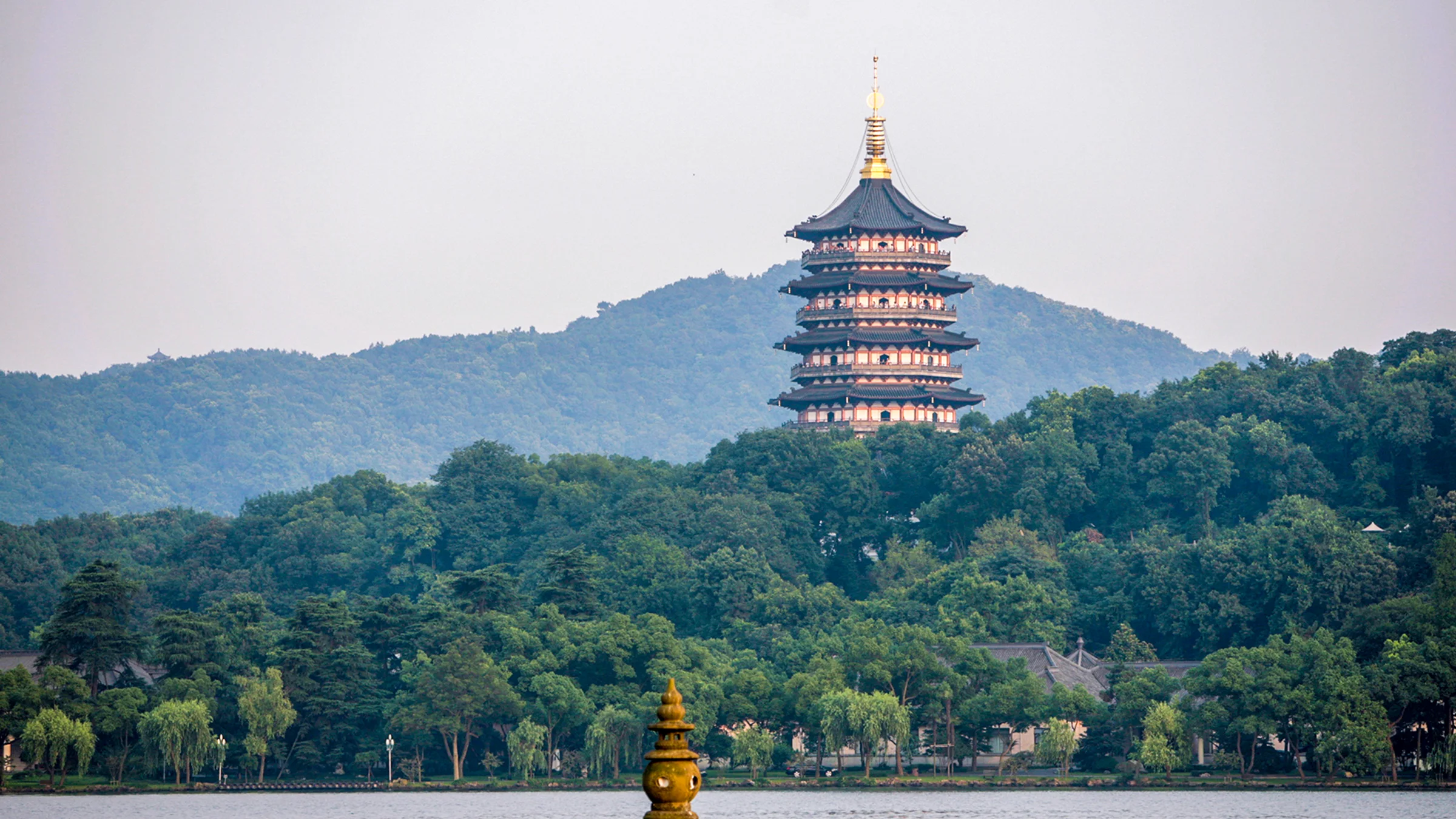
The image on this page is the one that survives both tests: five storeys, dark tiled eaves, red-and-white balustrades and a gilded spire above a wooded lakeside hill. That is the rebuilt Leifeng Pagoda, and it is not Baochu Pagoda — the other West Lake tower, a slender pale stone pagoda on the north shore that looks nothing like this. The accepted source was an 1800 by 1200 file upscaled to the site’s standard size, so it is softer than ideal; clarity of identification was the priority over sharpness, because a wrong subject is a factual error and a soft image is only a soft image.
Best photo spots
-
The top-floor balcony or viewing deck · From about forty minutes before sunset in the 1 May to 31 October band, when the tower itself catches the light from below and the whole south shore of the lake is laid out beneath you
This is the view the name Leifeng Sunset Glow was given for, and Kangxi listed it among the Ten Scenes of West Lake. The pagoda has been standing in the way of this particular light since 975, which is the whole point of it.
-
The ground floor glass panel over the foundation · Daytime, when the interior lighting and the glass read clearly without glare
Standing over the protective layer that covers the 975 tower's octagonal foundation is the single moment where the legend and the archaeology are physically two metres apart. The excavated relics are displayed in the same hall.
-
The hidden floor White Snake woodcarvings · Any time; the carving is lit for viewing rather than for photography
The story panel the reconstruction built specifically to tell, using five different carving techniques combined as what the operator calls overlay carving. Useful precisely because it is openly labelled as folklore.
-
The pagoda reflected across the water from the north or east shore · Late afternoon into dusk, when the tower is lit against the sky
The classic West Lake framing, and the view that makes the rebuilt pagoda legible as a tower rather than a detail. The south shore path itself is the walk that produces it.
Where to eat nearby
-
Leifeng Pagoda Ouxiangju Restaurant (雷峰塔·藕香居餐厅)
Hangzhou and Zhejiang cooking (杭帮菜 / 浙菜) · Mid-range; we could not verify a published range, so budget as an ordinary lakeside restaurant rather than a fine-dining one · On site, within the pagoda scenic area
-
Zhiweiguan Weizhuang, Leifeng branch (知味观味庄·雷峰店)
Hangzhou cuisine (杭帮菜), a time-honoured house known for Dongpo pork and West Lake vinegar fish · Mid-range to upper-mid; we could not verify a published range · On Nanshan Road near No. 1, a short walk from the pagoda
Frequently asked questions
How much does Leifeng Pagoda cost, and can I buy the ticket online?
¥40 per person, published by the operator. Free for children aged 6 and under with effective ID and for visitors with a disability ID; half price at ¥20 for students aged 7 to 18 and undergraduates, and for visitors aged 70 and over. On the question of booking online the operator is explicit and it is the catch: an online purchase requires the valid Chinese ID number of the purchaser. A passport holder should expect to transact at the on-site box office with the original document instead.
What time does Leifeng Pagoda open, and can I visit in the evening?
It depends on the season, which is why the hours are published as three separate schedules. From 1 November to 15 March, 08:00-17:30 with last admission 17:00. From 16 March to 30 April, 08:00-19:00 with last admission 18:30. From 1 May to 31 October, 08:00-20:00 with last admission 19:30. So yes, you can visit in the evening - but only between May and October. The operator notes that temporary adjustments follow announcements at the scenic area.
Is the pagoda I see the original?
No, and the current one is roughly a century old itself. The tower you can enter today opened on 25 October 2002, built to a design by Guo Daiheng and Lv Zhou of Tsinghua University's School of Architecture in Southern Song style. It stands on the site of a pagoda begun in 975 and standing in brick and wood until it collapsed on 25 September 1924, so the structure above ground is new even though the footprint, the foundation and everything below it are 950 years old.
What actually happened in 1924?
A long decline. During the late Qing the pagoda had fallen into disrepair with age, and a superstition that bricks from the tower could ward off illness or prevent miscarriage led people to steal bricks and grind them up, which weakened the foundation; the Chinese Wikipedia account adds that nearby construction work caused vibrations at the site. On the afternoon of 25 September 1924 it came down. Lu Xun wrote two essays about the collapse, arguing it represented the old feudal order and that its fall was a historical necessity, while Xu Zhimo and Yu Pingbo responded from a cultural and loss-oriented perspective. Eileen Chang later wrote a 1963 autobiographical novel about it.
What is the White Snake legend, and is it true?
It is a legend, and it is a genuinely old one. The story holds that a white snake and a green fish were said to dwell in the lake and that the pagoda was built to suppress them; a Chinese source quoted in the historical record describes a Song-dynasty master keeping a white snake in a bowl beneath Leifeng Pagoda. The popular narrative has the monk Fahai deceiving Xu Xian away to Jinshan Temple, with Bai Suzhen following to rescue him and being suppressed beneath the pagoda. That is fiction and folklore, not history. The rebuilt pagoda tells the story explicitly as a legend, with Dongyang woodcarvings on its hidden floor, while the archaeological record underneath it is a separate and much more interesting subject.
What did the excavation find?
The Zhejiang Provincial Institute of Cultural Relics and Archaeology cleared and excavated the site in 2000 and 2001, reaching the underground chamber on 11 March 2001. They identified the tower foundation, the underground palace, the surviving tower body and peripheral buildings including monk rooms and roads. The foundation is an equilateral octagon 17 m to a side and 41 m on the diagonal. Twenty-four excavated limestone column tops imply the original secondary platform had four columns and three bays on each face. The underground palace yielded 51 groups of artefacts and 3,428 coins dating from 175 BC, in the reign of Emperor Wen of Han, through to 960 AD. A further 1,104 stone carvings were recovered, roughly a thousand of them Avatamsaka Sutra fragments.
How long should I allow, and what should I not miss?
About an hour. The visit is vertical rather than lateral - escalators to the base, then four sightseeing elevators up through five floors - so the time is the exhibits and the queues rather than the walking. The two things not to miss are on the way in and at the top: on the ground floor, the glass panel directly over the protective layer covering the original foundation, which puts the archaeology under your feet; and on the fifth floor, the gilded dome with its lotus and the wall niches holding 2,002 miniature golden pagodas, one for every year since the rebuild.
Can I combine Leifeng Pagoda with West Lake and Su Causeway?
Yes, and it is the natural pairing - the pagoda stands on the south shore, on Nanshan Road, so it is on the walk. Two practical notes. The ¥40 is the pagoda only; the lake, the causeway and the rest of the West Lake scenic area are free, so there is no second ticket to negotiate. And because the pagoda's reason for existing is the evening light, the sensible order is the lake during the day and the pagoda from about an hour before sunset onwards, rather than the reverse.
Sources
- Hangzhou Leifeng Pagoda Culture and Tourism Development Co. Ltd, Ticketing Information and Policies on Free and Reduced Admission (official operator — the source of the ¥40 adult admission, free admission for children aged 6 and under with effective ID and for visitors with a disability ID, half price at ¥20 for students aged 7-18 and undergraduates and for visitors aged 70 and over, the statement that an online ticket purchase requires the valid Chinese ID number of the purchaser, and the statement that the scenic area has not authorised any third-party institution or individual to act as its ticket agent) · en.leifengta.com
- Hangzhou Leifeng Pagoda Culture and Tourism Development Co. Ltd, Business Hours (official operator — the source of the three-band seasonal opening schedule: 1 November to 15 March 08:00-17:30 with last admission 17:00, 16 March to 30 April 08:00-19:00 with last admission 18:30, and 1 May to 31 October 08:00-20:00 with last admission 19:30, plus the statement that temporary adjustments follow the scenic area's announcement) · en.leifengta.com
- Hangzhou Leifeng Pagoda Culture and Tourism Development Co. Ltd, official English site (the operator's contact details on 86-571-87982111 and fax 86-571-87979206, the site's own statement that the new pagoda was founded in December 2000 and completed in October 2002 with five storeys and cultural relics including wood-carvings and Ou sculptures, and the site's identification of the White Snake tale as a folktale it presents separately from the archaeology) · en.leifengta.com
- Leifeng Pagoda — English Wikipedia (the archaeological record: construction in 975 by Qian Chu of Wuyue for Consort Huang and the resulting Huangfei Pagoda name, the planned thirteen storeys reduced to seven and then to five, the 1120 destruction by war and fire, the 1171 renovation to five storeys, the Ming Jiajing burning of the wooden eaves by suspected Japanese pirates leaving the brick core, Kangxi's renaming of the scene to Leifeng Evening Glow, the brick theft that undermined the foundation, the collapse of 25 September 1924 and Lu Xun's two essays on it, Xu Zhimo and Yu Pingbo's responses and Eileen Chang's 1963 novel; Liang Sicheng's 1935 proposal and the May 1983 State Council approval, the December 2000 start and 25 October 2002 completion; the 2000-2001 excavation by the Zhejiang Provincial Institute of Cultural Relics and Archaeology including the octagonal foundation 17 m to a side and 41 m on the diagonal, the 24 excavated limestone column tops implying a four-column three-bay secondary platform, the surviving lowest storey with its sleeve-corridor structure and 37x18x6 cm bricks, the 51 groups of artefacts and 3,428 coins dating from 175 BC to 960 AD in the underground palace, the 1,104 stone carvings; the new pagoda's 71.679 m height broken down as 9.7 m protective cover, about 45 m body and 16.1 m spire, its 1,400-tonne steel structure and 200 tonnes of copper, and the floor-by-floor exhibits including the White Snake woodcarvings, the 12 poems, the Ten Scenes sculptures and the 2,002 miniature pagodas) · Wikipedia
- 雷峰塔 (Q1155765) — Wikidata (checked specifically because this repository has previously held coordinates taken from Wikimedia disambiguation pages: this item is NOT one. English description 'pagoda overlooking West Lake in Hangzhou, China', P31 pagoda, P131 Hangzhou, inception Tang dynasty, Commons category Category:Leifeng Pagoda, and its own coordinate statement of 30.23388889 / 120.145) · Wikidata
- 雷峰塔, Chinese Wikipedia (cited for the Chang Fei tower origin story drawn from Qian Chu's own Huayanjing inscription, the account in the Xixi youlan zhi and Qingbo xiaozhi of a monk keeping a white snake beneath the tower, and the Huigong zai'er drought narrative of the tower smoking and the residents believing the White Snake had escaped) · Wikipedia
- 20100719 Leifeng Pagoda and West Lake.jpg, Wikimedia Commons (CC BY-SA 4.0, Windmemories, own work, 19 July 2010 — the source of the hero image used on this page) · Wikimedia Commons
- File:20090524 Hangzhou Leifeng 7485.jpg, Wikimedia Commons (CC BY-SA, Jakub Hałun — REJECTED for this page: opened and inspected on 2026-10-17 and it shows an ornate bronze incense burner with a small tiled canopy in a paved park plaza, not a pagoda, despite being filed under Category:Leifeng Pagoda. Recorded here because it is a live Commons mis-categorisation that another agent working this site could otherwise pick up) · Wikimedia Commons
- File:2014.11.21.103724 Leifeng Pagoda Xihu Hangzhou.jpg, Wikimedia Commons (CC0 public domain dedication, Hermann Luyken, own work — a genuine Leifeng Pagoda photograph, downloaded and inspected for this page but not used, because in the frame the tower is distant and heavily obscured by mist and could not be confirmed from the image alone) · Wikimedia Commons
- 杭州雷峰塔景区开放时间(附预约方式), 杭州本地宝 Bendibao (a Hangzhou local-information service — cited for the corroboration that the adult ticket is ¥40 and, at lower confidence, for the statement that visitors without a second-generation resident ID, which includes foreign visitors, and anyone claiming a half-price concession must transact at the on-site box office; this rule is consistent with the operator's own Chinese-ID requirement for online purchase but we could not verify it on the operator's site) · hz.bendibao.com
- 雷峰塔·藕香居餐厅, 大众点评 Dianping listing and the matching Trip.com restaurant record (the source for the on-site Leifeng Pagoda Ouxiangju Restaurant trading as a current Hangzhou/Zhejiang restaurant, with the Trip.com record showing 73 traveller ratings at 3.8 out of 5) · Trip.com
- 浙江杭州雷峰塔附近美食, 顺途网 (a Chinese tourism-food aggregator — cited for the Zhiweiguan Weizhuang Leifeng branch, described as a time-honoured restaurant specialising in Hangzhou cuisine including Dongpo pork and West Lake vinegar fish, near No. 1 Nanshan Road. Weaker source than the Dianping and Trip.com records above and used only for this second recommendation) · tttl.cn