China National Tea Museum (中国茶叶博物馆), Hangzhou
中国茶叶博物馆 · Zhōngguó Cháyè Bówùguǎn
Quick answer
Entry is free and, per the local listing we checked, needs no advance booking for individual or independent visitors — you arrive and pass a security check. Carry your passport anyway, for two practical reasons: some museums in China price discounted and child categories off identity documents, and the museum runs group and study programmes for which an identity document is normally required. Neither of those affects ordinary walk-in admission. On interpretation, this is the one Hangzhou site where the answer is genuinely good: English Wikipedia records that the exhibitions are presented in Chinese and English, and the museum maintains a dedicated English version of its own website, plus Japanese and Korean versions, all operated by the museum. That is materially better than the old-street pages, where we could verify no signage information at all.
Why visit
- 1 Admission is free and needs no appointment — the museum moved to no-booking walk-in entry across both campuses, so you arrive and pass a security check
- 2 Open 09:00-16:30, Tuesday to Sunday, closed Mondays except on Chinese national public holidays. The Monday closure is the thing that catches people out
- 3 The exhibitions are in Chinese and English, and the museum runs a dedicated English website alongside Japanese and Korean versions — unusually good interpretation for a Hangzhou site
- 4 It is the only national first-class museum in China themed on tea and tea culture, and it dates itself to April 1991
- 5 It is one institution with two campuses about 1.7 km apart: the Shuangfeng campus on Longjing Road, which holds the permanent exhibitions, and the Longjing campus further up the tea gardens — and the Wikidata item carries a coordinate for each
- 6 The permanent halls are Chinese Tea Culture, World Tea Culture, West Lake Longjing Tea, and a donated teaware collection of 323 sets or pieces received since 1991
- 7 The Hangzhou culture bureau describes the Teaware Hall as holding Song-dynasty tea bowls and cup-stands — which is the single best reason to go if you have any interest in how tea was actually drunk
- 8 The campus is a garden with its own tea plots, on a 4.7-hectare site, which is the reason two hours is the right budget rather than one
Essential tips for foreigners
- Check what day it is before you plan anything else. The museum is closed on Mondays. That is the single most common reason to arrive at a shut door, and the exception runs the other way too — a Monday that is a national public holiday IS open, so a calendar holiday is safer than an ordinary Monday.
- Entry is free and needs no booking; the add-ons are not priced in public. The museum lists a tea ceremony performance, a tea study centre, guided tours and extracurricular programmes as services it runs, and publishes contact numbers for all of them but no tariff for any. If the tasting or the tea session is why you are coming, ring 0571-87964221 before you travel. We are flagging this rather than assuming the free entry means the whole day is free.
- Two hours, and go to the Shuangfeng campus. The Shuangfeng campus at No. 88 Longjing Road holds the permanent exhibitions and is what the published pin refers to; the Longjing campus at No. 268 Wengjiashan is further up the gardens and opened later, in May 2015. They are about 1.7 km apart, and Wikidata carries a coordinate for each — so if you are pinning this museum in your own planning, be deliberate about which one you mean.
- This is a daytime visit on a fixed clock, not an all-night street. If you are pairing it with Hangzhou's old quarter, the old quarter is open 24 hours and this museum shuts at 16:30. Do the museum first and the quarter after dark.
- Come for the teaware, not just the tea. The Teaware Hall's Song-dynasty bowls and cup-stands, and a collection built from 323 donated sets, are the part that most rewards a visitor who came for tea and did not expect to care about cups.
- Do not leave the museum and stop. Hangzhou's tea houses are the reason people come to this city, and they are up Longjing Road and in the villages beyond it. The museum is the primer; the drinking is the point. There is also a tea house on Hefang Street in the old town if you want tea on a city evening instead.
Suggested route
- 09:00 15 min Arrive at the Shuangfeng campus for the 09:00 opening, or a little before, so you are not queueing at the door with a coach group
- 09:15 40 min Start with the Chinese Tea Culture hall. It is the one that sets up everything else and it reads across into English
- 09:55 35 min Go to the Teaware Hall and give it the time it deserves — the Hangzhou culture bureau singles out its Song-dynasty tea bowls and cup-stands, and that is the part people remember
- 10:30 35 min Walk the campus. It is a garden with its own tea plots on 4.7 hectares, and the grounds are a reason in their own right rather than a gap between halls
- 11:05 35 min Finish with the World Tea Culture and West Lake Longjing halls, which read more quickly and give the Longjing story its proper context
- 11:40 2 hours Go and drink the tea. Up Longjing Road and into the villages is where the tea houses are, and the museum exists to make what you are about to drink mean something
Free entry — but not a free day, and we will not pretend otherwise
Start with the thing that is solidly established, because it is the part most people want to know and it is the part we can stand behind.
Admission to the museum is free. Hangzhou’s Municipal Bureau of Culture, Radio, Television and Tourism lists it without a price, the city’s local listings state it is free throughout the year, and the museum itself has published a notice moving both its campuses to no-advance-booking admission — individual and independent visitors simply arrive and pass a security check.
And here is what we could not verify, stated plainly. The museum’s own website lists a tea ceremony performance (茶艺表演), a tea study centre (学茶中心), extracurricular programmes (第二课堂), a conference service and a culture-creative gift shop among the services it runs. It publishes a telephone number for each. It publishes no tariff for any of them.
So if you are planning this trip because you want to drink tea properly — a guided tasting, a structured tea session, anything involving the teaware — you should not assume it comes free with entry, and you should not assume it costs a great deal either. The honest position is that we do not know. One phone call settles it: the visitor and general office line is 0571-87964221.
We are flagging this rather than rounding it off because a page that told you “it’s free” and left it there would have cost you the reason for the trip.
Closed Mondays, with one important exception
09:00 to 16:30, Tuesday to Sunday. Closed Mondays — except that it opens on Chinese national public holidays.
Those are the Hangzhou culture bureau’s published hours and two separate local listings agree with them independently. The Monday closure is the single most common way to arrive at a shut door, and note that it runs in both directions: an ordinary Monday is shut, a Monday that is a national holiday is open. Check the calendar, not just the weekday.
One source disagrees and we are not reconciling it silently. A separate Hangzhou local Q&A page gives a seasonal timetable instead — 09:00 to 17:00 from 1 May to 30 September, and 08:30 to 16:30 from 1 October to 30 April, still closed Mondays. Three sources agree on the flat 09:00-16:30 and one describes a summer extension. We publish the government figure, and if you are going in summer, treat 16:30 as your deadline rather than 17:00.
One museum, two campuses, and a pin to be careful with
The museum is one institution with two campuses, roughly 1.7 km apart in the tea gardens west of West Lake:
- Shuangfeng campus (双峰馆区), No. 88 Longjing Road, 4.7 hectares, opened April 1991, holding the permanent exhibitions.
- Longjing campus (龙井馆区), No. 268 Wengjiashan, further up the gardens, opened May 2015.
Together they cover about 122,000 square metres with a combined building area of around 13,000 square metres. The museum describes itself as the only national first-class museum in China themed on tea and tea culture.
This is not administrative trivia. The Wikidata item for this museum carries two coordinate statements about 1.7 km apart, one for each campus. Anyone who copied the item’s coordinate carelessly could easily put a traveller at the wrong gate, so the coordinate published on this page is stated explicitly, with its provenance, in the frontmatter above: it is the Shuangfeng campus, about 40 m from the first Wikidata statement, and it is the campus the permanent exhibitions are on.
A small caution about the age of the institution. Chinese Wikipedia’s infobox carries an “established 2009年8月” field, which conflicts with its own article text in the same page, with Wikidata’s inception of 1991, and with the museum’s own website. We publish April 1991, on the authority of the museum itself and three other sources; the 2009 figure is most likely the date of some later reorganisation and is recorded here only so nobody thinks we missed it.
What is actually in it
The permanent exhibitions, by the museum’s own naming:
- Chinese Tea Culture (中国茶文化展) — the long course of Chinese tea culture, including substantial coverage of Song-dynasty tea.
- World Tea Culture (世界茶文化展) — how Chinese tea went global and what drinking habits it produced.
- West Lake Longjing Tea (注春啜香——西湖龙井茶展) — Longjing specifically, the tea the city is actually known for.
- Donated Tea Ware and Cultural Relics (美美与共——社会捐赠茶具文化精品展) — 323 sets or pieces of cultural relic donated to the museum since it opened, including over a hundred Yixing zisha teaware pieces.
The Hangzhou culture bureau describes the two principal halls in a way worth repeating because it tells you where to point your attention: the Tea History Hall narrates the long course of Chinese tea culture with particular detail on the Song period, and the Teaware Hall shows fine teaware from many dynasties, including a number of Song tea bowls and cup-stands.
Spend the time there. The cup-stand — 盏托 — is the thing almost nobody photographs, and it is the thing that explains how a Song tea bowl was actually used: you lifted it off its stand with one hand and held it, and the stand was not decoration but tableware.
Do not come here and then leave
This is the point we most want to make, and the reason this page exists separately from the two old-street pages.
Hangzhou is a tea city, and the museum is a primer, not the destination. It tells you what you are looking at; it does not give you the thing itself. The tea houses are up Longjing Road and in the villages beyond it — Longjing Village is minutes away, and the whole valley from the museum up towards the Longjing campus and Meijiawu is tea country. That is where you sit down and drink something, and where the museum’s lessons become useful rather than decorative.
The food entries below are all in that valley and all on or near Longjing Road, which is the museum’s own street. We have listed them honestly: we could not verify any of their tariffs, and Chinese tea houses charge by the pot and by the seat rather than by the cup, so confirm before you order rather than after.
If you would rather drink tea on a city evening than in a tea garden, there is a long-established traditional tea house on Hefang Street in the old town, in a classical room with long-spouted copper pots and blue-and-white cups, serving gongfu tea with snacks made on the spot. That has its own page here, and it pairs with the old quarter because the quarter never closes — which is exactly why the museum, with its 16:30 close, should come first.
Best photo spots
-
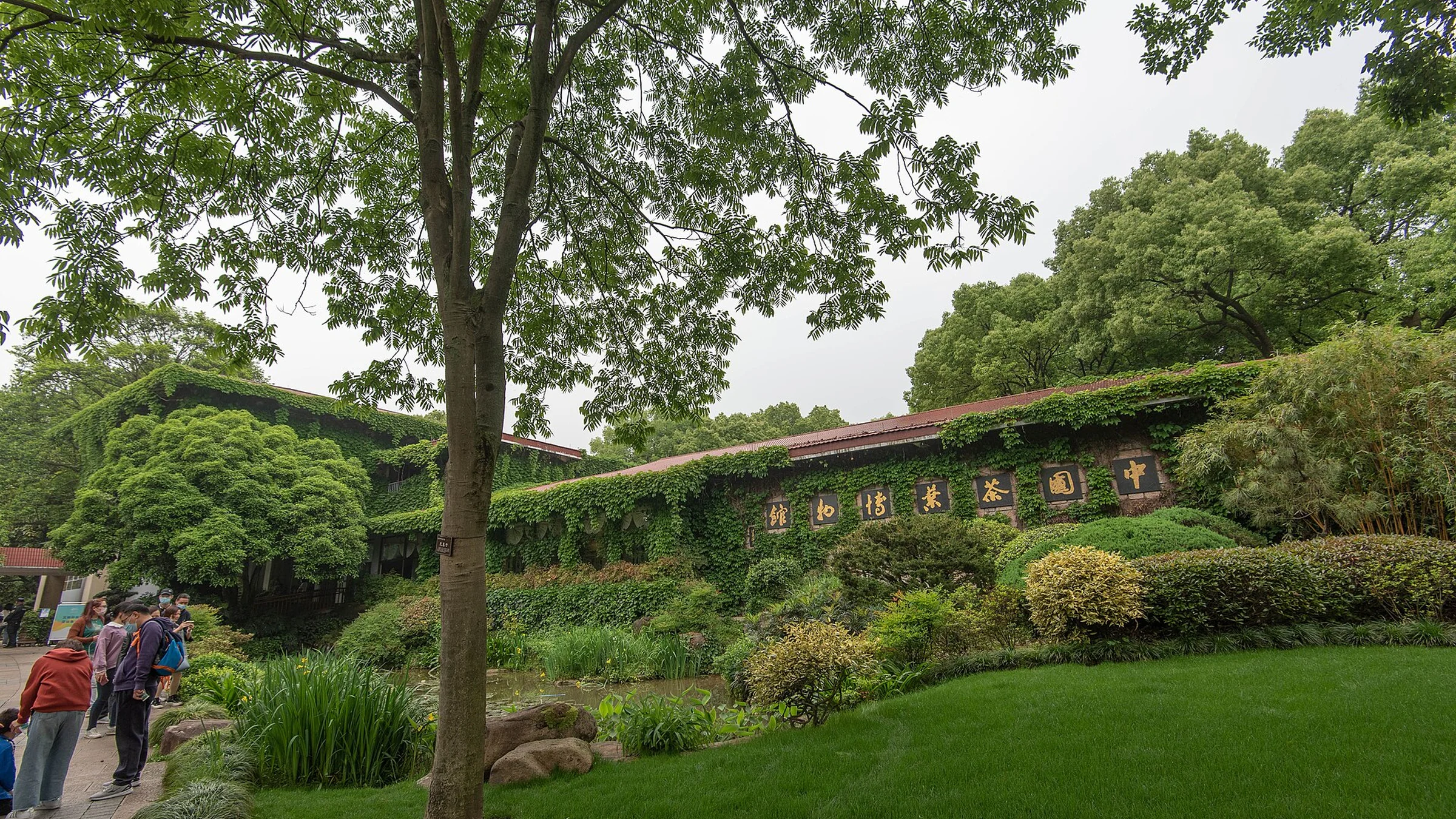
The creeper-covered facade of the Shuangfeng campus · Overcast or even light, which is when the gold lettering reads
The building is almost entirely hidden under dense creeper, and its name is set out character by character in gold on individual dark plaques. The photograph used on this page is of exactly this wall, and it is the clearest single image of the museum you will get.
-
The teaware galleries · Any time - these are interior and climate-controlled
Song-dynasty tea bowls and cup-stands, plus a collection of 323 donated sets or pieces received since 1991. Worth photographing the actual cup-stands rather than the showcases; the stand is the part almost nobody photographs and the part that explains how the bowl was used.
-
The campus tea plots · Late spring, when the new growth is showing
The museum grows tea on its own grounds, which is what separates it from a gallery in a city building. Seeing the bushes before you see the cups changes how the cups land.
-
The Longjing tea valley beyond the campus · Autumn for colour; morning for the stillness
The tea gardens west of West Lake that give Longjing its name run on from the campus up towards the Longjing campus and the villages. This is the landscape the tea on display came out of, and standing in it is the last part of the visit.
Where to eat nearby
-
龙井茶室 (Longjing Tea House)
Tea house, in the Longjing Tea Inquiry scenic area; the surrounding area also has a Longjing tea history exhibition hall, 风篁余韵 · Not published — Chinese tea houses charge by the pot and by the seat rather than by the cup · On Longjing Road further up the tea valley from the museum, at No. 627, inside the former Longjing Temple — the same road the museum is on, and part of the reason the museum is sited where it is
-
春雨茶楼 (Chunyu Tea House)
Tea house · Not published — budget by the pot and confirm before ordering · On the museum's own road at No. 144 Longjing Road, Xihu District, against the museum's No. 88 — the closest tea stop on the same street; telephone 0571-87996521
-
阿巧茶庄 (Aqiao Tea Shop)
Tea retailer and tea house in Longjing Village · Not published — this is a shop as much as a drinking room, so treat a purchase as a separate decision from a seat · At No. 163 Longjing Village, near Longjing Road, Manjuelong Road and Longjing Village Road, with the Longjing Village and Shuangmatou bus stops and routes 27 and 87 nearby; telephone 0571-87982583
Frequently asked questions
Is the China National Tea Museum free, and do I need to book?
Free, and no booking. Hangzhou's culture bureau lists it without a price, the city's local listings state admission is free all year, and the museum's own notice records that both its Shuangfeng and Longjing campuses moved to no-advance-booking admission — individual and independent visitors simply arrive and complete a security check. What is separately arranged is the guided tour, the extracurricular programmes, the tea ceremony performance, the tea study centre and conference service. Those are real services with contact numbers, but they are not entry.
Does the tasting or teaware session cost money? I want to be sure before I go.
We could not confirm this, and we would rather say so than let you budget on a guess. The museum's own website lists a tea ceremony performance, a tea study centre, a cultural-creative gift shop and guided tours as things it runs, and publishes telephone numbers for each — but no tariff for any of them. So: the museum galleries are free and verified; whether a tasting, a structured tea session or a teaware-related add-on is charged is genuinely unverified as far as we can tell. If that is the point of your visit, ring the visitor line on 0571-87964221 before you travel. It costs you one phone call and it is the difference between a good day and a wasted one.
What time does it open and is it really closed on Mondays?
09:00 to 16:30, Tuesday to Sunday, closed Mondays — with the important exception that it opens on Chinese national public holidays. Those hours are the Hangzhou culture bureau's, and two separate local listings agree with them. One local Q&A page instead gives a seasonal timetable, 09:00-17:00 from May to September and 08:30-16:30 from October to April, still closed Mondays; we could not corroborate that from an official source, so we publish the government figure and suggest confirming in summer. Plan to be out by 16:30 either way.
Is it one museum or two? Which one should I go to?
One museum, two campuses, about 1.7 km apart in the tea gardens west of West Lake. The Shuangfeng campus at No. 88 Longjing Road opened in April 1991 and holds the permanent exhibitions; the Longjing campus at No. 268 Wengjiashan opened in May 2015. Together they cover about 122,000 square metres. Go to the Shuangfeng campus unless you have a specific reason — it is the older one, it is the one on the main road, and it is where the permanent halls are. This matters more than it sounds, because the Wikidata item for the museum carries two coordinate statements a kilometre and a half apart, so a pin copied carelessly will put you at the wrong campus.
How long should I allow, and is it worth two hours?
Two hours at the Shuangfeng campus, and that is the honest figure. The individual themed halls are quick; what fills the time is a 4.7-hectare garden site with its own tea plots, plus the teaware collection. If you mainly want the Longjing hall and the tea history, ninety minutes is generous. Unlike the old-town streets, this is a timed indoor visit that shuts at 16:30, so it belongs earlier in the day than they do.
Is it in English, and will I understand it?
Better than most, and genuinely so. English Wikipedia records that the exhibitions are presented in Chinese and English, and the museum maintains a dedicated English version of its own website as well as Japanese and Korean versions. That is a materially better position than the old-town quarter, where we could verify no signage information at all. It does not mean every object label is translated, but it does mean the museum is built with a foreign visitor in mind in a way that most Hangzhou sites are not.
Can I drink tea there, or do I have to find it elsewhere?
You can, but plan it as a separate thing rather than assuming it is included. The museum runs tea ceremony performances, a tea study centre and its own tea plots, which is what makes it a good place to understand tea — but we could not verify whether any of that is charged or included with entry, and we have said so above rather than guessing. What is certain is that the tea houses of Longjing Road and the villages beyond it are minutes away in one direction, and that Hangzhou's old quarter has a traditional tea house of its own if you would rather drink tea on a city evening. The museum is the primer; the drinking is the point.
How do I get there?
We could not verify an official metro instruction and are not going to invent one. What the local listings do record is bus service, with routes 27 and the sightseeing route 3 serving the Shuangfeng stop. A taxi to No. 88 Longjing Road, Xihu District is the simplest option, showing the driver 中国茶叶博物馆 or 龙井路88号. The campus sits up in the tea gardens west of West Lake rather than in the walking city, so budget transport rather than assuming a walk from the lake.
Sources
- 中国茶叶博物馆 — the museum's own official site, 基本介绍 (Basic introduction) page (the two campuses and their opening dates stated by the museum itself: 双峰馆区(龙井路88号) opened to the public in April 1991 and 龙井馆区(翁家山268号) opened in May 2015; one institution with two campuses covering about 122,000 square metres with a total building area of about 13,000 square metres; and the museum's description of itself as the only national first-class museum themed on tea and tea culture) · teamuseum.cn
- 中国茶叶博物馆 — the museum's official site home and exhibition listings (the Shuangfeng campus stated as No. 88 Longjing Road on a 4.7-hectare site; the permanent exhibitions by name — Chinese Tea Culture, World Tea Culture, West Lake Longjing Tea, and Donated Tea Ware and Cultural Relics, the last noting 323 sets or pieces of cultural relics donated since the museum opened in 1991; the service menu including guided tour, extracurricular programmes, conference service, tea ceremony, tea study centre and cultural-creative gift shop; and the visitor, publicity and academic telephone numbers) · teamuseum.cn
- China National Tea Museum — Hangzhou Municipal Bureau of Culture, Radio, Television and Tourism (the city's own tourism authority giving the published opening hours as 09:00-16:30 Tuesday to Sunday, closed Mondays and open on national public holidays; both campus addresses; both campus telephone numbers; and the two permanent halls described — the Tea History Hall narrating the long course of Chinese tea culture with detail on Song-dynasty tea, and the Teaware Hall showing fine teaware from many dynasties including a number of Song tea bowls and cup-stands) · Government of the PRC
- 中国茶叶博物馆开馆时间一览 — Hangzhou Bendibao (independent local listing giving the same Tuesday-to-Sunday 09:00-16:30 hours with Mondays closed except on national holidays and stating the museum is free throughout the year, 常年免费开放; plus both campus addresses) · hz.bendibao.com
- 中国茶叶博物馆关于优化开放服务实行免预约入馆的公告 — Hangzhou Bendibao (the museum's own notice that BOTH the Shuangfeng and Longjing campuses have moved to no-advance-booking admission, with individual and independent visitors able to come without booking online, passing a security check before entry) · hz.bendibao.com
- 【杭州中国茶叶博物馆】攻略2026 — Hangzhou Bendibao attraction listing (admission recorded as free; bus routes 27 and sightseeing route 3 serving the Shuangfeng stop; and the same Tuesday-to-Sunday hours with the Monday closure and national-holiday exception stated again independently) · m.hz.bendibao.com
- 中国茶叶博物馆 — Chinese Wikipedia (the museum as a Hangzhou institution in Xihu District with two campuses at Shuangfeng Village and Longjing Village, opened to the public in April 1991, and rated a National First-Class Museum by the China Museums Association; its infobox also carries an 'established 2009年8月' field that conflicts with its own article text and with every other source — see the note in the ticketPriceNote and body below) · Wikipedia
- China National Tea Museum — English Wikipedia (the museum in Hangzhou, Zhejiang; that its exhibitions display tea production and different kinds of tea; and that the exhibitions are in Chinese and English — the basis for this page's statement about interpretation) · Wikipedia
- 中国茶叶博物馆 (Q1514687) — Wikidata, cited because src/lib/attraction-coords.ts records this QID; it is the correct museum item located in Hangzhou, it dates the institution to 1991, it gives the official site, and it is the source of the two coordinate statements about 1.7 km apart described in the coordinate note above · Wikidata
- Hangzhou — Wikivoyage (an independent coordinate for the museum at 120.115556 / 30.234722, which matches the Shuangfeng campus and corroborates the published pin; and the separate position it gives for the Longjing tea fields at 120.102278 / 30.221398, in the same tea-growing valley as the museum's second campus) · Wikivoyage
- 龙井茶室 — Baidu Baike (the Longjing Tea House in the tea valley the museum sits at the foot of: at No. 627 Longjing Road inside the former Longjing Temple, itself formerly the Shousheng Temple, part of the Longjing Tea Inquiry scenic area, which also has a Longjing tea history exhibition hall called 风篁余韵; and a directory listing recording daily hours of 08:00-22:00 for the tea house itself) · baike.baidu.com
- 阿巧茶庄 — Hangzhou city8 directory listing (a tea shop in the valley: at No. 163 Longjing Village in Xihu District, telephone 0571-87982583, near Longjing Road, Manjuelong Road and Longjing Village Road, with the Longjing Village and Shuangmatou bus stops and routes 27 and 87 nearby) · hz.city8.com
- 春雨茶楼 — Hangzhou city8 directory listing (a tea house on the museum's own road: at No. 144 Longjing Road in Xihu District, telephone 0571-87996521, near Longjing West Road, with bus stops including Longjing Village and Shangtiantu) · hz.city8.com