
China Snow & Winter 2026: 8 Ski Resorts, 5 Ice Festivals
China's 2026 winter is the breakout year for foreign ski tourism: 8 world-class resorts, 5 ice festivals and the cold-weather mistakes foreigners make.
China’s 2025-2026 winter is the breakout year for inbound ski tourism. Eight world-class resorts are within reach of foreign travelers, the Beijing-Chongli high-speed rail cuts travel from 4 hours to 50 minutes, and 5 ice festivals run from December through February. This guide is your one-stop resource — resorts, festivals, gear, transport, costs, and the 5 most expensive mistakes foreign skiers make in China.
Why China for Skiing in 2026
- Affordable by global standards: lift tickets run 280-580 RMB weekdays / 380-880 RMB weekends (about $40-$125), vs $150-$250 in the Alps or Rockies
- World-class infrastructure: Chongli (Zhangjiakou, near Beijing) hosted the 2022 Winter Olympics and now has 5 high-end resorts — Thaiwoo, Wanlong, Duolemeidi, Nanshan, and Genting Snow Park
- New 2026 upgrades: Beijing-Zhangjiakou bullet train (50 min, 91 RMB second class), high-speed Thaiwoo cable car, and English ski school at every Chongli resort
- No lift lines in low season: Chongli weekdays in early December or late February have 5-15 minute waits; peak weekends can hit 45-60 minutes
- Hot springs after skiing: most Chongli resorts and Yabuli have on-site or 10-min-away hot springs (150-300 RMB), a uniquely Chinese après-ski experience
China’s ski industry grew from 12 million skier visits in 2015 to 230 million in 2024-2025 (China Ski Industry White Paper 2025), and the international share is now 1.8% — up from 0.3% five years ago. The 2025-2026 season is the first where English-speaking ski instruction is the rule, not the exception, at all major resorts.
Winter is the easiest season to get around China: the cold is dry, transport runs normally, and everything is indoors or empty. The summer escapes guide covers the opposite end of the year for anyone planning the other half.
8 Best Ski Resorts for Foreigners in 2026
Beijing-Area: Chongli Cluster (3 Hours from Beijing, 50 Min by 2026 Bullet Train)
The 5 Chongli resorts sit in Zhangjiakou, 220 km northwest of Beijing. The 2022 Winter Olympics put the entire region on the international map, and the 2025 Beijing-Zhangjiakou bullet train (50 min, 91 RMB) makes a weekend trip trivial. All 5 accept foreign passports for lift tickets, equipment rental, and ski school. English signage and menus are standard at Thaiwoo, Wanlong, and Duolemeidi.
1. Thaiwoo Ski Resort (太舞滑雪场) — Best Overall
- Why: Most foreigner-friendly, 32 pistes, 1.5 km vertical drop, English-speaking ski school (10-25 instructors/day in peak), on-site hotels (4-star 太舞度假酒店 800-1,500 RMB/night, 5-star 太舞凯悦嘉轩 1,800-3,500 RMB/night)
- Pistes: 20% beginner, 50% intermediate, 30% advanced. Best for: first-time skiers up to advanced intermediates. Advanced/expert terrain is limited.
- Lift tickets: 410 RMB weekdays / 580 RMB weekends (full day). Half day: 280 RMB.
- Equipment rental: 180 RMB full ski set / 280 RMB snowboard
- Ski school: 800 RMB group (4 hours) / 1,800 RMB private (4 hours)
- Transport: Beijing North → Chongli (太子城站, 50 min, 91 RMB) → free resort shuttle (15 min)
- 2026 upgrade: New high-speed 6-seater cable car reduces lift lines by 40%
2. Wanlong Ski Resort (万龙滑雪场) — Best Pistes for Advanced Skiers
- Why: Longest pistes in China (one 4.2 km green-blue), best moguls, best tree skiing, oldest Chongli resort (founded 2003). More advanced skiers than other Chongli resorts.
- Pistes: 15% beginner, 50% intermediate, 35% advanced. 32 pistes, 1.3 km vertical.
- Lift tickets: 480 RMB weekdays / 680 RMB weekends (full day, slightly higher than Thaiwoo for advanced access)
- Equipment rental: 220 RMB full ski set
- Ski school: 1,000 RMB group / 2,000 RMB private
- Transport: Same as Thaiwoo — Beijing North → Chongli (太子城) → 10 min taxi
- Hot spring: On-site 万龙温泉, 280 RMB (highly recommended after-ski)
3. Duolemeidi Ski Resort (多乐美地滑雪场) — Most Luxurious
- Why: Boutique resort with 26 pistes, less crowded than Thaiwoo, on-site 5-star hotel, private ski lockers, and the best French restaurant in Chongli
- Pistes: 25% beginner, 55% intermediate, 20% advanced
- Lift tickets: 450 RMB weekdays / 620 RMB weekends
- Equipment rental: 200 RMB ski / 280 RMB snowboard
- Ski school: 900 RMB group / 1,800 RMB private
- Hotel: Duolemeidi Hotel 1,200-2,200 RMB/night (5-star, slope-side)
- Best for: Couples, families, skiers who want a quieter luxury experience
4. Nanshan Ski Resort (南山滑雪场) — Closest to Beijing
- Why: Only 80 km from Beijing (vs 220 km for other Chongli resorts), accessible by car (1.5 hours) or bus (3 hours, 60 RMB). Best for Beijing day-trippers.
- Pistes: 25% beginner, 55% intermediate, 20% advanced. 26 pistes, 1 km vertical.
- Lift tickets: 280 RMB weekdays / 380 RMB weekends (cheapest in Chongli)
- Equipment rental: 150 RMB ski set (cheapest too)
- Ski school: 600 RMB group (cheapest in Chongli, 4 hours)
- Downside: Less snow reliability (no high-alpine snowmaking), smaller vertical
5. Genting Snow Park (云顶滑雪场) — The Olympic Venue
- Why: 2022 Olympic venue, 41 pistes, 1.4 km vertical. Most piste variety in Chongli. Hosts FIS World Cup events.
- Pistes: 20% beginner, 45% intermediate, 35% advanced
- Lift tickets: 470 RMB weekdays / 670 RMB weekends
- Equipment rental: 200 RMB ski set
- Ski school: 850 RMB group / 1,700 RMB private
- Best for: Skiers who want to ski the same pistes as Olympic athletes
Northeast China: World-Class Far from Beijing
6. Yabuli Ski Resort (亚布力滑雪场) — Asia’s Largest
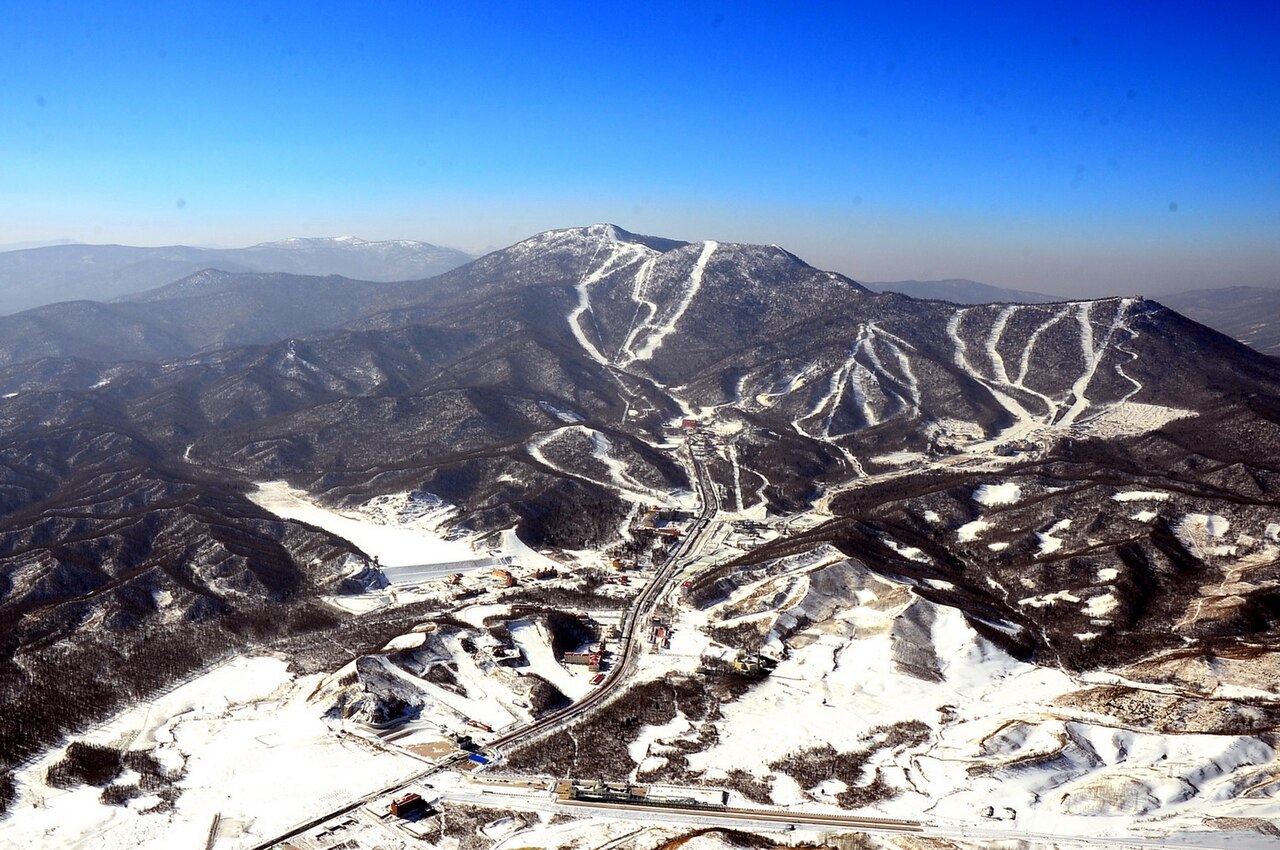
- Why: Asia’s largest ski resort (50+ pistes), 3 mountains, 1 km vertical, deep dry snow (similar to Hokkaido powder), 200 km from Harbin. The flagship of Chinese skiing since 1996. Olympic and World Cup venue.
- Pistes: 15% beginner, 50% intermediate, 35% advanced. Best for intermediates and advanced skiers who want real mountain terrain.
- Lift tickets: 380 RMB weekdays / 580 RMB weekends
- Equipment rental: 180 RMB ski set
- Ski school: 700 RMB group / 1,500 RMB private (English available, 5-8 instructors/day in peak)
- Transport: Fly to Harbin (HRB) → 2.5-hour taxi or pre-booked resort shuttle (300 RMB, 5-person van)
- Hotel: Yabuli Resort 600-1,200 RMB/night, or Polar Bear Lodge 1,500-2,500 RMB/night
- 2026 upgrade: New high-speed gondola from resort base to mid-mountain
7. Songhua Lake Ski Resort (松花湖滑雪场) — Lake-View Skiing
- Why: 35 pistes on the shore of Songhua Lake (Jilin Province, 1-hour drive from Jilin City, 4 hours from Changchun). Best lake-view skiing in China. Long blue runs ideal for intermediates learning powder technique.
- Pistes: 25% beginner, 60% intermediate, 15% advanced
- Lift tickets: 350 RMB weekdays / 520 RMB weekends
- Equipment rental: 180 RMB ski set
- Ski school: 700 RMB group / 1,400 RMB private (English available)
- Transport: Fly to Changchun (CGQ) → 4-hour resort shuttle (200 RMB) or high-speed train to Jilin City (吉林市, 30 min, 80 RMB) → 1-hour taxi
- Hotel: Songhua Lake Resort Hotel 800-1,500 RMB/night (lake view)
- Best for: Intermediates who want long scenic blue runs
8. Changbaishan Ski Resort (长白山滑雪场) — Volcanic Caldera Skiing
- Why: Inside the Changbaishan Nature Reserve (UNESCO World Heritage), 43 pistes on the volcanic slopes of Changbai Mountain, with views into North Korea. The only Chinese resort with a real high-alpine feel (1 km vertical from 1,800 m to 2,800 m elevation).
- Pistes: 20% beginner, 50% intermediate, 30% advanced
- Lift tickets: 420 RMB weekdays / 620 RMB weekends
- Equipment rental: 200 RMB ski set
- Ski school: 800 RMB group / 1,600 RMB private (English available, fewer instructors than Chongli — book 7+ days ahead)
- Transport: Fly to Changchun (CGQ) → 5-hour direct bus to resort (150 RMB) or 4-hour train to Fusong (抚松) → 1-hour taxi
- Hotel: Changbaishan Resort 1,200-2,000 RMB/night, or Wanda Resort 2,000-4,000 RMB/night (5-star)
- Best for: Skiers who want a true alpine experience, powder hunters, photographers
- 2026 note: Entry to Changbaishan Nature Reserve requires an additional 105 RMB ticket and passport ID for all visitors
5 Ice & Snow Festivals (December-February)
1. Harbin Ice and Snow World (哈尔滨冰雪大世界) — The Flagship
- When: December 20, 2026 - late February 2027 (closes when ice starts to melt, usually Feb 25-Mar 5)
- Where: Songhua River bank, Harbin (HRB). 1-hour taxi from Harbin Taiping International Airport (180 RMB).
- What: World’s largest ice festival — 200,000 cubic meters of ice carved into full-size buildings, lit with 100,000+ LED lights. 2026 theme: “Belt and Road Ice Silk Road.” Each year features 2-3 buildings over 30 m tall. Open 11 AM - 9:30 PM.
- Cost: 200-300 RMB daytime, 330-400 RMB night entry (after 4 PM — when the lights come on, this is the time to go)
- Time needed: 4-6 hours. Plan a full day — Harbin is huge and the festival is just one part.
- 2026 new: 4K projection mapping on the central ice castle (the largest in Asia)
2. Chagan Lake Winter Fishing (查干湖冬捕) — Jilin Province
- When: Annual opening ceremony December 28, 2026. Active fishing January-March.
- Where: Chagan Lake (查干湖), Qian’an County, Jilin Province. 4-hour drive from Changchun or 2-hour drive from Songyuan.
- What: A 1,000-year-old Mongol fishing tradition. The lake freezes 1+ m thick, and fishermen use giant nets pulled by horse-drawn winches to haul up to 100,000 kg of fish in a single catch. The opening ceremony features 1,000+ horses on the ice.
- Cost: 100 RMB entry, plus optional horse-cart ride (50 RMB) and lunch with fresh-caught fish (200-500 RMB for a group of 4)
- Time needed: Half day (best 9 AM - 2 PM)
- Best for: Photographers, culture lovers, families
3. Inner Mongolia Ice and Snow Festival (内蒙古冰雪节) — Hohhot
- When: January 5 - February 20, 2027
- Where: Zhaojun Tomb area + surrounding grasslands, Hohhot (HET). 1-hour flight from Beijing.
- What: Less crowded than Harbin, more Mongolian cultural focus. Features traditional Mongolian yurt camps, horse-drawn sleds, ice sculpture competitions, and grassland snowmobile tours.
- Cost: 150 RMB entry, 300-500 RMB for a full-day experience (yurt lunch + sledding + snowmobile)
- Time needed: 1-2 days (combine with Inner Mongolia grassland winter)
4. Shenyang Ice and Snow Festival (沈阳冰雪节) — Liaoning
- When: January 1 - February 20, 2027
- Where: Shenyang (SHE). Major venues: Shenyang Botanical Garden, Qipanshan Ice World.
- What: Smaller and less famous than Harbin, but 50% less crowded. Features 80+ ice sculptures and a 300-meter ice slide. Combine with Shenyang Imperial Palace (沈阳故宫) and the Liaoning Provincial Museum.
- Cost: 80-150 RMB per venue
- Time needed: 1 day
- Best for: Travelers who want a quieter alternative to Harbin
5. Beijing Longqingxia Ice and Snow Festival (北京龙庆峡冰灯) — Beijing Day-Trip
- When: January 15 - February 28, 2027 (4 PM - 10 PM)
- Where: Longqing Gorge, Yanqing District, 100 km northwest of Beijing. 2 hours by bus (50 RMB) or car.
- What: The closest major ice festival to Beijing. 400+ ice sculptures lit with colored lights, ice slides, and an ice castle. Smaller than Harbin (50,000 visitors vs 18 million) but a great option for Beijing-based travelers.
- Cost: 100 RMB entry + 50 RMB round-trip bus
- Time needed: Half day (best at dusk to see the lights)
5 Most Expensive Cold-Weather Mistakes Foreigners Make in China
Mistake 1: Underestimating Wind Chill
Most Chongli resorts run at 1,500-2,100 m elevation. With wind, -15°C becomes -30°C real feel. Fix: Buy windproof outerwear (Gore-Tex or equivalent), use ski goggles not sunglasses, and bring chemical hand/toe warmers (暖宝宝, 2 RMB each at any Chinese convenience store).
Mistake 2: Buying Tickets at the Gate on Peak Weekends
Peak Chongli weekends (mid-Jan to mid-Feb) sell out by 10 AM, and gate prices are 50-100 RMB higher than online. Fix: Book lift tickets 1-3 days ahead via Trip.com or the resort WeChat mini-program. Bring your passport.
Mistake 3: Choosing Cotton as a Base Layer
Cotton absorbs sweat, freezes, and stays cold. Most foreign skiers who “feel cold” but see Chinese skiers comfortable are wearing cotton. Fix: Merino wool or synthetic thermal underwear, 200+ gsm weight. Decathlon has affordable options (100-200 RMB) in Beijing.
Mistake 4: Skipping Hot Springs (Wasted Money)
A 280 RMB hot spring entry after skiing is the most cost-effective recovery in winter sports. Fix: Wanlong, Duolemeidi, and most Chongli resorts have on-site hot springs. Yabuli has a forest hot spring 10 min away. Go between 4-7 PM (post-ski window) — it’s cheaper and less crowded than evening.
Mistake 5: Going During Chinese New Year
Chinese New Year 2027 falls January 28 - February 4. Resort prices increase 80-100%, lift lines 3-4x longer, restaurants fully booked. Fix: Either go early January (cheaper, fewer crowds, similar snow) or late February (spring skiing, smaller crowds, 30-40% lower prices than peak).
7-Day Sample Itinerary: Beijing + Chongli + Harbin
Day 1-2: Beijing arrival + city highlights
- Arrive Beijing (PEK or PKX)
- Forbidden City, Temple of Heaven, Beijing hutong
- Pre-buy lift tickets, equipment, ski school at Thaiwoo via WeChat
- Buy thermal underwear at Decathlon (西直门 or 王府井 store) if you forgot
Day 3-4: Thaiwoo Ski Resort (2 days)
- Beijing North → Chongli (太子城, 50 min, 91 RMB, 8 AM train)
- 2 full ski days at Thaiwoo with English ski school
- Night 1: hot pot in Chongli town (200-300 RMB for 2 people)
- Night 2: on-site hot spring at Wanlong (280 RMB)
- Stay: Thaiwoo slope-side hotel (1,200-2,000 RMB/night)
Day 5: Transit to Harbin
- Chongli → Beijing (50 min) → Beijing Capital Airport (PEK) → Harbin (HRB, 2-hour flight, 600-1,200 RMB)
- Check into Harbin hotel (400-1,000 RMB/night)
- Evening: Central Street (中央大街) for Russian-influenced food and Saint Sophia Cathedral night photos
Day 6: Harbin Ice Festival + Siberian Tigers
- Morning: Siberian Tiger Park (东北虎林园, 90 RMB, 3 hours)
- Afternoon: Saint Sophia Cathedral, Central Street lunch (try 锅包肉, Russian bread)
- Evening: Harbin Ice and Snow World (night entry, 350 RMB, 4-6 hours)
Day 7: Yabuli day trip (optional) OR Departure
- Option A: 2.5-hour taxi to Yabuli, half-day skiing, back to Harbin for evening flight
- Option B: Ice and Snow World return visit, then flight out
- Total budget for 7 days: 8,000-15,000 RMB ($1,100-$2,100) per person mid-range, excluding international flights
Visa and Entry for 2026
57 countries qualify for the 240-hour (10-day) visa-free transit, which covers a Chongli weekend (2-3 days), a Harbin + Ice Festival trip (5-7 days), or a Chongli + Beijing + Harbin combo (7-9 days). The 30-day visa-free scheme covers 50 countries. For longer trips, the L-visa (tourist, 30 days) is the standard choice.
Practical apps to install before arrival (Google Play is blocked in China — use APK Pure or download in your home country):
- Alipay (passport-verified)
- WeChat (set up before departure)
- Trip.com (English ski resort booking)
- Maps.me (offline maps)
- The ski resort’s WeChat mini-program (search by name)
- Didi (China’s Uber) — English UI added 2024
VPN: Install before departure (Google, Gmail, Instagram, etc. are blocked). Astrill, ExpressVPN, or LetsVPN all work reliably in 2026. China hotel WiFi and resort WiFi often block VPN ports, so a Chinese eSIM (Airalo China, Holafly China) is essential.
When to Book and What It Costs in 2026
- Lift tickets: Book 1-3 days ahead via Trip.com or the resort mini-program. Prices don’t increase closer to the date, but weekends sell out.
- Ski school: Book 3-7 days ahead in low season, 7-14 days ahead for Chinese New Year and weekends.
- Hotels: Book 14-30 days ahead for peak (Dec 20 - Feb 15) and Chinese New Year.
- Flights to Harbin: Book 30-45 days ahead. Beijing-Harbin is 600-1,200 RMB round-trip. International to Beijing is the main cost.
- Equipment rental: Walk-in is fine, no advance booking needed.
- Total 7-day mid-range budget (excluding international flights): 8,000-15,000 RMB per person (1,100-2,100 USD)
Final Tips
- The first Chongli day, take a private 4-hour lesson (1,200-1,800 RMB). The lifts are fast, the pistes are wide, but the snow conditions change hourly. A local instructor’s first-day tip is worth 5 days of self-learning.
- Alipay works everywhere — Chongli resorts, Yabuli, Harbin restaurants, all accept foreign passport-bound Alipay (Tour Pass feature). WeChat Pay also works. Credit cards mostly do not.
- The 2026 Beijing-Chongli bullet train has dedicated ski equipment storage at the Chongli station. Bring a lock for the storage or use the resort’s free shuttle with your gear.
- Bring a power bank — phones die fast in -20°C. The cold drains batteries 3-4x faster than normal. Carry a 10,000+ mAh power bank in an inner pocket.
- Apps to download before you leave home: Alipay, WeChat, Trip.com, Didi, Maps.me, and your VPN. The Great Firewall blocks Google Play for new app downloads.
China’s 2025-2026 winter season is the year the country moves from “emerging ski destination” to “world-class ski destination.” With the 50-minute Beijing-Chongli train, English ski school at every major resort, lift tickets at 30-50% of Western prices, and 5 ice festivals within reach, there’s never been a better time to discover the China ski story.
Step by step
-
Choose your resort and book transport
For Beijing-weekend skiers: choose Thaiwoo (most English-friendly), Wanlong (best pistes), or Duolemeidi (most luxurious). All 3 are 50 min from Beijing North via the Beijing-Zhangjiakou bullet train (opened 2025). Book train tickets on 12306 (English UI). For longer trips: fly to Harbin (HRB) or Changchun (CGQ) and transfer.
Open link -
Reserve ski school in English
Book English ski school 3-7 days ahead via Trip.com, the resort's WeChat mini-program, or by emailing the resort concierge directly. State your level (1-9 on the Chinese system or describe honestly), age, weight/height (for equipment pre-fit), and any injuries. Cost: 600-1,200 RMB group, 1,200-2,500 RMB private.
-
Pre-arrival: download apps and pack
Install before leaving home (China blocks Google Play for new apps): Alipay (passport-verified), WeChat, Maps.me, Trip.com, the resort's WeChat mini-program. Pack: thermal underwear, mid fleece, 800+ fill down jacket, ski pants, 2 pairs wool socks, ski gloves with strap, balaclava, goggles, hand/toe warmers. Buy a Chinese SIM or eSIM (Airalo China, Holafly China, or China Unicom eSIM) before departure.
-
Buy lift tickets and arrive
Lift tickets: buy online via the resort mini-program or Trip.com 1-3 days ahead — saves 50-100 RMB vs gate price, and Chongli weekends sell out by 10 AM. Arrive at the resort by 8:30 AM to beat the crowds. Most Chongli resorts offer free shuttle from the bullet train station.
-
Rent equipment and start skiing
Equipment rental is at the base. Bring your own ski socks. Take 30 minutes to try boots — if they hurt at the rental shop, they'll hurt on the mountain. Most Chongli resorts have 5-15% green/blue pistes for first-timers and the ski school handles absolute beginners. Don't skip the warm-up runs.
-
Post-ski recovery
After-ski: most Chongli resorts have on-site hot springs (温泉, 150-300 RMB) — Wanlong and Duolemeidi are best. Harbin Yabuli has a forest hot spring 10 minutes away. Eat at the resort's mid-tier Chinese restaurant (the Western restaurants are overpriced and average). Evening: hot pot, dumplings, or东北菜 (Northeast Chinese cuisine).
FAQ
-
Do I need a Chinese visa to ski in China in 2026?
57 countries qualify for the 240-hour (10-day) visa-free transit, which covers a Chongli weekend or 5-day Yabuli trip if you enter from Beijing/Shanghai. The new 30-day visa-free scheme covers 38 countries as of late 2025. For longer trips, L-visa (tourist) or M-visa (business) is required. A China eSIM (Airalo or Holafly) handles all the apps (Alipay, WeChat, Maps) you'll need. -
Is English-speaking ski instruction available at Chinese resorts?
Yes, at the 5 main Chongli resorts and at Yabuli, Songhua Lake, and Changbaishan. Thaiwoo and Wanlong have 10-25 English-speaking instructors per day in peak season (Dec 20 - Feb 15). Cost: 600-1,200 RMB for a 4-hour group lesson (4-6 people), 1,200-2,500 RMB for private 1-on-1. Book 3-7 days ahead via Trip.com or the resort's English WeChat mini-program. -
How cold does it actually get, and what should I pack?
Chongli (near Beijing): -10 to -20°C. Yabuli and Changbaishan: -20 to -35°C (real wind chill can hit -45°C). Pack: thermal underwear (merino wool, 200+ gsm), mid-layer fleece, down jacket (800+ fill power), waterproof ski pants, ski gloves with wrist strap, neck gaiter or balaclava, ski goggles (NOT sunglasses — windburn is real), and 2 pairs of warm socks per day. Hand and toe warmers (暖宝宝, 2 RMB each at any convenience store) are essential. Avoid cotton — it stays wet and cold. -
Can I rent ski equipment at the resort as a foreigner?
Yes, every resort has rental. Sizes run from EU 36 to 48 for boots, 145-185 cm for skis/snowboards. Quality is mid-range (Head, Atomic, Burton are the common brands — not demo-level but good for 3-5 days). Cost: 150-250 RMB/day for full ski set (skis, boots, poles), 200-350 RMB/day for snowboard. Helmets are mandatory at all resorts and free with rental. Bring your own ski socks (any mid-thickness wool blend) — rental socks are thin and uncomfortable. -
What is the best time to go skiing in China in 2026?
The 2026-2027 season opens mid-November at Yabuli (snowmaking) and Changbaishan (natural). Peak Chongli season starts December 10 and runs to February 28. Best weeks: December 12-19 (fresh snow, low crowds, lower prices), January 8-22 (consistent snow, weekdays), and February 15-March 5 (sunniest, spring skiing). Avoid: Chinese New Year (Jan 28 - Feb 4, 2027 — prices +80%, crowds +200%), National Day, and the Spring Festival travel rush. -
Is Harbin Ice and Snow Festival worth visiting if I don't ski?
Yes — it's the world's largest ice festival (18 million visitors in 2025) and runs from late December to late February. The 2026 dates are December 20 - February 28. The festival has 3 main zones: Harbin Ice and Snow World (giant lit ice buildings, 200-300 RMB entry, 4-6 hours), Sun Island Snow Sculpture Art Expo (massive snow sculptures, 240 RMB, 2-3 hours), and Zhaolin Park Ice Lantern Show (free, smaller, 1 hour). Add the Siberian Tiger Park, Central Street (百年老街), and the Saint Sophia Cathedral. Best window: late December to mid-January (cold enough for ice to stay frozen and lit, before the harshest cold snap).
Related guides
- Itineraries
China Cool 2026: 8 Best Summer Escapes from the Heat
Escape 35-40°C coastal heat for mountain retreats averaging 18-26°C: Zhangjiajie 22-26°C, Jiuzhaigou 18-22°C, Kunming 20-25°C year-round.
11min read
- Itineraries
15 Hidden Gem Cities in China: 2026 Reverse Tourism
Skip Beijing and Shanghai. 15 verified lesser-known Chinese cities for 2026, plus the best 2-city combinations for a 5-7 day trip.
14min read
- Itineraries
China Honeymoon 2026: 4 Romantic Itineraries & Costs
China is 2026's surprise honeymoon destination — cheaper than Bali, less crowded than Paris. 4 ready-made itineraries (7, 14, 21 and 30 days) with costs.
16min read
- Itineraries
Yabuli & China Snow Town from Harbin 2026
Two winter side trips from Harbin: Yabuli ski resort (2h, beginner-friendly, ¥300-500 pass) versus China Snow Town (5h, snow village, overnight).
- Itineraries
China Family Travel with Teens 2026: 5 Itineraries
China is underrated for teens: safer than Europe, cheaper than Japan, with high-speed rail, e-sports centres and Great Wall toboggan rides.
14min read
- Itineraries
First Time in China 2026 Guide
First-time China 2026: visa-free entry, Alipay + WeChat Pay setup, the apps to install at home, common scams, and 30-50% savings. Verified 2026.
14min read