
Lingyin Temple + Feilai Peak: The Complete Guide (2026)
Lingyin Temple (灵隐寺) is the largest Buddhist temple in Hangzhou, founded 326 AD, with the Feilai Peak grottoes containing 1,000+ stone Buddhas. Tickets, transport, what to see, and how to combine with Flying Peak and Yongfu Temple.
Lingyin Temple (灵隐寺, “Temple of the Soul’s Retreat”) is the spiritual center of Hangzhou and the largest Buddhist temple in the city. Built in 326 AD by the Indian monk Huili, it is one of the oldest continuously operating Buddhist institutions in China and was ranked by Emperor Kangxi in the 17th century as among the “Five Great Mountains” of Chinese Buddhism. The current buildings are reconstructions — most recently rebuilt in 1974 after the Cultural Revolution — but the site has been continuously active for 1,700 years.
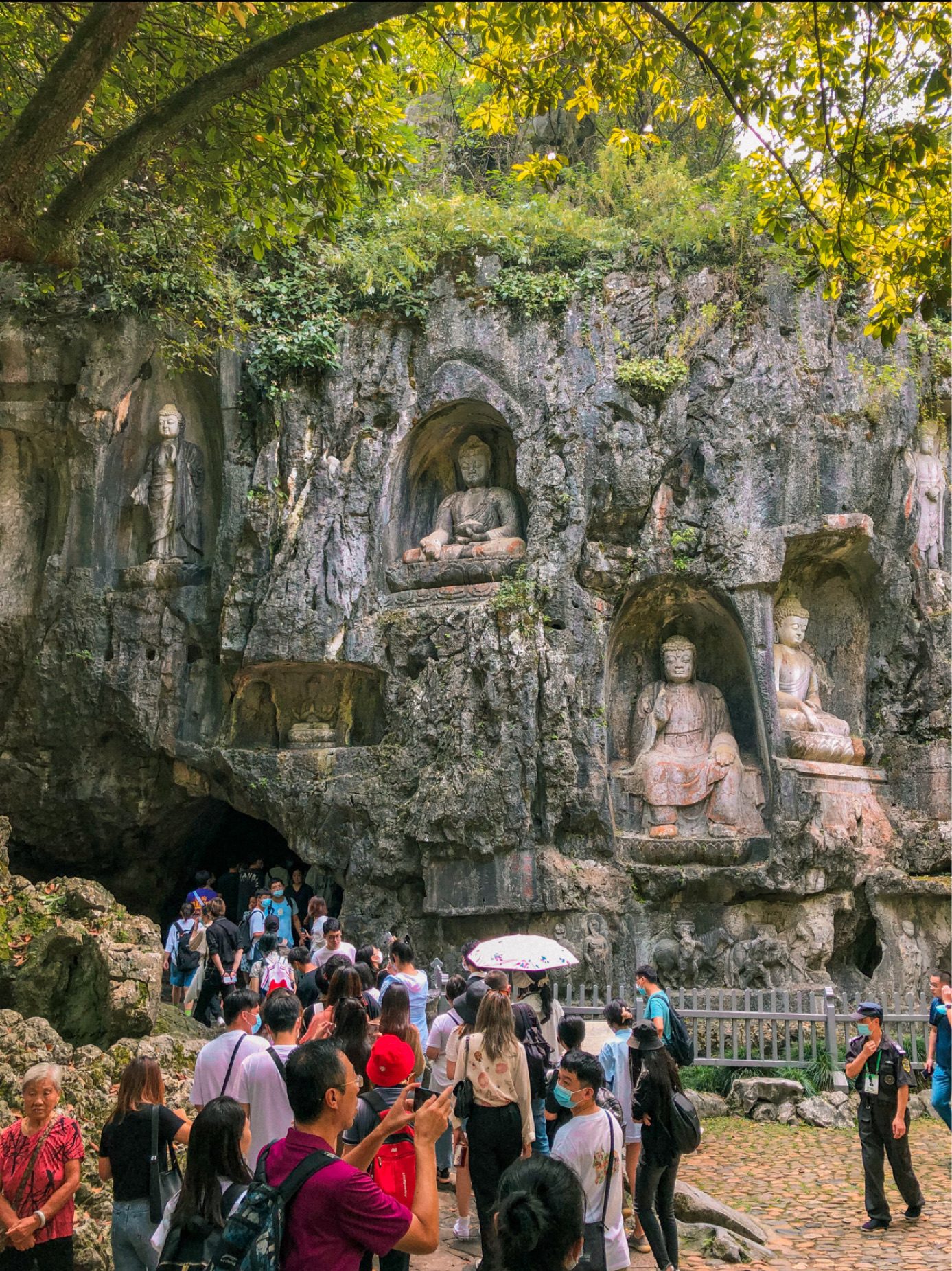
The temple sits at the foot of Feilai Peak (飞来峰, “Peak That Flew Here”), a limestone outcrop dotted with 1,000+ stone Buddhist carvings. The legend says the peak flew from India at the request of the monk Huili; the carvings range from the 10th century (Five Dynasties period) through the Yuan dynasty (13th-14th century). Together, temple + grottoes form one of the densest concentrations of Buddhist art south of the Yangtze — for the larger cave-art collection further north, see our Mogao Caves guide.
What to see
The temple complex (1.5 hours)
Enter through the Shanmen (山门, Mountain Gate), walk uphill through the axis of halls:
- Hall of the Heavenly Kings (天王殿) — first hall, with the Laughing Buddha (Maitreya) facing outward, and the Four Heavenly Kings inside. A 1974 reconstruction. Note the calligraphy plaque by Emperor Kangxi.
- Mahavira Hall (大雄宝殿) — the main hall, single-story but 33.6 m tall (one of the tallest single-story buildings in China). The 24.8-m seated Sakyamuni statue inside is made from 24 sections of camphor wood and covered in gold leaf. The largest wooden Buddha in China.
- Hall of the Medicine Buddha (药师殿) — a 1991 addition in the back, with the Medicine Buddha flanked by the Sun and Moon bodhisattvas. The wall behind is a glazed ceramic relief of a Bodhi tree.
- The 500 Arhats Hall (五百罗汉堂) — 500 bronze arhat statues, each uniquely carved. Some visitors count them looking for the “resemblance” arhat (supposedly the one that looks like you).
- Cool Spring Pavilion (冷泉亭) — a Tang-dynasty pavilion (built 825 AD) on a cold spring, north of the main axis. Famous for the 5-century calligraphy of Su Shi carved on a stone.
Vegetarian lunch: 11:30 AM in the temple refectory. ¥15-30, cash only. The “Hundred Vegetable Banquet” (百味斋) is a Hangzhou specialty, all dishes made from mushrooms, tofu, and seasonal vegetables.
Feilai Peak grottoes (1 hour)
The limestone hill right behind Lingyin Temple. More than 470 surviving Buddhist carvings in the cliff face, plus 100+ more on smaller rocks. Highlights:
- The 9-story Maitreya from the Five Dynasties period (10th century) — the earliest surviving carving on the peak
- The Yuan-dynasty Maitreya group (13th century) — considered the finest Yuan-era Buddhist sculpture in China, with distinctly Mongol facial features
- The “Sleeping Buddha” reclining on the eastern slope — carved directly into the rock, ~6 m long
- The 18 Arhats lined up along the southern cliff — Song dynasty (12th century)
The carvings are partly weathered but still legible. Bring binoculars if you have them — many of the higher Buddhas are 5-10 m up the cliff and the details are best from a distance.
The walking path through the peak takes 30-45 minutes. Steps in places but manageable for most visitors.
Yongfu Temple (永福寺, optional, +1 hour)
A short walk up the hill from Lingyin. ¥10 extra, or ¥80 combined with Lingyin. Smaller, quieter, in a forested setting. Best for visitors who want a second temple after Lingyin and 30 minutes of trail walking.
Taoguo Temple (韬光寺, optional, +1.5 hours)
Even higher up the hill from Yongfu — ¥10, 30-min climb. Reached by stone steps through a bamboo forest. The view from the top covers West Lake. Best for hikers and those who want to escape the Lingyin crowds entirely.
Practical info
Tickets: ¥75 Lingyin + Feilai Peak combined. ¥80 Lingyin + Feilai + Yongfu. Taoguo ¥10. Tickets are paper — keep them, you re-enter through the same gate.
Hours: 7:30 AM – 6:00 PM (last entry 5:30 PM). The 4:30 AM chanting ceremony is free but observation is silent and respectful — no photos, no talking.
Getting there:
- By bus: Bus 7, 278, 324M, 505, 103, 121, 1314 all stop at Lingyin Station
- By taxi: ¥20-25 from West Lake, 15 minutes
- By Metro: Line 3 to Huanglongdong Station, then bus 103 or 121, or a 15-min walk
- Tourist shuttle: Y2 from West Lake Cultural Square, every 15 min
Dress code: Shoulders and knees covered. No hats inside halls. Avoid pointing feet toward Buddha statues when sitting.
Photography: Allowed in the courtyards, restricted in the main halls (look for signs). No flash inside.
Dining: The Lingyin Vegetarian Restaurant outside the south gate is famous (¥100-200 per person, all-veg, traditional). Plus a string of restaurants on Lingyin Road serving Hangzhou classics.
The Buddhist significance
Lingyin is a Chan (Zen) Buddhist temple, one of the major Chan lineages of south China. The temple is part of the Chinese Buddhist Association’s official registry; resident monks (about 100) follow a daily schedule of 4:30 AM chanting, communal meals, work periods, and evening meditation.
The temple has been damaged and rebuilt many times — most recently 1974 — but the 1,700-year lineage of monks has been continuous through every dynasty. The current abbot, Guangquan, is the 48th abbot.
For visitors interested in Buddhism, the highlights are:
- The Jade Buddha Hall (a side hall) with a 1.5-m jade Buddha from Burma, a gift in 1956
- The Imperial Stele Pavilion — stone steles from the Tang through Qing dynasties
- The Bodhi tree in the side courtyard — a descendant of the original tree under which the Buddha attained enlightenment
What to skip
- The fortune-telling stalls outside the gate (some charge ¥50-200 for a “Buddhist blessing”)
- The “incense packages” sold at the entrance (temple provides 3 free incense sticks at the gate — those are sufficient)
- The “free tour guide” touts (they are selling temple donations)
When to visit
- Best: Weekday mornings, 7:30-9:30 AM. The temple fills up after 10 AM with tour buses.
- Avoid: Weekends, Chinese national holidays (especially Oct 1-7, Buddha’s Birthday lunar April 8), the 2 days before and after Lunar New Year.
- Seasonal: The temple is most atmospheric in early spring (March cherry blossoms in the courtyards) and late autumn (November maples). Winter is cold but quiet.
- Festival: Buddha’s Birthday celebration (lunar April 8) features a massive outdoor bathing of a small Buddha statue — visitor-friendly, free to observe.
After the temple
Walk to Longjing Village (15 min on foot, downhill) — the famous tea village. Have a cup of dragon-well green tea at the source. Most visitors combine Lingyin with Longjing for a half-day.
Walk to Hupao Spring (虎跑泉, 20 min) — a famous spring source, water so pure it is used to brew the local Longjing tea. ¥15, includes a small tea ceremony.
Lingyin pairs naturally with the rest of a Hangzhou trip — for the full 3-day plan that also covers the lake circuit and Hefang Street, see our 3-day Hangzhou itinerary.
Walk to Nine Creeks (九溪十八涧, 30 min via a forest trail) — a 4-km hike through tea fields and streams. Free, ends at Longjing Village. Best spring and autumn.
FAQ
Can I take photos of monks? No — the resident monks consider it intrusive. Photography is restricted in the main halls anyway.
Is the vegetarian lunch worth it? Yes — it is a Hangzhou specialty, and the experience (eating in the temple refectory) is part of the visit. Cash only.
Is it crowded? Very, after 10 AM and on weekends. Go at 7:30 AM opening or after 4 PM (last 1.5 hours before closing).
Are there any scams? A few — fake monks asking for donations outside the gate, incense sellers inflating prices, “free tour guides” selling prayers. Stick to the official ticket booth and do not give money to anyone who approaches you.
Can I attend the 4:30 AM chanting? It is open to respectful observers, but you need to be inside before 4:30. Realistically, you arrive the night before and stay nearby (Hupao Road has several small inns).
Plan your trip — verified tools
These free tools are built on real, monthly-verified data and help you skip the trial-and-error phase of China trip planning:
- China 240-Hour Visa-Free Transit Checker — 55 countries, 24 provinces, 65 ports. See if you qualify for 10-day visa-free transit, which cities you can visit, and the 5-step process.
- China 6-City 5-Day Budget Calculator — Real 2026 prices for 5 days in Beijing, Shanghai, Guangzhou, Chengdu, Xi’an, or Hangzhou. Budget / mid-range / comfort tiers, broken down line by line.
Verified August 2026 by TravelHubChina Editorial. We re-check prices and policy details monthly so the data doesn’t drift.
Step by step
-
Get to Lingyin from West Lake or the city
15 minutes by taxi (¥20-25) from West Lake. Bus 7, 278, 324M, 505, 103, 121, or 1314 to Lingyin Station. Or Metro Line 3 to Huanglongdong, then bus 103 or 121, or a 15-minute walk.
-
Arrive at 7:30 AM to beat the crowds
The temple opens at 7:30 AM (last entry 5:30 PM, closes 6:00 PM). Tour buses arrive after 10 AM. Buy the ¥75 combined ticket for Lingyin Temple plus Feilai Peak, or ¥80 to also include Yongfu Temple.
-
Walk the temple axis (1.5 hours)
Enter through the Shanmen (Mountain Gate), then the Hall of the Heavenly Kings, Mahavira Hall with the 24.8-m camphor-wood Sakyamuni, Medicine Buddha Hall, and the 500 Arhats Hall. End at the Cool Spring Pavilion.
-
Explore the Feilai Peak grottoes (1 hour)
The limestone hill behind the temple has 470+ surviving Buddhist carvings from the 10th-14th centuries. Highlights: the 9-story Maitreya from the Five Dynasties, the Yuan-dynastic Maitreya group, and the reclining Sleeping Buddha on the eastern slope.
-
Try the vegetarian lunch (optional, 30 min)
The temple refectory serves a Hundred Vegetable Banquet at 11:30 AM, ¥15-30 cash only. Eat in the courtyard — it is part of the Lingyin experience. Dress modestly: shoulders and knees covered.
FAQ
-
How long does it take to visit Lingyin Temple?
Allow 3 hours: 1.5 hours for Lingyin Temple itself, 1 hour for Feilai Peak grottoes (the limestone Buddhas carved into the cliff outside the temple), and 30 minutes for the walk between them. Add 1 more hour for the combined Yongfu Temple ticket if you have time. -
What is the difference between Lingyin Temple and Feilai Peak?
They are adjacent but separate attractions. Feilai Peak (飞来峰, 'Peak That Flew Here') is a limestone hill with 1,000+ stone Buddhist carvings from the 10th-14th centuries. Lingyin Temple is the active Buddhist temple complex at its base. The combined ticket is ¥75 for both — most visitors see them together since they are a 5-minute walk apart. -
Is Lingyin Temple a working temple?
Yes — it is an active Chan (Zen) Buddhist temple with about 100 resident monks. Daily chanting at 4:30 AM (silent observation only). Vegetarian lunch is served to visitors at 11:30 AM (¥15-30, cash only). Major ceremonies: Buddha's Birthday (April 8 lunar), Ullambana (July 15 lunar), and New Year. -
How do I get to Lingyin Temple from [West Lake](/articles/hangzhou-west-lake-complete-guide/)?
15 minutes by taxi (¥20-25). Bus 7 or 278 from anywhere on the lake's west side. Or the tourist bus Y2 from West Lake Cultural Square. By Metro: Line 3 to Huanglongdong Station, then bus 103 or 121, or a 15-min walk.
Related guides
-
Beijing Hutongs: A Complete Guide to the City's Ancient Alleyways (History, Map, How to Visit)
Complete guide to Beijing's hutongs: the 700-year history from Yuan dynasty to today, why hutongs are disappearing, the 6 best hutong areas to visit as a foreigner, how to navigate them on foot or by rickshaw, the etiquette rules, and how to experience the real local hutong life (not the tourist-trap version).
-
Beijing Hutong Rickshaw Tour: The Complete Guide (2026)
Everything you need to know about Beijing's hutong rickshaw tours: the history of the rickshaw, the 3 main rickshaw stands, how to negotiate a fair price (¥150-300/hour), the 4 most popular routes, what the rickshaw driver typically explains, how to avoid the commission-shop scams, and whether to do a self-walk or rickshaw tour.
-
10 Best Beijing Hutongs to Visit (Beyond the Tourist Traps)
Beyond the crowded Nanluoguxiang: 10 specific hutongs worth visiting, from the most authentic residential alleys to the most photogenic, with what makes each one unique, exact addresses, how to get there, and when to visit. Includes a printable walking map.