
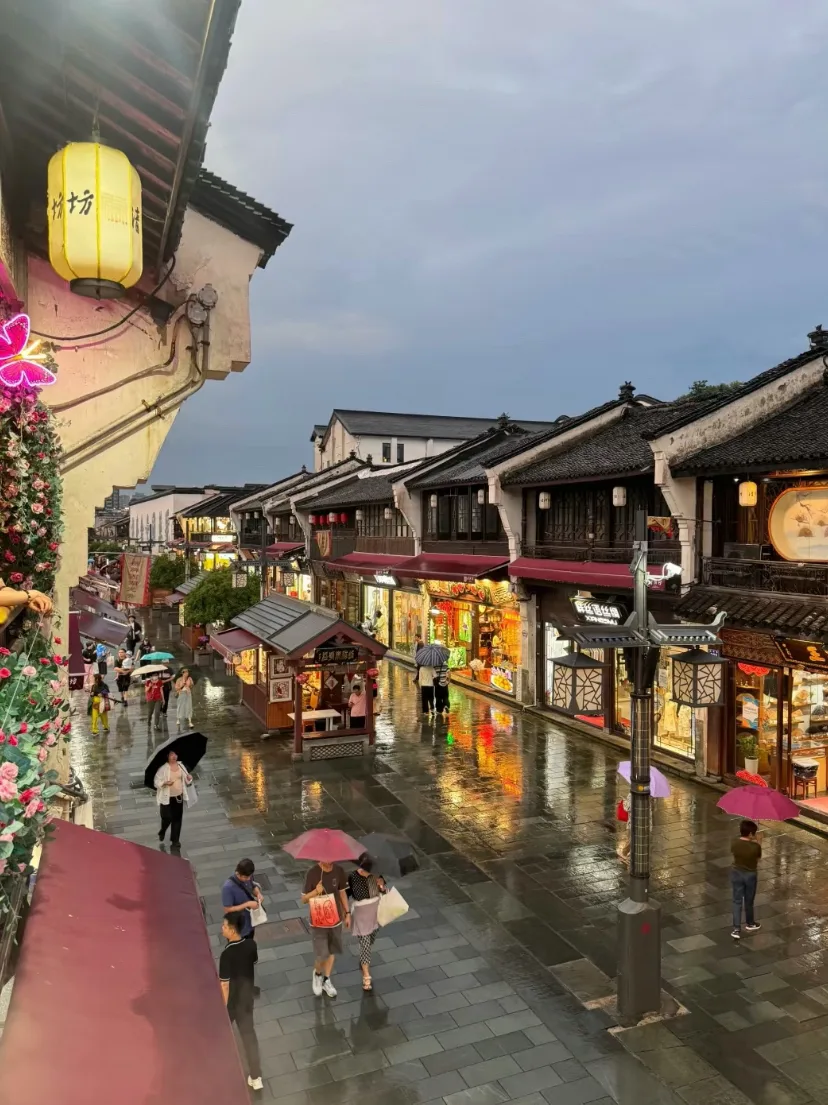
Hefang Ancient Street + Southern Song Imperial Street: Walking Guide (2026)
Hefang Street (河坊街) and the Southern Song Imperial Street (南宋御街) are restored Qing-era shopping streets in central Hangzhou. Free to walk, packed with tea shops, silk, snacks, and the 1908 Hu Qing Yu Tang pharmacy museum.
Hefang Ancient Street (河坊街) and the Southern Song Imperial Street (南宋御街) are the two best-preserved historic shopping streets in Hangzhou, running parallel in the city center about 5 minutes’ walk from West Lake. Both are restored (2007-2008), but in a more disciplined, less theme-park way than similar streets in other Chinese cities. The Southern Song Imperial is the more atmospheric, with the original 800-year-old stone paving preserved down the middle; Hefang is the busier, narrower, more commercialized companion.
The streets date to the Southern Song dynasty (1127-1279), when Hangzhou (then called Lin’an 临安) was the capital of China. The Imperial Street was the main processional avenue for the Emperor, lined with government offices, noble residences, and high-end shops. After the Mongols took the city in 1276, the street continued as a commercial district for another 700 years, with the same basic structure. The 2007 restoration preserved the historic facade while modernizing the buildings.
What to see on Hefang Street (1.5 hours)
Hefang is the busier, narrower street — 460 m long, 4-6 m wide, packed with shops, snack stalls, and pedestrians. Walking it top to bottom takes 30 minutes if you do not stop, 90 minutes if you do.
Top stops
- Wushan Square (吴山广场) — the south end of Hefang. Free, a small public square with a 9-tiered pavilion. The night view from here is the best photo angle of Hangzhou’s West Lake city lights. For how this stop fits in a wider Hangzhou day, see our 3-day Hangzhou itinerary.
- Wengji Mao House (翁佳) — a restored Qing-era merchant’s house. ¥10 entry. Three courtyards with period furniture. The woodwork in the second courtyard is the highlight.
- Hangzhou National Silk Store (杭州中国丝绸城) — the city’s main government-run silk store. Selection of silk scarves, robes, duvet covers. Prices are reasonable; the larger the purchase, the more bargaining room. Be cautious of “100% silk” labels — ask to see the certification.
- Dingsheng Cake Shop (定胜糕) — a 100-year-old bakery famous for the local Dingsheng cake, a small sweet steamed rice cake that smells like osmanthus. ¥5 each. Best eaten warm.
- Cong Bao Hui (葱包桧) — the signature Hangzhou street food. A scallion and youtiao (fried dough) wrapped in a thin pancake. ¥8. The famous shop is at the corner of Hefang and Dingan Road.
- Wushan Red Tea House (吴山茶馆) — a 100-year-old teahouse in a restored building. ¥20-30 for a pot of local tea and unlimited hot water. Sit on the second floor for the street view.
- The Emperor’s Tea Park (御茶园) — a small park with a tea house and a few tea bushes. Free, quiet, a good place to take a break from the crowds.
- Duanmen Bridge (端门桥) — at the north end of Hefang, a small stone bridge over the old canal. The bridge’s balustrade is the best spot for photographing the lanterns along the street.
What to see on Southern Song Imperial Street (1.5 hours)
The Imperial Street is wider and grander than Hefang — a 13-meter-wide avenue, 800 m long, divided into 3 lanes: pedestrian on the sides, the original Song-dynasty stone-paved central lane (with a glass floor in some sections showing the original stones below). It is less crowded and more atmospheric, especially after dark.
Top stops
- The original paving stones — walk the central lane. In some sections, glass covers the original 800-year-old stones from the Southern Song dynasty. Other sections show the original paving. Do not miss the section near Zhongshan Middle Road where the glass floor is widest.
- Hu Qing Yu Tang Pharmacy Museum (胡庆余堂中药博物馆) — the most important stop on the street. Founded in 1874 by the “Red-headed Businessman” Hu Xueyan, this is the largest traditional Chinese medicine pharmacy in China, still operating. The courtyard is free — beautifully restored, with the original gold-leaf carved sign, the giant drug-grinding mortar (a 1.5-m stone wheel), and the seasonal display of medicinal plants. The museum is ¥10 — a small collection of ancient medicine bottles, prescriptions, and the original “secret recipe room” (an inside-the-walls pharmacy that only certain family members could enter). The whole place smells of herbal medicine.
- Former residence of Hu Xueyan (胡雪岩故居) — across the street from Hu Qing Yu Tang, ¥20 entry. The mansion of the “Red-headed Businessman” who made his fortune as a banker and silk merchant in the late Qing dynasty. The whole complex is enormous — 10 courtyards, decorated in carved wood and gold leaf. Best example of late-Qing merchant architecture in Hangzhou.
- The old Cathay Hotel (华美饭店) — at the corner with Zhongshan Middle Road. Now a museum of Hangzhou history. ¥10.
- Zhang Xiaoquan Scissors Museum (张小泉剪刀博物馆) — small museum dedicated to the 400-year-old Zhang Xiaoquan scissors brand, famous in China. ¥5.
- Southern Song Imperial Street Memorial Archway (南宋御街牌坊) — the large stone archway at the north end of the street, with a 5-meter-wide wooden gate. Built in 2008 as the formal entrance to the restored street. The most-photographed landmark on Imperial Street.
What to eat
The street is famous for Hangzhou street food. Best bets:
| Food | Shop | Price | What it is |
|---|---|---|---|
| Cong Bao Hui (葱包桧) | Hefang Dingan Road corner | ¥8 | Scallion + fried dough in a thin pancake — the iconic Hangzhou street snack |
| Dingsheng Cake (定胜糕) | Dingsheng Cake Shop | ¥5 | Sweet steamed rice cake with osmanthus — the local “victory” cake |
| Wushan Red Tea (吴山红茶) | Wushan Red Tea House | ¥20-30/pot | A red tea developed in the 1930s, slightly sweet, smooth |
| Pian Er Chuan (片儿川) | Any small noodle shop | ¥15-25 | Hangzhou’s signature noodle — thin wheat noodles in broth with pork and bamboo shoots (one of the city’s classic street foods) |
| Dongpo Pork (东坡肉) | Louwailou (楼外楼) on Solitary Hill | ¥50-80/portion | The dish invented by Su Shi — slow-braised pork belly, very fatty, very rich |
| West Lake Vinegar Fish (西湖醋鱼) | Same as above | ¥80-100/whole fish | The other Hangzhou signature — grass carp in sweet vinegar sauce |
What to buy
Tea: The 2-3 tea shops on Hefang are tourist-priced (2-3x what you would pay at the source). Do not buy Longjing here — go to the source village to taste 4-5 grades side by side. Instead, look for:
- Anji white tea (安吉白茶) — Zhejiang white tea, ¥100-300/100g
- Jasmine tea (茉莉花茶) — green tea scented with jasmine flowers, ¥80-200/100g
- Tieguanyin oolong (铁观音) — wait, that is from Fujian, not Hangzhou. Skip.
Silk: Hangzhou is one of China’s silk capitals. Quality varies wildly. Look for Hangzhou Silk Brand (杭州丝绸) label. Prices:
- Silk scarf: ¥80-300
- Silk duvet cover: ¥500-1,500
- Silk robe: ¥300-2,000
Snacks to take home: Dingsheng cake, osmanthus sugar, candied lotus root. ¥30-100 for a small box.
Tea sets: Yixing clay teapots (紫砂壶) — the real ones are ¥200+, the fakes are everywhere. Do not buy unless you know what you are looking for.
Practical info
Hours: 24/7 for walking. Shops generally 9 AM – 10 PM. Restaurants open until 11 PM or later. Best at 5-7 PM (lanterns come on, tour groups leave).
Getting there:
- Metro Line 1 to Ding’an Road (定安路) station, Exit A, 3-min walk
- Bus K4, K7, Y1, Y2, Y10 to the Wushan Square or Drum Tower stop
- 15-min walk from West Lake’s east side
Free: Both streets are open public spaces.
WiFi: Available in most restaurants and shops. Public WiFi “i-hangzhou” works along the street.
Bathrooms: 3 public toilets along the route. Free, clean. Signposted in English.
Best time of day: Late afternoon to early evening (5-7 PM). The lanterns come on, the temperature drops, the tour groups have left.
Avoid: Weekends in summer (very hot and crowded), Chinese national holidays (impossible to walk), the noon hour in peak season (no shade, very hot).
Combinations
With Qinghefang Old Street (1-2 hours): the original Hangzhou old town, immediately south of Hefang Street. Mostly residential now, with a few small temples. Quieter, more authentic.
With Drum Tower (鼓楼, 30 min): the old drum tower of Hangzhou, now a small museum. ¥10.
With Wushan Hill (吴山, 1-2 hours): the small hill at the south end of Imperial Street. Free to walk up; the city views from the top are excellent.
With West Lake (full day): Walk Hefang + Imperial in the morning, taxi to West Lake (10 min) for the lake circuit in the afternoon. Stay in the lake area for sunset.
What to skip
- The “antique” shops selling fake Ming/Qing furniture — universally fake
- The “tea house performances” with girls playing guzheng — staged, not authentic
- The “Chinese knot” shops — they sell the same mass-produced knots as every other tourist street in China
- The silk shops claiming “100% mulberry silk” without certification
FAQ
Is the Imperial Street authentic? The street layout is authentic (800 years old), the paving stones are original, the historic buildings are real. The 2007-2008 restoration rebuilt the missing parts. It is a real historic street, not a theme park.
Can I use Alipay / WeChat Pay? Yes — almost every shop accepts both, plus cash. Foreign cards rarely work in small shops.
Is it English-friendly? Less than West Lake. The larger shops have English-speaking staff, the small stalls may not. Have Pleco (dictionary app) and Google Translate ready. Most menus have photos. For the key phrases that get you through the day (谢谢, 多少钱, 不要), see our essential Chinese phrases list.
Is it safe at night? Yes — well-lit, plenty of police presence, very crowded. Watch for pickpockets in the densest crowds.
Plan your trip — verified tools
These free tools are built on real, monthly-verified data and help you skip the trial-and-error phase of China trip planning:
- China 240-Hour Visa-Free Transit Checker — 57 countries, 24 provinces, 65 ports. See if you qualify for 10-day visa-free transit, which cities you can visit, and the 5-step process.
- China 6-City 5-Day Budget Calculator — Real 2026 prices for 5 days in Beijing, Shanghai, Guangzhou, Chengdu, Xi’an, or Hangzhou. Budget / mid-range / comfort tiers, broken down line by line.
Verified August 2026 by TravelHubChina Editorial. We re-check prices and policy details monthly so the data doesn’t drift.
Step by step
-
Plan your 2-3 hour visit window
Both streets are free to walk. Best at 5-7 PM when the lanterns come on and the tour groups have left. Allow 2-3 hours for the full walk; half a day if you want to eat, shop, and visit museums.
-
Take Metro Line 1 to Ding'an Road
Ding'an Road (定安路) station, Exit A, then a 3-minute walk to Wushan Square at the south end of Hefang Street. From West Lake's east side it is a 15-minute walk. Bus K4, K7, Y1, Y2, and Y10 all stop nearby.
-
Walk Hefang Street (1.5 hours)
Start at Wushan Square, walk north past the silk stores, tea shops, and snack stalls. Do not miss Dingsheng Cake (¥5), Wushan Red Tea House, the Emperor's Tea Park, and end at Duanmen Bridge.
-
Walk Southern Song Imperial Street (1.5 hours)
The parallel avenue 200 m away. See the original 800-year-old Song paving stones preserved under glass, the Hu Qing Yu Tang pharmacy museum (¥10), and the Former Residence of Hu Xueyan (¥20).
-
Eat street food and bargain
Try Cong Bao Hui (¥8), Pian Er Chuan noodles (¥15-25), or a pot of Wushan Red Tea (¥20-30). For tea, silk, and souvenirs, start at 60% of the asking price and meet in the middle.
FAQ
-
Is Hefang Street worth visiting?
Yes, but with realistic expectations. It is a tourist-oriented shopping street, not an authentic neighborhood. The atmosphere is pretty, the snacks are good, and the Hu Qing Yu Tang pharmacy museum is genuinely interesting. Do not expect 'old China' — expect a 2008-restored street that captures the look of a 1880s commercial district. Best at 5-7 PM when lanterns come on and tour groups have left. -
What is the difference between Hefang Street and Southern Song Imperial Street?
They run parallel, 200m apart, connected by alleys. Hefang is the busier, narrower, more touristy commercial street — mostly snack stalls and souvenir shops. Southern Song Imperial is the wider, more atmospheric avenue with the original Song-dynasty paving stones preserved in the center lane, plus more substantial historic buildings (Hu Qing Yu Tang, the old post office, etc.). Walk both; allow 1.5 hours each. -
Is Hefang Street free?
Yes — both streets are open public spaces. The Hu Qing Yu Tang pharmacy museum is ¥10 (free to walk the courtyard and shop). Most other historic house museums are ¥5-10. Wushan Red Tea house (吴山茶馆) is free to enter and ¥20-30 for a tea session. -
Can I bargain in the shops?
Yes, but lightly. The silk, tea, and souvenir shops are used to tourist haggling. Start at 60% of the asking price and meet in the middle. The snack stalls have fixed prices (no bargaining). Be polite — aggressive bargaining is culturally off-putting.
Related guides
- Culture & Practical
Lingyin Temple + Feilai Peak: The Complete Guide (2026)
Lingyin Temple (灵隐寺) is the largest Buddhist temple in Hangzhou, founded 326 AD, with the Feilai Peak grottoes containing 1,000+ stone Buddhas. Tickets, transport, what to see, and how to combine with Flying Peak and Yongfu Temple.
8min read
- Culture & Practical
Is It Safe to Travel to China in 2026? The Complete Foreigner's Safety Guide
Comprehensive 2026 safety guide for China travel: crime statistics, region-specific risks, scams targeting foreigners, US State Department advisory, LGBTQ+ safety, female solo travel, health and medical care, embassy registration, and 5-step arrival safety checklist. Plus: is it safe to travel to China right now in 2026 (yes, with normal precautions).
12min read
- Culture & Practical
Chinamaxxing 2026: 12 Chinese Lifestyle Experiences Every Foreigner Should Try
Chinamaxxing is the 2026 trend of foreign visitors going deep into Chinese daily life — hot water, ba duan jin qigong, hanfu, mahjong, tea ceremony, foot baths, and more. 12 hands-on experiences with where to try each one, what to expect, and how to book.
9min read
- Culture & Practical
LGBTQ+ Travel in China 2026: Safety, Apps, Cities & Practical Guide
Practical LGBTQ+ travel guide for China in 2026 — legal status (homosexuality is legal, no same-sex marriage), social attitudes by city, dating apps (Blued, Tantan, Aloha), the 3 most LGBTQ+-friendly cities (Shanghai, Beijing, Chengdu), nightlife, healthcare, family considerations, and 5 ready-made LGBTQ+-friendly city profiles. Updated 2026-08-21 with current legal status and city-by-city social attitudes.
- Culture & Practical
Solo Female Travel in China 2026: The Honest Safety Guide Foreigners Don't Get
China is statistically one of the safer large countries for solo female travelers, but the safety profile is different from Western countries. What works in Tokyo or Paris may not work in Beijing. The 2026 honest guide: 8 specific safety scenarios (DiDi at night, hostel vs hotel, walking alone, foreigner-targeted scams, hostel harassment, menstruation access, dating safety, embassy backup), ranked by frequency and risk. Includes the 5 phrases every solo female traveler should learn, and the 2 scenarios where you should NOT go alone.
5min read
- Culture & Practical
Beijing Hutongs: A Complete Guide to the City's Ancient Alleyways (History, Map, How to Visit)
Complete guide to Beijing's hutongs: the 700-year history from Yuan dynasty to today, why hutongs are disappearing, the 6 best hutong areas to visit as a foreigner, how to navigate them on foot or by rickshaw, the etiquette rules, and how to experience the real local hutong life (not the tourist-trap version).
8min read