
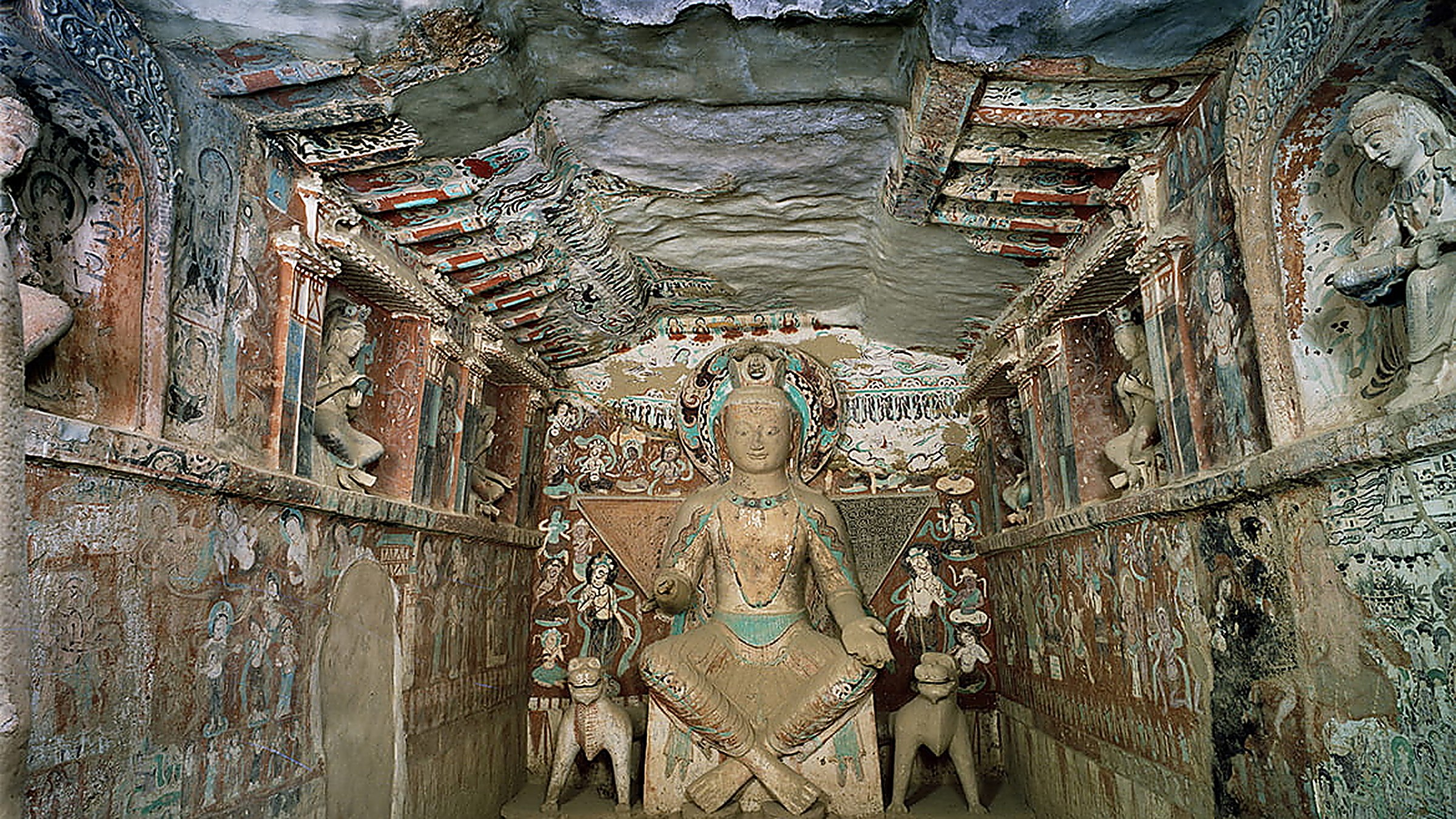
Mogao Caves Guide: Dunhuang Silk Road Buddhist Caves
Mogao Caves near Dunhuang: 735 Buddhist caves with 45,000 sqm of murals, UNESCO since 1987. Tickets (¥238), 6,000 daily cap, photography ban.
The Mogao Caves (莫高窟, Mògāokū), also called the Thousand-Buddha Caves, are a system of 735 Buddhist cave temples carved into a sandstone cliff near Dunhuang in Gansu province, western China. The caves were created between 366 and 1368 CE, with art accumulating over 1,000 years. Today they hold about 2,000 Buddhist statues and 45,000 square meters of murals - the world’s largest collection of Buddhist cave art. For Tibetan Buddhist art and architecture across the same plateau, see our Potala Palace scenic guide in Lhasa. UNESCO listed the Mogao Caves as a World Heritage Site in 1987. The Sichuan park at Jiuzhaigou is another UNESCO site of a very different character - lakes, forests, and Tibetan villages rather than desert caves.
The caves were a major stop on the ancient Silk Road, a network of trade routes connecting China with Central Asia, India, Persia, and the Mediterranean. Dunhuang was the gateway to China for travelers and traders from the West. The same western arc anchors our China classic 2-week itinerary, where Xi’an, Dunhuang, and the Hexi Corridor stops build toward modern China. The site receives about 1.5 million visitors per year, capped at 6,000 per day. All visits are by guided tour only. Photography is strictly forbidden inside the caves.
How to plan your visit
1-day Dunhuang plan (the minimum)
- Morning - Dunhuang Museum (free, 1-2 hours)
- Late morning - Drive to the Mogao Caves Digital Exhibition Center
- Midday - Watch the 2 films, shuttle to the cave site, guided tour (1.5-2 hours)
- Late afternoon - Mingsha Mountain and Crescent Lake for sunset (¥110, 2-3 hours)
2-day Dunhuang plan (recommended)
- Day 1 - Dunhuang Museum + Mogao Caves (4-5 hours)
- Day 2 - Mingsha Mountain + Crescent Lake (morning) + Yangguan Pass / Yumen Pass (afternoon, 80 km west, requires a tour)
3-day Dunhuang plan
- Day 1 - Museum + Mogao Caves
- Day 2 - Mingsha Mountain + Crescent Lake + Dunhuang night market
- Day 3 - Western Thousand-Buddha Caves (西千佛洞, smaller, less crowded, 35 km west) + Yangguan Pass
Tickets, booking, and payment
| Item | Price | Notes |
|---|---|---|
| Mogao Caves combined ticket | ¥238 peak / ¥148 off-peak | May-Oct / Nov-Apr |
| Digital Exhibition Center | Free with ticket | 2 short films |
| Shuttle to cave site | Free with ticket | 15 min |
| English guided tour | Free with ticket | Limited availability |
| Mingsha Mountain + Crescent Lake | ¥110 | 5 km from caves |
| Dunhuang Museum | Free | Tue-Sun, 9:00-17:00 |
| Western Thousand-Buddha Caves | ¥40 | 35 km west, smaller |
| Yangguan Pass / Yumen Pass | ¥50 + ¥50 | 80 km west, requires tour |
How to book:
- WeChat mini-program “莫高窟” - official booking, 2-5 days in advance. Chinese only.
- Trip.com - English, accepts foreign cards, ¥260-320 per ticket (slight markup). Most reliable for foreign visitors.
- At the gate - limited same-day tickets, usually available only in off-peak season (Nov-Apr).
- Tour packages - Trip.com and Dunhuang travel agencies sell 1-day Dunhuang tours ¥500-800 per person including transport, ticket, and English guide.
Free entry: Children under 1.2m. Seniors over 65 (with passport). Students with valid Chinese student ID.
Closures: The Mogao Caves are closed for 1 day per month for major conservation work (the date rotates; check the official site). Closed for 1 week in late January for the annual maintenance. Individual caves rotate for restoration.
Visitor cap: 6,000 visitors per day, including all tour groups and individual visitors. The cap is hit almost every day in peak season. Book 3-5 days in advance for July-August.
Getting there and around
By air (most common): Dunhuang Airport (DNH) is 13 km east of the city. Direct flights from Beijing (3h 30m), Shanghai (4h 30m), Xi’an (2h 30m), Lanzhou (1h 30m), Jiayuguan (1h), and Urumqi (2h). Xi’an is the most reliable connection point. The airport is ¥30 by taxi or ¥10 by airport shuttle bus.
By HSR: The closest HSR station is Liouyuan (柳园) on the Lanzhou-Xinjiang HSR line, 130 km northeast of Dunhuang. From Beijing, the HSR takes 13 hours via Lanzhou-Liouyuan; from Shanghai, 18 hours; from Xi’an, 9 hours. From Liouyuan, a connecting bus to Dunhuang takes 2.5 hours (¥40) or a private car ¥200.
Inside Dunhuang: Taxi is the primary way to get around. Most rides are ¥10-30 within the city. Dunhuang does not have a Didi network. Public bus is limited. Self-driving is straightforward - the city is small and the sites are well-marked.
To the Mogao Caves: Most visitors book a tour or a private car. Public bus Dunhuang 12 (¥5, 1 hour) runs 4-5 times per day from the city center. Taxi ¥80-100 one-way. Tour packages with hotel pickup and drop-off ¥150-250 per person.
What to bring
- Passport - required for entry, the security check, and the ticket check.
- Camera (but it will be stored in the locker) - photography is forbidden inside the caves. The lockers at the cave site are small; bring a small camera, not a large DSLR.
- Sun protection - the Dunhuang desert has UV index 9-11 in summer. Hat, sunscreen SPF 50+, polarized sunglasses, lip balm with SPF.
- Layered clothing - temperatures swing 20°C between day and night. The desert is hot in the day and cold at night. Even in summer, bring a warm jacket for evening.
- Comfortable walking shoes - the cave site has uneven stone paths; the sand dunes at Mingsha Mountain are hot and unstable.
- Water bottle (1-2L) - drink 3-4L per day. Tap water is not drinkable; bottled water is ¥3-5.
- Sand protection - if visiting Mingsha Mountain, a scarf or buff to cover your mouth in the sand. Sandstorms happen 5-10 days per year, usually in spring.
- Cash ¥500-1,000 - small vendors, the Mingsha Mountain camel rides, and some restaurants are cash-only. Most larger venues accept Alipay.
- Power bank - the desert sun drains phones quickly. Bring a 20,000 mAh pack.
The 5 photo spots that matter
- The Nine-Storey Cave exterior (Cave 96) - the 35.5m seated Buddha visible from outside, framed by the 9-story wooden facade. The most-photographed exterior at the cave site. Best 10:00-11:00 AM with side light.
- The cliff face of the 735 caves - looking up at the cliff with 4-5 levels of cave openings stacked vertically. The full scale of the site. Best 9:00-10:00 AM.
- Mingsha Mountain sand dunes at sunset - the most-photographed Dunhuang scene. The crescent-shaped spring in the foreground, sand dunes in the background, sunset colors. Allow 2 hours for sunset.
- Crescent Lake (月牙泉) - the 2,000-year-old crescent spring at the base of Mingsha Mountain. Best in the morning or late afternoon.
- Dunhuang Museum’s replica Cave 275 - the 4m tall Buddha from the Northern Wei period. The only place in Dunhuang where you can see detailed cave art up close without a guided tour.
Common mistakes to avoid
- Trying to take photos inside the caves. Strictly forbidden. The lockers at the entrance are checked, and guards patrol the caves. Fines up to ¥500. Just enjoy the caves in person.
- Going on a Chinese national holiday. 6,000 daily cap is hit, tours are fully booked weeks in advance, the site is shoulder-to-shoulder. Visit in shoulder season (April-May, September-October) instead.
- Skipping the Digital Exhibition Center. Many visitors rush through the films to get to the caves. The films provide essential context and the dome projection is exceptional. Allow 1.5-2 hours.
- Skipping the Dunhuang Museum. The museum has the only place in Dunhuang to see the murals up close (as replicas). Visit before the caves for context.
- Visiting the caves without a guide. Not possible - all tours are guided. But the guide quality varies; book the English tour if available.
- Trying to see all 735 caves. Not possible and not desirable. Most are unrestored. The guided tour covers the 8-10 most important caves; that is plenty.
- Wearing open shoes in the desert. The sand at Mingsha Mountain is hot (50-60°C in summer). Closed walking shoes or sandals with straps are essential.
- Driving to the Western Thousand-Buddha Caves without checking road conditions. The 35 km road to the western caves is partially unpaved. Rains can close it. Check conditions at your hotel before leaving.
Where to stay
- Dunhuang old town (敦煌市区) - 5 km from both the Mogao Caves and Mingsha Mountain. Most visitors stay here. Budget: Silk Road Youth Hostel, Dunhuang Hotel (¥150-300). Mid-range: Silk Road Dunhuang Hotel, Dunhuang Grand Soluxe (¥400-700). Boutique: The Silk Road Dunhuang Hotel, Dunhuang Yard (¥600-1,200).
- Near Mingsha Mountain - closer to the dunes for sunrise/sunset, 5 km from the caves. Mid-range: Mingsha Mountain Hotel, Dunhuang Resort (¥500-900).
- Near the Mogao Caves - closer to the cave site, 25 km from the city. Mostly mid-range resort hotels. Best for 1-day focused visits. Mid-range: Mogao Caves Resort (¥500-800).
Best season and what to expect
April-May (best for spring): Temperatures 15-28°C, light winds, wildflowers in the desert. Crowds are moderate (4,000-5,000 per day at the caves). The desert is comfortable for walking. Bring a light jacket for evening. For the country-wide view of the same window, see our best time to visit China guide.
June-August (summer): Hot (30-40°C) and dry. Crowds are heavy (5,500-6,000 daily cap is hit). Sandstorms happen 1-2 times per month. Mingsha Mountain is extremely hot in the day; visit at sunset. Avoid hiking in midday.
September-October (best for autumn): Temperatures 10-25°C, clear skies, comfortable. Crowds are extreme during Chinese National Day (Oct 1-7). The second half of September and the second half of October are the best windows.
November-March (winter): Cold (-10 to 8°C), possible snow. Crowds are very small (1,000-2,000 per day). The caves’ interior is unheated; bring warm clothes. Best for serious visitors and photographers. The dunes at Mingsha Mountain are quiet and beautiful in winter light.
Plan your trip - verified tools
These free tools are built on real, monthly-verified data and help you skip the trial-and-error phase of China trip planning:
- China 240-Hour Visa-Free Transit Checker - 55 countries, 24 provinces, 65 ports. See if you qualify for 10-day visa-free transit, which cities you can visit, and the 5-step process.
- China 6-City 5-Day Budget Calculator - Real 2026 prices for 5 days in Beijing, Shanghai, Guangzhou, Chengdu, Xi’an, or Hangzhou. Budget / mid-range / comfort tiers, broken down line by line.
Verified August 2026 by TravelHubChina Editorial. We re-check prices and policy details monthly so the data doesn’t drift.
Step by step
-
Fly or HSR to Dunhuang
Dunhuang Airport (DNH) has direct flights from Beijing (3h 30m), Shanghai (4h 30m), Xi'an (2h 30m), Lanzhou (1h 30m), and Urumqi (2h). The airport is 13 km from the city center, ¥30 taxi. HSR: Liouyuan (柳园) station on the Lanzhou-Xinjiang high-speed line, 130 km from Dunhuang, 2.5 hours by connecting bus or ¥200 taxi. Total HSR from Beijing is 13 hours via Lanzhou-Liouyuan; total HSR from Shanghai is 18 hours.
-
Stay 1-2 nights in Dunhuang city
Dunhuang is a small city of 200,000 people. Most visitors stay in the old town area, 5 km from the Mogao Caves and 5 km from Mingsha Mountain. Budget: Dunhuang Hotel, Silk Road Youth Hostel (¥150-300). Mid-range: Silk Road Dunhuang Hotel, Dunhuang Grand Soluxe Hotel (¥400-700). Boutique: The Silk Road Dunhuang Hotel (¥600-1,200). Avoid staying near the airport - too far from sites.
-
Visit the Dunhuang Museum first (free, 1-2 hours)
The Dunhuang Museum is in the city center, free entry, Tuesday-Sunday 9:00-17:00. It has 4,000+ artifacts from the Mogao Caves including replica murals, Buddhist statues, and Silk Road trade goods. The replica of Cave 275 (a 4m tall Buddha) is the highlight. Visit the museum in the morning for context before the cave site.
-
Pre-book Mogao Caves tickets 2-5 days in advance
Book via the WeChat mini-program "莫高窟" (Mogao Caves) or via Trip.com (English, accepts foreign cards). Select a morning time slot (8:00 AM or 9:00 AM tours are less crowded). The combined ticket is ¥238 peak / ¥148 off-peak, includes the Digital Exhibition Center, the shuttle, and the guided tour. Same-day tickets are possible in off-peak but sell out in peak.
-
Start at the Digital Exhibition Center (1.5-2 hours)
The Digital Exhibition Center is 15 km from the cave site and 10 km from the city. Arrive 30 min before your tour time. Watch 2 short films: "The Thousand-Buddha Caves" (history and Silk Road context, 20 min) and "The Dream of Dunhuang" (a digital dome projection of 8 famous caves, 20 min). Both films are included in the ticket. The dome projection is exceptional - worth the visit on its own.
-
Take the shuttle bus to the cave site (15 min)
From the Digital Exhibition Center, free shuttle bus to the cave site, 15 min. Buses run every 10 min. The cave site has a visitor center, a museum, and the cliff face with the 735 caves. Arrive 15 min before your guided tour to store all cameras, phones, and bags in the lockers (¥10 deposit, refundable).
-
Join the guided tour of 8-10 caves (1.5-2 hours)
The guided tour is included in the ticket. Tours are in Mandarin by default; English tours are available in peak season (limited, ask at the ticket office). Each tour covers a different selection of caves, rotated to spread visitor impact. Highlights: Cave 9 (late-Tang murals), Cave 16-17 (Library Cave), Cave 96 (35.5m seated Buddha, the largest indoor Buddha), Cave 148 (Tang dynasty reclining Buddha), Cave 257 (Northern Wei murals).
-
After the cave tour: museum and Nine-Storey Cave exterior
The on-site museum has replicas of famous caves and conservation exhibits (30-45 min). The Nine-Storey Cave (Cave 96) exterior is the iconic view of the cave site, with the 35.5m Tang-era Buddha visible from outside. The exterior of the cliff face, with 735 cave openings stacked vertically, is the most-photographed view. Allow 30-45 min for the museum and exterior view.
-
Pair with Mingsha Mountain and Crescent Lake (2-3 hours)
Mingsha Mountain (鸣沙山) and Crescent Lake (月牙泉) are 5 km from the Mogao Caves and 5 km from Dunhuang city. Entry ¥110. The crescent-shaped spring has been in the same spot for 2,000 years. Activities: camel rides (¥100, 1 hour), sand sliding (¥20), quad biking (¥150). The sunset view over the sand dunes is the most-photographed scene in Dunhuang. Allow 2-3 hours for the park.
FAQ
-
How much is the Mogao Caves ticket in 2026?
The combined ticket is ¥238 in peak season (May 1 - October 31) and ¥148 in off-peak (November 1 - April 30). It covers the Digital Exhibition Center (with 2 short films about the caves and Silk Road), the shuttle bus to the cave site, and a guided tour of 8-10 caves. Tickets must be booked in advance via the official mini-program or Trip.com. There is no foreigner surcharge. -
Can I take photos inside the Mogao Caves?
No - photography is strictly forbidden inside all caves. All cameras, phones, and bags must be stored in lockers (¥10 deposit) at the entrance before the tour. The only photography allowed is outside the caves (the cliff face and the Nine-Storey Cave exterior) and inside the Digital Exhibition Center. The rule exists to protect the 1,000+ year-old murals from camera flash and physical contact. Violators can be fined or asked to leave. -
How many caves can I see at Mogao?
8-10 caves per guided tour, depending on the season and the queue. Of the 735 total caves, only 60-70 are open to the public at any time; the rest are either unrestored, actively being studied, or closed for conservation. The guided tour is 1.5-2 hours. Each tour group is limited to 25-30 people. The most famous caves (Cave 9 with the Tang dynasty murals, Cave 96 with the 35.5m Buddha) are included on most tours. -
Do I need to book Mogao Caves tickets in advance?
Yes - the daily visitor cap is 6,000 and the tours sell out 2-5 days in advance during peak season (May-October). Book via the official WeChat mini-program "莫高窟" or Trip.com. The mini-program is Chinese only; use Trip.com for English booking with foreign card. Same-day tickets at the gate are possible in off-peak (November-April) but you may get a later time slot. -
What is the best time of year to visit the Mogao Caves?
April-May and September-October. Spring and autumn are 12-25°C with low humidity - the murals are at their best visibility and the desert is comfortable. July-August is hot (32-40°C) and can be windy (sandstorms). Winter (December-February) is cold (-10 to 5°C) but very quiet and the visitor cap is rarely hit. Avoid Chinese National Day (Oct 1-7) and the first week of May. -
How do I get to the Mogao Caves from Dunhuang city?
The caves are 25 km southeast of Dunhuang city, 30-40 min by car. Most visitors book a tour that includes hotel pickup, the Digital Exhibition Center, and the cave site. Public bus is limited (Dunhuang Bus 12, ¥5, 1 hour, 4-5 times per day). Taxi ¥80-100 one-way, ¥150-180 round-trip. Didi works in Dunhuang but availability is limited. Self-driving is straightforward - the route is well-marked. -
How long should I spend at the Mogao Caves?
4-5 hours for the full visit. 1.5-2 hours in the Digital Exhibition Center (2 short films, 20 min each, included in ticket), 30 min shuttle bus ride, 1.5-2 hour guided tour of 8-10 caves, 30 min for the museum and the Nine-Storey Cave exterior view. Add another 2-3 hours for the Mingsha Mountain and Crescent Lake spring park (¥110, 5 km from the cave site). -
What is the Silk Road significance of the Mogao Caves?
The Mogao Caves were a major stop on the ancient Silk Road, a network of trade routes connecting China with Central Asia, India, Persia, and the Mediterranean. Dunhuang was the gateway where traders, monks, and diplomats entered China from the West. The caves accumulated art, manuscripts, and trade goods for 1,000 years. The Library Cave (Cave 17) discovered in 1900 held 50,000+ manuscripts in 24 languages - one of the most important archaeological finds in human history.
Related guides
-
Big Wild Goose Pagoda Guide: Xi'an's 1,300-Year Tang Pagoda
Big Wild Goose Pagoda (Dayan Ta) in Xi'an: 64m Tang-dynasty brick pagoda from 652 AD, UNESCO since 2014 as part of the Silk Roads network. Tickets (¥50), climb times, and the free North Square musical fountain (9 PM nightly).
-
Jinli Ancient Street Guide: Chengdu's Most Photogenic Old Quarter
Jinli Ancient Street in Chengdu: a reconstructed Qing-era street next to Wuhou Shrine, 350m long, free entry. Best at dusk when the red lanterns come on. Combine with Wuhou Shrine and Du Fu Thatched Cottage.
-
Kuanzhai Alley Guide: Chengdu's Wide and Narrow Alleys
Kuanzhai Alley (Wide and Narrow Alleys) in Chengdu: 3 parallel Qing-era courtyard streets, free entry, the upscale alternative to Jinli. Best for boutique teahouses, Sichuan opera, and a quieter old-China experience.