

Shanghai Apartments for Rent: A Foreigner's 2026 Guide
Shanghai rent is two markets: agency one-bedrooms at ¥10,550, local ones at ¥4,800-7,500. What each channel costs, and the filings you owe in 24 hours.
Prices, fees and rules checked 15 November 2026 against the 2026 Shanghai municipal price guide, the State Council rental regulation in force since 15 September 2025, and 847 live Shanghai listings.
Shanghai rent is two markets wearing one name. The flats a foreigner gets shown run 40% to 140% higher than what the same district costs a Chinese tenant, and the gap is not a scam. It buys furnished rooms, an English-speaking agent, and a landlord willing to walk your passport to a police station. A one-bedroom in Jing’an has a median asking rent of ¥10,550 on the expat-facing market and ¥4,800 to ¥7,500 on the local one. Both numbers are true, and knowing which one you are being quoted is the single most useful thing on this page.
What follows is the part nobody explains at the airport: what each tier actually costs, the five channels that accept a passport, the ¥39,150 you need before keys, and the two separate filings the law wants within 24 hours of moving in.
What rent actually costs in Shanghai in 2026
Start with the expat-facing market, because that is what you will be shown. These are median asking rents from 847 live listings published by a Shanghai agency on 2 November 2026, covering ordinary long-term apartments and excluding serviced apartments:
| District | 1-bedroom (median) | 2-bedroom (median) | Listings sampled |
|---|---|---|---|
| Jing’an 静安 | ¥10,550 | ¥19,750 | 66 / 54 |
| Xuhui 徐汇 | ¥10,500 | ¥18,800 | 70 / 59 |
| Changning 长宁 | ¥12,300 | ¥17,900 | 34 / 43 |
| Huangpu 黄浦 | ¥11,400 | — | 28 |
| Pudong 浦东 | ¥9,500 | ¥18,800 | 23 / 25 |
Now the local market, from weekly platform listings in the same month (whole units, near a metro station, ordinary decoration):
| Area | 1-bedroom | 2-bedroom | Room in a shared flat |
|---|---|---|---|
| Huangpu / Jing’an | ¥4,800-7,500 | ¥7,500-12,000 | ¥2,800-4,500 |
| Xuhui (Xujiahui) | ¥4,300-6,500 | ¥5,800-9,200 | ¥2,300-3,600 |
| Pudong (Zhangjiang, Qiantan) | ¥3,100-4,600 | ¥4,600-6,600 | ¥1,700-2,700 |
| Minhang 闵行 | ¥2,700-3,900 | ¥3,900-5,700 | ¥1,400-2,100 |
| Songjiang / Jiading | ¥1,800-2,800 | ¥2,800-4,100 | ¥850-1,500 |
The citywide average sits near ¥3,550 a month, which tells you how much of the market lives outside the five central districts.
Why the two tables disagree. The agency sample is furnished, in buildings that accept foreign tenants, and quoted to people whose employer may be paying. The local sample is often unfurnished or simply decorated, and the landlord will expect a Chinese-language conversation and a Chinese bank transfer. Neither is dishonest, but if your default channel is an English-language agency you are buying the top of the market without being told that a cheaper one exists.
Budget utilities separately, because they are not included in any of the rents above and Shanghai’s tariffs are tiered by annual consumption:
| Utility | Tier 1 price (2026) | Annual tier-1 allowance |
|---|---|---|
| Water (incl. sewage) | ¥4.05 per m³ | 220 m³ |
| Electricity, peak 06:00-22:00 | ¥0.617 per kWh | 3,120 kWh |
| Electricity, off-peak 22:00-06:00 | ¥0.307 per kWh | same allowance |
| Gas | ¥3.00 per m³ | 310 m³ |
Run the arithmetic on the tariff rather than guessing: 300 kWh in a July month is about ¥185 at the peak rate, and a badly insulated one-bedroom heating itself with split units in January can burn through twice that. Spring and autumn bills are trivial by comparison. Shanghai has no municipal central heating, so winter warmth comes from those split units and the electricity bill that goes with them. This is the one line item foreign tenants consistently forget, and it is the reason a north-facing flat with single glazing feels expensive in February.
Flat or apartment: what the words actually mean here
In British English a flat is an apartment, and agents will use both for the same listing, so the word choice tells you nothing. What does matter is a distinction the English listings blur:
- 住宅 (residential title) is ordinary housing: residential water and electricity tariffs, gas piped in, and a lease that files normally with the housing bureau.
- 公寓 (commercial title, sometimes 商住) can look identical in photographs but bills utilities at commercial rates, often has no gas at all, and some buildings cannot host a residential lease filing.
Ask which one you are looking at before you discuss price. The tariffs in the table above are residential rates: commercial-title buildings are billed on the commercial schedule instead, so the same 300 kWh month costs more, and they usually lose gas cooking as well. The other three Chinese terms you need on a listing: 整租 (whole unit), 合租 (a room in a shared flat), and 一室户 (a studio or one-room unit with its own kitchen and bathroom).
Where to find a place: five channels, ranked
| Channel | Accepts a passport? | Cost to you | Best for |
|---|---|---|---|
| Wellcee 唯心所寓 | Yes, bilingual | 0% commission | Direct from owner, no agency fee |
| Agency branch (Lianjia, Beike, Centaline, Pacific) | Yes, in person | 35% of one month | Paperwork handled, vetted listings |
| Serviced apartment operator | Yes, English front desk | No commission, higher rent | Arriving with no Mandarin and no time |
| Chinese listing apps (Beike, Anjuke, 58) | Browse yes, transact no | Varies, high bait rate | Market research only |
| WeChat groups, Douban, Xianyu, sublets | Yes | 0%, highest risk | Cheap rooms, short gaps |
Wellcee is the one platform built around this problem. It allows only owners and genuine sublessors to post, bans agent accounts outright, and runs a Chinese-English interface, so the flat you message about is the flat you get. Zero commission, and a community of tenant reviews. The trade-off is coverage: dense in the central districts and along the Zhangjiang and Hongqiao commuter corridors, thin in the outer suburbs.
Agency branches are the default and the reason most foreigners pay the 35%. The trade is real: an agent will pull eight viewings into one afternoon, check the ownership certificate for you, and under Article 27 of the national rental regulation the agency that brokers the deal is the party obliged to file the lease. Walk into a branch rather than trying to register on the app, which assumes a Chinese mobile number.
Serviced apartments remove the language problem entirely and cost accordingly. Minimum stays are usually one month, everything from linen changes to the property fee is in the rent, and you get a VAT invoice, which matters if a company is paying.
Chinese listing apps are excellent for price research and terrible for transacting: the cheap listings at the top of the results are usually bait, replaced by a real flat at a higher price when you call.
WeChat groups and resale listings produce the cheapest rooms in the city and the highest share of disputes. If you go this way, the original lease must explicitly permit subletting, and you still need the owner’s ownership certificate and ID.
One channel to ignore: 保障性租赁住房, the government-backed rental programme, advertises studios at roughly ¥2,000 to ¥3,000. Eligibility is tied to graduate and talent programmes for Chinese residents, so do not build a budget around it.
The contract, the deposit and the agent fee
Here is the move-in arithmetic on a ¥9,000 one-bedroom, which sits just under the Jing’an agency median:
| Item | Amount |
|---|---|
| Deposit (1 month, 押一付三) | ¥9,000 |
| Rent paid up front (3 months) | ¥27,000 |
| Agency commission (35% of one month) | ¥3,150 |
| Lease filing | ¥0 |
| Total before keys | ¥39,150 |
That number is why people arrive in Shanghai and immediately look for a cheaper district. It is also why the deposit clause matters more than the rent: ¥9,000 is the largest single sum most tenants ever hand a stranger here.
The national regulation that took effect on 15 September 2025 changed three things that work in your favour:
- Article 8 requires the lease to be signed under real names and filed with the local housing authority, at no charge. If the landlord does not file it, the tenant may file it instead. That is the clause to quote when a landlord says filing is impossible.
- Article 10 requires the deposit amount, the return date and the conditions for deductions to be written into the contract, and forbids deductions without justification outside those conditions.
- Article 26 requires agencies to itemise their charges, and bars adding unlisted fees on top. A demand for a contract fee (合同工本费) or a viewing fee after you have agreed the commission is exactly what this article prohibits.
The filing itself is straightforward once you know where it lives. In Shanghai it runs through 随申办, the 一网通办 portal, or a community service centre, and it produces a 租赁备案通知书, normally ready the next day. The identity document for a foreign tenant is the passport, with one detail worth knowing in advance: under the Shanghai filing rules, if the document is written in a foreign script, a Chinese translation from a qualified translation company must be submitted at the same time. Budget a day for that, plus whatever the translation agency charges, unless your agent has handled foreign passports before. Filing itself is free, no matter what anyone tells you about the tax behind it.
Four clauses to write in before signing, whatever the template says:
- Who pays the property management fee (物业费). On residential leases it is normally the landlord. Get it in writing.
- The deposit return date and the handover list. Photograph every defect on move-in day, attach the list to the contract, and set a return window such as three working days after handover.
- The early-termination penalty. Commonly one to two months of rent. If you are on a 12-month contract and might leave in six, negotiate this down before signing, not after.
- The tax invoice (发票). Individual landlords pay tax on rental income and many quote a price that excludes it. If your employer reimburses housing against an invoice, settle who bears that cost in the contract.
Serviced apartments: the option that needs no Mandarin
If you are arriving on a posting with a housing budget and no Mandarin, this is the sane default. One all-inclusive rent covers furniture, utilities in most cases, twice-weekly cleaning, linen, WiFi, the property fee, gym access, a 24-hour front desk and a VAT invoice.
Real 2026 asking rents from the operators themselves:
| Property | Unit | Monthly rent |
|---|---|---|
| Citadines Changshou Road | 35-38 m² studio | from ¥9,500 |
| Citadines Changshou Road | 55 m² executive studio | from ¥13,000 |
| Citadines Changshou Road | 75 m² one-bedroom | from ¥19,000 |
| Citadines Yan’an West Road | 50-55 m² studio | ¥12,500-15,500 |
| Citadines Yan’an West Road | 75-85 m² one-bedroom | ¥14,500-19,500 |
| Ascott Huai Hai Road | 59-72 m² studio | ¥20,000-23,000 |
| Ascott Huai Hai Road | 83-108 m² one-bedroom | ¥25,000-30,000 |
Two things to notice. First, the floor is around ¥9,500, which is roughly what an agency-listed one-bedroom costs in the same districts, so a serviced studio is not the luxury premium people assume when the alternative is a furnished flat through an agency. Second, shorter stays cost more: the rates above assume annual or long-term leases, and a three-month booking will be quoted higher.
Book through the operator directly or through a hotel platform if you only need a month or two while you look. For the transition period specifically, Trip.com’s Shanghai hotel listings cover serviced-apartment-style properties as well as ordinary hotels, which is useful when you need somewhere to land before you have a Chinese phone number.
Register your address within 24 hours, and file the lease
Most English guides collapse these into one obligation. They are two different filings, run by two different parts of the government, for two different purposes.
The police filing is the temporary accommodation registration under Article 39 of the Exit-Entry Administration Law. If you stay anywhere other than a hotel, you or the person providing the accommodation must register with the local public security station within 24 hours of arrival. Since 21 September 2026 that filing can be done online nationwide, through the National Immigration Administration app, its WeChat or Alipay mini-program, or the NIA portal, with the same legal effect as walking in. It is free, it takes about five minutes with a passport, and skipping it carries a warning plus a fine of up to ¥2,000. Article 37 of the rental regulation separately obliges the landlord to report the identity of the people actually living in the flat, so a landlord who refuses to cooperate on this is telling you something about how the rest of the tenancy will go.
The lease filing is the housing bureau registration described above. It protects the contract, not your immigration status.
The full mechanics of the police registration, including what happens when a landlord or a hotel claims it cannot be done, are in our guide to China hotel registration for foreigners. Read it before you move in, not after.
Which district fits your commute
Shanghai’s rental map is essentially a metro map with prices attached. Line 2 is the spine: Hongqiao airport, Zhongshan Park, Jing’an Temple, People’s Square, Lujiazui, Century Park, Zhangjiang, Pudong airport. If you fly often or work in Lujiazui, living on line 2 is worth more than any other single decision you will make.
| District | Character | 1-bed local market | Trade-off |
|---|---|---|---|
| Jing’an 静安 | Business core, Jing’an Temple, Nanjing West Road | ¥4,800-7,500 | Central and quiet at night, the highest expat-market rents |
| Xuhui 徐汇 | Xujiahui, Hengshan and Wukang roads, former French Concession | ¥4,300-6,500 | Best streets for walking, older plumbing |
| Huangpu 黄浦 | People’s Square, Xintiandi, the old town | ¥4,800-7,500 | Walk to everything, tourist noise |
| Pudong 浦东 | Lujiazui, Century Park, Zhangjiang | ¥3,100-4,600 | More space per yuan, car-dependent outside the core |
| Changning 长宁 | Zhongshan Park, Gubei, Hongqiao | ¥4,000-6,000 | Gubei is the Japanese and Korean family belt |
| Minhang 闵行 | Caohejing tech cluster, Qibao | ¥2,700-3,900 | Cheapest near a major employment zone |
Three patterns worth knowing. Families with school-age children cluster in Gubei, Jinqiao and Biyun, where the international schools are, and pay for it. Singles and couples default to Jing’an and the French Concession for walkability. Anyone working in Zhangjiang or Caohejing should look at Pudong and Minhang respectively, where the same money buys a two-bedroom instead of a one-bedroom.
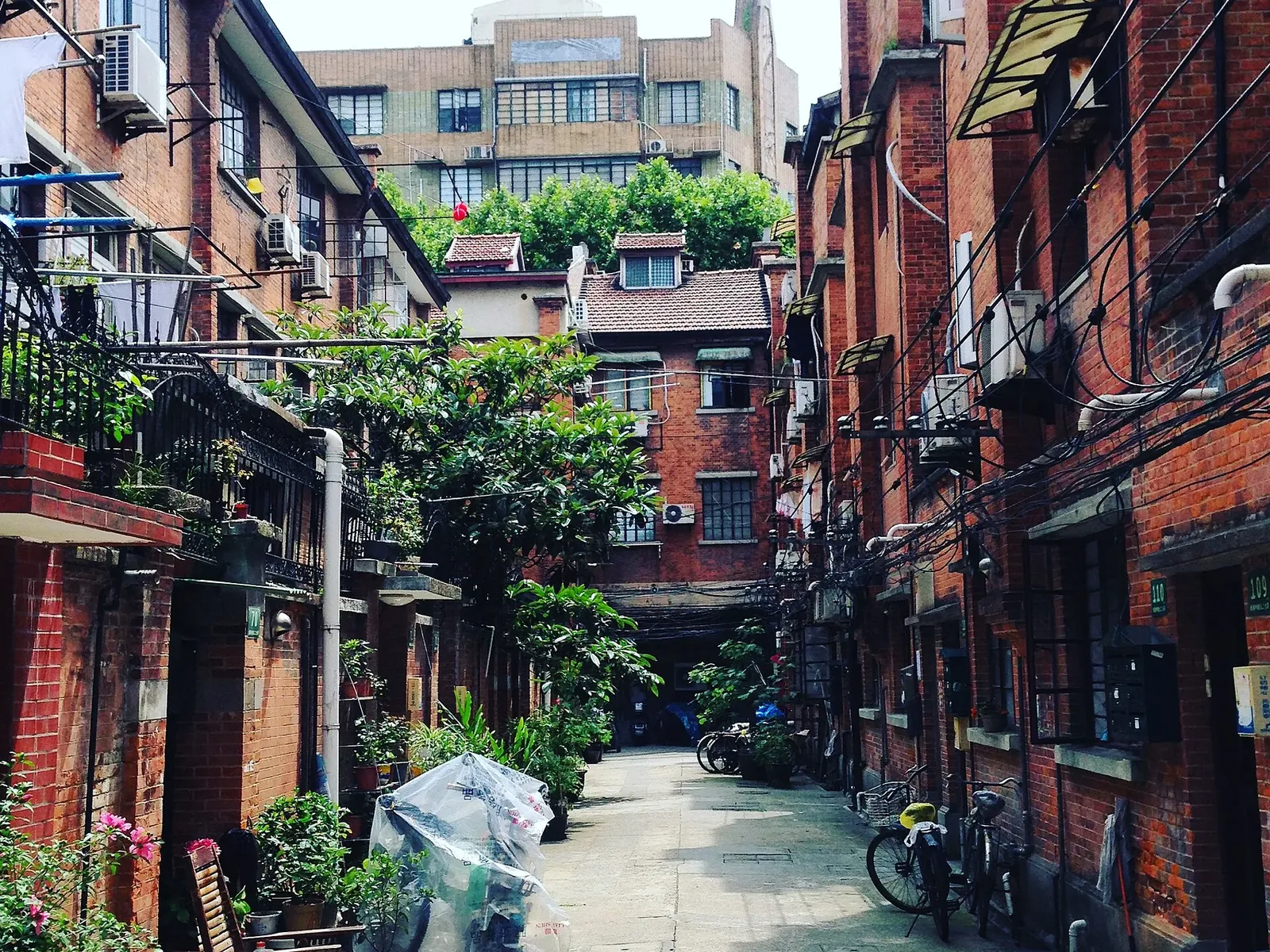 *
The lane houses in Xuhui and Jing’an deserve their own warning. A renovated 石库门 lane house is the most atmospheric rental in the city and the most likely to have single-glazed windows, a bathroom reached across a courtyard, and a damp problem in the rainy season. View in the rain if you can, and ask what the winter electricity bill was.
Your first two weeks: short-term before long-term
Do not sign from photographs, and do not sign on day one. The sequence that works:
- Book five to seven nights near the area you are targeting, not near the airport.
- Line up eight to twelve viewings across three days. Ask each agent to cluster viewings inside one or two compounds, because travel between compounds is what eats a viewing day.
- View at two times of day if a flat is a serious contender. Traffic noise, sunlight and whether the neighbours cook at 6pm are not visible in a 20-minute appointment.
- Decide on day three, sign on day four, and leave a week of overlap before your short-term booking ends.
For the short-term end, note that Airbnb has had no mainland China listings since 30 July 2022, so the old advice about booking a month on Airbnb and negotiating does not work. What replaced it is in our guide to alternative stays in China: hostels, guesthouses, temple lodgings and the domestic platforms that accept foreign passports. For a one-week landing in Shanghai, an ordinary hotel or a serviced studio is simpler and the price difference is small.
Five scams that target foreigners
- The deposit before viewing. A listing with professional photos at 30% below market, and an owner who is conveniently abroad and wants a deposit to hold the flat. Rule: no money moves before you have stood inside the property and seen the ownership certificate.
- The sublessor without permission. A 二房东 rents the flat from the owner and sublets it to you at a markup. If the original lease forbids subletting, you can be removed mid-tenancy with no recourse. Ask to see the original lease, not just the sublessor’s ID.
- The deposit that never comes back. Article 10 gives you the lever, but only if the return date and deduction conditions are in the contract and you have a dated handover list with photographs. Do this on move-in day, in front of the landlord.
- The commercial flat sold as an apartment. Commercial-title 公寓 with commercial utilities and no gas, advertised with the same photos and vocabulary as residential housing. Ask for the property certificate and check the land-use line.
- The Chinese-only contract with a two-month penalty. A 12-month lease with early termination set at two months of rent plus loss of deposit, and a clause requiring 60 days’ notice you were never told about. Have someone read clauses 7 to 12 before you sign, even if it costs you a translation fee.
One more, because it is illegal rather than merely unfair: partitioned flats. Article 7 forbids renting out kitchens, bathrooms, balconies, corridors, basements and garages as separate living space, and Article 39 sets the penalty at ¥2,000 to ¥10,000 for an individual landlord. A bedroom created by putting up a plasterboard wall inside a three-bedroom flat is that offence, and a police inspection can end the tenancy.
Can you rent on a tourist visa?
Yes. A lease is a civil contract, and nothing in the rental regulation or the exit-entry law requires a residence permit to sign one. Two things constrain you instead.
Time. Your permitted stay caps how long the tenancy is useful, and each re-entry restarts the 24-hour registration clock. A 12-month lease signed on a 30-day visa-free entry is legal and largely pointless unless you are in the process of extending.
The landlord’s risk control. Agents and landlords often ask for a visa valid beyond the lease term, because they do not want a tenant who overstays and brings a police visit. That is a commercial preference, not a legal requirement, and it is worth saying so plainly when it comes up. A lease never extends your visa, and it is not evidence for a residence permit application.
If you are planning to stay beyond 180 days, the visa question comes first and the apartment second. The categories that work, and what each one costs you in tax exposure, are set out in our digital nomad guide to China.
The bottom line
Shanghai is not an expensive city to rent in, but it is an expensive city to rent in badly. The spread between the two markets is ¥3,000 to ¥5,000 a month on a one-bedroom, which over a year is more than the deposit, the commission and the utilities combined. Choose the channel before you choose the flat, put the deposit terms in writing, file the lease yourself if the landlord will not, and complete the police registration inside 24 hours. Everything else is furniture.
Related guides
- China hotel registration for foreigners: the 24-hour rule
- Alternative stays in China: hostels, guesthouses and temple lodgings
- Digital nomad China 2026: visas, cities, costs
- Shanghai for foreigners: the complete 2026 guide
- Photos marked * in this article are from Wikimedia Commons — attribution and licence: Bernessaw, CC BY-SA 4.0*
Sources
- [1] 住房租赁条例(国务院令第812号,2025-07-16 公布,2025-09-15 施行) · State Council of the PRC · Nov 15, 2026
- [2] 中国政府网 — 租到满意房,专门法规来了:《住房租赁条例》9月15日起施行 · State Council of the PRC · Nov 15, 2026
- [3] 上海市住房租赁公共服务平台(网签备案、房源核验、政策法规) · Government of the PRC · Nov 15, 2026
- [4] 上海市房屋管理局等 — 《上海市住房租赁合同网签备案操作规定》(沪房规范〔2019〕11号) · Government of the PRC · Nov 15, 2026
- [5] 中华人民共和国出境入境管理法(第三十九条、第七十六条) · Government of the PRC · Nov 15, 2026
- [6] 国家移民管理局 — 关于全国推广网上办理外国人旅馆以外住宿登记的公告(2026年第7号,2026-09-21) · Government of the PRC · Nov 15, 2026
- [7] 上观新闻 — 2026年版上海市市民价格信息指南(水、电、燃气阶梯价格) · shobserver.cn · Nov 15, 2026
- [8] Jason Shanghai Homes — Shanghai rental prices by district, 847 live listings indexed 2 November 2026 · jasonshanghaihomes.com · Nov 15, 2026
- [9] 上海本周租房行情(2026-11-13):分区挂牌区间与全市套均租金 · mffb.com.cn · Nov 15, 2026
- [10] 腾讯新闻 — 资深房东不想让你知道的 8 个租房潜规则(中介费政府指导价上限 70%、Wellcee 直租模式) · news.qq.com · Nov 15, 2026
- [11] 上海馨乐庭长寿路服务式公寓 2026 年租金表(雅诗阁旗下 Citadines) · shanghaiservicedapartments.com · Nov 15, 2026
- [12] 上海淮海路雅诗阁服务公寓租金参考(Ascott Huai Hai Road) · knowapartments.com · Nov 15, 2026
- [13] Wellcee 唯心所寓 — 房东直租平台(中英文界面,中介账号封禁) · wellcee.com · Nov 15, 2026
Step by step
-
Fix the district by commute before you fix the budget
Plot your office on metro line 2 (Hongqiao airport, Jing'an Temple, People's Square, Lujiazui, Zhangjiang, Pudong airport) and rule out districts that need two transfers. Thirty extra minutes of commute is worth roughly ¥3,000 to ¥5,000 a month in rent, so decide that trade-off before you look at a single flat.
-
Book five to seven nights of short-term accommodation
Book near the area you are targeting, not near the airport. You need to view eight to twelve flats in three days, and agents will cluster viewings inside one compound if you ask them to. Do not sign anything from photographs.
-
Set your real budget including the 35% commission
Add one month of deposit, three months of rent and 35% of one month as commission, then add utilities. On a ¥9,000 flat the move-in total is ¥39,150 before you buy a single piece of furniture.
-
Pick the channel that matches your documents
Wellcee for direct-from-owner at zero commission, an agency branch for the paperwork-heavy route, or a serviced apartment operator if you have no Mandarin and no time. Chinese listing apps are fine for browsing but want a Chinese mobile number and real-name verification to transact.
-
Verify ownership before any money moves
Ask for the 房产证 (property ownership certificate) and the owner's ID, and check the name on the certificate matches the person signing. If a sublessor is involved, the original lease must permit subletting. No deposit before you have stood inside the flat.
-
Sign the municipal template and write in the four clauses
Use the Shanghai standard residential lease text. Add: who pays the property management fee, the deposit return date and the handover condition list, the early-termination penalty, and whether an official tax invoice (发票) is available if your employer pays housing.
-
File the lease and register with the police within 24 hours
File the lease through 随申办 or the Shanghai rental platform (free, passport plus a Chinese translation if required), then complete the temporary accommodation registration at the local police station or online via the NIA app. Keep both receipts: banks and the vehicle office ask for proof of address.
FAQ
-
How much does a one-bedroom apartment cost in Shanghai in 2026?
On the expat-facing agency market, a one-bedroom in Jing'an had a median asking rent of ¥10,550 a month in November 2026, Xuhui ¥10,500, Huangpu ¥11,400, Changning ¥12,300 and Pudong ¥9,500. The local Chinese market in the same districts lists one-bedrooms at ¥4,300 to ¥7,500. The difference is not a scam: the agency listings are furnished, come with an English-speaking agent and a landlord who will cooperate with the police registration. Expect ¥7,500 to ¥15,000 for a one-bedroom city centre, ¥4,500 to ¥8,500 for a studio, and ¥12,000 to ¥22,000 for a two-bedroom in Pudong or Lujiazui. -
Do I need a Chinese ID card to rent an apartment in Shanghai?
No. A passport is a valid identity document for the lease and for the housing bureau filing: the Shanghai rules name 护照 specifically as the identity document a foreign natural person submits, with one catch. If the document is written in a foreign script, a Chinese translation from a qualified translation company must be submitted at the same time. What trips foreigners up is not the lease but the apps: Lianjia, Beike and Ziroom all assume a +86 mobile number and a real-name account, so most foreigners end up transacting in a physical branch or going through a platform built for passports. -
How much is the agent fee in Shanghai, and who pays it?
The market standard at the big chains (Lianjia, Beike, Centaline, Pacific) is 35% of one month's rent from each side, so 70% in total. Shanghai's guidance caps the combined commission at 70% of the first month's rent, which means a quote of one full month from the tenant alone is the ceiling being loaded onto you. In practice the split is negotiable: under ¥5,000 a month the tenant rarely escapes 30%, while above ¥10,000 landlords usually absorb the whole commission and short leases under six months get no discount at all. Ask for the fee to be written into the contract, and refuse viewing fees, contract fees or registration fees added later. -
What does 押一付三 (ya yi fu san) mean?
One month of deposit plus three months of rent paid in advance. It is the default on agency leases. On a ¥9,000 flat you hand over ¥9,000 deposit plus ¥27,000 rent, and with a 35% commission of ¥3,150 your total before keys is ¥39,150. Direct-from-owner listings and serviced apartments often accept 押一付一 (one month deposit, one month rent), especially at higher monthly rents. Never accept a lease that asks for more than three months of rent up front plus two months of deposit: that shape is usually a sublessor with no ownership document. -
Can I rent an apartment in Shanghai on a tourist visa?
Yes. A lease is a civil contract and no law requires a residence permit to sign one. Two practical constraints apply. First, time: your permitted stay caps how long the tenancy is useful, and leaving China and re-entering restarts the 24-hour registration clock. Second, risk control: agents and landlords often ask for a visa valid beyond the lease term, because they do not want a tenant who overstays. A lease never extends your visa. If you intend to stay beyond 180 days you need the right visa category, and the lease itself is not evidence for a residence permit application. -
Do I have to register my address with the police within 24 hours?
Yes, and there are two separate filings that guides routinely confuse. The police filing is the temporary accommodation registration under Article 39 of the Exit-Entry Administration Law: within 24 hours of moving in, either you or the person providing the accommodation registers with the local public security station. Since 21 September 2026 it can be filed online nationwide through the National Immigration Administration app, its WeChat or Alipay mini-program, or the NIA portal, with the same legal effect as appearing in person. The second filing is the lease filing at the housing bureau, a different system with a different purpose. Skipping the police filing carries a warning plus a fine of up to ¥2,000. -
Can I rent an apartment in Shanghai without speaking Chinese?
Yes, through three routes. Wellcee (唯心所寓) runs a bilingual interface, bans agent accounts and connects you directly to owners at zero commission. Serviced apartment operators such as Citadines and Ascott run English-speaking front desks and handle everything for a single all-inclusive rent. Agency branches in Jing'an, Xuhui and Pudong routinely have one English-speaking agent, and the contract itself follows a standard municipal template, so the language barrier is mostly about reading the four clauses that matter rather than the whole document. -
Why is my rent higher than what my Chinese colleagues pay?
Because you are being shown a different market. Agency listings aimed at foreigners are furnished, in better-maintained buildings, and priced for tenants whose employer often pays. The 847 live listings sampled in November 2026 put a Jing'an one-bedroom at a median of ¥10,550, while the local market in the same district ran ¥4,800 to ¥7,500. Closing that gap is a channel decision, not a negotiation skill: direct-owner platforms, Chinese-language listing sites, and a Chinese-speaking colleague who will sit in on viewings will each move the number more than haggling over ¥200.
Related guides
- Stays & Hotels
Beijing Apartments for Rent: Expat Guide for 2026
Beijing apartments run ¥6,500-15,000 for a Chaoyang one-bedroom, and heating is a separate bill that can add ¥2,700 a season. What rent a flat in Beijing really costs, the commission cap, and the extra filing foreign tenants trigger.
14min read
- Stays & Hotels
Shanghai Disneyland for Foreigners: Tickets & 1-Day Plan
2026 tickets are ¥475-799. How to skip the lines, TRON vs Soaring, the must-ride ranking and a tested 1-day itinerary with no backtracking.
10min read
- Itineraries
Shanghai Itinerary 2026: 5 Days from the Bund to Zhujiajiao
Shanghai itinerary for 5 days: from the Bund to Zhujiajiao — Yu Garden, the French Concession, a water-town day trip and Shanghai Tower. ¥2,000-3,500 (US$278–486).
11min read
- Stays & Hotels
Digital Nomad China 2026: Visas, Cities, Costs
Live and work remotely from China in 2026: which visa to use (M, F or 30-day visa-free), the best cities, monthly rents, connectivity and the tax rule.
- Stays & Hotels
Airbnb Left China: Hostels, Capsules & Homestays 2026
Airbnb stopped taking mainland China bookings in 2022. What works now: hostels $7-17, capsules $11-28, temple lodges $21-56, and foreigner-friendly homestays.
9min read
- Stays & Hotels
Cosmetic Surgery in China 2026: Costs vs Korea and the US
Rhinoplasty in China costs $3,000-6,000 against $8,000-15,000 in Korea; breast $3,500-7,000 and facelifts $4,000-8,000, at hospitals like Shanghai 9th.
14min read

