
3 Days in Wuhan: Yellow Crane Tower, East Lake Cherry Blossoms, Hot Dry Noodles (2026 Itinerary)
A foreigner-friendly 3-day Wuhan itinerary: Yellow Crane Tower at sunset, East Lake cherry blossoms in spring, Hubei Provincial Museum's 2,400-year-old bronze bells, Hubu Lane hot dry noodles, and the first road-rail bridge over the Yangtze. With prices, transit times, and a Wuhan food survival guide.
Wuhan is the meeting of two rivers and three cities. The Yangtze and the Han converge in the middle of town, splitting the city into the three historic towns that make up the modern municipality: Wuchang (武昌) on the Yangtze’s south bank, Hankou (汉口) north of the Han, and Hanyang (汉阳) between them. Population 13+ million, area 8,500 km², capital of Hubei province. Wuhan is the historic “thoroughfare of nine provinces” — every north-south rail and road line passes through here — and the cradle of the 1911 Wuchang Uprising that ended 2,000 years of imperial rule.
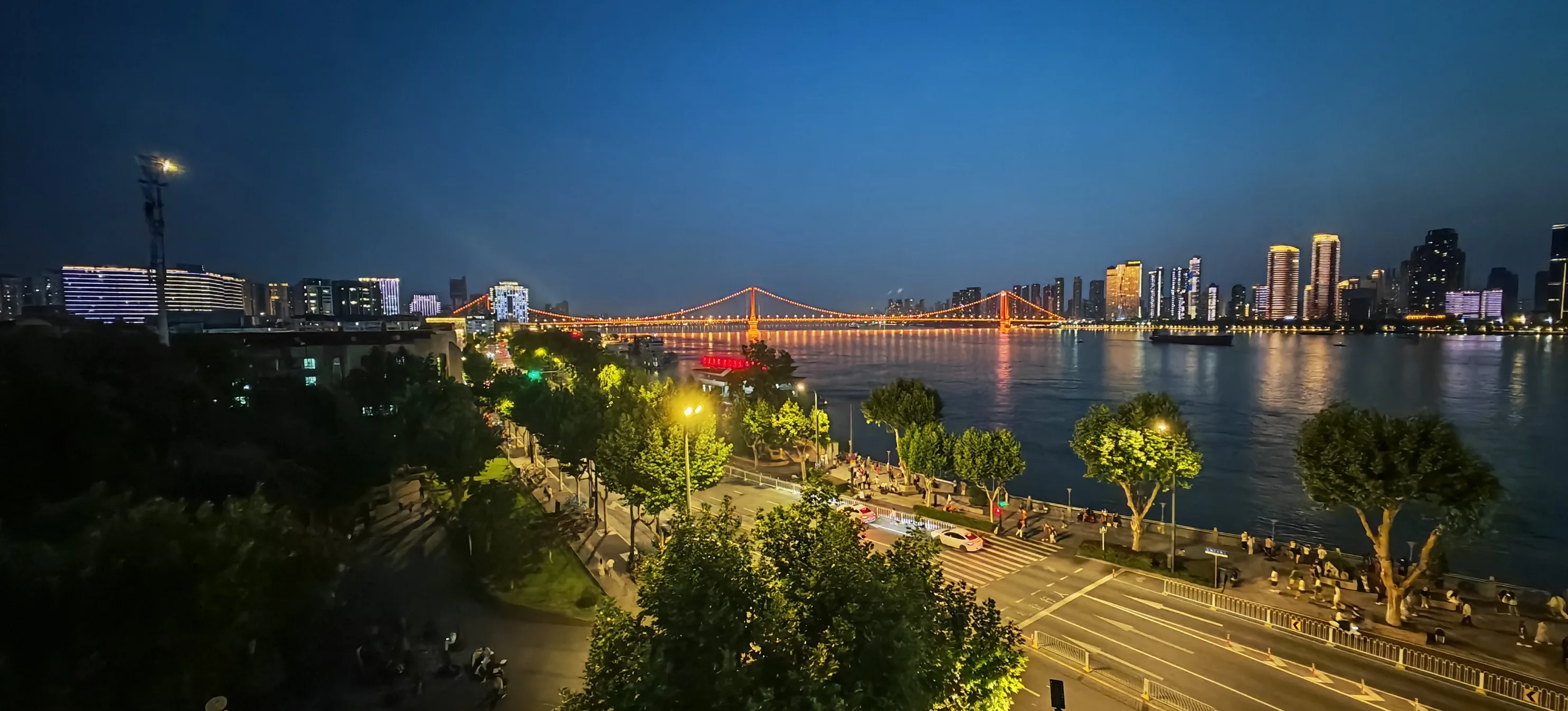
The reason to come is the rivers. The Wuhan Yangtze River Bridge (武汉长江大桥), opened in 1957, was the first road-rail bridge over the Yangtze — a Soviet-aided engineering icon that the Chinese still call the “First Bridge of the Yangtze” (万里长江第一桥). The night view from the Wuchang riverfront, with the bridge lit gold and Hankou’s skyline across the water, is one of the most photographed urban scenes in central China. And Yellow Crane Tower (黄鹤楼) — the 1,800-year-old traditional pagoda on the Wuchang bluff — has been a Chinese literary symbol since the Tang dynasty.
Day 1: Yellow Crane Tower + Hubu Lane + Yangtze night view
Yellow Crane Tower is the money shot. Aim to be there at 8:30 AM (right at opening, ¥80 entry) or 1.5 hours before sunset for the best light. The 5-story concrete-rebuilt pagoda is on a small hill inside a 7-hectare park, with a clean view over the Yangtze, the 1957 bridge, and the Hankou skyline. The inside is a small museum of Tang poetry and local history — most visitors go up the stairs, look at the view, and come back down. Allow 1.5 hours total.
Then walk 10 minutes north to Hubu Lane (户部巷), Wuhan’s 150-year-old food street. The narrow lane has 200+ vendors in two parallel rows — the must-eat is 热干面 (re-gan-mian, hot dry noodles), Wuhan’s signature breakfast: alkaline noodles tossed in sesame oil, served with pickled radish and a spoonful of chili. The Cantonese “wonton noodle” tradition meets the Hubei sesame oil tradition. ¥5-10, ready in 3 minutes. Also try 豆皮 (dou-pi, mung-bean pancake with sticky rice and pork), 面窝 (mian-wo, donut-shaped rice fritter), and the local sweet 蛋酒 (egg wine, a warm rice wine beaten with egg and sugar).
In the evening, walk south to the Wuchang riverfront (武昌江滩) for the night view. The riverfront is a 6-km public park with walking and cycling paths, a few cafés, and the best free show in town: the Yangtze Bridge lit gold, Hankou’s skyline across the water, the boats on the river. The most photogenic spot is the Wuchang anchorage of the bridge (武昌桥头), 1.5 km south along the riverfront. Allow 1.5 hours.
Day 2: East Lake cherry blossoms + Hubei Museum
East Lake (东湖) is the largest urban lake in China — 33 km², six times the size of Hangzhou’s West Lake. The east side (Donghu Moshan, 磨山) has the Moshan Cherry Garden (磨山樱花园), 10,000+ cherry trees in 80+ varieties, peaking late March to early April. Entry to the garden is ¥60, but you can walk in from the east gate (东门) for free. The view from the hill is the lake and the city skyline behind. Rent a bike (¥30/hour, plenty of bike-share options inside the park) for the 100+ km lakeside bike path — one of the best urban rides in China. Allow 2-3 hours.
Then take metro Line 4 west to Hubei Provincial Museum (湖北省博物馆, free, ID required). The museum’s highlight is the Marquis Yi of Zeng bronze bells (曾侯乙编钟) — 64 bronze bells from 433 BC, the world’s oldest complete set of tuned bells, still playable. The bianzhong performance (¥15) at 10:30 AM and 2:30 PM is a 15-minute mini-concert where a small ensemble plays ancient Chu state music on the original 2,400-year-old bells. The museum also has excellent Chu Culture (战国) bronze, lacquerware, and sword collections. Allow 2 hours.
For dinner, head to Jiqing Street (吉庆街) in central Wuchang — the street is famous for its 露天 (open-air) food stalls: small plastic stools, loud music, fresh-grilled fish and squid. Try 鸭脖 (ya-bo, duck neck, the late-night snack, slightly sweet and very spicy) and 武昌鱼 (Wuchang fish, a freshwater fish from nearby Liangzi Lake, best steamed with ginger and scallion). Allow 1.5 hours. The atmosphere is more local and less touristy than Hubu Lane.
Day 3: Wuhan Yangtze River Bridge + Wuchang historic district
The Wuhan Yangtze River Bridge (武汉长江大桥) is the city’s most recognizable symbol. The bridge opened in 1957 — the first road-rail bridge over the Yangtze, Soviet-aided design, 1.67 km long, double-deck (cars on top, trains on the bottom). Walking the upper pedestrian deck is free. The view from the middle of the bridge — north to Hankou’s skyline, south to Wuchang’s Yellow Crane Tower — is the classic Wuhan postcard. Allow 1.5 hours.
From the bridge’s south end, walk 15 minutes to the Wuchang historic district. The 辛亥革命武昌起义纪念馆 (Wuchang Uprising Memorial, free) is in the former HQ of the 1911 rebellion that overthrew 2,000 years of imperial rule and established the Republic of China. The museum is small but well-curated, with English captions and a few original artifacts. Allow 1 hour.
Then take a taxi 10 minutes to Guiyuan Temple (归元禅寺, ¥10), a 350-year-old Buddhist temple famous for its 500 life-size 羅漢 (arhat) statues in the Hall of Arhats. Each statue has a unique expression and a name — visitors are encouraged to find “their own” arhat based on birthday or birth year. The temple is one of the four great Buddhist temples in Hubei. Allow 1 hour.
If you have an extra day, take the HSR from Wuhan to Wudangshan Station (武当山西站, ¥120, 1.5 hrs) for the Wudang Mountains (武当山, UNESCO) — the sacred Taoist mountains, 1,000+ years of cliff temples, the birthplace of tai chi. Most travelers do this as a guided day tour (¥600-800/person).
Where to stay in Wuhan
Most travelers stay in Hankou (汉口, north of the Han River) — the modern downtown, with the most hotels, the best restaurants, and the most foreigner-friendly infrastructure. The Wuhan International Plaza area and the Jianghan Road pedestrian street are the most central. From Hankou, the metro reaches Yellow Crane Tower (35 min via Line 1 → 5), East Lake (45 min via Line 1 → 4), and Hubei Museum (40 min via Line 1 → 4) without transfers.
Wuchang (south of the Yangtze) is the more historic neighborhood — quieter, more local, better for a 2-3 day stay. The Wuhan University area and East Lake area are popular for travelers who want a more relaxed stay.
Book hotels on Trip.com for the best rates — Wuhan has 2,500+ hotels ranging from ¥150/night hostels to ¥1,800/night luxury properties like the Hilton Wuhan Optics Valley and the Marco Polo Wuhan.
Getting to and from Wuhan
Wuhan has three main train stations: Wuhan Station (武汉站, north, HSR Beijing–Shanghai line), Hankou Station (汉口站, central, regular trains), and Wuchang Station (武昌站, south, regular trains and HSR to the south and west). The Tianhe International Airport (天河机场, WUH) is 30 km northwest of downtown, with metro Line 2 direct to Hankou (45 min, ¥7).
Step by step
-
Day 1 morning — Yellow Crane Tower at sunrise or late afternoon
Arrive in Wuhan, check in to a hotel in the Hankou or Wuchang riverfront area. Take metro Line 5 to Huanghelou Station (黄鹤楼站), Exit A. The Yellow Crane Tower (黄鹤楼) is Wuhan's iconic symbol — a 5-story traditional pagoda first built in 223 AD, rebuilt 5 times, current concrete version from 1985. Entry ¥80. The view over the Yangtze and Wuhan skyline from the top floor is the money shot. Allow 1.5-2 hours. Avoid midday (12-2 PM) for fewer crowds and better photos.
-
Day 1 lunch — Hot dry noodles at Hubu Lane
Walk 10 minutes north from Yellow Crane Tower to Hubu Lane (户部巷), Wuhan's 150-year-old food street — 200+ vendors along a narrow lane behind the old Hankou customs house. The must-eat is 热干面 (re-gan-mian, hot dry noodles) — alkaline noodles tossed in sesame oil, served with pickled radish and chili. ¥5-10. Also try 豆皮 (dou-pi, mung-bean pancake with sticky rice and pork, ¥10), 面窝 (mian-wo, donut-shaped rice fritter, ¥3), and 三鲜豆皮 (three-delicacy bean skin, ¥15). Allow 1.5 hours.
-
Day 1 evening — Yangtze River night view from Wuchang riverfront
Walk 20 minutes south from Hubu Lane to the Wuchang riverfront (武昌江滩). The view across the Yangtze to Hankou's lit-up skyline is the best free show in town. The Wuhan Yangtze River Bridge (武汉长江大桥, 1957) is the Soviet-aided double-deck road-rail bridge, lit gold at night. Walk along the riverfront for 1.5 km south to the bridge's Wuchang anchorage for the classic photo. Allow 1.5 hours. For a closer look at the bridge, walk across the upper pedestrian deck (free).
-
Day 2 morning — East Lake cherry blossoms (March-April only)
Take metro Line 4 to Dongting Station (东亭站), Exit D, and walk 10 minutes to Moshan Hill (磨山) inside East Lake Scenic Area (东湖风景区, ¥60 entry, free if you walk in from the east gate). East Lake is China's largest urban lake — 33 km² of cherry blossoms in spring, lotus in summer, plum and plum blossom in winter. The Moshan Cherry Garden has 10,000+ cherry trees, peaking late March to early April. Allow 2-3 hours. Rent a bike (¥30/hour) at the east gate for the 100+ km lakeside bike path.
-
Day 2 afternoon — Hubei Provincial Museum's bronze bells
Take metro Line 4 to Hubeisheng Bowuguan Station (湖北省博物馆站), Exit C. The Hubei Provincial Museum (湖北省博物馆, free, English captions, ID required for entry) is one of China's top 5 museums. The highlight is the Marquis Yi of Zeng bronze bells (曾侯乙编钟) — 64 bronze bells from 433 BC, the world's oldest complete set of tuned bells, still playable. The bianzhong performance is at 10:30 AM and 2:30 PM (¥15). Allow 2 hours. The museum also has excellent Chu Culture (战国) bronze, lacquerware, and sword collections.
-
Day 2 evening — Jiqing Street food crawl (Wuchang)
Take metro Line 4 to Jiyu Bridge Station (积玉桥站), walk 10 minutes to Jiqing Street (吉庆街), Wuchang's liveliest night-food street. The street is famous for its 露天 (open-air) food stalls — small plastic stools, loud music, fresh-grilled fish and squid. Try 鸭脖 (ya-bo, duck neck, ¥15) and 武昌鱼 (Wuchang fish, ¥80, best with friends). Allow 1.5 hours. The atmosphere is more local and less touristy than Hubu Lane.
-
Day 3 morning — Wuhan Yangtze River Bridge walk
Take metro Line 4 to Zhongnan Road Station (中南路站), transfer to Line 2 to Xudong Station (徐东路站), walk 15 minutes to the Wuhan Yangtze River Bridge (武汉长江大桥). The bridge opened in 1957 — the first road-rail bridge over the Yangtze, Soviet-aided design, 1.67 km long, double-deck (cars on top, trains on the bottom). Walk the upper pedestrian deck for free. The view from the bridge — north to Hankou's skyline, south to Wuchang's Yellow Crane Tower — is the city's classic postcard. Allow 1.5 hours.
-
Day 3 afternoon — Wuchang historic district + Guiyuan Temple
From the bridge, walk 15 minutes south to the Wuchang historic district. The 辛亥革命武昌起义纪念馆 (Wuchang Uprising Memorial, 1911 Revolution Museum, free) is in the former HQ of the rebellion that overthrew 2,000 years of imperial rule. Allow 1 hour. Then take a taxi 10 minutes to Guiyuan Temple (归元禅寺, ¥10), a 350-year-old Buddhist temple famous for its 500 life-size 羅漢 (arhat) statues, each with a unique expression. Allow 1 hour. End the day with a sunset view from the temple's garden.
-
Day 3 alternative — Wudang Mountains day trip (UNESCO)
If you have a full extra day, take the HSR from Wuhan to Wudangshan Station (武当山西站, ¥120, 1.5 hrs). The Wudang Mountains (武当山) are the UNESCO sacred Taoist mountains — 1,000+ years of temples built into cliffs, the birthplace of tai chi's internal martial arts tradition. Cable car to the Golden Summit (金顶, ¥90 up + ¥80 down) for the 1,612m peak with the Golden Hall temple. Allow 8-10 hours total. Most travelers do this as a guided day tour from Wuhan (¥600-800/person with transport, ticket, and lunch).
FAQ
-
Is 3 days enough for Wuhan?
Yes for the city core (Yellow Crane Tower, East Lake, Hubei Museum, Hubu Lane, Yangtze Bridge, the historic riverfront). 2 days is doable if you skip East Lake's cherry blossom gardens. 4 days lets you add a day trip to the Wudang Mountains (UNESCO, 4 hrs by HSR) or Mount Jiugong (1.5 hrs). Most foreign travelers do Wuhan as a 2-3 day stop between Beijing and the south — it's a natural HSR hub, with Shanghai 4.5 hrs south and Xi'an 5 hrs west. -
What is Wuhan famous for food?
Three things: 热干面 (re-gan-mian, hot dry noodles — Wuhan's signature breakfast, ¥5-10 at any street stall), 鸭脖 (ya-bo, duck neck — the late-night snack, slightly sweet and very spicy, ¥10-20 a pack), and 武昌鱼 (Wuchang fish — a freshwater fish from nearby Liangzi Lake, best steamed). Hubu Lane (户部巷) is the 150-year-old food street that serves all three, plus 豆皮 (dou-pi, mung-bean pancake with rice and pork), 面窝 (mian-wo, donut-shaped rice flour fritter), and 三鲜豆皮 (three-delicacy bean skin). -
When is the best time to visit Wuhan?
March-April for East Lake cherry blossoms (peak late March to early April, the Wuhan University cherry blossom avenue is world-famous but requires a free reservation 3-7 days in advance). October-November for clear Yangtze views and mild weather (15-25°C). Avoid June-August — Wuhan is one of China's 'three furnaces' (alongside Chongqing and Nanjing), with 35-40°C heat and 80%+ humidity. December-February is grey and damp (2-8°C) but the fewest crowds. -
How do you pronounce Wuhan?
Wǔ-hàn, with a falling-rising tone on the first syllable and a falling tone on the second. The 武汉 characters literally mean 'Han river's wu (military outpost)' — the city sits where the Han River meets the Yangtze. In older English writing, Wuhan was spelled 'Wuhan' or 'Wu-han' (Wade-Giles). The city is made of three historic towns — Wuchang (武昌, on the Yangtze's south bank), Hankou (汉口, north of the Han River), and Hanyang (汉阳, between the rivers). -
How do you get around Wuhan?
Metro is the best option — Lines 1, 2, 4, and 6 cover Yellow Crane Tower, East Lake, and Hubei Museum. Yellow Crane Tower Station (黄鹤楼站) on Line 5 is a 5-minute walk to the tower. Hubei Provincial Museum is on Line 4 (Dongting Station). Taxis are cheap (¥15-40 for most cross-city rides) and the city is flat, so cycling is feasible. East Lake's 100+ km of lakeside bike paths is one of the best urban bike rides in China. Google Maps works for transit, but Apple Maps is more reliable in China. -
Is Wuhan worth a stop on a China trip?
Yes, especially as a 2-3 day add-on to a Beijing–Shanghai HSR run (Wuhan is on the main north-south line). Yellow Crane Tower is one of the Four Great Towers of China. Hubei Provincial Museum's Marquis Yi bronze bells are a UNESCO-grade collection. East Lake cherry blossoms rival Tokyo's. The Wuhan Yangtze River Bridge is a 1957 Soviet-aided engineering icon. And the food alone — hot dry noodles, duck neck, Wuchang fish — is worth a stop for any food-focused traveler.
Related guides
- Itineraries
3 Days in Chongqing: Hongya Cave Night, Hotpot, Yangtze Cable Car (2026 Itinerary)
The perfect 3-day Chongqing itinerary: Hongya Cave at night, Chongqing hotpot, Yangtze River cable car over the river, Jiefangbei, Ciqikou ancient town, and a Dazu Rock Carvings day trip. With prices, transit times, and a foreigner-friendly hotpot survival guide.
10min read
- Itineraries
3 Days in Hangzhou: The Perfect Itinerary (2026 First-Timer's Plan)
A 3-day Hangzhou itinerary for first-timers: West Lake, Lingyin Temple, Longjing tea, the Southern Song Imperial Street, and an optional Wuzhen day trip. Day-by-day plan with timing, transport, costs, and how to combine with Shanghai.
9min read
- Itineraries
China Group Tours in 2026: Complete Guide (Worth It? Best Operators, Costs, and How to Avoid the Traps)
Comprehensive 2026 guide to China group tours: top 6 tour operators (Intrepid, G Adventures, EF, China Highlights, Wild China, Backroads) with prices, group sizes, and reviews. Plus: pros and cons vs independent travel, top 5 sample itineraries (14-day Grand Tour, photography, food, family, adventure), how to avoid shopping trap stops, and whether Tibet, Xinjiang, and Silk Road tours are worth the premium.
10min read
- Itineraries
China Cool 2026: 8 Best Summer Escapes from the Heat (Foreigners' Guide)
China Cool is the 2026 trending travel movement — escaping the summer heat to China's mountain and forest retreats averaging 18-26°C. 8 hand-picked destinations with transport, stay, and food tips for foreign visitors.
11min read
- Itineraries
China's 15 Hidden Gem Cities: The 2026 Reverse Tourism Guide for Foreigners
Skip Beijing and Shanghai. China's 15 hidden gem cities for 2026 — verified lesser-known destinations (Wuyuan, Fenghuang, Songpan, Dali, Wuyi, Tengchong, Jianshui, etc.) with how to get there, what to do, where to stay, and food. Reverse tourism trend up 187% YoY in 2026.
14min read
- Itineraries
China Honeymoon 2026: The Ultimate Romantic Travel Guide (Itineraries, Cost, Visas)
China is the surprise 2026 honeymoon destination — cheaper than Bali/Maldives, less crowded than Paris, with hidden romantic gems. 4 ready-made itineraries (7 / 14 / 21 / 30 days) covering Yunnan, Sichuan, Jiangnan, and Tibet-Yunnan grand circuits. 2026 visa rules, costs, best seasons, and how to avoid the 5 most common honeymoon mistakes in China.
16min read